 Published on and written by Cyril Jarnias
Cyprus’s political capital, administrative center, and economic engine, the city of Nicosia offers a real estate market very different from coastal resorts like Limassol or Paphos. Here, it is not summer tourists dictating prices, but civil servants, diplomats, students, employees of large companies, and a new wave of digital professionals. The result: consistent housing demand year-round, stable rents, and price growth that is more steady than spectacular.
This article provides a detailed analysis of the Nicosia real estate market, including price evolution per square meter, rental yields, recommended neighborhoods, taxation, financing options, as well as risks and prospects. All numerical data is sourced from official bodies and specialized studies (Central Bank of Cyprus, RICS, KPMG, Landbank Analytics, Ask Wire, Global Property Guide).
A real estate market driven by fundamentals
Nicosia is often described as a market “driven by fundamentals” more than by speculation. Prices are rising, but without the volatility observed on the coast. This dynamic is due to several structural factors.
The city concentrates the country’s main political (ministries, embassies), academic (major universities), and economic (banks, fintech) institutions. The government is betting on a “headquartering” strategy to attract international businesses, leveraging tax advantages, EU membership, and a legal environment based on British common law.
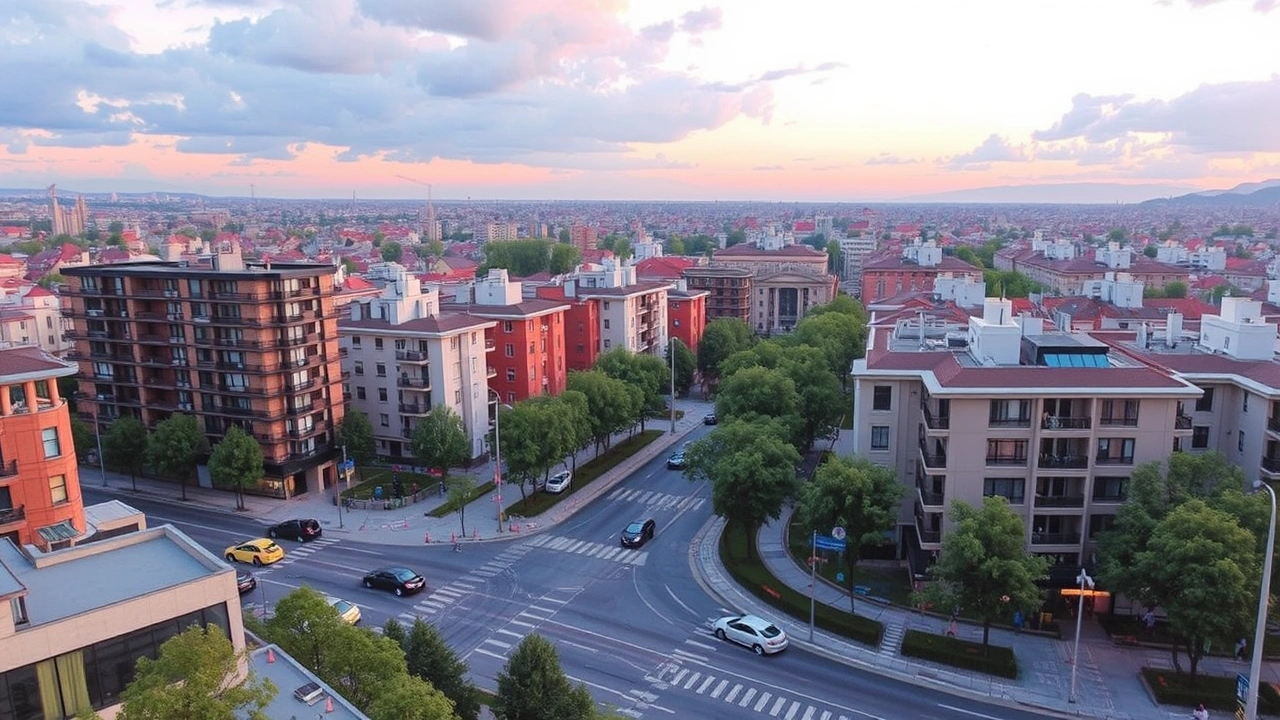
At the same time, urbanization is intensifying: approximately 67% of the district’s population lives in urban areas, with growth of about 0.76% per year. By 2030, the metropolitan population is expected to grow by about 7%, while employment would increase by nearly 17%. This combination (more residents, even more jobs) exerts lasting pressure on housing demand, especially in central and first-ring neighborhoods.
Despite a general slowdown in the Cypriot market, linked to a stabilization of prices nationwide, Nicosia displays remarkable resilience. In 2024, while other districts saw their sales volumes decline, the capital was the only one to record an increase in the number of transactions.
Price evolution: steady progression rather than a surge
In recent years, real estate prices in Nicosia have followed a relatively steady upward trend.
Recent price growth
In 2024, several indicators converge:
– apartment prices in the city increased by about 4.2%,
– houses appreciated by around 4.8%,
– the average price of residential properties in the district appreciated by about 3%,
– according to the Central Bank index (RPPI), apartments show an annual increase of 5.1% and houses of 4%.
Average annual growth of real estate values in Nicosia according to some analyses.
Price levels: where does Nicosia stand?
The city remains clearly more affordable than Limassol or Paphos. While the national average price for new apartments hovers around €281,000 and in Limassol new developments far exceed €400,000, Nicosia still offers opportunities starting from much more modest budgets.
The main orders of magnitude are as follows:
| Key Indicator | Indicative Value in Nicosia |
|---|---|
| Average residential price per m² (district) | ≈ €2,170 to €2,518 /m² |
| Downtown apartments | ≈ €2,350 /m² |
| Apartments outside downtown | ≈ €1,850 /m² |
| General apartment range | ≈ €1,800 – €2,800 /m² |
| Average house price per m² | ≈ €2,095 – €2,376 /m² |
| Median housing price (all types) | ≈ €300,000 – €350,000 |
| Median new apartment price | ≈ €190,000 |
| Median new house price | ≈ €314,500 |
| Average 4-bedroom house price | ≈ €350,000 |
For an investor, this means that an entry ticket between €180,000 and €350,000 provides access to the majority of the residential market, particularly 2 to 3 bedroom apartments in sought-after neighborhoods. It is precisely this range of €180,000 to €350,000 that concentrates most transactions and investor interest.
Transaction volume: an active and growing market
While most coastal areas have seen their activity slow down, the capital follows a different scenario.
In 2024, Nicosia recorded:
– 3,460 residential transactions, representing annual growth of approximately 4.2%,
– of which 2,560 apartment sales (+4.1% year-on-year) and 900 houses (+4.7%),
– an overall jump of about 13.6% in transactions compared to 2023,
– a 14% increase in sales contract deposits, peaking in June.
The total value of residential sales in 2024 stood around:
– €236.9M for apartments,
– €49.8M for houses.
Volume increase in new residential sales between January and September 2024.
This dynamism continues in 2025: in the first quarter, apartment sales reached about 376 units (+17.5%), for a value of €72M (+18%), while houses grew by nearly 7.8% in number and 25% in value. In March 2025, the number of transactions in the district increased again by 18% compared to the previous year.
Nicosia is therefore, statistically, the only major Cypriot district where transactional activity continues to grow strongly, which is a reassuring signal for a medium- to long-term investor.
A deep, stable, and profitable rental market
For any investor, the key question remains: can you easily rent out, at what price, and with what yield?
Structural and non-seasonal rental demand
Unlike coastal cities heavily dependent on tourism, rental demand in Nicosia rests almost exclusively on:
– civil servants and ministry employees,
– embassy and international organization staff,
– employees of banks, service companies, fintech, and IT firms,
– teachers, researchers, and university staff,
– a significant student population,
– a community of expatriates and young professionals attracted by corporate headquarters.
This tenant base is present year-round. Occupancy rates in central and first-ring neighborhoods average between 92% and 95%, with vacancy periods typically limited to two to four weeks between tenants. This is far from the volatility linked to the high tourist season.
Rent levels: how much does an apartment yield?
Several sources show notable rent increases in recent years:
– in 2022, apartment rents jumped by about 11%,
– in 2023, they progressed by another approximately 5.5%,
– in 2024, the increase shows a form of lull, around 1.6% in the fourth quarter, with an annual progression of about 4.5%,
– for houses, the increase is more moderate (about 3.2% per year).
The observed average rents are as follows:
| Property Type (Nicosia) | Average Monthly Rent |
|---|---|
| Studio | ≈ €500 – €600 |
| 1 bedroom | ≈ €700 – €850 (downtown: ≈ €550–€850, outside downtown: ≈ €450–€800) |
| 2 bedrooms | ≈ €800 – €1,200 (downtown often ≈ €800–€900) |
| 3 bedrooms | ≈ €1,200 – €1,600 (up to €2,000 downtown) |
| House / villa | ≈ €1,300 – €2,200 |
| Average rent all types (Q2 2025) | ≈ €1,330/month |
Another analysis places the projected average rent for a two-bedroom apartment around €800 per month, with levels potentially reaching €1,500–€1,700 for recent, well-located properties in the city center.
In January 2025, advertised rents averaged €1,017/month for apartments and €1,900/month for houses, with 917 apartments and 190 houses available for rent.
Rental yields: Nicosia’s place on the Cypriot scale
On the scale of Cyprus, average gross residential real estate rental yields fluctuate between 4% and 6%. Apartments are the most profitable property type (about 5.42% national average yield), ahead of houses (about 3%). Offices, meanwhile, can achieve yields close to 5.6%.
Nicosia distinguishes itself as follows:
– several studies estimate the average gross yield for apartments around 4.63% to 4.78%,
– others place it higher, with ranges of 5% to 7% depending on the neighborhood and housing type,
– the RICS/KPMG index indicates an average yield of about 5% for the capital, versus 6% for Limassol and 4% for Larnaca or Paphos.
In the most central areas (business district, Engomi, Ayios Omologites, university zones), some segments of 1 or 2 bedroom apartments achieve calculated yields between 6% and sometimes over 8% when the purchase price remains moderate.
To illustrate the yield logic, take the example of an apartment priced at €200,000 in Nicosia, generating a monthly rent of €1,000 (or €12,000 per year). This gives a gross yield of 6%. With the market’s average yield around 5%, Nicosia represents an interesting compromise between yield and stability, additionally offering an estimated annual capital appreciation perspective between 4% and 6%.
Long-term vs. short-term rentals
The dominant model in Nicosia remains long-term rentals of 12 to 24 months. The city certainly has an active Airbnb market, with about 590 listings in a recent year, largely dominated by entire apartments. But stays there are often longer (many listings impose a minimum of 30 nights or more), and seasonality is less pronounced than by the sea.
The best short-term rental properties (top 10% of the market) exceed monthly revenues of about $1,980, with occupancy rates above 80% and average daily rates starting at $126. The median for properties is closer to $829 per month for an occupancy rate near 38%. Suffice to say that, unless the positioning is very relevant (immediate proximity to universities, the historic center, or ministries) and management is professional, seasonal rentals are not, in Nicosia, the yield El Dorado found on the coast.
For an investor seeking predictability and simplicity, classic long-term leasing remains clearly the primary strategy.
Understanding Nicosia’s neighborhoods: where to invest?
The city is far from homogeneous. Prices, rents, rental demand, and capital appreciation potential vary significantly from one sector to another.
Market cores: Strovolos, Engomi, Aglandjia
These three neighborhoods form the capital’s dynamic “first ring”.
– Strovolos This is one of the most sought-after sectors by families and executives. It features good schools, numerous shops, local services, and quick access to major roads. Apartments trade on average around €2,100/m², with an active resale market between €180,000 and €320,000. Rental demand is solid, occupancy rates are high, and price appreciation prospects are judged among the strongest for the coming years. The only downside: traffic can be very heavy during peak hours.
Engomi is considered Nicosia’s premium neighborhood, characterized by the presence of embassies, international organizations, university campuses, and businesses. Real estate prices are higher there, with an average cost of about €2,600/m² for apartments, and can be higher for recent developments. Properties with 2 to 3 bedrooms are typically offered between €280,000 and €450,000. This market offers an attractive counterpart: vacancy rates are very low, rents are high, and yields for quality furnished properties exceed the city average.
– Aglandjia (or Aglantzia) This neighborhood combines proximity to the center, green spaces, development of new projects, and the presence of university institutions. Prices remain more affordable than in Engomi while offering good revaluation potential. Aglandjia is regularly cited as one of the best value/price compromises for medium- to long-term investment, particularly for two-bedroom apartments.
Forecasts indicate that Strovolos, Aglandjia, and Dasoupoli (an adjoining sector) should record the strongest price increases by 2026, with expected growth between 4% and 6% per year, or even more in the tightest segments.
Other promising neighborhoods
– Dasoupolis Located at the junction of several major axes, this neighborhood is presented as a future development hub, with infrastructure projects, modern office buildings, and good accessibility. Current prices are still slightly lower than those in Engomi, leaving potential for catch-up.
A neighborhood close to the center, offering a good mix of townhouses and modern buildings, with healthy rental demand.
The average price per m² hovers around €1,850.
Properties are generally offered between €160,000 and €280,000.
The sector offers a mix of townhouses and modern buildings.
Rental demand in this sector remains healthy.
– Lakatamia and Latsia Two suburban districts with strong growth, featuring a significant supply of houses and small new buildings. Road accessibility and still reasonable prices make them areas appreciated by families willing to move slightly away from the center for more space. Recent projects can be positioned around €288,000 + VAT for family homes.
– Pallouriotissa and Kaimakli Historical and redeveloping neighborhoods, located east of downtown, where prices per m² remain relatively low (about €1,600–€1,650/m²). They can accommodate investment strategies on small apartments (studios or 1 bedroom) within budgets of €100,000 to €150,000, with good local rental demand.
– Ayios Omologites / Makedonitissa / downtown These sectors, close to major administrative and university axes, present interesting rental yields, sometimes exceeding 6% on small units (1 bedroom) when the purchase price remains contained. The city center, in particular, can show yields calculated from market data above 10% for some micro-segments of 1 bedroom, even though these theoretical figures assume almost permanent occupancy.
Summary of main positioning by budget
| Budget | Property Types & Typical Areas |
|---|---|
| ≈ €100,000 | Studios or 1 bedroom in Kaimakli, Lakatamia, developing sectors, often older or requiring renovation |
| €150,000 – €200,000 | 2-bedroom apartments on the outskirts, small townhouses in Lakatamia/Latsia |
| €200,000 – €300,000 | Modern 2–3 bedroom apartments in Strovolos, Aglandjia, Ayios Omologites, simple family homes |
| €300,000 – €400,000 | High-end 2–3 bedroom apartments in Engomi, Strovolos, well-located family homes |
| > €400,000 | Luxury properties (penthouses, villas, large houses) in Engomi, downtown, premium sectors |
Property typology: which segment to choose?
The market report highlights a diversification of supply, but with a very clear dominance for apartments.
Affordable apartments and studios
This is the preferred segment for investors seeking pure yield. The advantages are clear: relatively low entry price, controlled condo fees, high liquidity upon resale, limited vacancy, and constant demand from students, young professionals, and expatriates.
Points to note:
– lower unit rents,
– more frequent tenant turnover,
– long-term value growth often slower than for rarer properties,
– risk of rent control or affordable housing measures if social tension increases (this point is mentioned as potential in analyses, even though no specific cap is in place today).
High-end apartments and penthouses
This segment is developing in neighborhoods like Engomi, Strovolos, or around new major projects (like the towers of The Landmark Nicosia). The clientele consists of business leaders, diplomats, multinational executives, and wealthy expatriates.
Assets:
– high rents,
– generally solvent and stable tenants,
– strong patrimonial dimension and long-term valuation potential,
– benefit from attractive Cypriot taxation (no inheritance tax, favorable regime for non-domiciled residents).
Drawbacks:
– significantly higher entry ticket,
– increased sensitivity to international economic cycles and foreign demand,
– sometimes longer resale times in a market less deep than classic first-time buyer market,
– higher maintenance costs.
Houses and villas
Single-family homes and villas primarily target local families, certain expatriates, business leaders, or diplomats who prioritize space and a calmer residential environment.
They generally offer:
– higher monthly rents than apartments,
– long-term leases for well-established families,
– the possibility to renovate or modify more freely.
But they also involve:
Investing in a house rather than an apartment typically involves more immobilized capital, significantly higher maintenance costs (garden, roof, air conditioning, etc.), lower liquidity upon resale, and a gross yield often lower than that of small apartments, even though capital appreciation may compensate in the long term.
Offices, retail, and warehouses
As the administrative and economic center of the country, the office market is particularly active in central neighborhoods, with numerous recent and upcoming projects: The Hill Business Center, The Cross Point, The Loop, The Asteroid, or major mixed-use complexes like the Landmark project.
Warehouses and industrial premises, on the other hand, are mainly concentrated in:
– the zones of Latsia, Dali, Tseri,
– the industrial zone of Strovolos,
with prices per m² ranging from €1,200 to €2,500, rents around €5 to €12/m², and average gross yields fluctuating between 6% and 9%, on leases of 5 to 10 years. This is a more technical segment, highly dependent on macroeconomic conditions and regulations, but it can be an excellent diversification tool for an already established portfolio.
Financing and loan conditions for foreign buyers
Cypriot banks offer real estate financing to both residents and non-residents. The credit market is regulated by the Immovable Property (Transfer and Mortgage) Law, and operates largely in euros with variable rates indexed to the European Central Bank.
General conditions
The main lines of real estate loans in Cyprus are as follows:
Main characteristics and conditions of real estate loans for foreign investors.
Average term of 20 to 25 years (10 to 40 years possible). Minimum amount generally around €75,000, with a frequent maximum of €500,000.
Current variable rates: 4.2% to 4.6% on average. Offers starting from about 3.3% on new builds and up to 7.5% on high-risk resale properties. Fixed rates possible for 3, 5, or 10 years.
For non-residents: 30% to 50% of the property value. For residents or EU citizens: 10% to 30%.
For foreigners, financing often covers 60% to 70% of the value estimated by the appraiser.
Banks require that the monthly payment does not exceed about 30–35% of the borrower’s monthly income, with a comprehensive review of creditworthiness (pay stubs, tax returns, bank statements, etc.). The loan maturity age is usually before 65–70 years old.
Specifics for non-Europeans
Nationals of third countries (UK, USA, etc.) must, in addition to bank requirements, obtain an acquisition permit from the Council of Ministers to buy property in the Republic of Cyprus, and can in principle only hold a limited number of properties (in practice, often one or two properties, or land up to 4,014 m²).
To access permanent resident status via investment, you must:
– purchase a new property worth at least €300,000 (excluding VAT),
– have an annual income of at least €50,000 from abroad (increased by €15,000 for a spouse and €10,000 per child),
– agree not to engage in salaried employment in Cyprus.
The permanent residency by investment procedure is expedited (about two months of processing) and can be a decisive argument for some investors targeting Nicosia as a base for Europe.
Real estate taxation: purchase, ownership, rental, and resale
The Cypriot tax environment is one of the key elements that make real estate investment attractive.
On purchase: VAT, stamp duty, and transfer fees
On new properties, the standard VAT is 19%. A reduced rate of 5% exists for a primary residence, under conditions:
– buyer is a natural person over 18 years old,
– property intended to be a primary and permanent residence,
– no previous benefit from the reduced rate,
– property is new, not yet occupied,
– application of the reduced rate on the first tranche of €350,000 (within a total price limit of €475,000) or on the first 130 m² (within a limit of 190 m²), with more favorable transitional rules for some older permits.
Stamp duty on the sales contract is progressive:
| Contract value tranche | Stamp duty rate |
|---|---|
| 0 – €5,000 | 0% |
| €5,001 – €170,000 | 0.15% |
| > €170,000 | 0.20% (global cap €20,000) |
The title transfer fees, paid to the Department of Lands and Surveys at the time of registration in your name, follow a scale:
| Value tranche per acquirer | Transfer fee rate |
|---|---|
| 0 – €85,000 | 3% |
| €85,001 – €170,000 | 5% |
| > €170,000 | 8% |
A 50% reduction on these fees is in effect, and when VAT has been paid on the property, they are generally waived. For purchases in joint ownership, the value is split among the co-buyers for calculation.
In addition to the purchase price, anticipate lawyer fees (about 1% of the price), as well as potential loan arrangement fees and bank processing fees.
Ownership taxation
The national immovable property tax was abolished in 2017. Therefore, only the following remain:
– annual municipal taxes (garbage, lighting, etc.), varying by municipality, generally between €85–€90 and €300–€500 per year,
– sewerage board contributions, proportional to the property’s value,
– condominium fees in apartment buildings,
– home insurance, particularly inexpensive in Cyprus (about €50 per month for comfortable coverage).
Rental income
Rents received in Nicosia by a non-resident are taxable in Cyprus to the extent that they are income of Cypriot source.
Taxation consists of two parts:
– a flat 20% deduction on gross rent is generally allowed to cover expenses,
– income tax is applied according to a progressive scale:
| Annual income bracket | Income tax rate |
|---|---|
| 0 – €19,500 | 0% |
| €19,501 – €28,000 | 20% |
| €28,001 – €36,300 | 25% |
| €36,301 – €60,000 | 30% |
| > €60,001 | 35% |
For tax residents domiciled in Cyprus, a Special Defence Contribution of 3% on 75% of gross rents is added. Non-residents, however, are only taxed on their Cypriot income and are generally not subject to this contribution.
On resale: capital gains and exit taxes
Capital gains on sales of immovable property in Cyprus are subject to a 20% tax (Capital Gains Tax, CGT), calculated on the difference between the sale price and the acquisition cost (increased by justified improvements and certain expenses).
Each taxpayer benefits from lifetime allowances on their taxes.
– €85,430 on the capital gain from a primary residence, provided they have resided there for at least five years,
– €25,629 on the sale of agricultural land,
– €17,086 on other property sales.
The cumulative allowances cannot exceed €85,430 per person over their lifetime. Certain transfers are fully exempt (inheritances, donations between close relatives).
Additionally, a 0.4% sales tax of the price is due by the seller to fund housing programs for Cypriot refugees.
Major projects and development prospects in Nicosia
Beyond market dynamics, the value of a real estate investment also depends on the future urban environment. On this point, Nicosia benefits from an exceptional pipeline of public and private projects.
The President of the Republic has presented over 80 projects for the capital and its periphery, together exceeding one billion euros. They cover various domains: road infrastructure (Nicosia ring road, new avenues), culture (major archaeological museum), health, education, mobility, urban redevelopment, and housing.
Among the flagship projects:
An overview of the main urban development and regeneration projects underway or planned in the Cypriot capital, aiming to transform its landscape and infrastructure.
Conversion of the site into a vast square with a park, shops, a 700-seat amphitheater, and an underground parking lot for over 500 vehicles.
Major project including the renovation of a 5-star Marriott hotel and the construction of two towers (offices & 53 luxury apartments). Investment > €100M.
Construction of a 40,000 m² museum with exhibition spaces, workshops, underground parking, cafes, and public spaces.
Complex combining a hospital, residences, university buildings, shops, and a condo-hotel. Investment > €150M.
Construction of several ministerial buildings to centralize key administrations in the heart of the city.
Massive improvements around the Venetian walls: Eleftheria Square, promenades, bike lanes, renovation of historic streets.
These investments should:
The development of the city center helps strengthen its residential attractiveness, boost the value of nearby real estate, increase the number of local jobs, and improve mobility and quality of life for residents.
For an investor, monitoring the location of these projects allows anticipation of future “hotspots”: some areas currently in transition could see significant price catch-up once construction is complete.
Advantages and risks of investing in Nicosia
No market is risk-free. However, the capital’s profile presents several strengths for a prudent investor.
Major advantages
– Demand stability: as the country’s economic, administrative, and university engine, Nicosia generates continuous demand, relatively independent of tourist cycles.
– Attractive yields: around 5% gross on average for apartments, with the possibility of targeting 6–7% on well-targeted micro-markets.
– Favorable legal and tax environment: law inspired by common law, EU membership, 12.5% corporate tax, no inheritance tax, abolition of national property tax, extensive network of international tax treaties.
Main risks and constraints
– Slower price growth than on the coast: capital appreciation is more regular than spectacular; this is not a market for quick speculation.
– Sensitivity to macroeconomic context: a recession or regional geopolitical shock could slow the arrival of new businesses and reduce high-end demand.
– Rising construction costs: since 2021, construction and renovation costs have increased by about 18%, which can impact the profitability of new projects or renovations.
– Bureaucracy and permit delays: obtaining building permits remains a sometimes lengthy process, even though a digital reform is underway.
– Constraints for non-Europeans: limitation on the number of properties, government authorization requirement, high down payment, and restrictions on certain uses (e.g., some banks are reluctant to finance properties intended for short-term rentals).
How to practically approach an investment project in Nicosia?
Even if each situation must be studied case by case, a few principles emerge from the numerical overview.
An investor seeking recurring income, with a horizon of at least ten years, would be wise to focus:
– on two or three bedroom apartments, in the range of €180,000 to €350,000,
– in neighborhoods like Strovolos, Engomi, Aglandjia, Dasoupolis, or Ayios Omologites,
– in recent or well-renovated buildings, offering good energy performance (Class A), balconies or terraces, and quality internet connection.
The search for better long-term capital appreciation could steer towards:
Discover the different types of investments and residences available in the Cypriot capital, from up-and-coming neighborhoods to the most exclusive developments.
Invest in large-scale projects like the GSP, museums, or along major axes undergoing redevelopment.
Explore new constructions in sectors like Aglandjia, Latsia, or Lakatamia, offering good value for money.
Opt for exclusivity in new-generation towers and mixed-use complexes, such as Landmark Nicosia.
In all cases, a few precautions are essential: meticulous verification of property titles, building permits, cadastral documents, use of an independent lawyer, tax simulation including stamp duty, transfer fees and potential VAT, study of the real rental market (not just listings), and, if necessary, advice from a mortgage broker or local professional.
Conclusion: Nicosia, a capital for patient investors
Investing in real estate in the city of Nicosia is not betting on a speculative wave driven by a tourist trend, but aligning with a market that progresses at the pace of the country’s real economy. The Cypriot capital combines:
Main factors contributing to the performance and security of an investment in real estate.
Benefit from solid rental yields, ensuring regular profitability.
Enjoy regular long-term property valuation.
Invest in an attractive legal and tax environment.
Supported by ambitious infrastructure and urban planning programs.
Benefit from diversified and enduring rental demand.
For a medium- to long-term investor, particularly a European one or someone seeking permanent residency in the European Union, Nicosia offers a rare compromise between security, profitability, and valuation potential. The key remains to carefully choose your neighborhood, your property type, and to surround yourself with the right professionals to navigate a market that is at once mature, technical, and rich in discreet opportunities.
Disclaimer: The information provided on this website is for informational purposes only and does not constitute financial, legal, or professional advice. We encourage you to consult qualified experts before making any investment, real estate, or expatriation decisions. Although we strive to maintain up-to-date and accurate information, we do not guarantee the completeness, accuracy, or timeliness of the proposed content. As investment and expatriation involve risks, we disclaim any liability for potential losses or damages arising from the use of this site. Your use of this site confirms your acceptance of these terms and your understanding of the associated risks.

Cyril Jarnias is an independent expert in international wealth management with over 20 years of experience. As an expatriate himself, he is dedicated to helping individuals and business leaders build, protect, and pass on their wealth with complete peace of mind.
On his website, cyriljarnias.com, he shares his expertise on international real estate, offshore company formation, and expatriation.
Thanks to his expertise, he offers sound advice to optimize his clients' wealth management. Cyril Jarnias is also recognized for his appearances in many prestigious media outlets such as BFM Business, les Français de l’étranger, Le Figaro, Les Echos, and Mieux vivre votre argent, where he shares his knowledge and know-how in wealth management.