
 Published on and written by Cyril Jarnias
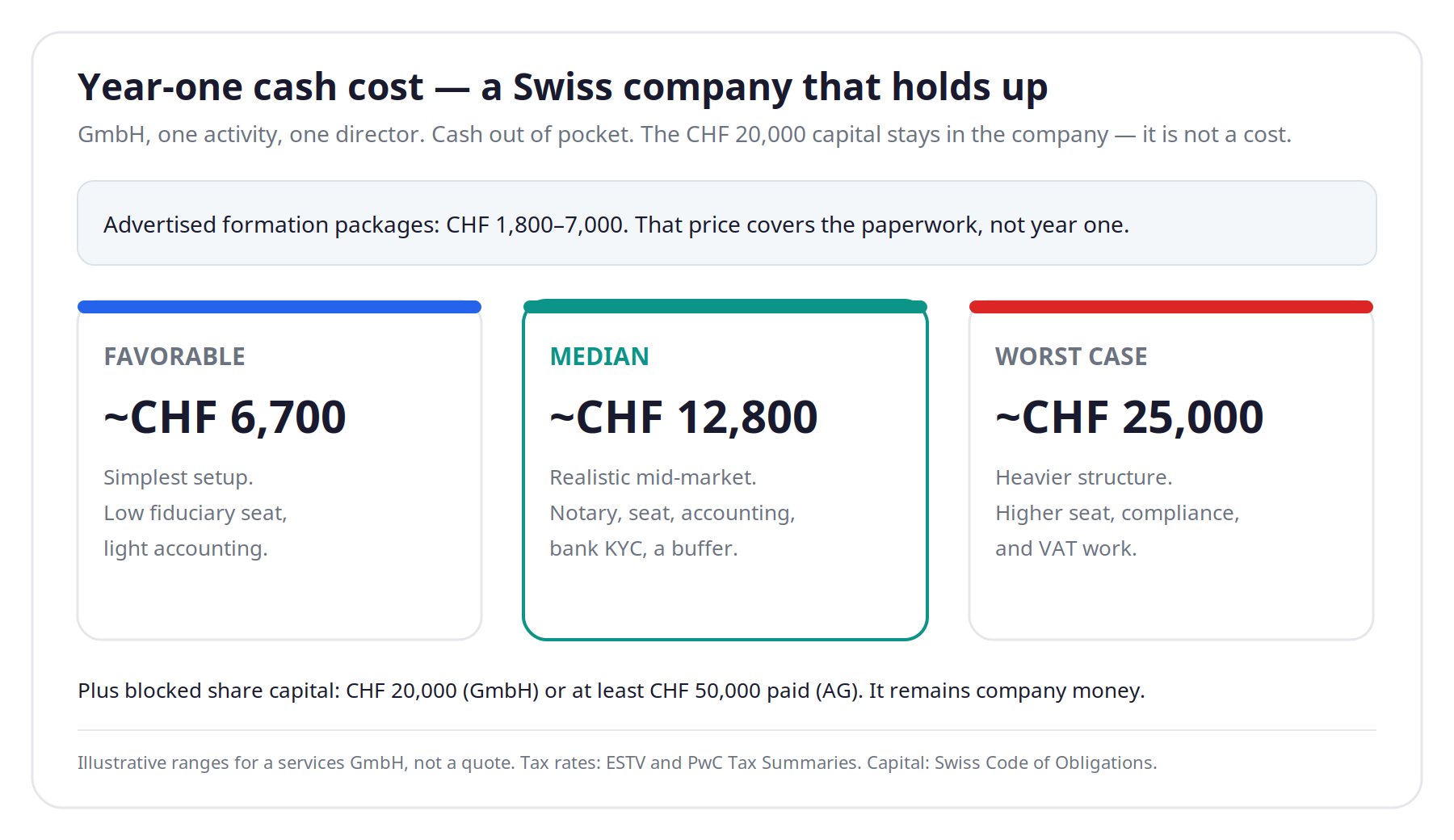
Formation providers quote CHF 1,800 to 7,000 for a package that sets up a Swiss company. None of them shows the cost of a company that holds up: the resident director, the accounting, the bank account, and the substance that keeps it from being reclassified as a letterbox. If Switzerland is the wrong structure for your situation, a cheap formation becomes the most expensive purchase you can make. This guide gives you the real year-one budget, the legal requirements you cannot skip, and the signals that tell you to walk away.
Listen to this guide
GOOD TO KNOW
This is general information, not personal advice. Tax and cost figures below are dated and drawn from official Swiss sources (ESTV, the Code of Obligations, PwC Tax Summaries). Re-check the latest official figures before you commit.
Disclaimer: The information provided on this website is for informational purposes only and does not constitute financial, legal, or professional advice. We encourage you to consult qualified experts before making any investment, real estate, or expatriation decisions. Although we strive to maintain up-to-date and accurate information, we do not guarantee the completeness, accuracy, or timeliness of the proposed content. As investment and expatriation involve risks, we disclaim any liability for potential losses or damages arising from the use of this site. Your use of this site confirms your acceptance of these terms and your understanding of the associated risks.
Discover our articles to learn more about setting up a company in Switzerland:

In 2026, a European entrepreneur has never had so many options on the table. On one hand, Switzerland continues to [...]

Setting up a structure in Switzerland or developing a business there often means quickly hitting a simple reality: without a [...]

Switzerland has a reputation for being an attractive country for businesses, but its taxation is far from uniform or simplistic. [...]
Setting up a business in Switzerland starts with choosing a legal form. Behind this seemingly administrative choice lie very concrete [...]
Two different tests decide whether a Swiss company you run from abroad still holds in 2027. Passing one does not [...]
Forming or owning a Swiss company does not, by itself, make you a Swiss tax resident. Your personal tax residence [...]

Sofia is a non-EU founder with a profitable consulting business. She incorporated a Swiss GmbH, then assumed the company would [...]

Marcos is a foreign founder ready to file. He has a name, a canton and a capital amount. What he [...]

Setting up a company in Switzerland is attracting more and more founders, both foreign and local. Competitive taxation, political stability, [...]

Building a 100% online business with a company based in Switzerland is attracting more and more European and international entrepreneurs. [...]
Setting up a Swiss company without ever taking a flight to Zurich or Geneva still feels, for many, like an [...]

Setting up your company in Switzerland is a dream for many entrepreneurs. Attractive tax environment, political stability, a strong financial [...]

Expanding across the border is a dream for many French business leaders. A solvent market, competitive taxation, political stability, a [...]

Switzerland is recognized as one of the most dynamic ecosystems for entrepreneurship and innovation in Europe. With over 52,000 new [...]
Embarking on entrepreneurship in Switzerland is an exciting adventure, yet one fraught with pitfalls for newcomers. The Swiss Confederation certainly [...]

Switzerland, renowned for its financial stability and leading banking system, attracts numerous entrepreneurs from around the world. Opening a corporate [...]

Switzerland is renowned for its attractive tax environment, drawing numerous entrepreneurs and investors from around the world. However, the Swiss [...]

Switzerland, renowned for its quality of life and attractive salaries, attracts many foreign workers. However, its labor law system has [...]

Switzerland, renowned for its economic stability and business-friendly environment, attracts numerous entrepreneurs eager to establish their companies there. Whether you’re [...]
Switzerland, known for its economic stability and highly skilled workforce, attracts numerous companies looking to establish operations there. However, the [...]

Switzerland, recognized for its economic and political stability, offers fertile ground for ambitious entrepreneurs. In 2024, the country achieved a [...]

Starting a business in Switzerland is an exciting adventure, but one that requires making crucial choices from the very beginning. [...]

Switzerland, known for its economic stability and business-friendly environment, attracts many entrepreneurs looking to establish their companies there. Whether you’re [...]

Switzerland, known for its watchmaking precision and exquisite chocolate, also possesses a unique corporate culture that reflects the country’s values [...]

Switzerland, recognized for its innovation and economic stability, offers a favorable environment for intellectual property (IP) protection. For entrepreneurs and [...]

Switzerland, known for its economic stability and high standard of living, offers a dynamic and sophisticated consumer market. Understanding the [...]

Switzerland, renowned for its economic stability and business-friendly environment, continues to offer enticing opportunities for entrepreneurs in 2025. Despite global [...]

Switzerland, renowned for its economic stability and business-friendly environment, attracts numerous entrepreneurs looking to establish their companies there. However, before [...]

Switzerland, a country renowned for its economic stability and quality of life, is attracting more and more entrepreneurs from around [...]

The Swiss e-commerce landscape is undergoing rapid evolution, driven by technological innovation and changing consumer behaviors. In this dynamic market, [...]
Switzerland, renowned for its economic stability and exceptional quality of life, attracts numerous foreign investors eager to acquire real estate. [...]
Switzerland: An Entrepreneurial Paradise in the Heart of Europe
Switzerland still attracts founders for reasons that are real, and for reasons that brochures exaggerate. The real reasons are political and monetary stability, a banking system that still opens accounts for operating companies, and access to European customers without EU membership. The exaggerated reason is the idea of a discreet, lightly taxed shell that runs itself from abroad. That second product is not what Swiss law, Swiss banks, or Swiss tax authorities sell in 2027.
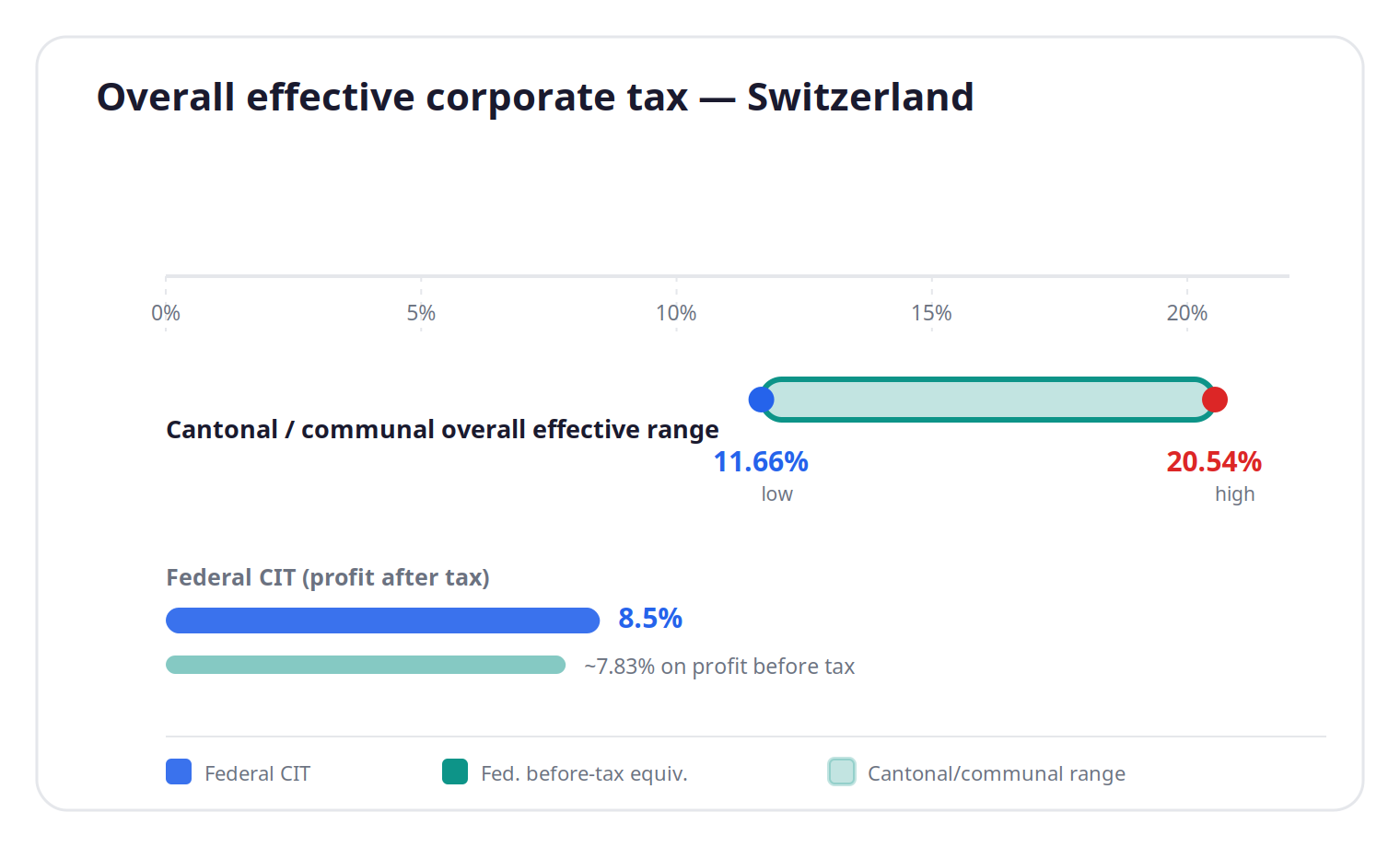
The country sits at the centre of European road, rail and air links, with a multilingual workforce and a civil-law system that foreign counsel can actually read. Corporate tax is low by regional standards, but it is not a flat national rate. A federal tax of 8.5% on profit after tax (about 7.83% on profit before tax) is only the first layer. Cantonal and communal taxes take the overall burden to roughly 11.66%–20.54%, depending on where the company is actually run. PwC Tax Summaries
For a founder deciding where to incorporate, that range is a genuine advantage provided the structure is operated from and in Switzerland. A registered address with no staff, no decisions and no bankable story does not collect the low rate. It collects questions.
Switzerland is also not a secrecy jurisdiction for a new company. Banking secrecy toward the Swiss tax authorities has been rolled back for years, and automatic exchange of information applies to reportable accounts. The remaining advantage is quality of institutions, not invisibility. If the pitch you received leads with discretion, asset protection and “no questions”, it is selling a Switzerland that no longer exists for this use.
What still holds:
- A predictable political and monetary system, outside the euro but inside the European economic orbit.
- A corporate tax burden that can sit at the bottom of the Western European range, if substance matches the canton you chose.
- Courts, a commercial register and a notarial system that counterparties recognise.
- A labour market that can staff a real office, at Swiss salary levels, not at offshore nominee prices.
What does not hold: a virtual seat, a nominee director you never brief, and a promise that the company will be “Swiss” for tax and banking purposes while every decision is taken elsewhere. That is the gap this guide is written to close.
What a Swiss company really costs in year one
The advertised package is the paperwork. Year one is the paperwork plus the seat, the accounting, the bank, and the compliance that keeps the company from being treated as a letterbox. The figures below are illustrative ranges for a services GmbH, not a quote. They assume one activity, one director, a low-cost fiduciary seat and no bank lending. Change the hypothesis and the number moves.
HYPOTHESES
a GmbH, a single services activity, one director, a fiduciary registered office, no lending. “Favorable” is the simplest setup that still has a seat and accounts. “Median” is a realistic mid-market file. “Worst-case” is a heavier structure, extra compliance, or a file the bank and the notary will not process on the cheap.
| Line item | Favorable | Median | Worst-case |
|---|---|---|---|
| Formation package (lawyer/fiduciary) | CHF 1,800 | CHF 3,500 | CHF 7,000 |
| Notary + commercial register | CHF 1,200 | CHF 2,000 | CHF 3,000 |
| Registered office / fiduciary seat (year 1) | CHF 1,500 | CHF 1,800 | CHF 3,000 |
| Blocked capital (GmbH CHF 20,000) | CHF 20,000 own funds, blocked | CHF 20,000 | CHF 20,000 |
| Accounting + tax filing (year 1) | CHF 1,500 | CHF 3,000 | CHF 6,000 |
| Bank account opening / KYC | CHF 200 | CHF 500 | CHF 1,000 |
| VAT compliance if you register | CHF 0–1,000 | CHF 1,000 | CHF 3,000 |
| Recurring misc + buffer | CHF 500 | CHF 1,000 | CHF 2,000 |
| Cash out of pocket (excl. capital) | ~CHF 6,700 | ~CHF 12,800 | ~CHF 25,000 |
| Plus blocked share capital | + CHF 20,000 | + CHF 20,000 | + CHF 20,000 |
Do not book the blocked CHF 20,000 as a “cost”. It stays in the company and is released to the operating account after registration. The cash you do not get back in year one is roughly CHF 7,000 to CHF 25,000, above the CHF 1,800–3,500 the first search ads imply.
KEY FIGURE
the real year-one cash cost of a Swiss company that holds up is roughly CHF 7,000 to 25,000, before the blocked share capital.
An AG changes the capital line, not the logic. Nominal capital is CHF 100,000, of which at least 20% and never less than CHF 50,000 must be paid at incorporation. The seat, the accounts and the bank do not become cheaper because the vehicle is an AG. They often become more expensive, because the governance file is heavier.
What you will still pay in year two
Year two drops the notary and the formation package. It does not drop the seat, the accounts, the tax filing, or the bank. A dormant company with a fiduciary address still receives invoices. If you hired, payroll contributions start on the first salary, not at incorporation. If you registered for VAT, returns continue whether or not the year was busy. Budget the median operating line — seat, accounting, bank, a buffer — as a recurring cost, not as a one-off the package “included”.
The quoted price is not the year-one cost.
Canton, notary, fiduciary seat and the blocked capital account usually land after the invoice you were shown.
What a formation package does not buy
A full-service package usually covers the articles, the notary slot, the register filing and a registered address for the first year. Read the engagement letter for four items that are often outside the headline price:
- The blocked capital. It is your money, deposited before the notary will proceed. A package that “includes capital” is either financing it (rare, and not free) or describing the account-opening assistance, not the CHF 20,000.
- A director the bank will accept. A nominee on a menu is not substance. If you are non-resident, the register and the bank commonly expect a person with Swiss or European access who can actually sign and be reached. That person is a cost and a governance fact, not a line in the brochure.
- The operating account. Opening the blocked-capital account is not the same as keeping an operating account after KYC. Refusal, or a conditional opening, happens after you have already paid the notary.
- Year-one accounts and tax. The first closing, the federal and cantonal return, and VAT if you are in scope are recurring professional fees. They are not “included” unless the letter says so in months, not in adjectives.
ATTENTION
a package priced like a shelf company, sold to a non-resident, with a virtual seat and no named director who will actually manage, is the pattern that stalls at the bank or is later treated as a letterbox. The cheap invoice is not the risk. The missing substance is.
Before you pay a fiduciary, ask for the engagement letter in writing and check five points: who the director is and where that person lives; whether the seat is a real office or a mail drop; whether accounting and the tax return are in the annual fee or billed later; what happens to the fee if the bank refuses the account; and whether the provider will put its name on the commercial register as an organ of the company. A provider that will not answer those five points in writing is not cheaper. It is unfinished.
When to say no
A Swiss company is the wrong structure today when any of the following is the actual plan:
- There is no activity and no substance planned in Switzerland. What you are buying is a letterbox with a reputable postcode.
- The intent is a tax-free shell. Swiss authorities and Swiss banks are built to see through that, and the OECD minimum tax is irrelevant to the point: the domestic system already expects an operating company.
- You are confusing the company with personal residence. A Swiss company does not give you a permit, a tax home, or the right to live in the country. If the goal is to live in Switzerland, the company is the wrong tool and the wrong order of steps.
- The profit and the activity would be better served by a simpler or more local vehicle. Switzerland’s year-one cash cost pays off above a certain level of activity, contracts and banking need. Below that, you are buying a brand.
KEY FIGURE
Switzerland’s overall corporate rate can sit near 11.7% at the bottom of the official range — but only if the substance is genuinely in Switzerland.
If more than one of those points applies, the cheaper decision is the one that does not cost you a letterbox rejection, a bank refusal, or a reclassification. Saying no before the notary is the point of this page.
Swiss Legal Structures: Choosing the Right Vehicle for Your Success
Swiss private company law gives an operating business two limited-liability vehicles, plus a sole proprietorship that does not limit liability at all. The choice is a profile decision. It is not a generic preference for “the Swiss company”. For the AG/GmbH/sole trade-off in detail, see choosing the legal form.
| AG (public limited company) | GmbH (limited liability company) | |
|---|---|---|
| English gloss | Corporation / joint-stock company | Limited liability company |
| Minimum capital | CHF 100,000 nominal | CHF 20,000 |
| Paid at incorporation | at least 20%, and never less than CHF 50,000 | CHF 20,000 fully paid |
| Share transfer | easier, which matters for investors and an exit | restricted, notarial formalities |
| Best suited for | raising capital, employee shares, a later exit | a solo founder or a small team keeping control |
| Legal basis | Code of Obligations, art. 621 and 632 | Code of Obligations, art. 773 and 777c |
Capital figures come from the Swiss Code of Obligations. For the AG, the minimum share capital is CHF 100,000 (art. 621), of which at least 20% and in any case at least CHF 50,000 must be paid in (art. 632). For the GmbH, the minimum capital is CHF 20,000 and it must be fully paid (art. 773 and art. 777c paragraph 1, in force since the 2008 revision).
The Corporation (AG): The Choice for Big Ambitions
The AG is the vehicle counterparties expect when the company will raise money, issue employee shares, or be sold. Liability of shareholders is limited to the capital. Governance is a board, not a handshake. That formality is the product: investors and banks can read the articles, the register and the signatory rights without reconstructing a private agreement.
The AG is the wrong default for a solo consultant who wants the lowest cash outlay. You will block at least CHF 50,000, maintain a board, and pay for a heavier file, in exchange for transferability you do not yet need. Choose it when the next step is external capital or an exit that requires shares someone else can hold. Choose it also when the commercial counterpart — a bank, a licensor, a public tender — has already said it will only contract with an AG. That is a profile fact, not a status symbol.
Shareholder identity is not a secrecy feature you should plan on. The commercial register and the beneficial-ownership file exist so that banks and authorities can see who controls the company. An AG that is sold as “anonymous” is being mis-described.
The Limited Liability Company (GmbH): Flexibility and Control
The GmbH is the default for a founder who will own the company, invoice from it, and does not have an investor at the table. Capital is lower, it must be fully paid, and transfers of shares are deliberately heavier than in an AG. That restriction is a feature if you want to keep control. It is a defect if you already know you will bring in co-investors within the year.
Management can sit with the shareholders or with appointed managers. For a non-resident founder, the practical constraint is not the statute. It is whether a person with the right to sign can satisfy the bank and be reached when the register or the tax office writes. A GmbH with no such person is not “flexible”. It is unfinished.
EXAMPLE
“Matthias”, a non-resident founder with about EUR 1 million in assets, planned a holding for international services. He chose a GmbH (CHF 20,000 fully paid) because he needed a low-cost vehicle with restricted share transfers. He had no external investor and wanted to keep control. The choice was right for that profile. It would have been wrong if the same person had already signed a term sheet.
When a form becomes relevant: choose a GmbH if you are a solo founder or a small team optimizing cost and keeping control. Choose an AG once you plan external investors, employee share schemes, or an exit that needs transferable shares.
Sole Proprietorship: Simplicity and Autonomy
A sole proprietorship has no minimum capital and no notary in the AG/GmbH sense. You can start faster, and you keep the profit directly. You also keep the debts. There is no limited liability. If the activity is small, local, and you already live in Switzerland, it can be the honest first step. If the point of the project is to separate personal wealth from commercial risk, or to contract as a foreign founder without moving, the sole proprietorship does not do that job.
Registration in the commercial register becomes necessary once the business crosses the statutory turnover threshold or operates in a regulated form. Even below that line, banks and counterparties often ask for a register extract. “Simple” does not mean invisible, and it does not mean asset protection.
A sole proprietorship is also a poor answer to “I want a Swiss company but I will not live there”. The person and the business are the same taxpayer. You have not created a separate Swiss vehicle. You have created a Swiss personal activity, with Swiss personal-tax consequences if the activity makes you taxable there.
Swiss Taxation: A Major Asset for Your Business
Swiss corporate tax is a three-layer system: federal, cantonal, communal. There is no single “Swiss rate” a provider can promise you. The rate you actually pay follows the canton — and the commune — where the company is taxed, which follows where it is managed and has its seat, not the canton named — see the cantonal tax breakdown in a brochure.
Corporate Tax: An Attractive Tax Burden
| Band / situation | Approx. rate | Source |
|---|---|---|
| Federal tax on profit after tax | 8.5% (about 7.83% on profit before tax) | PwC Tax Summaries |
| Overall, federal + cantonal + communal | about 11.66% to 20.54% | PwC Tax Summaries |
| Low-canton examples (Zug, Schwyz, Nidwalden) | bottom of that range, if substance is there | canton tax authorities |
| High-tax cantons | top of that range | canton tax authorities |
| VAT, standard | 8.1% | ESTV |
| VAT, reduced | 2.6% | ESTV |
| VAT, accommodation | 3.8% | ESTV |
| OECD minimum tax (Pillar Two) | groups with at least €750 million global revenue; an SME is outside it | ESTV |
Why “just pick Zug” is misleading. The low-canton advantage is real. It depends on substance: people, premises, and decisions in that canton. Choosing Zug, or Schwyz, or Nidwalden, with no presence there invites a challenge to where the company is actually managed. You do not collect the bottom of the range by renting a letterbox in the cheapest canton while the contracts are signed elsewhere.
Two updates matter more than the brochure rate. First, the old cantonal special statuses — holding, domiciliary and mixed companies — were abolished. Do not plan on a privileged holding regime. A participation relief can still apply to qualifying shareholdings under federal rules, but that is a relief on qualifying dividend and capital-gain income, not a licence to run an empty holding. Second, the OECD minimum tax (Pillar Two, the Swiss top-up tax) applies to large multinational groups at or above €750 million of global revenue. It does not touch an SME. If a seller tells you the global minimum tax has “ended” Swiss corporate tax for a founder-owned company, that seller is wrong.
VAT: Competitive Rates
Swiss VAT is federal, not cantonal. The rates on the ESTV page are a standard rate of 8.1%, a reduced rate of 2.6% for defined categories of goods and services, and a special rate of 3.8% for accommodation (overnight stays with breakfast). These are low by EU standards. They are not optional, and they are not a reason to incorporate.
You register when you are within the scope of Swiss VAT, including where foreign businesses cross the registration threshold on Swiss supplies. A company that only invoices non-Swiss clients from a Swiss seat still needs a position on whether it must register, charge, and file. That position is a yearly compliance cost — the VAT line in the year-one table — not a sentence in the formation pack. The reduced and accommodation rates apply to defined supplies. They are not a general discount on your invoices.
Tax Treaties: Avoiding Double Taxation
Switzerland has a wide treaty network. Treaties allocate taxing rights and, for many non-resident shareholders, reduce the domestic tax withheld on dividends, interest and royalties. They do not erase Swiss tax on Swiss-source profit, and they do not let you choose the treaty you like if the company is managed somewhere else.
Dividends paid by a Swiss company are, at domestic level, subject to anticipatory tax. A shareholder who is tax-resident in Switzerland generally reclaims it through the ordinary return. A shareholder who is not must rely on the treaty between Switzerland and the country of residence, and on the paperwork that treaty requires. A formation package does not file that reclaim for you unless the letter says so.
Treaty access itself has a substance condition in practice. A company with no people and no activity in Switzerland is a weak claimant for relief. The treaty table in a brochure is not a plan. The plan is where the company is managed, who signs, and which country will also claim the profit.
Setting Up Your Company in Switzerland: A Structured and Efficient Process
The sequence is fixed. You cannot register an AG or a GmbH by uploading a form. Before you file, work through the 12-point checklist to open a Swiss company. A notary is required. The commercial register is the moment the company exists. The bank sits on both sides of that moment: capital in before, operating account after.
Step 1: Planning and Preparation
Decide the vehicle, the canton, and the name before you book the notary. The name must be distinguishable and must respect the rules of the commercial register; a fiduciary can run the search, and you can check existing names yourself on Zefix before you pay anyone for an extract. Zefix extracts are free. Paying for a “company search” that is a Zefix printout is a signal, not a service.
At this step you also decide who will sign, where the seat will be, and what the company will actually do in the first twelve months. If you cannot describe the activity, the customers and the person who will manage, you are not ready for step 2. You are ready for the “when to say no” section above.
Write the activity in one sentence a bank compliance officer can repeat. “International consulting” is not that sentence. The customers, the countries, and the reason the work sits in Switzerland are.
Step 2: Legal Formation
The articles of association, the founders’ resolution and the capital deposit come before the register. The minimum capital goes into a blocked account at a Swiss bank. The notary authenticates the formation documents. For a GmbH that means CHF 20,000 fully paid. For an AG it means at least CHF 50,000 paid against CHF 100,000 nominal. Contributions in kind are possible and slower: they need a valuation and extra notarial work, which is a worst-case line, not a shortcut.
This is the step providers compress into “we handle the notary”. What they cannot compress is a bank that has not opened the blocked account, or a founder who has not produced the KYC file. Until that account exists, the notary does not have a company to incorporate.
Step 3: Registration in the Commercial Register
The register filing typically includes the authenticated articles, proof that the capital was deposited, the founders’ minutes, and the acceptance of office by the directors or managers. The canton of the seat is the canton of the register. Fees vary by canton and by the number of entries; budget them inside the notary-and-register line of the year-one table rather than as a national stamp duty you can Google once.
Registration is the legal birth of the company. It is also public. The extract will show the seat, the purpose, the capital and the persons with signatory rights. That publicity is a feature for counterparties. It is the opposite of a discreet shell.
Step 4: Post-Incorporation Procedures
After the extract is issued, the blocked capital is released and the operating account can be opened — if the bank is satisfied. You then register for tax, obtain the enterprise identification number (UID), and, from the first hire, register for social insurance. VAT registration is a separate decision, driven by the supplies you make, not by the fact of incorporation.
A realistic file, with a cooperative bank, is measured in weeks, not in a weekend. A file with a non-resident owner, a thin purpose clause and no local signatory is measured in months, or in a refusal. Anyone who quotes “48 hours” is quoting the notary slot, not the bank.
Switzerland vs. Other Offshore Jurisdictions: A Strategic Choice
Switzerland is not an offshore island, and comparing it to one as if the only variable were the headline tax rate is how founders buy the wrong tool. The useful comparison is: where do you need the company to be bankable, contractable and defensible, and where will you actually operate it — Swiss company or EU company?
Stability and Reputation: The Swiss Advantage
The advantage that survives a bank review is institutional. A Swiss commercial register extract, a Swiss notary and a Swiss operating account are readable by European counterparties in a way a Caribbean register often is not. Political continuity and the rule of law are the product. Discretion is not. If your counterpart, your investor or your landlord needs a jurisdiction they will not have to explain to their own bank, Switzerland can be that jurisdiction. If they need the lowest possible tax on profit earned somewhere else, it is not.
Comparison with Other Attractive Jurisdictions
| Question | Switzerland | A classic offshore centre | An EU alternative (for example Luxembourg) |
|---|---|---|---|
| What you are buying | a high-compliance operating base | a holding or booking centre | an EU company, with EU law and EU substance rules |
| Bank account | difficult without substance, possible with it | often the point of failure | possible, still a KYC file |
| Tax | low, not zero; canton matters | may look lower, and attract more scrutiny | competitive in defined regimes, not a blank cheque |
| If you will not put people there | usually the wrong choice | also usually the wrong choice, for different reasons | also usually the wrong choice |
This option becomes relevant if you need a European operating company that banks and contracts under its own name, and you will put management, or a genuine local director with authority, in Switzerland. It does not become relevant because a comparison table showed a lower rate than France, Germany or a Caribbean island. Singapore is a serious alternative when the customers and the team are in Asia. It is not a substitute for a Swiss seat you will never use.
Social Obligations in Switzerland: A Balanced System
The social system is a payroll fact, not a formation fact. You do not “set it up” in the notary pack and forget it. You meet it from the first salary, including your own if you are employed by the company.
Mandatory Social Insurance
The mandatory stack has a stable architecture, even though the percentages move by federal ordinance and should be read on the current OASI/DI contribution leaflet rather than copied from an old guide:
- Old-age and survivors’ insurance (AHV/AVS), disability insurance (IV/AI) and income compensation (EO/APG), generally split between employer and employee.
- Unemployment insurance (ALV/AC), with a ceiling and a solidarity component above it.
- Accident insurance (UVG/LAA), compulsory for employees.
- Occupational pension (BVG/LPP), once salary and age thresholds are met. The rate is not a single national number; it depends on the plan and the age band.
- Family allowances, which are cantonal.
These are costs of having people, including a founder on a Swiss payroll. They are not in the CHF 1,800 package. A company with no employees still has a seat and accounts. A company that hires has this stack on top, from month one. Ask the payroll provider for the current official rates before you model a salary. Do not model them from a 2025 blog.
Labor Law: Flexibility and Protection
Swiss employment law is more flexible than French or German law, and less flexible than a brochure that says “hire and fire”. The legal maximum weekly working time is 45 hours for industrial, office, technical and sales staff, and 50 hours for other workers. The statutory minimum paid holiday is four weeks, five for younger workers. A probation period is common and can run up to three months. Notice then scales with length of service, typically from one month upward, and the contract can set a longer notice.
There is no federal minimum wage. Some cantons, and many collective agreements, set a floor for defined sectors. Salaries in practice sit well above those floors in the cities where you would actually put an office, because the labour market and the cost of living do. A business plan that staffs Zurich or Geneva at Eastern European salaries will not hire, and a business plan that ignores payroll on-costs will miss the year-one budget from the first contract.
Opening a Corporate Bank Account in Switzerland: A Crucial Step
A Swiss company without a business account cannot pay, cannot be paid, and often cannot finish incorporation, because the capital has to sit in a Swiss blocked account first. The account is not a courtesy that follows the register extract. It is a gate. The step-by-step order is in opening the business account.
Choosing the Right Bank
Pick a bank for the file you actually have, not for the brand. A large universal bank, a cantonal bank, or a smaller institution used to non-resident-owned operating companies are different files. What matters is whether that institution opens accounts for your activity, your ownership chain and your countries of operation. Credit Suisse is not a current choice; it was absorbed by UBS. A guide or a provider still listing it as an option has not updated the file.
Fees, e-banking, and the ability to pay suppliers in the currencies you invoice are secondary to one question: will this bank open the account for this owner? Ask that before you pay the notary. A refusal after the capital is blocked is how “cheap” formations become stuck capital.
Account Opening Procedure
The practical sequence is:
- Blocked capital account. The minimum capital is deposited and blocked.
- Incorporation. Notary, then the commercial register.
- Operating account. The capital is released, and the business account opens if KYC is accepted.
Documents the bank will ask for overlap with the notary file and then go further: articles, register extract, identification of every director and beneficial owner, a description of the activity, and the source of the funds. A meeting, in person or by video, is common. “Remote” does not mean “no questions”.
Due Diligence and Compliance
Swiss banks apply know-your-customer and anti-money-laundering rules as a condition of the account, not as a formality after it. Non-resident-owned companies are scrutinised for substance. If the company looks like a letterbox — no premises you can describe, no person who decides, no customers you can name — the account is slow, conditional on a local presence, or refused.
ATTENTION
plan the substance story before you approach the bank. This is where cheap formations stall, after the invoice has been paid.
Promising Sectors in Switzerland: Innovation and Growth Opportunities
Sector choice does not lower the year-one cost. It decides whether that cost buys a credible purpose. A purpose clause that says “all lawful commercial activities” is a register line, not a bank file. The sectors below are places where a Swiss seat is a commercial argument, not a tax costume.
Cutting-Edge Technologies and Innovation
Life sciences, medtech, software, robotics and parts of fintech can justify a Swiss company when the team, the lab, the university link or the customers are there. ETH Zurich and EPFL in Lausanne are real talent pools. They are not a reason to incorporate if your developers and your clients are elsewhere. A technology company with no one in Switzerland is the same letterbox as a consulting company with no one in Switzerland. The label does not create substance.
Finance and Business Services
Wealth management, insurance, reinsurance and cross-border advisory are deep Swiss markets. They are also regulated. A formation package does not give you a financial licence, a distribution passport, or the right to advise European clients from a Zurich letterbox. If the activity is regulated, the year-one budget above is the floor, not the file. Licensing, local compliance staff and capital requirements sit on top, and they are a different decision from “open a GmbH”.
Precision Industry and Luxury
Watchmaking, precision instruments, pharmaceuticals and specialised machinery are industries where “Swiss” is a commercial fact counterparties pay for. They are also industries with premises, people and inventory. They fit the cost structure in this guide. A trading company that never touches the goods, invoicing from a fiduciary address, does not inherit that reputation. It inherits the bank’s questions about the flow of funds.
Recruiting in Switzerland: Attracting and Retaining the Best Talent
You recruit in Switzerland when the company needs someone there. You do not recruit a nominee so that a foreign company can look staffed. The distinction matters for the bank, for the tax office, and for the person whose name is on the register.
Understanding the Swiss Labor Market
The market is tight in the cities and the technical trades, multilingual, and expensive. German, French and Italian are not interchangeable across cantons; English works in Zurich and in international teams, and works less well the moment a local authority or a local supplier is on the other side of the table. Unemployment figures move and are published by SECO; do not build a hiring plan on a round number from an old article. Build it on the role, the canton and the permit.
Effective Recruitment Strategies
A role that must be filled locally is advertised where Swiss candidates actually look, and it is paid as a Swiss role. Partnerships with ETH, EPFL or a cantonal university matter if you are hiring graduates into a real team. They do not matter if the “hire” is a director of convenience. An employer brand is irrelevant until the company can explain, in one paragraph, what the person will do in Switzerland on a Monday morning.
Talent Integration and Retention
For an employee moving from abroad, the company is not the immigration file. EU and EFTA nationals have a facilitated route. Third-country nationals do not: the permit is a separate, stricter process, and a Swiss company does not shortcut it. Plan the permit before you promise the start date. Once the person is there, retention is ordinary: a contract that respects the holiday and working-time rules above, a salary that matches the city, and work that is real enough that the person is not a name on a register.
GOOD TO KNOW
a Swiss company does not give its foreign owner a residence permit. Hiring a local director does not give the owner one either. Residence is a personal procedure. Keep it separate from the incorporation file.
Tax residence is not the company
Forming a Swiss company does not make you a Swiss tax resident. Your personal home, and the place where you actually manage the company, are separate tests. Many founders incorporate in Switzerland and keep their personal residence elsewhere. That can be legitimate. It has to be intentional. The two tests are separated in company vs tax residence.
If you manage the company from the country where you live, that country may tax the profit, or treat the Swiss company as resident there, whatever the register extract says. If you move to Switzerland, personal tax, social insurance and a residence permit enter the file, and the company does not settle them. The expensive mistake is to pay for a Swiss vehicle in order to solve a personal-tax question it cannot solve.
IN SUMMARY
A Swiss company is cheap on paper and expensive in practice. Budget roughly CHF 7,000 to 25,000 of year-one cash cost on top of CHF 20,000 (GmbH) or at least CHF 50,000 paid in (AG). Meet the signatory and substance requirements. Open the bank account with a story a compliance officer can repeat. The tax advantage applies if the company is genuinely run from Switzerland. The OECD minimum tax does not touch an SME. Before you commit, get an independent review of whether Switzerland — or a company at all — is the right tool for your project.
FAQ
- What does a Swiss company really cost in year one? About CHF 7,000 to 25,000 out of pocket for a GmbH that holds up, plus CHF 20,000 of blocked capital that stays in the company. An AG blocks at least CHF 50,000 against CHF 100,000 of nominal capital. The advertised package is the paperwork, not this total.
- AG or GmbH — which should I choose? A GmbH if you are a solo founder or a small team and you want to keep control at CHF 20,000 fully paid. An AG if you will raise capital, issue employee shares, or need transferable shares for an exit.
- Do I need a resident director? The company must be represented by someone with signatory power (Code of Obligations art. 718 for the AG board, art. 814 for the GmbH managers). Banks and the register commonly expect a person domiciled in Switzerland or with direct European access. That is a practice you will meet, not a slogan.
- Can I run it from abroad? Only with real substance: a seat you can describe, activity, and management that is not a fiction. A company run entirely from abroad is the letterbox case. Your country of residence may also claim the profit if that is where the decisions are taken.
- Which canton has the lowest tax? The overall range, federal plus cantonal plus communal, is about 11.66% to 20.54%. Low-canton names sit toward the bottom of that range only if the substance is there. Naming Zug in the articles does not create that substance.
- Is Switzerland a tax haven? No. It is a low-tax, high-compliance jurisdiction. The old special cantonal holding regimes are gone. The OECD minimum tax applies to groups at or above €750 million of global revenue, not to a founder-owned SME.
- Does the company make me a Swiss resident? No. Residence, a permit and personal tax are a separate decision. Incorporating first, in the hope that the company will solve the personal move, is the wrong order.
- What does a cheap package actually buy? The legal formation and, sometimes, a year of registered address. Not the capital, not a bankable director, not the operating account, and not the year-one accounts.
If you are weighing a Swiss company — or wondering whether it is the right structure at all — get an independent review before you commit.
One decision left: is a Swiss company right for you?
A structure with no real substance in Switzerland costs more than it protects.
Sources
- ESTV — Swiss VAT rates — standard 8.1%, reduced 2.6%, accommodation 3.8%.
- ESTV — top-up tax — OECD minimum tax, large groups only.
- Fedlex — Swiss Code of Obligations — capital (art. 621, 632, 773, 777c) and representation (art. 718, 814).
Disclaimer: The information provided on this website is for informational purposes only and does not constitute financial, legal, or professional advice. We encourage you to consult qualified experts before making any investment, real estate, or expatriation decisions. Although we strive to maintain up-to-date and accurate information, we do not guarantee the completeness, accuracy, or timeliness of the proposed content. As investment and expatriation involve risks, we disclaim any liability for potential losses or damages arising from the use of this site. Your use of this site confirms your acceptance of these terms and your understanding of the associated risks.

Cyril Jarnias is an independent expert in international wealth management with over 20 years of experience. As an expatriate himself, he is dedicated to helping individuals and business leaders build, protect, and pass on their wealth with complete peace of mind.
On his website, cyriljarnias.com, he shares his expertise on international real estate, offshore company formation, and expatriation.
Thanks to his expertise, he offers sound advice to optimize his clients' wealth management. Cyril Jarnias is also recognized for his appearances in many prestigious media outlets such as BFM Business, les Français de l’étranger, Le Figaro, Les Echos, and Mieux vivre votre argent, where he shares his knowledge and know-how in wealth management.





