
 Published on and written by Cyril Jarnias
Moving to the UK means entering a country where medieval churches, ultra-modern mosques, glittering Hindu temples, bustling gurdwaras, and a growing non-religious population all coexist. For an expat, gaining a solid understanding of this religious landscape—and how it shapes daily life, school, work, and public holidays—is not a luxury: it’s essential for avoiding faux pas, building good relationships, and fully enjoying local life.
This article provides a practical guide to beliefs, religious places and holidays, behavior in places of worship, and the legal framework regarding religion at work and school. It also explains how to use interfaith networks to facilitate integration.
1. The UK’s Religious Panorama: A Christian, Pluralistic… and Increasingly Secularized Country
On paper, the UK remains a predominantly Christian country. But the most recent data paints a much more nuanced reality, where the “non-religious” are rising rapidly and religious minorities are very visible in some cities.
1.1 Who Believes What? The Key Figures
The latest censuses show a gradual shift towards a so-called “post-Christian” society, even though Christianity remains the largest religion. In England and Wales, the 2021 census was historic: for the first time, less than half the population identified as Christian.
Here is a summary of the most significant data for an expat.
Religious Distribution – UK Overview (2021–2022 Censuses)
| Territory | Christian (%) | No Religion (%) | Muslim (%) | Hindu (%) | Sikh (%) | Buddhist (%) | Jewish (%) | Other / Not Stated (%) |
|---|---|---|---|---|---|---|---|---|
| United Kingdom (overall) | ≈46.5 | ≈37.8 | ≈6.0 | ~1–1.7 | ~0.9 | ~0.5 | ~0.5 | ≈6 (other + non-responses) |
| England & Wales | 46.2 | 37.2 | 6.5 | 1.7 | 0.9 | 0.5 | 0.5 | 0.6 other religions |
| Scotland | 38.8 | 51.1 | 2.2 | – | – | – | – | Remainder |
| Northern Ireland | 79.7 | 17.4 | 0.57 | – | – | – | – | 1.3 other / 1.5 not stated |
Three key points stand out for a newcomer:
Islam is the second largest religion in the UK in terms of adherents, after Christianity.
The generational contrast is striking: among 16–29 year-olds, surveys indicate up to 70% of young people identify as “non-religious.” At the other end of the spectrum, nearly 70% of people over 60 still identify as Christian. Understanding this generational divide helps interpret certain interactions: a senior practicing colleague may experience religion very differently from largely secularized younger colleagues.
1.2 The Major Christian Families
For an expat, it’s useful to recognize the major Christian branches, as they structure a good deal of social life and public ceremonies.
Some Major Christian Families
| Tradition / Church | Particularities in the UK |
|---|---|
| Church of England (Anglican) | Established church in England, ~16,000 parishes, Archbishop of Canterbury as symbolic figure, bishops sit in the House of Lords. |
| Church of Scotland | National Presbyterian church, independent of the state, governed by assemblies of ministers and elders. |
| Catholic Church | Second major Christian family in England and Wales, very present in Scotland and numerically the majority in Northern Ireland. Recent strong immigration (notably Polish) is slowing the decline. |
| Methodists, Baptists, URC, etc. | Well-established Protestant denominations, often very active locally (neighborhood groups, social work). |
| Pentecostal & African / Caribbean Churches | Rapid growth, especially in large cities (London, Birmingham, Manchester). Very lively worship, strong music and community involvement. |
For a Christian expat, this diversity means it’s generally possible to find a community close to your own sensibility (traditional liturgy, evangelical style, charismatic, etc.). For a non-believing expat, it mainly means that many local social initiatives (food banks, youth clubs, home visits) are driven by churches.
1.3 Religious Minorities and Local Mapping
Religious minorities are very unevenly distributed. Nationally, Muslims represent about 6% of the population, but in some urban neighborhoods they approach or exceed one-third, or even more.
Here are some useful reference points to know and keep in mind to help you get your bearings and facilitate your procedures.
| Religious Group | Notable Concentration Points |
|---|---|
| Muslims | High proportions in Tower Hamlets (~40%), Newham, Blackburn with Darwen, Bradford, Birmingham, Leicester, certain neighborhoods in Manchester and industrial towns of the North. |
| Hindus | Significant presence in Harrow (~25.8%), Leicester (~17.9%), London in general (the well-known Neasden Temple). |
| Sikhs | Concentrations in Wolverhampton (~12%), Sandwell (~11.5%), Birmingham, Leicester, West London. |
| Jews | Strong communities in Hertsmere (~17%), Barnet (~14.5%), North-West London boroughs, Manchester, Leeds. |
| Buddhists | Increased presence in Rushmoor (~4.7%) and some urban areas with immigration from East Asia or Southeast Asia. |
In other words, whether you live in London, Leicester, or a small rural town, your experience of religious pluralism will be very different. But even in less diverse areas, schools and public institutions are required to cover several religions in class and respect strict legal frameworks for equality.
2. Institutions, Places of Worship, and Religious Life Day-to-Day
The UK combines a legacy of a state religion, a plurality of powerful religious structures, and a well-organized non-religious sector (notably Humanists UK). Understanding this architecture helps decode the place of religion in public life.
2.1 Religion and Institutions: A “British-Style” Secularism
Unlike France, the United Kingdom is not a strictly secular state. The Church of England is “established”: the monarch is its Supreme Governor, bishops sit in the House of Lords, and certain national ceremonies (coronations, commemorations) are explicitly Christian.
Alongside this:
– The Church of Scotland is recognized as the national church, but legally independent from the state.
– In Wales and Northern Ireland, there is no longer an established religion; several traditions coexist, with a strong historical Protestant influence in Northern Ireland.
– The state does not employ a religious test for access to public office (outside the monarchy) and the legal framework guarantees freedom of religion and non-religion.
An expat in Great Britain observes a paradox: on one hand, public ceremonies heavily steeped in Christianity (like Christmas or Remembrance Sunday), and on the other, a professional and educational environment that openly promotes religious diversity. This is manifested through discussions about this diversity at work, school visits to mosques and temples, and the institutional recognition of humanist associations.
2.2 Places of Worship: From Cathedral to Multi-Purpose Hall
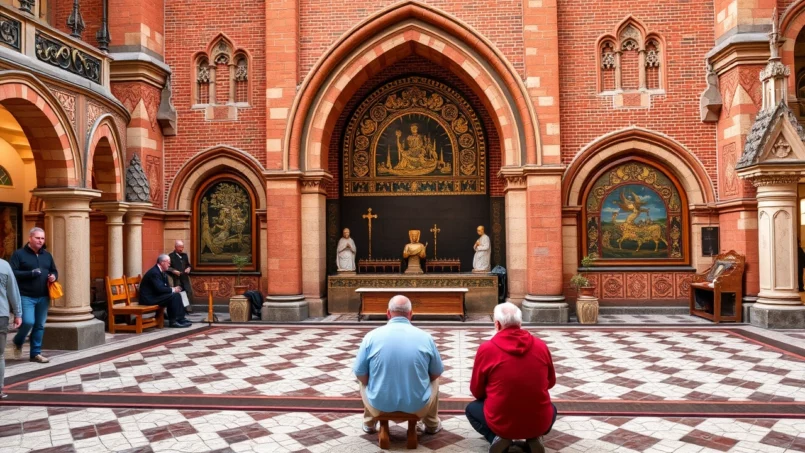
Religious diversity is written into the country’s architecture. Major Christian sites – Westminster Abbey, Canterbury, St Paul’s, York Minster, Durham, Iona Abbey, Lindisfarne – are both historic monuments and active places of worship. It is essential to remember they are not just museums: they hold daily services, weddings, funerals.
Alongside these icons, a profusion of more modest places dots the landscape: nearly deserted rural chapels, Arts & Crafts churches, Quaker meeting houses, evangelical churches set up in repurposed industrial buildings, neighborhood mosques, Hindu and Buddhist temples in urban areas, gurdwaras often open 7 days a week with community kitchens.
To find your way, several online directories are very useful:
Several websites and online directories help locate places of worship for different faiths across the UK.
Allows you to find a Church of England parish by postal code, often with service times and information on activities (youth groups, family events, online service streaming).
Church Finder, UK Christian Web, or The UK Church Directory: broader directories covering many Christian churches of different denominations.
List mosques, synagogues, Hindu, Buddhist, or Sikh temples in a given region (such as those existing for Nottingham, Leicester, or other cities).
For a believing expat, these tools are valuable for quickly finding a welcoming community; for a non-believing expat, they are just as useful for identifying religious actors involved in neighborhood life, often drivers of social or cultural projects open to all.
2.3 How to Behave in Places of Worship?
The guidelines are remarkably consistent, regardless of the place or tradition. British educational materials (notably instructions for school visits) emphasize a few simple principles: respect, modesty, listening.
In practice:
In places of worship, respect dress codes (shoulders and knees covered, shoes removed, hair covered for women in some cases). Avoid certain gestures like pointing your feet at sacred objects. Gratefully accept food offerings like prashad, unless you have dietary restrictions. Always ask permission before taking photographs. Finally, observe rites discreetly; active participation is often reserved for the faithful, but alternatives like a blessing may be offered.
School visit guides emphasize that respectful questions are encouraged: priests, imams, rabbis, monks, or lay leaders are generally delighted to explain symbols and rituals, provided they feel they are being listened to without provocation.
3. Holidays, Calendar, and Social Life: What Structures the Year
Living in the UK means learning to juggle religious holidays, civic commemorations, and official public holidays (the bank holidays). Understanding who celebrates what helps in planning vacations, invitations, meetings, and team events without awkwardness.
3.1 Bank Holidays and Christian Heritage
The official calendar remains strongly marked by Christianity: Christmas, Good Friday, and Easter Monday are national holidays. Christmas (December 25) and Boxing Day (December 26) are at the heart of a festive season that extends far beyond the religious framework: end-of-year decorations, family meals, gifts, Christmas markets, near-total shutdown of public services on the 25th (including transport in London).
Easter alternates between religious dimension (Resurrection worship, Good Friday and Easter Vigil liturgies) and secular aspects (chocolate eggs and bunnies, Easter egg hunts, long extended weekends in the countryside).
Certain Christian holidays, while no longer national bank holidays, retain local importance. This is the case for St. George’s Day (patron saint of England), St. Andrew’s Day (Scotland), St. David’s Day (Wales), and St. Patrick’s Day (Northern Ireland and Irish communities).
3.2 Major Non-Christian Holidays Visible in Public Spaces
The multi-religious character of the UK is increasingly manifested through public non-Christian celebrations, especially in large cities.
Some key milestones:
Ramadan and Eid al-Fitr are very visible in Muslim neighborhoods, with nighttime celebrations. For Eid al-Adha, slaughter takes place in licensed abattoirs, with meat then redistributed. Diwali, particularly in Leicester, is a major festival of lights. Vesak commemorates key events in the Buddha’s life. Hanukkah is marked by the lighting of a large menorah in Trafalgar Square.
For an expat manager or HR professional, integrating this calendar into planning meetings, major internal events, or important interviews is a very strong signal of respect. Many companies now display a multi-faith calendar on their intranet or in offices.
3.3 Memory, Commemorations, and Collective Identity
Two civic dates take on a particular spiritual or ethical tone:
– Holocaust Memorial Day (January 27): national commemoration of the Holocaust and other genocides. Many cities organize interfaith ceremonies, often coordinated by interfaith councils. Participating or at least being aware of it is highly appreciated, especially by Jewish communities and actors in interfaith dialogue.
– Remembrance Day (November 11) and Remembrance Sunday: remembrance of the war dead. Minute of silence at 11 am, wearing of the poppy, ceremonies at war memorials and at the Cenotaph in Whitehall. The tone is both patriotic, solemn, and sometimes marked by Christian prayers. Even without religious practice, many Brits care deeply about it.
Added to this are a set of folk traditions sometimes linked to Christian or pagan roots – Halloween, Bonfire Night (Guy Fawkes Night), May Day, etc. – that structure neighborhood events, school celebrations, and office conversations (“What are you doing for Bonfire Night?”).
3.4 Ethno-Cultural Holidays: When Religion and Culture Blend
Many celebrations straddle the line between religious holiday and cultural event:
– Chinese / Lunar New Year, celebrated in grand style in London (Chinatown, parades, lion dances).
– New Yam Festival in Nigerian Igbo communities, celebrated, for example, by the Ndi Igbo North East England group.
– Festivals of Caribbean and African diasporas, including the famous Notting Hill Carnival in London, where a spiritual dimension can sometimes be found (gospel music, Rastafarian references, etc.).
For an expat, participating – even just as a spectator – is an excellent way to discover religious diversity experienced in a festive mode, well beyond formal rituals alone.
4. Religion at School: What You Need to Know for Your Children
If you arrive with children, you will very soon see them come home from school talking about mosques, Diwali, Christmas, or visits to a gurdwara. Religion is addressed both as a subject of study and as a social reality to be respected.
4.1 Religious Education is Compulsory… But Not Confessional
Throughout the state system, teaching related to religion is legally compulsory, even though it goes by different names in different nations:
– Religious Education (RE) in England and Northern Ireland;
– Religious and Moral Education (RME) in Scotland;
– Religion, Values and Ethics (RVE) in Wales (new title since 2022).
The common guideline is to prepare children to live in a diverse society. The English syllabus, for example, must reflect that religious traditions are “mainly Christian” but also cover “other principal religions”: in practice, this generally means Buddhism, Hinduism, Islam, Judaism, and Sikhism, with a growing place for non-religious worldviews (humanism, atheism).
The lessons are not meant to catechize, but to inform and develop moral reflection, understanding of others, and capacity for respectful debate. Many school trips include guided visits to different places of worship, to familiarize children with these environments.
Principle of secular education in France
4.2 Right of Withdrawal and Parental Choice
Parents retain in principle a right of withdrawal for their children from all or part of religious education and acts of collective worship at school (although this right is being gradually phased out in Wales for the new RVE curriculum).
This right is rarely used, but it’s good to know it exists. If you believe certain content deeply contradicts your convictions (religious or not), dialogue with the school leadership is the first step; partial or total withdrawal can then be considered.
Keep in mind that schools:
– are not required to provide alternative teaching funded by them;
– must simply ensure the material supervision of withdrawn children;
– generally appreciate parents clearly stating their expectations and remaining open to discussion.
4.3 Visits to Places of Worship: What Children Actually Experience
Guidance for teachers gives very concrete instructions, which are useful to know as an expat parent to reassure your children and possibly accompany them:
In a church: no hats for boys, respect silence, and do not cross areas reserved for clergy. In a mosque: remove shoes, women cover their hair and arms, prayer often separate, ablutions possible. In a Hindu temple: remove shoes, sometimes hand washing, do not approach the altar without invitation, possibility of receiving prashad. In a synagogue: wear a kippah (provided), separation of men and women in some communities. In a Sikh gurdwara: remove shoes, cover head and legs, avoid pointing feet at the scriptures, possible sharing of a free meal at the langar.
Knowing this in advance allows you to explain the meaning of the rules to your children, especially if they come from a country where these practices are less familiar.
5. Religion at Work: Rights, Duties, and Best Practices
In British professional life, religion and beliefs are protected by a robust legal framework, mainly through the Equality Act 2010 (for England, Scotland, and Wales) and equivalent legislation in Northern Ireland. For an expat, it’s crucial to understand both what the law guarantees – and what it does not require.
5.1 What the Law Protects
British law prohibits discrimination based on “religion or belief” – and specifies that non-belief is equally protected. This covers:
– major religions (Christianity, Islam, Hinduism, Sikhism, Buddhism, Judaism, etc.);
– philosophical convictions equivalent to a religious belief in terms of depth, coherence, and seriousness (for example, certain environmental commitments, “vegan ethics,” convictions about climate change);
– the right not to believe (atheism, agnosticism, humanism).
The protection applies to all stages of the employment relationship, including recruitment, promotion, working conditions, pay, dismissal, any detrimental treatment, as well as harassment situations such as repeated jokes, a hostile environment, or disparaging remarks.
5.2 Accommodations and Limits: What the Employer Must… or Can Do
Unlike for disability, there is no formal legal duty of “reasonable accommodation” for religion. However, if an internal rule particularly penalizes people of a certain religion, it may constitute indirect discrimination if it is not justified by a legitimate aim.
In practice, many employers go beyond the strict legal obligations and implement:
– quiet spaces that can serve as prayer or meditation rooms;
– flexible hours to allow for Friday prayers or early departure for religious holidays;
– adapted menus (halal, kosher, vegetarian) at corporate events;
– flexible dress code policies, allowing the wearing of Sikh turbans, headscarves, kippahs, or beards for religious reasons.
But the law also recognizes possible limits, if the employer demonstrates a serious reason, for example:
Accommodations for religious reasons can be limited by legitimate requirements: safety (e.g., prohibition of dangerous objects or incompatibility with protective equipment), service efficiency (e.g., inability to systematically grant leave due to understaffing), and the neutrality of image towards customers, provided this rule is applied consistently and non-discriminatorily.
As an expat, it is reasonable to: adapt to new cultures, learn the local language, respect local norms and customs, and build a social network to facilitate integration.
– make your requests openly (schedule adjustment for Yom Kippur, leave for Eid, possibility to pray at noon, etc.) explaining the religious meaning;
– discuss alternatives in case of a partial refusal (changing time slots, occasional remote work, shift swaps);
– note that the employer is not obligated to grant all requests, but must show they have been seriously considered.
5.3 Dress, Symbols, and Appearance
The UK adopts a pragmatic approach. The Equality and Human Rights Commission recommends that dress codes respect religious expression, barring serious obstacles. The most notable example is that of Sikhs, benefiting from specific exemptions to wear a turban instead of a helmet in most sectors, except certain high-risk military or emergency situations.
More broadly, the courts have reminded:
The courts
– that banning all visible religious symbols may be legal if applied uniformly and justified (a policy of “neutrality”);
– that banning some symbols but not others is, however, very problematic legally;
– that restricting the full-face veil (niqab) for reasons of communication (teaching, patient interactions) may be permitted, provided accommodation solutions are sought first.
For an expat, the advice is simple: if you wear visible religious signs, inquire about internal policies, and, in case of difficulty, engage in dialogue before assuming bad intent. Major UK employers are accustomed to these issues.
6. Living with Diversity: Interfaith, Dialogue, and Community Life
British religious diversity is not just a mosaic of places of worship; it’s also a dense network of dialogue organizations, interfaith cooperation, and grassroots initiatives. For an expat, these structures are ideal gateways for understanding and meeting people.
6.1 Interfaith Networks: How to Use Them When You Arrive
For a long time, the Inter Faith Network for the UK (IFN) served as a national hub for listing interfaith structures and disseminating best practice guides (like the “Building Good Relations with People of Different Faiths and Beliefs” code or the “Let’s Talk” booklet on dialogue). The IFN ceased its activities in 2024, but its legacy continues through:
– national networks (Faith & Belief Forum, Council of Christians and Jews, Christian Muslim Forum, Interfaith Scotland, Northern Ireland Inter Faith Forum, etc.);
– regional platforms (Faiths Forum for London, East of England Faiths Agency, North East Regional Faiths Network, Leicester Council of Faiths…);
– a multitude of local groups (Watford Interfaith Association, Bromley 3 Faiths Group, Women’s Interfaith Network, Muslim Jewish Forum of Manchester, etc.).
For you, practically, these structures offer:
Discover different ways to participate in interfaith life, from reflection to concrete action, to foster dialogue and mutual understanding.
Participate in conferences, shared meals, “Peace Feasts,” or multi-faith iftars to engage in a friendly setting.
Join reading groups (*Scriptural Reasoning*) to explore and discuss the foundational texts of different traditions.
Discover initiatives like The Feast or Solutions Not Sides, designed to engage and interest teenagers, including expats.
Get involved in universal causes like environmental protection, fighting hate, or welcoming refugees.
Many of these events are free and open to all, regardless of personal conviction. Participating once or twice will give you a very concrete idea of how Britons experience religious diversity on the ground.
6.2 Inter Faith Week: A Good Time to Take the Temperature
Every year, an Inter Faith Week is organized nationally. For one week, institutions, associations, schools, places of worship, and local councils put on events around a unifying theme (for example: service to the community, shared values, sense of belonging).
It’s a particularly rich moment for:
At interfaith events, it’s possible to freely visit places of worship, attend panel discussions on themes like faith facing climate change or mental health, observe school projects involving pupils, and meet neighbors from different communities.
For a newly arrived expat, noting the dates of the local Inter Faith Week and browsing the event program is a quick way to map out the religious and interfaith actors in your new city.
6.3 Religion, Values, and Society: What the Figures Reveal
Numerous opinion surveys give some additional keys to interpretation:
– A growing majority of Britons say they are “not religious,” but many of them remain attached to certain traditions (church weddings or funerals, celebrating Christmas).
– A large part of the population says they *trust* people of other religions, even though a minority still believes “only their religion is acceptable“.
– Religious engagement remains an important driver of volunteering and social action (food banks, support for the homeless, assistance for migrants), which explains why institutions like the NHS rely on multi-faith chaplaincies.
For an expat, this means it’s entirely possible to be non-believing and fully integrated; but it also means that, in many neighborhoods, religious actors will be unavoidable partners for understanding and improving local life.
7. Practical Advice for Expats: Finding Your Way Without Getting Lost
At the end of this overview, a few practical pointers can serve as a guide.
7.1 Observe Before Judging
The UK bears the traces of a long history of religious conflict, discrimination, and then progressive emancipation (toleration acts for Protestant non-conformists, Catholic emancipation, abolition of the blasphemy law, legal recognition of minority traditions). The current atmosphere therefore mixes:
– strong sensitivities on certain issues (antisemitism, Islamophobia, historical discrimination);
– a sometimes very corrosive sense of humor, including about religion;
– a deep attachment to certain symbolic traditions, even among less practicing individuals.
As an expat, to avoid misunderstandings, it’s recommended to adopt an attitude of respectful observation. This involves asking questions, listening actively, and avoiding constantly comparing situations to those in your home country.
7.2 Dare to Talk About Religion… But Tactfully
Unlike some countries where religion is taboo in work conversations, Britons can talk about it quite freely, especially in the context of diversity initiatives or interfaith events. But the manner matters greatly:
– avoid generalizations about “Muslims,” “Catholics,” etc.;
– clearly distinguish between personal convictions and facts (e.g., “in my Church, we practice this” rather than “Christians do that”);
– acknowledge the legitimacy of non-religious people to be fully present in these conversations.
In many companies, there are employee networks organized around themes like religion (Christians, Muslims), sexual orientation (LGBT+), or family situation (parents). These groups can offer safe spaces for discussion on these sensitive or personal topics.
7.3 Use Local Resources
Upon arrival, it’s worth it to :
– browse religious directory sites (to identify communities of your tradition or those of your neighbors);
– find out if there’s an interfaith council in your city (often listed on the city council or diocesan website);
– inform yourself about specific local holidays (in Scotland or Northern Ireland, the calendar is not exactly the same as in England).
Finally, if you work in sensitive sectors – healthcare, education, social services – the resources produced by the NHS or educational authorities on taking spirituality and beliefs into account are excellent tools for understanding local expectations.
8. By Way of Conclusion: A Demanding Diversity, But Rich in Opportunities
The UK is neither a bastion of religiosity nor a spiritual desert: it is a space where major historical religious traditions coexist with a spectacular rise of the “non-religious,” where monumental cathedrals and small neighborhood temples share the same street, where highly structured laws protect both religious practice and the right not to believe.
For an expat, this reality is both demanding and fruitful:
– demanding, because it requires navigating complex histories, multiple sensitivities, and a precise legal framework;
– fruitful, because it offers countless opportunities for encounters, learning, and participation, whether you are a believer or not.
By taking the time to understand this religious map, to respect the customs of places of worship, to know your rights at work, to pay attention to the holiday calendar of your colleagues and neighbors, and possibly to step through the door of an interfaith event, you give yourself the means to turn difference into a resource rather than an obstacle.
Perhaps this, beyond the statistics, is the key to “understanding local religious practices” in the UK: seeing in this diversity not a threat to your identity, but an invitation to broaden your horizons – without renouncing what is your own.
Disclaimer: The information provided on this website is for informational purposes only and does not constitute financial, legal, or professional advice. We encourage you to consult qualified experts before making any investment, real estate, or expatriation decisions. Although we strive to maintain up-to-date and accurate information, we do not guarantee the completeness, accuracy, or timeliness of the proposed content. As investment and expatriation involve risks, we disclaim any liability for potential losses or damages arising from the use of this site. Your use of this site confirms your acceptance of these terms and your understanding of the associated risks.

Cyril Jarnias is an independent expert in international wealth management with over 20 years of experience. As an expatriate himself, he is dedicated to helping individuals and business leaders build, protect, and pass on their wealth with complete peace of mind.
On his website, cyriljarnias.com, he shares his expertise on international real estate, offshore company formation, and expatriation.
Thanks to his expertise, he offers sound advice to optimize his clients' wealth management. Cyril Jarnias is also recognized for his appearances in many prestigious media outlets such as BFM Business, les Français de l’étranger, Le Figaro, Les Echos, and Mieux vivre votre argent, where he shares his knowledge and know-how in wealth management.





