
 Published on and written by Cyril Jarnias
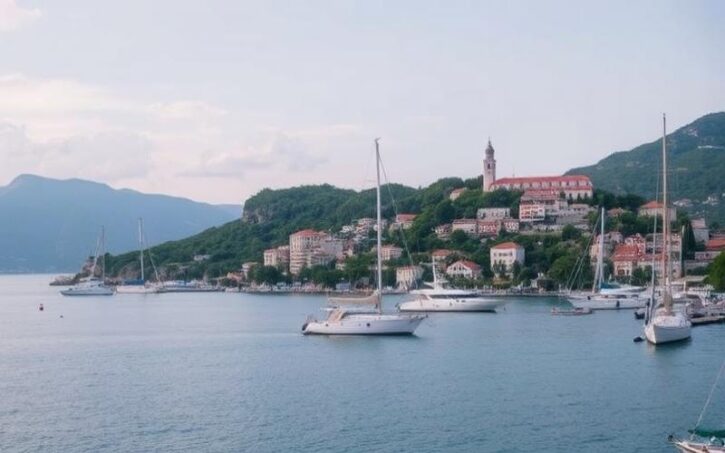
On the shores of the Adriatic, at the entrance to the Bay of Kotor, the city of Herceg Novi stands out as one of the most interesting real estate markets on the Montenegrin coast. More authentic and less overexposed to mass tourism than Budva or Tivat, it combines still reasonable prices, potential for capital appreciation, strong rental demand, and Mediterranean quality of life. For a French-speaking investor, it’s one of the few corners of Europe where you can still combine sea views, a mild climate, and growth prospects.
A Market at the Crossroads
[Herceg Novi] is at once a historic city, an administrative center, and one of Montenegro’s main tourist hubs. The old town dates back to the 14th century, its alleys wind around Venetian and Ottoman fortresses, and the sub-tropical vegetation gives the city its nickname of “city of the sun” and of mimosa. Yet, despite this postcard setting, the destination has long been overlooked by large-scale mass tourism programs, which has allowed it to retain a very distinct Montenegrin charm.
50
Real estate prices on the coast increased by nearly 50% between 2023 and 2024 nationwide.
On the Montenegrin coast, the average price in 2025 hovers around €2,328 per square meter. In the municipality of Herceg Novi, the latest surveys show that apartments trade at a median price around €3,080/m², while houses are around €2,474/m². These figures remain below the rates charged in ultra-premium complexes like Porto Montenegro in Tivat or Luštica Bay, while offering a comparable natural environment.
A “Kotor Bis” at a Discounted Price
Local players often describe Herceg Novi as “the rest of the Bay of Kotor, but with a steep discount compared to Tivat and Kotor“. In other words, you enjoy the same UNESCO-listed Adriatic fjord, the same panoramic views of the sea and mountains, but without paying the premium of already saturated destinations. This price gap, combined with growing demand, fuels the idea that the city is at the beginning of a cycle of gentrification faster than other stretches of the coastline.
Good to Know:
The clientele has historically been composed of Montenegrins, Serbs, and Bosnians. It is now evolving with an increase in visitors from Western Europe, Croatia (attracted by more affordable prices), the Middle East, and Russia, although Russian demand has recently slowed due to the geopolitical context.
Rising Prices, But Still Affordable
The appeal of an investment in Herceg Novi is measured by looking closely at price levels, yields, and market dynamics.
Price Levels: From Mid-Range to Ultra-Luxury Villas
Recent data already provides a fairly accurate idea of the price scale on site.
| Indicator | Indicative Value in [Herceg Novi] |
|---|---|
| Median Apartment Price (2025) | ≈ €3,080/m² |
| Average House Price (2025) | ≈ €2,474/m² |
| Downtown Apartments (range) | €2,400 – €3,500/m² |
| Outskirts Apartments (range) | €2,000 – €2,500/m² |
| Luxury Apartments (entry-level) | ≈ €5,000/m² |
| Luxury Villas (top segment) | up to €23,000/m² |
The market is not homogeneous. Properties near premium complexes like Portonovi or along the seaside promenade reach significantly higher levels, sometimes exceeding €6,000/m² for very well-located new developments. Conversely, in neighborhoods set back or on the hills, it is still possible to find opportunities below €2,000/m², particularly in constructions from the 1990s–2000s or in some villages within the municipality.
Example:
Some recent listings illustrate this diversity:
– Studio in Igalo, 70 m from the sea, with terrace: €75,000
– Bright apartment in Đenovići, a 5-minute walk from the sea and Portonovi marina: €105,000
– Large 3-bedroom apartment in Igalo with panoramic sea view, 2 minutes from the beach: €170,000
– Duplex in Igalo, sea view, 200 m from the shore: €188,000
Tip:
These are accessible entry-level prices for a European coastal market that is rapidly moving upmarket.
What About Sustainability for Locals?
An interesting indicator for the investor is the price-to-income ratio, which gives an idea of real estate pressure on the local population.
| Indicator | Value in [Herceg Novi] / Montenegro |
|---|---|
| Average Monthly Net Salary | ≈ €750 |
| Price-to-Income Ratio | 16.75 |
| Price of a 1-bedroom in the city center (purchase, median) | ≈ €2,850/m² |
| Mortgage Rate (20-year fixed) | ≈ 5% per annum |
A price-to-income ratio close to 17 already indicates real tension: for many Montenegrins, homeownership in coastal areas is becoming difficult without a significant down payment. This is one of the reasons why demand is largely driven by foreign buyers and investors, reinforcing the logic of a seller’s market, particularly in sought-after locations.
Solid Rental Yields Driven by Tourism
The other pillar of the investment case in Herceg Novi is rental income. Montenegro is heavily dependent on tourism and real estate (nearly 80% of its exports), which can be scary in case of an external shock, but also means the entire ecosystem is calibrated to value rental properties.
Rising Rents and Stable Yields
Market data provides a clear overview of average rents in the city.
| Rental Type | Average Monthly Rent |
|---|---|
| 1-bedroom Apartment – Downtown | ≈ €680 (range €600–€1,000) |
| 1-bedroom Apartment – Outskirts | ≈ €502 (range €460–€550) |
| 3-bedroom Apartment – Downtown | ≈ €1,133 (range €1,000–€1,200) |
| 3-bedroom Apartment – Outskirts | ≈ €850 (range €800–€1,000) |
Relating these rents to purchase prices yields average gross yields of around 5.03% downtown and 4.90% in the outskirts. Nationally, gross yields on the coast range between 4.4% and 7.1%, with peaks close to 10% for the best-located properties in high season (Portonovi, Porto Montenegro, etc.).
Yield Configurations
In practice, three main yield configurations can be distinguished to characterize the performance of systems or processes.
Configuration where yield increases significantly with scale or intensity of effort, often observed in the start-up or optimization phase.
Configuration where yield remains stable and proportional to inputs, characteristic of a well-tuned and predictable system.
Configuration where yield decreases beyond a certain point, indicating limits, saturation, or inefficiencies.
– Short-term rentals focused on tourism (Airbnb, Booking, etc.): 6 to 10% gross depending on location and management.
– Long-term rentals (annual): 4 to 7% gross, more stable but less spectacular.
– Luxury segment (villas, high-end residences): 5 to 9% for very well-managed properties, with an international clientele of high purchasing power.
Note:
The profitability of a property on the coast is strongly linked to the tourist season, from May to October, with a peak in July-August when demand and rates increase significantly. A well-located and equipped property (pool, air conditioning, etc.) can then rent for a price well above the entry-level (€30-50/night).
Numerical Yield Example
Take a simple example: a one-bedroom apartment downtown, purchased for €150,000 (approximately 52 m² at €2,900/m²) and rented:
– 90 days per year on short-term rental at an average of €70/night (high + mid-season): €6,300
– 9 months on monthly rental at €650/month: €5,850
Gross annual revenue: €12,150, i.e., a gross yield of about 8.1%. Subtracting fees, management, property tax, and taxes, you remain in a range of 5 to 6% net if the occupancy rate is well optimized.
The key to this type of strategy is professional management: well-crafted listings, quality photos, presence on multiple platforms, dynamic pricing policy according to the season, quick response to messages, and on-site services (check-in, cleaning, maintenance). Many local agencies, such as CMM Montenegro or Montenegro Prospects, offer integrated services ranging from acquisition to rental management.
Where to Invest in Herceg Novi?
The municipality of [Herceg Novi] is vast – approximately 235 km² – and stretches along the shoreline, up to the villages of the Luštica peninsula and the hills of the hinterland. Not all neighborhoods offer the same risk/return profile.
Stari Grad: The Historic Heart with Strong Tourist Demand
The old town, or Stari Grad, is the most iconic area. Cobbled streets, Baroque churches, fortresses like Forte Mare or Kanli Kula, renovated stone houses: the charm works at first glance. It’s also a tourist magnet, making it a prime location for:
– small apartments for short-term rental,
– boutique hotels or guesthouses,
– ground-floor shops during the season.
However, the scarcity of land and characterful buildings drives up prices. They are closer to levels observed in Kotor, while generally remaining below. For an investor primarily targeting seasonal rental yield and medium-term resale, it is a logical premium sector, but one that requires being selective on the entry price.
Igalo: The “Health & Wellness” Hub
To the west of [Herceg Novi], Igalo stands out for its wellness and medical positioning. It is home to the “Dr. Simo Milošević” Institute, one of the largest rehabilitation and balneotherapy centers in the Balkans, renowned for its marine mud and mineral springs. This specialization attracts a clientele of spa-goers, older, often on long stays.
In real estate terms, this translates to:
– A robust demand for comfortable apartments, close to the sea and clinics.
– Steady rentals outside the peak tourist season, through health stays or long-term rentals.
The transaction examples in Igalo show reasonable price points with strong proximity to the sea, making it an interesting sector for a mix of seasonal / medium-term rental.
Đenovići and Kumbor: The Portonovi Effect
A few kilometers from the center, Đenovići and especially Kumbor have changed dimension with the arrival of the mega-project Portonovi, a luxury complex developed for over one billion euros on 24 hectares. It features a marina, luxury boutiques, a 5-star One&Only hotel, high-end residences, international schools, and premium services.
500000
The starting price of a studio at Portonovi, illustrating the surge in real estate prices within the resort.
– Long-term rental demand to house employees and executives of the complex.
– Increased international recognition of the area.
– Improvement of infrastructure, especially maritime.
This is typically an area for investors seeking capital growth, with properties still affordable just a few minutes’ walk or drive from the resort.
Zelenika, Baošići, Bijela: The Relaxed Residential Coast
As you gradually move away from the center, you reach villages like Zelenika, Baošići, or Bijela. These areas are quieter, often cheaper, and more oriented toward:
– long-term investment,
– families or retirees looking to live year-round,
– projects for single-family homes with gardens.
Good to Know:
The village of Zelenika is particularly suitable for a long-term real estate investment. It offers a more peaceful atmosphere and prices below the regional average, while maintaining easy access to the sea and the main coastal road.
Baošići itself is the subject of a concrete project for a 4-star senior condotel, with a restaurant, shops, and a pool. The land, close to the sea and surrounded by modern villas, already benefits from a building permit and approved technical studies. This type of project illustrates well the upscale shift of the coast, with products targeting specific niches like affluent retirees.
Hill Neighborhoods: Podi, Trebesin, Sušćepan
Inland, the villages of Podi, Trebesin, or Sušćepan offer panoramic views of the bay at prices well below those of the first sea line. You can find:
– single-family homes with land,
– buildable plots, sometimes already with planning permission,
– residential projects with sea views.
These areas are ideal for those who prioritize the view and space over immediate beach proximity. For a developer investor or an individual looking to build, these are interesting reservoirs, provided you carefully check the planning framework and utilities (road, water, electricity).
Infrastructure: A Territory in Transition
The appeal of Herceg Novi also lies in its connectivity. The city is located near the Croatian border, with Dubrovnik airport about thirty kilometers away, and about 23 km from Tivat airport (via the Kamenari–Lepetane ferry). These two platforms offer regular connections with many European capitals, strengthened in recent years, notably by increased rotations from airlines like Turkish Airlines.
Major Road and Energy Projects
Several structuring projects are underway or under study:
Transport and Energy Infrastructure in Montenegro
Major projects aimed at improving mobility and energy security in the Bay of Kotor region and beyond.
Creation of a highway with a Herceg Novi bypass to relieve downtown congestion and drastically reduce travel times to Kotor and the southern coast.
Studies for a 1,700 m bridge, inspired by the Pelješac bridge, which would shorten the road link between the two shores of the bay by about 60 km.
Alternative scenarios for an undersea tunnel, with an estimated budget of around a hundred million euros.
A new 38.5 km Vilusi–Herceg Novi high-voltage line to integrate more renewable energy and secure the region’s power supply.
In addition, there are more targeted municipal projects: modernization of the Škver marina, creation of a shopping mall (Atrium Mall), construction of multi-story parking lots, development of sports infrastructure (sports hotel in Igalo), or restoration of medieval fortresses to enhance the cultural offering.
Tip:
For an investor, ongoing construction projects in a territory signal improved accessibility in the medium term and a progressive upscaling of the area. This dynamic is likely to lead to long-term real estate price increases.
A Legal Environment Rather Favorable to Foreigners
One of Montenegro’s great strengths in general, and of Herceg Novi in particular, is the openness of the market to foreign capital. The country uses the euro, facilitates financial flows (with upcoming integration into the SEPA zone), and applies a relatively liberal property regime.
What Foreigners Can Buy
In practice, a non-Montenegrin investor can acquire: real estate, company shares, financial securities, economic assets, intellectual property rights, and other investments in various sectors of activity.
– apartments, studios, houses, villas,
– commercial premises (shops, small hotels),
– buildable land in urban areas,
– income properties (apartment buildings, small residences).
Note:
The acquisition of large agricultural land, forests, islands, or plots in sensitive areas (borders, national parks, cultural sites) is limited. However, it is common to circumvent these restrictions by using a Montenegrin company (SPV).
Purchase Process: Standardized but to be Monitored
The standard process unfolds as follows:
1. Property selection and price negotiation (often a 5% discount is possible). 2. Signing of a preliminary contract with payment of a deposit (usually 10%). 3. Thorough legal checks (title deed, absence of mortgages or disputes, planning compliance). 4. Signing of the final deed before a Montenegrin notary, with a sworn interpreter present if the buyer does not speak the language. 5. Registration in the cadastre (List Nepokretnosti), which confers ownership.
7-9
The round-trip transaction cost for a property in France is estimated between 7 and 9% of its value.
Taxation: A Competitive Framework
On the taxation side, Montenegro plays the attractiveness card:
– Transfer tax: 3% up to €150,000, then a progressive scale (5% or 6% above certain thresholds), calculated on the market value.
– VAT at 21% on new properties sold by a developer (in lieu of the transfer tax).
– Annual property tax set by municipalities, generally low (often < 0.5% of the value), with possible exemptions for primary residences.
– Tax on rental income: around 9 to 15%, with deduction of certain expenses.
– Capital gains tax: 15% on the net gain.
There is no wealth tax, and a property owner can apply for a temporary residence permit, renewable, opening the door to long-term installation, before a possible permanent residence after five years.
Investment Strategies for Herceg Novi
Depending on risk profile, budget, and investment horizon, several approaches emerge.
Strategy 1: Seasonal Rental in the City Center
Type of property: small apartments or studios in Stari Grad, Savina, Topla, or close to the seaside promenade. Target audience: international tourists, urbanites, couples, digital nomads.
The principle is to maximize income during high and mid-season, while accepting lower occupancy in winter. [Herceg Novi]’s assets for this strategy are numerous:
– Long season (May–October).
– Year-round lively city, with festivals, restaurants, cultural events (Mimosa Festival, concerts in the fortresses, etc.).
– Growing demand for “lifestyle” stays: remote work, wellness stays, extended city breaks on the Bay of Kotor.
Platforms like Airbnb or Booking.com are already widely used, and regulations simply require registering the accommodation as tourist lodging and respecting the ban on major work during the high season. A property with a sea view, balcony, air conditioning, and good Wi-Fi immediately stands out in the market.
Strategy 2: Long-Term Rental Focused on “Lifestyle”
Type of property: 2 or 3-bedroom apartments in residential neighborhoods (Igalo, Zelenika, Bijela, Đenovići), sometimes in new buildings with pool, parking, video surveillance.
Target audience: expatriates, families, retirees, employees of complexes like Portonovi, remote workers.
This strategy relies on a very stable occupancy rate, with 12-month renewable leases. Monthly rents are lower than seasonal ones, but management, wear and tear, and marketing costs drop significantly.
For an investor considering spending a few months per year on site themselves, it’s a comfortable formula: the property is maintained, expenses are covered, and you can block certain periods for personal use.
Strategy 3: Betting on Emerging Areas
Type of property: houses to renovate, buildings from the 1990s–2000s, buildable plots in sectors like Đenovići, Kumbor outside Portonovi, Zelenika, Podi, Trebesin.
Target audience: investors with a 5–10 year horizon, developers, property traders.
Here, the idea is not to aim for immediate maximum yield, but to benefit from:
Example:
The valuation of the Montenegrin real estate market is driven by several factors: upscaling with projects like Portonovi, Cape Mimosa, or resorts on the Luštica peninsula; the gradual improvement of road, bridge, tunnel, and electrical grid infrastructure; and the psychological effect of a potential accession to the European Union, an event historically associated with price increases of 20 to 40% in new member states.
This type of strategy requires patience, a good knowledge of the area, and increased vigilance regarding the legality of constructions (some built during the 2000s without full permits) to avoid bad surprises upon resale.
Strategy 4: Niche Hospitality and Senior Condotels
Projects like the Baošići condotel aimed at an affluent senior clientele show the emergence of very specific niches: serviced residences with medical services, “wellness” programs, sports complexes.
[Herceg Novi], with its tradition of spa treatments in Igalo, its medical institutions, and its mild climate, is particularly well-positioned for this type of product. For an institutional investor or a group of investors, these operations offer:
– more predictable recurring revenues,
– strong differentiation,
– significant chances of appreciation at the time of exit, provided a solid concept is executed.
Quality of Life and Cost of Living: The Hidden Asset
An angle often underestimated by purely financial investors is the ability of [Herceg Novi] to attract those who live there – whether tenants, end buyers, or the investors themselves.
The cost of living remains moderate: a couple can live comfortably on about $1,400 per month according to some estimates, rent included for a 2-bedroom downtown. Transportation remains inexpensive (an average of around forty euros per month), dining is affordable, and the cultural offering is dense for a city of this size.
Good to Know:
The city offers a wide variety of leisure activities: access to several beaches (like Topla, Žanjice, Mirište, or Rose), a 7 km seaside promenade (Šetalište Pet Danica), hiking on Mount Orjen, visiting fortresses, spa days in Igalo. It also has about fifty sports clubs, several museums, a large library, and numerous summer festivals.
This quality of life is a key factor for the sustainability of rental demand, particularly in the long-term and primary residence segments.
Risks Not to Underestimate
No destination is perfect, and Herceg Novi is no exception to certain risks that must be integrated into a serious investment strategy.
Good to Know:
The Montenegrin economy is heavily dependent on tourism and foreign capital, making it vulnerable to external shocks. The real estate market still has a degree of informality, requiring rigorous due diligence. High prices relative to local incomes can generate political tensions. Harmonization with European norms implies a risk of regulatory evolution (taxation, obligations). Finally, particular vigilance is required regarding the quality of late-2000s constructions, which may have structural or administrative defects.
The best defense is to surround yourself with independent professionals: lawyer, notary, possibly architect or engineer, and a trusted agency, while maintaining a cautious approach to promises of overly attractive yields.
Conclusion: Why Herceg Novi Deserves to Be on Investors’ Radar
At a time when many Mediterranean destinations have already experienced their major wave of price increases, [Herceg Novi] ticks a rare combination of boxes on the European market:
5-7
The average gross rental yields at the entrance to the Bay of Kotor, a premium real estate market in Montenegro.
For a French-speaking investor looking for a compromise between potential appreciation, rental income, personal use, and geographical diversification, the city of Herceg Novi today appears as one of the most coherent bets on the Adriatic Balkans. Provided you choose the right neighborhood, secure the legal aspects, and arm yourself with a little patience, it is still possible to enter at a time when the city’s real estate story seems far from having reached its peak.
Disclaimer: The information provided on this website is for informational purposes only and does not constitute financial, legal, or professional advice. We encourage you to consult qualified experts before making any investment, real estate, or expatriation decisions. Although we strive to maintain up-to-date and accurate information, we do not guarantee the completeness, accuracy, or timeliness of the proposed content. As investment and expatriation involve risks, we disclaim any liability for potential losses or damages arising from the use of this site. Your use of this site confirms your acceptance of these terms and your understanding of the associated risks.

Cyril Jarnias is an independent expert in international wealth management with over 20 years of experience. As an expatriate himself, he is dedicated to helping individuals and business leaders build, protect, and pass on their wealth with complete peace of mind.
On his website, cyriljarnias.com, he shares his expertise on international real estate, offshore company formation, and expatriation.
Thanks to his expertise, he offers sound advice to optimize his clients' wealth management. Cyril Jarnias is also recognized for his appearances in many prestigious media outlets such as BFM Business, les Français de l’étranger, Le Figaro, Les Echos, and Mieux vivre votre argent, where he shares his knowledge and know-how in wealth management.





