
 Published on and written by Cyril Jarnias
Located in the heart of eastern Georgia, the city of Gori attracts far less attention from foreign investors than Tbilisi or Batumi. However, behind this relative discretion lies a real estate market with still moderate prices, in a strategic, tourist-friendly, well-connected city supported by a national framework very favorable to investors. For those seeking an alternative to the already well-valued major Georgian metropolises, investing in real estate in the city of Gori can be a serious option.
This article provides a detailed analysis including the urban and economic context, market structure, price levels, legal and tax framework, rental appeal, as well as the main risks and points of caution. It aims to offer a concrete, well-argued, and directly actionable overview.
Gori: A Strategic but Still Under-the-Radar Georgian City
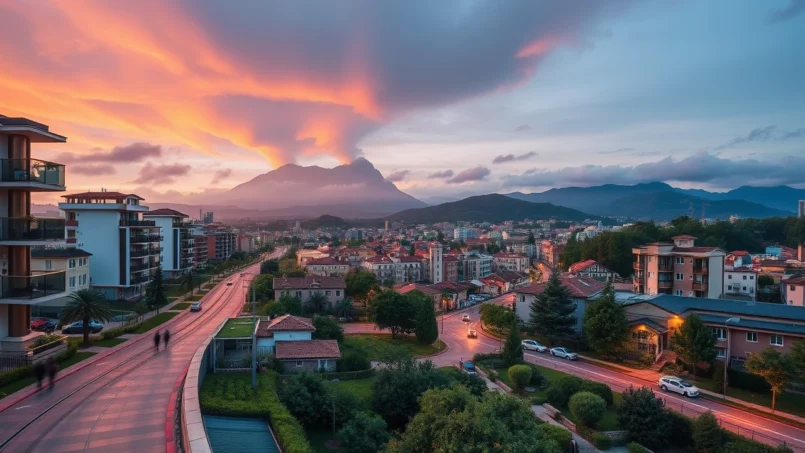
Gori is a major city by Georgian standards, but remains little-known to foreigners. It is located in a valley, at the confluence of the Kura (Mtkvari) River and its tributary the Bolshaya Liakhvi, about 86 kilometers from Tbilisi. Mountains border it to the south and west, creating a landscape of hills and rivers, conducive to outdoor activities.
The region enjoys a humid continental climate, characterized by warm summers and relatively mild winters, with an average annual temperature of around 11°C and moderate precipitation. This temperate climate, combined with the terrain, rivers, and mountain air, is a major asset for quality of life, enhancing its appeal for a residential purchase or a long-term rental project.
Gori plays a central role in the Shida Kartli region: it is the regional capital and a major hub on the main east-west transport corridors. The city is well-connected, with a railway station, links to Tskhinvali, an urban bus network, and a position on a strategic road corridor. This logistical situation is a direct asset for real estate valuation, facilitating daily commutes and access for tourists.
The homeownership rate in Gori, the highest in Georgia, where almost all households own their home.
A Complete Urban Fabric and a Service-Oriented Economy
To measure real estate potential, one must first understand the urban structure of Gori. The city has well-established social infrastructure: schools, kindergartens, medical facilities, sports complexes. It is home to two universities, a G. Eristavi drama theater, as well as a historical and ethnographic museum rich with over 48,000 items, including art collections, folk objects, and historical documents.
The city of Gori, far from being an isolated small rural locality, offers a complete urban framework. Daily services are provided by national brands like the Populi supermarket, the Telefon phone store, and SOCAR gas stations, as well as a range of local shops, restaurants, and markets, including the central market. This array of amenities meets the expectations of tenants and buyers.
The local economy is primarily based on services related to tourism and commerce. The city serves as a base to visit major tourist sites such as:
– Uplistsikhe, an ancient cave city located about ten kilometers away;
– Ateni Sioni, a medieval church in a picturesque valley;
– The Gori Fortress, perched on a hill overlooking the city.
Gori, the birthplace of Joseph Stalin, derives part of its tourist appeal from a museum dedicated to him. This site attracts a steady flow of foreign and local visitors, firmly anchoring the city in the Georgian tourist circuit.
Simultaneously, major projects are underway or announced: development of wind, solar, and hydroelectric parks, extension of gas pipeline networks including the Baku–Tbilisi–Ceyhan corridor. At the national level, Georgia dedicates a high share of its GDP to infrastructure (roads, water, education, tourism), with budgets exceeding 7–8 billion lari per year. Gori, as a regional hub, indirectly benefits from this continuous effort, which in the long term improves the accessibility and appeal of its real estate stock.
A Still Affordable Real Estate Market: Price Overview in Gori
Compared to Tbilisi or Batumi, Gori stands out primarily for its still low price level, particularly in the secondary market. Available data provides clear benchmarks for entry thresholds.
Price Levels by Property Type
The table below summarizes the observed price floors per square meter for the main segments of Gori’s real estate market:
| Property Type | Indicative Minimum Price (USD/m²) |
|---|---|
| Apartment (secondary market) | 300 – 400 |
| Apartment (new building) | from 950 |
| Single-family house | from 800 |
| Commercial real estate | ~ 1,000 |
These levels reflect minimums, actual prices can vary more widely based on location (center vs. outskirts), building condition, year of construction, floor, view, quality of finishes, or proximity to transport routes and services.
Average price per square meter exceeding 1000 USD in some districts of Tbilisi, compared to a significantly lower market in Gori.
For an investor seeking a modest entry point, the resale market in Gori is particularly attractive: a 60 m² apartment on the secondary market can be found, in the most affordable cases, for an acquisition price between $18,000 and $24,000 USD. This price level theoretically leaves room for future appreciation, especially if infrastructure and tourism continue to develop.
Examples of Transactions and Listings
Some listed advertisements give a realistic order of magnitude:
| Property (listing excerpt) | Total Price (USD) | Price per m² (approx.) |
|---|---|---|
| 6-room private house, suitable for family hotel | 270,000 | 925 |
| 4-room apartment, 112 m² (older building, central avenue) | 160,000 | 1,429 |
| 3-room private house (81 m², older house) | 55,000 | 680 |
| 5-room apartment | 150,000 | 1,261 |
| 2-room apartment | 75,000 | 1,500 |
These examples show, on one hand, that it is possible to find relatively inexpensive properties, and on the other hand, that the best locations or well-appointed units can command prices significantly above the average, especially on central axes or for properties suited for tourist use (family hotel, guesthouse).
Residential vs. Commercial: What Positions for an Investor?
As everywhere, an investor in Gori can focus either on residential real estate or on commercial space. Each segment has specific advantages, to be weighed against the risk profile and return objectives.
Investing in Residential: Diffuse and Stable Demand
The residential market falls into two main categories: new apartments in recent complexes, and older apartments from the secondary market, often derived from the Soviet and post-Soviet stock.
Older apartments, very numerous, form the base of supply. They are generally well-located, in neighborhoods that have long had all amenities: schools, kindergartens, shops, medical infrastructure. Many of these homes offer generous volumes, higher ceilings than in modern constructions, and often good sound insulation. In return, they frequently require modernization work (plumbing, electricity, finishes, joinery).
Modern standards still rare in the city, targeting local clientele and investors.
High-performance materials, better energy efficiency, video surveillance, secure entrances, and parking.
Fitness spaces or playgrounds sometimes integrated to enhance quality of life.
Developers offer apartments with floor plans designed for space optimization.
An emerging local middle-class clientele attracted to these new standards.
Attractive to investors due to rental potential linked to universities and tourism.
The national gross rental yield for apartments in Georgia averages around 7.5 to 8 %, with peaks above 9 % in tourist areas like Batumi, and more moderate but stable values in Tbilisi. Gori is not documented as finely, but its relatively low purchase prices combined with rental demand linked to students, civil servants, military personnel, and tourists suggest decent yields, provided the location and property type are well-chosen.
The Specific Opportunity of Tourist Rentals
The city welcomes a steady flow of visitors attracted by Uplistsikhe, the fortress, the Stalin Museum, and the surrounding landscapes. However, it is explicitly mentioned that there are few hotels in Gori. This imbalance creates an interesting niche for short-term rentals (Airbnb-type), guesthouses, or small family hotels.
The case of a 6-room private house presented as ideal for a family hotel illustrates this type of setup: large area, potential to multiply bedrooms, potentially strategic location. The challenge for an investor is to correctly calibrate capacity (number of rooms), seasonality (tourist high season linked to climate and holidays), and pricing.
At the national level, short-term rental yields can exceed 9% gross in tourist areas. Gori, although less saturated and cheaper than Batumi, benefits from the country’s growing tourist dynamism, supported by a budget plan focused on infrastructure. It can be an interesting complement for an investor already present in Tbilisi or Batumi.
Commercial Real Estate: Job Creation and More Marked Appreciation
The commercial segment in Gori (offices, shops, industrial premises, small warehouses) starts at levels mentioned around 1,000 USD/m², sometimes above the best residential locations. Listings mention storage units with cold rooms, offices, non-agricultural land, or land near the market or main road, offered at interesting prices considering usage potential (store, workshop, depot, tourist service).
Commercial investment is presented as an effective lever for job creation and improvement of the local economy. This type of property is more suited to experienced investors, able to identify a need: neighborhood supermarket, small hotel, café, B2B service offices, repair shop, gas station, etc. Commercial leases, in Georgia as elsewhere, can be of longer duration than residential leases, with indexed rents, but rental vacancy is also riskier in an unfavorable economic climate.
New or Old in Gori: Choosing Between Modern Comfort and Appreciation Potential
One of the key choices for an investor is deciding between a new building and older real estate. Gori allows for a fairly clear comparison of these two worlds.
The Advantages of New Buildings
The new residential complexes built in Gori use modern techniques and materials and adhere to more recent construction standards. They can offer:
– functional layouts;
– better energy efficiency;
– reduced maintenance costs in the short term;
– a secure environment (video surveillance, controlled entry);
– sometimes services (gym, playground, parking).
These properties are often located in developing peripheral neighborhoods, where new infrastructure (shops, schools, medical services) is appearing. This dynamism opens up appreciation potential, as today’s neighborhood can become a sought-after residential area as the city expands.
In Gori, the relative scarcity of new developments enhances this appeal: each new quality project, well-located, can benefit from a scarcity premium, both upon resale and for rental.
The Strengths of Older Properties: Location and Character
The secondary market constitutes the main mass of the real estate stock. It includes apartments in older buildings, often well-integrated into the most established urban fabrics. These properties generally offer:
– immediate proximity to services (shops, schools, transport);
– generous areas and spacious layouts;
– sometimes buildings with architectural or historical value.
Acquiring an older home presents an attractive price per m² (often between $300 and $400 USD), freeing up a budget for renovations. However, it frequently implies renovations (electricity, plumbing, insulation), potentially higher maintenance costs, and common areas often in need of refurbishment.
From an investment standpoint, a renovated older property in a central location can combine ideal location and significant appreciation, especially if the local market tightens in the coming years.
Comparative Summary
The table below summarizes the key differences between new and old in Gori:
| Criterion | New Buildings in Gori | Older Stock / Secondary Market |
|---|---|---|
| Price per m² | Higher (≈ 950 USD/m² and up) | Lower (from 300–400 USD/m²) |
| Location | Developing neighborhoods | Well-equipped older neighborhoods |
| Property Condition | Recent construction, little work needed | Renovations frequently required |
| Layout / design | Modern, optimized plans | Larger volumes, but sometimes less functional |
| Maintenance Cost | Relatively low in short term | Potentially higher |
| Appreciation Potential | Strong if neighborhood appreciates | Strong with good renovation and good location |
| Rental Appeal | Modern image, comfort, security | Central address, old-world charm |
A prudent investor can diversify: a new apartment for simplicity of management and modern clientele, complemented by an older apartment to renovate to capture higher potential appreciation.
Land Market: Cheap Plots, But Regulations to Master
The municipality of Gori and its surrounding villages also offer many land opportunities. Dozens of listings show plots, often agricultural, at very low prices: $1 to $3 USD/m² in some nearby villages. These extremely modest values concern plots intended mainly for agricultural or semi-rural uses.
Georgian law directly prohibits foreign individuals from acquiring agricultural land. In Gori, the purchase of residential and commercial property is unrestricted, but for agricultural land, only specific legal setups, such as creating a Georgian company, are possible, requiring solid legal advice.
On the other hand, non-agricultural land, especially near the main road or markets, can be used to develop commercial projects (warehouses, shops, workshops, small tourist units). In some cases, businesses are sold with their buildings and land, offering both a real estate asset and an operational structure.
A Very Open Legal Framework and a Simplified Purchase Process
One of Georgia’s great strengths for a real estate investor is its legal framework extremely open to foreigners. The so-called “open door” policy fully applies to Gori.
A foreigner can buy and own most types of real estate under the same conditions as a Georgian citizen, without restrictions on number or value. The only notable limitation concerns agricultural land, as mentioned above.
The property registration system is fully digitized via the public registry, allowing quick verification of ownership and any encumbrances. In practice, a simple purchase can be finalized in one to three days if all documents are ready.
Documentation and Language
For a direct purchase, a foreign buyer will generally need to provide:
– a valid passport;
– a Georgian tax identification number (obtained during the procedure);
– proof of funds or documentation on the source of funds for significant transactions;
– a sales contract drafted in Georgian;
– the extract from the public registry attesting to the owner and encumbrances.
All deeds and contracts are drafted in Georgian, hence the importance of using a professional interpreter or a bilingual lawyer. Using a local lawyer is also essential to verify:
Before finalizing a real estate purchase, it is crucial to verify several key points: the chain of title (property history) to ensure the legitimacy of the sellers; the absence of family disputes or unresolved inheritance to avoid future claims; the compliance of building permits for recent constructions, ensuring the work is legal; and finally, cadastral boundaries, especially for land, to prevent any neighbor disputes.
Acquisition and Residence: The Key Threshold of $100,000 USD
Another advantage of Georgia is the possibility of linking real estate investment and residence. In Gori as elsewhere in the country, a foreigner who acquires a residential property valued at or above $100,000 USD can apply for a residence permit based on investment. This permit is for a limited duration but renewable, and can pave the way to permanent residence if conditions are maintained for several years.
For higher amounts ($300,000 USD and more), pathways to longer-term residence exist, although they are more relevant for larger real estate portfolios.
Taxation: Understanding the Impact on Profitability
The Georgian tax environment is known for being simple and competitive, but it remains essential to know the main applicable mechanisms for an investment in Gori.
Property Tax
Property tax is due annually based on the market value of the property. The standard rate is 1 %, but it is modulated based on the household’s annual income:
– below 40,000 GEL of total annual family income, there is no property tax;
– between 40,000 and 100,000 GEL, the rate varies from 0.05 % to 0.2 %;
– above 100,000 GEL, it ranges between 0.8 % and 1 %.
For a foreign investor with modest income in Georgia, this structure can result in a limited property tax burden, or even none, if the declared family income remains below the threshold.
Real Estate Capital Gains
Capital gains on the sale of real estate are in principle subject to income tax. However, Georgian law is very favorable to individuals:
For a home (house or apartment) resold more than two years after acquisition, the capital gain may be exempt if the property was not used for continuous economic activity. If sold within two years, a reduced rate of 5 % applies to the capital gain on homes. For commercial properties, the capital gain may be taxed at a 20 % rate if the resale occurs within two years, but the long-term exemption rules remain stricter.
An investor who adopts a holding strategy of at least two years for residential properties can therefore benefit from very light taxation on capital gains.
Rental Income
For renting to individuals, the state offers a simple regime: a flat tax of 5 % on gross rents, without deduction of expenses. This regime is competitive for an investor who does not have very heavy operating expenses.
For rentals to businesses (shops, offices, etc.), taxation is calculated at a 20% rate. This rate applies not to gross income, but to net income, after deduction of admissible expenses such as maintenance, repair, and depreciation costs.
The transition to VAT only occurs from a threshold of 100,000 GEL in rental income over a rolling 12-month period, which leaves wide margin for small and medium investors.
Net Yield
At the national level, it is estimated that net yields average 1.5 to 2 percentage points below gross yields, once tax and ongoing expenses are factored in. A gross yield of 8 % therefore often translates to a net yield around 6 %.
For Gori, the lack of precise statistical data requires reasoning by analogy: low purchase prices, rental demand linked to tourism and universities, and moderate taxation can allow for comparable yields, provided management is optimized and vacancy is limited.
Financing: What Options to Buy in Gori?
Real estate purchases in Georgia are still largely made in cash, especially by foreigners. However, financing solutions exist, including for non-residents.
Georgian banks can grant real estate loans to foreigners, usually with:
– a personal contribution of 30 to 50 %;
– a loan term of 5 to 15 years;
– interest rates around 7–11 % for dollar loans, and 10–15 % in lari (GEL).
Certain currency restrictions exist, notably for Georgian citizens. Foreigners can generally choose between the lari, euro, and dollar. The main conditions for obtaining a loan are the ability to prove stable income and to provide a professional property appraisal, which will serve as collateral.
Developers in Gori also offer installment payment plans, sometimes interest-free, especially during project launch phases. It is common to have:
– a first payment of 20 to 30 %;
– monthly or quarterly payments over 1 to 5 years;
– full and complete ownership registered at the end of the plan or in stages.
It is also worth noting that some developers accept payment in cryptocurrency, which can simplify the transaction for highly digitalized investors, even though this does not exempt from traditional registration in fiat currency in the official registries.
Specific Advantages of an Investment in Gori
Several factors make the city particularly interesting compared to other Georgian destinations.
First, the price level: the secondary market floors around $300–400 USD/m² remain well below average prices in Tbilisi or Batumi, even though the city has a solid base of infrastructure, public services, and tourist flows. This leaves room for catch-up potential if Gori’s notoriety increases.
Gori benefits from a strategic geographic position on East-West transport corridors. Significant national investments in road and municipal infrastructure and energy projects improve the region’s accessibility, which could stimulate real estate demand in the medium term.
Third, the tourist profile: Gori is an integral part of Georgia’s historical and cultural circuits, with a highly visited Stalin Museum, an iconic fortress, a lively central market, and proximity to Uplistsikhe. The current lack of hotels opens an attractive niche for short-term rentals or small accommodation units.
The legal framework ensures equal treatment between foreigners and citizens. Many nationalities benefit from visa-free stays of up to one year. Taxation is attractive with a moderate tax rate of 5% on residential rents and possible exemptions on long-term capital gains, creating an environment conducive to rental or property investment.
Finally, the very high ownership rate (94.9 %) has a dual effect: it limits competition from large institutional landlords and makes private landlords significant players in the market, while ensuring a certain social and residential stability.
Points of Caution and Risks to Monitor
No real estate investment is without risk, and Gori is no exception.
Among the areas requiring caution, we can mention:
Several critical factors must be taken into account: the city’s historical demographic dynamics, its strong dependence on the tourist cycle, the imperative to verify construction quality (new or old), the absolute necessity of a legal examination of property titles due to risks of irregularities, and an analysis of regional geopolitical risk, notably linked to past tensions with South Ossetia.
How to Structure an Investment Strategy in Gori?
For a French-speaking investor wishing to position themselves in Gori, a structured approach could follow several steps.
The first step is to define the primary objective: rental yield, long-term appreciation, or mixed use (personal residence + rental). A profile seeking regular income will favor a well-placed older apartment, rented annually to local residents or students, or even to tourists if the property is near points of interest.
A more speculative profile will bet rather on a well-located new development, in an early phase, hoping for appreciation upon delivery and in the first years of operation, possibly coupled with short-term rental exploitation.
The next step involves selecting the neighborhood and analyzing very closely:
– walking distance to attractions (museums, fortress, universities, central market);
– accessibility by bus or taxi from the station;
– the density of competing offers for rental or tourist accommodation.
Next comes purchase negotiation, keeping in mind that listed prices are not always firm, especially in a market still little-frequented by foreigners.
Finally, it is crucial to anticipate property management: handling inspections locally, rent collection, maintenance, managing bookings if seasonal rental. In a city like Gori, finding a reliable local partner (agency or independent manager) is often the link that makes the difference between a successful investment and a source of hassle.
Conclusion: Gori, a Niche Market to Watch Closely
Investing in real estate in the city of Gori means betting on a niche market, away from the major speculative waves that have already hit Tbilisi or Batumi. It means accepting a less liquid, less documented environment, but also a cheaper one, with catch-up potential and interesting exposure to cultural and historical tourism.
The national framework, characterized by its openness to foreigners, moderate taxation, and a massive effort on infrastructure, is favorable to investors. The city itself offers a pleasant living environment, a complete urban fabric, a service economy, and solid tourist anchoring. The scarcity of hotels also creates a specific opportunity for alternative accommodation projects.
Provided that a rigorous due diligence is conducted, the particularities of the local market are well understood, and one is assisted by Georgian professionals while reasoning on a multi-year horizon, Gori can find its place in a real estate diversification strategy in Georgia, midway between seeking yield and building tangible assets in a human-scale city.
Disclaimer: The information provided on this website is for informational purposes only and does not constitute financial, legal, or professional advice. We encourage you to consult qualified experts before making any investment, real estate, or expatriation decisions. Although we strive to maintain up-to-date and accurate information, we do not guarantee the completeness, accuracy, or timeliness of the proposed content. As investment and expatriation involve risks, we disclaim any liability for potential losses or damages arising from the use of this site. Your use of this site confirms your acceptance of these terms and your understanding of the associated risks.

Cyril Jarnias is an independent expert in international wealth management with over 20 years of experience. As an expatriate himself, he is dedicated to helping individuals and business leaders build, protect, and pass on their wealth with complete peace of mind.
On his website, cyriljarnias.com, he shares his expertise on international real estate, offshore company formation, and expatriation.
Thanks to his expertise, he offers sound advice to optimize his clients' wealth management. Cyril Jarnias is also recognized for his appearances in many prestigious media outlets such as BFM Business, les Français de l’étranger, Le Figaro, Les Echos, and Mieux vivre votre argent, where he shares his knowledge and know-how in wealth management.





