
 Published on and written by Cyril Jarnias
Investing in real estate in the city of Rustavi is akin to betting on a transforming industrial city, 30 minutes from the Georgian capital, in the heart of a country with one of Europe’s most dynamic economic growth rates. With still very affordable prices per square meter, gross rental yields exceeding 11%, and a wave of public and private investment in infrastructure, Rustavi is beginning to emerge as a credible—and cheaper—alternative to Tbilisi and Batumi.
A Strategic Industrial City, Now an Affordable Suburb of Tbilisi
Rustavi (often spelled Rustavi in international sources) is located in southeastern Georgia, on the banks of the Mtkvari River, about 28.5 km from Tbilisi. The drive between the two cities typically takes between 20 and 40 minutes, placing Rustavi de facto within the capital’s residential belt.
Historically a major industrial center in the Soviet era with nearly 90 enterprises, the city today has an industrial park of over 2,000 hectares. It remains specialized in manufacturing, including metal processing, fertilizer production, industrial chemicals, building materials, and steel.
Simultaneously, Rustavi’s urban image has evolved profoundly. The city is described as quiet, green, and rather cozy, and is still known throughout the region as Georgia’s “car capital” thanks to its massive used car market, the largest in the South Caucasus.
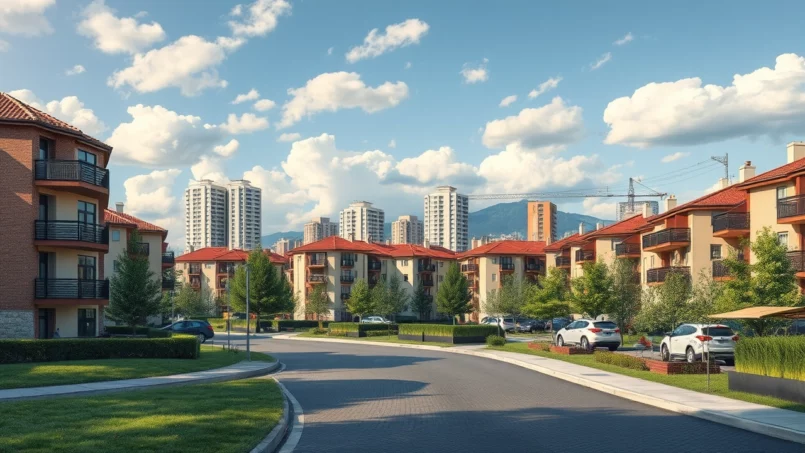
The city of Rustavi, Georgia, illustrates a territorial structure marked by the Mtkvari River. It divides into two distinct parts: the “old” part, built in a Stalinist architectural style where projects mainly aim to preserve this heritage, and the “new” part, characterized by the proliferation of modern residential complexes.
This geographical and functional positioning immediately sets the tone for the real estate market: a city of production and logistics, in immediate proximity to the capital and an international highway (E‑60), with significantly lower land and residential costs than Tbilisi.
Strong National Macroeconomic Fundamentals
Before delving into the details of Rustavi’s market, one must understand the Georgian background. For several years, Georgia has displayed impressive growth. GDP has exceeded 100 billion GEL, compared to less than 28 billion in 2012, and GDP per capita has risen from about $4,300 in 2020 to over $9,000, with a projection beyond $10,000 by the end of 2025.
Average annual growth rate anticipated by the IMF for the country, keeping it at the forefront of European economies.
This dynamic is accompanied by a sharp drop in unemployment (13.9% in 2024 vs. 26.7% in 2012) and a significant reduction in poverty (from 30% to 9.4% over the same period). The government aims for less than 4% unemployment and poverty by 2028, by creating 200,000 additional jobs and raising the average salary to 3,500 GEL (compared to 2,170 GEL in Q1 2025).
The Georgian real estate sector is experiencing strong growth, with a residential price index up 11.5% in Q1 2025 and a record market value of $4.3 billion in 2024, supported by massive infrastructure modernization.
For an investor in Rustavi, these elements matter for two reasons: they guarantee a base of solvent demand at the national level and reinforce the credibility of major structural projects (industrial zones, logistics centers, hospitality, tourism), which in turn impact local land values.
A Very Affordable Residential Real Estate Market
One of Rustavi’s main attractions lies in its prices. While Tbilisi and Batumi have already experienced several years of strong appreciation, Rustavi remains in a significantly lower range.
According to data compiled for 2024-2025, apartment prices in Rustavi generally range between $700 and $1,200 USD per square meter, with some more expensive spot projects. A fifty-square-meter apartment in a new building can thus cost around $45,000, roughly half the price of a comparable property in Tbilisi or Batumi.
Some development projects in the city displayed, for example, the following price levels: significant discounts on consumer goods, bundled offers at advantageous prices, or special rates for local services. These examples illustrate the pricing strategies used to attract customers during promotional events.
| Project (example) | Building Type | Starting Price (USD/m²) |
|---|---|---|
| Building Rustavi (12 floors) | New, sold | 510 |
| Bau Star Rustavi (9 floors) | New | 520 |
| House on Shartava 14 (13 floors) | New | 700 |
| House on Lomouri (8 floors) | New | 700 |
| House on Leselidze 30a (10 floors) | New | 700 |
| AIM Rustavi (Murman Lebanidze 20b) | New (12 floors) | 830 |
| Project ID 28626 (12 floors) | New | 850 |
| Mardieli Rustavi (13 floors) | New | 2,000 |
These figures show the wide dispersion of the market: true entry-level products around $500–$700/m², standard programs around $800–$900/m², and premium projects approaching capital city levels.
Compared to other Georgian cities, Rustavi is at the lower end of the range. Tbilisi starts around $1,400–$1,800/m², Batumi around $1,470–$1,800/m², while cities like Gori or Poti have starting prices close to $760–$780/m². At equal price, the immediate proximity to Tbilisi nevertheless gives Rustavi greater rental potential than many more remote regional centers.
A Rental Market with Gross Yields Over 11%
The second major asset of the local market lies in its yields. Data compiled by Numbeo for August 2024 indicates a gross rental yield of approximately 11.07% in the city center and 11.11% in the outskirts. In other words, annual gross rents represent slightly over 11% of the property value, a very high level on a European scale.
The average rents recorded help understand these figures:
| Housing Type | Location | Average Monthly Rent (GEL) |
|---|---|---|
| 1-bedroom apartment | City Center | 700 |
| 1-bedroom apartment | Outside Center | 654.67 (range 400–1,064) |
| 3-bedroom apartment | City Center | 1,200 |
| 3-bedroom apartment | Outside Center | 800 |
When related to purchase prices often below $1,000/m², these rents mechanically produce high yields. The “price-to-rent” ratios confirm this profitability: around 9 in the center and 9 in the outskirts. In theory, it would take nine years of rent to cover the purchase price, which is still very short.
In the first quarter of 2025, the average rental yield in Georgia was about 7.53%, with major cities like Tbilisi or Batumi around 7–9%. Rustavi outperforms this national average thanks to a more favorable price-to-rent ratio.
However, it should be kept in mind that these gross yields do not account for expenses (maintenance, property tax, management fees, repairs, vacancy). National analyses estimate that net yields are generally 1.5 to 2 points lower than gross yields. Even applying this discount, Rustavi would remain at levels of 9–9.5%, which is still very competitive.
Local Purchasing Power, Credit, and Accessibility
To assess the sustainability of these rents, it is useful to compare them with local incomes. The Numbeo survey gives an average net salary in Rustavi of about 833 GEL per month. This means that a tenant spending all that income on a 700 GEL rent for a 1-bedroom in the city center would theoretically stay within limits, but with a small margin for other expenses. In practice, this confirms that rental demand is fueled by both local households and commuters to Tbilisi, and even by demand from industrial sector workers.
Average annual interest rate for a 20-year fixed mortgage loan in Georgia.
In this context, Rustavi is clearly a market of owners who acquired their property in the past (the homeownership rate reaches 89%), but also of tenants for whom purchase often remains out of reach. This structural gap between borrowing capacity and rental levels reinforces the appeal of rental investment for buyers with equity, whether Georgian or foreign.
A Regulatory Environment Very Favorable to Foreign Investors
Georgia stands out in the region for a legal framework particularly open to international real estate investors. Foreigners can buy and fully own residential or commercial properties anywhere in the country, including Rustavi, without residency requirements or a local partner. The only exception: agricultural land, which is in principle inaccessible for direct ownership, except through certain specific structures or situations.
Registering a property with the National Public Registry Agency takes 1 to 5 business days. An express one-day registration is possible for an additional fee. The procedure, fully handled by a notary connected to the electronic registry, typically uses bilingual deeds (Georgian/English or Georgian/Russian).
From a tax perspective, the framework is also attractive. There is no acquisition tax on the purchase of standard residential properties. The annual property tax remains low, generally less than 1% of the property value</strong and often much less for individuals. Rental income from residential housing can be taxed at a flat rate of 5% of the gross for individuals who declare themselves as landlords, instead of the standard 20% income tax. Upon resale, no capital gains tax is due if the property has been held for more than two years. Below this period, a 5% rate applies to the capital gain for housing.
The amount of real estate investment in dollars opening the way to a five-year permanent residence in Georgia.
For a foreign investor, Rustavi therefore benefits from the same degree of legal security, moderate taxation, and simplified procedures as the major Georgian metropolises, with the added bonus of significantly lower prices.
A City Massively Equipped with Public Infrastructure
Beyond the private market, the public investment strategy in Rustavi is a strong indicator of the state’s commitment to supporting the city in the long term. The Municipal Development Fund (MDF), attached to the Ministry of Infrastructure, is currently overseeing seven infrastructure projects in Rustavi, for a total amount exceeding 41.6 million GEL.
Complete renovation and modernization operations of school facilities, including accessibility and infrastructure upgrades to standards.
Complete rehabilitation designed to accommodate 830 students. Creation of new classrooms, sports fields, and restrooms.
Scheduled complete renovation. Redoing of courtyards and full installation of heating, water, and sewage networks.
Systematic adaptation of buildings for people with disabilities, in accordance with current standards.
Simultaneously, four kindergartens are undergoing construction or renovation work as part of a dedicated national program. The future structures will have dormitories, playrooms and administrative offices, elevator systems, emergency exits, and their gardens will include playgrounds and recreational areas. Again, accessibility for children with disabilities is planned from the design stage.
Budget in GEL for the construction of a football technical center and two fields, one with a 200-seat stand.
Basic urban infrastructure is also well in place: 24/7 water supply, natural gas network, reliable electricity, extensive internet connectivity, as well as an efficient intercity transport network that quickly connects Rustavi to Tbilisi, other cities in the Kvemo Kartli region, and the international road axis.
These structural investments naturally create a more robust demand for modern housing located near schools, kindergartens, sports facilities, or transport routes. For an investor, identifying land pockets and new residential complexes around these public projects can be a particularly profitable location strategy.
A Powerful Industrial and Logistics Fabric, Driver of Real Estate Demand
The local economy of Rustavi rests on a solid industrial base. The dominant sectors are metal processing, mineral fertilizer production, industrial chemicals, building materials, and metal profiles. Several emblematic companies have made significant investments there:
Concrete examples of recent investment and industrial developments in various sectors in Georgia.
16 million GEL investment in the first phase, making the plant the only one in the country in this segment.
10 million GEL investment that tripled productivity, reaching 300 tons of monthly production and creating about 200 jobs (total staff: 450 employees).
Installation of a cogeneration plant with a 9 MW SIEMENS turbine for 16 million GEL, reducing external electricity consumption by 20%.
11 million GEL investment. Partner of Nike, Adidas, Puma and others, the company employs nearly 3,500 people.
Around these major sites, the Rustavi industrial zone covers approximately 2,020 hectares. It benefits from a direct railway connection to the Tbilisi–Baku line, the E‑60 highway, as well as high-voltage power substations (35, 110, and 220 kV). All essential urban services (industrial water, gas, electricity, sewage) are available, with land prices lower than those in Tbilisi.
This is the area in hectares of industrial land belonging to the private sector, the largest share among identified owners.
For real estate investors, this productive fabric has two implications. On one hand, it generates a steady flow of local jobs, hence households looking for housing close to their workplace. On the other hand, it supports the valuation of specialized real estate (workshops, warehouses, offices) in and around the industrial zone, which opens a second segment for diversification for investors able to position themselves in commercial real estate.
Public and Private Projects in Health, Education, and Services
Beyond industry, Rustavi is strengthening its service offerings with a clear upgrade of health and education infrastructure. The city already has about twenty multidisciplinary clinics and medical facilities, as well as 17 diagnostic centers and clinics. A modern medical center, Mardaleishvili Medical Center, is under development with an investment of about 4 million GEL.
On the educational front, the presence of the Modus vocational college and its FabLab illustrates the desire to develop technical and technological skills at the local level. Combined with a school education system undergoing modernization, this enhances the city’s attractiveness for families and young professionals.
This type of facility plays a key role in medium-term residential demand. Neighborhoods close to hospitals, schools, and training centers are generally sought after by the middle class, who prioritize access to services. In Rustavi, the strengthening of this infrastructure thus contributes to structuring new residential “addresses,” at still reasonable prices but promised gradual appreciation.
A Dynamic National Real Estate Investment Context
The Georgian real estate market experienced a phase of euphoria after the pandemic, with sometimes over 30% annual increase in transaction volumes between 2022 and 2023 and price increases exceeding 35% in some Tbilisi neighborhoods. Since 2024, the trend has been more moderate, with an average price increase of about 8.4% in 2024 compared to 20.5% the previous year.
Approximately 39,600 apartments were sold in Tbilisi in 2024, representing a 2.3% increase compared to 2023.
In this context, many analysts emphasize the interest in looking at secondary or peripheral markets where prices have not yet skyrocketed, but where fundamentals remain solid: demographic growth, employment, infrastructure, regional tourism. Rustavi clearly fits this category: a smaller, less publicized market, but driven by proximity to the capital, a strong industrial base, and significant public investment.
For an investor, this means it is still possible to position oneself in low-cost properties, with high rental yields, while benefiting medium-term from the spread of price increases from the major metropolises.
New Residential Complexes and Property Typology
Since 2014, construction activity has intensified in Rustavi, with multiple residential complexes and commercial projects. Over the past three years, 15 residential complexes have obtained building permits, and nine new projects are currently under construction for a total amount of about 64 million GEL.
As everywhere in Georgia, developers often sell apartments according to different levels of finish, called “frames”:
The **black frame** finish corresponds to a stage where the structure, facade, windows, and entrance door are in place, utilities (water, electricity, gas) are brought to the door, but the interior remains raw. Its main advantage is the low purchase price, but a significant renovation budget must then be planned. The **white frame** goes further: walls are plastered, floors are leveled, utilities are distributed inside, sometimes with a boiler installed. It saves time and energy on renovation, for a moderate extra cost. The **green frame** is an “eco-friendly” evolution of the white frame, with an emphasis on energy efficiency and sustainable materials, resulting in better comfort and reduced long-term expenses.
For a rental investor in Rustavi, it may be wise to favor white or green frame in well-located projects (close to transport, schools, or industrial zones) to reduce the time between purchase and rental. Black frames may suit a more “value-add” oriented investor, capable of managing a renovation project to create a product of better quality than the local average.
Diversification: Residential, Commercial, Industrial
One of Rustavi’s specific strengths is offering, within a reduced perimeter, several complementary real estate segments.
On the residential front, demand comes from both:
– the local population, who remain mostly homeowners but generate demand for intra-urban mobility (changing neighborhoods, upgrading standards);
– industrial workers, looking for housing near the activity zone;
– commuter households working in Tbilisi but wanting to benefit from lower rents and prices.
This is the maximum number of vehicles the gigantic 50,000 m² car market can accommodate, attracting an international clientele.
On the industrial front, the scale of the dedicated zone and the presence of heavy infrastructure (high-voltage substation, railway line, international road, industrial water) allow for the development of warehouses, logistics parks, and production units at lower logistical cost. Accessibility to Tbilisi International Airport, as well as proximity to the Armenian and Azerbaijani borders, gives these assets a regional dimension.
An investor can adapt their strategy according to their profile: focus on long-term apartment rentals, diversify with commercial premises related to the car market, or orient towards industrial and logistics operations. A specific opportunity involves acquiring land or buildings from state-owned heritage put up for auction.
Yield, Risks, and Investor Profile for Rustavi
The gross yields over 11% displayed by Rustavi are attractive, but they should not overshadow the inherent risks of any real estate investment. The city remains significantly less liquid than Tbilisi or Batumi: it is easier to buy than to sell quickly, and the secondary market depth is lower. Furthermore, dependence on industry and the car trade exposes the city to sectoral cycles.
Consider the high level of mortgage rates in Georgia. An investment too heavily financed by borrowing can become vulnerable to a rate hike or a temporary drop in rents. In this context, Rustavi primarily targets investors with substantial personal capital.
– investors with sufficient equity capital to limit leverage;
– those seeking high rental yield rather than quick capital appreciation;
– profiles capable of accepting lower liquidity and a medium/long-term holding horizon.
To contain risks, several principles of prudence are essential: carefully verify the legal status of the property (ownership, absence of debts or mortgages), examine the developer’s track record (history, deliveries, financial situation), choose promising locations (proximity to the center, transport, schools, or employment zones), and maintain a cash reserve to cover vacancy periods, repairs, and unforeseen events.
On a national scale, analysts anticipate net yields generally between 6% and 12% depending on the property type and location. Rustavi, with its still very low entry prices and relatively high rents, is globally in the higher part of this range, provided one buys at the right price and manages the property actively.
Rustavi vs. Tbilisi and Batumi: Complementarity More Than Competition
For an investor discovering Georgia, the natural temptation is to focus on Tbilisi and Batumi, which concentrate approximately 72% and 20% of national transactions, respectively. These two cities indeed offer superior liquidity, diversified rental markets (long-term, short-term tourist, co-living, etc.), and significant image appeal.
The Georgian real estate market presents contrasting dynamics. In concentrated areas like Batumi, prices are high, yields may be under pressure, and there is a risk of overbuilding, especially for seaside towers. Conversely, cities like Rustavi offer a more discreet and industrial market, with solid fundamentals (proximity to the capital, public investment, productive base) that could lead to a gradual convergence of prices towards those of the major metropolises.
Rather than thinking in terms of competition, an investor can consider a Georgian portfolio strategy:
– properties in Tbilisi, in central or well-connected neighborhoods, to secure liquidity and aim for more regular capital appreciation;
– one or several lots in Batumi, oriented towards tourist rentals and high seasonal yields;
– apartments and, possibly, commercial premises in Rustavi, to boost the overall yield thanks to generous rents relative to the purchase price.
This intra-country diversification helps smooth out sectoral and geographical risks while benefiting from the country’s overall economic momentum.
Conclusion: A Market Ahead of the Curve for Patient Investors
Investing in real estate in the city of Rustavi means accepting to move off the usual radar of international investors to position oneself ahead of a valuation curve. The city combines several characteristics rarely found together:
– still low prices per square meter, often between $700 and $1,000, less than half an hour from the capital;
– gross rental yields exceeding 11%, well above regional averages;
– a powerful industrial base, supported by significant investments from local and international companies;
– a massive flow of public investment in schools, kindergartens, sports facilities, and health, improving residential attractiveness;
– a national framework favorable to foreign investors: mild taxation, simplified acquisition, possible residence via real estate, strong economic growth.
In return for the opportunities, the investor must accept a market less liquid than Tbilisi’s, sensitivity to industrial cycles, and the necessity for rigorous selection of locations, developers, managers, and contractors.
For a profile seeking high yield, capable of staying invested for several years and ready to rely on local advice to secure operations, Rustavi can be a cornerstone of a Georgian real estate strategy. In a country aspiring to become a regional hub for transit, services, and investment, betting on this green, discreet but very well-connected industrial city means getting ahead of a trend that, in the medium term, could well close the gap with the already flourishing markets of the coast and the capital.
Disclaimer: The information provided on this website is for informational purposes only and does not constitute financial, legal, or professional advice. We encourage you to consult qualified experts before making any investment, real estate, or expatriation decisions. Although we strive to maintain up-to-date and accurate information, we do not guarantee the completeness, accuracy, or timeliness of the proposed content. As investment and expatriation involve risks, we disclaim any liability for potential losses or damages arising from the use of this site. Your use of this site confirms your acceptance of these terms and your understanding of the associated risks.

Cyril Jarnias is an independent expert in international wealth management with over 20 years of experience. As an expatriate himself, he is dedicated to helping individuals and business leaders build, protect, and pass on their wealth with complete peace of mind.
On his website, cyriljarnias.com, he shares his expertise on international real estate, offshore company formation, and expatriation.
Thanks to his expertise, he offers sound advice to optimize his clients' wealth management. Cyril Jarnias is also recognized for his appearances in many prestigious media outlets such as BFM Business, les Français de l’étranger, Le Figaro, Les Echos, and Mieux vivre votre argent, where he shares his knowledge and know-how in wealth management.





