
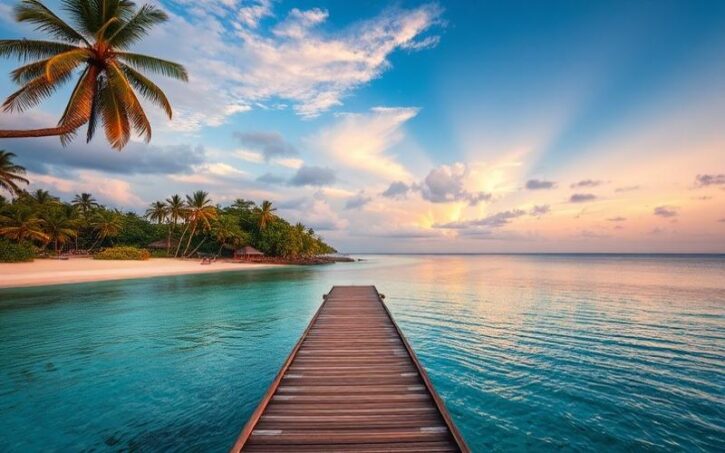
 Published on and written by Cyril Jarnias
Seychelles: A Model of Sustainability in Green Real Estate
Amid growing environmental challenges, the Seychelles is positioning itself as a sustainability model through its commitment to green real estate. In 2025, this island paradise continues to set cutting-edge standards to ensure new constructions adhere to ecological and energy principles.
Good to Know:
Local policies reinforce this green momentum by implementing attractive subsidies to encourage property owners and investors to adopt sustainable technologies.
Discover in this article how the Seychelles is turning ecological aspirations into concrete actions while preserving the exceptional natural beauty that makes them world-renowned.
Introduction to Green Real Estate in the Seychelles
The Seychelles is an archipelago whose exceptional environment is globally recognized for its unique biodiversity, white sand beaches, coral reefs, and endemic flora and fauna. This remarkable natural wealth is both the country’s main asset and a fragile ecosystem facing multiple threats: habitat destruction, tourism pressures, pollution, and climate change.
Preserving this island environment has been central to national policy for several decades. The Seychelles is among the world’s conservation pioneers, having enshrined this priority early in its constitution: nearly 60% of the land territory now enjoys protected status—the highest rate worldwide. Two major natural sites, the Vallée de Mai and Aldabra Atoll, are UNESCO World Heritage Sites. The government also highlights historical initiatives like the 18th-century Malavois Decree against turtle slaughter to affirm its longstanding commitment to environmental protection.
Green real estate refers to any property project designed according to sustainable development principles: low ecological impact, maximum energy efficiency, responsible use of local resources (bio-based or recycled materials), sustainable water management, and harmonious integration into the local ecosystem. This model is crucial in the Seychelles, where every construction can severely affect sensitive natural environments: protecting coral reefs threatened by polluted runoff or limiting deforestation that would endanger endemic habitats.
Facing these specific challenges, several government initiatives already structure this sector:
- Creation of the first national marine park (Sainte-Anne) as early as 1973
- Constitutional inclusion of ecological objectives
- Recent expansion of terrestrial and marine protected areas
- Active promotion to international investors around an “ecological Eden” image
In response to persistent challenges related to demographic and tourism growth, as well as vulnerability to climate change, an ambitious new regulatory framework will take effect in 2025:
| Mechanism | Main Objective | Primary Application |
|---|---|---|
| New Ecological Standards | Drastically reduce carbon footprint | New construction & renovation |
| Targeted Subsidies | Accelerate adoption of green materials/technologies | Real estate developers & individuals |
| Strengthened Controls | Ensure strict compliance with sustainable standards | Urban planning permits |
These measures are fully aligned with a comprehensive ecological transition approach aimed at reconciling economic development—particularly through high-end tourism—with the lasting preservation of an irreplaceable island ecosystem.
Good to Know:
The Seychelles, an archipelago known for its remarkable biodiversity and unique marine landscapes, prioritizes ecology to preserve its fragile environment. Green real estate is essential here to protect ecosystems while meeting housing needs. This involves using sustainable materials, efficient resource management, and minimizing carbon footprint. For several years, the Seychellois government has emphasized sustainable development with financial incentives and awareness programs. By 2025, new standards and subsidies will be established to encourage the transition to greener construction. These measures aim to strengthen the integration of green technologies, reduce construction waste, and increase energy efficiency, contributing to the long-term sustainability of these paradise islands.
Eco-Construction Standards in the Seychelles
Overview of current eco-construction regulations in the Seychelles
The Seychelles has an evolving regulatory framework governing eco-construction, integrating the preservation of marine and terrestrial environments. The Nature Reserves and Conservancy (Seychelles Marine Spatial Plan) Regulations, 2025, recently enacted, impose specific restrictions and conditions based on zones covered by the marine spatial plan. This text defines prohibited or conditionally permitted activities in various sensitive ecological zones and specifies jurisdiction and applicable penalties for non-compliance.
Furthermore, the Environment Protection Act (2016), amended by regulation S.I. 40 of 2025 on environmental taxes, introduces an incentive-based ecological tax on certain equipment with high global warming potential (GWP). Property projects must therefore incorporate these requirements when selecting materials and technical equipment to limit their environmental impact.
Mandatory Standards for Property Projects
- Strict compliance with ecological zoning established by the Marine Spatial Plan
- Limitation or prohibition of polluting activities in certain zones
- Application of progressive taxes on equipment with high GWP
- Systematic consideration of Nature-based Solutions in all coastal or infrastructure planning
Summary Table: Key Mandatory Standards
| Domain | Main Requirement |
|---|---|
| Ecological Zoning | Prohibition/limitation by zone |
| Technical Equipment | Tax proportional to GWP |
| Coastal Management | Integration of NBS & blue conservation |
Legal Implications
Compliance with these standards is legally binding: any violation may result in administrative or criminal penalties, including suspension of the concerned property project. Stakeholders must regularly stay informed of regulatory updates to avoid legal risks.
Relevant Ecological Certifications and Labels
To ensure compliance with national and international requirements, project developers are recommended to:
- Obtain an internationally recognized label such as EDGE (“Excellence in Design for Greater Efficiencies”), LEED, or BREEAM.
- Aim for national certification when available—a pilot project to adapt a Seychellois national framework is currently supported by several international partners.
Impact on Architectural Landscape and Local Economy
The systematic integration of ecological criteria strongly influences:
- Increased use of local bio-based materials
- Architectural enhancement of Seychellois natural heritage
- A gradual but controlled increase in initial costs, potentially offset by sustainable reduction in energy expenses
- Local development in the green sector: specialized jobs, sustainable artisanal industries
Key Stakeholders Involved
Non-exhaustive list:
- Ministry of Environment (MACCE)
- Local authorities responsible for permit issuance
- Active environmental NGOs such as SeyCCAT or The Nature Conservancy
- International partners like PEW Charitable Trusts and University of Oxford
Notable International Collaborations
Several organizations actively contribute to technical and institutional strengthening: PEW Charitable Trusts supports marine mapping; TNC backs innovative financing; SeyCCAT coordinates certain pilot project calls focusing on ecological restoration integrated into new constructions.
Recent Examples Illustrating These Standards
Some emblematic achievements:
- Eco-responsible construction of an integrated hotel complex strictly adhering to “Zone 2” zoning, with maximum rainwater harvesting;
- Residential buildings equipped exclusively with thermal equipment not exceeding a minimal threshold to limit their contribution to global warming;
- Renovated community center primarily using locally certified wood from sustainably managed forests in compliance with SMSP;
These examples testify to the Seychelles’ dynamism toward an architecture decidedly oriented toward active conservation while stimulating its green economy.
Good to Know:
The Seychelles has implemented rigorous eco-construction standards, including mandatory requirements such as energy efficiency, use of sustainable materials, and waste management. These standards are legally framed, and compliance is often verified through certifications like the “Green Building” label. Strict application of these standards promotes a modern and sustainable architectural landscape while stimulating the local economy through specialized job creation. Key stakeholders involved include the Seychellois government and international collaborations, striving to adopt global best practices. Recent projects, like the eco-responsible complex at Cap Ternay, perfectly illustrate this compliance by adopting innovative and environmentally respectful construction techniques.
Subsidies for Renewable Energy Projects
The Seychelles actively encourages the development of renewable energy projects, particularly in solar, wind, and hydroelectric power, through various subsidy mechanisms and incentives for property owners and real estate developers.
Types of Subsidies and Financial Aid Available:
- Direct Funding:
- Concessional loans like the one granted by the African Development Bank (AfDB), with a recent amount of USD 25 million aimed at supporting solar, wind, and hydroelectric projects. These funds facilitate capital access for private or public developers wishing to invest in green infrastructure.
- International grants from organizations such as the European Union or bilateral partnerships (e.g., Chinese contribution to the Ile Perseverance solar project).
- Tax Incentives:
- Partial or total exemptions on import duties for renewable energy equipment.
- Reductions on property tax or certain local levies for buildings incorporating green energy solutions.
- Tax Credits:
- Real estate developers can benefit from specific tax credits by investing in grid-connected solar photovoltaic, wind, or hydroelectric installations.
Comparative Summary of Main Mechanisms:
| Type of Aid | Beneficiaries | Energy Concerned | Funding Source | Main Terms |
|---|---|---|---|---|
| AfDB Loan (USD 25M) | Developers/owners | Solar/Wind/Hydro | African Development Bank | Preferential rates for large projects |
| EU/China Grant | Public developers | Solar | EU / China | Co-financing up to over 70% of total cost |
| Tax Exemption | All | All | Seychellois Government | On import of equipment & materials |
| Tax Credit | Private/public developers/owners | All | Seychellois Government & international partners |
Alignment with Environmental Standards and National Objectives:
These measures are part of the energy roadmap aiming for a minimum 19% share from solar by mid-2025, progressing toward an ambitious goal: achieving 100% renewable electricity production by 2035. National environmental requirements also mandate that each new property project integrate a green energy component to:
- Significantly reduce dependence on fossil fuels,
- Limit national emissions per their NDC (Nationally Determined Contributions) commitments,
- Optimize limited land use through innovative technologies like floating solar,
- Promote ecological preservation via mandatory preliminary studies.
Economic and Ecological Benefits for the Real Estate Sector:
- Significant reduction in operational energy costs through locally produced clean energy
- Easier access to international financing conditioned on environmental performance
- Increased property value for real estate incorporating these technologies
- Local creation of skilled jobs around installation, maintenance, and decentralized management
The systematic integration of these subsidies not only allows private and institutional investors to secure their investments against global energy fluctuations but also directly contributes to the sustainable—both economic and ecological—positioning of the Seychellois real estate sector.
Good to Know:
In the Seychelles, property owners and developers engaged in renewable energy projects benefit from various subsidies, including tax incentives and credits for installing solar, wind, and hydroelectric systems. The Seychellois government, in collaboration with international bodies, also offers direct financial aid to encourage the development of green real estate by 2025. These subsidies align with the country’s strict environmental standards and sustainability goals, reducing initial investment costs while maximizing economic benefits such as energy efficiency and carbon emission reduction. These supports contribute to the island’s energy transition by stimulating the adoption of renewable technologies, with notable positive impacts on the local environment and real estate sector.
The Role of BREEAM Certification in the Seychelles
BREEAM certification is gaining increasing importance in Seychelles property projects, establishing itself as an essential benchmark for environmental sustainability and energy efficiency. It values buildings that adopt responsible practices while meeting international demand for green real estate and enhancing the country’s attractiveness to foreign investors.
BREEAM’s Role in Promoting Sustainability
- Significant reduction in energy and water consumption
- Decrease in carbon footprint related to buildings
- Incentive to use local and renewable materials
- Optimization of thermal comfort without resorting to energy-intensive air conditioning
Specific Certification Criteria
To obtain BREEAM certification, a project must meet several requirements across different categories:
| Category | Example Criteria |
|---|---|
| Energy | Energy performance, use of renewable energy |
| Water | Efficient water resource management |
| Materials | Responsible selection, low carbon impact |
| Health & Well-being | Indoor air quality, acoustic management |
| Pollution | Emission limitations |
| Waste Management | On-site sorting and recycling |
In the Seychelles, these criteria are adapted to account for:
- The tropical climate (passive thermal comfort management)
- Limited freshwater availability (rainwater harvesting)
- Local resources (preference for regional FSC-certified wood or bio-based materials)
- Vulnerability to climate change (cyclone-resilient design)
National Incentives
The Seychellois government actively encourages the use of BREEAM through:
- Partial subsidies on environmental audit costs for developers certifying their projects under this standard
- Temporary tax relief for buildings meeting certain energy efficiency thresholds recognized by BREEAM
- Priority in certain administrative procedures or public tenders
Recent Examples Illustrating Its Positive Impact
- An eco-responsible hotel complex in Mahé achieved “Excellent” level, notably through its bioclimatic design adapted to the local climate.
- A pilot residential program integrated hybrid solar panels and advanced water recovery systems to ensure partial autonomy—inspired by the European “house without heating” concept awarded in recent BREEAM Awards.
- Renovated offices were distinguished for their extensive reuse of local materials.
Seychelles’ Regional Positioning Through BREEAM
By massively integrating this internationally recognized label by 2025, the Seychelles consolidates its status:
The Seychelles positions itself as an undisputed regional leader in sustainable real estate. This dynamic not only tangibly improves the national built environment but also serves as an exemplary showcase for other island nations facing similar ecological challenges.
The widespread adoption of the BREEAM standard thus directly contributes to:
- Attracting green investments,
- Promoting local architectural innovation,
- And building a strong image in the global sustainable development market.
Good to Know:
BREEAM certification plays a key role in Seychelles green real estate, promoting environmental sustainability and energy efficiency by requiring buildings to meet strict criteria adapted to the island context, such as optimal use of local resources and management of climate challenges. Projects must integrate eco-energy solutions, like using sustainable materials and solar technologies, while respecting the Seychelles’ fragile ecosystem. Financial incentives and national subsidies are available to encourage BREEAM adoption, enhancing its economic and ecological appeal. Recent projects, such as BREEAM-certified hotel complexes, illustrate its success and position the Seychelles as a regional pioneer in sustainable development by 2025, attracting environmentally conscious investors and tourists.
Disclaimer: The information provided on this website is for informational purposes only and does not constitute financial, legal, or professional advice. We encourage you to consult qualified experts before making any investment, real estate, or expatriation decisions. Although we strive to maintain up-to-date and accurate information, we do not guarantee the completeness, accuracy, or timeliness of the proposed content. As investment and expatriation involve risks, we disclaim any liability for potential losses or damages arising from the use of this site. Your use of this site confirms your acceptance of these terms and your understanding of the associated risks.

Cyril Jarnias is an independent expert in international wealth management with over 20 years of experience. As an expatriate himself, he is dedicated to helping individuals and business leaders build, protect, and pass on their wealth with complete peace of mind.
On his website, cyriljarnias.com, he shares his expertise on international real estate, offshore company formation, and expatriation.
Thanks to his expertise, he offers sound advice to optimize his clients' wealth management. Cyril Jarnias is also recognized for his appearances in many prestigious media outlets such as BFM Business, les Français de l’étranger, Le Figaro, Les Echos, and Mieux vivre votre argent, where he shares his knowledge and know-how in wealth management.





