
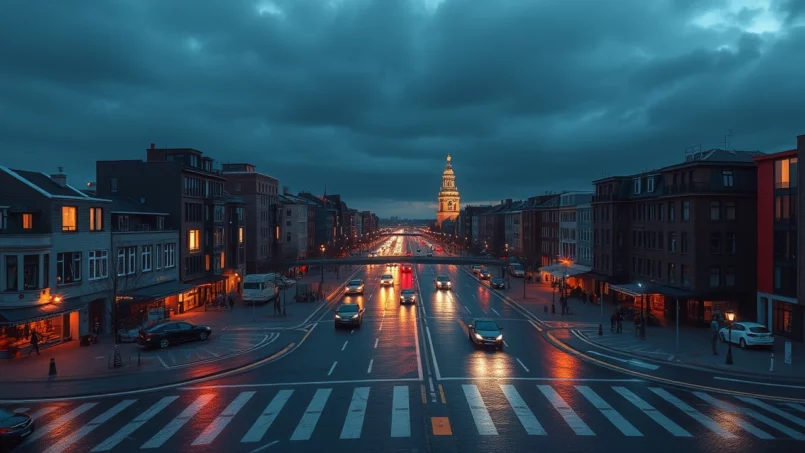
 Published on and written by Cyril Jarnias
At first glance, Upcoming Urban Development Projects ICELAND may seem modest given the country’s size. Less populated than the Cleveland metropolitan area and smaller than Ohio, the island is nonetheless engaged in an urban transformation of uncommon scale: massive densification of Reykjavík, entirely new neighborhoods, reconfiguration of the transport system, reinvention of airport and industrial zones, not to mention the rise of small regional centers.
The strategic plan aims for carbon neutrality around 2040, while addressing the challenges of growing demographic and real estate pressure. The actions are detailed, quantified, and already underway.
A Highly Structured Strategic Framework
Icelandic urban projects are not built in a vacuum. They are part of a bundle of national and municipal strategies of rare coherence.
Reykjavík, the capital located on the south shore of Faxa Bay and the heart of a metropolitan region of nearly 243,000 inhabitants, has adopted a Municipal Plan 2010‑2030 that guides all development: a compact city, priority given to brownfields over greenfields, strengthening of public transport, protection of green spaces and the coastline, and above all a drastic reduction in emissions.
This is the amount, in billion Icelandic krónur, of the Reykjavík Green Deal’s ten-year investment program.
At the national level, the Planning Policy 2024‑2038 and a Strategic Regional Plan set the tone: carbon neutrality before 2040, a 55% reduction in emissions by 2030 in cooperation with other European countries, and planning policies designed to support this shift.
Quantified Targets Reshaping the City
To gauge the scope of upcoming projects, one need only look at some key targets that structure urban decision-making.
| Key Objective | Deadline | Scope |
|---|---|---|
| Reykjavík Carbon Neutrality | 2040 | Entire City |
| Reduction in Road Transport Emissions | 2030 | –35% vs. 2005 |
| Share of Car Trips | 2030 | 58% (vs. 73% in 2017) |
| Share of Cycling in Trips | 2025 | 10% |
| 100% Municipal Fleet Zero-Emission Vehicles | 2025 | City Fleet |
| Proposed Ban on New Gasoline/Diesel Cars | 2030 | National Level |
| Near-Zero Waste CO₂ | 2025 | Waste Management |
| Proximity to Basic Services | 2025 | 90% of residents within short distance |
| Share of New Housing within Existing Fabric | Ongoing | 90% |
These figures are not mere statements of intent: they are integrated into urban, transport, and housing plans, and determine the location of new neighborhoods and major facilities.
Reykjavík Densifies: 15,000 Additional Homes and Entire Neighborhoods to be Invented
With a population just under 140,000 and strong appeal (over 2 million international visitors per year), Reykjavík faces considerable housing demand. Municipal projections forecast an additional 25,000 inhabitants by 2030, requiring 14,500 new residential units.
The response is not sprawl but a highly regulated densification: 1,000 to 1,500 new apartments per year, for a targeted total of 10,000 to 15,000 homes over a decade, with 90% within the current urban perimeter and 80% near the future Borgarlína bus rapid transit line.
Ártúnshöfði–Elliðaárvogur: The Former Industrial Frontier Becomes a Town of 20,000
The most iconic project of this densification is undoubtedly the new Ártúnshöfði–Elliðaárvogur neighborhood, developed on a vast industrial brownfield, between major roads (Vesturlandsvegur, Höfðabakki) and the shores of Grafarvogur and Elliðaárvogur.
Number of homes planned to create a second urban center in eastern Reykjavík.
The local plan approved in 2022, developed in part with the developer Klasi and ASK Architects, lays the groundwork for a complete neighborhood: at least two schools integrating kindergarten and elementary, a “magnet” school for older students, all connected by a landscaped pedestrian axis punctuated with rest areas and playgrounds. Open views to the sea, large outdoor spaces, and well-designed soft mobility links are meant to make this density desirable.
The transport dimension is central: the first phase of Borgarlína will run through the neighborhood from 2031, and Krossamýrartorg will become an interchange hub where three bus rapid transit lines will intersect. This is not a car-centric neighborhood, but one built around a sustainable mobility corridor.
Keldur: A New Dense, Mixed-Use, and Climate-Neutral Hub East of the City
Another major upcoming project, often referred to as “Crafting Keldur”, aims to transform the former Keldnaholt area into a modern urban neighborhood for 13,000 residents and 8,000 jobs. On 115 hectares, the masterplan envisions 5,800 homes and 150,000 m² dedicated to activity, all with buildings of 3 to 5 stories in a logic of reasonable density.
The neighborhood is inserted into a continuous urban corridor of about 10 km, linking the historic center to the eastern periphery along the future Borgarlína. The projected travel time between Keldur and the old center is 20 minutes by bus rapid transit.
The setup is particularly interesting: the public entity Transport for the Capital Area (TfCA) manages the development and sale of land, and all land revenue must be reinvested in transport infrastructure, including Borgarlína. A way to directly align urban planning and mobility funding.
| Keldur – Key Figures | Value |
|---|---|
| Approximate Area | 115 ha |
| Planned Population | 13,000 inhabitants |
| Planned Jobs | 8,000 |
| Planned Housing Units | 5,800 |
| Floor Area for Employment | 150,000 m² |
| Building Height | 3 to 5 stories |
| Horizon for First Lot Allocations | From 2027 (planned) |
An international masterplan competition was held in 2023, won by the Swedish firm FOJAB in association with Ramböll. The first detailed plans are to be confirmed around 2026, followed by the start of infrastructure construction and international lot marketing from 2026‑2027.
Vatnsmýri, Skerjafjörður, Vogabyggð: Other Fronts of Densification
The densification of Reykjavík is not limited to these two major projects. Other structuring sectors are under planning or already under construction.
The City of Reykjavík is developing several major sustainable neighborhood projects. In Vatnsmýri, the future relocation of the airfield will enable the creation of a major neighborhood with up to 3,600 homes by 2030 and a long-term potential of 6,900 homes and 12,000 jobs. The Skerjafjörður and Vogabyggð sectors are seeing the emergence of new residential neighborhoods, accompanied by schools and well-connected to the Borgarlína transport network, with a planned bridge for soft mobility. Finally, on the Orkureitur site, a BREEAM-certified neighborhood of over 40,000 m² will blend 436 apartments, shops, and services in a mixed-use, low-carbon approach.
Add to this a series of more targeted densification projects, such as Heklureitur (several hundred apartments), the conversion of parking lots or garages into residential buildings, or the redevelopment of the Hlemmur bus terminal area, now a lively square centered around a food court.
Housing, the Core Issue: Quantity, Price, and Environmental Quality
Facing a housing crisis also fueled by tourism growth, Reykjavík has tightened its housing policy. The 2014 Municipal Plan already required that at least 25% of new units be affordable. In practice, the city has gone further: since 2015, about 35% of construction has been reserved for social or affordable housing.
Construction targets and distribution of new housing for the period 2023-2033.
An average of 1,600 homes built each year until 2033.
35% of construction, or about 5,600 units over ten years, dedicated to affordable, sustainable, and socially inclusive housing.
25% of new apartments in neighborhoods must be built by non-profit housing associations.
Greener Housing: Lifecycle Assessment and Construction Innovation
Housing projects are not only numerous: they must also meet increasing environmental requirements. Starting September 1, 2025, the Icelandic Housing and Construction Authority (HMS) will require a life cycle assessment (LCA) and a carbon footprint calculation for all construction projects. The BREEAM label is increasingly used as a benchmark, especially for large developments.
The “Green Housing of the Future” project in Reykjavik, led by Iða Real Estate Development and Grænt húsnæði ehf., is testing on five municipal plots buildings aiming for a 50 to 60% reduction in carbon footprint and 40% reduction in energy consumption over their lifecycle compared to a reference building.
The “Græni Klettur” building at Frakkastígur 1, already underway, relies heavily on material reuse to limit emissions. At Veðurstofuhæð, over 200 homes are planned for diverse profiles, following a logic of social mix and sustainable mobility.
Transport in Transition: Borgarlína, Sundabraut, and the 15-Minute City
While the building sector is regulated, it is especially transport that concentrates climate challenges. According to various analyses, transportation accounts for between 54 and 82% of Reykjavík’s territorial emissions, despite almost entirely renewable electricity and heating (over 99% hydro and geothermal electricity, about 90% geothermal district heating).
Borgarlína, the Backbone of a More Sustainable Mobility Network
The structuring response is called Borgarlína, or CityLine: a bus rapid transit (BRT) system designed as the backbone of public transport in the capital area. The buses, 18 to 24 meters long, will run largely on dedicated lanes, with a promised frequency of 7 to 10 minutes, quality stations, and integrated mobility hubs (bike access, real-time information, intermodality).
| Borgarlína – Key Elements | Details |
|---|---|
| Length of First Line | 14.5 km |
| Number of Stations (1st line) | 25 |
| Major Structures | 3 |
| Targeted Start of Service for 1st Line | Late 2026 / early 2027 |
| Total Number of Planned Lines | 7 by 2034 |
| Coverage Goal | 70% of residents within 400 m of frequent service |
| Estimated Cost | ~70 billion ISK (~€470 million) |
The project is not just a change in supply: it is linked to a transport agreement signed in 2019 between the state and the six municipalities of the metropolitan area (Reykjavík, Kópavogur, Garðabær, Hafnarfjörður, Mosfellsbær, Seltjarnarnes), which conditions major new urban developments on their proximity to Borgarlína. At least 80% of new housing must be within its zone of influence.
A French-Danish-Icelandic consortium, including Artelia, is responsible for the complete technical design of a Bus Rapid Transit (BRT) network. This mission covers mobility aspects, eco-design, infrastructure, carbon footprint, acoustics, as well as operational support and passenger information systems. The goal is to create one of the most sustainable BRT networks in the world.
A 311 Billion ISK Transport Charter for the Entire Metropolitan Area
Borgarlína is part of a broader Transport Charter for the capital region, updated in 2024, which commits 311 billion ISK in investment until 2040. This roadmap results from a compromise between the state and municipalities to make up for chronic underinvestment since the 2008 crisis, exacerbated by the tourism boom.
The distribution of planned investments illustrates the paradigm shift:
| Investment Category (Transport Charter) | Share of Total Budget |
|---|---|
| Major Roads | 42% |
| Borgarlína + Bus Lines | 42% |
| Pedestrian and Bike Paths | 13% |
| Traffic Management and Safety | 3% |
An independent study by the Cowi consultancy estimates the socio-economic benefits at 1,140 billion ISK over 50 years, with an internal rate of return of 9.2% and a benefit-cost ratio of about 3.5: each króna invested would thus generate three krónur in collective gains, mainly through reduced travel times, congestion, and better modal choice freedom.
The charter includes structuring projects: Sundabraut, a major axis in a PPP to open up neighborhoods on either side of Kleppsvík Bay (construction start in 2026 for at least 5 years), the burying of Miklabraut over 2.8 km, and the partial covering of Sæbraut to reconnect the waterfront to neighborhoods.
From Car-Dependency to a “Healthy Multimodal System”
Beyond major works, the political goal is to change habits: the modal share of cars, which represented about 73% of trips in 2017, must drop to 58% by 2030, while active modes (walking, cycling) aim for 30% and public transport 12%.
The percentage increase in Reykjavík’s bike lanes in recent years, as part of its ambitious cycling plan.
Simultaneously, the Strætó bus fleet is beginning to electrify, gas stations are to be halved by 2025, and the deployment of electric vehicle charging stations is progressing to support an already well-advanced transition (in 2020, 19% of new registrations were electric or plug-in hybrid).
The logic of the “15-minute city” plays a key role here: by bringing homes, jobs, services, and leisure closer together, it allows nearly everything to be done on foot or by bike in each neighborhood. The idea that 90% of residents have basic services nearby by 2025 structures the location of public facilities in both new developments and existing neighborhoods.
Energy, Climate, and Nature: A Carbon-Neutral City Capitalizing on Geothermal Energy
Icelandic urban projects benefit from a considerable advantage: an energy system already largely decarbonized. Over 99% of electricity comes from hydropower and geothermal sources, and about 80% of total energy consumed is renewable. Homes are heated nearly 90% by geothermal district heating networks.
Reykjavík adopted a climate policy as early as 2009 and an Action Plan 2021‑2025 aligned with the Paris Agreement, structured around six priorities: walkable city, energy transition, healthy mobility, circular economy, green buildings, and carbon sequestration.
In this last area, the city works closely with Reykjavik Energy (OR) and the company Carbfix, known for its technology of mineralizing CO₂ in basalt, which “turns CO₂ into stone” underground. Simultaneously, “climate forests” are being developed in partnership with the Reykjavík Forestry Society, to increase urban and peri-urban carbon sinks.
The public utility Sorpa operates a biogas and composting plant. This facility aims to virtually eliminate methane emissions from landfills by 2025. The municipal goal is to bring CO₂ emissions from waste close to zero in the very short term.
Finally, specific projects like ICEWATER, funded by the EU’s LIFE program, aim to improve water quality in iconic sites such as Vatnsmýri and the Tjörnin pond in the heart of Reykjavík. The idea is to combine urban density and ecological restoration.
A New Urbanity Around Airports and Industrial Zones
Beyond the capital, Upcoming Urban Development Projects ICELAND also outline a profound transformation of logistical and industrial interfaces. Major airport and port hubs are becoming grounds for urban and energy experimentation.
K64: The Strategic Urbanization of the Keflavík Corridor
About 50 km from Reykjavík, Keflavík International Airport is the entry point for almost all foreign visitors. Around this infrastructure, a vast masterplan, called K64 and led by Kadeco, brings together the state, the airport operator Isavia, and the municipalities of Reykjanesbær and Suðurnesjabær.
Over 55 km², the ambition is to create an integrated development zone, combining airport activities, residential neighborhoods, educational facilities, services, and cultural programs. The site is to become a sort of “full-scale laboratory” for sustainability, betting on innovation in aviation, energy (including hydrogen and advanced fuels), and technology.
Integrated development project on the Reykjanes UNESCO Geopark
The plan identifies several catalytic sites: the airport forecourt, set to host a public transport terminal, traveler services, and a reorganized car rental hub; Helguvík‑Bergvík, being converted into an eco-industrial park dedicated to accelerating the energy transition; Helguvík Port, focused on maritime logistics; Aðalgata, set to densify into a mixed-use neighborhood blending R&D, residences, and community life; and Ásbrú, a former military base already in transformation, destined to concentrate housing and productive activities.
This project is part of a broader dynamic of modernizing Keflavík: 30% terminal expansion in the short term, consideration of a third runway in the longer term, creation of a logistics hub called Diamond Gate, and deployment of infrastructure for sustainable aviation fuels.
Grundartangi, Akranes, and Circular Industrialization in the Regions
In the west of the country, the Grundartangi industrial zone, already home to 21 companies including large aluminum and ferro-alloy plants, is on its way to being redeveloped into an eco-industrial park. The Grundartangi Development Association promotes a circular economy model where by-products and surplus energy from heavy industries serve as resources for new activities.
The Icelandic town of Akranes is developing a “Climate Park” in an industrial zone, intended to host carbon-negative businesses. This project involves cooperation with the company Transition Labs and its Running Tide initiative, which uses underwater kelp forest cultivation to capture and store carbon sustainably.
Here again, urban planning, energy, and climate are closely intertwined: the evolution of regional industrial zones is no longer thought of only in terms of jobs, but also of circularity and contribution to the country’s carbon neutrality.
New Regional Centers: Hamborg, Selfoss, Akureyri, East Iceland
Icelandic urban transformations are not concentrated solely in the capital area. Regional development plans foresee the creation or strengthening of service centers in all regions, to distribute economic opportunities and reduce demographic imbalances.
Hamborg: A New Village in East Iceland
In the Fljótsdalur valley, about a thirty-minute drive from Egilsstaðir, a singular project illustrates this strategy: an entirely new village, Hamborg, is to be built in the municipality of Fljótsdalshreppur, which currently has barely a hundred permanent residents.
The planned investment, in million Icelandic krónur, for the basic infrastructure and masterplan design of the Hamborg village.
This micro-project fits into a regional scheme aiming to ensure access to a major urban center within 60 minutes from any point in East Iceland, with a networked public transport offer and densification of existing villages rather than residential sprawl.
South Iceland: 5,500 Homes to be Built in Ten Years
In the south, the region is attracting more and more households seeking more affordable housing than around Reykjavík. Demographic forecasts are being met or exceeded, and authorities estimate that about 3,000 apartments need to be built quickly, 5,500 over the next decade.
Despite a slowdown due to high interest rates, construction activity remains robust and is expected to pick up with improving financial conditions. The region benefits from generally lower borrowing rates than the metropolitan area, reinforcing its residential appeal.
Akureyri, Egilsstaðir, Seyðisfjörður: Accessibility and Polarities
National transport plans also foresee an improvement in connectivity to regional towns: a long 13.5 km tunnel between Seyðisfjörður and Egilsstaðir, which would become one of the longest in Europe, is to facilitate exchanges in the East; Akureyri, the major city of the North, is testing MaaS (Mobility as a Service) solutions to integrate public transport and soft mobility, with a target of a 10% modal shift to more sustainable modes.
In all these towns, regional plans emphasize developing compact neighborhoods, diversifying housing types, proximity of services, and the systematic consideration of natural risks (avalanches, landslides, floods, eruptions, jökulhlaups).
Governance, Participation, and Innovation: A Highly Collaborative Urban Fabrication
The described transformations are not based solely on technical plans, but also on sophisticated governance. Reykjavík relies on a Department of Environment and Planning headed by Ólöf Örvarsdóttir, while the mayor, Dagur B. Eggertsson, steers the overall vision with a strong emphasis on social inclusion.
A political steering group oversees the Climate Action Plan. The development of this plan integrated over 200 public contributions, collected online, demonstrating an unusual level of participation for this type of document.
Digital Platforms and Participatory Budgets
The capital has gained international recognition for its participatory democracy tools. The Better Reykjavik platform, launched in 2010 with the Citizens Foundation, allows residents to submit, debate, and prioritize proposals for the city. In over ten years, more than 8,900 ideas and 19,000 arguments have been submitted, and about 450 proposals have been processed as part of the municipal agenda-setting process.
The My Neighborhood participatory budget allocates about 450 million ISK (approximately 6% of the city’s investment budget) to citizen-led projects in Reykjavík.
Participation, which had declined for a time, reached a record with about 12.5% of the city’s population voting online in recent editions. For a country with a 99% literacy rate, these digital tools naturally fit into civic daily life.
Research and International Cooperation
The city does not work in isolation. A dedicated service, attached to the mayor’s office, coordinates its participation in numerous research and innovation projects funded by the European Union (Horizon, LIFE), Nordic Innovation, or private funds like Bloomberg.
Reykjavík actively participates in several innovative European projects aimed at improving the sustainability, safety, and quality of life for its citizens.
Energy transition project to develop carbon-neutral urban communities.
Enhancing security around transport hubs, with a focus on the Hlemmur area.
Initiative on digital identity for citizen services.
Co-design of green spaces with residents of the Breiðholt neighborhood.
Collaboration with Lahti (Finland) on sustainable transport development.
At the national level, the Planning Agency runs a consultation portal and guidelines on sustainable urban planning and environmentally friendly transport, co-developed with the Association of Municipalities of the Capital Area. Again, the goal is to disseminate best practices beyond the capital alone.
Towards Which Urban Iceland?
The upcoming urban development projects ICELAND outline a map in deep recomposition. In the capital area, Reykjavík is transforming into a denser, more mixed-use city, more articulated around public transport corridors and complete, human-scale neighborhoods. Industrial brownfields are becoming labeled green neighborhoods, old parking lots are being covered with cross-laminated timber buildings and vegetated strips, waterfronts are being returned to pedestrians and cyclists thanks to the tunneling of certain arteries.
Around Keflavík, urbanization is developing on former airport and military zones. In the West, industrial complexes are implementing large-scale circular economy. In the South and East, the densification or creation of villages and small towns aims to ensure equitable access to services, transport, and energy.
The Icelandic bet is twofold. On one hand, leveraging unique structural advantages – geothermal resources, almost entirely renewable electricity, manageable size of urban areas – to move faster and further than other countries towards carbon neutrality. On the other, using this transition as a lever to improve daily life: access to housing, quality of public spaces, health through active mobility, simplified access to daily services.
The major urban projects in Iceland are measured in investments and infrastructure, but their essence lies in precise urban planning choices: the 15-minute city, priority given to brownfield redevelopment, the establishment of affordable housing quotas, and the systematic integration of climate issues into planning. These principles aim to reduce dependence on private cars, shorten perceived distances, and maintain permeability between city and nature, despite densification.
A French business owner, around 50 years old, with a well-structured financial portfolio in Europe, wanted to diversify part of his capital into residential real estate in Iceland to seek rental yield and exposure to the Icelandic króna. Allocated budget: $400,000 to $600,000, without leveraging credit.
After analyzing several markets (Reykjavík, Kopavogur, Hafnarfjörður), the chosen strategy consisted of targeting an apartment or a small single-family house in a dynamic neighborhood of Reykjavík, combining a target gross rental yield of 7 to 8% – the higher the yield, the higher the risk – and appreciation potential linked to tourism and housing pressure, with an all-in ticket (acquisition + fees + potential renovations) of about $500,000.
The mission included: market and neighborhood selection, connection with a local network (real estate agent, lawyer, accountant), choice of the most suitable structure (direct ownership or via an Icelandic company) and integration of this asset into an overall wealth strategy, while managing legal, tax, and rental risks.
Disclaimer: The information provided on this website is for informational purposes only and does not constitute financial, legal, or professional advice. We encourage you to consult qualified experts before making any investment, real estate, or expatriation decisions. Although we strive to maintain up-to-date and accurate information, we do not guarantee the completeness, accuracy, or timeliness of the proposed content. As investment and expatriation involve risks, we disclaim any liability for potential losses or damages arising from the use of this site. Your use of this site confirms your acceptance of these terms and your understanding of the associated risks.

Cyril Jarnias is an independent expert in international wealth management with over 20 years of experience. As an expatriate himself, he is dedicated to helping individuals and business leaders build, protect, and pass on their wealth with complete peace of mind.
On his website, cyriljarnias.com, he shares his expertise on international real estate, offshore company formation, and expatriation.
Thanks to his expertise, he offers sound advice to optimize his clients' wealth management. Cyril Jarnias is also recognized for his appearances in many prestigious media outlets such as BFM Business, les Français de l’étranger, Le Figaro, Les Echos, and Mieux vivre votre argent, where he shares his knowledge and know-how in wealth management.





