
 Published on and written by Cyril Jarnias
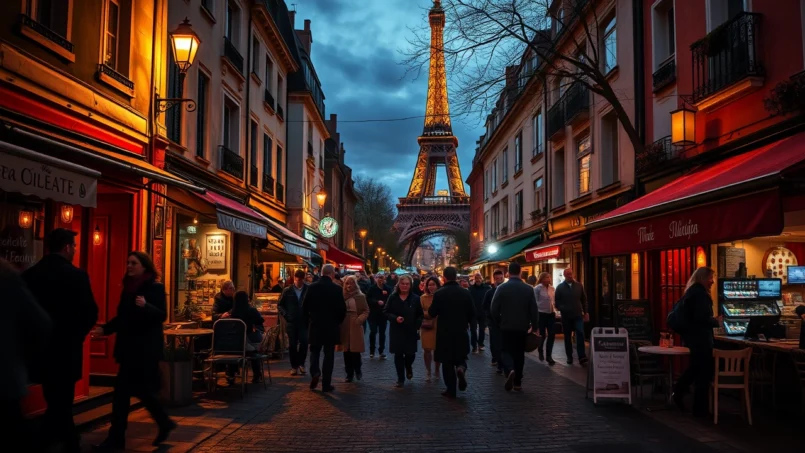
France loves to party. From the banks of the Loire to the rooftops of Paris, from the Marseille calanques to the Garonne quays in Toulouse, French nights have become a true playground, where culture, clubs, late-night restaurants, wine bars, jazz scenes, and major summer festivals converge. But behind the postcards, a practical question always comes up: where to go out, how to get there… and how to get back home alive without blowing your budget?
When planning a night out, it’s useful to consider club prices, neighborhood vibes, transport schedules, and local regulations. Examples of vibrant cities include Paris, Nantes, Rennes, Bordeaux, Lyon, Marseille, Toulouse, and Lille.
Paris, the world capital of French nights
Paris alone concentrates around 200 clubs and discos within its city limits, a density unique in France. It’s estimated there are nearly 10 million club outings per year in the Île-de-France region, with close to 20,000 direct and indirect jobs (DJs, bartenders, security, organizers).
Paris’s strength lies in the diversity of its nightlife districts. Bastille, Oberkampf, Pigalle, Le Marais, La Villette, La Butte-aux-Cailles, Les Grands Boulevards, the Canal Saint-Martin, and the Latin Quarter each offer a very different signature.
Party districts and iconic addresses
Bastille remains one of the epicenters of nightlife, with a string of bars and clubs where you can easily slide from a drink to a dance floor. Oberkampf has established itself as a playground for fans of electronic music, rock, and live music bars, while Le Marais mixes sophisticated cocktail bars, pubs, LGBTQ+ spots, and late-night restaurants.
Pigalle, long a “red-light” district, now combines legendary concert venues and electro clubs (La Machine du Moulin Rouge, Bus Palladium, La Cigale, Le Carmen, Chez Moune…). Further northeast, La Villette and the Canal de l’Ourcq have multiplied hybrid venues: microbreweries like Paname Brewing Company, cultural spots like Le Point Éphémère, large venues like Le Zénith or Le Trabendo.
Several establishments illustrate the originality of nightlife in Paris: Le Moonshiner, a speakeasy bar hidden behind a pizzeria; Le Candelaria, a taqueria concealing a cocktail bar; Le Dernier Bar avant la Fin du Monde, a 400 m² geek fantasy bar; La Gare Le Gore, a club set up in an old train station; as well as concepts like Gossima Ping Pong Bar, a ping-pong bar, and La Lucha Libre, a bar equipped with a wrestling ring.
Clubs: How much does a night out in Paris cost?
Club entry in France generally ranges between €10 and €25, but Paris pulls the average up, especially at trendy spots. La Machine du Moulin Rouge illustrates the range well: around €20 for a “standard” night, €30 or more when an international DJ is booked. The same logic applies to Rex Club, YOYO, L’Arc Paris, or Phantom.
The price ranges for Parisian clubs can be summarized as follows:
| Type of club | Typical entry fee range | Profile / typical example |
|---|---|---|
| “Low cost” / neighborhood | €10 – €20 | Le 9b, La Station, certain nights at Wanderlust |
| Mid-range | €20 – €30 | La Java, Rex Club, La Machine du Moulin Rouge |
| High-end / VIP | €30 – €40 and more | YOYO, L’Arc Paris, certain clubbing rooftops |
Where the bill really climbs is at the bar: a beer is often charged between €8 and €12, a cocktail between €12 and €18, up to €25 in VIP areas. Bottles of champagne are more likely between €80 and €150 at the bar, and can far exceed €150 – €500 at a VIP table.
A few clubs include entry in the price of a table with a minimum spend, but this rule is not universal and varies by establishment. It is therefore essential to check this information in advance and not leave it to chance.
How to go out “smart” in Paris
Parisians who go out a lot know: timing changes everything. From Monday to Thursday, prices are often reduced, sometimes even free entry to attract a crowd. On Fridays, prices go up a notch, but Saturdays concentrate the most expensive nights. Another lever: arrival time. Many clubs offer free or reduced entry before a certain time (often midnight).
Apps and loyalty cards complete the arsenal. Services like Nightfloor or cards like “White Card” provide access to discounts, even skip-the-line access for regulars. Student nights remain one of the best deals for small budgets, with discounts upon showing a student card or dedicated weeknight parties.
As for alternatives to big clubs, Paris is full of dance bars, pop-up parties in abandoned spaces, electronic festivals (from NoART at the Domaine de Saint-Cloud to the major events at La Villette), or simply concerts in legendary venues like L’Olympia, Le Bataclan, La Maroquinerie, Le New Morning, or La Philharmonie.
Getting back at night: Metro, night bus, taxi, bike
The capital has developed a nighttime network that allows, in theory, getting home without a car.
This is the number of Noctilien night bus lines that ensure nighttime service in Paris when the metro and RER stop.
Bike-sharing (Vélib’) and electric scooters complete this landscape. Paris has about 1,000 km of bike lanes and some 1,400 Vélib’ stations for 20,000 bikes (including 35% electric-assist). A single-use fare starts at €3, a 3-day pass from €20. Scooters often cost around €1 to unlock plus €0.15 to €0.25 per minute. But the “drink or drive” rule applies to handlebars too: drinking and driving applies just as much to cyclists or scooter riders.
Finally, taxis and ride-sharing services (VTC) (Uber, Chauffeur Privé, Caocao, etc.) ensure rides home at any hour. The legal minimum for a taxi ride is set at €7.30, with a fixed booking surcharge (€4 for immediate booking, €7 for advance). To avoid bad surprises, authorities advise prioritizing official taxis, checking the license plate and driver’s name, and paying by card whenever possible.
Nantes and Rennes: Two regional capitals that stay up late
Far from being limited to Paris, French nightlife has become clearly structured in regional metropolises. Nantes, the “City of the Dukes,” and Rennes, the beating heart of Brittany, are two good examples.
Nantes: From warehouses on the Loire to medieval alleys
Traversed by the Loire, Erdre, and Sèvre rivers, Nantes has transformed its industrial past into a vast nighttime playground.
On the quays, the former Hangar à Bananes warehouse has become a major party hub: bars like Dock Yard (Irish rock vibe), La Calle (Cuban rums), La Terrasse de l’Île (creative cocktails), concert halls (Warehouse, Le Ferrailleur), clubs (D3), theater (Théâtre 100 Noms), and even a popular culture center coexist in the same complex. It’s one of the city’s liveliest spots, with programming ranging from karaoke to major electro events.
A few streets away, the Bouffay district offers a completely different setting: medieval cobbled alleys, pedestrian streets at night, Irish pubs, inventive cocktails, intimate venues for local artists, stand-up shows, huge beer menus, and crêperies for late-night cravings.
Nantes Tourist Guide
More upscale, Île Feydeau houses cocktail bars and clubs in beautiful 18th-century buildings. You go from a Prohibition-inspired Bootlegger to a steampunk Chat Noir, from a Tiki Bar with exotic rums to a Café Rouge Mécanique dedicated to local bands, or to L’R de Rien for a piano-bar vibe.
Nearby, other venues animate Nantes nights: Le Lieu Unique, a former LU biscuit factory converted into a cultural center with an industrial bar, bookstore, and hammam; Stéréolux, a temple for contemporary music and digital arts; the Théâtre Graslin for opera, classical, and ballet; or the Machines de l’Île, a steampunk fairy-tale park that attracts visitors during the day but contributes to the unique image of the quays even at night.
Creative workshops, cruises, and cultural late nights
Nantes’s originality also lies in offering a nighttime scene that isn’t limited to bars. A platform like Funbooker lists a host of evening activities: mural tufting workshops, kokedama, jesmonite objects, ceramics, kintsugi, watchmaking, Asian cooking, axe throwing, cross-car driving, or aerobatic flight initiation. Prices start around €18 – €20 (axe throwing, quiz, immersive experiences) and climb to nearly €400 for an aerobatic plane flight.
Discover the museum in the evening with varied cultural programming and free late-night entry upon reservation.
The museum opens for late nights every Thursday until 9 PM.
Enjoy dance performances, talks, or screenings during these evenings.
Until December 18, 2025, entry from 7 PM to 9 PM is free upon reservation.
Admire works by masters like Picasso, Monet, Kandinsky, or Kapoor in a calmer atmosphere.
Finally, when the weather is nice, the Loire becomes a prime setting for sunset cruises, sometimes paired with jazz or acoustic concerts. Some evenings like “Les Valseuses” combine sailing and music for around forty euros, while night cruises towards the estuary lighthouses or sound and light shows like “Dans la Nuit, Liberté” in the surrounding countryside complete the picture.
Rennes: Bars until 3 AM and alternative culture
In Rennes, nightlife is largely experienced in bars. One particularity stands out: many establishments close at 3 AM, a late hour for a city of this size. The list is long: L’Aventure (historic music bar in the courtyard of the former Saint-Michel prison), La Banque, Le Cactus, Le Caveau (oldest night bar in Rennes), La Contrescarpe, Le Corner Shelter, Le Doujezu, Le Plan B, Le Kilkenny, Melody Nelson (steampunk cocktails), Penny Lane, La Place (half bar, half club), Le Church, Le P’tit Vélo, Pub Gall’, La Nouba, Tiffany’s, L’Upper, Le Zing…
Some establishments, like L’Aventure, have an almost legendary past, having hosted icons such as Jacques Dutronc, Serge Gainsbourg, or Étienne Daho. Set in a former “Pennsylvanian”-style prison, this place perfectly embodies and crystallizes the bohemian spirit characteristic of the city.
Around these bars, Rennes offers a range of nighttime activities similar to Nantes’s: axe throwing at Les Frères Jack, escape rooms (Get Out), collaborative virtual reality experiences (Virtual Room, EVA), TV-style quiz games, bar-venues like L’Uzine, the Modjo climbing gym, not to mention the Marché des Lices, a huge Saturday morning market that extends the night for late risers with galettes-saucisses and hard cider.
Bordeaux: When nightlife revolves around wine
It’s hard to talk about nightlife in France without mentioning Bordeaux and its wine bars. The city is full of spots that have made the evening glass an art of living. Some establishments list over 1,000 references, others over 1,500, sometimes with 20 to 40 wines served by the glass thanks to Enomatic machines.
In this landscape, Le Bar à Vin, Vins Urbains, Wine More Time, Oh Soif, Le Flacon, Aux Quatre Coins du Vin, and Latitude 20 at the Cité du Vin are headliners. Price ranges are relatively accessible for a world wine capital: you can find glasses around €3.50, and bottles starting at €15 – €20, even if some menus go up to €1,500 for the most prestigious vintages.
Here is an overview of the profiles of some typical Bordeaux wine bars:
| Type of wine bar | Number of references (order of magnitude) | Notable characteristics |
|---|---|---|
| Grand institutional bar | 1,000 – 1,500 | Very broad menu, grand crus, refined decor |
| “Exploratory” wine bar | 300 – 700 | Focus on world wines, natural, biodynamic |
| Neighborhood wine cellar bar | 100 – 250 | Intimate atmosphere, personalized advice |
| High-tech Enomatic bar | 40 – 60 wines by the glass | Tasting via prepaid card, 3/6/12 cl measures |
Bordeaux’s nightlife largely revolves around these spots, but is also increasingly opening up to other horizons: jazz, concerts in vaulted cellars, introductory workshops, themed tastings (wines from female winemakers, world tour in 6 glasses, food-wine pairings…), or even evenings on the rooftop of the Cité du Vin, where the entry ticket includes a panoramic tasting.
Lyon, Marseille, Toulouse, Lille: Four distinct nightlife styles
Other major French cities have each developed a very distinct nighttime identity, blending bars, clubs, festivals, and hybrid venues.
Lyon: Presqu’île of bars, electro clubs, and guinguettes on the water
In Lyon, the Presqu’île concentrates an impressive density of bars, especially around Rue Sainte-Catherine, Rue Mercière, and Rue de l’Arbre Sec. The Rhône and Saône quays serve as a stage for a string of péniches and boat-bars that turn the riverbanks into a festive promenade, especially in good weather.
The city offers every possible format: British pubs (Elephant & Castle, The Smoking Dog, King Arthur), beer bars with dozens of taps (Le Boston, Welsh Beer Bar, Les BerThoM, 405 bar à Bières), sophisticated cocktails (Le Fantôme de l’Opéra, L’Officine, L’Antiquaire, Le Grisbi, Black Forest Society, Le Rambler, Le Cigale), hidden speakeasies (La Baignoire, Le Passage), gamer venues (Le Meltdown Lyon), cheap student bars (Le République, Le Saint-James), or large late-night generalist bars like Le Big White.
Lyon offers a varied nightlife scene with major clubs like Le Sucre (electro rooftop at Confluence), Le Petit Salon and Le Terminal Club for techno/house, as well as discos and bar-clubs like Ayers Rock, Le Plouf, or Ninkasi Cordeliers. The city also has Latino clubs like La Feria or Barrio Club.
Residents benefit from a rather developed transport network (4 metro lines, 5 tram lines, over 100 bus lines). The metro stops around midnight, partly relayed by night buses. The bike-sharing system (Vélo’v) allows getting home late if you haven’t overindulged in alcohol, and the city is quite walkable in central districts, at the cost of some climbs if you venture towards Croix-Rousse or Fourvière.
Marseille: Beach, port, free concerts, and major festivals
In Marseille, nightlife is often lived outdoors. The “L’Été marseillais” event, created in 2020, has completely reshuffled the summer cards. From June to late August, the city deploys a large-scale free program: concerts, dance shows, artistic performances, nautical activities, family activities, in all districts, from the Vieux-Port to the Prado beaches, from the northern neighborhoods to La Canebière or Le Panier.
A flagship feature: the “Scène sur l’eau”, installed on the port quay at the Vieux-Port, which hosts free concerts all summer, from disco-funk to popular headliners, and local artists. An “L’Été marseillais Village” then takes over at the Florence Arthaud nautical stadium, while an “L’Été marseillais Club” and a host of neighborhood activities complete the party.
Add to this the Fête de la Musique, massive in the Phocaean city, festivals like Marsatac, Watts Summer Festival, or the Delta Festival (on the Prado beaches), concerts at venues like La Friche la Belle de Mai, the Cepac Silo, or the Orange Vélodrome, not to mention a large number of pubs, cocktail bars, restaurants, and clubs spread between the Vieux-Port, Cours Julien, La Joliette, the beaches, or Les Goudes.
Again, nighttime transport and topography play a role. The Marseille metro closes relatively early, often forcing reliance on buses, cars, taxis, or ride-sharing for the return, especially after a night at the beach or a seaside club.
Toulouse: Capital of live music and jazz
Toulouse heavily bets on concerts. Around large venues (Zénith, Casino Barrière, Le Bikini, Halle aux Grains, Le Metronum), the city maintains a particularly dynamic jazz scene: clubs like Le Mandala (open since 1985), Le Taquin, festivals like “Jazz sur son 31” (nearly 40 years old, dozens of concerts mostly free, spread across 36 towns), “The Jazz Room” at the La Vénus cabaret, or series like Jazz au Bistrot, organized by the Le Jazz pour Tous association.
On Thursdays, Fridays, and Saturdays, many bars (The Four Monkeys, Ô Boudu Pont, Le Père Peinard, etc.) offer rock, metal, hip-hop, or electro concerts. Entry prices generally range from €5 to €20, sometimes the evening is free. For late-night cinema screenings, venues like Le Bijou, les 3T, l’ABC, or l’American Cosmograph are also worth discovering.
Toulouse’s nightlife isn’t centered around a few “mega-clubs”, but rather a tight network of bars, café-théâtres, and small venues, creating a very “live” city spirit, ideal for those who prefer a concert to a dancefloor.
Lille: Estaminets, bistros, and ultra-late restaurants
In the North, Lille bets on its art of the table, including very late. The metropolis has hundreds of restaurants, estaminets, kebab shops, Chinese hot pots, hybrid food courts, but also noisy, warm bistros where the evening easily stretches late into the night.
The old town (Vieux-Lille) concentrates chocolatiers, traditional estaminets, old-fashioned bistros. Wazemmes plays the card of culinary diversity around its market, while new hybrid venues like food court/urban farms (Cageot, for example) are popping up around the city. Meanwhile, you can find very late-night spots within Paris itself – Au Pied de Cochon (open 24/7), Le Tambour, L’Alsace on the Champs-Élysées, Le Départ Saint-Michel, Le Rey, or Le Mabillon – which also serve as nocturnal refuges for Lille residents on a trip to the capital.
What a night costs… and what a club brings in
Behind the euphoria of French nights lies a heavy economic sector. Starting a discotheque represents a colossal investment: between €268,000 and €780,000 in initial budget depending on size and positioning, sometimes over a million euros for a very high-end establishment in a city center.
The typical distribution of investments looks like this:
| Expense item | Low range | High range | Approximate share of budget |
|---|---|---|---|
| Premises (purchase or 1st year rent) | €100,000 | €300,000 | 35 – 40% |
| Work / fitting out | €50,000 | €150,000 | 15 – 20% |
| Sound & lighting | €40,000 | €150,000 | 15 – 20% |
| Furniture & decor | €30,000 | €80,000 | 10 – 12% |
| Licenses & permits | €8,000 | €10,000 | 3 – 4% |
| Initial stock & launch marketing | €20,000 | €50,000</td | 7 – 8% |
| Starting cash flow | €20,000 | €40,000 | 8 – 10% |
Monthly fixed costs can climb from €40,000 to €80,000 (rent, salaries, security, SACEM/SPRE fees, energy, insurance, maintenance…). For an average club, turnover is around €25,000 – €30,000 per month, with big variations: €1,500 for a small night in the suburbs, up to €50,000 for a very big night in a city-center premium establishment.
70% of a discotheque’s revenue comes from beverage sales, which is the key to its profitability.
Overall, the average gross margin for a club on its turnover is around 70%, and the net margin is 10 to 30% for well-managed establishments, with strong seasonal variations (summer more profitable, some slow winter months).
Rules, licenses, and hours: What the law allows (or doesn’t)
If France loves to party, it strictly regulates its nights. The opening and closing hours of cafés, bars, restaurants, and discotheques are set by prefectoral orders in each department, with power shared with mayors outside Paris. Generally, most drinking establishments must close around 2 AM (or 1–1:30 AM in some departments) and cannot reopen until 4 or 5 AM.
Establishments whose main activity is dancing have a special status and can generally stay open until 7 AM. To open beyond standard hours, the operator must request a night-time derogation, provide a noise impact study if amplified music is played, and comply with acoustic standards. Authorizations can be automatic on certain dates (July 14, December 24 and 31, Fête de la Musique) or granted on a case-by-case basis for local festivals or private events.
Alcohol licenses, “happy hours,” and minor protection
Selling alcohol requires obtaining a license: license III (drinks up to 18% ABV), license IV (all alcoholic beverages), or a “restaurant” license limited to drinks accompanying a meal. You must complete 20 hours of training to obtain an “operating permit.” To sell alcohol at night, after 10 PM, a specific permit (PVBAN) is required.
‘Open bars’ (unlimited alcohol) are prohibited, except under strictly defined exceptions. ‘Happy hours’ are only tolerated if promotions also include non-alcoholic drinks. Selling alcohol to minors under 18 is prohibited, and they cannot be alone in a bar.
Operators are required to display their hours, their prices, the origin of meats and wines, prevention messages (alcohol and driving, minor protection), smoking bans, and to provide free drinking water whenever they serve alcohol.
Penalties for offenses can be heavy: warning, administrative closure, fines of several thousand euros, even license revocation. An establishment that continues to open outside permitted hours risks a €3,750 fine and disciplinary closure, with no access to public aid during the sanction.
Getting around at night: Party yes, but safety first
A point often overlooked by party-goers is the return trip. Road safety figures are stark: the risk of a fatal accident is seven times higher at night than during the day, while nighttime traffic represents only about 10% of total traffic. In 2023, 41% of road deaths occurred at night.
The causes are multiple: reduced visibility, fatigue and drowsiness, alcohol or drugs, excessive speed on less busy roads, animals more active in the countryside, difficulty estimating distances.
Official recommendations for safe night driving include: avoid taking the road after a long workday, sleep a few hours before a long night drive, and never combine heavy meals, alcohol, and driving. On the road, it is advised to ease off (drive slower than during the day), increase safety distances (at least three seconds from the vehicle ahead), stop for 20 minutes every two hours, and especially at the first sign of drowsiness (eye tingling, stiff neck, heavy shoulders, irritability).
Lighting also plays a big role: prioritize well-lit roads when possible, regularly check the condition and alignment of headlights, keep windshield and mirrors impeccably clean, adjust headlight beams if the vehicle is loaded. Outside built-up areas, use high beams only when alone on the road and lower them when meeting another vehicle to avoid dazzling.
Pedestrians and users of soft mobility (bikes, scooters, electric unicycles) are particularly vulnerable. At night, wearing light-colored clothing or reflective devices is recommended, especially outside built-up areas, as they significantly improve visibility. In the city, use sidewalks and shoulders, walk facing traffic outside built-up areas, hold a child’s hand on the inner side of the path, and never cross outside a crosswalk if there is one within 50 meters.
In case of a breakdown or accident at night, the law requires a reflective vest and a warning triangle. Some insurers and authorities also recommend downloading the official e-constat automobile app in advance to facilitate procedures in case of a material damage accident.
Planning your night well: Budget, route, alternatives
Enjoying French nightlife without ending up broke or in danger involves a minimum of preparation.
The realistic budget for a night out in a big city, including entry, drinks, and transport.
Planning ahead remains your best ally: book in advance when possible, check last train or last bus times, identify a plan B (Noctilien in Paris, night bus or tram in other regions, on-duty taxi, ride-sharing), inquire about dress codes to avoid being turned away at a club entrance.
In many cities, establishments combine bar, restaurant, and club. Dining on-site avoids multiple nighttime journeys and better distributes the budget over the entire evening.
Finally, don’t underestimate the value of free or very cheap experiences: museum late nights (like in Nantes), open-air cinemas (Parc de la Villette in Paris, summer evenings in Marseille), municipal concerts of L’Été marseillais, night markets (Pornic, for example), entertainment on quays or in parks. Going out at night in France isn’t limited to pushing open a club door at €30 entry.
A multifaceted French night… to be tamed
From Paris to Marseille, from Nantes to Lyon, from Bordeaux to Toulouse, France today offers a true archipelago of nights: club nights, cultural nights, concert nights, gastronomic nights, summer nights under the stars, or beach festival nights.
A successful evening requires good preparation: establishments are subject to strict regulations and significant investments. For customers, it’s crucial to plan the return trip, as road risks increase with fatigue or alcohol, and public transport often stops before bars close.
Knowing where to go out in France therefore means learning to juggle these dimensions: spotting the right neighborhood, the right format (wine bar, club, concert, creative workshop, cruise, festival), the right budget, the right route. But that’s also what makes the charm of these nights: each city, each neighborhood, each venue imposes its own grammar. All that’s left is to read it… and live it with lucidity.
A 62-year-old retiree, with a well-structured financial portfolio over one million euros in Europe, wanted to return and establish tax residency in France after several years abroad, to secure his legal framework, prepare his estate, and continue investing in Europe, while managing his overall tax burden. Allocated budget: €10,000 for complete support (tax optimization, return formalities, wealth structuring), without forced sale of assets.
After analyzing several possible countries of residence (Portugal, Italy, Spain, France), the chosen strategy consisted of targeting France for legal security, access to a quality medical and social network, the possibility of using certain mechanisms (impatriate regime under conditions, PEA, life insurance, usufruct/naked ownership) and the depth of its real estate market. The mission included: pre-return tax audit (risks of exit tax in the departure country, double taxation treaties), choice of region to settle (Paris, Atlantic coast, South), transfer of banking residence, plan for (re)establishing French tax residency (183 days, home, center of economic interests), connection with a network of local experts (notary, tax lawyer, wealth manager), and overhaul of the wealth strategy to optimize income, investments, and estate planning over the long term.
Disclaimer: The information provided on this website is for informational purposes only and does not constitute financial, legal, or professional advice. We encourage you to consult qualified experts before making any investment, real estate, or expatriation decisions. Although we strive to maintain up-to-date and accurate information, we do not guarantee the completeness, accuracy, or timeliness of the proposed content. As investment and expatriation involve risks, we disclaim any liability for potential losses or damages arising from the use of this site. Your use of this site confirms your acceptance of these terms and your understanding of the associated risks.

Cyril Jarnias is an independent expert in international wealth management with over 20 years of experience. As an expatriate himself, he is dedicated to helping individuals and business leaders build, protect, and pass on their wealth with complete peace of mind.
On his website, cyriljarnias.com, he shares his expertise on international real estate, offshore company formation, and expatriation.
Thanks to his expertise, he offers sound advice to optimize his clients' wealth management. Cyril Jarnias is also recognized for his appearances in many prestigious media outlets such as BFM Business, les Français de l’étranger, Le Figaro, Les Echos, and Mieux vivre votre argent, where he shares his knowledge and know-how in wealth management.





