
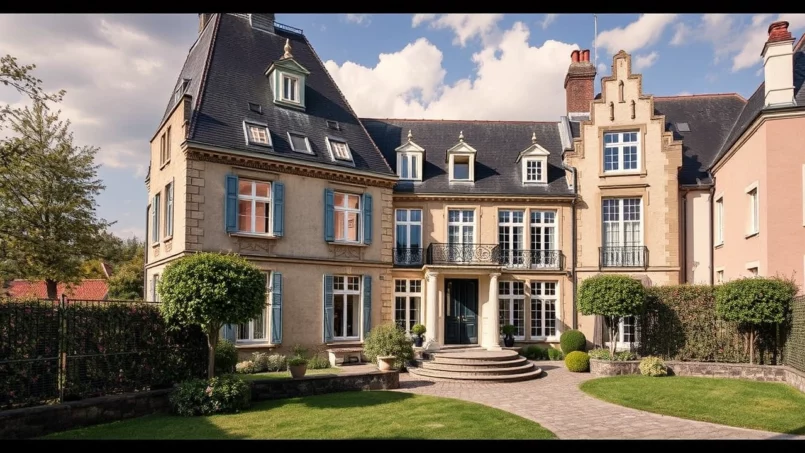
 Published on and written by Cyril Jarnias
The Belgian luxury property market is no longer a niche segment. With an estimated value of around 5 billion euros in 2025 and an estimated annual turnover of 2 billion euros, this segment has established itself as a full-fledged pillar of the residential real estate sector. In a country where residential prices are still increasing by about 3% per year, the high-end segment displays its own momentum, driven by Belgian and international wealth, but held back by supply constraints, taxation, and regulation.
The luxury market in Belgium is evolving towards hyper-connected and sustainable properties, such as penthouses in Brussels, design villas in Knokke-Heist, renovated townhouses with energy efficiency, or apartments in mixed-use towers. It is characterized by a balance between scarcity, regulatory pressure, and the search for long-term investments.
Solid growth against a backdrop of a stable economy
Various studies converge: the Belgian luxury property market is on a steady growth trajectory. Projections mention a compound annual growth rate exceeding 4% until 2033, with some scenarios even suggesting an average progression of around 9% per year for the 2025‑2032 period. In practice, market observers estimate an annual increase of 3 to 4% for this segment, which remains robust in a European context marked by rising interest rates and price corrections.
Belgium’s GDP stands at around 578 billion dollars, the foundation of a stable and diversified economy.
In the overall residential market, resilience is evident: housing prices increased by 3.58% year-on-year in the third quarter of 2024, even as many neighboring countries experienced real-term declines. Projections anticipate increases of around 3% in 2025 and 3.8% in 2026. In this context, it is not surprising that high-end assets, inherently rarer, have held up better, or even outperformed, particularly in Brussels’ prime neighborhoods or along the coast.
A 5 billion euro market, but highly concentrated
The total value of the luxury property market is around 5 billion euros in 2025. The annual turnover is estimated at 2 billion, a level already reached or exceeded in 2021, when transactions in this segment generated about 2.2 billion euros. Analysts forecast that the market’s value will reach around 6 billion dollars by 2032.
In 2021, the Belgian luxury real estate market was characterized by limited volume, with only 1,247 properties for sale at 1 million euros or more. Transactions were distributed as follows: 1,222 in Flanders, 302 in the Brussels-Capital Region, and 169 in Wallonia. The municipality of Knokke‑Heist dominated this segment with 288 high-end sales, demonstrating the geographical concentration of this market.
The landmark episode remains the sale of a property for over 30 million euros in April 2022, a transaction handled by BARNES Léman, which shows the heights Belgian ultra-luxury can reach in exceptional cases.
A highly contrasted luxury geography
The Belgian luxury market is first and foremost a market of location. Price gaps between municipalities, neighborhoods, and even streets are considerable, far beyond what the national average might suggest.
Brussels, international showcase and heart of the prime market
Brussels remains the engine of the luxury segment, driven by the presence of European institutions, NATO, thousands of multinationals, and a population where 70% are estimated to have foreign origins. The region has nearly 1.25 million inhabitants, over 3,000 international organizations, and a significant percentage of expatriate executives.
Prices reflect this. The average price per square meter there exceeds €3,400/m² for apartments and €3,300/m² for houses, with much higher peaks in the most prestigious streets. In thoroughfares like Kasteeltjeslaan in Uccle or Rue du Buisson in Brussels-City or Ixelles, prices exceed €5,500/m², and even approach €5,700/m². Neighborhoods such as Avenue Louise, Abbaye de la Cambre, Bois de la Cambre, or Place Brugmann concentrate a significant portion of the high-end supply.
Price figures illustrate this intra-Brussels hierarchy.
| Neighborhood (Brussels) | Avg. Price €/m² | Avg. Rent (approx.) | Annual Trend |
|---|---|---|---|
| Ixelles | 4,257 | €1,374/month | +3.7% |
| Uccle | 4,013 | €1,200–1,500/month | +2.9% |
| Etterbeek | 3,956 | €1,100–1,300/month | +3.1% |
| Watermael‑Boitsfort | 3,815 | €1,100–1,400/month | +2.8% |
| Auderghem | 3,721 | €1,050–1,350/month | +4.2% |
| Saint‑Gilles | 3,691 | €900–1,100/month | +3.5% |
| Schaerbeek | 3,224 | €850–1,000/month | +4.8% |
| Evere | 3,055 | €800–950/month | +3.9% |
For high-end single-family homes, the entry price frequently exceeds 1 million euros, particularly in Uccle, Woluwe‑Saint‑Pierre, or Rhode‑Saint‑Genèse, on the outskirts of the capital. In the third quarter of 2024, the median price of a 4-facade house in Brussels reached over one million euros (€1,020,250), a level that anchors the metropolis in the category of European prime markets.
Knokke‑Heist and the coast: the multi-million dollar seaside dream
On the Belgian coast, Knokke‑Heist dominates the luxury market without competition. The municipality ranks as the most expensive in the country, with a median house price around €840,000, but the reality of the high-end segment far exceeds this threshold. The average price of a luxury villa there exceeds 2 million euros, and prices in certain neighborhoods like Bronlaan – Het Zoute can reach median values of 3.1 million euros for the top 25% of the most expensive transactions.
Figures for the most expensive neighborhoods and streets give a glimpse of this concentration of wealth.
| Area / Street (Knokke-Heist) | Typical Price or P75* |
|---|---|
| Bronlaan – Het Zoute | ≈ €3,100,000 (P75) |
| Kalverkeetdijk‑Zuid | ≈ €1,530,000 (P75) |
| Zeedijk – Het Zoute | ≈ €1,295,000 (P75) |
| Duinbergen – Albertstrand | ≈ €1,080,000 (P75) |
| Albertstrand | ≈ €875,000 (P75) |
| Knokke Heilig Hart | ≈ €785,000 (P75) |
P75: price at the 75th percentile, i.e., for the top 25% of the most expensive sales.
Since 2010, villa prices in Knokke-Heist have increased by about 22%, confirming their enduring appeal by the sea.
Inland Flanders, Brabant, and upscale “green” municipalities
Beyond the coast, a series of Flemish and Brabant municipalities stand out. Sint‑Martens‑Latem, Kraainem, Wezembeek‑Oppem, Tervuren, as well as Schilde, Keerbergen and Zoersel show median house prices ranging between €485,000 and €690,000, often for spacious properties on large wooded plots.
Some data illustrate this mapping.
| Municipality (houses, median price) | Median Price (€) |
|---|---|
| Knokke‑Heist | 840,000 |
| Sint‑Martens‑Latem | 690,000 |
| Kraainem | 577,500 |
| Wezembeek‑Oppem | 550,000 |
| Rhode‑Saint‑Genèse | 540,000 |
| Tervuren | 520,000 |
| Schilde | 515,000 |
| Keerbergen | 492,000 |
| Zoersel | 485,000 |
| Lasne | 535,000 |
Neighborhoods like Ter Borcht – Voshol in Brasschaat, Kapellenbos in Kapellen, or Koningshof in Schoten show prices in the range of €900,000 to nearly €1.8 million for transactions in the top quartile, making them pockets of discreet grand luxury, often sought by wealthy families wishing to remain close to Antwerp or Brussels while enjoying a green setting.
Antwerp, Ghent, Bruges: cultural metropolises moving upmarket
Antwerp, the country’s second city and a major European port, has established itself as a full-fledged high-end market. Its historic center, quays like Cockerillkaai, Sint‑Aldegondiskaai or Napoleonkaai, as well as flagship projects like the Antwerp Tower, concentrate a supply of luxury apartments and penthouses. Prices there regularly exceed €4,000/m² in prime sectors, while the city center averages around €2,880/m² and the periphery about €2,370/m².
An exceptional real estate project offering 240 new apartments and penthouses, characterized by its modern design and privileged location in the heart of Antwerp.
Large glass facades up to 30 m in length, interior loggias, and panoramic views.
Underground parking and apartments designed for a premium living experience.
Located steps from the central station, the pedestrian Operaplein, and the Meir shopping street.
Attracts affluent Belgians and international investors seeking premium rental products.
Ghent and Bruges, with average prices ranging between €2,000 and €3,800/m², offer a unique mix of historic heritage and economic dynamism. In Bruges, a UNESCO World Heritage site, some character properties trade at prices comparable to those in upscale Brussels neighborhoods, especially when they combine central location, architectural charm, and careful energy renovation.
Who buys Belgian luxury?
The profile of luxury property buyers in Belgium has evolved profoundly. Where, just a few years ago, international clients dominated, Belgian buyers now represent nearly 75% of prestige transactions, compared to about 50% three years earlier. The rise of domestic high-net-worth individuals – 73 families alone holding around 23 billion euros in savings – partly explains this shift.
HNWI, expats, and foreign investors
Demand is driven by a growing population of HNWIs (wealth exceeding 1 million dollars excluding primary residence) and UHNWIs (over 30 million dollars), both Belgian and foreign. International buyers come mainly from France, the Netherlands, the United Kingdom, but also from the Middle East and Asia. Brussels particularly attracts this target, due to its function as the European capital, the presence of NATO, countless lobbies, law firms, and regional headquarters of multinationals.
Demographics favor the market: Belgium has over 2.2 million residents born abroad, and Brussels saw 56,166 people settle from abroad in 2023. In certain neighborhoods popular with expatriates, rental vacancy rates are very low, and in Flanders, it is estimated that 40 to 50 people sometimes compete for the same rental property.
Analysis of the Belgian real estate market
A country open to foreign capital
Legally, Belgium adopts a very permissive approach to foreign real estate investment. There are no restrictions on property purchases by non-residents, whether individuals or companies. Foreigners enjoy the same property rights and legal recourse as locals, with no limit on the number or value of properties held.
Major Belgian banks (BNP Paribas Fortis, KBC Bank, Belfius, ING Belgium) readily grant loans to non-residents. The loan-to-value (LTV) ratio for this clientele is generally between 60% and 75%, compared to up to 90% for a resident buying their primary residence. Late 2024-early 2025, interest rates for a 20-year loan are around 3% to 3.2%, after peaking in late 2023.
This accessibility, combined with the absence of a general wealth tax, numerous double taxation treaties, and possible exemptions on capital gains from primary residences, enhances the country’s appeal for mobile wealth seeking a pied-à-terre or a diversification hub.
What is bought? Villas, apartments, waterfront, and heritage properties
Luxury properties in Belgium are roughly divided into two main families: single-family homes (villas, townhouses, country estates) and apartments/penthouses. Houses and villas dominate in value volume in the very high-end segment, but the weight of apartments continues to grow in metropolitan areas.
Houses and villas: space, privacy, outdoors
In the house category, several sub-segments stand out. Contemporary villas, often highly energy efficient, with a swimming pool, large gardens, and advanced home automation, are mainly located on the outskirts of Brussels, in Knokke‑Heist, in Flemish green municipalities, or in certain sought-after Walloon villages.
19th or early 20th-century townhouses and mansions, with cut stone and high ceilings, are more concentrated in Brussels (Uccle, Ixelles, Saint‑Gilles, Schaerbeek), sometimes converted into multi-family residences or fully renovated private homes, with extensive energy upgrades to meet new regulations.
In general statistics, 4-facade houses show highly differentiated median prices by region:
| Region | 4-facade house, median price Q3 2024 (€) |
|---|---|
| Brussels‑Capital | 1,020,250 |
| Flanders | 419,900 |
| Wallonia | 310,000 |
These figures encompass the entire market, not just luxury, but give an idea of the baseline gap on which premiums related to prime location, size, and amenities are added.
Apartments, penthouses, and mixed-use residences
In large cities, luxury is increasingly represented by apartments, often on the top floor (penthouses), benefiting from panoramic terraces, elegant entrance halls, concierge services, and sometimes shared amenities (gyms, spas, coworking spaces).
Average price per square meter for apartments in Brussels in 2023
Antwerp, with average prices of around €3,200/m² for new apartments in 2024, is multiplying projects like Initium or Montevideo, which combine upscale housing with fitness spaces, coworking, or soft mobility services, in line with mixed-use and sustainable neighborhoods. Ghent, with new construction prices approaching €3,800–4,200/m², follows a similar trajectory.
Waterfront and waterside properties
The coast remains a strong marker of the luxury market, with a significant premium for sea views, direct beach access, or immediate proximity to the most prestigious dikes. Apartments on the Zoute dike, second-row villas with large gardens and partial sea views, or lakefront properties (like at Galgenweel near Antwerp) enjoy strong demand, including for high-end seasonal rentals.
Prices driven by scarcity, energy, and taxation
If Belgian luxury is doing well, it is also because supply remains limited. Urban planning constraints, stricter energy regulations, rising construction costs, and the scarcity of permits in some regions reduce the flow of new properties meeting the highest standards.
New supply under pressure
In 2023, Belgium nevertheless recorded the strongest growth in housing construction per capita in Europe, but the trend quickly changed. Between early 2023 and late 2024, residential building permits fell by nearly 14% over nine months, to 16,448 permits, while the number of authorized dwellings decreased by about 9% to 34,059 units. In Brussels, the drop is even more pronounced, with a decline of around 39% in residential building permits over the same period.
A structural deficit of 375,000 homes is projected by 2030, while renovations remain rare (1.5% of houses and 1% of apartments per year). In the luxury segment, this leads to longer completion times, increased costs, and higher valuation for existing, well-located properties that already meet standards.
Energy, the new segmentation criterion for luxury
One of the major shifts in recent years is the increasing weight of energy performance in price formation. Flemish regulations, for example, require buyers of homes with a poor energy certificate (E or F) to renovate them to reach at least a D label within five years. In practice, this has created a clear price gap: in Flanders in 2023, homes with an A or B certificate saw their prices increase by an average of 1.5%, while properties rated E or F lost about 1.6%.
Sales premium for A-rated properties compared to D-rated homes in France.
For the luxury segment, this means that large, poorly insulated older houses are increasingly difficult to sell without a major renovation project, while new low-energy villas, A+ new apartments, or already rehabilitated historic properties command a significant premium.
Heavy but refocused taxation
Transaction costs remain high in Belgium, particularly for luxury purchases, where the absolute amount of taxes is considerable. Depending on the region, standard registration duties are around 12% in Flanders and 12.5% in Wallonia and Brussels, although preferential regimes have been introduced for primary residences.
Standard registration duty rate in Brussels, against which the new reductions in Flanders and Wallonia are compared.
In the high-end segment, these benefits mainly benefit wealthy families buying their primary residence, while investors or multi-property owners remain subject to the highest rates. To this are added notary fees (on average 1.6% of the price, including 21% VAT), appraisal fees, the annual tax on cadastral income, as well as potential capital gains tax for properties resold within short timeframes (up to 33% for land sold within the first five years, 16.5% for a building resold within five years outside of the primary residence).
In practice, the “full cycle” of an investment, from purchase to resale, can represent cumulative transaction costs of around 10 to 20% of the price, which encourages luxury investors to adopt a long-term holding strategy.
A deeply digitized and technology-driven market
Belgian luxury is not immune to major technological trends. Both in terms of products and sales processes, digitalization has become standard.
Smart homes, home automation, and high-end security
Belgium is among the most advanced European countries in integrating smart home technologies. It is estimated that about 17% of households already use connected alarm systems, and projections indicate that one in three households worldwide will be equipped with smart home technology by 2027. Nationally, forecasts anticipate a significant share of new residential developments classified as “smart homes,” with centralized home automation, optimized energy management, remote control, and electric vehicle charging stations.
In the luxury segment, technological and sustainable features are now expected standards. They include advanced home automation (security, energy management, connected appliances) and wellness systems. These installations, like charging stations and photovoltaic panels, significantly increase the property’s value: a heat pump can add €15,000 to €25,000, and solar panels €10,000 to €20,000.
Virtual tours and international marketing
To reach a dispersed clientele between Brussels, Paris, London, Dubai, or Hong Kong, major agencies – Engel & Völkers, Sotheby’s International Realty, Christie’s International Real Estate, Be Luxe Belgium, Home Invest Belgium, or IMMOBEL – heavily rely on virtual tours, augmented reality, and multilingual online platforms. Portals like Immoweb, Zimmo, Logic‑Immo, or Immovlan have become essential showcases, but the luxury segment distinguishes itself with targeted campaigns, high-quality videos, and a strong presence on specialized social networks.
The Belgian luxury real estate market is becoming more international, as shown by the arrival of Christie’s International Real Estate in 2023 through a local partnership and the presence of other global brands. It remains moderately concentrated: the top ten players account for 40 to 50% of sales, with the rest covered by numerous specialized boutiques and independent agencies.
High-end rental: yield and rental tension
The rental market represents about 30% of the Belgian residential stock, with a very high proportion of tenants in Brussels (about 60% of households). In major cities, rents have increased significantly, partly due to rising interest rates that have pushed some households away from homeownership.
In Brussels, average rents exceed €1,200 per month for a standard apartment, and semi-detached properties can rent for around €1,850 on average. In prime areas, a one-bedroom apartment frequently rents for over €1,200–1,300, and two-bedroom units go for around €1,500 or more. Nationally, the average rent is around €949 per month, again illustrating the Brussels premium.
The average gross yield for high-end apartments in Brussels, the highest among the major Belgian cities mentioned.
Rental tension is particularly strong in Flanders, where there can sometimes be between 40 and 50 serious candidates for the same property. Vacancy rates remain low in major cities (around 5% in Antwerp, 5.2% in Ghent, slightly more in Brussels), fueling a continuous rise in rents, estimated at nearly 18% since 2021.
A protective but complex legal framework
Belgium stands out for a highly protective legal framework for property rights, with a property rights index of 92 in 2024, well above the global average, and a relatively efficient judicial system (fewer than six civil and commercial cases per 100 inhabitants in 2021). Any real estate transfer must go through a notary, who guarantees the validity of the deed, proper handling of funds, and registration of the title.
For foreign buyers, it is generally recommended to be assisted by both a mandatory notary and a bilingual local lawyer. This combination is essential to navigate the complexity of the Belgian real estate market, marked by regional variations (three Regions with distinct tax rules and a multilingual context), the complexity of urban planning regulations, and environmental issues (like soil pollution or flood risks). Due diligence should systematically include verification of property titles, urban planning compliance, analysis of the energy performance certificate (PEB/EPB), and, for co-owned properties, review of the accounts and co-ownership regulations.
Challenges and risks: expensive construction, regulated credit, affordability in question
Despite its dynamism, the Belgian luxury property market is not without risks. Rising construction costs, stricter energy requirements, permit complexity, and prudent credit regulation weigh on the prospects of some projects.
Construction costs and supply shortage
Materials, labor, and technical standards have significantly increased construction costs since the 2022 energy crisis. Household investment in construction has fallen by about 5.4% since its peak in early 2022, and confidence in the sector has deteriorated, leading to a slowdown in new projects, including in the high-end segment.
The decline in new housing supply meets structurally strong demand, fueled by demographics and evolving lifestyles (teleworking, search for space, quality of life). This imbalance should maintain upward pressure on prices in the most sought-after neighborhoods.
Stricter credit conditions
In the general mortgage market, Belgian banks have already granted nearly 30.8 billion euros in new loans in 2023, with the total number of outstanding loans exceeding 240 billion euros by the end of 2024. Belgium ranks among European countries with the highest number of mortgages per capita. While rates have risen, peaking in late 2023 before stabilizing around 3–3.3% for 20-year terms in 2024‑2025, they remain relatively low compared to other European markets.
Prudential authorities have tightened credit granting conditions, particularly for high loan-to-value (LTV) loans and for investors. For luxury properties exceeding €500,000, the maximum LTV is often limited to 70-80%, requiring a larger personal contribution. Furthermore, rising interest rates have increased the debt service-to-income (DSTI) ratio, reducing the borrowing capacity of some borrowers, including those with affluent profiles.
Affordability and perception of overvaluation
On a macro level, several models indicate a slight overvaluation of the Belgian residential market, although this assessment varies. Some studies mention an overvaluation of 36% relative to income (price-to-income) in the second quarter of 2024, while the interest-rate-adjusted overvaluation would fall to about 17%. Other more sophisticated models (KBC Economics, ECB, Belfius) range from slight overvaluation (often below 10%) to even slight undervaluation depending on assumptions.
For the luxury segment, which is more liquid and less dependent on bank financing, the risk of a sharp correction seems limited in the short term, especially due to the chronic scarcity of prime properties. But the perception of a “pricey” market is well established: more than half of Belgians consider housing unaffordable, and 86% believe the climate targets applied to the housing stock are unrealistic.
What future for Belgian luxury real estate?
Looking ahead to 2030, several forces will shape the Belgian luxury property market. The first is demographic and economic: a high urban population (98% of inhabitants live in urban areas), an expected increase in the number of households, the growing strength of technology hubs (Brussels, Antwerp, Ghent, Leuven), and the permanence of Brussels as a European political center will guarantee a solid base of high demand.
The second is environmental and regulatory. Renovation obligations, the generalization of demanding energy labels, the goal of a carbon-neutral residential stock by 2050, and the evolution of tax incentives (reduced VAT rates to 6% for some demolition-reconstruction projects, new performance standards) will favor the most virtuous properties and penalize those that cannot be effectively upgraded.
Technological evolution, with the development of smart homes, residential IoT, electric vehicle charging stations (often mandatory and tax-advantaged), and integrated digital services (like coworking or digital concierge), is becoming a luxury standard beyond finishes and location.
Finally, the fourth is financial and geopolitical. The European Central Bank’s interest rate trajectories, risks of a global economic slowdown, geopolitical tensions, and competition from other asset classes (art, private equity, digital assets) will influence the choices of HNWIs and UHNWIs. To date, the combination of a relatively serene political environment, taxation without a general wealth tax, a protective legal system, and a strategic geographical location at the heart of Europe nevertheless argue for maintaining Belgian luxury real estate among the favored assets of major fortunes.
The Belgian luxury real estate market is expected to continue growing, but in a more selective manner. Exceptional, sustainable, and well-located properties will see their value reinforced, while energy-intensive or poorly positioned properties risk becoming niche assets. For investors and buyers, the key criteria are now: excellent location, optimal energy performance, and intrinsic construction quality.
A French entrepreneur around 50 years old, with a well-structured financial portfolio already in Europe, wanted to diversify part of his capital into residential real estate in Belgium to seek rental yield and exposure to a stable eurozone market. Allocated budget: 400,000 to 600,000 euros, without using credit.
After analyzing several markets (Brussels, Antwerp, Liège), the chosen strategy consisted of targeting a rental property or a luxury apartment in a dynamic urban neighborhood, combining a target gross rental yield of 5 to 6% – “the higher the yield, the greater the risk” – and medium-term appreciation potential, with an overall ticket (acquisition + notary fees + potential renovations) of around 500,000 euros. The mission included: selection of the city and neighborhood, connection with a local network (real estate agent, notary, accountant), choice of the most suitable holding structure (direct ownership or a Belgian holding company), and definition of a diversification plan over time.
Disclaimer: The information provided on this website is for informational purposes only and does not constitute financial, legal, or professional advice. We encourage you to consult qualified experts before making any investment, real estate, or expatriation decisions. Although we strive to maintain up-to-date and accurate information, we do not guarantee the completeness, accuracy, or timeliness of the proposed content. As investment and expatriation involve risks, we disclaim any liability for potential losses or damages arising from the use of this site. Your use of this site confirms your acceptance of these terms and your understanding of the associated risks.

Cyril Jarnias is an independent expert in international wealth management with over 20 years of experience. As an expatriate himself, he is dedicated to helping individuals and business leaders build, protect, and pass on their wealth with complete peace of mind.
On his website, cyriljarnias.com, he shares his expertise on international real estate, offshore company formation, and expatriation.
Thanks to his expertise, he offers sound advice to optimize his clients' wealth management. Cyril Jarnias is also recognized for his appearances in many prestigious media outlets such as BFM Business, les Français de l’étranger, Le Figaro, Les Echos, and Mieux vivre votre argent, where he shares his knowledge and know-how in wealth management.





