
 Published on and written by Cyril Jarnias
Beyond the postcard image, Austria is undertaking a profound overhaul of how its cities develop, house their residents, facilitate mobility, and protect themselves from the climate. Between major housing projects, building energy transitions, new subway and railway lines, ambitious climate plans, and “sponge cities,” the country has embarked on a decisive decade.
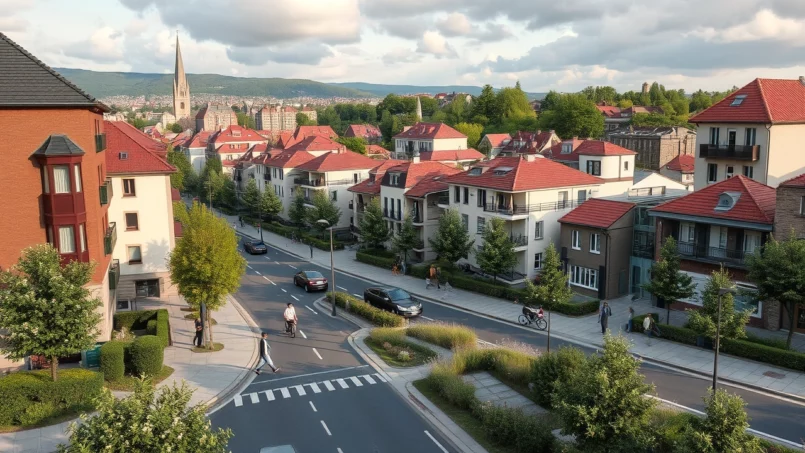
Several Austrian cities, including Vienna, Graz, Linz, Salzburg, and Innsbruck, are experimenting with urban models integrating housing, climate adaptation, sustainable mobility, and social inclusion, with a common goal: improving quality of life.
Housing a booming urban population without sacrificing affordability
One of the main drivers of urban projects in Austria is very simple: the urban population continues to grow. Approximately 64% of the country’s inhabitants already live in cities, and in the capital, the growth is spectacular. Vienna, with a current population of about 1.9 million, is expected to reach 2 million before 2030; the metropolitan area will exceed 3 million. Since the early 2000s, Vienna’s population has climbed by about 25%, and the expected milestone of 200,000 additional residents by the end of the decade demands massive housing production.
Number of new housing units Vienna plans to build between 2014 and 2025 according to its STEP 2025 urban development plan.
The scale of the effort is particularly visible in new construction. Between 2010 and 2021, 311,100 new buildings were constructed across the country, representing 130 million square meters of usable floor space. In parallel, the social and cooperative housing sector remains a pillar: about a quarter of Austria’s residential stock consists of social housing, and nearly one in four homes nationwide is rented from a non-profit organization or a municipality. Limited-profit cooperatives manage over a million housing units, account for more than 40% of new multi-family construction, and occupy over 80% of the lowest price segment for recent construction.
Over 60% of Vienna’s residents live in subsidized housing.
Regulated rents, a limited-profit sector, and a cooling effect on the entire market
This institutional architecture is not just social; it is also a market stabilization tool. Housing managed by limited-profit associations shows average rents approximately 25% lower than those in the private for-profit sector; municipal rents are even lower. Available data provides an interesting overview:
| Type of rental housing in Austria | Estimated average monthly rent | Key characteristics |
|---|---|---|
| Municipal housing (Vienna) | ≈ €480 | Strong public control, open-ended leases, high protections |
| Limited-profit/Cooperative housing | ≈ €590 | Limited-profit cooperatives, access based on need criteria |
| Unregulated private rental | ≈ €770 | Free-market rents, much faster rate increases |
Studies show a market-cooling effect: each 10% increase in the share of cost-based housing could reduce market rents by about €0.40 per m². In the long term, the strategy of mass-producing subsidized housing thus exerts downward pressure on all prices, including in the private sector.
Between 2021 and 2023, rents sometimes increased by 25%, while rental supply fell by over 13% in 2024, as demand is expected to grow by nearly 10%. In response, the government adopted 55 measures, including a freeze on regulated rents in 2025, cap increases of 1% (2026) and 2% (2027), limitations on increases in the unregulated sector, and extending the minimum lease term from three to five years.
The budgetary impact is far from marginal. Without intervention, the rent increases scheduled for April 2025 would have represented a cumulative additional cost of around €138 million for tenants. The announced freeze will affect over a million housing units, including more than 500,000 older apartments, nearly 697,000 cooperative units, and 220,000 municipal apartments in Vienna.
Model neighborhoods for compact, mixed-use, and climate-neutral urbanism
The Austrian discourse on the cities of tomorrow does not stop at the mere question of the number of homes. It also concerns urban form, the mix of functions, the place of nature, and carbon footprint. Vienna champions compact, land-efficient urbanism: it boasts the lowest amount of sealed surface area per capita in the country, at about 79.3 m² per person, compared to a national average of 330.1 m². Half of its municipal territory is still covered by green spaces, and about one-third of the city’s surface area is public green space, equating to nearly 13,000 hectares.
Aspern Seestadt, Nordbahnhof, Donau City: major urban laboratories
Among the flagship large-scale projects, the former Aspern air base in eastern Vienna has been transformed into “aspern – Vienna’s Urban Lakeside,” one of Europe’s largest urban expansion projects. On 240 hectares (approximately 800 acres), the city is building a new neighborhood expected to house 20,000 to 25,000 residents and around 20,000 jobs by the late 2020s. The site is designed as a showcase for sustainable cities: over 40 hectares of forest have been planted, a central artificial lake serves as a landscape feature and micro-climate regulator, and buildings test low-energy and positive-energy solutions as part of the “Aspern Smart City Research” program.
The Nordbahnhof neighborhood in Vienna is an example of the redevelopment of a former railway brownfield. On 85 hectares, this former marshaling yard has been transformed into a mixed-use district including housing and offices, notably integrating a 10-hectare park left to spontaneous natural evolution, described as “urban wilderness.” Surveys reveal that resident satisfaction with community life there is nearly 30% higher compared to more conventional neighborhoods.
Donau City, developed on former floodplains between the Old Danube and the canalized river, embodies another facet of the strategy: a hub of office and residential towers, including the DC Tower 1 (250 m high), and the Danube Flats project, announced as one of the tallest residential buildings on the riverbank in Europe.
These projects are often accompanied by structured developer competitions, a control tool that Vienna uses systematically: proposals are evaluated based on criteria of social sustainability, architectural quality, environmental performance, and economic feasibility. Since 1995, every new subsidized housing program in the capital is evaluated using a quality framework, which has progressively raised standards.
Vienna’s strategy is based on an explicit principle of “social mix”: social housing is not reserved for the poorest households, with income ceilings that can go up to 180% of the area’s median income. Access is controlled at entry, but tenants do not have to leave their homes if their incomes rise. This logic creates developments where working-class and middle-class residents coexist.
Mixed-income neighborhoods can generate up to a 35% increase in community connections.
The social zoning policy, introduced in 2018, adds an additional layer: on large development plots in Vienna, two-thirds of floor space must be dedicated to affordable housing, with long-term rent control. The city has 3.2 million m² of land reserves dedicated to social housing, managed by the quasi-public Wohnfonds Wien corporation, tasked with acquiring and preparing land.
Making the city a climate ally: from passive buildings to sponge cities
Austria has set a target of climate neutrality by 2040, an objective adopted both at the federal level and by the City of Vienna. The national climate adaptation strategy, revised in 2024, emphasizes a dual pillar: reducing emissions and adapting to already inevitable impacts. Cities are on the front line.
Since the 1990s, the country has established itself as one of the European pioneers of high-performance building. The “passive house” standard, born in Austria in the mid-1990s, has seen spectacular growth: over 14,000 buildings meet this standard to date, often achieving 75 to 90% savings on heating and cooling needs compared to conventional construction. In the best new multi-family buildings equipped with heat pumps, final energy consumption for heating and hot water can drop to around 12 to 13 kWh per m² per year, a level bringing the sector close to the target climate threshold of 6 kg CO₂e per m² by 2030.
Decarbonizing a massive existing stock: gentle renovation and phasing out gas
While new construction has become highly efficient, the bulk of emissions still comes from the existing building stock. Vienna has launched a large-scale renovation program via the “Wir SAN Wien” campaign and its operational arm WieNeu+, which combines neighborhood renovation, climate adaptation, and citizen participation. Historically, the capital has practiced “gentle renovation” since the 1970s, governed by the 1984 Housing Rehabilitation Act: between 1984 and 2001, nearly 142,000 apartments were upgraded, and the number of dwellings considered under-equipped was more than halved.
The City of Vienna is committed to phasing out the use of gas for heating, hot water, and cooking in its buildings by 2040 through the “Raus aus Gas” (“Out of Gas”) campaign. Approximately 1,400 buildings, representing nearly 95,000 apartments, are affected. To support this transition, a decarbonization bonus of €1,000 to €1,500 is offered to residents to help cover replacement costs. Pilot projects, such as the renovation with timber extensions and heavy insulation of a 1960s complex on Gregorygasse, demonstrate the effectiveness of this approach, reducing energy needs by 87%.
The investments are massive: about 80 renovation projects are underway in municipal housing complexes, with a volume of approximately €800 million. At Deutschordenstrasse, two 1950s buildings are switching to geothermal energy, with on-site information points for tenants. Elsewhere in the country, exemplary renovations like the “Wir inHAUSer” complex in Salzburg (expanding from 75 to 99 units, switching from gas to a combination of waste heat + biomass + photovoltaics, reducing parking in favor of a shared mobility station) show the general direction.
The whole effort is supported by the housing subsidy policy (“Wohnbauförderung”), which mobilized around €2.2 billion in 2023, and by national funds dedicated to decarbonization (around €370 million the same year). In the federal states, these funds are used to finance the additional costs of energy performance, the switch to renewables, and adaptation measures.
Sponge cities to survive heatwaves
The most visible dimension of climate change in cities remains heat. In Vienna, days over 30°C have increased from an average of 9 per year (1961–1990) to over 20 (1991–2020); in the recent decade, the figure is around 28 hot days per year, or even more during peaks like the summer of 2003, which recorded 44 heatwave days and 180 excess deaths. So-called “tropical nights” (where the temperature does not drop below 20°C) are also multiplying: on average, nearly nine nights per year in Vienna between 2011 and 2021, compared to three in previous decades, with a record 42 tropical nights in 2015. Nationally, heat already causes more deaths than road traffic.
To combat urban warming, Vienna is deploying green and blue infrastructure and has mapped its heat islands. A study identifies ten vulnerable districts where temperatures could rise by up to 8°C by 2050 without action.
In response, the capital has launched several concrete programs. The “Coole Straßen” (“Cool Streets”) initiative transformed, starting in 2019–2020, dense streets in vulnerable neighborhoods into cooled spaces: removal of parking, lighter-colored surfaces, plantings, temporary misters. An evaluation on Kirchengasse (7th district) showed that with more trees, vegetated surfaces, and light-colored pavements, the heat stress felt by pedestrians could be reduced by up to 15°C. In Esterházy Park, soil opening, vegetation, and mist installations lowered the perceived temperature by up to 6°C.
Two recently adopted texts structure the action: the 2023 amendment to Vienna’s building code now prohibits the direct discharge of rainwater into the sewer system and strengthens the protection of street trees, while facilitating green roofs and facades; the 2024 revision of the Tree Protection Act introduces stricter obligations regarding replanting and long-term maintenance, with requirements for the quality of replacement species. The “sponge city” principle is spreading: maximum on-site water infiltration, managing runoff to nourish trees and limit flooding, multiplying unsealed surfaces.
These principles do not only concern Vienna. They are also found, for example, in Graz, Innsbruck, or the city of Tulln, where Nibelungenplatz is being converted from a 211-space parking lot into a green space and meeting place, with parking reduced to 54 spaces and 71% permeable surface area. In several urban areas (Linz, Barcelona, Lyon, Budapest, but also Linz and Vienna), tram tracks are gradually being grassed over, adding green corridors, while squares like Johann‑Nepomuk‑Vogl‑Platz or Praterstern are being redesigned according to this model.
The City of Vienna is deploying a €100 million program, “Lebenswerte Klimamusterstadt” (“Liveable Climate Model City”), from 2021 to 2025. It funds about 320 projects across the 23 districts, including shade tree plantings, small green squares, benches, and water features. A specific component also supports building greening and soil unsealing, particularly in inner courtyards.
Parks, forests, and renatured rivers
Beyond streets, large urban nature reserves are also evolving. Vienna plans to maintain a ratio of approximately 50% green space on its territory and is already a pioneer in biodiversity with nearly 40% protected area. Several major projects are upcoming: a “Biodiversity Park” of about 11 hectares will be created in the 22nd district, east of Hirschstetten pond; Donaupark is being reconfigured; Walter‑Kuhn Park (Favoriten) is preparing to offer 10,000 m² of greenery to dense neighborhoods; the vast “Freie Mitte” natural area (93,000 m²) in the 2nd district will be completed soon. The city has also been working for decades on the renaturation of the Wien River between the outskirts and the Danube Canal, a complex but emblematic project of watercourse reclamation.
In other major cities, these types of strategies are integrated into urban plans. Graz established a dedicated thematic program for green spaces as early as the late 1990s, extended by the “Green Net Graz” concept to connect parks, green corridors, and landscapes; Linz adopted a Green Space Plan as early as 1985, updated to maintain a satisfactory “greening degree” on over half of its surface area; Salzburg relies on a Green Space Protection Declaration and a “green space deduction” tool requiring large projects to reserve 15 to 20% of their area for public green spaces; Innsbruck, finally, structures its actions through a green space concept and a dedicated “Tree‑Line‑Concept” for tree alignments.
National estimates suggest that in Austria’s six largest cities, the expansion of green spaces linked to urban growth and adaptation measures could reach 11% by 2050, at the cost of average annual investments of around €119 million for new parks until 2030, then €93 million until 2050, plus increasing maintenance costs (from €7.6 to €13.4 million per year).
Mobility: a silent revolution in urban transport
The other major leg of Austria’s urban transition is mobility. Climate goals require a drastic reduction in emissions from the transport sector, which still accounts for a significant share of national greenhouse gases. In Vienna, about 43% of emissions come from private motorized traffic. The response is deployed both at the federal level, with the 2030 Mobility Masterplan, and locally, via Sustainable Urban Mobility Plans (SUMP) and Sustainable Urban Logistics Plans (SULP).
The 80:20 bet and the €1-per-day transit pass
The capital aims for a modal split of “80:20”: 80% of trips made on foot, by bicycle, or by public transport, 20% by car. Recent figures show significant progress: in 2022, about 35% of trips were on foot, 30% by public transport, with the car share sharply down compared to past decades. The motorization rate has fallen to about 381 passenger cars per 1,000 inhabitants, one of the lowest among comparable metropolises.
Vienna’s public transport network carries nearly 2.4 million passengers per day.
Parking policies reinforce this logic: short-term parking is now generalized in all 23 districts, costing about €5 for two hours on-street, while peripheral park-and-ride facilities charge about €4.40 per day. Vienna didn’t wait for the pedestrian zone trend: its first pedestrian zone, in the old town, was established as early as 1974.
Massive subway expansion and major railway projects
The coming years will be marked by a major project: the U2xU5 project, a combined extension of the U2 and U5 subway lines. This is the city’s largest infrastructure and sustainability project, with 12 new stations and four new interchange hubs. The 5th district, Margareten, will benefit from a subway station for the first time, directly serving approximately 55,000 residents. Full commissioning is now expected around 2030, after delays related to environmental challenges. Estimates suggest this project will generate an additional 300 million public transport journeys per year, save some 550 million car kilometers, and create or consolidate nearly 30,000 jobs.
This is the total amount, in billions of euros, of investments and maintenance planned by Austrian Federal Railways (ÖBB) for the Austrian rail network between 2024 and 2029.
New projects are being funded, such as the future Köstendorf–Salzburg line, quadrupling tracks approaching Salzburg to separate freight, regional, and long-distance traffic, or double-tracking key sections towards Southeastern Europe. Rail freight benefits from a dedicated push: lengthening sidings for long trains, modernizing marshalling yards, supporting industrial sidings.
Zero-emission buses, active mobility, and urban logistics
Urban and regional buses are also set to change their face. The Austrian Recovery and Resilience Plan allocates nearly $960 million to zero-emission mobility, including an initial tranche of about $285 million for purchasing approximately 600 electric or hydrogen buses and creating charging or refueling infrastructure. The transposition of the EU Clean Vehicles Directive requires that from 2021, 45% of new public buses be “clean” (half of them zero-emission), then 65% from 2026, always with at least half zero-emission. By the second quarter of 2026, at least 650 decarbonized urban buses must be in operation.
Wiener Linien plans for all its municipal vehicles to be electric from 2025-2026, with a fleet of over 400 zero-emission buses. No new fossil-fuel buses will be purchased after 2026. To support this transition, Wien Energie opened the capital’s first hydrogen refueling station for buses and trucks in 2021.
Other cities are not standing by. Graz tested a fuel cell bus as early as 2019 with Postbus, and the state of Carinthia is leading the “H2 Carinthia” project to deploy buses running on local green hydrogen, with five vehicles already acquired. In Burgenland, electric bus lines and an on-demand taxi service (BAST) are being expanded.
In parallel, all major cities are working on active mobility. National Masterplans for walking and cycling have inspired regional strategies (like in Styria or Salzburg), and many “school streets” have been established to secure school surroundings. The capital has deployed a modernized bike-sharing system (WienMobil Rad), integrated into multimodal WienMobil stations that combine tram, bus, train, car-sharing, and scooters. A single app, WienMobil, allows planning, booking, and paying for all these services.
Urban logistics is also the subject of experiments: a “Logistics 2030+” plan for the Vienna–Lower Austria region includes 35 measures and 133 actions, ranging from nighttime deliveries to temporary hubs in unused daytime depots (Remihub project), to the electrification of delivery fleets.
Funding the transformation: the key role of public and European investment
This urban transformation, whether concerning affordable housing, energy renovation, public transport, or green spaces, relies on large financial scales. At the Austrian level, nearly €3 billion in federal housing funds are allocated annually. Vienna, for its part, spends on average about €465 to €470 million per year on housing policies, supplemented by approximately €440 million in dedicated revenue (a 1% payroll tax generating around $240 million, plus about €200 million from loan repayments, ground lease fees, and rental income).
The European Investment Bank has provided up to €800 million in funding to Erste Bank for housing over the past six years.
The figures involved are summarized in the table below:
| Mechanism / Actor | Approximate Amount | Main Purpose |
|---|---|---|
| Federal housing funds | ≈ €3 billion / year | Construction and renovation of affordable housing |
| Wohnbauförderung (subsidies 2023) | ≈ €2.2 billion | Brick-and-mortar subsidies and energy renovation aid |
| Vienna’s annual housing expenditure | ≈ €465–470 million | Municipal stock, cooperatives, new construction |
| Vienna’s dedicated housing revenue | ≈ $440 million / year | Payroll tax, repayments, rents |
| EIB–Erste Bank financing (total) | €800 million (over 34 years) | Subsidized / non-profit rental housing |
| Housing investment linked to these loans | > €2.25 billion | Approx. 11,000 homes over several years |
| Recent EIB loans Salzburg/Innsbruck | €175 million | Affordable and energy-efficient apartments |
The sustainable building sector also benefits from national research programs. The “Buildings of Tomorrow” program launched in 1999 by the ministry responsible for transport, innovation, and technology has supported some 300 projects out of over 700 proposals, with more than €35 million in grants, including 25 full-scale pilot projects across the country. A second phase focused on positive-energy buildings. More recently, the “Lighthouses for resilient cities 2040” series or innovation labs like “Smart Cities Demo” support entire neighborhoods.
Social inclusion, homelessness, and climate justice: blind spots to address
The strength of the Austrian model should not obscure its areas of vulnerability. On the social front, approximately 20,000 people are officially registered as homeless in Austria, but BAWO, the national platform of services for homeless people, estimates the real figure, including hidden homelessness, is about twice as high, for a population of 9 million. A state-commissioned report in 2021 concluded that 25,000 affordable housing units incorporating a “Housing First” strategy could end homelessness by the middle of the decade.
Launched in 2021 with funding from the Federal Ministry of Social Affairs, this project tested scaling up the Housing First approach. It mobilized 27 NGOs across all federal states and the limited-profit housing sector. Between September 2021 and April 2023, it enabled over 1,100 people to settle permanently in about 550 homes, with over 60% women among the assisted adults. The usual initial fees required from tenants were covered by a public budget, and associations were supported by training, meetings, and webinars coordinated by BAWO.
The cooperative sector, originally largely reserved for Austrian nationals, is gradually opening to an increasingly diverse population – in Vienna, about 30% of residents are foreign nationals, but the naturalization rate remains below 1%. However, Austrian legislation does not collect data on ethno-racial origin, complicating the measurement of discrimination and the implementation of explicit racial justice policies in housing. Some observers also point to obstacles created by strict citizenship and residency status requirements for access to certain types of housing.
Producing housing, preserving existing affordable stock, protecting tenants, preventing exclusion, and promoting a new narrative around the caring city are considered inseparable.
Local authorities and the Global Policy Leadership Academy
A Western Europe watched… and a model under pressure
Viewed from abroad, Austria, and particularly Vienna, has become a reference point. The capital has been ranked several times as the world’s most livable city by Mercer and the Economist Intelligence Unit, first in several “smart city” and “green city” rankings. Field studies, like the “Vienna Social Housing Field Study,” compare, for example, the case of Vienna to San Diego: 1.9 million inhabitants and $470 million in annual social housing expenditure on one side, 1.4 million inhabitants and only $13 million for affordable housing on the other. While almost 60% of Viennese live in public or social housing, North American cities struggle to reach double-digit figures.
The sustainability of Vienna’s social housing model is threatened by rising interest rates (mortgage rates at 3.2%), the impending end of credit regulations like KIM, labor shortages, and construction cost pressures. These factors are expected to cause housing completions to drop, from 43,400 in 2023 to fewer than 30,000 projected for 2025, despite innovative solutions like the prefabricated timber WohnBAUM program.
Furthermore, aging infrastructure, including transport (tunnels, stations, railways), and recruitment difficulties in public operators are causing delays and disruptions. The 2023 report of the Vienna Court of Audit highlights the lack of staff renewal at Wiener Linien, despite recent efforts on salaries and language training.
Austrian cities are adopting a strategy of planned and heavily regulated urbanism to respond to the climate emergency. This approach includes transforming former airfields into carbon-neutral districts, converting 1950s complexes to geothermal energy, drastically reducing space for cars, greening parking lots, and financing thousands of cooperative housing units. This direction is crucial in a context where climate damage already costs the country over €2 billion per year, with projections reaching up to €12 billion by 2050 without additional action.
Upcoming urban development projects in Austria can thus be read as the concrete implementation of three deliberate political choices: considering affordable housing as essential infrastructure on par with rails or water networks; making the city a tool for climate protection, rather than a passive victim of warming; and placing collective and active mobility at the heart of urban design. It remains to be seen to what extent this model, currently envied, will be able to sustain and adapt to the test of time, economic crises, and upcoming social tensions.
A French business executive, around 50 years old, with a well-structured financial portfolio in Europe, wanted to diversify part of his capital into residential real estate in Austria to seek rental yield and euro exposure outside of France. Allocated budget: €400,000 to €600,000, without using credit.
After analyzing several markets (Vienna, Graz, Linz), the chosen strategy consisted of targeting a family apartment in a recent building in an up-and-coming neighborhood of Vienna or Graz, combining a target gross rental yield of about 4–5% – keeping in mind that “the higher the yield, the higher the risk” – and medium-term appreciation potential, with an all-in cost (acquisition + fees + possible refurbishment) of around €500,000.
The mission included: city and district selection, connection with a local network (real estate agent, notary, tax advisor), choice of the most suitable structure (direct ownership or via a holding company), and definition of a diversification plan over time. This type of support allows one to benefit from opportunities in the Austrian market while managing legal, tax, and rental risks.
Disclaimer: The information provided on this website is for informational purposes only and does not constitute financial, legal, or professional advice. We encourage you to consult qualified experts before making any investment, real estate, or expatriation decisions. Although we strive to maintain up-to-date and accurate information, we do not guarantee the completeness, accuracy, or timeliness of the proposed content. As investment and expatriation involve risks, we disclaim any liability for potential losses or damages arising from the use of this site. Your use of this site confirms your acceptance of these terms and your understanding of the associated risks.

Cyril Jarnias is an independent expert in international wealth management with over 20 years of experience. As an expatriate himself, he is dedicated to helping individuals and business leaders build, protect, and pass on their wealth with complete peace of mind.
On his website, cyriljarnias.com, he shares his expertise on international real estate, offshore company formation, and expatriation.
Thanks to his expertise, he offers sound advice to optimize his clients' wealth management. Cyril Jarnias is also recognized for his appearances in many prestigious media outlets such as BFM Business, les Français de l’étranger, Le Figaro, Les Echos, and Mieux vivre votre argent, where he shares his knowledge and know-how in wealth management.





