
 Published on and written by Cyril Jarnias
Sandwiched between Argentina and Brazil, with a long Atlantic coastline, Uruguay is attracting a growing number of expatriates, investors, retirees, and digital nomads. Ranked the safest country in South America by several indexes, a stable democracy with low corruption, a high standard of living, and a very progressive society: the picture is enticing, but it’s essential to understand the finer details before packing your bags.
This guide covers all the essential aspects for a long-term move to Uruguay: choosing cities and neighborhoods, residency paperwork, local taxation, how the healthcare system works, cost of living estimates, the real estate market, opening a bank account, schooling for children, remote work possibilities, and details about daily life.
Understanding the Country Before Moving
Uruguay has about 3.5 million inhabitants, nearly half of whom live in and around the capital, Montevideo. The landscape is gentle, made up of plains and low hills, with no climatic extremes. The climate is temperate with four distinct seasons: warm summers, cool and humid winters, frequent winds, but no hurricanes or major earthquakes.
Often nicknamed the “Switzerland of South America,” Uruguay stands out for its strong indicators: it is the top Latin American country for rule of law, one of the least corrupt in the Americas, and its democracy is classified as “full.” It has a robust social system and a high per capita GDP in the region. Economically, its currency, the Uruguayan peso (UYU), floats freely without capital controls, and its membership in Mercosur gives it privileged access to neighboring markets.
Uruguayan culture is known for being calm, tolerant, very middle class. Same-sex marriage, legalization of marijuana, regulated abortion, strict separation of Church and State: this is clearly a progressive environment. Maté – a bitter herbal infusion sipped from a gourd – is omnipresent, as are soccer and tango.
Montevideo and the Main Areas for Relocation
For an expatriate, the choice of city and especially neighborhood greatly impacts daily life. Montevideo concentrates the country’s economic, cultural, and academic activity. It is regularly cited as the city offering the best quality of life in South America by studies like Mercer.
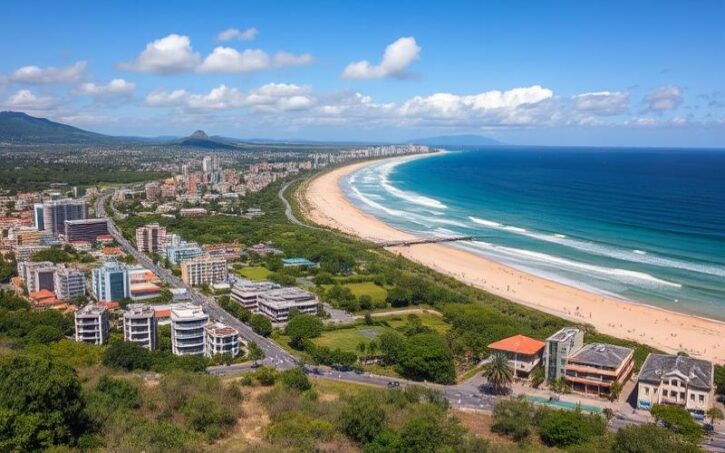
The city is built around the Río de la Plata and a long coastal promenade, the rambla, stretching for 20 to 25 km. People walk, jog, bike, and drink maté watching the sunset, especially near Playa Ramírez. Montevideo has 62 neighborhoods (“barrios”), each with different atmospheres, prices, and profiles.
Ciudad Vieja and Centro: Historic Heart and Downtown
Ciudad Vieja is the original city, a grid of about 8 by 12 blocks lined with colonial, baroque, and classic buildings. It’s home to the port, bank headquarters, government ministries, the Solís Theatre, Mercado del Puerto, Plaza Independencia, and several historic churches. During the day, nearly 100,000 people work there, but barely 16,000 live there: in the evening, the streets empty, except around Plaza Independencia where cafés remain more lively.
Security has been strengthened with more than 3,000 surveillance cameras. In renovated historic buildings overlooking the main squares (Independencia, Matriz, Zabala), one-bedroom apartments start around USD 150,000, with rents starting at about USD 700. For an investor, these locations on the main squares are considered safe bets.
Although there is constant activity during the day, it is recommended to avoid strolling on foot in certain streets of this neighborhood after 9 p.m., even though violence there is much lower than in other Latin American capitals.
Cordón, Barrio Sur, Palermo, Parque Rodó: Young and Student Neighborhoods
North of Palermo, Cordón is home to the main public university, the University of the Republic, as well as the National Library. It’s a student neighborhood, with more affordable rents and vibrant nightlife. Southern Cordón, sometimes nicknamed “Cordón Soho,” is seeing a boom in specialty coffee shops, design boutiques, and small restaurants. For a well-located two-room apartment, rents are around USD 700.
Between Ciudad Vieja and more residential neighborhoods lie Barrio Sur, Palermo, and Parque Rodó, frequented by younger people: universities, bars, pubs, trendy restaurants, a “hipster” vibe. Barrio Sur is the heart of Afro-Uruguayan culture and candombe, the drum parades that resonate year-round. Palermo is experiencing a boom in residential towers, while Parque Rodó offers a large park with a lake, rides, playgrounds, an amphitheater for Carnival, and a very shallow beach ideal for children.
Pocitos and Punta Carretas: The Capital’s “Chic Side”
For many expatriates, Pocitos and Punta Carretas are the natural entry points into the city.
Negotiable purchase price for a two-room apartment in the affluent and densely populated Pocitos neighborhood of Montevideo.
Punta Carretas, on a small peninsula, is the other upscale neighborhood. Next to the Montevideo Golf Club and the city’s chicest shopping mall – a former penitentiary converted into a mall – it features modern buildings with amenities, stately homes, gourmet restaurants, and quality cafés. Rents for a modern apartment often exceed USD 1,200 per month, and a good two-room apartment for sale is priced above USD 200,000. The rambla there is particularly pleasant for running or walking.
To the East: Buceo, Malvín, Punta Gorda, Carrasco
East of Pocitos, Buceo is home to the World Trade Center and Montevideo Shopping. It’s an urban, dense, commercial neighborhood attracting young professionals working in the service sector, especially tech and finance.
Further out, Malvín and Punta Gorda become more residential and family-oriented. Malvín, with its two beaches (Malvín and Punta Gorda) and many single-family homes, offers a calmer atmosphere than Pocitos. You’ll find large supermarkets like Devoto Fresh Market, quite close to North American standards. Rents are not particularly low: peace, quiet, and ocean views come at a price.
Carrasco and Punta Gorda are prestigious, green residential areas. Carrasco, in particular, offers a suburban lifestyle with large houses, embassies, high-end restaurants and hotels (like a Sofitel with a casino), and well-regarded international schools. Ideal for expat families, the neighborhood is also very close to the international airport (5 to 10 minutes by car).
Beyond the city’s administrative limits, Carrasco Este and developments like La Tahona, in the neighboring department of Canelones, offer closed or semi-closed communities around artificial lakes and a golf course, with houses ranging from USD 500,000 to over a million dollars. The law does not allow fully gated neighborhoods within Montevideo proper, hence this development just across the departmental border.
Other Options: Prado, “Budget” Neighborhoods, and Coastal Towns
In the north-central part of the capital, Prado is nicknamed the “green lung” thanks to its immense 106-hectare park, with botanical gardens, a museum, and the presidential residence. You’ll find European-style houses, very little nightlife, and a peaceful, family-friendly atmosphere. The trade-off is that the beach is far away.
For tighter budgets, neighborhoods like La Comercial or Aguada (close to university areas) offer lower rents. Tres Cruces concentrates the large intercity bus terminal and a huge shopping mall, making it a convenient but noisy hub.
Outside Montevideo, expatriates are very interested in coastal towns. Punta del Este, sometimes presented as the region’s “Saint-Tropez,” attracts tourists and investors, with a high season very profitable for short-term rentals. Colonia del Sacramento, a colonial city and UNESCO World Heritage site, attracts with its historic charm and urban projects like +COLONIA. Prices there are above the national average, around USD 1,800/m² for residential real estate.
Cost of Living and Expatriate Budget
Uruguay is one of the most expensive countries in Latin America. Comparative studies rank it as the second most expensive country in the region, with an overall cost of living higher than 68% of the world’s countries. Montevideo is in the top three most expensive cities on the continent.
However, compared to North America or Western Europe, Uruguay often remains somewhat less costly, especially for rents: some estimates put the cost of living about 17% lower than in the United States, with rents up to 60-70% cheaper.
To get a better sense, it’s useful to look at rough estimates in Uruguayan pesos.
Some Daily Price Benchmarks
| Expense Item | Typical Range (UYU) |
|---|---|
| Simple restaurant meal | 450 – 1,200 |
| 3-course meal for 2 (mid-range) | 1,600 – 4,000 |
| Draft beer (pint) | 80 – 250 |
| Cappuccino | 100 – 250 |
| Decent bottle of wine | 200 – 600 |
| City bus ticket | 42 – 61 |
| Monthly transport pass | 1,800 – 4,000 |
| Fixed-line internet subscription | 1,300 – 2,600 |
| Mobile plan (10+ GB) | 400 – 2,000 |
| Movie ticket | 300 – 500 |
| Gym membership (month) | 1,200 – 4,000 |
Regarding housing, the differences are significant between downtown, outskirts, and secondary cities.
| Type of Housing | Average Rent Range (UYU/month) |
|---|---|
| 1 bedroom downtown | 20,000 – 40,000 |
| 1 bedroom outside downtown | 15,000 – 30,000 |
| 3 bedrooms downtown | 30,000 – 80,000 |
| 3 bedrooms outside downtown | 24,000 – 52,000 |
| Private room in shared apartment | 12,000 – 20,000 |
| 1-bedroom apartment downtown (Montevideo/Punta/Salto) | 30,000 – 45,000 |
Utilities for an 80–90 m² apartment (water, electricity, gas, trash) average between 4,000 and 8,000 UYU, with an internet bill around 1,200–1,300 UYU. Electricity is relatively expensive: many households watch their heating use in winter.
For groceries, a single person typically spends between 12,000 and 18,000 UYU per month, while a family budget is more likely between 25,000 and 35,000 UYU. Significant savings can be made by favoring street markets (“ferias”) for your shopping, rather than large supermarkets like Disco, Devoto, or Tienda Inglesa.
Cost of living studies and expatriate testimonials converge on average monthly budgets (rent included) as follows:
| Profile | Typical Monthly Budget (USD) in Montevideo |
|---|---|
| “Frugal” single person | 1,200 – 1,800 |
| Comfortable single person | 1,800 – 2,500 |
| Comfortable couple | 2,500 – 4,000 |
| Family of four | 4,500 – 7,000+ |
In smaller cities or outside the most expensive neighborhoods, these amounts can be significantly lower.
Healthcare System: A Real Strength for Expatriates
Healthcare is one of Uruguay’s major assets for those looking to settle long-term. The country has established a mixed, public and private system that guarantees universal coverage to legal residents.
The Public Pillar: ASSE
The public network, managed by the State Health Services Administration (ASSE), covers the entire territory through hospitals and clinics. Access is virtually free, funded by taxes and the national health fund (FONASA). Consultations, hospitalizations, surgeries, emergencies, tests, imaging, chronic disease management, or basic dental care are covered, with no exclusions based on age or pre-existing conditions.
This pillar, however, has limits: longer wait times for specialists, older infrastructure, overcrowding in some services, low proportion of English-speaking staff. About 39% of the population uses it.
“Mutualistas”: The Most Popular Option
The majority of the middle and upper classes and a large part of expatriates opt for mutualistas: private, non-profit cooperatives attached to hospitals, financed by a monthly membership fee. You become a “socio” of one of these institutions and gain access to its network of clinics, labs, and doctors.
Main benefits and common exclusions in supplemental health insurance contracts.
Family practitioners, specialists, medical imaging, hospitalization, maternity, and preventive programs.
Private ambulance and emergency medical service at home.
Optical care, complex dentistry, and psychotherapy are generally poorly or not covered.
Rates for an expatriate paying directly (outside FONASA) range, depending on the mutualista and comfort level, between about USD 50 and USD 200 per month per person. In the Maldonado department (Punta del Este), basic plans are around USD 50–60, while a “VIP” plan can climb to USD 150–180. Consultations involve small co-payments: a few dollars for a general practitioner, a bit more for a specialist or emergencies.
Some mutualistas impose age limits for membership, generally around 60-65 years old, or require a high entry fee for older members. Others, like Médica Uruguaya or La Asistencial, are more flexible. The main institutions in Montevideo include Asociación Española, Médica Uruguaya, CASMU, Círculo Católico, as well as the highly reputable British Hospital, which offers its own closed plan.
“Premium” and International Private Insurance
A small segment of the population – just over 2% – chooses high-level private insurance, sometimes with international coverage (Uruguay, Argentina, even the United States). Monthly premiums can range from USD 200 to over USD 800, but these products provide access to a wider choice of doctors, high-end facilities like the British Hospital, and benefits like international medical evacuation.
For highly mobile expatriates or those wishing to receive treatment in Europe or North America, international insurers (Cigna, Allianz, AXA, etc.) and specialized brokers complement the local offering.
Beyond the numbers, the quality of care is generally considered comparable to that of developed countries, with costs nowhere near U.S. levels. A hospital stay, surgery, or specialist consultation costs, after the mutualista, a fraction of its North American equivalent.
Visa, Residency, and Citizenship: What Are the Options for Moving?
Uruguay’s immigration policy is known for being clear and relatively welcoming. Many nationalities can enter visa-free for a short stay, before applying for residency in the country.
Entering the Country: Tourist Visa or Not
Citizens of the European Union, the United Kingdom, Canada, most Latin American countries, and the United States do not need a visa for a tourist stay. Upon arrival, they are usually granted 90 days, extendable once for another 90 days with the immigration services, totaling 180 days.
Other nationalities – including several African, Asian, and Middle Eastern countries – must apply for a short-stay visa at a Uruguayan consulate before traveling. The standard application includes a valid passport, form, photo, proof of funds and accommodation, return ticket, with fees around USD 42 and a processing time of about 20 business days.
Main Types of Residency
Once in the country, several paths are open to those looking to settle: work, studies, family reunification, own financial means, investment, remote work, or, for nationals of Mercosur and associated countries, a specific simplified procedure.
Applications are processed by the Dirección Nacional de Migración (DNM). Documents generally required include: police clearance certificates from all countries of residence in the past five years (apostilled and translated), a local medical certificate, an up-to-date Uruguayan vaccination record (tetanus, measles, and MMR for children), proof of financial means, and proof of address.
Residency Based on Means of Subsistence (Rentista / Financially Independent)
This scheme – often called the “rentista” visa – targets those who can prove a stable income generated abroad (pension, rental income, dividends, remote salary, interest…). It does not require a specific investment amount nor the purchase of property in Uruguay, only the demonstration of a regular and legal income stream.
The authorities often use an implicit minimum of around USD 1,500 per month for a single person, more for a couple or family (e.g., USD 3,000 for four). Proof can include rental contracts, pension statements, dividend certificates, corroborated by an accountant’s report and bank statements. A simple account history is usually not enough.
With this status, you are not supposed to work for a local employer. However, it opens the path to temporary and then permanent residency, access to the healthcare system, a bank account, etc.
“Retiree” Path
Quite similar to the previous scheme, residency for retirees requires a regular retirement pension, typically at least USD 1,500 per month. It also allows certain benefits, such as the possibility to import a container of household goods and a personal vehicle duty-free.
Digital Nomad Permit
Acknowledging the rise of remote work, Uruguay created a specific permit for foreign teleworkers and freelancers whose income comes from outside the country. This permit, established by a recent decree, is applied for online after entering Uruguay (usually as a tourist).
The procedure requires creating a digital ID on the government portal, filling out a form, and providing the following documents: passport copy, address in Uruguay (Airbnb or temporary rental accepted), proof of remote work (contract or client letters), private health insurance covering the entire stay, vaccination certificate, and a sworn statement of sufficient means. Although no formal minimum income is required, specialists recommend a monthly budget of at least USD 1,500 to USD 2,000 to live comfortably.
Administrative fees are modest – about ten dollars – payable via local networks (Abitab, Redpagos, etc.). The permit is valid for 180 days, renewable once for an additional 180 days. It can serve as a stepping stone to a more classic residency later.
Residency Through Work, Study, or Family
A local job offer, enrollment in a Uruguayan university, or reunification with a spouse or parent who is already a resident/permanent also allows for an application. In these cases, some timelines and documents differ (employment letter, enrollment certificate, proof of family ties), but the scheme remains similar: application to the DNM, a “constancia de trámite” allowing you to stay and work during processing, and later obtaining a definitive cédula.
Paths via Mercosur
Nationals of Mercosur member and associated countries (Argentina, Brazil, Paraguay, Venezuela, Chile, Peru, Colombia, Ecuador, Bolivia, among others) benefit from a simplified procedure, with fewer requirements for proof of income and reduced or even non-existent fees for certain permits.
From Resident Status to Citizenship
Permanent residency grants the right to live and work without time limit. To maintain it, you simply need to return to Uruguay at least once every three years.
After a period of residency, naturalization is possible in Uruguay. The minimum duration is counted from the first entry into the country: it is three years for a person married or with an “established” family in the country, and five years for a single person. The procedure, managed by the Electoral Court, is based on an assessment of the applicant’s integration. Criteria include fluent command of Spanish, evidence of established ties in the country (such as housing, economic activity, or participation in social life), as well as testimony from two Uruguayan citizens unrelated to the applicant.
Uruguay accepts dual citizenship. The Uruguayan passport grants visa-free or visa-on-arrival access to more than 150 countries, including the Schengen Area, the United Kingdom, Japan, Singapore, Australia, and Canada, making it a very strong travel document for a Latin American citizen.
Expatriate Taxation: A Territorial System
For someone considering expatriation, taxation is a major issue. Uruguay applies a “source” principle: as a general rule, it only taxes income generated within the country. Salaries, pensions, rental income, or dividends received abroad remain, in most cases, outside the scope of local tax.
Becoming a Tax Resident
The status of tax resident does not automatically coincide with immigration residency, although in practice they often align. The basic rules are set by national tax legislation and a specific decree.
Several entry paths exist:
– staying in Uruguay for more than 183 days per year;
– establishing your “center of life” in the country (resident family, main economic interests, etc.);
– investing beyond certain thresholds in real estate or a local business, combined or not with a minimum presence.
Minimum investment in USD for a residential property allowing you to be considered a tax resident in Uruguay, subject to stay conditions.
Each year, the tax administration (DGI) may verify that the conditions continue to be met. An annual tax residency certificate can be issued to assert this status with other countries or financial institutions.
Income, Wealth, and Consumption Taxes
Resident individuals are subject to Personal Income Tax (IRPF) only on their Uruguayan income. Salaries, professional fees, and activity income are taxed progressively up to 36%, but with thresholds that leave a good portion of the population below the highest rates. Capital income (interest, dividends, rents, capital gains) is generally taxed at a fixed 12% rate for residents, and at rates ranging from 7% to 25% for non-residents depending on the nature of the flow and the destination country.
Net wealth located in Uruguay (real estate, deposits, certain local financial assets) is subject to a wealth tax above a certain threshold. This threshold is approximately USD 120,000 for a single person and USD 240,000 for a couple. The rates are low and progressive. Assets held abroad are not subject to this tax.
VAT is set at 22% for most goods and services, with a reduced rate of 10% on basic necessities. Municipalities also levy an annual property tax, calculated on the cadastral value of the property.
Notable point: there is no inheritance tax, no gift tax, and no “exit tax” when leaving the country.
“Tax Holidays” for New Residents
To attract foreign capital, Uruguay has established a specific regime for new tax residents: those who become residents from a certain date can choose between two options for their foreign-source income:
– a total exemption on certain foreign capital income (dividends, interest) for 11 years;
– or a definitive reduced rate of 7% on the same income, for life.
This possibility, combined with the territorial system, the absence of wealth tax on foreign assets, and institutional stability, explains why Uruguay is seen as a long-term base by international entrepreneurs and investors.
Real Estate: Buying, Renting, Investing
The Uruguayan real estate market is one of the most open in the region. A foreigner can buy property under the same conditions as a citizen: no nationality restrictions, no prior residency requirement, whether for a city apartment, a country house, coastal land, or even farmland (with some nuances for large estates).
A Dynamic and Secure Market
Market studies project the total volume of Uruguayan real estate at around USD 250 billion, with a dominant residential segment and expected annual growth of over 4% in the coming years. Demand is fueled by urban demographics, a rising middle class, the arrival of expatriates, and the popularity of second homes, especially on the coast.
Number of real estate transactions registered in Uruguay in 2023, mainly concentrated in Montevideo and beach areas.
For a foreigner, the standard process involves three players: a real estate agency (responsible for the search and negotiation), a public notary (“escribano público”) mandatory for any property transfer, and possibly an independent lawyer or tax advisor for patrimonial and fiscal aspects.
Purchase Process and Hidden Costs
Once a property is found, the buyer makes an offer and, if accepted, signs a reservation agreement (“boleto de reserva” or “promesa de compraventa”) accompanied by a deposit, often 10% of the price. The notary then conducts a thorough verification: 30-year chain of title, existence of mortgages or encumbrances, tax compliance, zoning regulations. If everything is in order, the signing of the final deed (“escritura pública”) generally takes place within 30 to 60 days, with payment of the balance via a bank check or secured wire transfer.
The total cost of a complete property purchase and resale cycle, expressed as a percentage of the price.
Prices are almost always listed in U.S. dollars, so ingrained is the history of peso inflation. In major cities, central housing can reach high price per square meter, especially in Montevideo, Punta del Este, and Colonia. Conversely, small towns and the interior offer much more accessible values.
Rentals and Tenant Rights
The rental market is regulated by texts protective of tenants. Leases for primary residence must respect minimum durations and rent increases are indexed to official indices. Eviction procedures, in case of non-payment, can be lengthy, often on the order of a year.
To rent, a foreigner generally must provide a security deposit (often one month), references, and, crucially, a guarantee (“garantía”), issued by a bank or insurance company, which commits to paying the landlord in case of default. This requirement sometimes complicates the initial setup; some expatriates therefore start with furnished rentals via platforms like Airbnb or serviced residences, which are more flexible, even if it means accepting a higher rent for the first few months.
Banking and Finances: Opening a Local Account
To manage housing, bills, professional activity, or an investment, having a bank account in Uruguay is very useful. The local banking system is reputed to be stable and well-regulated. The country long had an image as a discreet financial haven, but it has significantly aligned with international transparency standards (FATCA, CRS, anti-money laundering, etc.).
Both residents and non-residents can open a bank account in Uruguay, but the procedures have become stricter. Opening must be done in person at a branch; no standard account creation remotely or by proxy is possible. Furthermore, some banks impose a substantial initial deposit, like the BROU (the main public institution) which requires, for example, USD 5,000 blocked for six months, or a minimum of USD 50,000 for certain premium accounts.
Banks require at minimum a passport, proof of address (which can be a rental contract or, failing that, a residence certificate issued by the local police station), a bank reference letter on letterhead, and proof of fund origin: employment contracts, investment statements, pension certificates, sale deeds, etc. For residents, the cédula and a local tax ID number greatly simplify the procedure.
Monthly management fees are higher than elsewhere: about USD 50 for a non-resident and USD 30–35 for a resident. In return, opening an account generally gives access to a dual peso/dollar account and modern online and mobile banking services, although the interface is often only in Spanish.
For an expatriate wishing to transfer funds regularly from their home country, it may be relevant to combine a local account with international transfer services (like Wise) to reduce fees.
Working, Starting a Business, or Teleworking from Uruguay
The Uruguayan economy traditionally relies on agriculture (meat, wool, dairy products) and their derivatives, but the country has also positioned itself in services, notably software, fintech, and business process outsourcing.
Montevideo concentrates the service sector, especially in neighborhoods like Ciudad Vieja (historic business district), WTC Buceo (World Trade Center), or free zones like Zonamerica. English is fairly common in some business circles, although a good level of Spanish remains a major advantage for integrating into the local job market.
Uruguay is actively deploying a strategy to attract digital nomads and international entrepreneurs. The country offers excellent internet connectivity, numerous coworking spaces (Sinergia UY, Nook, Co‑Work Latam, Copper Cowork…), great openness to foreign investment, a territorial tax regime, and legal stability. Cities like San José or Punta del Este are developing smart city projects and modern infrastructure to attract this specific audience.
For many expatriates, the winning model is to maintain income in foreign currency through remote work or an online business, while benefiting from the Uruguayan quality of life and source-based taxation. In this case, it’s essential to properly structure one’s situation in consultation with a tax advisor, to comply with the rules of one’s home country and avoid double taxation.
Schools and Education for Families
Schooling is often the primary concern when moving with a family. Uruguay has a free and compulsory public system until age 14-15, with instruction only in Spanish. For expatriates seeking a bilingual or international curriculum, several private institutions stand out, mainly in Montevideo and the Punta del Este region.
Among the best known:
An overview of the main international schools offering American, British, French, or International Baccalaureate (IB) programs in Montevideo and the Punta del Este region.
Located in Carrasco, Montevideo. Offers an American diploma and the International Baccalaureate (IB). Characterized by a mostly English-speaking faculty and small class sizes.
Founded in the early 20th century. Prepares for IGCSE and then the International Baccalaureate (IB), in a strong British pedagogical tradition.
Part of the worldwide French education network. Offers a complete francophone curriculum leading to the French baccalauréat.
International College, St. Brendan’s, Colegio Inglés, Woodlands School, and several bilingual schools (English, Italian, German…) spread throughout the capital and its periphery.
Institutions like Woodside School, St Clare’s College, or International College Punta del Este, also offering IB or British programs.
Fees are significant: for an international school, expect roughly USD 7,000 or more per year per child, not including initial enrollment fees, uniforms, and activities. In return, these institutions offer highly multicultural environments, teachers trained in international pedagogies, and pathways recognized by North American and European universities.
Note: homeschooling is generally not recognized as a valid form of schooling for residency procedures, except in special cases related to significant disabilities.
Daily Life, Safety, and Leisure
One of the most often cited arguments by expatriates is the sense of safety. Uruguay consistently ranks at the top of South America in peace and safety rankings. Violent crime remains low on a regional scale, even if certain neighborhoods in Montevideo require standard precautions (no flashy displays, vigilance at night).
Public transport, especially buses, is widely used, taxis and ride-hailing services like Uber work well, and in central neighborhoods, many residents live without a car. Gasoline is expensive, and the maintenance and insurance of a vehicle can weigh on a budget.
Life in Montevideo is punctuated by outdoor activities like walks on the rambla, beach sports, rugby, and kitesurfing, as well as a rich cultural offering with theaters, concerts, and museums. The city has many independent cafés, artisan markets, and bookstore-cafés. Carnival, which lasts over 40 days with nightly shows, candombe parades, and “comparsas,” is a unique event in South America for its length.
Culinary-wise, Uruguay is a paradise for meat lovers: asado (barbecue) and parrillada, chivito (a loaded steak sandwich), but also empanadas and ñoqui on the 29th of the month. Local wine, notably the tannat grape, is gaining international recognition. Vegetarian and vegan offerings are growing, especially in central Montevideo neighborhoods and Punta del Este.
Moving Smartly: Some Practical Advice
Expatriating to Uruguay isn’t complicated, but it’s prudent to approach the project with method.
A frequent strategy is to first rent furnished accommodations in different neighborhoods – via Airbnb or co-living residences – for a month or two, to get a feel for the atmospheres (Pocitos vs. Carrasco vs. Centro, for example) before signing a long lease or buying.
For a purchase, it is crucial to hire an independent notary (neither the seller’s nor one close to the agent) to avoid conflicts of interest, especially given the common practice of dual agency where the same agent represents both parties. For property searches, favor local platforms like MercadoLibre, InfoCasas, or Gallito.
Regarding budget, several expatriates emphasize it’s better to budget generously compared to online estimators: some prices found can seem optimistic. Construction and renovation costs, for example, have seen significant increases and can exceed a newcomer’s initial projections. To keep control of expenses, simple habits help: live a bit away from the most expensive neighborhoods, favor local markets, cook rather than eat out constantly, watch electricity use in winter, check before signing if utilities are included in the rent.
Although many Uruguayans speak English, especially in business circles, in Punta del Este, or in private schools, mastering Rioplatense Spanish remains crucial for good integration. In Montevideo, several language schools for foreigners are available, particularly in Ciudad Vieja and Centro. Gentle immersion, for example by sharing a coffee or a maté, significantly accelerates getting your bearings in the country.
—
Moving to Uruguay is neither a cheap paradise nor an ordeal. It’s a choice of compromise: a country more expensive than its neighbors but safer and more stable, smaller than the Latin American giants but more transparent, endowed with good infrastructure, a robust healthcare system, and a reassuring legal environment. For those who carefully prepare their project – residency, taxation, housing, schooling, language – Uruguay offers a high-quality living environment and, above all, a form of serenity rare in the region.
Disclaimer: The information provided on this website is for informational purposes only and does not constitute financial, legal, or professional advice. We encourage you to consult qualified experts before making any investment, real estate, or expatriation decisions. Although we strive to maintain up-to-date and accurate information, we do not guarantee the completeness, accuracy, or timeliness of the proposed content. As investment and expatriation involve risks, we disclaim any liability for potential losses or damages arising from the use of this site. Your use of this site confirms your acceptance of these terms and your understanding of the associated risks.

Cyril Jarnias is an independent expert in international wealth management with over 20 years of experience. As an expatriate himself, he is dedicated to helping individuals and business leaders build, protect, and pass on their wealth with complete peace of mind.
On his website, cyriljarnias.com, he shares his expertise on international real estate, offshore company formation, and expatriation.
Thanks to his expertise, he offers sound advice to optimize his clients' wealth management. Cyril Jarnias is also recognized for his appearances in many prestigious media outlets such as BFM Business, les Français de l’étranger, Le Figaro, Les Echos, and Mieux vivre votre argent, where he shares his knowledge and know-how in wealth management.





