
 Published on and written by Cyril Jarnias
Investing in real estate in the Maldives is a dream: white sandy beaches, overwater villas, ultra-luxury residences managed by major hotel brands, favorable taxation and high rental yields. But behind the postcard image lies a very specific legal, fiscal, and environmental framework. Without solid reference points, a foreign investor can easily get lost between leasehold agreements, integrated tourism models, sector-specific taxes, climate risks, and investment residency programs.
This article provides a detailed overview of the Maldivian real estate market based on research data. It aims to help French-speaking investors understand how the market works, the types of assets available, price ranges, observed yields, major risks, and the essential steps to take before any commitment.
A Niche Real Estate Market, Driven by High-End Tourism
The Maldives is an archipelago of nearly 1,200 coral islands grouped into 26 atolls. The country is one of the world’s symbols of luxury tourism, with over 130 resorts, often each situated on their own private island. The economy relies heavily on this sector: approximately 28% of GDP comes directly from tourism, and up to 70% including indirect effects. Other pillars, such as fishing and limited agriculture, remain secondary.
Tourism rebounded after the pandemic, surpassing 2019 levels and crossing the threshold of two million visitors per year.
Real estate naturally follows this dynamic. The market is distinguished by three fundamental characteristics: an extremely limited land supply, a strong concentration in the luxury segment, and a close dependency on international tourism. Together, this makes it a highly sought-after niche market, but also a very particular one for a foreign investor.
Land Ownership: Why Freehold Does Not Exist for Foreigners
Before even discussing prices or yields, one must understand the basic rule: in the Maldives, a foreigner cannot own land in freehold. The Constitution reserves freehold land ownership for Maldivian citizens. The State is the ultimate owner of all land, and access for foreign investors almost exclusively goes through long-term leases.
This framework is based on several key texts: the Constitution, the Land Act, the Tourism Act for everything related to the tourism sector, the Maldives Investment Act (or Foreign Investment Act), as well as a set of specific regulations, notably on long-term leasing under the “strata leasing” regime for villas and rooms in resorts. The legal system mixes Islamic law (Sharia), common law, and statutory law.
For an investor, the scheme of buying a villa “for life” does not exist. The acquisition pertains to usufruct rights, typically for 50 to 99 years, tied to a master lease held by an operator. At expiry, the land reverts to the State, unless the lease is renegotiated, which is never automatic.
Leasehold, Strata, Joint-Venture: Possible Investment Forms
Concretely, several structures allow a foreigner to invest:
– Classic leasehold: The State leases an entire island or a plot to an operator (often a hotel group or developer), for a duration typically ranging from 50 to 99 years. The foreign investor can enter into this lease, for example by financing the resort’s development or by becoming a shareholder in the company holding the lease.
The strata lease is the most common acquisition formula for an individual in a resort. It involves buying a fraction (villa, apartment, overwater bungalow, suite) of a large project. The buyer obtains a right of use and to collect rental income for the remaining term of the resort’s master lease. Legally, it is a long-term leasehold right on a defined unit, not an ownership of the land itself.
– Joint-venture with a local partner: For some projects, especially outside classic tourist zones, the law imposes a minimum Maldivian participation (for example, 5% of capital), the rest can be held by the foreign investor (up to 95%). This structure is common for large hotel complexes, infrastructure projects, or certain urban developments.
– Integrated Tourism Model projects: Since 2019, this model allows for mixed developments combining hotel, residential, and commercial components. Foreigners can acquire units under strata title (villas, apartments) as long as the project is in an approved zone.
Each structure involves different rights and risks, particularly in case of non-renewal of the master lease, disputes with the operator, or changes in the regulatory framework.
Legal and Regulatory Framework: An Open but Highly Regulated Environment
While the Maldives prohibits land ownership for foreigners, they conversely encourage international investment, especially in tourism. The Foreign Investment Act allows 100% foreign ownership of a company in all sectors, subject to obtaining an investment license issued by the competent ministry, primarily the Ministry of Economic Development.
Authorities assess each project based on several criteria: investor’s financial capacity, local job creation, technology transfer, environmental impact, contribution to development objectives (notably Vision 2040). Approval is mandatory: without it, a real estate investment by a foreigner is not valid.
The sector benefits from expedited procedures and specific regulatory frameworks offering various advantages for project development.
A faster process is in place, notably through tenders for leasing islands for development, governed by dedicated regulations in the Tourism Act.
Special Economic Zones offer incentives such as tax relief, favorable customs regimes, and streamlined administrative procedures.
These specific zones also provide additional incentives to attract and facilitate investments in the tourism sector.
In parallel, the country recently modernized its foreign investment law, notably introducing a more in-depth assessment of investors’ financial capacity, and strengthened oversight of foreign currency operations via a Foreign Currency Act that enshrines the central role of the rufiyaa (MVR) while providing exceptions for tourism-related and international investment transactions.
Where to Invest: Key Atolls, Emerging Areas, and the Urban Market
The archipelago is vast, but investment real estate is concentrated in a few well-identified zones. Their location, accessibility level, and maturity strongly influence prices and yields.
Most Sought-After Atolls
Around the capital, the two Malé Atolls (North and South) constitute the historic heart of Maldivian tourism. Their proximity to Velana International Airport reduces transfers by seaplane or speedboat, appealing to both tourists and investors. Overwater villas or beachfront properties trade at high levels here.
Farther north, Baa Atoll, a UNESCO Biosphere Reserve, has become a hotspot for the ultra-high-end, with iconic brands like Soneva. Prices there reflect this notoriety, especially for branded villas.
Lhaviyani, Raa, Dhaalu, Noonu, or Addu Atoll in the south offer growth opportunities, with valuations still in an upward phase, especially on integrated projects or less developed islands.
A few price benchmarks by region illustrate these differences.
| Region / Atoll | Property Type | Indicative Price Range (USD) |
|---|---|---|
| North Malé Atoll | High-End Overwater Villa | 1,800,000 – 3,500,000 |
| North Malé Atoll | Beach Villa | 1,500,000 – 4,000,000 |
| South Malé Atoll | Overwater Villa | 1,200,000 – 2,800,000 |
| South Malé Atoll | Resort Residence | 800,000 – 1,800,000 |
| Baa Atoll | Luxury Branded Villa | 1,500,000 – 3,200,000 |
| Baa Atoll | Private Island Lease | 8,000,000 – 25,000,000 |
| Lhaviyani Atoll | Overwater Residence | 900,000 – 2,200,000 |
| Lhaviyani Atoll | Garden / Lagoon Villa | 700,000 – 1,500,000 |
| Addu Atoll | Investment Villas | 500,000 – 1,500,000 |
| Greater Malé (Urban) | Apartment | 250,000 – 900,000 |
In the capital Malé itself, land scarcity drives prices sky-high: they typically range from $5,000 to $10,000 per square meter, significantly higher than in the rest of the country. In some sought-after neighborhoods, an average cost close to 11,000 euros per square meter is even mentioned.
Urban Market vs. Resort Real Estate
The urban market of Greater Malé (Malé, Hulhumalé, neighboring areas) follows a completely different logic than resort real estate. It features apartments intended for the local population, expatriates, or mixed use. Rents there are more “classical,” for example:
The average gross rental yield for a downtown apartment in the Maldives is about 7.43%.
Conversely, resort villas target very high-end tourism, with nightly rates that can be in the thousands of dollars. The yields and business models are radically different, as the investor participates in an integrated rental program managed by a hotel operator.
What Types of Properties for a Foreign Investor?
In the Maldives, the range of properties accessible to a foreigner is wide, but heavily oriented towards luxury hospitality and stays. Several major categories can be distinguished.
Overwater Villas and Beach Villas in Resorts
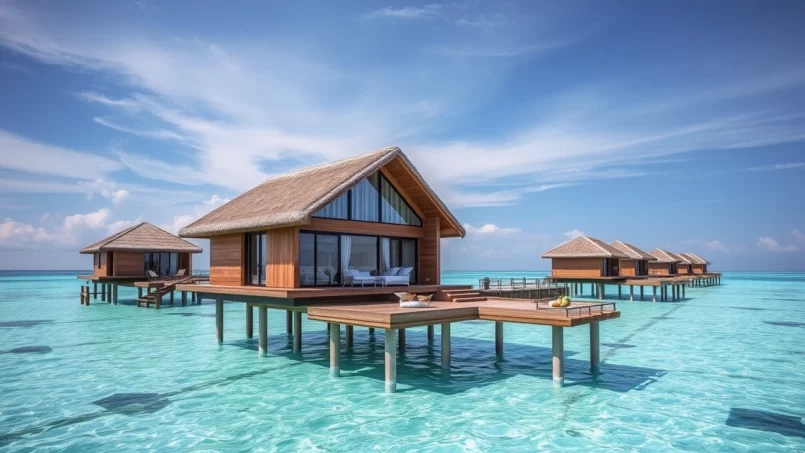
This is the iconic image of the Maldives: the overwater villa with direct lagoon access. In the Malé, Baa, or Noonu atolls, these units are often offered as part of residences branded by international names. Ultra-spacious beach villas situated directly on the sand are also found.
Prices generally start around one million dollars for a quality villa in a well-positioned resort and can far exceed 5 to 10 million dollars for very large properties or those signed by iconic brands.
Integrated Residences and Resort Apartments
Some projects, like the Coral Residences at Kandima (Dhaalu Atoll), offer beach apartments and two or three-bedroom residences, managed like a resort but with a more residential feel. Entry prices are around 1.2 million dollars for a high-end seafront apartment.
In some integrated projects, resort apartments or suites are offered for sale for about a million dollars. These offers typically include turnkey rental programs, where rental management is taken care of.
Private Islands and Island Leases
For institutional investors or very high-net-worth individuals, it is possible to lease an entire island, often for 50 to 99 years, to develop a resort. Amounts vary based on size, location, and touristic potential, but it is not uncommon to see entry tickets between $5 million and over $25 million solely for the leasehold right to the island, to which construction and operational costs are added.
This is the annual rent in dollars per square meter due to the State for island leases.
Urban Apartments and Expansion Projects
Finally, investors can look at urban developments in areas like Hulhumalé, an artificial island expanded by land reclamation, intended to absorb part of the population growth and host mixed projects (housing, business zones, service centers). Specific regulations govern foreign participation in these projects, but windows exist for real estate or infrastructure investments.
Market Performance: Capital Appreciation and Rental Yields
Historical data shows that Maldivian real estate has, overall, performed well over time, despite crises. Between 2010 and 2015, the average annual appreciation was between 4% and 5%. From 2016 to 2020, this increase accelerated to reach 6% to 8% per year. The 2020-2022 period, marked by the pandemic, slightly slowed the pace to a 3-5% annual increase. Since 2023, the market has rebounded vigorously, with 8% to 10% annual increases observed in many segments.
Medium-term projections anticipate an average progression around 5% per year, with disparities depending on regions and property types:
| Segment / Location | Estimated Annual Appreciation (5 years) |
|---|---|
| Premium Branded Properties | 6 – 8% |
| Malé Atolls (North & South) | 5 – 7% |
| Baa Atoll | 7 – 9% |
| Emerging Atolls (Lhaviyani, Raa, etc.) | 8 – 10% |
| Greater Malé Urban Area | 4 – 6% |
| Undeveloped Island Leases (with project) | 10 – 15% |
For off-plan purchases in premium resorts, increases of 15% to 20% between launch price and project completion are frequently observed, which can constitute a first source of capital gain, even before rental operation.
Rental Yields: Between 4% Net for Beach Villas and Over 10% for Some Operations
Regarding yields, figures vary considerably depending on the asset’s positioning, brand, occupancy rate, and management model. It is useful to distinguish gross yields from net yields after operational costs and taxes.
Sector data indicates, as a guide, the following ranges for net yields:
| Property Type | Indicative Net Annual Yield |
|---|---|
| Premium Branded Overwater Villas | 5 – 7% |
| Beach Villas | 4 – 6% |
| Integrated Resort Residences | 6 – 8% |
| Urban Apartments (Greater Malé) | 7 – 10% |
| Guesthouses and Small Local Hotels | 8 – 12% |
On a gross scale, some resorts announce spectacular performances: Soneva villas, for example, can generate up to 12% annual rental yield during normal operation according to some sector sources, although these figures must be nuanced by high management and maintenance fees.
How a Typical Yield on a Resort Villa is Structured
Numerical examples help form a concrete idea. Imagine a beach villa purchased for $2 million. With an annual occupancy rate of 65% and an average nightly rate of $1,200, the gross annual revenue nears $285,000. If we deduct 30% for operational costs (staff, marketing, management, energy, major maintenance) and about 2.5% for a reserve for major works, the net revenue is around $175,000, representing a yield close to 8.75% on the invested capital, without leverage.
This is the annual net revenue, after expenses, generated by leasing a luxury villa, representing a return on investment of about 18%.
In practice, most villas fall within the ranges of 4% to 8% net annual yield, which remains very competitive compared to many mature residential markets, especially in Europe or North America, where gross yields for prime properties rarely exceed 5%.
Taxation: Little or No Personal Tax, but Significant Sector-Specific Taxes
One of the major attractions of the Maldives for high-net-worth investors lies in their personal taxation. For individuals, there is no global income tax in the day-to-day life of most non-residents, no specific capital gains tax dedicated to real estate, no inheritance or wealth tax. However, on the corporate and real estate operations side, a set of taxes and levies apply that must be well integrated into one’s financial model.
Transaction and Holding: What to Anticipate
On the purchase of a property or leasehold right, the main tax is the Goods and Services Tax (GST), set at 6% for real estate. To this are added notary and lawyer fees (often 1 to 1.5% of the price for legal assistance), registration fees (around 0.1 to 0.2%), and possibly agency or exchange fees. In total, acquisition costs for a foreigner are generally between 8% and 12% of the purchase price.
Daily green tax per tourist in standard-sized establishments to fund environmental protection in the Maldives.
At the corporate level, Business Profit Tax or corporate tax applies at a rate of 15% on profits exceeding 500,000 MVR (approximately $32,500). Below this threshold, the rate is 0%. Certain payments abroad (dividends, interest, royalties) may be subject to a 10% withholding tax, unless a double taxation agreement applies, currently limited to a few countries like the United Arab Emirates or Bangladesh.
Net Yields: The Impact of Management and Maintenance Costs
Beyond taxes, the operational cost structure is crucial, especially in the aggressive marine environment of the Maldives. Between staff, energy, logistics (seaplanes, boats), maintenance of overwater structures, underwater inspections, and reef protection actions, operators estimate that 25% to 35% of gross revenue can go to recurring expenses. Many resorts additionally allocate an annual envelope of 2% to 3% of the property’s value for structural maintenance.
In integrated management programs, management and marketing fees, often between 40% and 60% of rental turnover, explain the significant difference between the advertised gross yield and the net yield actually received by the owner.
Residency, Visas, and Investor Programs
Acquiring a property in the Maldives does not automatically confer citizenship, nor even permanent residency. The country does not offer an “investment passport.” However, several schemes offer stay or temporary residency facilities to real estate investors or entrepreneurs.
A Special Resident Visa is accessible to buyers of a property worth at least $250,000 in an approved development. This renewable residence permit is issued for 5 years and can include certain family members. It grants the right to reside in the Maldives, without constituting a path to naturalization.
Minimum amount in dollars to invest in a local business to benefit from an Investor Visa.
There is also a “retirement”-type program, granting a 5-year visa to anyone depositing at least $250,000 in a Maldivian bank account, with no activity obligation. Finally, short stays are covered by the free tourist visa on arrival (30 days, extendable to 90 days) and by business visas with a maximum duration of one year.
More recently, an investment residency program has been promoted in partnership with Henley & Partners, with very high contribution levels for some categories (between $5 and $10 million for large investors) but also entry thresholds around $250,000 for purchasing properties in eligible projects. This is part of the Vision 2040 strategy to diversify the economy.
Who Buys and Why?
The profile of buyers reflects the market’s highly international orientation. Available data indicates that Europeans represent about half of the buyers (French, Swiss, British, Germans leading), Asians about 30% (Indians, Chinese, Singaporeans), and North Americans and Middle Eastern investors the remaining 20%.
Investors are attracted to the Maldives for various reasons: seeking a personal haven or exclusive secondary residence, rental investment to generate high income from a dynamic tourism market, or portfolio diversification, supported by a resilient luxury tourism sector and limited land supply.
The rise of groups and developers from the United Arab Emirates illustrates this positioning: over $3 billion in Maldivian projects are backed by Gulf capital by 2030, with massive programs like Zamani Islands (eight islands, superyacht marina, residences sold for up to $25 million) or Samana Ocean Views, designed with creator Elie Saab.
Major Risks: Environment, Dependency on Tourism, and Legal Complexity
The idyllic image should not hide very real risks. The first is environmental. The Maldives is the world’s flattest country, with an average elevation of about 1.5 meters and a highest point of 2.4 meters. Several international projections estimate that many islands could become barely habitable by the end of the century if sea levels continue to rise at the current rate. The government already devotes nearly 30% of its national budget to climate adaptation.
Coastal assets are exposed to physical risk (erosion, flooding, storms) and a growing regulatory risk (strengthened environmental requirements, relocations, evolving national priorities). Investors now favor sites with better natural elevation and enhanced protection systems.
The second major risk lies in dependency on international tourism. A sharp drop in visitor numbers, as during the pandemic, immediately impacts resort occupancy and thus rental income. Even though the market has demonstrated resilience, this factor must be considered in projections, especially for heavily leveraged projects.
The legal framework, while transparent, constantly evolves. Risks include government changes, tax adjustments (like the Green Tax), changes in foreign exchange rules, and stricter oversight of investments, especially regarding currency flows and transparency of beneficial owners.
Finally, the market’s fundamentally leasehold structure induces a specific risk: the closer one gets to the end of the lease, the more the asset’s value tends to erode if no extension is negotiated. Renegotiating or extending a master lease with the State is not guaranteed and depends on political and administrative decisions. Investors must therefore carefully examine the remaining lease term, extension conditions, and the developer’s ability to defend these interests with the authorities.
Financing, Deal Structures, and the Role of Professionals
The majority of transactions involving international buyers are conducted in cash: over 70% of buyers pay without recourse to local credit. Bank financing for foreigners is rare and often unattractive, with high interest rates (over 10% for some long-term loans) and complex collateral requirements.
In practice, financing options often include:
Investors have several solutions to finance their foreign real estate acquisition. Developers often offer payment plans with an initial deposit of 30% to 50%, followed by installment payments until delivery, sometimes with interest rates of 5% to 8%. It is also possible to obtain financing in one’s country of residence, backed by other assets. Finally, setting up corporate structures, sometimes domiciled in tax-advantageous jurisdictions or offering greater banking flexibility, is another option.
The purchasing process generally follows several steps: property reservation with a deposit, due diligence period, signing a Sale & Purchase Agreement, obtaining government approval, staged payments, registration of rights at the Land Registry, setting up a rental management contract, and finally tax registration with Maldivian authorities if the property generates income.
In the context of resort real estate in the Maldives, hiring a specialized lawyer is not an option but a necessity, notably to conduct required legal checks.
– the master lease of the island or land (remaining term, renewal conditions, development obligations),
– environmental and tourism permits,
– compliance of the strata-title regime,
– allocation of responsibilities between owner, operator, and developer,
– exit modalities (resale, pre-emption rights, resale to foreigners or Maldivians).
Many investors also choose to rely on a local partner or a Maldivian consultant, if only to navigate administrative procedures, language, and customs.
Conclusion: An Exceptional Market, Requiring Meticulous Preparation
Investing in real estate in the Maldives offers a virtually unique cocktail: a natural setting among the most spectacular in the world, a very high-end positioning, limited land supply, light personal taxation, and potentially very attractive rental yields, particularly in well-managed branded resorts.
The legal framework prohibits freehold land ownership for foreigners, imposing 50 to 99-year leases. It requires mastering strata-title structures, joint-ventures, tourism-specific taxes, and long-term climate risks. The resale market is narrow, local financing limited, and profitability heavily depends on the health of the global tourism sector.
For a savvy investor, capable of mobilizing specialized legal advice, conducting thorough due diligence, and accepting the logic of a high-end rental asset rather than a “patrimonial” property in the European sense, the Maldives can constitute a powerful addition to an international portfolio, both as a source of income and as a pleasure asset.
The key to a successful real estate investment in the Maldives rests on three essential pillars. First, one must understand that one is purchasing a usufruct right and not land in freehold. Second, it is crucial to analyze in detail the financial and legal solidity of the project operator and the terms of the master lease. Finally, it is imperative to integrate from the start the climate challenges and regulatory evolutions that will shape the archipelago in the coming decades. Respecting these conditions allows this rare investment to reconcile luxury, global tourism, and environmental challenges.
Disclaimer: The information provided on this website is for informational purposes only and does not constitute financial, legal, or professional advice. We encourage you to consult qualified experts before making any investment, real estate, or expatriation decisions. Although we strive to maintain up-to-date and accurate information, we do not guarantee the completeness, accuracy, or timeliness of the proposed content. As investment and expatriation involve risks, we disclaim any liability for potential losses or damages arising from the use of this site. Your use of this site confirms your acceptance of these terms and your understanding of the associated risks.

Cyril Jarnias is an independent expert in international wealth management with over 20 years of experience. As an expatriate himself, he is dedicated to helping individuals and business leaders build, protect, and pass on their wealth with complete peace of mind.
On his website, cyriljarnias.com, he shares his expertise on international real estate, offshore company formation, and expatriation.
Thanks to his expertise, he offers sound advice to optimize his clients' wealth management. Cyril Jarnias is also recognized for his appearances in many prestigious media outlets such as BFM Business, les Français de l’étranger, Le Figaro, Les Echos, and Mieux vivre votre argent, where he shares his knowledge and know-how in wealth management.





