
 Published on and written by Cyril Jarnias
Owning a beach house, an overwater villa, or a small guesthouse in the Maldives is a dream. But transforming an existing building – sometimes aging, poorly insulated, or vulnerable to weather hazards – into a comfortable, profitable, and sustainable property is a much more complex undertaking than a simple “refresh.”
Renovation must contend with a corrosive environment, extreme climate, changing regulations, and reliance on imports, all within the framework of an ambitious national climate policy. However, the luxury tourism market is promising, with high rental rates for well-designed villas and growing demand for ecotourism.
This article offers a detailed guide, in clear language, to understand how to renovate intelligently in the Maldives, based on the latest data, studies, and public policies.
Understanding the Maldivian Context Before Any Renovation
Before thinking about decor or an infinity pool, you must first look at the big picture: an archipelago of over 1,000 coral islands, of which more than 80% are less than one meter above sea level, with an economy heavily dependent on tourism and a territory on the front line of climate change.
Climate and urban statistics highlight the challenge. Almost all islands report annual flooding and coastal erosion. Almost half of the housing stock is within 100 meters of the shoreline, as is over 80% of critical infrastructure. The country has even had to build artificial islands like Hulhumalé, raised 1.8–2 meters above mean sea level, to secure new developments.
In this context, renovating a villa, guesthouse, or small hotel is never just an aesthetic project. It is a project of climate adaptation, energy optimization, and precise risk management.
A Construction Sector that is Both an Engine and Fragile
Construction is one of the pillars of the Maldivian economy. It accounts for several billion rufiyaa in real GDP, benefits from tourism investments and public housing programs, and remains closely linked to the health of the hotel sector.
In the construction sector in the Maldives, there are up to 13 expatriate workers for every one Maldivian worker.
Renovating a property in the Maldives therefore also means managing material costs exposed to global fluctuations, construction crews composed largely of foreigners, and a financial system where access to credit can still be complicated, despite innovative programs for energy efficiency.
A Regulatory Framework That Is Strengthening
Legally, the country has undertaken a profound reform of its building and urban planning regulations. A Construction Act (law 04/2017) is in force, accompanied by numerous regulations published in 2019. A national building code exists, but its set of reference documents (compliance documents) is still being consolidated, particularly to fully integrate climate and energy performance requirements.
For a real estate project, obtaining the necessary permits requires navigating between several ministries and agencies (Construction, Housing, Urban Planning, Planning, Disaster Management, Environmental Protection), with the first permit generally issued by the Ministry of Housing and local councils.
In parallel, the government has launched “Resilient Housing Guidance for the Maldives”, a resilient housing guide developed with the World Bank, which proposes simple prescriptive procedures to strengthen existing houses against strong winds, flooding, and extreme heat. Although this document mainly targets modest and small-sized homes, it offers a useful technical basis for any serious renovation project.
Choosing a Strategy: Comfort, Luxury, Returns… or Resilience?
Renovating a property in the Maldives isn’t just about changing the furniture. It’s about defining a clear strategy: what priority to give to thermal comfort, perceived luxury, energy performance, climate resilience, or long-term financial value?
In the Maldivian tourism market, some strong trends stand out. The best-designed overwater villas and beach villas often rent at very high rates, with occupancy rates above 70% annually for iconic units. In this segment, design and quality of experience have become real value drivers: international studies show that properties with strong architectural signatures can sell at a premium of around 3.5%, and show better occupancy rates on rental platforms.
To stand out, especially to a high-end clientele, it is essential to cater to their growing sensitivity to cultural authenticity and environmental impact. This materializes through collaborations with Maldivian artisans, integration of local materials, and the implementation of serious efforts in solar energy, water management, and coral restoration programs.
For an individual owner, these major trends translate into several concrete guidelines.
Making Climate a Central Parameter of the Project
A successful renovation project must start with a local climate diagnostic: type of risks (more frequent cyclonic winds in the north, moderate earthquakes in some southern atolls, higher tsunami probability on eastern shores, etc.), exposure to erosion, distance from the shoreline, groundwater level.
The official recommendations for resilient houses are very explicit: avoid building within 20 meters of the shoreline (and more on particularly exposed islands), preserve a coastal vegetation buffer of at least 20 meters, and raise floors a minimum of 30 to 60 cm above road level, or even more in areas prone to repeated flooding.
For a renovation, this can mean: repairing, modernizing, adjusting spaces, and enhancing the interior and exterior of a building.
During a complete overhaul of a building’s slab, several actions can be taken to ensure its longevity. This includes raising the finished ground floor level, adding steps and a ventilated plinth to improve air circulation, and improving perimeter drainage to evacuate water. For older structures already partially colonized by water, it is essential to treat or rebuild the foundations.
Integrating Profitability and Operating Costs
The energy bill is heavy in the Maldives. Electricity, mostly produced by island diesel generators, is expensive, with a high cost per kilowatt-hour and a significant CO₂ emission factor. The country still spends tens of millions of dollars annually on diesel subsidies, and electricity demand has surged in recent years.
Renovating also means reducing this dependence. The authorities have made building energy efficiency a priority through a vast project called “Strengthening Low Carbon Energy Island Strategies.” This program has produced an energy efficiency guide adapted to Maldivian constructions, code documents on ventilation, natural and artificial lighting, as well as a voluntary energy labeling system, “Hakathari,” for electrical appliances.
Ecological improvements that reduce costs and add value to your rental property.
Opt for units labeled 4 or 5 stars to significantly reduce your operating costs.
Improve the comfort and energy efficiency of your property with quality insulation and natural ventilation.
Installing rooftop solar panels is a strong marketing point to attract a clientele willing to pay for an eco-friendly stay.
Seeking Authenticity Without Falling into Pastiche
The “tropical island” aesthetic has long been caricatured, with an accumulation of dark woods, decorative palms, and exotic clichés. The current trend in the most prominent villas is quite different: a return to a more subtle authenticity, which values local materials – coral stone in masonry elements, coconut wood, woven palm thatch roofs (fangi) – and artisanal know-how (weaving, traditional embroidery like kasabu, textiles inspired by feyli).
Leading resorts have recently completely redesigned their beach villas, moving from rather dark and compartmentalized bungalows to large, very open volumes bathed in natural light, with light palettes (sands, lagoon blues, soft greens) and custom furniture blending international design and Maldivian craftsmanship. For a private owner, drawing inspiration from these examples means favoring fluid indoor-outdoor spaces, shaded terraces, garden showers, and décor that truly tells the story of the archipelago instead of imitating it from afar.
Physical Constraints: A Marine Environment That Wears Everything Down Faster
Renovating a house a few meters from the Maldivian lagoon means dealing with an invisible but relentless enemy: salt. The spray-laden air, near-permanent humidity, winds that whip the façades—all contribute to accelerating material corrosion and degradation.
International studies on buildings in coastal areas are clear: metals exposed to sea air corrode up to ten times faster than in a dry indoor environment. Metal roofs that could last thirty years in an inland city may sometimes last only fifteen to twenty by the ocean. Reinforced concrete, if not designed and maintained for these conditions, sees its reinforcement bars rust, swell, and cause the concrete to crack within a few years.
What Suffers the Most in a Maldivian House
In a seaside property in the Maldives, the weak points are always the same: metal structure, concrete reinforcement, roofing fasteners, exterior joinery, hardware, air conditioning units, and all exposed parts of electrical and mechanical installations.
The mechanisms are well known. Salt acts as an electrolyte, increasing the conductivity of the water film that deposits on metal surfaces and accelerating oxidation reactions. In concrete, chloride ions gradually penetrate to the reinforcement, triggering internal corrosion. The rusting iron expands – up to three times its volume – creating stresses that crack and spall the concrete.
Material Corrosion Expert
The result, for an owner, is rust stains, paint that blisters and flakes, chunks of concrete that fall off, hinges or locks that seize up, air conditioning units that overconsume and fail prematurely.
Designing the Renovation as an Anti-Corrosion Shield
To extend the lifespan of a Maldivian property, the renovation must incorporate precise material and architectural strategies.
For durable coastal construction, it is essential to choose specific materials: use suitable stainless steel, hot-dip galvanized steel for structures, seawater-resistant aluminum alloys for joinery, and composites or reinforced fibers where possible. For concrete, favor low-permeability mixes enriched with cementitious additions (fly ash, silica fume) and, if necessary, incorporate corrosion inhibitors for the reinforcement.
Coatings play a major role. Paint systems must combine a zinc-rich or anti-corrosion epoxy primer, one or more intermediate coats, and a polyurethane or other high-performance marine finish. Porous materials (stone, brick, exposed concrete) benefit from protection with breathable surface water repellents.
Architecturally, the fight against corrosion also involves the building design: generous roof overhangs that shelter façades, efficient rainwater drainage systems, sloped surfaces rather than horizontal ones to prevent water stagnation, and good ventilation of crawl spaces, roofs, and wall cavities to allow for rapid drying.
Diagnosing Before Renovating: Structure, Risks, and Comfort
Before deciding what to do, you must understand what you have. A quality diagnostic is essential, especially for houses built several decades ago, sometimes without engineering oversight.
The official guide for resilient housing in the Maldives emphasizes the importance of starting with an assessment of the site (exposure to winds, flooding, earthquakes) and the existing structure (foundations, walls, roof, connections). This logic applies equally to a family home or a rental villa.
Evaluating Structure and Site
A first level of diagnosis can be visual: look for cracks, misalignments, signs of moisture, areas of spalled concrete, advanced rust spots, frame deformations, or ground settlement. But ideally, this work should be supplemented by a civil engineer or architect registered with the authorities, especially if the project includes adding a story or major transformations.
The exact location of the building matters as much as its condition. A house located within 20 meters of the shoreline, in an area where storm surge flooding is frequent, cannot be secured in the same way as a house set further back on naturally higher ground. In some cases, “hard” coastal protection solutions (seawalls, rock armor) already exist; in others, “soft” coastal engineering measures – beach nourishment, preservation of the vegetation buffer, limiting construction on the front line – will be favored.
Studies conducted by the government and its partners show that nature-based solutions, such as coral reef and mangrove restoration, can provide very effective long-term coastal protection, while being more sustainable and less costly than massive concrete structures, which are often destructive to sediment dynamics and ecosystems.
Analyzing Thermal Comfort and Ventilation
Renovation is also an opportunity to rethink thermal comfort. Temperatures regularly exceed 30°C (86°F), with high humidity. Traditional Maldivian homes managed this climate with raised floors, opposing openings to promote cross-ventilation, and breathable materials like coral stone and thatch roofs.
New guidelines recommend optimizing natural ventilation, building orientation, shading of openings, and the use of thermal mass to mitigate heat peaks. In practice, this can involve widening openings, adding sunshades, vegetating façades, or modifying roofs to integrate high-level ventilation.
At the same time, it’s advisable to optimize the use of air conditioning, which accounts for a significant share of electricity consumption in tourist villas. Installing highly efficient, properly sized units, and educating users about their settings (setpoint temperature, regular filter maintenance, etc.) is an integral part of the strategy.
Administrative Procedures and Legal Framework for Renovation
In the Maldives, serious property renovation isn’t done “under the radar.” A good portion of projects, as soon as they affect the structure, surfaces, or the use of the premises, must go through an authorization procedure with the competent authorities.
The Ministry in charge of housing and urban infrastructure issues building permits and controls the application of regulations. Projects of at least two stories, or presenting certain technical challenges, must additionally be reviewed by the Ministry of Construction and Infrastructure. Architectural and structural plans must be signed by duly registered professionals and reviewed by accredited “checkers.”
For an owner, this means: commitment to managing your real estate asset, consideration of legal responsibilities, and the need to maintain a good relationship with your tenants.
– submission of a complete permit application file,
– payment of fees (several hundred dollars for the permit, several thousand for plan validation),
– site inspections (site setup, foundations),
– then, upon completion, application for an occupancy permit issued by the urban development authority.
Water and sewerage connections, managed in Malé by the water company and nationally by other operators, require specific applications. According to compiled accounts, these steps take between a few days and a month each.
On tourist islands, where villas and bungalows belong to resorts under lease from the state, any major renovation must also be approved by the Ministry of Tourism, through lease contract amendments if it involves deeply redeveloping the infrastructure.
Making Renovation a Lever for Energy Transition
The Maldives has set particularly ambitious goals: achieving carbon neutrality by 2030, and ensuring at least 33% of the country’s electricity comes from renewable sources in the medium term, subject to sufficient international financing. The energy-intensive building sector is at the heart of this strategy.
The renovation of existing properties is therefore a key opportunity. It allows for improving the building envelope (insulation, air tightness), modernizing equipment (AC, lighting, refrigerators, pumps), and integrating renewable technologies (solar panels, diesel-solar hybrid systems, small electrical storage solutions).
Concrete Tools for Owners
The country already has several practical levers. The “Hakathari” program, a voluntary energy labeling system, helps identify the most efficient air conditioners and other appliances, rated from 3 to 5 stars. An agreement has been signed with the Maldives Islamic Bank to facilitate financing for these high-efficiency appliances, offsetting the investment premium through a guarantee mechanism that reduces risk for the bank. Preferential rate credit facilities (e.g., 10% per year) thus exist for purchasing labeled appliances.
Other instruments are being prepared or already adopted for the public sector. These include integrating energy efficiency criteria into public procurement and using life-cycle cost calculation methods. These methods allow for comparing bids not only on the initial purchase price, but on all costs over the full lifetime, including installation, consumption, maintenance, and end-of-life.
Private owners, especially operators of tourist villas, would do well to take inspiration from these logics: rather than opting for cheap-to-buy but expensive and polluting-to-operate equipment, renovation can be an opportunity to switch to more sustainable solutions, amortized through energy savings.
The Rapid Rise of Solar: A Trend to Integrate
Thanks to several projects funded by international donors, the Maldives has already equipped over a hundred islands with hybrid systems integrating several tens of megawatts of photovoltaic power and batteries. In the hotel sector, some resorts have led the way by becoming fully or largely powered by the sun, with solar farms producing several hundred kilowatts.
For a villa or small guesthouse, a photovoltaic installation (rooftop or shade structure) of a few kilowatts can cover a significant portion of air conditioning and lighting needs, especially if these are optimized. The ‘My Solar’ financing program allows households to finance these installations through savings on their energy bills.
In a renovation project, planning for the roof structure, cable pathways, and panel orientation from the design stage reduces costs and ensures harmonious integration with the building.
A Measurable Financial Impact
Scenario studies done for the country show that by massively strengthening energy efficiency in buildings, the Maldives could save hundreds of gigawatt-hours of electricity and avoid emitting hundreds of thousands of tons of CO₂ by 2040, while saving over $300 million on energy bills.
At the scale of a house or villa, this translates into substantial savings over the property’s lifespan, especially since the cost of diesel-generated electricity remains high. For an owner financing their renovation with credit, incorporating these savings into the financing plan can make a higher level of investment viable, provided you think long-term.
Designing a Truly Resilient Renovation
Making a property more beautiful and comfortable is one thing; making it more resistant to climate shocks is another. In the Maldives, the two must go hand in hand.
The Maldivian resilient housing guide defines a “resilient” house as a set of qualities: resistance to hazards, durability, affordability, healthy comfort, economic value, capacity to adapt over time, and suitability for local practices.
Raising the Structural Bar
Structurally, some principles emerge from the technical recommendations developed for the country:
– care for foundations, taking into account the water table level and risks of heave or scour from flooding,
– ensure structural continuity with horizontal and vertical ties (bond beams, properly reinforced columns),
– strengthen connections between walls, floors, and roof to resist wind uplift forces,
– use well-anchored lightweight roofs, rather than very heavy coverings that could cause damage if they fall.
When renovating a building that could support an additional story, a specific permit is required and verification by an engineer of the foundations and load-bearing walls is needed. If the structure is insufficient, it must be strengthened or lighter materials used for the vertical extension.
Managing Water: Rain, Sea, and Groundwater
Water is a multiple risk in the Maldives. It comes from the sky, with episodes of intense rain capable of flooding poorly drained plots, but also from the sea, as swells, storm surges, or tsunamis. Add to this rising groundwater, which can weaken soils and deteriorate unprotected foundations.
For a renovation, it’s crucial to rethink water management at the plot scale:
– creating or improving rainwater drainage systems (surface slopes, gutters, vegetated swales),
– raising certain floor levels or technical spaces,
– installing discreet curbs or low walls to limit water ingress,
– collecting and storing rainwater from roofs, to reduce pressure on freshwater networks and have a reserve in case of shortage.
National adaptation studies identify aquifer recharge and freshwater resource preservation as medium and long-term priorities for the country. In this context, a house designed to store and manage water efficiently becomes a valuable asset, both for its owner and for the island as a whole.
Drawing Inspiration from “Soft” Coastal Solutions
A seaside renovation must account for littoral dynamics. Surveys conducted on dozens of Maldivian islands have shown that hard structures (massive seawalls, concrete tetrapods, rock armor) are sometimes ill-suited, very costly to maintain, and incompatible with natural sediment transport processes.
Conversely, so-called “soft” measures – beach nourishment, maintaining dune belts, planting mangroves or coastal trees, limiting construction in exposed areas, building on stilts – often prove more effective and less costly in the long run, provided they are well-designed and maintained.
For an owner, this doesn’t mean they can undertake coastal works on their own, which often falls under the jurisdiction of the state or municipality. But it implies thinking of their plot as part of a broader system: avoid removing coastal vegetation to clear the view, don’t build too far forward on the beach, and accept that some areas must remain natural to protect the whole.
Between Dream Design and Environmental Requirements
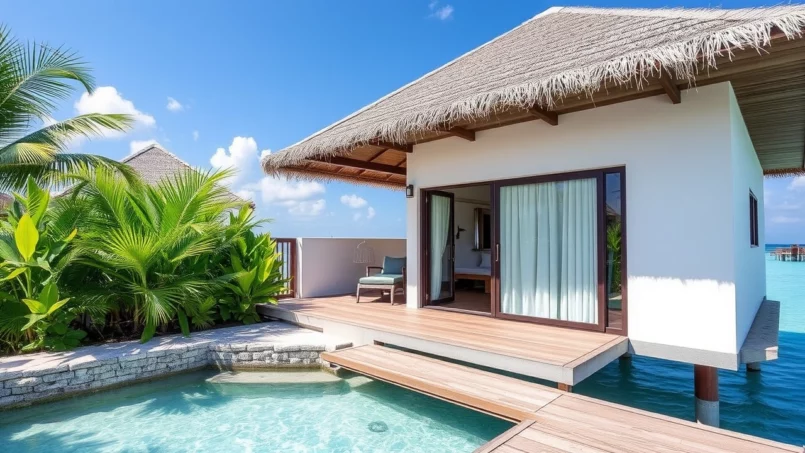
The Maldives’ appeal relies largely on its spectacular accommodations: overwater villas with pools, beach bungalows surrounded by tropical gardens, underwater suites like “The Muraka.” Renovating a property here clearly means positioning yourself in this universe.
But the most successful projects today no longer settle for accumulating external signs of luxury. They seek to tell a story: that of the island, its artisans, its corals, its winds. And they do so with a much more advanced ecological awareness than in the past.
Weaving a Local Architectural Narrative
Architects and designers working on new waves of Maldivian villas focus on immersion. They combine international materials (marble, travertine, bronze) with traditional coral stone, woven palm wood ceilings, textiles inspired by local attire, and art pieces by Maldivian artists.
For a renovation project, without necessarily having the colossal budgets of large hotel groups, the logic remains the same: value what is local and tell an authentic story. This can involve:
– partitions or cladding with reconstituted coral stone,
– ceilings with wood latticework or thatch,
– weaving, pottery, or sculpture workshops offered to guests if the property is rented,
– integrating photos, engravings, or objects from neighboring communities.
These choices aren’t just aesthetic. They contribute to the economic sustainability of the islands by creating outlets for artisans and strengthening the uniqueness of the place in a highly competitive tourism market.
Reducing Ecological Footprint Without Sacrificing Comfort
Simultaneously, the most advanced properties display clear environmental commitments: partial or full solar power, advanced wastewater treatment systems, ban on single-use plastics, on-site vegetable gardens to reduce food miles, active reef restoration.
The Maldivian government has banned single-use plastics and encourages tourism operators to adopt eco-friendly practices. Many of the country’s hotels and infrastructure have already obtained international certifications like EarthCheck, Green Globe, EDGE, and LEED.
A renovating owner can, on their scale, aim for this type of excellence by:
– eliminating single-use plastics from the property,
– opting for low-VOC (Volatile Organic Compounds) paints and adhesives,
– managing waste on-site more thoroughly (sorting, composting, possibly partnerships with recycling initiatives),
– reducing water consumption with water-efficient fixtures and reusing some greywater where technically and legally feasible.
Managing Costs, Labor, and Supplies
Renovating a property in the Maldives means navigating an island economy where almost everything – from cement and PVC pipes to sanitary ware and aluminum profiles – arrives by ship, often from neighboring countries like India or Malaysia. Import data shows steady growth in volumes, with dozens of suppliers and projects involved.
This dependence translates into high and volatile costs, linked to international prices, transport, and customs duties. Economic studies by the World Bank and the Maldivian central bank also highlight the country’s vulnerability to external debt and the pressure this puts on fiscal and monetary policies.
Wages and Labor: Finding a Balance
The construction workforce is predominantly expatriate, with a significant overrepresentation of workers from Bangladesh, India, and Sri Lanka. The average annual salary for a construction worker remains modest, around a few hundred dollars per month, with high variability depending on experience, skill level, and company size.
For an owner managing a renovation, these realities translate into:
– labor quotes that are relatively competitive compared to some Western markets,
– but also increased needs for supervision and coordination, due to language barriers, sometimes heterogeneous skill levels, and a shortage of specialized skills (engineers, specialized technicians).
For the success of your project, it’s crucial to select a serious construction company with experienced engineers and site supervisors. Rigorous project monitoring is also essential, especially if you are not on-site during the work.
Optimizing Material Logistics
Regarding materials, optimization involves several levers:
– plan orders early to avoid delays linked to sea transport,
– choose, if possible, materials already available in the country through regular importers, rather than exotic references complex to ship,
– consider using prefabricated or modular systems, which reduce construction time and logistical uncertainties.
Some recent development projects in the Maldives have thus used advanced lightweight structural systems, designed in a factory then assembled on-site, to gain speed and quality, while limiting local environmental impact.
Long-Term Maintenance: Renovation Doesn’t Stop at Handover
In a coastal environment like the Maldives, it’s unrealistic to think a building, even renovated with advanced materials, can do without very regular maintenance. Maintenance isn’t an option; it’s a condition for the property’s survival.
Technical recommendations emphasize the need for periodic inspections of façades and structures, cleaning with fresh water to remove salt deposits, repainting or reapplying protective coatings every two to three years, or even more frequently on the most exposed elements.
Regular maintenance of technical systems (air conditioning, ventilation, pumps, electrical equipment) is essential to prevent rapid corrosion of components. Without it, these systems can suffer from energy overconsumption and costly failures.
Preparing for a Changing Climate
Finally, renovations must be designed with a certain climatic “futurism”. Projections for the end of the century mention temperature rises of several degrees and a continuing sea level rise, with an increase in extreme events. In the most pessimistic scenarios, a large part of the coral islands could be permanently submerged.
One should not refrain from investing today, but do so by anticipating and integrating the possibility of new future adaptations. For example, a company might choose modular technology or an evolutive platform for its new projects, allowing it to adapt more easily to regulations, markets, or technologies that may change later.
– designing structures that can be raised,
– using modular systems that can be moved or reconfigured,
– avoiding the heaviest investments in areas already highly threatened by erosion, unless a long-term public coastal adaptation plan exists.
The Maldivian authorities are working on developing a National Adaptation Plan which should provide a clearer framework for these choices in the coming years. In the meantime, prudence involves close dialogue with island councils, technical services, and, where applicable, climate risk experts.
Conclusion: Renovating in the Maldives, a Technical, Cultural, and Political Project
Renovating a property in the Maldives, whether a family home, rental villa, or small hotel, isn’t just about a few cosmetic upgrades. It’s a project at the crossroads of technique (structure, corrosion, energy), culture (craftsmanship, local identity), economics (material costs, financing, rental returns), and climate policy (carbon neutrality goals, adaptation to sea level rise).
The guides published by Maldivian ministries, World Bank studies, energy efficiency and resilient island pilot projects, as well as the experiences of pioneering resorts in sustainability, now provide a solid foundation for anyone wanting to embark on this path.
To turn a renovation into a success, the owner must understand the specific challenges, surround themselves with competent professionals, scrupulously respect administrative procedures, and anticipate climate risks. This approach yields a property that is aesthetic, comfortable, energy-efficient, and more resilient to storms and flooding, while aligning with the country’s future vision.
The tables below summarize some useful benchmarks to keep on hand throughout the project.
Main Climate Risks by Atoll Zone
| Atoll Zone | Dominant Risks Identified |
|---|---|
| Northern Atolls | Cyclones and tropical storms, storm surges, strong winds |
| Eastern Atolls | Higher tsunami risk, storm surges |
| Southern Atolls | Long-period swells, flooding from intense rain, earthquakes |
| All Atolls | Coastal erosion, extreme heat, sea level rise |
Key Areas for a Successful Renovation in the Maldives
| Area | Main Objective | Examples of Actions During Renovation |
|---|---|---|
| Structure & Foundations | Resist winds, moderate earthquakes, flooding | Strengthen ties, raise floor level, check load-bearing capacity |
| Envelope & Corrosion | Limit accelerated degradation in marine environment | Stainless steel, galvanized steel, low-permeability concrete, marine paints |
| Comfort & Energy | Reduce AC while remaining comfortable | Cross-ventilation, sunshades, 4–5 star AC, solar panels |
| Water & Sanitation | Manage shortages and extreme rain | Rainwater harvesting, network optimization, water-efficient fixtures |
| Coastline & Nature | Protect the site without harming ecosystems | Preserve coastal vegetation, avoid building too far forward |
| Design & Culture | Create a strong, authentic identity | Local materials, Maldivian craftsmanship, architectural storytelling |
By combining these dimensions, renovating a property in the Maldives becomes much more than a construction site: it’s a concrete contribution to the resilience and ecological transition of a country fighting to remain habitable, while continuing to captivate the world.
Disclaimer: The information provided on this website is for informational purposes only and does not constitute financial, legal, or professional advice. We encourage you to consult qualified experts before making any investment, real estate, or expatriation decisions. Although we strive to maintain up-to-date and accurate information, we do not guarantee the completeness, accuracy, or timeliness of the proposed content. As investment and expatriation involve risks, we disclaim any liability for potential losses or damages arising from the use of this site. Your use of this site confirms your acceptance of these terms and your understanding of the associated risks.

Cyril Jarnias is an independent expert in international wealth management with over 20 years of experience. As an expatriate himself, he is dedicated to helping individuals and business leaders build, protect, and pass on their wealth with complete peace of mind.
On his website, cyriljarnias.com, he shares his expertise on international real estate, offshore company formation, and expatriation.
Thanks to his expertise, he offers sound advice to optimize his clients' wealth management. Cyril Jarnias is also recognized for his appearances in many prestigious media outlets such as BFM Business, les Français de l’étranger, Le Figaro, Les Echos, and Mieux vivre votre argent, where he shares his knowledge and know-how in wealth management.





