
 Published on and written by Cyril Jarnias
Purchasing real estate in the Maldives is a dream for many international investors. With its turquoise waters, overwater villas, and strong tourism growth, the country ticks all the boxes for a prestigious residence and a pleasurable investment. But behind the postcard image lies a very particular legal framework: a foreigner cannot own the land. Everything rests on long-term leases, a set of specific laws, and tight government control.
Before signing a contract, it is essential to understand the legal framework, possible structures, costs, associated visas, and the main risks specific to property purchase for a non-resident in the Maldives.
A Unique Legal Framework: Why Foreigners Don’t Buy Land, but Time
In the Maldives, any real estate consideration starts with an unavoidable reality: the Constitution reserves land ownership for Maldivian citizens. Foreigners simply do not have the right to own land outright (freehold). The State remains the ultimate owner of the plots.
In Singapore, international investors are not excluded from the real estate market. They participate actively through a long-term lease, or ‘leasehold’ system. In this framework, the investor does not buy the land itself, but acquires a right of use and development for a very long period, which can extend from several decades to nearly a century.
This architecture is based on several key texts: the Land Act, the Foreign Investment Act, the Tourism Act, and various laws on foreign investment. The combination incorporates Islamic law (particularly for inheritance matters), statutory law, and common law influences. In this scheme, the State’s objective is twofold: to attract private capital while retaining control of land in a country with limited land surface area that is vulnerable to sea level rise.
Forms of Tenure: Leasehold, Strata, and Integrated Development
For a foreigner, the question is therefore not “Can I buy land?”, but rather “What type of lease or right of use can I obtain?”. Three main families of structures dominate the market.
Classic Leasehold: A Lease of up to 99 Years
The most common form remains the long-term lease granted directly by the State, or via a developer who itself holds a master lease on an island or a plot. For tourism or commercial projects, terms of 50 years are frequent, with in some cases the possibility of extension up to 99 years.
Some leases, structured in multiple phases (e.g., an initial 10-year term followed by two 20-year renewal options), grant the lessee a right of use close to temporary ownership. They can thus build, operate, rent, or even transfer their rights, subject to the approval of the competent authorities.
Strata Lease: Owning a Villa or Apartment in a Resort
A second, very popular avenue for individuals is holding under a “strata” title. This involves purchasing a unit – villa, bungalow, suite, apartment – within a larger tourism development, such as a branded residence or a resort.
The investor acquires a leasehold right over a part of the building, generally for a term equivalent to the master lease. This status confers classic rights: access to the property, peaceful enjoyment, possibility to mortgage the right, sublet, use services (water, electricity, internet), and participate in the rental program managed by the operator.
Integrated Projects and Mixed-Use Tourism
Since the introduction of the Integrated Tourism model in 2019, a new category has been developing: mixed complexes combining hotels, private residences, commerce, and sometimes marinas or leisure centers. In these projects, some residential units may be offered to foreigners under long-term leases or strata leases, while remaining within a tourism framework.
This is the case for emblematic developments like Coral Residences or floating city projects, which combine residence, tourism, and sustainability objectives.
What Foreigners Can (Really) Buy
Despite the idyllic image of a private villa on a deserted island, the range of properties actually accessible to foreigners is more limited and highly regulated. The government reserves access to segments deemed “high-end” or strategic for tourism.
Concretely, a non-Maldivian can invest primarily in:
Discover the different investment opportunities in the luxury tourism and leisure sector.
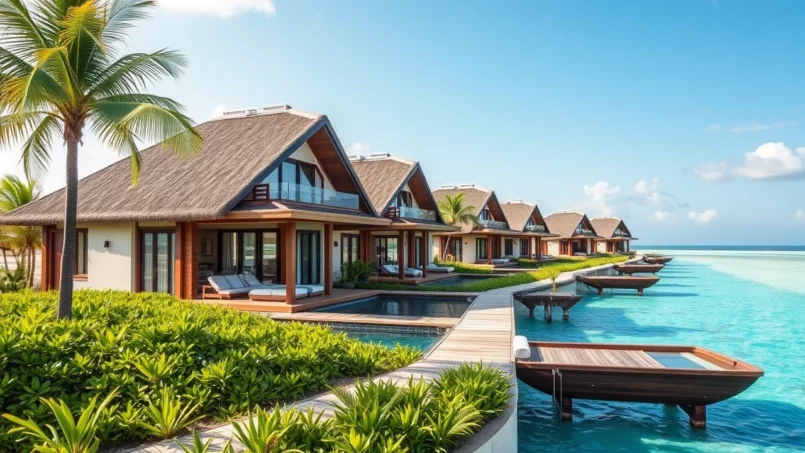
Invest in overwater or beachfront villas integrated into high-end luxury resorts.
Opt for apartments or suites in serviced hotel residences.
Acquire units in condominium-type projects integrated into dynamic tourism zones.
Take advantage of leases for entire islands or portions of islands to develop a private resort.
Invest in commercial spaces dedicated to boutiques, restaurants, dive centers, etc.
The purchase of a purely residential house in a local neighborhood or land on a populated island outside a tourism zone remains exceptional and highly restricted. The legislator’s philosophy is clear: foreign investment must primarily serve economic development, particularly tourism, and not transform inhabited islands into international residential markets.
Examples of Products and Price Ranges
According to recent market data, the following approximate figures are observed in segments open to foreigners:
| Property Type | Typical Location | Indicative Price Range (USD) |
|---|---|---|
| “Premium” Overwater Villa | North Malé Atoll | 1.8 to 3.5 million |
| High-End Beach Villa | Major Tourism Atolls | 1 to 2.5 million |
| Urban Residence Apartment | Greater Malé | 250,000 to 900,000 |
| Unit in a Resort (Strata Residence) | Internationally Branded Resorts | 250,000 and up (often starting at 250,000) |
In Malé, the per-square-meter price for luxury real estate is generally between 5,000 and 10,000 dollars. In tourism atolls, value is measured more by unit (villa or bungalow) than by surface area.
Where to Invest: Key Atolls, New Projects, and Designated Zones
The map of opportunities closely follows the geography of tourism. Atolls near the capital, as well as certain zones of high environmental value, concentrate a large part of projects open to foreign capital.
Among the key regions are:
Overview of the main atolls and their tourism and economic characteristics.
The most accessible atolls from the international airport, with a high density of branded resorts.
A UNESCO Biosphere Reserve, highly sought after for eco-responsible luxury.
Atolls hosting major tourism developments and economic diversification projects.
Raa, Dhaalu and Noonu Atoll, where opportunities for new resorts and managed residences are emerging.
The government regularly designates islands or plots specifically intended for tourism or residential developments aimed at foreign clientele. Certain coastal areas of Kaafu Atoll, for example, are identified to host luxury residential complexes.
Emblematic Projects: Between Innovation and Marketing
Several projects illustrate how the country uses real estate to position itself in specific niches:
| Project | Main Concept | Capacity / Ambition |
|---|---|---|
| Maldives Floating City | Eco-designed floating city, homes and commerce | Aimed at approximately 20,000 residents |
| Coral Residences / Kandima | Overwater villas and pavilions, resort-type services | 50-year leases on luxury units |
These projects highlight architectural innovation, adaptation to climate change, and the promise of a “year-round resort” lifestyle, while still being structured around long-term leases.
Amounts to Invest: From the $250,000 Ticket to Mega-Projects
The entry ticket depends largely on the nature of the investment. An individual buyer aiming for a managed residence in a resort is not in the same league as a developer wanting to lease an entire island.
Several thresholds are set by regulations to guide investor profiles.
| Type of Project or Visa | Minimum Investment (USD) |
|---|---|
| Hotel / Resort Project (Developer) | Approximately 1,000,000 |
| Development of a resort under full foreign ownership (new regime) | From approximately 10,000,000 (depending on sector) |
| Industrial / Logistics / Health / Energy Projects | 100,000,000 |
| Sustainable Township Development | 500,000,000 |
| Investor Visa (business) | 250,000 in a registered company |
| Special Resident Visa linked to property | 250,000 and up in an approved project |
| Temporary Residence (up to 3 years) | Leasehold property of at least 100,000 |
For an individual targeting a villa or apartment in a branded residence, the $250,000 threshold is generally considered the starting point for quality properties offering serious rental potential.
The Step-by-Step Purchase Process
The acquisition process follows a fairly standard pattern for foreign investors, with some local specificities. The key is to keep in mind that each step is supervised by the State, either directly or through the developer.
1. Define the Project and Target the Right Segment
Before discussing contracts, it is crucial to clarify the objective: pure rental investment, mixed use (vacations + income), base for a visa application, or a more ambitious development project. This choice guides the type of property, location, and legal structure (strata, direct lease, joint-venture, etc.).
2. Select a Property and Sign a Reservation Agreement
Once the project is defined, the buyer – often accompanied by an agent specialized in international real estate – identifies a property matching their criteria. To reserve a villa or apartment, it is common to sign a reservation agreement accompanied by a deposit. This document specifies the price, the validity period of the reservation, and the conditions under which the paid amount is refundable or not.
3. Perform Comprehensive Due Diligence
This is probably the most important step, especially in a country where land remains state-owned and structures can be complex. Due diligence should cover:
– the existence and validity of the master lease held by the developer or resort operator
– the registration of the lease with the Land Registry or the competent ministry
– any mortgages, liens, third-party rights, or disputes on the plot or project
– compliance with zoning rules and construction and operating permits
– environmental impact studies and specific risks (erosion, flooding, sea level rise)
– the financial strength and track record of the developer or operator
In practice, this analysis often lasts from 30 to 90 days depending on the complexity of the case. It should be conducted by a local lawyer well-versed in Maldivian real estate law, ideally accompanied by technical advisors (engineer, environmental specialist, tax advisor).
4. Negotiate and Sign the Sales & Purchase Agreement (SPA)
Once due diligence is satisfactory, the next step is to formalize the transaction via a Sales & Purchase Agreement. This contract details:
– the precise object of the sale (leasehold right over a unit, share in a company holding the lease, etc.)
– the price and payment currency
– the payment schedule: initial deposit, staged payments, payment upon delivery
– construction obligations if the property is off-plan (pre-construction)
– performance guarantees, delay penalties, termination clauses
– usage rights (personal stays, access to services, possibility to join a rental program)
For properties under construction, payments are often linked to milestones: foundations, weathertight stage, interior finishing, final delivery. An initial payment of 20 to 30% of the price is frequent, with the remainder staggered until handover.
5. Obtain Government Approvals and Register the Lease
No transaction involving a foreigner is fully effective without the approval of the authorities. Depending on the nature of the project, different administrations are involved:
Main ministries involved in the investment process and their specific areas of competence.
Responsible for investments in resorts or projects integrated into the tourism sector.
Manages general investment agreements and the economic framework.
In charge of registering properties at the Land Registry.
Once the agreements are signed and the fees paid (registration fee, stamp duty, taxes), the leasehold is registered, and a title or certificate is issued to materialize the foreign owner’s right for the duration of the lease.
6. Finalize Management and, Where Applicable, the Rental Program
After registration, the investor must arrange the management terms of their property:
– enrollment in a rental program managed by the resort, with revenue sharing
– independent management (rarer in a purely hotel setting)
– hybrid solution combining a number of weeks for personal use and rental for the rest of the time
In resorts, management fees often represent 40 to 60% of gross rental revenue, but in return the operator handles marketing, operations, and maintenance.
Costs and Taxation: What to Anticipate
The cost structure in the Maldives is influenced by two factors: the systematic use of leases rather than freehold ownership, and the country’s tourism positioning. Acquisition costs are not limited to the price stated on the brochure.
Acquisition Cost and Purchase Taxes
In a typical transaction, a foreign buyer must anticipate:
– a Goods and Services Tax (GST) of approximately 6% on the purchase price of the property
– lease registration fees, proportional to the value and duration of the contract
– a stamp duty calculated on the value of the lease or transfer
– lawyer and advisor fees, varying according to the complexity of the transaction
– possibly real estate agent or buying agent fees
In total, transaction costs for a foreign investor generally range between 8% and 12% of the property price.
Recurring Costs and Operating Taxation
Once owner of their lease, the investor must factor in several annual charges and taxes related to tourism operations:
The investor must anticipate several financial charges: an annual lease rent (land rent) due to the State or the master lessor, a Tourism Land Rent calculated per square meter on resort head leases (often $8 to $10/m²/year), and the Green Tax of $6 per night per tourist, collected from guests. To this are added the GST (generally 6%) on rental income, a potential Business Profit Tax of 15% if the holding is through a company, and a 10% withholding tax on certain payments to non-residents.
From a tax perspective, there is currently no specific capital gains tax regime as a separate entity: capital gains from disposal are integrated into taxable income under the system provided by the income tax law. For non-resident individuals, taxation in principle applies only to income from Maldivian sources.
Yields and Price Dynamics
Despite this tax context, recent data indicates that: economic issues remain crucial for sustainable development.
This is the net annual yield, expressed as a percentage, that resort or urban environment apartments can achieve.
On the capital side, quality leases have seen their value increase on average by 8 to 12% per year over the last five years, depending on the segment. Current projections lean more towards an annual increase of around 5% in the medium term, in a context of market maturation.
Financing: Few Local Banks, Lots of Cash and Developer Plans
Financing is one of the most delicate aspects for a foreigner. Maldivian banks essentially offer loans to residents and local businesses. Access to credit for a non-resident buying a resort villa is therefore limited.
Nevertheless, several options exist:
Several solutions exist to finance a real estate purchase abroad: direct payment plans with developers (approx. 30% down payment, rates of 5-8%), loans via international banks or financial institutions (often backed by local assets), and combined strategies including bridging loans, currency hedging, and rental guarantees to secure cash flow.
In any case, the Maldives remains a market dominated by cash or near-cash buyers, which reinforces the need for a net return analysis stripped of all charges and taxes.
Visas and Residence: When Real Estate Opens the Door to Stay
For many investors, the interest of a purchase goes beyond simple financial return. The authorities have well understood this lever and have put in place several visa schemes linked to investment.
Special Resident Visa Linked to Property
For buyers who invest at least $250,000 in an approved project, a Special Resident Visa may be granted. This status offers a renewable right of stay in five-year periods, generally extendable to close family members. However, it does not grant citizenship or permanent residence: it is a long-term stay permit, conditional on maintaining the investment.
Investor Visa and Other Schemes
In parallel, an Investor Visa is available for those who place at least $250,000 in a registered company in the Maldives. This visa allows stays of up to five years, with renewal possibility.
Amount of bank deposit required to benefit from the Maldives retiree visa program.
Finally, for real estate investments over $100,000, it is possible to obtain temporary permits or multiple-entry visas for a duration of up to three years, facilitating property management and frequent stays.
Joint Ventures, Local Companies, and Special Economic Zones
Behind many projects lie more sophisticated structures involving local companies, joint ventures, or special zone regimes.
The Foreign Direct Investment Policy and investment laws provide for several schemes:
Foreign participation in a Maldivian company varies by business sector. In large-scale tourism, a foreign investor can hold up to 95% of the capital. For professional services (architecture, accounting), participation is capped between 49% and 75%. Some sectors, such as parts of retail trade or domestic logistics, remain closed or very limited to new foreign investment.
Furthermore, Special Economic Zones can offer additional incentives – temporary tax exemptions, customs facilities, etc. – provided they meet high investment thresholds and respond to development objectives defined by the government.
Risks: Environment, Politics, Lease Duration, and Resale
Even if the overall picture seems attractive, real estate investment in the Maldives carries specific risks that must be measured.
Environmental Vulnerability and Long-Term Horizon
The archipelago is one of the countries most exposed to rising sea levels, with an average altitude of about 1.5 meters. Several studies mention the possibility that some islands may become difficult to inhabit by the end of the century. This has two consequences for the investor:
– a risk of physical degradation (erosion, flooding, more frequent storms) affecting constructions
– uncertainty about the very long-term value of leases, especially those nearing expiry in future decades
The authorities therefore impose environmental impact studies and strict standards for coastal construction, but these measures do not eliminate the systemic risk.
Dependence on Tourism and Demand Volatility
The Maldivian economy is heavily dependent on tourism, which represents nearly one-third of GDP directly and up to 70% including indirect effects. A prolonged drop in visitor numbers – whether related to health, economic, or geopolitical crises – can affect:
– resort occupancy rates
– property owners’ rental income
– the value of leasehold rights on the secondary market
Investors should account for the cyclical nature of markets and avoid basing their financial projections on scenarios of linear or uniform growth over time.
Legal Complexity of Leases and Risk of Non-Renewal
A lease of 50 or 99 years can give an impression of quasi-perpetual security. In reality, several points must be monitored:
The value of a lease generally diminishes as its expiry approaches, except in the case of a negotiated extension. Its renewal is not automatic: it is subject to state policy, the developer’s compliance with commitments, and regulatory evolution. The legal structure is often complex, with a master lease, sub-leases for villas, and separate management contracts.
If the holder of the master lease fails to meet its obligations (island rent, environmental standards, etc.), the sub-leases – even perfectly paid by individual owners – can find themselves weakened. Hence the importance of due diligence covering both the project and the operator.
Limited Resale Market
Unlike very liquid international residential destinations, the secondary market in the Maldives remains relatively narrow. The potential buyer of a resort villa is, by nature, a foreign investor in a niche segment. Resale timelines can therefore be long: it is not uncommon for a transaction to take between 6 and 12 months to complete.
The investor must factor in this illiquidity, avoid overestimating their ability to exit a position quickly, and consider a medium- to long-term investment horizon.
How to Limit Risks: The Savvy Investor’s Checklist
In this context, a few best practices are essential for approaching a real estate purchase project in the Maldives methodically.
First, surround yourself with a team of professionals: a Maldivian lawyer specialized in real estate and foreign investment, a tax advisor familiar with the local system and international conventions, an engineer or technical expert to check the condition or design of the property, and, ideally, a contact in the home country to handle overall estate planning aspects.
Next, push due diligence beyond the documents provided by the developer. It can be useful, for example, to:
Before any commitment, it is imperative to: verify the chain of title of the master lease over several decades; obtain modern maps and surveys (GPS) to confirm plot boundaries, the exact location of units, and distance from the coastline; review existing environmental reports, especially on erosion and climate risks; and analyze the financial statements and liabilities of the developer or operating company.
Finally, tailor the legal and tax structure to one’s personal situation. For some, holding the asset directly in one’s own name will be simplest. For others, using a local or international company, or even a joint-venture type structure, will better manage taxation, succession, and asset protection.
A Niche Market, but Structured and Growing
Despite the complexity of its legal framework and environmental risks, the Maldivian real estate market remains attractive for a certain investor profile: significant assets, long-term horizon, appetite for “lifestyle” assets, and a desire to diversify outside one’s home country.
The economy benefits from robust tourism, a currency pegged to the US dollar (approx. 15.42 MVR to 1 USD), and projected GDP growth in the range of 5 to 7% per year in the coming years. Rental and capital values of high-end properties have shown good resilience and notable growth in recent years.
Purchasing real estate in the Maldives is a complex estate planning operation. It requires mastering the land lease regime, anticipating risks related to climate change, understanding the economic dependence on the tourism sector, and dealing with a State that retains strict control over land ownership.
In the Maldives, foreigners don’t buy a piece of land, but the right to occupy and exploit it for several decades. Well-structured and well-understood, this right can offer a rare mix of yield, potential appreciation, and personal pleasure. Poorly prepared, it can conversely become a source of legal and financial friction. The difference plays out, very concretely, in the quality of preparation and in the ability to surround oneself with the right advice from the start.
Disclaimer: The information provided on this website is for informational purposes only and does not constitute financial, legal, or professional advice. We encourage you to consult qualified experts before making any investment, real estate, or expatriation decisions. Although we strive to maintain up-to-date and accurate information, we do not guarantee the completeness, accuracy, or timeliness of the proposed content. As investment and expatriation involve risks, we disclaim any liability for potential losses or damages arising from the use of this site. Your use of this site confirms your acceptance of these terms and your understanding of the associated risks.

Cyril Jarnias is an independent expert in international wealth management with over 20 years of experience. As an expatriate himself, he is dedicated to helping individuals and business leaders build, protect, and pass on their wealth with complete peace of mind.
On his website, cyriljarnias.com, he shares his expertise on international real estate, offshore company formation, and expatriation.
Thanks to his expertise, he offers sound advice to optimize his clients' wealth management. Cyril Jarnias is also recognized for his appearances in many prestigious media outlets such as BFM Business, les Français de l’étranger, Le Figaro, Les Echos, and Mieux vivre votre argent, where he shares his knowledge and know-how in wealth management.





