 Published on and written by Cyril Jarnias
For a long time, Papua New Guinea remained on the periphery of the world’s luxury real estate map. However, behind the image of a mining and agricultural country, an atypical prestige market is now emerging, driven by major gas projects, rapid urbanization, and the arrival of foreign investors seeking high returns. Port Moresby concentrates the bulk of this dynamic, but other cities like Lae, Kokopo, or Madang are beginning to attract attention. This market, as promising as it is complex, operates at the intersection of a resource-based economy, a customary land tenure system, and a highly targeted international demand.
A Luxury Market in a Resource Economy
Papua New Guinea is often described as one of the last “frontier markets” for real estate in the Asia-Pacific region. With a population of around 9.4 million and only 13% urban dwellers, the country remains largely unurbanized. Yet, its GDP hovers around US$27.9 billion, with growth projected between 3.0% and 4.5% annually until 2028, driven by the mining, oil, and agricultural sectors. This economic structure largely explains the nature of the luxury property market.
The US$19 billion PNG LNG (Liquefied Natural Gas) project triggered a real estate boom in Port Moresby starting in the late 2000s.
The prestige residential market is thus closely tied to resource cycles. When a major project starts, the demand for high-end housing for expatriate executives, oil company managers, consultants, and diplomats skyrockets, pushing up both sale prices and rents for executive villas, luxury apartments, and secure compounds. Conversely, at the end of construction phases—or during a drop in oil prices—demand recedes, expatriates leave, and the market corrects.
Between 2010 and 2015, during the PNG LNG project boom, real estate prices increased by 15 to 20% annually. From 2015 to 2019, in the post-boom period, annual changes ranged from -2% to +3%. The pandemic (2020-2022) accentuated the correction with declines of -5% to 0%, particularly in the high-end segment affected by expatriate departures. Since 2023, the market has experienced a healthier recovery, with annual increases of 5 to 8%, driven by new resource projects and diversified demand.
Port Moresby, Heart of the Luxury Property Market
When discussing prestige properties in Papua New Guinea, one must first discuss Port Moresby. The capital concentrates about 85% of the national real estate market. It hosts most political institutions, the headquarters of major companies, embassies, and almost the entire stock of high-end residences and apartments.
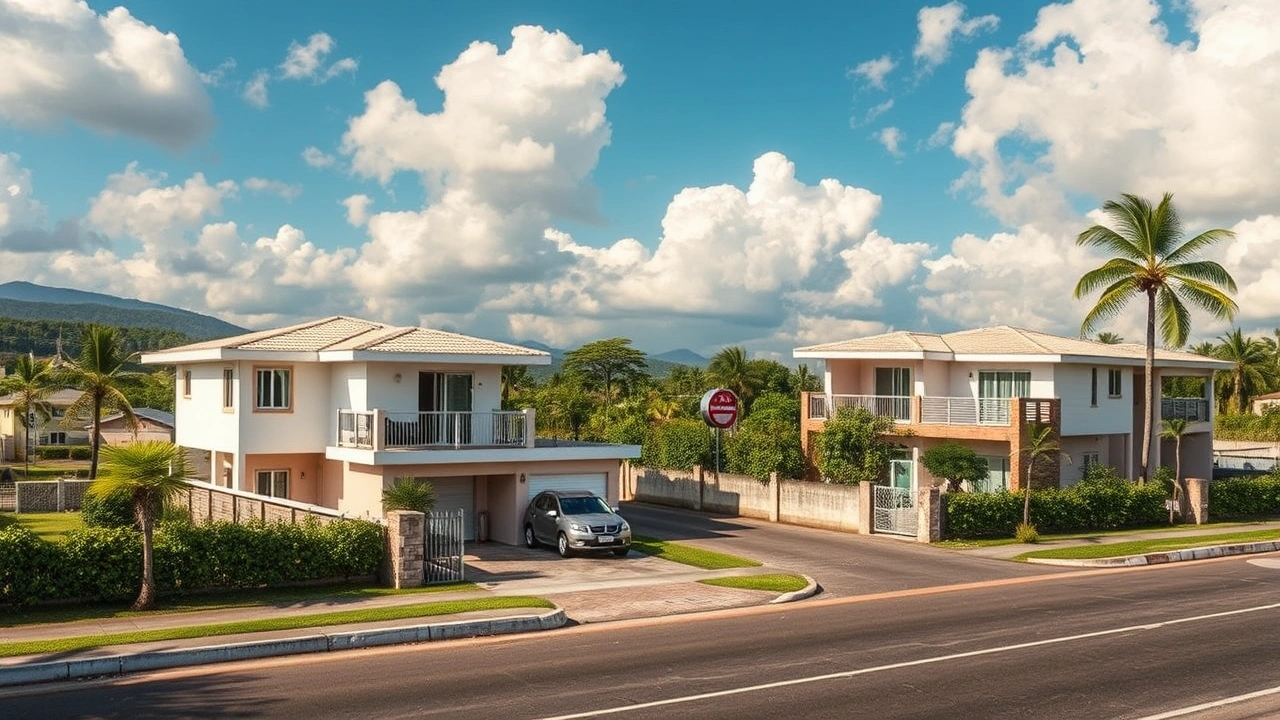
The most sought-after neighborhoods for luxury residential real estate in Port Moresby are Paga Hill, Touaguba Hill, Ela Beach, Badili Point, Harbour City, and The Peninsula. Located on hillsides or by the sea, they offer panoramic views of Fairfax Harbour Bay and quick access to the business center. These areas also benefit from superior security levels, with increased guard presence, access controls, and CCTV systems.
Executive homes in these neighborhoods reach spectacular price levels for a middle-income country. Available estimates place the range between 4 and 8 million kina for a luxury villa in Paga Hill or Touaguba, equivalent to over one to more than two million US dollars. In the luxury apartment segment, prices align with these levels: at the Seaview International Gardens complex at 2 Mile Hill, units with 2 to 5 bedrooms trade between 1.7 and 4 million kina. A three-bedroom apartment in a highly sought-after residence like Ela Vista was listed, for example, at 2.7 million kina, with potential rental income of 20,000 kina per month.
To better visualize the price scale and main segments, the situation can be summarized in the following table.
Indicative Prices for High-End Properties (Port Moresby and Major Cities)
| Location / Segment | Property Type | Price Range (PGK) |
|---|---|---|
| Paga Hill / Touaguba (Port Moresby) | Luxury Executive Residences | 4,000,000 – 8,000,000 |
| Waigani / Hohola (Port Moresby) | Office Buildings | 3,000,000 – 15,000,000 |
| Korobosea / Boroko (Port Moresby, mid/high) | 3-Bedroom House | 800,000 – 2,000,000 |
| Eriku / Top Town (Lae) | Mid/High-End Residential | 600,000 – 1,500,000 |
| City Center (Madang) | Commercial Buildings | 800,000 – 2,000,000 |
| Waterfront (Madang) | Coastal Properties with Tourism Potential | 500,000 – 1,200,000 |
| City Center (Mount Hagen) | Mixed-Use Buildings (Retail + Housing) | 700,000 – 1,800,000 |
| Kokopo (center) | Residential Compounds | 600,000 – 1,400,000 |
| Resource Project Areas | Staff Accommodation | 1,000,000 – 4,000,000 |
In parallel, rents reflect the scarcity and quality of supply. In Port Moresby, during the peak of the gas boom, luxury apartments and executive houses rented at levels that placed the city among the world’s most expensive markets for expatriates. One study recorded weekly rents ranging from 550 to 8,000 kina for houses, with an average of 2,146 kina and a median of 1,700 kina. In the upper segments, weekly rents of 4,000 to 7,000 kina were not exceptional at the height of the PNG LNG era, although subsequent corrections brought some properties down from 7,000 to 5,000 kina per week.
A Varied Luxury Offer: Villas, Gated Estates, and High-End Towers
The high-end market in Papua New Guinea is not limited to a few isolated villas. It has structured itself around several property types and large integrated developments, often driven by institutional investors or local conglomerates.
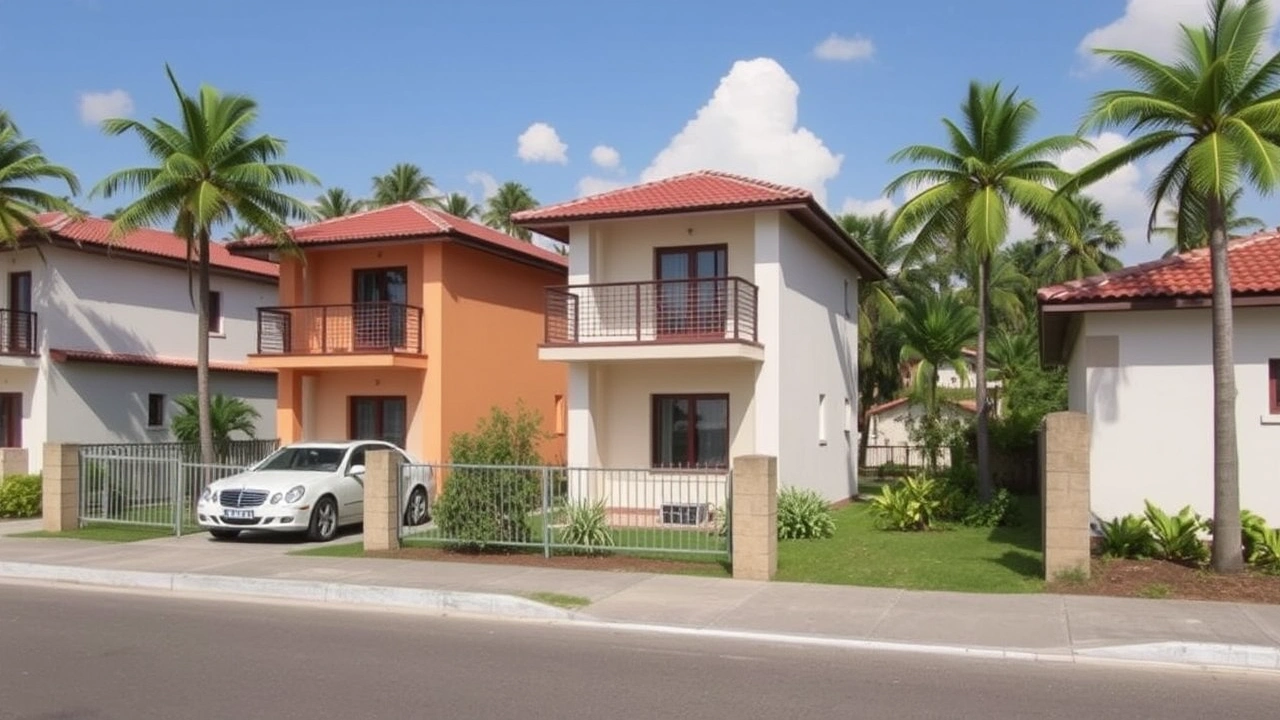
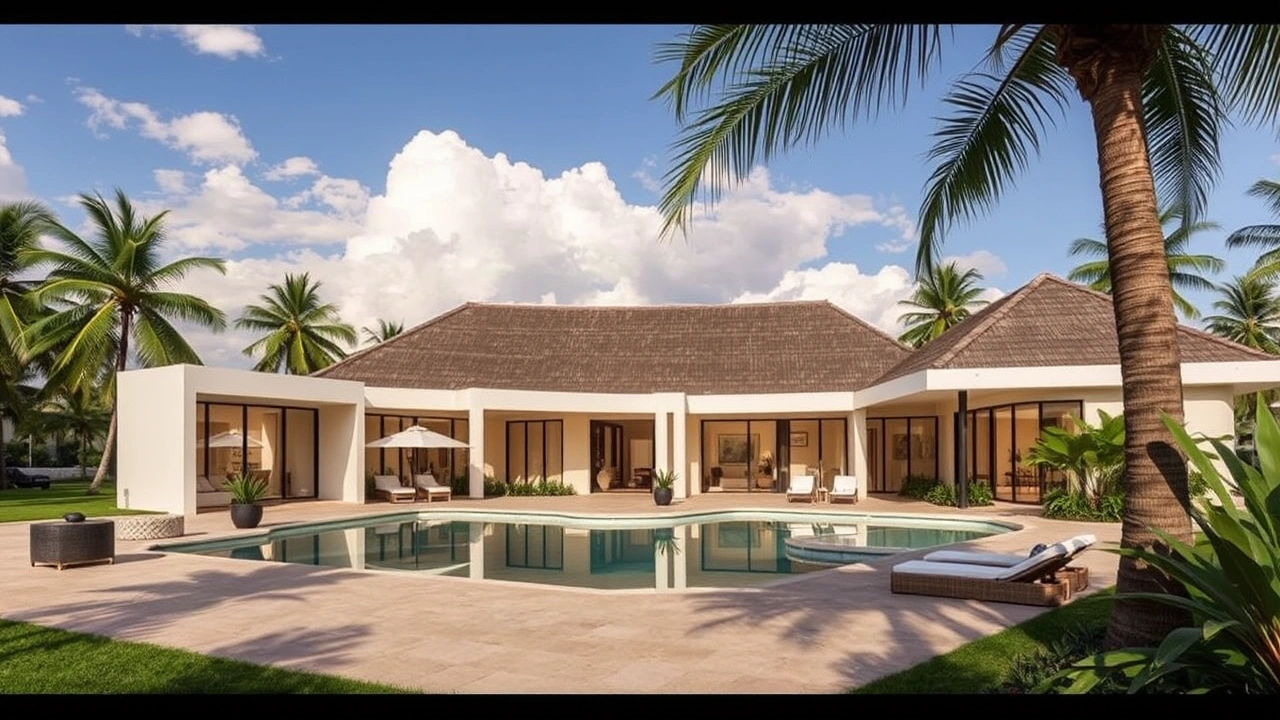
First, there are individual executive residences, most often modernized “high set” houses (on stilts) or large concrete villas with enclosed grounds, swimming pools, carports, and security posts. This format remains highly appreciated by expatriate families and some local senior executives, as it combines privacy, significant living space, and the possibility of housing domestic staff.
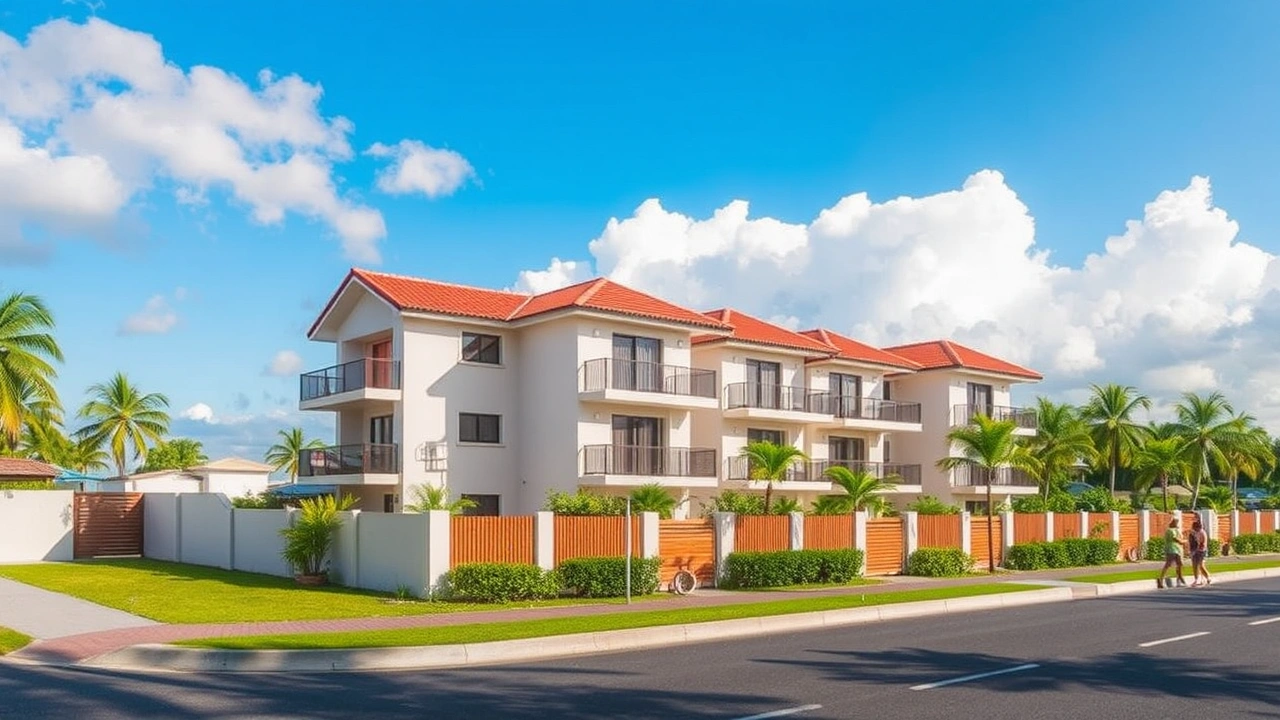
Compounds and gated residences, such as The Peninsula at Harbour City, constitute the main offering of luxury real estate. They provide high-end units (townhouses, apartment buildings) and services equivalent to those of a resort: maintenance of common areas, professional management, amenities (swimming pools, tennis, gym, clubhouse), 24/7 security, and technical infrastructure (generators, water, internet). Some even include shuttles to the city center or airport.
Several emblematic projects shape this prestige offer:
An overview of the principal luxury residential and mixed-use projects transforming the urban landscape of the Papuan capital.
Development by Pacific Palms Property (Steamships). Includes an original 12-story building (1987) and a new 13-level tower adding 40 luxury apartments.
Located at 2 Mile Hill. A 1.4-billion-kina investment for 122 apartments (2 to 5 bedrooms) with views of Walter Bay, developed in three phases.
Mixed-use hubs combining Grade A offices, retail, dining, and sometimes serviced apartments, creating upscale mixed-use neighborhoods.
Developed for Nambawan Super. Combine a luxury hotel and apartment towers with pools, fitness areas, and secure parking.
Venezia Estate and Era Dorina Estate offer a setting favored by companies: apartments and townhouses with enhanced security, CCTV, on-site management, and recreational facilities.
This housing model reflects the profile of the occupants: multinational executives, embassy staff, managers of international NGOs, regional businessmen. All seek an international standard, but also—and above all—a high level of security in a country where risks of urban crime are significant.
High Yields, Extreme Ratios: The Financial Logic of Luxury
Investors interested in the high-end segment in Papua New Guinea are often drawn by one key argument: the advertised rental yields far exceed those of developed markets. For premium residential properties in Port Moresby, sector studies mention gross yields of 8 to 12%. Mid-range residential complexes—highly sought after by employees of local companies and national executives—can target 10 to 15%. For office real estate, the ranges climb to 12-18%, while staff compounds in resource project areas fluctuate between 15 and 20%, or even above 25% for some camps during intensive construction phases.
The maximum estimated total yield over five years for a staff compound in a mining or gas project area in Papua New Guinea.
However, these attractive figures must be placed in a context where relative price indicators reach extremes. The price-to-income ratio is estimated at 131.5 for the entire country, indicating a market dramatically disconnected from local purchasing power. In Port Moresby, the price-to-rent ratio reaches 40.14 in the center and nearly 68 in the periphery, evidence of a market driven by a very specific clientele—expatriates and large companies—more than by national households.
The overall gross yields of the property portfolio, between 1.4% and 2.5%, mask a fragmented reality. This aggregate average includes many overvalued or mismatched properties that are difficult to rent. In parallel, a minority of high-quality assets, well-positioned in the corporate segment, can offer double-digit yields. Therefore, it is crucial to analyze the market by segment to avoid misleading generalizations.
Local financing adds a layer of complexity. For citizens, schemes like the First Home Ownership Scheme allow borrowing up to 400,000 kina over 40 years at 4%, and some banks like Kina Bank offer home loans over 30 years at around 6.95%. But these products remain reserved for citizens, mainly for residential homeownership. For foreign investors, access to credit is extremely limited: rates between 8 and 15%, required deposits of 30 to 50%, and a marked bank preference for cash acquisitions, hence a strong presence of investors with significant equity.
A Unique Land Tenure Framework: 97% Customary Land
One of the most decisive particularities of the real estate market in Papua New Guinea lies in the structure of land ownership. Approximately 97% of the territory remains under customary tenure, collectively held by clans or tribes according to local rules. This type of land cannot be freely bought or sold, and its registration in the national system is complex. In contrast, only about 3% of the land consists of “alienated” land—state-owned or rare private freehold—primarily concentrated in urban centers.
In Papua New Guinea’s capital, an estimated 60% of land belongs to the state domain, a reserve now nearly exhausted.
For foreigners, the constraint is even stronger: freehold ownership is reserved for citizens, and access to land is exclusively through state leases—typically for 99 years—or subleases on existing structures. Any foreign participation in a real estate project requires the creation of a local entity (often a limited liability company registered in Papua New Guinea), obtaining a foreign enterprise certification from the Investment Promotion Authority (IPA) with a minimum investment of 100,000 kina, and approval from the Minister for Lands for the related land transactions.
High-end projects typically combine a locally registered, foreign-controlled company, a state lease on urban land, and sometimes a joint venture with customary landowners via “business leases”. It is crucial to note that old Special Agriculture and Business Leases (SABLs), revealed as abusive by a commission of inquiry, are now highly controversial and largely contested.
The administrative complexity translates into registration processes that can involve up to 17 different agencies and last over a year for converting customary land into registered titles. This cumbersome process fuels legal risk—disputes over boundaries, challenges by clans, complaints about compensation—and reinforces the risk premium demanded by international investors.
High Transaction and Operating Costs
For an investor interested in a luxury villa or a prestige residence in Port Moresby, the acquisition price is only the first step. Peripheral costs, often underestimated, weigh heavily on overall profitability.
Transaction costs for a non-resident typically represent between 5% and 10% of a property’s purchase price.
Once the property is acquired, ongoing expenses remain high. The annual land tax is around 5% of the unimproved land value. Security services—24/7 guards, barriers, alarms, sometimes guard dogs—represent annual budgets between 50,000 and 150,000 kina for a high-end residential complex. Property management fees, for owners who delegate to an agency or professional manager, range between 8% and 15% of monthly rents. Additionally, there is the corporate tax, set at 30% for resident companies outside the mining and petroleum sectors, and the Goods and Services Tax (GST) at 10% on most goods and services related to real estate operations.
The timeline for a real estate transaction varies from 3 to 6 months, potentially exceeding a year in case of administrative, banking, or title-related blockages. Managing cash flows is crucial in a context of tensions on the kina and restrictions on access to foreign currency, requiring constant vigilance and mastery of central bank requirements for conversion and repatriation of income.
Demand: Between Expatriates, Local Elites, and New Global Millionaires
The profile of the clientele for luxury properties in Papua New Guinea is very specific. First, there are expatriates linked to the mining, oil, and gas sectors, but also to financial institutions, NGOs, UN agencies, and diplomatic missions. Companies in these sectors, to attract and retain talent in a country perceived as high security risk, very often include fully covered housing in salary packages: serviced apartments, townhouses in compounds, villas in secure neighborhoods. These expatriates constitute the primary tenant base for high-end properties, with lease contracts often negotiated directly between the company and the owner or agency.
A small local elite, composed of entrepreneurs, leaders of national groups, and high-ranking politicians, is gradually accessing luxury property ownership. Their financing often combines personal savings, superannuation housing advances, and bank credit. Although a minority, this clientele contributes to locally anchoring the premium segment in neighborhoods like Touaguba, Ela Beach, or Waigani.
Finally, the global luxury market exerts a growing influence. Internationally, the prestige real estate segment represents nearly US$903.2 billion in 2024 and is expected to approach US$1,300 billion by 2032, with a compound annual growth rate of 4.5%. In the Asia-Pacific region, luxury residential property prices increased by an average of 3.1% in 2024. Papua New Guinea remains a niche market in this landscape, but it attracts a fringe of investors keen on urban “frontier markets”: some real estate portals list over 30,000 searches for luxury houses for sale in the country, originating from investors in about twenty countries. These potential buyers are less interested in a primary residence than in a yield-generating asset, capable of diversifying a portfolio and benefiting from the risk premium.
Over 70% of Papua New Guineans are believed to be renters, reflecting a real estate market very unaffordable for a majority of the population.
Secondary Cities and Coastline: The Other Luxury Cards
While Port Moresby dominates, prestige real estate is no longer limited to it. The country’s second city, Lae, a strategic industrial center on the coast, is also seeing the emergence of high-end housing and building offerings, particularly for executives of logistics, manufacturing, and mining companies. In the Eriku and Top Town neighborhoods, houses and residential complexes trade between 600,000 and 1.5 million kina, with weekly rents around 2,000 to 3,000 kina for well-located apartments.
In Mount Hagen, in the Highlands, mixed-use retail-apartment buildings reach a value of 1.8 million kina.
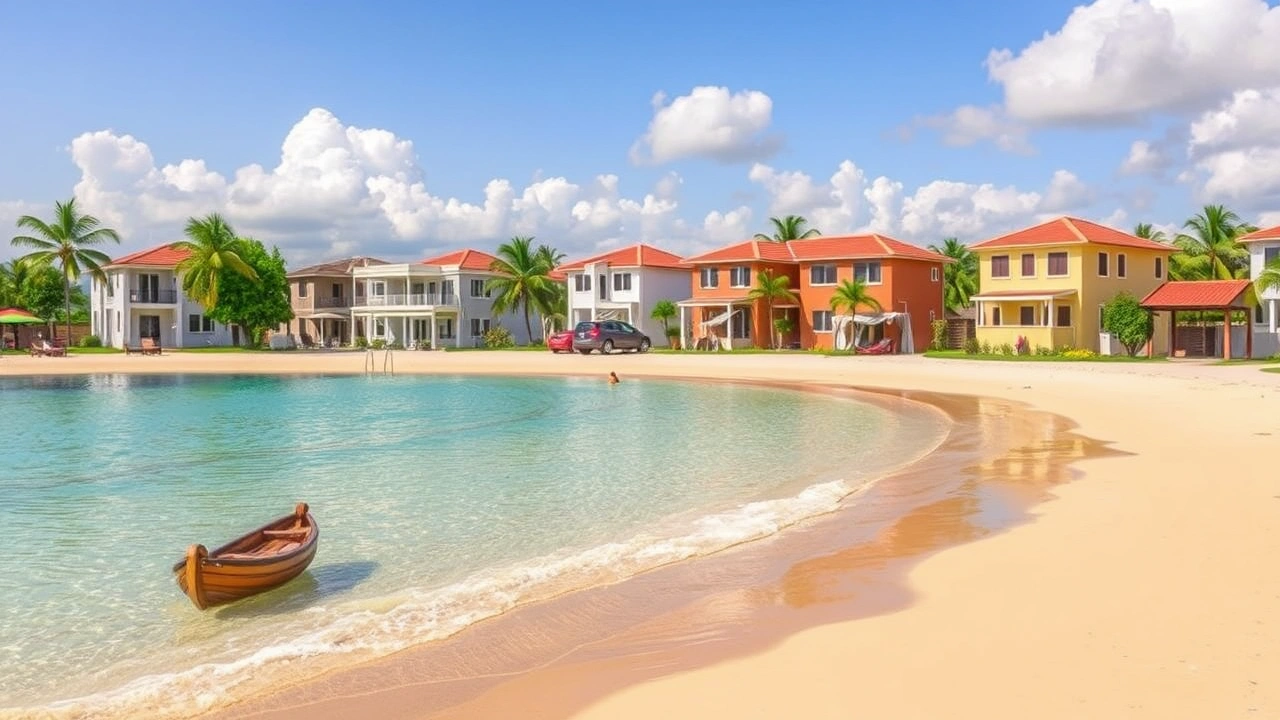
These secondary markets offer two advantages: entry prices 30 to 50% lower than those in Port Moresby, and sometimes a less direct link to the extreme cycles of major gas projects. For an investor looking to position themselves in boutique hospitality, coastal resorts, or long-stay residences for regional executives, cities like Madang, Alotau, or Wewak offer an interesting testing ground, provided the constraints of transport, infrastructure, and local labor are well managed.
Structural Risks and Volatility: The Flip Side
Behind the promises of double-digit yields and quick capital gains, the luxury property market in Papua New Guinea carries a series of risks that no serious investor can ignore.
The first, often cited by companies and international organizations alike, is security. Port Moresby and Lae experience high levels of urban crime, including burglaries, thefts, sometimes carjackings, and assaults. For prestige real estate, this translates into a permanent cost: fences, walls, cameras, guards, secure vehicles, alarm systems… Without these measures, a property, even a luxurious one, immediately loses its appeal to both foreign and local occupants.
The number of expatriates who left Papua New Guinea following the collapse of oil prices and the end of the PNG LNG construction phase.
The third risk concerns governance and the regulatory environment. Papua New Guinea ranks among countries perceived as highly exposed to corruption according to international indicators. Frequent ministerial changes, particularly in key economic and lands posts, generate policy reversals and a degree of unpredictability. The draft Foreign Investment Regulatory Authority Bill, if strengthened, could further toughen the conditions for foreign participation in certain market segments.
Electrification rate in 2018, with a target of 70% set for 2030.
These factors explain why this market, while carrying spectacular opportunities, remains reserved for players with a high risk tolerance, capable of mobilizing strong local teams (lawyers, land consultants, specialized agencies) and funding international-level security and maintenance systems.
A State Torn Between Opening to Capital and Social Pressure
Faced with these challenges, Papua New Guinean authorities try to find a delicate balance. On one hand, the long-term development strategy “Papua New Guinea Vision 2050” explicitly recognizes that foreign investment is essential to bridge deficits in housing, infrastructure, and urban facilities. The state multiplies signals of openness: Public-Private Partnership (PPP) programs, creation of Special Economic Zones (SEZs) offering tax relief and simplified procedures, encouragement to invest in mid-range housing for the emerging class.
Up to 45% of urban populations live in informal settlements, illustrating the inaccessibility of the formal real estate market.
To try to address this, the government has launched several programs—the National Affordable Lands and Housing Programme, the National Land Development Programme—and announced the construction of tens of thousands of affordable homes over 20 years, notably in the National Capital District. A 319-million-kina envelope was allocated to the NLDP over four years, and the National Housing Corporation spoke of a target of 40,000 units in the capital. In reality, these ambitions clash with reality: lack of financing for private projects, very high cost of imported materials, insufficient legal protection for buyers in case of developer bankruptcy, and administrative burdens.
In the current context of a housing crisis, the promotion of luxury real estate projects (towers, villas) is becoming politically sensitive. Furthermore, tightened controls on foreign investment and on special leases (SABLs) can slow down or legally block some high-end projects developed on customary land.
How to Position Oneself in This Luxury Market?
For an international or regional investor considering positioning themselves in the luxury property market in Papua New Guinea, several elements are imperative.
First, one must accept that this country is not a “classic” real estate market where one buys an apartment to rent to a solvent domestic clientele. Luxury demand depends primarily on the expansion plans of resource companies, the presence of international organizations, and the ability of companies to offer compensation packages including housing. The value of a high-end complex in Port Moresby can therefore vary radically depending on the progress of an LNG or mining project.
To establish a presence, it is essential to respect strict legal prerequisites: registration of a local company, IPA certification, secured state lease, clarification of relations with customary landowners, verification of titles with the Registrar of Titles, and consultation with a specialized lawyer. Thorough due diligence from the prospecting stage is crucial, according to experienced players.
Thirdly, the operational dimension must not be underestimated. A luxury compound in Port Moresby is not just a set of walls and swimming pools: it is a machine that consumes electricity (often produced by generators), treated water, security equipment, qualified technicians, bilingual managers, gardeners, maintenance staff. The quality of management makes the difference between an asset capable of maintaining high rents from multinationals, and a complex that deteriorates rapidly, loses its tenants, and sees its yield erode.
The timing of purchase is crucial. Investing at the peak of a boom, when prices already reflect maximum rents, carries a risk of correction, as observed between 2013 and 2017. Conversely, buying during a low phase, characterized by a 30 to 50% drop in rents and sellers under pressure, can offer attractive opportunities for investors with liquidity and a long-term vision.
A Luxury Frontier, Between Opportunity and Uncertainty
The luxury property market in Papua New Guinea reflects, in its own way, all the country’s contradictions: mineral wealth and urban poverty, sustained growth and fragile institutions, openness to capital and jealous defense of customary land, glass towers by the marina and vast informal settlements on the periphery. Port Moresby, with its hills overlooking the sea, its secure compounds, and its brand-new office towers, encapsulates this duality.
This market offers high yields, strong speculative potential, and participation in urban transformation. However, it entails risks: volatility of rents and prices, land tenure complexity, security costs, dependence on resources, and an unstable political environment.
Ultimately, Papua New Guinea is neither a safe haven for cautious investors nor a simple El Dorado for easy yield hunters. It is a frontier luxury market, requiring deep local knowledge, a capacity to withstand shocks, and a patient approach, anchored in the long term. Those who can combine these elements with a clear strategy may find their place there; others would do well to observe from afar these hills of Paga Hill and Touaguba, where a unique chapter of high-end real estate in the Pacific is being written today.
Disclaimer: The information provided on this website is for informational purposes only and does not constitute financial, legal, or professional advice. We encourage you to consult qualified experts before making any investment, real estate, or expatriation decisions. Although we strive to maintain up-to-date and accurate information, we do not guarantee the completeness, accuracy, or timeliness of the proposed content. As investment and expatriation involve risks, we disclaim any liability for potential losses or damages arising from the use of this site. Your use of this site confirms your acceptance of these terms and your understanding of the associated risks.

Cyril Jarnias is an independent expert in international wealth management with over 20 years of experience. As an expatriate himself, he is dedicated to helping individuals and business leaders build, protect, and pass on their wealth with complete peace of mind.
On his website, cyriljarnias.com, he shares his expertise on international real estate, offshore company formation, and expatriation.
Thanks to his expertise, he offers sound advice to optimize his clients' wealth management. Cyril Jarnias is also recognized for his appearances in many prestigious media outlets such as BFM Business, les Français de l’étranger, Le Figaro, Les Echos, and Mieux vivre votre argent, where he shares his knowledge and know-how in wealth management.