
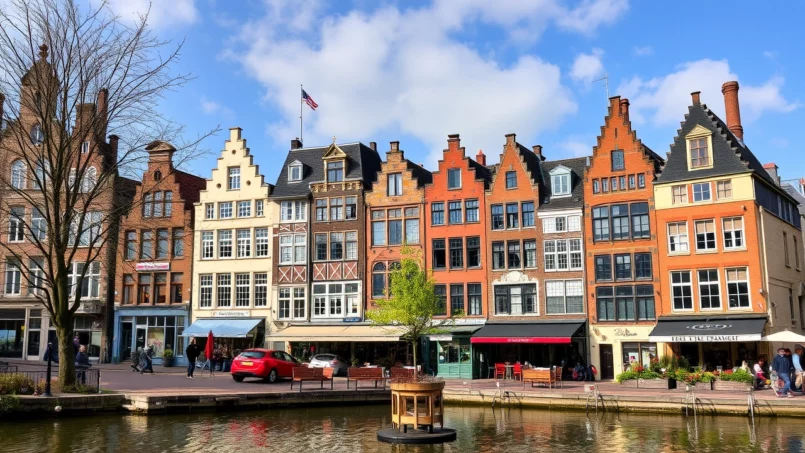
 Published on and written by Cyril Jarnias
Moving to Belgium appeals to many expats: decent salaries, quality public services, a renowned healthcare system, a central location in Europe… But all this comes at a price. Belgium ranks among the most expensive European countries, even if it remains more affordable than London, Amsterdam, or major Swiss cities.
When preparing for a move, it’s crucial to understand the complete structure of a household budget, taking into account regional disparities, the weight of taxes and social security, as well as the fastest-growing expense items like housing, energy, and international schools.
This guide is based on recent statistical data to provide an overview, particularly for Brussels, Antwerp, and Ghent, while remaining readable for someone discovering the country.
Overview: Belgium, an expensive country… but not out of reach
Belgium is one of the countries with a high cost of living. Available figures converge: the cost of living is about 1.5 times higher than the global average and the country is ranked among the 25 most expensive destinations worldwide. In Europe, it is in the top tier: the 13th most expensive country on the continent.
For an expat, a few concrete benchmarks help put things in perspective.
Typical monthly budgets
Cross-referenced statistical sources allow us to identify consistent ranges.
| Profile | Estimated Monthly Budget in Belgium (incl. rent) | Comment |
|---|---|---|
| Single person (Belgium, all cities) | €1,750 – €2,030 | “Comfortable” level according to sources, with modest rent |
| Single person in Brussels | €2,100 – €2,800 | Capital and most expensive city |
| Family of four (Belgium) | €4,000 – €4,550 | Average budget for a decent standard of living |
| Family of four in Brussels | €4,000 – €5,650 | High variability linked to housing and schooling |
Looking at average per-person spending nationwide, Belgian statistics indicate about €20,121 per year, or €1,677 monthly in 2025 (all inclusive). This figure incorporates regional differences: around €1,692 in Flanders, €1,628 in Wallonia, €1,738 in the Brussels-Capital Region.
The average monthly net salary in France covers about 1.6 months of expenses, offering limited leeway.
Belgium vs. neighboring countries
For context, it’s useful to compare Belgium to other major expat destinations in Europe.
| Country / City | Estimated Monthly Cost Family of 4 | Estimated Monthly Cost Single Person | Comment |
|---|---|---|---|
| Belgium | €4,518 | €1,760 | Reference |
| Germany | €5,048 | €1,880 | Slightly more expensive |
| Netherlands | €5,589 | €2,352 | Significantly more expensive, especially Amsterdam |
| United Kingdom | €5,338 | €2,210 | More expensive, especially London |
| United States (with rent) | €6,419 | — | Overall more expensive when including housing |
On a capital city scale, Brussels remains significantly more affordable than London, Amsterdam, or New York: the cost of living is estimated to be about 33% lower than London and over 50% lower than New York, while still being higher than Warsaw or Bucharest.
The main lines of an expat budget
Behind the national averages lies a fairly stable spending structure. In 2025, for an average resident, the monthly budget breaks down roughly as follows:
Average breakdown of monthly expenses per student, based on the provided data.
Rent or loan repayment, plus utilities. About €500–550 per person.
Grocery shopping and non-alcoholic beverages. About €235 per person.
Commuting costs. About €170 per person.
Health-related expenses. About €82 per person.
Internet, phone. About €49 per person.
Outings, restaurants, hotels. About €244 total.
Clothes and shoes. About €67 per person.
For an urban expat, especially in Brussels, these amounts easily increase a notch, as housing, international schools, or certain private services significantly inflate the bill.
Housing: a tight market, especially in Brussels
Housing is the item that most varies the budget between cities. Belgium as a whole is not cheap, but the big difference lies between Brussels on one side, and medium-sized cities or less central municipalities on the other.
Rent levels in major cities
Recent data gives the following order of magnitude for a one-bedroom apartment.
| City | 1 Bedroom City Center | 1 Bedroom Outside Center | 3 Bedrooms City Center | 3 Bedrooms Outside Center |
|---|---|---|---|---|
| Brussels | ≈ €1,095–1,200 | ≈ €917–930 | ≈ €1,985–2,000 | ≈ €1,536–1,600 |
| Antwerp | ≈ €890–901 | ≈ €755 | ≈ €1,425 | ≈ €1,122 |
| Ghent | ≈ €865–920 | ≈ €739 | ≈ €1,317 | ≈ €1,149 |
| Belgium Average | ≈ €827 | ≈ €704 | ≈ €1,241 | ≈ €1,036 |
Brussels is clearly the most expensive, with an average rent for all sizes combined around €1,350–1,415 per month. The national average, across all regions, hovers around €949 monthly.
The gap is also visible in the overall cost of living: a single person will spend on average around €2,104 per month in Brussels, €1,953 in Antwerp, €1,806 in Ghent, compared to only €1,226 in Namur or €1,282 in Charleroi.
Brussels neighborhoods: from luxury to affordable
Brussels is a patchwork of very different municipalities. For an expat, the choice of neighborhood heavily impacts the budget.
The average monthly rent can reach €1,400 for an apartment in Brussels’ most expensive municipalities, like Woluwe-Saint-Pierre.
The trends are not favorable for newcomers: in Brussels, rents increased by nearly 8.6% in 2023, another 5% in 2024, which is over 14% in five years and about 36% over ten years. Forecasts point to annual increases of 3 to 5% until 2026.
Many expats, especially young professionals or students, bypass the price of large apartments by opting for other solutions.
The minimum monthly price for a student room in shared housing or a co-living space.
To this are added the constraints of the Belgian market: the classic residential lease runs from 3 to 9 years, with a three-month notice period for the tenant, a security deposit of up to three months’ rent for an unfurnished property, and the obligation to register the lease. These elements don’t increase the cost to the owner but require anticipating the length of stay.
Real estate purchase: expensive in the city, more modest elsewhere
For those considering a purchase in the medium term, prices per square meter give an order of magnitude.
| Location | Average Price per m² Apartment City Center | Average Price per m² Apartment Outside Center |
|---|---|---|
| Brussels | ≈ €4,200–4,430 | ≈ €3,820–3,880 |
| Antwerp | ≈ €4,190 | ≈ €3,150 |
| Belgium (average) | ≈ €4,193 | ≈ €3,215 |
Nationwide, the square meter is estimated at around €3,050 for an apartment, €2,037 for a house in 2025. Terraced or semi-detached houses trade around €259,500, four-facade houses rather towards €370–395,000.
A purchase involves significant additional costs: registration fees of around 10% (with an exemption on a first portion), 21% VAT for a very recent property, notary fees that can go up to 4%, and agency commission often between 3 and 5%.
Utilities and energy: a heavy expense item
Long neglected in basic budgets, housing utilities have increased sharply. Belgium is now among the European countries where energy is among the most expensive.
For a standard 85 m² apartment (electricity, heating, water, waste), the average monthly bill is around €199 nationally, but the common range is from €150 to €300 depending on the home’s size, insulation, household composition, and city.
Figures for major cities are instructive:
| City | Basic Utilities 85 m² / Month |
|---|---|
| Brussels | about €220–240 |
| Antwerp | about €180–240 |
| Ghent | about €178–220 |
| Liège | about €200–260 |
Unit prices confirm this level: towards the end of 2023, a kilowatt-hour of gas cost about €0.084, electricity nearly €0.28, above the European average for electricity.
The average price of water in Belgium is about €3.22 per cubic meter.
To these utilities add internet access: a fixed connection with at least 60 Mbps and unlimited data is billed around €50 per month, sometimes a bit less in a bundle with TV. Belgium is also known for high internet and telecom tariffs compared to its neighbors.
For a single person, a simple rule of thumb is to budget €120–200 per month for energy + €40–60 for internet/phone. For a family, it’s closer to €250–300 for energy utilities + €50–70 for communication.
Food: a hefty grocery bill, restaurants not cheap
Food often constitutes the largest expense item for a Belgian household, ahead of housing in some statistics, especially if eating out is included.
Groceries: €250–400 per person per month
Expenditure studies show that a typical resident spends about €235 per month on food and non-alcoholic beverages. In practice, budgets vary widely.
For an expat, a realistic benchmark is:
– €250–400 per month for a single person,
– €500–800 for a couple,
– €800–1,200 for a family of four.
The structure of a typical basket gives an idea of the products that weigh the most: about 20% of the budget for meat, 18% for bread and cereals, nearly 12% for milk, cheese, and eggs.
The unit prices observed in supermarkets illustrate a high cost of living: a liter of milk costs between €1 and €1.30, a 500g loaf of bread about €2, a dozen eggs €3.50 to €3.70, a kilo of chicken breast €10 to €11.50, a kilo of potatoes around €2, and a kilo of apples or oranges between €2 and €2.50.
The major chains are well known: Carrefour, Delhaize, Colruyt, Albert Heijn, with discounters like Aldi and Lidl, and organic shops such as Bio‑Planet. Many Belgians living near borders don’t hesitate to shop in France, Germany, or the Netherlands to benefit from slightly lower prices, with estimates indicating that groceries in Brussels are on average 10% more expensive than in these neighboring countries.
Restaurants: a bill that adds up quickly
Dining out quickly adds to the monthly bill. The order of magnitude is fairly homogeneous across the country.
Overview of average prices for meals and drinks in Brussels and Belgium, to help you budget for outings.
A simple meal in an inexpensive restaurant runs around €15–18 in Brussels, a bit over €18 on the national average.
A full three-course dinner for two at a mid-range restaurant easily comes to €80.
A fast-food meal like McDonald’s costs about €10 in the country, €7.50–10 in Brussels depending on the combo.
Coffee is also not negligible: a standard cappuccino costs around €3.30–3.70.
Draft beer, an iconic beverage, costs about €4 per pint on average, up to €5 or more in some capital city bars.
For an expat who often lunches out, the “restaurants” line can easily exceed €200 monthly, especially if you multiply coffees and outings with colleagues.
Transportation: dense network, reasonable costs… except for the car
Regarding transportation, Belgium is rather well positioned relative to its standard of living. The country has a dense rail and urban network covering most needs, allowing many expats to do without a car daily, especially in the city.
Public transport: €49–55 for a monthly pass
In practice, a good portion of residents get by with a standard monthly subscription: around €49 for urban and regional networks, around €55 for a full STIB pass in Brussels after recent indexations.
A single city ticket commonly costs between €2.10 and €2.50, often valid for one hour with unlimited transfers (metro, tram, bus). In Brussels, combined ticket systems like Brupass allow travel on urban networks and suburban trains around the capital for a slightly higher price.
On the national Belgian rail network, a single journey costs €7.50 for those under 26, and subscriptions or multi-trip cards offer significant discounts for regular commuters.
Ultimately, budget studies estimate the average monthly transportation expenditure at about €170 per person, with an important nuance: it rises to €210 in Wallonia, more car-dependent, but is limited to €126 in Brussels, where public transport is denser and car use more restrictive.
Car: a combination of taxes, insurance, and gas
Belgium ranks high in Europe for the cost of car ownership. Recent studies place this expense around €1,100–1,200 per year for an average owner, but this figure doesn’t necessarily reflect the daily life of an expat who drives more or opts for a newer vehicle.
In practice, you need to add up all the relevant elements to get the final result.
– compulsory liability insurance at €60–125 per month,
– an annual circulation tax whose amount varies by region and engine power,
– fuel around €1.70–1.85 per liter for gasoline or diesel,
– maintenance and repairs, around €200–400 per year,
– city parking, charged €1–3 per hour or €80–150 per month for a resident permit in very sought-after neighborhoods.
Conversely, Belgian highways are free, facilitating intercity or cross-border travel.
For an urban expat, the equation is often simple: a public transport pass for €49–55 and a bike or bike-share system cost much less than a car, not to mention the stress of traffic and parking.
Healthcare system: very high standard, real costs to anticipate
Belgium is regularly ranked among European countries with one of the best healthcare systems. For an expat, this translates to broad coverage… provided they register properly and understand the reimbursement mechanism.
Compulsory public insurance
Anyone residing in Belgium must join a mutual insurance fund (mutualité/ziekenfonds) within 90 days of arrival. This obligation stems from a framework law that established compulsory health insurance; failure to register can lead to fines of up to €2,500 and the obligation to pay for healthcare in full.
The employee’s share of social security contributions represents 13.07% of gross salary.
In addition to these deductions, each member pays a modest annual contribution to their mutual fund, around €64 per year (i.e., a little over €5 per month), sometimes with a reduced rate for certain profiles.
What is reimbursed… and what is out-of-pocket
The compulsory insurance covers the essentials of basic care: visits to the GP, basic dental care, specialist consultations, hospitalizations, certain medications, maternity, emergencies, etc. But it operates on a partial reimbursement basis: rarely 100% of costs, more often 50 to 75%.
Concretely, a visit to a general practitioner billed around €27–30 will result in an out-of-pocket expense of about €5–6 for the patient, if the doctor applies the agreed-upon rates. For a specialist whose consultation is billed €50 or more, the typical personal contribution is around €12.
Although hospital stays are better covered, a night in a private room can cost between €300 and €600. A portion of this amount remains your responsibility, especially if the doctor is not recognized by the Social Security system.
The average health budget figures speak volumes: households spend about €82 per person per month on healthcare (excluding social salaries), and insurers largely supplement this via reimbursements.
Value of private supplementary insurance
For an expat, two situations often arise:
– A waiting period: new members may face a delay of several months before being fully covered by the mutual fund. Private international insurance is then highly recommended.
– A need for increased comfort: private hospital room, coverage for certain dental care or alternative medicine, coverage abroad, reduction of co-payments.
Basic private contracts start around €10–20 per month. A more comprehensive plan, including hospitalization in a single room, extended dental care, or international coverage, easily rises to €30–70 monthly. The majority of Belgians have at least hospitalization insurance, sometimes provided by the employer.
Taxation and salaries: decent net, strong tax pressure
The cost of living in Belgium cannot be understood without discussing salaries and tax. The country has one of the heaviest income tax burdens in Europe, but in return, the social safety net and quality of public services remain high.
Progressive tax scale
Income is taxed according to a progressive scale with four brackets:
– 25% on the first bracket,
– 40% on the next bracket,
– 45% on the middle bracket,
– 50% on everything exceeding a threshold around €48–50,000 annually (regularly adjusted threshold).
To this are added:
This is the percentage of social security contributions deducted from the employee’s salary.
In practice, for an expat executive earning around €4,000 gross per month (just under €50,000 annually), the net salary after tax and deductions often falls between €2,200 and €2,600 per month, depending on family situation and benefits (company car, group insurance, etc.).
The average gross salary is around €3,800–3,830 monthly, the average net around €2,430–2,460 per month. The legal minimum wage now exceeds €2,100 gross, for a net around €1,600.
Specifics for expats: special regimes and double taxation
Belgium has established a special tax regime for certain “inpatriate” workers and researchers, offering net allowances exempted up to a fraction of salary (up to 30%, and soon 35% without a cap in some cases) to compensate for the additional costs of expatriation. Not all expats are eligible, as strict conditions apply (minimum salary, no prior residence in Belgium, etc.), but for those who benefit, it significantly improves disposable income.
Belgium has signed numerous double taxation avoidance agreements, notably with France, Germany, the United Kingdom, the United States, and Canada. These agreements prevent paying tax twice on the same income through exemption or tax credit mechanisms.
Education and childcare: free in public, very expensive in international schools
For expat families, school and childcare are often decisive expense items. The good news: public education is of decent quality and free, and preschool is accessible from age 2.5. The bad news: international schools, often favored for children who regularly move countries, cost a small fortune.
Public daycare centers use a fee scale indexed on income: a day of care can cost less than €3 for a modest household, up to nearly €40 per day for the highest incomes. Ultimately, the monthly bill for a public daycare often varies between €60 and €750 for full-time.
In the private sector, a daycare spot easily reaches €600–800 per month. Other solutions exist:
The minimum hourly rate for a childminder in France is about €5.
In Brussels, private nursery structures charge around €568 per month on average, but some international schools offer much more expensive nursery sections.
Schooling: public free, international very costly
Public schools, managed by the linguistic communities, are state-funded. They do not charge tuition fees, only ancillary costs (materials, trips, meals), which remain in the order of a few hundred euros per year per child.
Subsidized private schools charge modest amounts (about €650 per year). In contrast, international schools, particularly numerous in Brussels, follow foreign or international curricula (IB, British, American, European programs) and operate without public subsidies.
The fee scales are impressive:
The average annual cost of international primary education in France is about €15,700.
To this are frequently added non-refundable application fees (from €50 to over €1,000), “capital” or “development” contributions, school transport, cafeteria, paid extracurricular activities, etc. Companies employing high-level expats sometimes cover these costs in the package.
Universities: relatively affordable
In higher education, Belgium is a good deal for student expats compared to other Anglo-Saxon countries. In public universities, tuition fees for European students are around €980–1,100 per year. For non-EU students, fees vary more, generally between €2,500 and €7,500 per year depending on the program.
Business schools and private universities, however, have higher rates, between €10,000 and over €20,000 annually for some master’s programs.
Telecoms, internet, and media: more expensive than you think
Expats are often surprised by the cost of telecommunications in Belgium. A standalone fixed internet connection starts at around €23–30 per month, but most complete packages (high-speed internet and television) are rather between €40 and €90 monthly.
A simple formula for a household is to plan: a balanced budget that accounts for fixed and variable expenses, while ensuring savings for unforeseen events.
An estimate of common expenses for internet, mobile, and streaming services in France.
About €50 per month for comfortable speed internet access.
Between €20 and €25 per month for a plan with a dozen gigabytes of data.
A few dozen additional euros for platforms like Netflix or Disney+, each costing between €3 and €20.
In total, the monthly “communication” budget per person comes out around €49 on average, a bit more in Brussels.
Leisure, sports, outings: comfort has a price
One of Belgium’s attractions for expats is its quality of life: dense cultural offerings, gastronomy, bars, festivals, amusement parks, sports clubs, etc. All items that shouldn’t be neglected in the budget.
Average monthly expenditure in euros of residents for leisure and culture, according to aggregated data.
In practice, we find price levels comparable to other Western European countries:
– movie ticket at €12–14,
– museum entry between €10 and €15,
– amusement park between €30 and €50 per day,
– large gym like Basic‑Fit around €20 per month, premium gyms at €100–180,
– concerts between €30 and €70 per ticket, sporting events €20–100.
For someone who regularly goes to the movies, museums, restaurants, and is a gym member, a leisure budget of €150–250 per month is not excessive.
Regional differences: Brussels, Flanders, Wallonia
Beyond specific prices, the “spending profile” varies from region to region.
The estimated monthly cost of living per person in 2025 in the Brussels-Capital Region, the highest of the three Belgian regions.
In reality, an expat with a comfortable salary and a Brussels-based position will often aim for housing in the Brussels region (center, upscale municipalities, or affluent suburbs like Uccle), placing their budget in the upper national range.
Who pays how much? Sample budgets
To make these figures more concrete, it’s useful to put them in perspective with some typical expat profiles.
Young single professional in Brussels
Assume an employee in the services sector or European institutions, with a net income of €2,500 per month.
A plausible budget, without extravagance but comfortable, could look like this:
– rent for a studio or 1-bedroom outside hypercenter: €900–1,000,
– utilities and energy: €150–180,
– internet + mobile: €60–70,
– groceries: €280–320,
– restaurants / cafes: €150–200,
– public transport (pass): €49–55,
– leisure, sports, cultural outings: €150–200,
– healthcare (excluding social contributions, small co-pays, private insurance): €30–50,
– miscellaneous / clothes / unforeseen: €150–200.
With a monthly income of €1,900 to €2,100, it’s possible to have a savings or travel capacity of €400 to €600, provided spending on outings and fine dining restaurants is moderated.
Family of four on the outskirts of Brussels
Take a couple of expats with two children, only one member working full-time with a net around €4,000 (or two salaries totaling this amount). If the children attend an international school in Brussels, the scale changes completely.
Annual international school fees for two children amount to €30,000–40,000, or €2,500–3,300 per month.
In this scenario, the simple total of housing + groceries + schooling already far exceeds €5,500 per month. Without partial coverage of school fees by the employer, the overall bill can become difficult to sustain.
Conversely, a family placing their children in the public system and living in a medium-sized city like Namur or Mons can maintain a very decent standard of living with an overall budget around €3,500–4,000 monthly.
Inflation and outlook: a cost of living under pressure
During 2023–2025, Belgium experienced high inflation, like most of its neighbors. The annual rate reached 4.4% in 2024, before being projected to slow to 2.9% in 2025 and 1.9% in 2026. The impact on the cost of living is already visible: in three years, average annual per-person expenditures have gone from about €18,300 to a projection of over €20,000.
Rents, energy, and food continue to become more expensive, putting pressure on the cost of living. Although salaries and allowances keep up thanks to Belgium’s automatic wage indexation mechanism, this effect compensates for inflation with a certain lag and its impact varies by sector of activity.
For an expat negotiating a contract, these elements argue for: competitive remuneration, attractive social benefits, appropriate health coverage, coverage of relocation expenses, administrative support, and a good work-life balance.
– asking for remuneration aligned with qualified local salaries (average net salaries being around €2,400–2,500, an experienced professional often positions above €3,000–3,500 net),
– discussing coverage of international school fees, supplementary health insurance, and possibly a housing budget,
– factoring into calculations that current expenses will continue to evolve, even if inflation is expected to slow.
In summary: a high cost of living, but consistent with the level of services
Belgium is neither a low-cost destination nor an “off-ground” country like Switzerland or Luxembourg. The cost of living is high, especially in Brussels and certain sought-after municipalities, and some items – international school, spacious housing, energy, telecoms – really weigh on an expat’s budget.
In return, purchasing power remains decent for those with a qualified local salary, thanks to:
France stands out for its set of public services and social protections that structure the daily lives of its inhabitants.
An extensive and developed public transport network, facilitating travel within metropolitan areas and between regions.
A quality healthcare offering, supported by a reimbursement system that guarantees broad access to care.
A public, secular education system, from preschool to university, free of charge, a foundation of equal opportunity.
A diverse and accessible cultural offering, from museums to festivals, animating the territory year-round.
Extensive social protection covering major risks: illness, unemployment, family allowances, and retirement.
For a well-informed expat, the key is therefore to calibrate your project with full knowledge: choose your city and neighborhood according to your income, decide between local public school and international institution, avoid total dependence on a car if possible, optimize your health coverage and tax situation.
With these parameters correctly anticipated, Belgium offers an attractive compromise: a cost of living that is indeed not negligible, but a level of services and quality of life that, for many, justifies the investment.
Disclaimer: The information provided on this website is for informational purposes only and does not constitute financial, legal, or professional advice. We encourage you to consult qualified experts before making any investment, real estate, or expatriation decisions. Although we strive to maintain up-to-date and accurate information, we do not guarantee the completeness, accuracy, or timeliness of the proposed content. As investment and expatriation involve risks, we disclaim any liability for potential losses or damages arising from the use of this site. Your use of this site confirms your acceptance of these terms and your understanding of the associated risks.

Cyril Jarnias is an independent expert in international wealth management with over 20 years of experience. As an expatriate himself, he is dedicated to helping individuals and business leaders build, protect, and pass on their wealth with complete peace of mind.
On his website, cyriljarnias.com, he shares his expertise on international real estate, offshore company formation, and expatriation.
Thanks to his expertise, he offers sound advice to optimize his clients' wealth management. Cyril Jarnias is also recognized for his appearances in many prestigious media outlets such as BFM Business, les Français de l’étranger, Le Figaro, Les Echos, and Mieux vivre votre argent, where he shares his knowledge and know-how in wealth management.





