
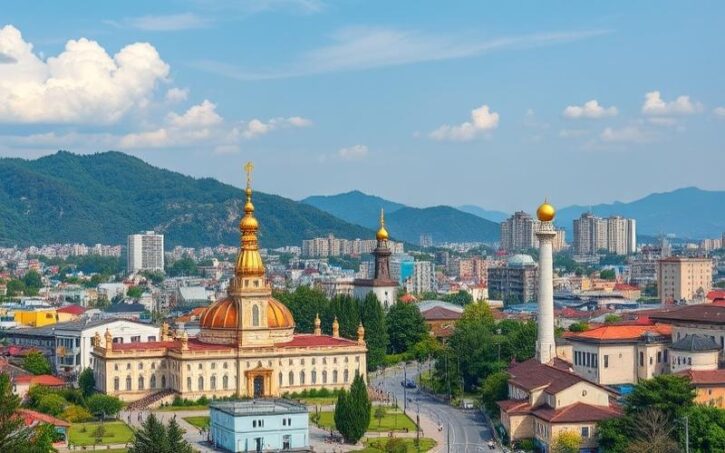
 Published on and written by Cyril Jarnias
Moving to South Korea means entering a country where cutting-edge technology coexists with millennia-old rituals. Even though a slight majority of the population claims no religious affiliation, daily life remains deeply marked by Buddhist, Christian, Confucian, and shamanic traditions, not to mention a dense set of family rites like jesa. For an expatriate, understanding this religious landscape and the codes that accompany it is not just a cultural extra: it is a key to understanding society and a concrete way to avoid faux pas.
This article covers the country’s main religious traditions, appropriate behavior in places of worship, the influence of Confucianism on social relations, and provides guidance for participating in or respecting local religious life.
Religious Overview: A Very Spiritual, Not Very Practicing Country
Recent figures paint a paradoxical South Korea: highly influenced by religion, yet increasingly detached from formal affiliations. The most recent surveys show that about half the population claims no religion, while the rest is primarily split between Christianity and Buddhism.
Here is a snapshot of current religious affiliations:
| Religious Affiliation | Estimated Share of the Population |
|---|---|
| No Religion | ~51–52% |
| Christianity (total) | ~31% |
| – of which Protestantism | ~20% |
| – of which Catholicism | ~11% |
| Buddhism | ~16–17% |
| Other Religions | ~1% |
This table doesn’t tell the whole story. A large portion of Koreans who declare themselves “non-religious” still use the services of fortune tellers, shamans, or Buddhist temples for specific rituals (exams, marriage, business, health). Similarly, deeply Confucian values structure family, school, and corporate life without being perceived as a “religion.”
For an expatriate, a colleague may state she is “not a believer” while still participating in family ancestral rites, occasionally consulting a shaman, and attending a wedding in a Protestant megachurch, without this constituting an apparent contradiction in her eyes. This illustrates the overlapping and flexibility of religious practices and identities in certain cultural contexts.
Confucianism: The Invisible Backbone of Daily Life
Even though only a tiny minority of Koreans identifies as “Confucian,” the legacy of Confucianism permeates all areas of social life. The country long ranked as one of the most Confucian states in the world, particularly during the Joseon dynasty, which adopted it as its official ideology.
At the heart of this system, several principles structure behaviors:
These fundamental principles structure relationships and behaviors in societies influenced by Confucianism. They include filial piety (hyo), which demands respect and duty towards parents and elders; a strict hierarchy of relationships (parent-child, husband-wife, etc.); ritual propriety (ye), guiding conduct according to status; the valorization of study and exams as a path to success; and the priority given to group cohesion over individual expression.
Concretely, this translates into highly visible gestures for an expatriate: the age question asked upon first meeting, the systematic use of titles (professor, director, “-ssi” after a name), greetings with a bow, the required discretion on the subway, the deference shown at the table towards the eldest person. Religion in the strict sense doesn’t explain everything; but without this Confucian foundation, many Buddhist, Christian, or shamanic rites would be hard to understand.
Korean Buddhism: Living Temples and “Temple Stay” Programs
Introduced in the 4th century and long the dominant religion, Buddhism remains one of the major cultural forces in South Korea. Over 900 traditional temples dot the country, often nestled in mountains or spectacular natural settings. Even if regular practice is in the minority (a very small portion of Buddhists participate in weekly ceremonies), temples play a central role in spiritual and touristic life.
What is a Korean Temple Like?
A Korean temple is not a simple building, but a complex of structures organized like a small sacred city. From the first entrance gate, the space is considered sacred. The visitor typically passes through several symbolic gates before reaching the main Buddha hall.
You will frequently find:
The main architectural elements and structures found in a traditional Korean Buddhist temple.
A series of symbolic gates marking the passage to the sacred: Iljumun (Gate of One-ness), Gates of the Guardian Deities, and Gate of Non-Duality.
The central building housing the main statues of Buddha and bodhisattvas, used for ceremonies and meditation.
Pagodas, stone stupas, and lanterns, often erected to house sacred relics or commemorate masters.
Dedicated to guardian deities, mountain spirits, or specific ritual functions.
Buildings to house monks and nuns, kitchens (dining hall), administrative offices, and sometimes visitor accommodations.
The entire site is a place of practice for the monastic community, but most temples are open to visitors, believers or not.
Conduct Codes in a Buddhist Temple
The first rule is restraint. A temple is neither an amusement park nor a photoshoot backdrop, but a living place of prayer and meditation. A few essential principles make the visit smoother:
For a respectful visit, adopt a calm attitude (no music, shouting, or running), refrain from smoking and drinking alcohol. Treat objects (pagodas, statues, lanterns) as sacred. For photos, avoid the interior of halls and worshippers. Use side doors, remove shoes and hats before entering (keep socks on). To pray, position yourself to the side, never facing the main statue directly.
A brief greeting with hands joined (hap-jang) at chest level and a slight bow of the head is an appropriate way to show respect, especially when encountering a monk or nun. However, it is highly frowned upon to touch them: mere physical contact may require them to perform a subsequent purification ritual.
Offerings, Incense, and Donations
Many visitors, including non-Buddhists, choose to place an offering, light a candle, or a stick of incense. The intention matters more than the amount or the gesture. In practice:
– Donation boxes are placed in various locations.
– It is common to leave a small amount (a few thousand won) when lighting a candle or incense.
– Signs sometimes indicate the suggested amount for a lantern or a particular ritual.
In the main hall, offering incense follows a precise protocol: approach quietly, hands joined, bow, light the incense using an already lit candle, then raise the incense stick to forehead height before placing it in the burner. For a novice expatriate, it is advisable to stick to a simple bow and a discreet donation, which is entirely appropriate.
Participating in a “Temple Stay”
“Temple stay” programs are an ideal bridge between tourism and spiritual immersion. Over fifty temples across the country offer this type of stay, ranging from a day of initiation to an extended weekend.
As a rule:
– The stay includes accommodation in a simple room, strict vegetarian meals, and participation in some ceremonies.
– The cost is typically between 50,000 and 100,000 won per night, including meals and activities.
– Simple attire is provided (loose pants and vest), symbolizing detachment from material concerns.
– Days often start very early (3–4 AM) with the temple bell, followed by chanting, seated or walking meditation, communal work, and silent meal rituals.
– A common rule: no consumption of alcohol or meat, and no physical contact between men and women during the stay.
For an expatriate, experiencing a temple stay doesn’t mean you have to convert or adopt Buddhist doctrine. It is primarily a learning experience of monastic rhythm, silence, and discipline, close to the heart of Korean Buddhism.
Christianity in South Korea: Megachurches, Neighborhood Congregations, and English Services
Christianity experienced spectacular growth in South Korea during the 20th and 21st centuries. Today, about one-third of the population identifies as Christian, with an even greater influence in certain urban areas, notably the greater Seoul metropolitan area and the western provinces.
Diversity of Churches and Worship Styles
The Korean Christian landscape is extremely fragmented: Presbyterian, Methodist, Baptist, Pentecostal, Lutheran, Anglican, Catholic, independent evangelical movements, new churches emerging from Protestantism… For an expatriate, it can be dizzying.
A few structural traits:
– Protestants (especially Presbyterians and Methodists) represent the majority of local Christianity.
– Catholics form a minority but highly structured group, with dynamic parishes.
– Very large churches – sometimes called “megachurches” – hold multiple services each Sunday, with amplified music, giant screens, simultaneous translation.
– Worship styles range from very formal liturgy, close to the European style, to charismatic celebrations incorporating pop music, theater, or multimedia.
Korean Christian culture places central importance on community life, expressed through home groups, prayer cells, Bible studies, volunteer activities, and mutual support. At the same time, influenced by Confucian culture, it is often characterized by a marked hierarchical structure, where the pastor or priest holds a preeminent position.
Where to Find Services in English?
For expatriates, the language barrier can be an obstacle, but the offer in English is surprisingly wide, especially in the Seoul area and in major cities like Busan, Incheon, Daejeon, Daegu, or Gwangju. Online directories – for example, specialized directories or English-language magazines – list dozens of communities offering services partly or entirely in English.
You will find:
– English-speaking ministries integrated into large Korean churches.
– Protestant or Catholic parishes with an international vocation.
– Independent communities targeting foreign workers, students, or mixed families.
Some websites like Gospel Hub Korea list available English-speaking ministries in the country, while noting that this list is neither exhaustive nor a quality label. The administrators highlight the existence of many controversial or cult-like religious groups and invite users to report problematic cases.
For a Christian expatriate, online resources allow you to search for a church or group by filtering by city, denomination, or language. It’s also possible to check reviews from other worshippers before visiting.
Best Practices for Attending a Local Church
Without going into the details of each community, some codes are almost universal in Korean churches:
– Punctuality: Arrive before the announced time, as services are often highly structured.
– Appropriate attire: Neat clothing, rather sober colors (avoid flashy white at a wedding, reserved for the bride).
– Respect for hierarchy: Address the pastor or priest with the appropriate title, avoid immediate familiarity.
– Participation: It is generally expected of regular members to join a small group, a volunteer service, or a ministry (welcoming, music, children).
Korean churches, particularly Protestant ones, are also known for their missionary zeal, including abroad. An expatriate may be asked to join a prayer group, a charity project, or a short-term mission. It is perfectly acceptable to politely decline; the important thing is to do so without hurting the “kibun” (feeling, face) of your interlocutor.
Jesa: Ancestral Rites at the Heart of the Korean Family
It’s difficult to understand Korean religious life without mentioning jesa, this highly elaborate system of rites in honor of ancestors. Inspired by both ancient shamanic beliefs and Confucian norms formalized under Joseon, jesa is still practiced today by a large majority of families, regardless of their official religious affiliations.
Nature and Frequency of Jesa
Jesa is not “worship” in the monotheistic sense, but a ritual of memory and gratitude towards the deceased, performed “as if they were still present”. It expresses filial piety and strengthens the cohesion of the family lineage. Several forms are distinguished:
Filial piety in Korea manifests through several distinct commemorative rites. Gijesa is an annual ceremony held on the anniversary of an ancestor’s death. Charye is a simplified rite practiced during major family holidays like Seollal (Lunar New Year) or Chuseok (harvest festival). Sije refers to seasonal rites or those dedicated to more distant ancestors. Finally, Myoje is a ceremony performed at the gravesite, which may be complemented by simply visiting and cleaning the grave, called seongmyo.
These rites often take place late in the evening or at dawn, in the family home or, for important lineages, in a dedicated shrine.
The Typical Progression of a Jesa
In its classic form, jesa follows an extremely codified protocol. The central element is the offering table (jesasang) set before an ancestral tablet (shinwi) or a paper tablet (jibang) bearing the deceased’s name.
The main stages include:
The example describes the key stages of a Korean commemorative ceremony (Jesa) in honor of ancestors. It begins with inviting the spirits (gangsin) via incense and a first libation of alcohol. This is followed by collective bows (chamsin) and then serving a ritualized banquet. The central rite involves three successive libations (choheon, aheon, jongheon), often led by the eldest. The family then observes a moment of silence (yusik), symbolically letting the spirits partake. The ceremony concludes with offering tea, burning a paper tablet, and a communal meal (eumbok) where the now-blessed food is shared.
For an expatriate invited to a jesa, it is not expected to know all these steps. Observing carefully, bowing when others do, maintaining a reverent attitude, and wearing sober clothing are largely sufficient.
Religions’ Stances on Jesa
The way different religions perceive jesa explains many contemporary Korean attitudes:
– Catholicism, after long forbidding it, now considers it a civil rite of family memory rather than an idolatrous practice. Many Catholics therefore participate in jesa.
– Buddhism easily integrates ancestral rites, which fit into its vision of karmic and family bonds.
– A significant portion of Protestants, however, continue to refuse participation in jesa, seeing it as conflicting with Biblical monotheism.
For an expatriate, this internal diversity is important: two colleagues who say they are “Christian” may have very different practices regarding ancestral rites, and this topic can remain sensitive even within families.
Shamanism (Musok): The “Gut,” Rituals You Don’t Always See, But That Still Structure Society
Less visible than temples or churches, Korean shamanism nonetheless continues to play a major role in the country’s symbolic life. It is an indigenous, polytheistic tradition centered on interaction with a multitude of spirits: local deities, house spirits, mountain, sea spirits, discontented ancestors, wandering souls.
Who are the Mudang?
The officiants are the mudang, predominantly women. They serve as intermediaries between humans and spirits through divination and especially through complex rituals called gut. The calling to become a mudang often comes through an existential crisis or unexplained illness (sinbyeong), interpreted as a “call from the spirits.” The person must then be initiated by an experienced shaman and undergo an enthronement rite (naerim-gut).
In contemporary practice, mudang:
Korean shamans practice in three types of distinct places: homes, businesses, and dedicated shrines (guttang).
The Gut: Spectacular and Codified Ceremonies
A typical gut is a fascinating mix of music, dance, theater, trance, and symbolic or real sacrifices (food, sometimes animals in more traditional rituals). It includes:
– Multiple colorful costumes, often changing during the rite.
– A percussion orchestra (drums, gongs, cymbals) and flutes.
– Ritual chants (muga) in an ancient language.
– Possession phases where the spirit “speaks” through the shaman’s mouth (kongsu).
– Abundant offerings: fish, meats, rice cakes, fruits, alcohol.
– A final moment where offerings are shared, the food consumed, and ritual effigies and papers burned to accompany the spirits.
The Korean gut comes in many types, each with a specific purpose: initiation ritual (naerim-gut), purification of a deceased soul (ssitgim-gut), communal rite for a village’s prosperity (dodang-gut), ceremony for fishermen, or specific Jeju rituals for the sea goddess. Several of these traditions are now listed as intangible cultural heritage, some even having received UNESCO recognition.
How Might an Expatriate Encounter Shamanism?
Even without directly attending a gut, a foreigner might encounter shamanism in various forms:
– Shamanic shrines in mountains or certain neighborhoods, recognizable by colorful flags and the multicolored “taegeuk” symbol.
– Small domestic altars dedicated to deities of the kitchen, house, or toilet.
– Very popular fortune-telling sessions, frequented by students before exams or couples before marriage.
– Public rituals organized for symbolic events (disasters, commemorations, major urban projects).
The recommended attitude for an expatriate is respectful curiosity. Photographing a gut in progress without permission, commenting in a condescending manner, or disrupting a ceremony would be a serious affront. On the other hand, attending with the participants’ consent, remaining discreet, and, perhaps, leaving a small symbolic offering as a sign of respect is entirely possible.
Jeongwol Daeboreum and Major Traditional Festivals: When Religion Blends with Festivity
Korean religious life is not limited to weekly worship or monastic retreats. It is also expressed through a calendar of traditional festivals where rites, folklore, and beliefs intertwine.
Among them, Jeongwol Daeboreum, the festival of the first full moon of the lunar year, holds a special place. Considered one of the country’s major traditional festivals, it blends agrarian rites, fire games, symbolic foods, and auspicious predictions.
Associated practices include:
Daljip Taeugi is a large ritual fire where a “moon house” made of straw is burned to chase away evil spirits and carry the residents’ wishes. Jwibulnori games involve twirling iron boxes filled with embers over rice paddies to fertilize the soil and eliminate pests. These practices are accompanied by eating Ogokbap (five-grain rice) and dried vegetables (Mugun-namul) for future health, as well as communal rituals for the village’s tutelary deities.
For an expatriate, these festivities are a privileged gateway into the Korean religious imagination, halfway between shamanic rites, Confucian practices of homage to nature, and village conviviality.
Dress Code and Behavior in Religious Places
Whether it’s a Buddhist temple, a church, a shamanic shrine, or a family ceremony, the basic rule is the same: modesty and restraint. Korean fashion can be very modern on the streets of Seoul, but in religious places, certain implicit codes apply.
In practice, it is recommended to:
For visiting temples and shrines in Japan, it is essential to adopt respectful attire and appropriate behavior. Cover shoulders and knees, and avoid plunging necklines, very short skirts, or tank tops. Opt for loose, sober clothing without provocative messages. Choose neutral or dark colors, knowing that all-black is often associated with mourning. Bring shoes that are easy to remove, as many interior spaces require walking in socks. Also remove caps and hats once inside. Finally, avoid eating, drinking, or chewing gum in sacred spaces.
These rules are not always explicitly posted, but respecting them makes interactions much smoother. In some highly touristic sites, cover-up clothing may even be lent to visitors deemed too scantily clad.
Confucianism, Hierarchy, and Politeness: The “Religion” of Respect
Beyond formalized rituals, many behaviors perceived by foreigners as “cultural” actually have a spiritual root in Confucian ethics. Understanding these dynamics helps decode the country’s “diffuse religiosity.”
A few useful concepts:
Three key concepts govern social relationships: Kibun (dignity to preserve), Nunchi (the art of sensing the atmosphere to maintain harmony), and Jeong (deep attachment motivating strong solidarity).
This manifests, even in religious contexts, through:
– The importance of letting the eldest or higher-ranking person speak first.
– Avoiding saying “no” directly to an invitation so as not to offend.
– Care taken to offer and receive objects, gifts, or business cards with both hands, sometimes with a slight bow.
In a church, temple, or home where a jesa is taking place, these codes are as important as the prayers recited.
For an expatriate moving to a different city within the country, the distribution of religious affiliations can vary significantly. Certain areas are more Christian, others more Buddhist. This is visible in the landscape: red crosses lit at night, temples nestled on slopes, shamanic shrines by the sea.
An overview helps to get oriented.
Overview
| Region (grouped) | Protestantism | Catholicism | Buddhism | No Religion |
|---|---|---|---|---|
| Whole Country | ~20% | ~11% | ~16% | ~51% |
| Seoul | ~22% | ~13% | ~13% | ~51% |
| Incheon / Gyeonggi | ~21% | ~12% | ~12% | ~53% |
| Gwangju / Jeolla Provinces | ~25% | ~11% | ~11% | ~51% |
| Daegu / North Gyeongsang | ~17% | ~10% | ~23% | ~49% |
| Busan / Ulsan / South Gyeongsang | ~13% | ~7% | ~29% | ~49% |
| Gangwon / Jeju Island | ~16% | ~16% | ~18% | ~49% |
This shows that the industrial and maritime southeast is strongly Buddhist, while the Seoul region and the southwest are more marked by Protestantism. For an expatriate wishing to participate in a religious community life, these regional differences can influence residence or weekend choices.
Superstitions and Gestures to Avoid: When Religion Surfaces in Daily Life
Even in a very modern urban environment, some superstitions are still taken seriously, often with humor but sometimes with genuine apprehension. They are linked to beliefs about death, spirits, or bad luck.
Among the most important for an expatriate:
Several actions or objects are avoided in Korea because they are associated with death or bad luck. The number 4 (사, ‘sa’), a homophone for ‘death’, is omitted in room numbers or gifts. Writing a living person’s name in red evokes funerary registers. Sticking chopsticks upright in a rice bowl recalls incense sticks for the dead. Giving knives, sharp objects (symbolizing cutting a tie), white flowers, or sets of four items is also considered bad luck.
These taboos do not stem from an organized religion, but from this animist foundation of Korean culture, at the crossroads of shamanic and Confucian rites. Respecting them is a mark of cultural sensitivity.
Integrating Without Getting Lost: Practical Advice for Expatriates
The plurality of the Korean religious landscape can be intimidating, but it also offers many entry points for those who wish to better understand the country or find spiritual grounding.
A few guidelines for orientation:
When participating in rituals, observe discreetly and mimic the gestures of others rather than improvising. Always ask for permission before taking photos, touching a ritual object, or attending a ceremony. Approach the experience with curiosity and without proselytizing, addressing the eldest person or main officiant first out of respect for hierarchy. Accept that you won’t understand everything: the key is to perceive the social and emotional function of the ritual, rather than mastering its theology.
Finally, for religious expatriates themselves, the country offers a wide range of possibilities: Sunday services in English, international masses, Buddhist retreats adapted for foreigners, cultural programs on ancestral rites. Specialized directories list dozens of English-speaking churches, and many temples offer explanations of their practices in English.
Understanding local religious practices, such as domestic altars, jesa tables, monastic robes, or shamanic rituals (gut), allows one to grasp fundamental values of South Korean society. The point is not to adhere to them, but to perceive the respect for elders, the attention paid to the invisible, and the quest for collective harmony, where the boundaries between religious, cultural, and familial are often blurred.
Disclaimer: The information provided on this website is for informational purposes only and does not constitute financial, legal, or professional advice. We encourage you to consult qualified experts before making any investment, real estate, or expatriation decisions. Although we strive to maintain up-to-date and accurate information, we do not guarantee the completeness, accuracy, or timeliness of the proposed content. As investment and expatriation involve risks, we disclaim any liability for potential losses or damages arising from the use of this site. Your use of this site confirms your acceptance of these terms and your understanding of the associated risks.

Cyril Jarnias is an independent expert in international wealth management with over 20 years of experience. As an expatriate himself, he is dedicated to helping individuals and business leaders build, protect, and pass on their wealth with complete peace of mind.
On his website, cyriljarnias.com, he shares his expertise on international real estate, offshore company formation, and expatriation.
Thanks to his expertise, he offers sound advice to optimize his clients' wealth management. Cyril Jarnias is also recognized for his appearances in many prestigious media outlets such as BFM Business, les Français de l’étranger, Le Figaro, Les Echos, and Mieux vivre votre argent, where he shares his knowledge and know-how in wealth management.





