 Published on and written by Cyril Jarnias
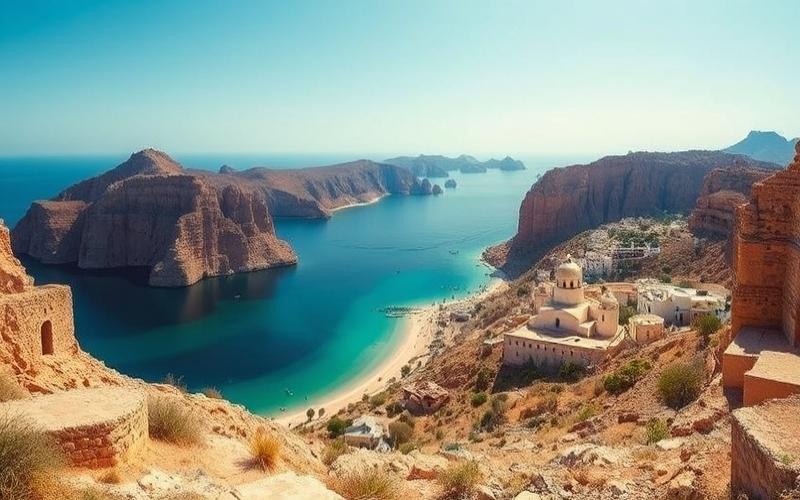
The island of Cyprus, a jewel of the Eastern Mediterranean, boasts a fascinating history spanning over 11,000 years. Situated at the crossroads of Europe, Africa, and the Near East, Cyprus has been the stage for numerous conquests and cultural influences that have shaped its unique identity. Let’s dive into this captivating epic that has made Cyprus what it is today.
From Mythical Origins to the Dawn of History
The history of Cyprus dates back to time immemorial. The island’s first inhabitants are believed to have arrived as early as the 10th millennium BC, marking the beginning of a long saga. The ancient Egyptians called it “Alashia,” the Assyrians “Iatnana,” and the Phoenicians “Enkomi.” But it was its Greek name, “Kupros” (Κύπρος), that gave it its current name. This name, meaning “copper,” testifies to the importance of the deposits of this precious metal that brought fame and prosperity to the island in antiquity.
Cyprus has always been a crossroads of exchange and influences. Since antiquity, the island has assimilated diverse cultures, from Minoan Crete to Mycenaean Greece, and throughout the Levantine basin. This strategic position made Cyprus a coveted prize for the great powers of each era.
Good to know:
The name “Cyprus” is the origin of the word “copper” in many languages, reflecting the island’s historical importance in the trade of this metal.
The Era of Kingdoms and Persian Domination
For a long time, Cyprus was divided into independent city-kingdoms. In the 6th century BC, the island became a major stake in the conflicts between the Persians and the Greeks. In 526 BC, the Persian King Cambyses II conquered Cyprus, marking the beginning of a period of Persian domination. However, the Cypriot kings retained a certain autonomy, while having to pay homage to their suzerain.
This period saw the emergence of a unique Cypriot culture, blending Greek and Eastern influences. The city-states began minting their own coinage at the end of the 6th century BC, using the Persian weight system. King Evelthon of Salamis was probably the first to use silver and bronze for his coins.
Good to know:
Despite Persian domination, Cyprus retained a strong Hellenic identity, which would play a crucial role in its future history.
The Epic of Alexander and the Hellenistic Era
In 334 BC, the history of Cyprus took a new turn. The Cypriots joined Alexander the Great in his conquest of the Persian Empire. The island played a crucial role in Alexander’s campaigns, providing skilled sailors for his expeditions to Syria, Egypt, and as far as India.
After Alexander’s death in 323 BC, Cyprus found itself at the heart of the struggles between his generals. Ultimately, it was Ptolemy who prevailed in 294 BC, integrating the island into his Hellenistic kingdom of Egypt. This period marked a profound Hellenization of Cypriot culture. The Cypro-syllabic script disappeared in favor of the Greek alphabet, and Phoenician and indigenous characteristics gradually faded.
Good to know:
It was during this period that the city of Arsinoe was founded, between old and new Paphos, by Ptolemy II Philadelphus.
Rome and Byzantium: Cyprus at the Heart of Empires
In 58 BC, Cyprus became a Roman province, marking the beginning of a new era. The island prospered under Roman rule, benefiting from the Pax Romana and developing close trade links with Rome. It was also during this period that Christianity was established in Cyprus, with the visit of Saint Paul and Saint Barnabas in 45 AD.
With the division of the Roman Empire in 395, Cyprus came under the control of the Byzantine Empire. This period saw the island become an important center of Orthodox Christianity. Many churches and monasteries were built, some of which still survive today and testify to Cyprus’s rich Byzantine artistic tradition.
Good to know:
For Cypriots, the transition from the Roman Empire to the Byzantine Empire was never perceived as a rupture, but rather as a continuity.
The Crusades and Frankish Domination
The history of Cyprus took a new turn in 1191, when Richard the Lionheart, en route to the Third Crusade, conquered the island. He quickly sold it to the Templars, who in turn ceded it to Guy de Lusignan, the deposed king of Jerusalem. Thus began the Frankish period of Cypriot history, which lasted nearly three centuries.
Under the Lusignan dynasty, Cyprus became a prosperous kingdom and an important cultural center. The island served as a rear base for the Crusaders and developed close ties with Western Europe. This period saw the construction of many Gothic castles and cathedrals, some of which are still visible today.
Good to know:
It was during this period that sugarcane cultivation was introduced to Cyprus, becoming a major source of income for the kingdom.
Venice and the Ottoman Empire: Cyprus at the Heart of Mediterranean Conflicts
In 1489, the Republic of Venice took control of Cyprus. The Venetians fortified the island, aware of its strategic position facing Ottoman expansion. However, in 1571, after a long siege, the Ottomans captured Famagusta, marking the beginning of Turkish domination over Cyprus.
The Ottoman period saw the emergence of a significant Muslim community on the island. However, the majority of the population remained Orthodox Christian. The Orthodox Church of Cyprus played a crucial role in preserving the island’s Greek identity during this period.
Good to know:
Despite Ottoman domination, the Orthodox Church of Cyprus retained broad autonomy and served as an intermediary between the population and the Ottoman authorities.
The British Era and the March Towards Independence
In 1878, in the context of the decline of the Ottoman Empire, the United Kingdom took control of Cyprus. The island officially became a British colony in 1925. This period saw the emergence of a Greek-Cypriot nationalist movement demanding enosis (union with Greece).
The struggle for independence intensified after the Second World War. In 1955, EOKA (National Organization of Cypriot Fighters) launched a guerrilla campaign against the British. After years of conflict and negotiations, Cyprus finally gained independence on August 16, 1960.
Good to know:
The United Kingdom retained two sovereign bases in Cyprus after independence, which still exist today.
Modern Cyprus: Challenges and Opportunities
The recent history of Cyprus has been marked by intercommunal tensions between the Greek and Turkish communities. In 1974, a coup supported by the Greek junta provoked a Turkish military intervention, resulting in the de facto division of the island.
Today, Cyprus has been a member of the European Union since 2004, although the application of the acquis communautaire is suspended in the northern part of the island. Despite the challenges, Cyprus remains an important cultural and economic crossroads in the Eastern Mediterranean, attracting many expatriates and investors.
Good to know:
Despite the division, reconciliation and reunification efforts are underway, with the support of the international community.
The millennial history of Cyprus makes it a fascinating destination for expatriates passionate about history and culture. From its mythical origins to its current status as an EU member, Cyprus offers a journey through the ages, where every stone tells a story.
Disclaimer: The information provided on this website is for informational purposes only and does not constitute financial, legal, or professional advice. We encourage you to consult qualified experts before making any investment, real estate, or expatriation decisions. Although we strive to maintain up-to-date and accurate information, we do not guarantee the completeness, accuracy, or timeliness of the proposed content. As investment and expatriation involve risks, we disclaim any liability for potential losses or damages arising from the use of this site. Your use of this site confirms your acceptance of these terms and your understanding of the associated risks.

Cyril Jarnias is an independent expert in international wealth management with over 20 years of experience. As an expatriate himself, he is dedicated to helping individuals and business leaders build, protect, and pass on their wealth with complete peace of mind.
On his website, cyriljarnias.com, he shares his expertise on international real estate, offshore company formation, and expatriation.
Thanks to his expertise, he offers sound advice to optimize his clients' wealth management. Cyril Jarnias is also recognized for his appearances in many prestigious media outlets such as BFM Business, les Français de l’étranger, Le Figaro, Les Echos, and Mieux vivre votre argent, where he shares his knowledge and know-how in wealth management.