 Published on and written by Cyril Jarnias
Obtaining a passport from the country Monaco means gaining access to one of the most coveted travel documents in the world. This small burgundy booklet, adorned with the coat of arms and equipped with an electronic chip, opens the doors to more than 170 countries without a prior visa, including the entire Schengen Area and the United States. But behind this freedom of movement lies a demanding administrative journey, which begins long before submitting a passport application: one must first be Monegasque, in a country where nationality is rare, control is very strict, and dual nationality is in principle prohibited.
This guide explains the process for becoming Monegasque, including the practical steps for application, the specific conditions for adults and minors, as well as the freedom of movement, the tax context, and the residency implications associated with this passport.
Understanding what a Monaco passport is
The passport of the country Monaco is an individual electronic travel document, incorporating a biometric chip. This chip contains identity and security data, complemented by watermarks and anti-fraud devices scattered throughout the pages.
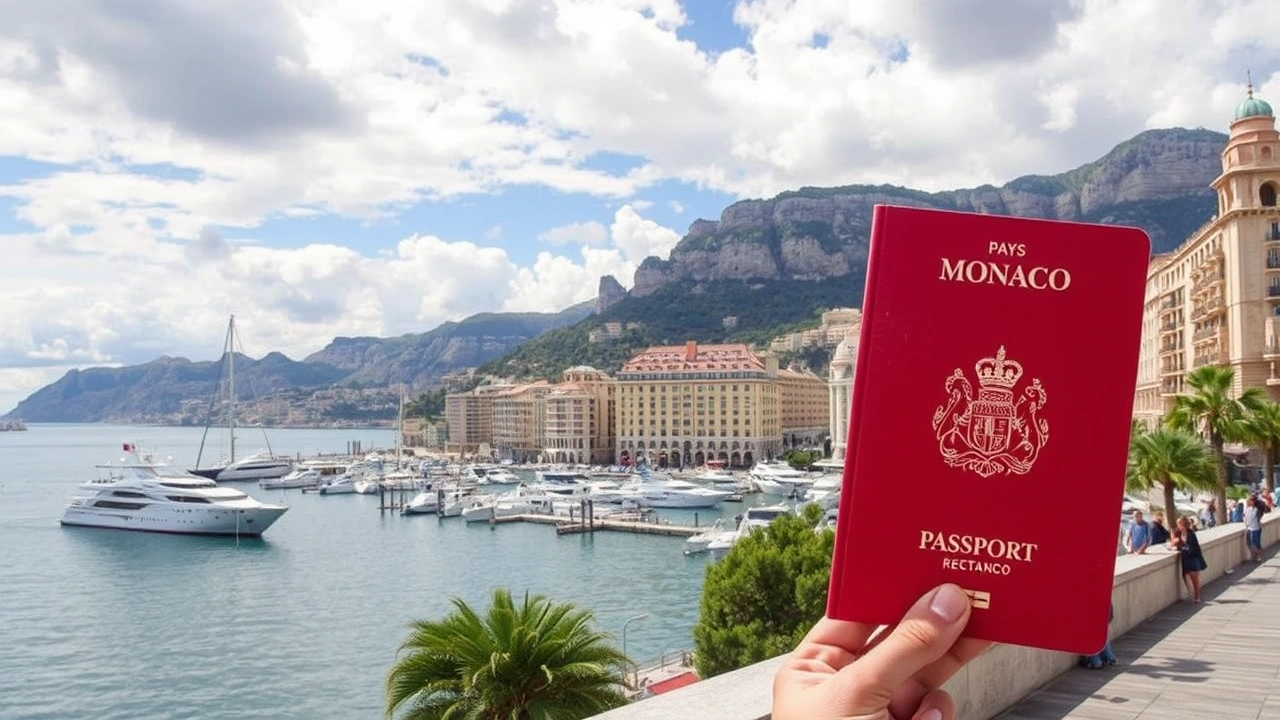
The Monaco passport is an individual and nominative document. It is dark red in color with gold lettering, the national coat of arms, and the inscription “Principality of Monaco.” Each person, including children, must have their own passport; it is forbidden to inscribe a child on a parent’s passport.
Legally, this passport is reserved for persons possessing Monegasque nationality. No exceptions are provided: being a resident, even long-term, even very wealthy, is not enough. The passport attests to both the identity and nationality of its holder.
Why the Monaco country passport is so sought-after
The Monegasque passport is distinguished by the freedom of movement it provides. Holders benefit from visa-free access, or visa on arrival, to more than 170 countries and territories. Recent estimates mention 174 to 177 destinations, which places this document among the best passports in the world in terms of travel “power,” according to rankings like the Henley Passport Index or the Passport Index.
Citizens of Monaco enjoy great freedom of movement, being able to travel visa-free within the Schengen Area and to the United States, subject to stay conditions and passport validity. They also benefit from major domestic advantages: near-universal absence of income tax, high security, quality infrastructure, a developed banking system, and a prestigious international image.
This combination of international mobility and a favorable tax and security environment explains the appeal of the Monaco passport, but also the extreme rigor of the conditions for obtaining it.
First essential step: becoming Monegasque
Even before thinking about submitting a passport application, one must meet the basic condition: possessing Monegasque nationality. This nationality is governed by Law No. 1.155 of December 18, 1992, which defines the various avenues of access and cases of loss.
Monaco stands out due to two strong characteristics. First, dual nationality is in principle prohibited for naturalized persons: obtaining Monegasque nationality generally requires renouncing other passports. Second, naturalization is considered a favor granted by the Sovereign Prince, not an automatic right, even if all formal conditions are met.
Nationality by descent or birth
The most “simple” way to be Monegasque remains being born into the right family. A child automatically obtains nationality when at least one parent is already Monegasque. The place of birth does not matter: a baby born abroad to Monegasque parents is Monegasque from birth.
Monegasque legislation provides for several specific cases. A child born to a Monegasque mother can transmit or receive nationality, even if the mother herself acquired it through marriage or naturalization. Furthermore, adopted children can access nationality under certain conditions. Finally, children found in Monegasque territory who reach the age of 21 there may also claim nationality.
Another automatic case concerns children born in Monaco to unknown parents: nationality is then conferred by birth on the territory, to avoid statelessness. Conversely, a child born in Monaco to foreign parents does not become Monegasque for that reason alone.
Nationality by marriage
Marrying a Monegasque citizen does not confer an immediate right to a passport. Marriage only provides, in time, the possibility to request nationality. The timeframes depend on the date of the union: for marriages after July 1, 2022, one must wait at least 20 years of marriage before being able to make a declaration of nationality. For earlier unions, a 10-year period applies.
The marital relationship must still be ongoing at the time of the application, and the Monegasque spouse must have retained their own nationality. A foreign widow or widower can also apply for nationality, provided they have not remarried.
This is the number of nationalities a spouse can exceptionally hold, although dual nationality is generally prohibited.
Naturalization: the main path… and the most demanding
For those who have neither Monegasque ancestors nor spouses, naturalization is the central path. Officially, the basic requirement is to have legally resided in Monaco for at least 10 consecutive years, from age 18, with a valid residence permit.
The residence must be continuous: long absences can reset the counter. Beyond this time criterion, the candidate must demonstrate integration into Monegasque society (language, social life, local roots), a stable and lawful economic situation, and a clean criminal record in the countries where they have resided in the last five years. Proof of exemption or completion of military obligations in the country of origin is also required.
List of supporting documents required for processing a Monegasque naturalization file. All documents must be provided as originals or certified copies, and translated into French or English.
Foreign passport, birth certificates, and marriage certificate if applicable.
Documents attesting to legal residence in Monaco.
Attestation of renunciation of original nationality or commitment to do so upon acceptance.
Criminal record extract from the country of origin and previous countries of residence.
Bank attestations demonstrating financial stability.
Letters of recommendation from personalities or institutions.
The application is addressed on stamped paper to the Prince or the Civil Registry and Nationality Office. It is subject to cross-investigations by several administrations, including security services, and the final decision rests entirely with the sovereign. Processing can take one to two years. A €250 fee is charged for examining the file, non-refundable in case of refusal.
Even with an impeccable background, naturalization remains a privilege: each year, only a few dozen files (around 50 to 100) are successful. In case of a positive decision, the new citizen swears an oath of allegiance to the Prince and the Principality, and must in principle renounce other nationalities.
Exceptional cases
The law provides for the possibility, for the Prince, to grant nationality by “high favor” to persons who have rendered exceptional services to the State, notably in cultural or sports domains. In these situations, the ten-year residence requirement may be waived. But these cases remain very rare and are more of a symbolic exception than a standard channel.
Residence and residence permit: the airlock before nationality
For foreigners who one day envision a passport from the country Monaco, the first step is obtaining a residence permit. Anyone aged 16 or over wishing to live more than three months per year in the Principality must obtain a residence card. Minors under 16 can benefit from a specific travel document, but not a proper residence card.
Residence in Monaco can be based on an employment contract with a local company, the creation of an economic activity, studies, family reunification, or simply demonstrating sufficient financial resources. In practice, for wealthy individuals, the most frequent scenario relies on proof of financial solvency.
The residential journey in Monaco unfolds in three stages. The first is the ‘temporary residence permit,’ valid for one year and renewable, conditional on staying at least three months per year in the Principality. After a few years, the resident can obtain an ‘ordinary residence permit’ valid for three years, with the same minimum presence requirement. Finally, after about nine years of life in Monaco, the ultimate stage is the ‘privileged residence permit,’ valid for ten years, which requires spending at least 183 days per year in the territory.
Obtaining these cards requires presenting a structured file: passport, birth certificate, criminal records from countries of residence in the last five years, proof of accommodation (deed of ownership, lease of at least one year, or attestation of lodging with a relative), and above all proof of resources. The latter often involves opening a bank account in the Principality, with a substantial deposit, commonly around €500,000 to €1,000,000, or more depending on the institution. The bank then provides a reference letter attesting to the applicant’s financial capacity.
Nationals outside the European Economic Area must first obtain a long-stay visa (type D) from a French consulate, Monaco having delegated this authority. After submitting a complete file, an interview is mandatory with the Residents Section of the Public Security Directorate. Fees, varying by card type (e.g., €80 for a first permit), apply for issuing residence permits.
Processing times are around six to eight weeks for EEA nationals, and up to sixteen to twenty weeks for others. Recent residence cards also incorporate an electronic chip enabling activation of a digital identity usable for the Monegasque administration’s online services.
It is important to keep in mind that this residence, even long-term, does not automatically confer nationality, nor automatically a passport, but it is an essential prerequisite for considering naturalization after a decade of life in Monaco.
Characteristics of the Monegasque passport: validity, name, security
Once nationality is acquired, the passport becomes a simple administrative act… but governed by specific rules.
The validity period depends on the holder’s age at the time of issuance. An adult obtains a document valid for 10 years. A child aged between 3 and 18 is issued a passport valid for 5 years. For those under 3, validity is reduced to 3 years, to account for the rapid evolution of physical features in very young children.
The passport is issued based on the birth name. A used name (that of a spouse, ex-spouse with authorization, or deceased spouse) can be added, but only if it already appears on the nationality certificate, which may require prior updating of that document.
Technically, the Monegasque passport is fully biometric: the chip contains the digitized photo and signature, as well as other identification elements. The interior pages feature watermarks, special inks, and other devices designed to complicate any forgery attempts.
Where and how to submit a passport application
The processing of passport applications for the country Monaco is centralized with the Ministry of State. Applicants must appear in person at the reception located at the main entrance, Place de la Visitation, 98000 Monaco. The counter is open Monday to Friday, from 9:30 AM to 5:00 PM.
No submission by email is possible, and scanned or photocopied copies are not accepted as main supporting documents. The administration only works from originals. This requirement applies to first applications as well as renewals or replacements after loss or theft.
The file is based on an official form, different for adults and minors. For an adult, the form titled “First application or renewal of Monegasque passport for adult” (reference 301-0008_05-2023) must be used. For a minor, the form “First application or renewal of Monegasque passport for minor” (reference 301-0009_05-2023) is required. These documents can be downloaded as PDF files or obtained directly at the Ministry of State reception.
Ministry of State of Monaco
The forms must be printed “actual size” using software like Adobe Acrobat Reader, then completed legibly and signed in black ink. The signature must absolutely remain within the designated box, as it will be scanned and integrated into the chip. From age 10, a child signs themselves, their signature also being digitized.
The issuance time is about five working days after the file is submitted, subject to the indications on the receipt. The new passport must be collected in person at the submission counter. To keep the old canceled passport (for example if it contains a valid visa), it is imperative to report the presence of these visas at the time of submission to prevent the corresponding pages from being damaged during cancellation.
In case of loss or theft, a report must first be made to a police service. Without this official declaration, no new passport can be issued. The receipt or original police report for loss or theft is then attached to the replacement application file.
Required documents for an adult
For an adult who is already a Monegasque national, the list of documents is relatively short, but each element must meet strict specifications.
The core of the file is the appropriate form, duly completed and signed. To this form is added an identity photo meeting the precise standards set by the administration. The photograph must be taken by a professional photographer: prints from automatic photo booths, photos taken with a smartphone, or digital files printed at home are refused.
The photo must measure 4.5 cm by 3.5 cm, be in color and dated within the last six months. The face must be forward-facing, with a neutral expression (mouth closed, no smiling), against a light but not pure white background. Wearing glasses and head coverings is prohibited, except for duly justified religious reasons. The ears and the oval of the face must be fully visible. It is recommended to provide the full contact sheet; the agents will cut the required format themselves. Unused photos are returned with the passport.
The old passport must be presented when submitting the file. If it has been lost or stolen, the original police report replaces this document. Finally, if the applicant wishes to use a name different from their birth name, and this request is based on a divorce, a copy of the court decision authorizing the continued use of the former married name must be included in the file.
The amount in euros of the stamp duty for an adult, payable only in cash or by check made out to the Public Treasury.
Passport applications for minors
Monegasque children must also be holders of their own passport. There is no longer a provision for inscribing a child on a parent’s document. However, the rules are adapted to their minor status, both administratively and financially.
The specific form for a minor must be completed and signed in black ink by the holder(s) of parental authority. From age 10, the child additionally provides their own signature, inserted in the designated box to be digitized.
Identity photos for children must meet strict criteria: format 4.5 x 3.5 cm, in color, dated within the last six months. The face must be forward-facing on a light background, without glasses or headgear, with ears exposed. For infants, the photo can be taken in a lying position, provided the hands supporting the head are not visible.
The child’s old passport, if it exists, must be presented. In case of loss or theft, the official police report serves as proof.
For any minor’s passport, a specific form (ref. 301-0009_11-2020) must be signed by both parents, regardless of their family status. In case of exclusive parental authority, a judicial document attesting to this situation and specifying that the other parent no longer exercises this authority is required. The absence of these documents prevents passport issuance.
Stamp duties are reduced for minors. For a child under 3, the cost is €30. Between 3 and under 18, the amount is €60. Again, only payment in cash or by check made out to the Public Treasury is accepted.
For travel, a specific point concerns minors leaving the territory without being accompanied by a holder of parental authority. In this case, a “Permission to Leave the Territory” is mandatory. It is a separate form, which must be accompanied by a photocopy of the identity document of the signatory. This measure is distinct from the guardianship affidavits sometimes required by airlines.
Validity, renewal, and cases of loss or theft
As seen above, the validity period varies by age at issuance. Upon expiration, renewal follows the same procedure as a first application: submission to the Ministry of State, presentation of the old document, new compliant photo, and payment of stamp duties. The old passport is canceled upon receipt of the new one, but it can be returned upon request.
In case of loss or theft of a passport, the holder must immediately report the disappearance of the document to a police authority, whether in Monaco or abroad. The receipt or police report obtained is mandatory for requesting a replacement passport, either upon return to the Principality or through a Monegasque diplomatic representation abroad (depending on services offered). Without this proof, no new passport will be issued.
When the old passport still contains long-term visas, useful for future trips, it is recommended to clearly point this out when submitting the application, so that the relevant pages are not perforated or invalidated by cancellation. In some cases, agents can physically preserve the pages bearing these visas, while rendering the booklet overall unusable as a travel document.
Costs and payment methods
The direct cost of a Monegasque passport, once nationality is acquired, remains moderate relative to the Principality’s average purchasing power. The stamp duty is €90 for an adult, €60 for a minor aged 3 to 17, and €30 for a child under 3. These amounts are payable only in cash or by check made out to the Public Treasury. No bank cards are accepted at the counter.
These fees are relatively low compared to the sums mobilized upstream to obtain residence, then naturalization: bank deposits of at least several hundred thousand euros, very high rents to live in Monaco, overall cost of living in one of the most expensive cities in the world, lawyer or consultant fees for the nationality file, and administrative fees related to residence permits.
Freedom of movement and validity requirements
One of the main advantages of the passport of the country Monaco is the ease of international travel it offers. Monegasque citizens can travel without a prior visa throughout the entire Schengen Area, as well as to the United States, and to a very large number of other countries, often with a simple stamp upon arrival.
For countries requiring a visa, Monegasque nationals must consult the Ministry of Foreign Affairs and Cooperation. For visa-exempt countries, a remaining passport validity of at least six months after the planned return date is often required. Non-compliance with this rule can lead to a refusal of boarding or entry into the territory.
In Europe, Schengen rules also include validity requirements: a passport must have been issued less than ten years ago and be valid for at least three months after the intended exit date from the area. Even though Monaco is not part of the European Union, it is deeply integrated into the Schengen Area via France, and its citizens are subject to these constraints when moving within this zone.
Tax and living environment: what the passport entails
Behind the small burgundy booklet lies a very particular lifestyle choice. Monaco abolished income tax in 1869 and does not tax the income of resident individuals, with one notable exception: French citizens, under bilateral agreements, remain subject to French taxation. There is no wealth tax, nor capital gains tax for individuals.
The inheritance and gift tax rate for direct line descendants in Monaco is 0%.
This attractive tax framework comes at the cost of a stratospheric cost of living. Average rents for a one-bedroom apartment in the center exceed several thousand dollars per month, while a three-room apartment can range from $13,500 to $19,000 monthly. The price per square meter is among the highest in the world, and even everyday expenses like fuel remain well above the European average.
Monaco is renowned for its exceptional security, with a strong police presence and a very low crime rate. For holders of the Monegasque passport, this secure environment, combined with a favorable tax framework and excellent international mobility, constitutes a unique triple advantage.
Possessing a Monegasque passport does not exempt one from respecting specific rules when traveling with children. Minors must hold their own passport, adapted to their age. When one of them leaves the territory without being accompanied by a person exercising parental authority, a permission to leave the territory becomes essential.
For a minor to travel without their parents, a specific permission to leave the territory, signed by the parent or legal guardian and accompanied by a copy of their identity document, is mandatory. This document is distinct from any forms possibly required by airlines. The child must carry their passport (or ID card for some travel within Europe), the original authorization, and the copy of the signing parent’s identity document.
Border controls can focus on both the validity of the passport and the regularity of this authorization. The absence of either can result in a refusal of exit or entry into the concerned territory.
What the Monaco country passport does not allow
In many countries, it is possible to “buy” citizenship by investing a sum defined by law, through so-called “citizenship by investment” programs. Monaco has not adopted this model. There is no legal provision allowing direct acquisition of nationality, and then a passport, in exchange for a one-time investment in real estate or government bonds.
It is possible to obtain a right of residence by demonstrating a high level of resources and investment, for example through ownership of real estate in the Principality or significant bank placements. However, this status is that of a resident, not a citizen. To acquire Monegasque nationality, one must follow the classic naturalization process, which requires at least ten years of continuous presence, renunciation of other nationalities, and a discretionary decision by the Prince.
This absence of a fast track to nationality partly explains the rarity of the Monegasque passport. Estimates mentioned around 6,000 passports in circulation in 2009, for an overall population of 38,000 to 39,000 inhabitants of which only a minority are citizens.
Examples of durations, costs, and statuses
To better visualize the essential parameters related to the passport of the country Monaco, some data can be presented in the form of tables.
A first table illustrates the validity periods and stamp duties based on the holder’s age at the time of issuance.
| Holder Category | Age at Issuance | Passport Validity Period | Stamp Duty to Pay |
|---|---|---|---|
| Adult | 18 years and over | 10 years | €90 |
| Child (minor) | From 3 to under 18 years | 5 years | €60 |
| Young child | Under 3 years | 3 years | €30 |
A second table summarizes the main avenues of access to nationality, an essential prerequisite for a passport application.
| Avenue of Access to Nationality | Main Conditions | Specificities |
|---|---|---|
| Descent / Birth | At least one Monegasque parent | Place of birth irrelevant |
| Birth in Monaco to unknown parents | Parents unidentified | Automatic nationality |
| Marriage | 10 or 20 years of marriage depending on union date | Marriage ongoing, spouse remained Monegasque |
| Naturalization | 10 years of continuous residence, integration, clean record | Discretionary decision of the Prince |
| Personal decision of the Prince | Exceptional services rendered to the State | Possible exemption from certain conditions |
Finally, a third table recalls the main aspects of freedom of movement linked to the passport.
| Aspect of International Mobility | Situation for a Holder of a Monegasque Passport |
|---|---|
| Entry into the Schengen Area | Visa exemption, subject to passport validity and length of stay |
| Entry into the United States | Visa exemption for short stays (specific U.S. conditions) |
| Other countries | More than 170 destinations without a visa or with visa on arrival |
| Residual validity requirement | Often at least 6 months of remaining validity, depending on destination country |
This data illustrates both the appeal and the complexity surrounding the passport of the country Monaco.
In summary: a prestigious document, a long journey
Obtaining the passport of the country Monaco is not just about filling out a form or paying a stamp duty. For the vast majority of foreigners, this passport is only the final step on a path marked by conditions, which begins with a long-term settlement in the Principality, goes through years of controlled residence, significant investments, real integration into Monegasque society, and then a closely regulated naturalization procedure with an uncertain outcome.
For persons born Monegasque, on the other hand, the passport remains a standard administrative act, admittedly strict in form (standardized photos, originals mandatory, payment in cash or by check to the Public Treasury), but ultimately comparable to that of many other countries.
In any case, this document embodies both a rare nationality, a particular tax environment, and a very high degree of freedom of movement. It is this blend of prestige, mobility, and legal protection that makes the passport of the country Monaco an object of desire, as much as a symbol of belonging to one of the smallest and most coveted principalities in the world.
A 62-year-old retiree, with a financial estate exceeding one million euros well-structured in Europe, wanted to change his tax residence to optimize his tax burden and diversify his investments, while maintaining a strong link with France. Allocated budget: €10,000 for comprehensive support (international tax advice, administrative formalities, relocation, and wealth structuring), without forced sale of assets.
After analyzing several attractive destinations (Monaco, Greece, Cyprus, Mauritius), the chosen strategy was to target Monaco for its absence of income tax for non-French individuals conducting a local activity, the absence of a wealth tax, a high-end banking environment, and great legal stability. The mission included: pre-expatriation tax audit (exit tax, abuse of law risks), obtaining Monegasque residence (housing conditions, resources, police file), CNAS/CPAM detachment, transfer of banking residence, plan for breaking French tax residency (183 days/year, center of economic interests), integration into the local network (lawyers, private banks, family office), and asset adaptation to reduce risks of double taxation via the FR-MC treaty and secure inheritance.
Planning to move abroad? Contact us for custom offers.
Disclaimer: The information provided on this website is for informational purposes only and does not constitute financial, legal, or professional advice. We encourage you to consult qualified experts before making any investment, real estate, or expatriation decisions. Although we strive to maintain up-to-date and accurate information, we do not guarantee the completeness, accuracy, or timeliness of the proposed content. As investment and expatriation involve risks, we disclaim any liability for potential losses or damages arising from the use of this site. Your use of this site confirms your acceptance of these terms and your understanding of the associated risks.

Cyril Jarnias is an independent expert in international wealth management with over 20 years of experience. As an expatriate himself, he is dedicated to helping individuals and business leaders build, protect, and pass on their wealth with complete peace of mind.
On his website, cyriljarnias.com, he shares his expertise on international real estate, offshore company formation, and expatriation.
Thanks to his expertise, he offers sound advice to optimize his clients' wealth management. Cyril Jarnias is also recognized for his appearances in many prestigious media outlets such as BFM Business, les Français de l’étranger, Le Figaro, Les Echos, and Mieux vivre votre argent, where he shares his knowledge and know-how in wealth management.