 Published on and written by Cyril Jarnias
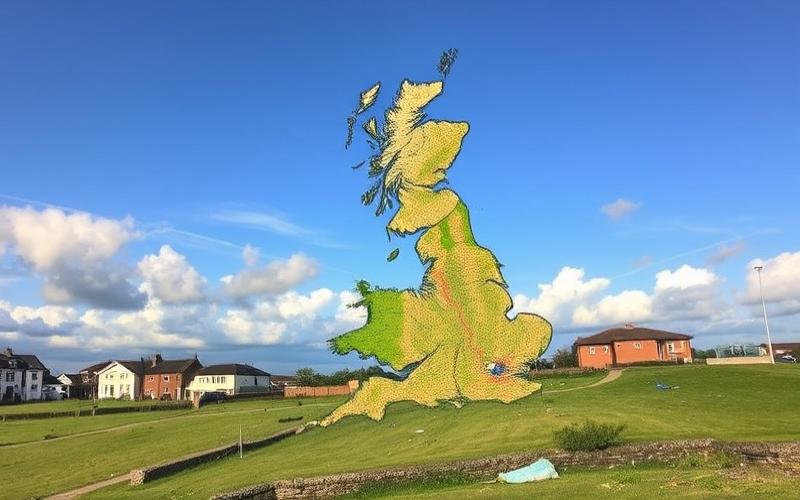
Choosing stops for a first trip to the United Kingdom can quickly become a headache: between the major capitals, medieval castles, white cliffs, free museums, and UNESCO-listed landscapes, it’s impossible to see everything in a single stay. Yet, a few places clearly stand out, both for their history and the visitor experience they offer.
This article lists essential sites to visit in the UK, highlighting the country’s unique assets: UNESCO World Heritage sites, internationally renowned museums, spectacular landscapes, and a professional approach to heritage management, notably through organizations like English Heritage and the National Trust.
Understanding the UK “Must-Sees”
The United Kingdom, which ratified the UNESCO World Heritage Convention in the mid-1980s, now has 35 inscribed sites (including overseas territories), the vast majority of which are cultural properties, a few natural sites, and one mixed site. This density of exceptional places, distributed between England, Scotland, Wales, Northern Ireland, and associated territories, provides a good framework for identifying priority sights.
Initiatives like Historic England’s “Irreplaceable: A History of England in 100 Places” and the list of “Seven Natural Wonders of the UK” created with the Royal Geographical Society aim to promote lesser-known sites of great landscape and historical value.
Finally, a large part of the built heritage – castles, abbeys, country houses – is managed by specialized organizations. English Heritage, for example, maintains hundreds of sites, including over 300 accessible for free, with an annual maintenance cost exceeding £4.2 million. An annual membership, starting at around £42, allows free entry to many sites for the member and up to six children, a detail that matters for families.
An Overview of Major Types of Must-See Sites
| Site Category | Iconic Examples | Key Features |
|---|---|---|
| Urban Historical Monuments | Tower of London, Westminster Abbey, Edinburgh Castle | National symbols, often UNESCO-listed |
| Landscapes and Natural Wonders | Jurassic Coast, Lake District, Giant’s Causeway | Natural or mixed sites, hiking and panoramas |
| Heritage Cities | Bath, York, Cambridge, Edinburgh | Remarkably preserved historic centers |
| Castles and Stately Homes | Windsor, Blenheim Palace, Caernarfon, Dunvegan | Royal residences, fortress castles, grand parks |
| World-Class Museums | British Museum, National Gallery, National Museum of Scotland | Free collections, spectacular architecture |
Using this framework, one can outline an ideal itinerary across the different nations of the UK.
London: Capital of Icons and Museums
It’s hard to discuss the country’s must-see sites without starting with London, a city whose skyline – a mix of glass towers and Gothic spires – is one of the most recognizable in the world. The capital alone concentrates four UNESCO World Heritage sites and an impressive array of monuments.
Tower of London and Tower Bridge: The Iconic Pair
The Tower of London almost summarizes a millennium of English history by itself. Built from the 11th century by William the Conqueror, with the White Tower as its original core, it has been successively a royal fortress, palace, state prison, and execution site. Anne Boleyn and Catherine Howard, two of Henry VIII’s wives, met their end here, which sets the tone for the visit.
Today, the Tower attracts visitors for several distinct reasons: the chance to see the Crown Jewels up close (over 24,000 gemstones), the presence of the Yeoman Warders – the famous Beefeaters – who guard it, and of course the legend of the ravens said to protect the realm as long as they remain. Listed as a UNESCO site since 1988, the Tower is one of the most visited historical sites in the country, with an adult entry ticket costing around £30.
Right next to the medieval fortress, Tower Bridge, a 19th-century bascule bridge, embodies the typical London contrast between old and modern. Its neo-Gothic towers house a museum, a glass walkway 40 meters high, and the original Victorian engine rooms, combining industrial engineering prowess and historical heritage.
Westminster: Power, Coronations, and a View of “Big Ben”
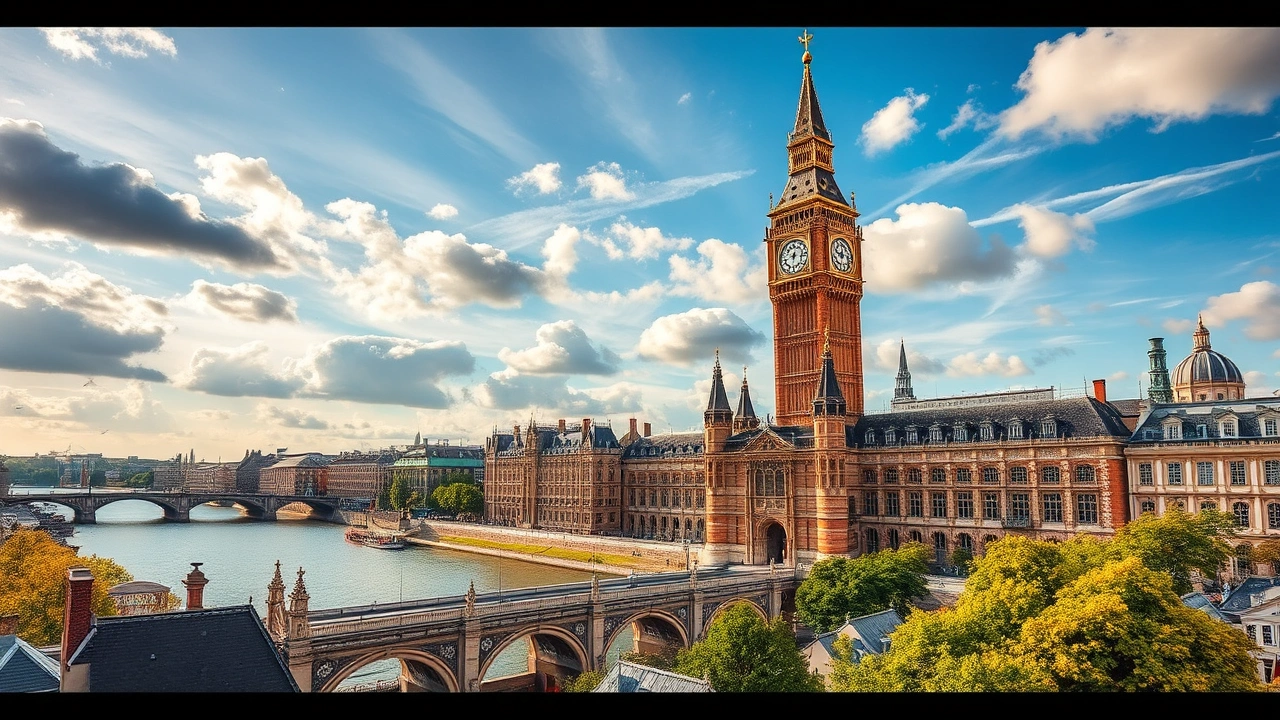
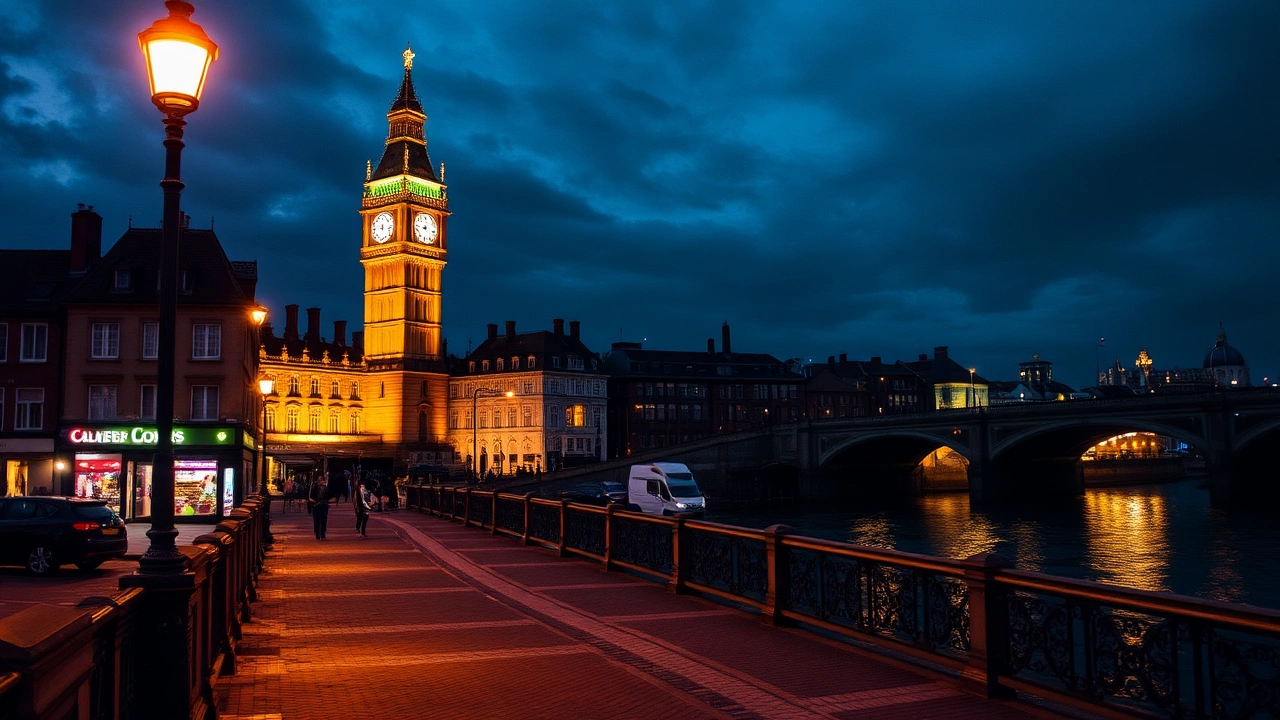
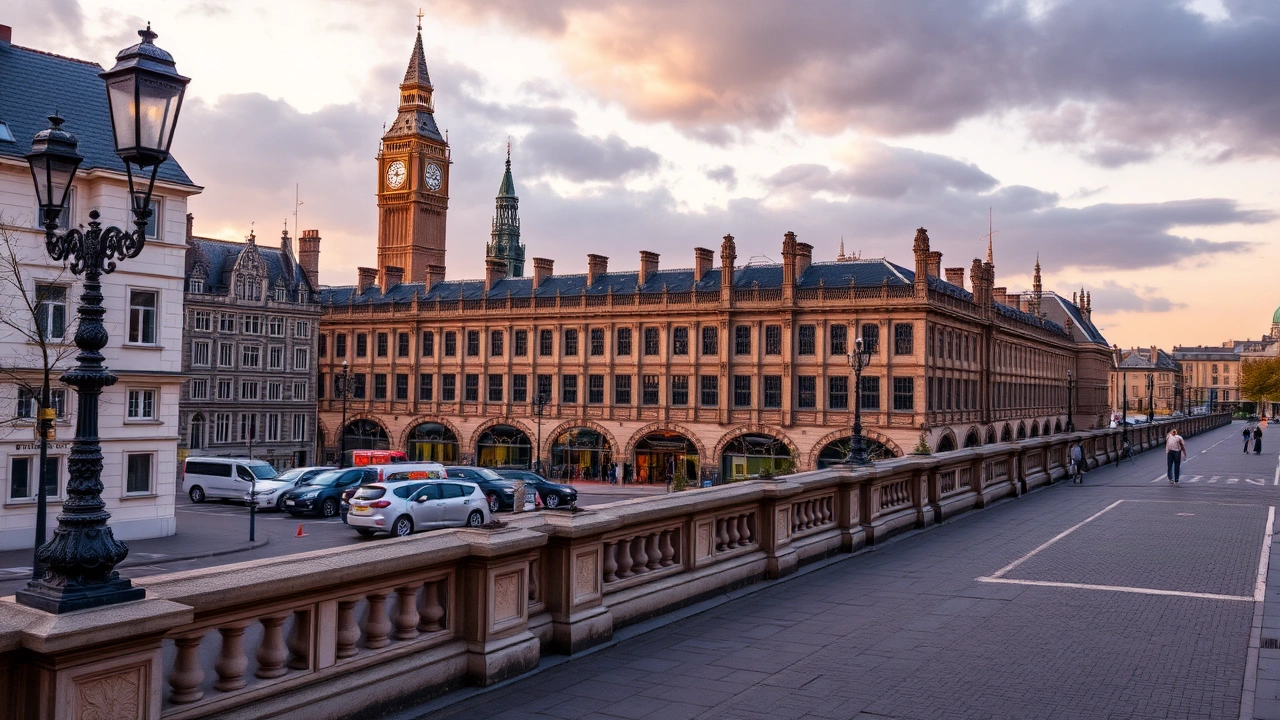
Still on the Thames bank, the complex formed by the Palace of Westminster, Westminster Abbey, and St. Margaret’s Church constitutes another major core. The seat of the British Parliament, the current palace is a neo-Gothic edifice rebuilt after the 1834 fire, but parts of it, like Westminster Hall, date back to the Middle Ages. Its silhouette is inseparable from the Elizabeth Tower, whose great bell is nicknamed “Big Ben”.
Facing it, Westminster Abbey, a vast Gothic church, plays a central role in monarchical life: all coronations have taken place there since 1066. The nave houses many royal tombs and the famous “Poets’ Corner”, where British writers and artists are buried. This dual Palace-Abbey ensemble is also inscribed as a UNESCO World Heritage site, underscoring the universal value of this hub of power and national memory.
Buckingham Palace, Trafalgar Square, and the Grand Royal Spectacle
Another absolute icon: Buckingham Palace, the monarch’s official London residence since Queen Victoria made it her home in the 19th century. The former Buckingham House, acquired by George III, has over time become a palace of 775 rooms surrounded by nearly 40 acres of gardens. In summer, the State Rooms open to the public for a few weeks; the rest of the year, the Changing of the Guard continues to draw crowds at the gates.
Nearby, Trafalgar Square marks the symbolic heart of the city. Former site of the royal stables and then a prison, the square was redeveloped in the 19th century around Nelson’s Column, which commemorates the naval victory at Trafalgar. Fountains, bronze lions, and the monumental facade of the National Gallery make it one of the most filmed and photographed gathering places in the country.
World-Class Museums: The Capital of Free Culture
One of London’s great assets lies in the free entry to most major national museums for their permanent collections. This policy allows for unrestricted discovery of some globally significant institutions.
Among them, the British Museum, founded in 1753 and opened to the public in 1759, stands out. Presented as the world’s oldest national public museum, it holds around eight million objects covering the entire span of human history, from prehistory to contemporary times. Visitors encounter the Rosetta Stone, the Parthenon sculptures, and an impressive collection of Egyptian antiquities.
Some useful references:
| London Museum | Main Theme | Access to Permanent Collections |
|---|---|---|
| British Museum | World history, antiquities | Free |
| Natural History Museum | Natural sciences, biodiversity, fossils | Free |
| Victoria and Albert Museum (V&A) | Decorative arts and design over 3,000 years | Free |
| Science Museum | History of science and technology | Free |
| Tate Modern | Modern and contemporary art | Free (permanent collections) |
| National Gallery | European painting from the 13th to 20th centuries | Free |
The Natural History Museum, housed in a spectacular Victorian building, is often considered a “cathedral of nature”, with its giant skeletons, mineral displays, and collections covering 4.5 billion years. Right next door, the V&A displays over 4 million objects, from Italian Renaissance sculpture to contemporary design. The Tate Modern, with free admission to its permanent collections, occupies a former power station and has established itself as the world’s most visited modern art museum.
Observatories, Bridges, and Panoramic Views
London can also be discovered from the sky. The London Eye, a 135-meter high observation wheel on the South Bank, allows you to take in the whole city during its 30-minute rotation. The Shard, a 310-meter skyscraper, remains the tallest building in the UK and offers an even more spectacular view from its viewing platforms.
The Prime Meridian, located at the Royal Observatory in Greenwich, defines 0° longitude and Greenwich Mean Time (GMT).
England Beyond London: Stones, Abbeys, and Factories
Leaving the capital allows you to experience another facet of the UK’s must-sees: landscapes shaped over millennia, preserved villages, and major industrial sites that shaped modernity.
Stonehenge and the Southwest: The Magic of Stones and Spas
It’s hard to ignore Stonehenge, the megalithic circle on Salisbury Plain, one of the most famous prehistoric monuments in the world. Archaeologists estimate the site developed gradually between 3000 and 1600 BC, with the main stones aligned around 2500 BC. Two types of stones are recognizable: the imposing sarsens and the smaller bluestones, some of which came from Wales.
Inscribed as part of the UNESCO site “Stonehenge, Avebury and Associated Sites”, the monument continues to intrigue due to its alignment with the solstice sun and its Neolithic burial context: excavations have uncovered several dozen cremations nearby. Today, access to the stone circle is regulated; visitors circulate at a distance, but special timed visits sometimes allow entry inside the ring by reservation.
An hour’s drive further west lies Bath, another must-see. Founded by the Romans around natural hot springs, the city became a renowned spa center, then a showcase of Georgian style in the 18th century. Listed as a World Heritage site since 1987, Bath is also part of the transnational “Great Spa Towns of Europe” site.
Discover the major sites that define the charm and renown of this historic city.
One of the best-preserved ancient bath complexes in Europe.
The city’s emblematic great Gothic church.
Famous bridge lined with picturesque shops.
Spectacular ensembles of residential architecture in Bath’s characteristic honey-colored stone.
The city cultivates the legacy of the author who lived here and set two of her novels here.
Fossil Coasts and Spectacular Gorges: The Jurassic Coast and Cheddar Gorge
Still in the southwest, the Jurassic Coast, between Devon and Dorset, stretches for about 150 km with a succession of cliffs and coves listed by UNESCO for their exceptional geological value. This coastline exposes, like an open book, 185 million years of life’s history, from the Triassic to the Cretaceous, with countless fossils, famous arches like Durdle Door, and bays like Lulworth Cove.
Inland, in the Mendip Hills, Cheddar Gorge impresses with its sheer cliffs and caverns. The gorge, over 130 meters deep, began forming at the end of the last ice age; its caves yielded “Cheddar Man”, the oldest complete human skeleton discovered in Britain, over 9,000 years old. Beyond the spectacular landscape, it’s a concentrated dose of prehistory accessible to the public.
Abbeys, Castles, and Romantic Landscapes of Northern England
Heading north, several UNESCO sites testify to the country’s religious and feudal richness. Near Ripon in Yorkshire, Studley Royal Park and the ruins of Fountains Abbey form a landscape and monastic ensemble listed in 1986. The Cistercian abbey, founded in the 12th century and dissolved in the 16th during the Reformation, stands amidst 18th-century water gardens designed to create picturesque vistas.
Further north still, Durham brings together a majestic Norman cathedral, built between 1093 and 1133, and a castle erected from 1072 on a promontory overlooking the River Wear. The cathedral-castle duo is one of the first British ensembles inscribed on the UNESCO list. The cathedral holds the relics of St. Cuthbert and the Venerable Bede, key figures of early English Christianity.
Durham, historic site
Not far away, Hadrian’s Wall still traces the scar of the ancient northern frontier of the Roman Empire. Built from 122 AD under Emperor Hadrian, this defensive wall of about 80 Roman miles is part of the transnational “Frontiers of the Roman Empire” site. Forts, auxiliary camps, and museums now dot the route, making this wall both a hiking destination and an open-air history lesson.
Lake District and Industrial Landscapes: Nature and Revolution
The Lake District, in the county of Cumbria, represents another major facet of English must-sees. This region of mountains and lakes, celebrated by Romantic poets and picturesque painters, is inscribed on the UNESCO list as a cultural landscape. It boasts around a dozen major lakes, including Windermere, the largest, and Ullswater, more tranquil. Hiking trails, boat trips, and scenic roads abound, offering a condensed version of nature in an almost pristine state.
As a counterpoint, several major industrial sites have also gained global recognition, highlighting the country’s pioneering role in the Industrial Revolution. Ironbridge Gorge in Shropshire takes its name from the world’s first iron bridge, built in 1779. The textile mills of the Derwent Valley Mills in Derbyshire represent the beginnings of the modern factory system. Further west, the mining landscape of Cornwall and West Devon is a reminder that in the 19th century, this region supplied up to two-thirds of the world’s copper, via tunnel networks that even ran under the sea.
Finally, the model village of Saltaire, in Yorkshire, illustrates Victorian industrial paternalism, with its monumental mill and urban planning centered on workers’ well-being. Far from mere “curiosities”, these places help us understand how the contemporary industrial world was built.
Blenheim Palace, Warwick, Leeds, and Other Postcard Castles
South of the Midlands, Blenheim Palace, a vast Baroque mansion surrounded by gardens, constitutes another major UNESCO site. Designed by John Vanbrugh and Nicholas Hawksmoor, this palace is best known as the birthplace of Winston Churchill. Its visit, between state rooms, landscaped park, and exhibitions on the WWII Prime Minister, has become a classic day trip from London.
Similarly, the country abounds in spectacular castles, even if not all are world heritage listed. Warwick Castle, for example, originally built by William the Conqueror and later transformed into an imposing stone fortress, was long the seat of the Earls of Warwick, including the famous Richard Neville, nicknamed “the Kingmaker” during the Wars of the Roses. East of London, Leeds Castle, perched on islands in the middle of a lake, is sometimes called “the loveliest castle in the world”, a slightly subjective title but indicative of its visual impact.
Scotland: Perched Castles, Double Cities, and Wild Islands
Crossing into Scotland is a change in visual scale: fortresses perched on volcanic outcrops, stone villages battered by winds, remote archipelagos, and jagged mountains compose a distinct universe.
Edinburgh: A Capital Inscribed as World Heritage
The Scottish capital concentrates two distinct yet complementary urban ensembles, grouped in a single UNESCO site: the Old Town, with its sloping medieval alleys, and the New Town, planned in the 18th century according to rational urban principles.
Dominating the whole scene, Edinburgh Castle occupies the summit of an ancient volcanic rock. This fortress houses the Scottish Crown Jewels (Honours of Scotland) and the famous Stone of Destiny, traditionally used in Scottish and later British coronations, repatriated to Scotland in the 1990s. The view from the ramparts embraces the city, the Firth of Forth, and, on clear days, the surrounding hills.
Descending the Royal Mile, which connects Edinburgh Castle to the Palace of Holyroodhouse, reveals the city’s theatrical character with its closes, inner courtyards, Gothic churches, and museums like The Real Mary King’s Close. A few minutes from the center, the summit of Arthur’s Seat offers a natural escape with a commanding view over the city.
Highlands, Lochs, and Monumental Bridges
Beyond the capital, the Scottish Highlands have become almost a tourist myth. Glacial valleys, deep lochs, single-track roads, and shifting light compose a setting sought after by photographers and hikers alike.
Glencoe, for example, is famous both for its dramatic landscapes – notably the three peaks of the “Three Sisters” – and for the massacre of the MacDonald clan in the 17th century. Further north, the Glenfinnan Viaduct, a curved railway viaduct with 21 arches, has become iconic thanks to its appearance in the Harry Potter films, regularly traversed by a famous steam locomotive.
On the east coast, the Forth Bridge, a gigantic cantilever railway bridge opened in the late 19th century, is also a World Heritage site. Its red silhouette spanning the Firth of Forth illustrates the technological ambition of the industrial age.
Orkney, St Kilda, Flow Country: Islands and Extremes
Several Scottish sites also stand out on UNESCO lists for their remote or archaic character. The “Heart of Neolithic Orkney” brings together on the Orkney Islands an exceptional ensemble of prehistoric monuments: the Skara Brae village, the Ring of Brodgar stone circle, burial mounds and ritual remains, offering a rare glimpse into Neolithic life.
The St Kilda archipelago, off the Hebrides, is a mixed (natural and cultural) UNESCO site. It features a spectacular marine environment and bears witness to a now-vanished island culture, the last village of which was evacuated in the 20th century. Access is extremely difficult, reserved for favorable sea conditions, contributing to its exceptional and almost mythical character.
The latest addition to Scotland’s list of natural wonders, the Flow Country in the north, represents one of the largest expanses of peatland in Europe. This site is crucial for carbon storage and hosts specific biodiversity, earning it listing as a natural site in its own right.
New Lanark and “Social” Landscapes
Not all Scottish must-sees are wild landscapes. New Lanark, a 19th-century model industrial village founded by social reformer Robert Owen, is inscribed as a UNESCO site exemplifying a working community seeking to reconcile production and workers’ welfare. Like Saltaire in England, it offers an interesting counterpoint to mountain scenery: social utopia at the heart of the industrial revolution.
Wales: Castles, Slate, and Aqueducts
Often less publicized than England or Scotland, Wales nonetheless harbors several must-see sites, especially for those interested in medieval castles and landscapes shaped by extractive industry.
The Fortified Castles of Edward I in Gwynedd
A major ensemble is that of the “Castles and Town Walls of King Edward in Gwynedd”, which brings together four fortresses and their town walls: Caernarfon, Conwy, Harlech, and Beaumaris. Built in the 13th century by the King of England to secure his dominance over Wales, these castles impress with their military design, their position on the coast or at river mouths, and their state of preservation.
Caernarfon Castle, recognizable by its massive polygonal towers and walls encircling part of the town, served as the setting for the investiture of the Prince of Wales in 1969. This event illustrates how these medieval fortresses remain embedded in the narrative and ceremonies of the contemporary British monarchy.
Industrial Landscapes: Slate and Coal
Further northwest, the “Slate Landscape of Northwest Wales”, recently inscribed by UNESCO, recalls that this region supplied nearly a third of the world’s slate in the late 19th century. Quarries, workers’ villages, and transport infrastructure form a complete cultural landscape, marked by stone extraction.
Located in south Wales, this site illustrates the era of iron smelting and coal mining. It includes blast furnaces, mine galleries, a railway, and workers’ settlements. These elements make it a complementary testimony to the industrial sites of Cornwall or the English Midlands in the grand narrative of the industrial revolution.
Pontcysyllte Aqueduct: The Aqueduct That Kisses the Clouds
One of the most dizzying feats of engineering in the UK is also found in Wales: the Pontcysyllte Aqueduct and Canal. This aqueduct, over 300 meters long and completed in the early 19th century, carries the canal nearly 40 meters above the River Dee valley on a series of slender arches. Listed by UNESCO, it can be traversed on foot or by boat, offering an astonishing suspended navigation experience.
Northern Ireland: Basalt Columns and Moravian Villages
Across the Irish Sea, Northern Ireland offers two particularly emblematic World Heritage sites.
Giant’s Causeway: The Geological Legend
The “Giant’s Causeway and Causeway Coast“, on the Antrim coast, lines up about 40,000 polygonal basalt columns, formed by the rapid cooling of a lava flow some 60 million years ago. This natural pavement, where some columns reach a dozen meters high, has inspired many legends – notably that of an Irish giant who built a causeway to Scotland.
Annual number of visitors the natural site can accommodate, one of the most visited in Ireland.
Gracehill and the Moravian Ensembles
More discreet, the village of Gracehill, also in Northern Ireland, is part of a transnational site dedicated to Moravian Church settlements. This heritage bears witness to the establishment of this Protestant religious community in several European countries and across the Atlantic. The inclusion of Gracehill in this global network shows how even modestly sized villages can enter the category of “must-see” places, provided they illustrate a chapter of global history.
Overseas Territories: Atlantic Remnants and Isolated Islands
The must-see sites associated with the United Kingdom are not limited to the mainland. Several overseas territories host World Heritage sites, some among the most isolated on the planet.
Remote Archipelagos and Preserved Ecosystems
In the South Atlantic, the islands of Gough and Inaccessible, linked to St. Helena, form a protected natural site remarkable for its almost intact marine and terrestrial ecosystems. These uninhabited islands, except for a meteorological station, harbor endemic species and important seabird colonies, including the endangered Northern Rockhopper Penguin.
Further east, Henderson Island in the Pitcairns offers an example of an intact island ecosystem, listed by UNESCO. In Gibraltar, the Gorham’s Cave Complex presents exceptional evidence of Neanderthal occupation. Finally, in Bermuda, the historic town of St. George and its fortifications illustrate the beginnings of British colonization in the Atlantic.
These sites do not feature on classic traveler itineraries, but they complete the portrait of a United Kingdom whose must-see appeal extends far beyond its European borders.
Heritage Cities: Bath, York, Cambridge, and Others
While London and Edinburgh often come to mind first, several other British cities are well worth the detour and can be considered key stops on a trip.
Bath: Roman Baths and Georgian Elegance
We have already mentioned Bath as a UNESCO site, but the city deserves a closer look. The Roman Baths, fed by hot springs, are one of the most evocative ancient attractions in the country, with their monumental pool, temple remains, and a museum that preserves, among other pieces, a gilded bronze head of the goddess Sulis Minerva. Around this ancient core, Georgian town planning produced some of the country’s finest facades, notably the Royal Crescent and the Circus.
As complements, places like the Jane Austen Centre, the Assembly Rooms, or the Fashion Museum offer more cultural angles on the city. Bath is also very suited to exploration on foot, among gardens, landscaped parks, and shopping streets.
York: City Walls, Cathedral, and Viking Heritage
Further north, York by itself encapsulates several layers of British history: Roman foundation, Viking capital, prosperous medieval town, and major religious center. The Gothic York Minster cathedral dominates the urban landscape, while the narrow lanes of the Shambles still evoke the medieval trading city. The walls encircling the historic center can be walked freely, offering an original viewpoint over the city.
Even though the urban center is not yet inscribed as a World Heritage site, York is on the UK’s UNESCO Tentative List, proof of its heritage importance. Local museums – from the Jorvik Viking Centre to the York Castle Museum – further enrich the visit.
Cambridge: Colleges, Chapels, and River
Cambridge, for its part, is defined by its university, one of the oldest and most prestigious in the English-speaking world. Strolling through college courtyards, visiting King’s College Chapel, or settling into a flat-bottomed boat for a “punt” on the Cam gives a fairly precise idea of what a city shaped by academic life was – and remains.
Although not UNESCO-listed, the city is a must-visit thanks to its high density of historic buildings, its internationally renowned museums like the Fitzwilliam Museum, and its unique atmosphere.
A Few Other Cities with High Tourist Potential
One could extend the list with Oxford, another great university city, Manchester and its industrial heritage, Liverpool and its revitalized waterfront around Albert Dock, or Cardiff, the Welsh capital, which combines a medieval castle, a central park, and a modernized bay area.
Even if not all have a global label, these cities share several characteristics with listed sites: a strong architectural identity, a history legible in the urban space, and a particularly rich cultural offer – museums, festivals, events.
Museums and Culture: A Cross-Cutting “Must-See”
Beyond monuments and landscapes, one of the UK’s major assets lies in the density and quality of its museums across the territory. London remains at the forefront, but institutions like the National Museum of Scotland in Edinburgh, St Fagans National Museum of History in Cardiff, or the major museums of Manchester, Bristol, and Glasgow are each destinations in themselves.
Two examples illustrate this importance.
British Museum and National Gallery: Universal Treasures
The British Museum, already mentioned, presents an encyclopedic vision of human history. The National Gallery on Trafalgar Square plays an equivalent role for European painting, with masterpieces from the Renaissance to Impressionism. The free admission to these institutions, combined with their proximity to major squares and monuments, makes them almost natural stops on any visit.
St Fagans and the Role of Open-Air Museums
St Fagans National Museum of History near Cardiff illustrates another model: the open-air museum dedicated to everyday life. Since the post-war period, over forty historic buildings have been dismantled and rebuilt there – farms, schools, workshops, chapels – to preserve the memory of Welsh society. The site underwent a major renovation and has been awarded museum of the year by specialist institutions, proof that this very immersive form of museum has won over the public.
The UK has a network of dozens of specialized museums, like those for cryptography at Bletchley Park, coal mines at Big Pit, or tramways at Crich. Spread across the territory, they allow for a pleasant mix of landscapes, villages, and cultural discoveries during a road trip.
A Mosaic of Sites for a Structured Trip
Bringing all these places together, one can identify several “backbones” for a trip around the UK’s must-see sites.
One could imagine, for example:
– an itinerary focused on the UNESCO sites of England: London (Tower, Westminster, Kew, Greenwich), Bath, Stonehenge and Avebury, Blenheim Palace, the Jurassic Coast, Durham, Fountains Abbey, the Lake District, Ironbridge, Derwent Valley Mills, and mining Cornwall;
A typical Scottish circuit might include Edinburgh, the Forth Bridge, the Highlands, New Lanark, and Orkney. For more adventurous travelers, it’s possible to add the St Kilda archipelago or the peatland areas of the Flow Country.
– a Welsh stay around the castles of Edward I, Pontcysyllte, and the slate and coal landscapes;
– a Northern Ireland getaway focused on the Causeway Coast, the Giant’s Causeway, and possibly Gracehill and Belfast.
The advantage of this approach is twofold: it guarantees seeing the country’s most emblematic sights while enjoying a variety of settings – urban, rural, coastal, mountainous, industrial – which is one of the UK’s great strengths.
What Makes These Sites Truly “Must-Sees”
What ultimately distinguishes these places from the rest of the UK’s abundant tourist offer stems from several combined factors.
First, their objective heritage value, recognized by both international bodies (UNESCO) and national institutions (Historic England, Royal Geographical Society, etc.), ensures they contribute something unique to humanity’s narrative, whether through their architecture, history, or geology.
Heritage sites, like the Tower of London or Giant’s Causeway, are actively enhanced through interpretation devices, modern museography, good accessibility, and cultural events. They don’t just exist; they actively tell their story to visitors.
Finally, the diversity of experiences they offer – an adrenaline rush on a vertiginous aqueduct, aesthetic emotion before the Jurassic Coast cliffs, a sense of going back 5,000 years at Stonehenge, a plunge behind the scenes of power at Westminster – makes them strong milestones in any trip.
It is this combination of historical importance, masterful presentation, and evocative power that makes these sites the true must-sees of the United Kingdom, the ones that, long after returning home, continue to pleasantly haunt travelers’ memories.
Disclaimer: The information provided on this website is for informational purposes only and does not constitute financial, legal, or professional advice. We encourage you to consult qualified experts before making any investment, real estate, or expatriation decisions. Although we strive to maintain up-to-date and accurate information, we do not guarantee the completeness, accuracy, or timeliness of the proposed content. As investment and expatriation involve risks, we disclaim any liability for potential losses or damages arising from the use of this site. Your use of this site confirms your acceptance of these terms and your understanding of the associated risks.

Cyril Jarnias is an independent expert in international wealth management with over 20 years of experience. As an expatriate himself, he is dedicated to helping individuals and business leaders build, protect, and pass on their wealth with complete peace of mind.
On his website, cyriljarnias.com, he shares his expertise on international real estate, offshore company formation, and expatriation.
Thanks to his expertise, he offers sound advice to optimize his clients' wealth management. Cyril Jarnias is also recognized for his appearances in many prestigious media outlets such as BFM Business, les Français de l’étranger, Le Figaro, Les Echos, and Mieux vivre votre argent, where he shares his knowledge and know-how in wealth management.