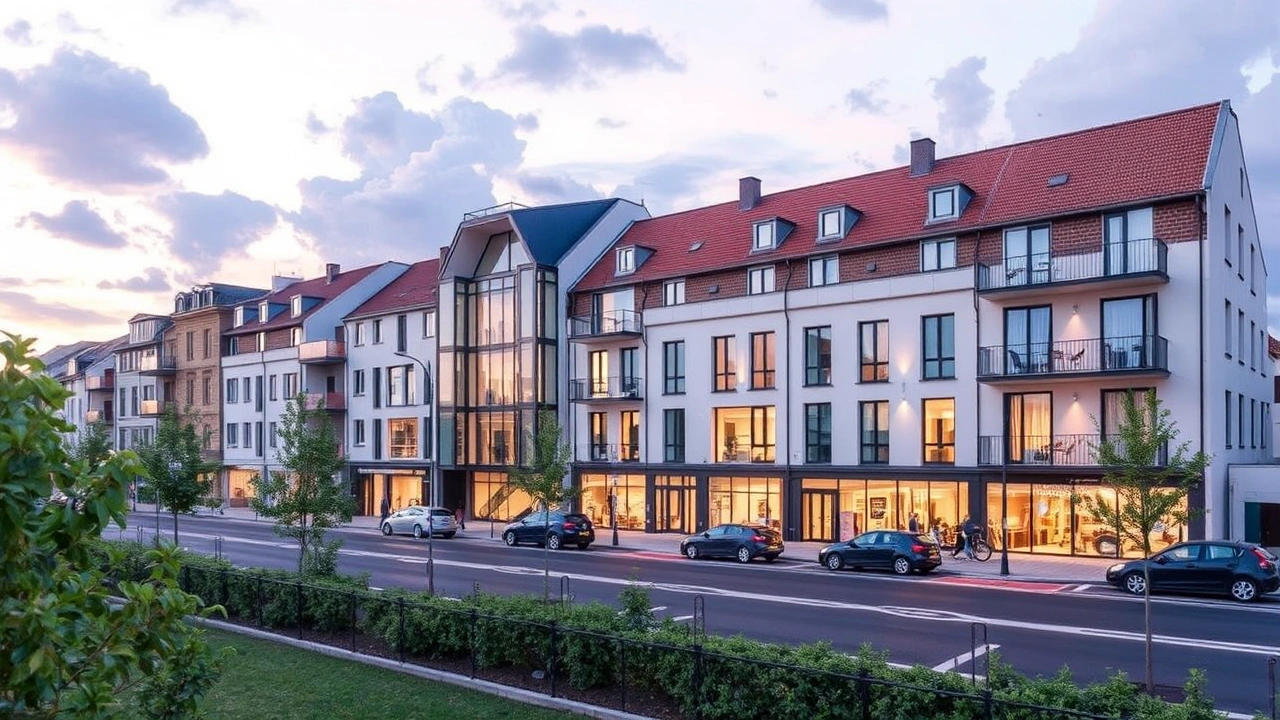
 Published on and written by Cyril Jarnias
Long under the radar, the Austrian commercial real estate market has become one of the most sought-after in Europe for investors seeking stability, predictable returns, and durable assets. Between Vienna’s weight as an international hub, the rise of logistics, the recovery of hotels, and growing ESG requirements, the country now offers a sophisticated, yet legible, playing field for long-term capital.
This analysis identifies investment opportunities, presents key figures, details the legal and tax framework, and examines influential trends like teleworking, ESG criteria, and the cost of debt to anticipate future performance.
A Market Renowned for Its Stability and Secure Framework
Real estate in Austria enjoys a solid reputation: few bubbles, few crashes, but a steady progression of values and rents that typically outpaces inflation. This trajectory rests on several pillars.
First, the macroeconomic environment. The country has a GDP of around $480 billion, inflation brought down to around 2.8%, and an AA+ sovereign rating with a stable outlook. The labor market remains robust, and projections point to a lasting return to a growth path, with inflation close to the 2% price stability target. In this context, the European Central Bank has begun to ease its monetary policy, which has already led to lower key interest rates and a gradual improvement in financing conditions.
The Austrian real estate market is characterized by high-quality building stock, a protective legal framework for all parties, and high reliability. Property rights are strong, access to information via the land register (Grundbuch) is transparent, and transactions require a notarized deed, significantly reducing the risk of disputes.
Finally, the investment climate is open, particularly for European nationals, who enjoy the same rights as domestic citizens. Non-European investors can purchase but often need to obtain permission from the regional land authority, with stricter rules in some Alpine states for vacation homes. For commercial investments, especially in urban areas, these approvals generally remain accessible, provided a clear economic project is presented.
A Legal Environment Designed for Institutional Investors
Legally, Austria has integrated modern foreign investment screening mechanisms while preserving the attractiveness of its market. The Investment Control Act (Investitionskontrollgesetz) transposes the European framework for screening FDI: it applies to non-EU/EEA/Swiss investors acquiring stakes in Austrian companies active in sensitive sectors (defense, critical energy, data, health, key technologies, supply security, etc.).
Approximately 90 authorization procedures for foreign investments are finalized each year in Austria.
At the same time, the fight against money laundering is highly structured: identification of the beneficial owner, justification of the origin of funds, enhanced KYC obligations. These constraints, often seen as a barrier to entry, actually help to enhance the market’s value by making it less permeable to short-term speculative capital.
Vienna, Engine of the Office Market and International Showcase
Vienna concentrates the bulk of the country’s commercial real estate investment. In the office segment, the capital alone accounts for more than 11.7 million m², nearly half of which is modern stock meeting VRF criteria (buildings under 25 years old or fully renovated, air-conditioned, with elevators and sustainability standards).
The chronically low vacancy rate, the limitation of new development, and the push of ESG requirements create a very favorable environment for owners of prime assets.
A Tight but Evolving Office Market
Recent statistics show an overall market vacancy rate around 3.3% to 3.6% for the entire Viennese stock, and about 4% to 4.5% for modern stock. In other words, the vacancy rate is remarkably low for a major European metropolis, despite the rise of teleworking.
The volume of new deliveries remains moderate: just over 90,000 m² in 2024, a range of 110,000 to 130,000 m² expected for 2025, before a predictable drop to less than 85,000 m² in 2026, with further slowdown expected in 2027. Developers, faced with rising construction costs and the cost of debt, have largely abandoned speculative projects, favoring pre-leased buildings.
Forecasted lease take-up for 2025 has been revised upward, from about 170,000 m² to over 210,000 m². The third quarter recorded exceptional performance with more than 89,000 m² leased, representing an increase of over 300% compared to the same period in 2024. This recovery, after a post-COVID trough, is stabilized by the sectoral diversification of lessees, including NGOs, educational institutions, law firms, and companies from the pharmaceutical, insurance, energy, and media sectors.
Rental indicators reflect this tightness:
| Indicator (Vienna Offices) | Recent Approximate Level |
|---|---|
| Prime CBD Rent (€/m²/month) | 28.5 – 29.0 |
| Good Location Rent (€/m²/month) | ~25.0 |
| Average Rent (€/m²/month) | ~17.3 |
| Overall Vacancy Rate | 3.3 – 3.6% |
| VRF Modern Stock Vacancy | 3.8 – 4.5% |
The recent increase in prime rents by about 2% year-on-year, and nearly 9% for “good locations” outside the hyper-center, reflects a catch-up movement after several years of relatively stable rents. The scarcity of well-located new product, coupled with the obligation for large companies to comply with increasingly strict ESG criteria, supports this upward trajectory.
Teleworking, Remote Work Law, and New Office Uses
One of the structural factors in Austria’s office market is the rise of remote work. Before the pandemic, teleworking accounted for only about 15% of total working time. At the peak of the health crisis, this share rose to over 50%. Long-term projections indicate that managers now anticipate about 40% of working time remotely, equivalent to two days per week on average for full-time employees.
Austria has established a new law on teleworking, applicable from 2025. This law broadens the definition of teleworking to any professional activity performed outside the employer’s premises, whether at home, in a coworking space, a hotel, or a connected public place, subject to a prior written agreement. There is neither an automatic right for the employee nor an obligation for the employer to offer it. Nevertheless, this practice is becoming a central element of human resources policies, particularly to attract and retain talent from Generations Y and Z.
For commercial real estate, the impact translates less into a collapse in office demand than into a qualitative restructuring. Many companies are reducing their gross floor area but are significantly upgrading: more collaborative square meters, project spaces, informal areas, fewer permanently assigned desks. This shift of “less quantity, more quality” is clearly visible in location decisions, with marked interest in newly built or restructured buildings that are flexible, well-served, and eco-certified.
Owners of secondary assets, poorly located or energy-intensive, face a double penalty: structural vacancy and the obligation to fund heavy renovations to avoid their assets falling into the category of ‘stranded assets’ – buildings difficult to lease in the medium term due to non-compliance with expected sustainability and comfort standards.
Owners of non-compliant real estate assets
Market Polarization: Prime vs. Secondary
Yield data clearly illustrates this polarization.
| Office Asset Typology (Austria) | Approximate Prime Yield |
|---|---|
| Prime Offices, Top Locations | ~4.75% (downward trend) |
| Secondary Offices, B Locations | ~6.0% |
| Historical Peak (before recent correction) | >5.0% for prime |
After a phase of price correction linked to the rapid rise in interest rates from 2022, the market seems to have reached a bottom. Yields adjusted upward, then began to compress again for the best locations. In other words, prices are rising for core assets, while B or C assets remain under pressure, or even must concede significant discounts to find buyers.
In this context, opportunities exist at two levels:
– The core and “trophy” segment in the best neighborhoods of Vienna or in well-equipped new tertiary districts (Main Station, Donau City, mixed-use developments) where the shortage of products for sale creates strong competition among institutional investors, family offices, and specialized funds.
– Office buildings in “B-locations” offering clear potential for value-add through green restructuring (certification, energy improvement, reconfiguration of floor space, addition of services), or even partial or total conversion to residential or hotel use.
Logistics: An Under-Supplied European Hub, Key for Yields
Thanks to its position at the crossroads of the major Brenner, Rhine-Danube, and Baltic-Adriatic corridors, Austria is a strategic link in European supply chains. The country ranks in the top 5 worldwide on the World Bank’s Logistics Performance Index, a ranking reflected in the vitality of the warehouse and platform market.
Distribution of key floor space dedicated to logistics and industry along Austria’s main transit axes.
Concentrates about 8.2 million m² of space, nearly two-thirds of which is dedicated to pure logistics.
A major structuring hub along the Danube, complementing the country’s supply.
An important hub positioned on this strategic European transit axis.
A Lasting Imbalance Between Supply and Demand
Demand is driven by e-commerce, last-mile logistics, and the reorganization of supply chains. Players like the national postal service and e-commerce giants occupy a growing share. Despite a wave of deliveries that eased some of the supply tension in 2024, vacancy remains low and new projects are quickly absorbed, often through pre-leasing.
Rents reflect this imbalance:
| Logistics Market Austria (Vienna Area) | Indicative Data |
|---|---|
| Rent Range (€/m²/month) | 7 to 9 (depending on location) |
| Historical Prime Logistics Yield | 3.8% (with a trough at 3.5%) |
| Recent Prime Yield (post-correction) | ~4.75% |
| Logistics share of European investment | ~24% of total commercial |
Despite the temporary rise in yields linked to higher interest rates, the logistics segment remains one of the most sought-after: high liquidity, rental growth, controlled tenant risk on the best assets. In the long term, the lack of available land and public policies to combat land consumption reinforce the scarcity of sites, particularly in urban or peri-urban areas.
For the investor, several strategies are emerging: acquisition of prime, long-leased assets with secure cash flow (core logic), development or redevelopment of brownfield sites within existing industrial zones, or positioning in urban logistics, particularly around Vienna, Graz, and Linz.
Retail, Hotels, Managed Residential: The Rise of ‘Beds & Sheds’
Beyond offices and logistics, Austrian commercial real estate offers other pockets of opportunity, particularly in neighborhood retail, hospitality, and institutional residential.
Retail: Prime, Retail Parks, and Discount Formats
Austrian physical retail has suffered from the combined shocks of inflation, weak consumption, and the high-profile bankruptcy of a major developer, which cast a shadow over some malls and large centers. However, the market is far from being distressed.
Vienna’s prime axes – the “Golden U”, the old town, Mariahilfer Straße – are seeing pedestrian traffic close to pre-crisis levels, driven by the massive return of tourists (over 17 million overnight stays recently, almost at record levels). Luxury brands, international food & beverage concepts, and discount retailers are multiplying openings in these locations.
The average yield for grocery-anchored retail parks, significantly higher than that of prime offices.
Generalist shopping centers, especially in low-density peripheries, are still struggling and will only become interesting again through repositioning strategies (mixed-use, entertainment, services, healthcare, coworking).
Hospitality: A Rebound Fueled by Tourism
The Austrian hospitality industry has benefited from a spectacular return of tourists. Vienna has nearly regained its historic overnight stay records, and Alpine regions continue to attract sustained international clientele, both summer and winter. This dynamic translates into renewed interest in hotel investment, particularly for establishments in Vienna’s city center, Salzburg, and the most iconic mountain resorts.
The annual transaction volume for hotels has exceeded 250 million euros, up from the previous year.
For investors, one of the most promising angles consists of repositioning obsolete tertiary buildings into accommodation (hotels, coliving, student housing), capitalizing on both the pressure on the housing market and the need for more flexible hotel products.
Institutional Residential: A Highly Competitive Safe Haven
Even though residential partly falls under a different asset class, it weighs heavily in the strategies of major Austrian investors, often as a complement to their office and logistics exposure. With prime yields falling below 3% in the best Viennese neighborhoods, and rents rising due to the shortage of new housing, residential assets are considered a particularly resilient portfolio cornerstone.
Specialized funds and long-term investors (pension funds, insurance companies, foundations) are actively returning to this segment after a brief pause with rising rates. A common strategy involves combining acquisitions of entire residential buildings with urban densification operations or the conversion of obsolete tertiary assets into housing.
Who Invests, With Which Vehicles, and At What Costs?
One of the striking features of the Austrian commercial real estate market is the diversity of its players. After a period where domestic investors largely dominated, international capital – notably from Germany, Central Europe, but also from across the Atlantic and Asia – is returning strongly.
Investor Profile: Family Offices, Funds, and Institutions
Family offices, foundations, and other private investors with significant equity were the most active at the cycle’s trough, taking advantage of large institutions’ hesitation to position themselves on deals of 30 to 60 million euros, particularly on quality office buildings and retail parks.
Investment funds (open or closed), listed real estate companies, and dedicated vehicles (specialized funds, club deals, joint ventures) are gradually regaining control. Their appetite focuses on:
Focus on four main axes for diversifying and securing a real estate portfolio.
Investment in office and logistics buildings generating secure cash flow, with solid tenants.
Portfolio stabilization through institutional, student, and senior housing.
Targeting proven tourist locations for hotels and serviced residences.
Intervention on assets requiring deep restructuring: green repositioning or change of use.
Structuring: Direct Purchase, Special Purpose Vehicles, and Funds
Investors have an arsenal of legal structures for holding real estate in Austria. The simplest scheme remains direct acquisition by a natural or legal person with registration in the Grundbuch. For large-scale operations, especially for non-residents, establishing an Austrian or European company quickly becomes the norm.
The GmbH (limited liability company) is the preferred vehicle: minimum share capital of 35,000€, half of which must be paid up, liability limited to contributions, corporate income tax rate now aligned around 23%, and relatively flexible governance. Joint-stock companies (AG) are used for large groups, with a higher starting capital. Partnerships (OG, KG, GmbH & Co. KG) remain relevant for tax-transparent structures, where taxation occurs at the partner level.
For diversified exposure without direct management, real estate funds (open or closed) pool risks and offer professional management. Although REITs are not yet established under Austrian law, similar vehicles like listed property companies, governed by foreign legislation, provide a convenient alternative.
Structuring choices directly impact capital gains taxation, the ability to optimize tax on rental income, and estate planning. Private foundations (Privatstiftung), widely used in the German-speaking world, for example, allow holding real estate assets across generations, with a specific intermediate tax regime.
Transaction Costs and Taxation: A Framework to Anticipate
Investing in Austrian commercial real estate involves significant transaction costs, which must be integrated into business plans from the outset. At acquisition, the basic scheme is as follows:
| Cost Item at Purchase (Standard Transaction) | Order of Magnitude |
|---|---|
| Real Estate Transfer Tax (RETT) | 3.5% of the price |
| Land Register Entry Fees | 1.1% of the price |
| Real Estate Agency Fees | 3 – 3.6% + VAT |
| Legal Fees | 1 – 2% + VAT |
| Notary Fees | 0.5 – 1% + VAT |
| Miscellaneous (permits, certificates…) | a few hundred to a few thousand € |
In total, transaction costs for a foreign investor are typically between 9% and 11% of the acquisition price, excluding possible mortgage registration fees (1.2% of the loan amount) if bank financing is arranged.
From a tax perspective, the main parameters are:
– Corporate income tax at 23% for companies (GmbH, AG, etc.);
– taxation of rental income for individuals at progressive rates that can reach up to 55%;
– flat-rate taxation of real estate gains at 30% for natural persons (with the option for the progressive scale, or special regimes for very old properties);
– withholding tax of 27.5% on capital income (dividends, capital gains on shares).
Structuring through a company often allows for optimizing the taxation of income and deferring the taxation of capital gains, especially in case of reinvestment. However, Austrian legislators have tightened the rules regarding transfers of shares in real estate companies: a transfer of more than 95% (and soon 75%) of the shares in a company holding real estate can trigger real estate transfer tax, even without a direct transfer of property in the land register.
Financing: A Developed but More Selective Banking Market
Bank financing remains the backbone of real estate investment in Austria. Major national and regional banks – Erste, Bank Austria (UniCredit), Raiffeisen, etc. – offer variable-rate loans indexed to EURIBOR, with a margin depending on the risk profile.
Loan rates for non-resident borrowers now range between 3.5% and 5% over terms of 15 to 25 years.
Prudential constraints – capital requirements, limits on real estate exposure, compliance with national macroprudential standards – furthermore encourage banks to favor well pre-leased projects, backed by solid counterparties and with clearly established ESG characteristics.
For larger projects, other instruments complement senior debt: mezzanine financing, bank club deals, bond issues, or even recourse to private debt funds. But these alternative solutions, often more expensive, do not fully compensate for the increased caution of traditional banks.
ESG and Certifications: The New Nerve of the War
One of the most decisive factors for the future of Austrian commercial real estate is the rise of sustainability. Under the combined effect of the European Green Deal, the Energy Performance of Buildings Directive, and extra-financial reporting obligations (taxonomy, CSRD), institutional investors can no longer ignore the environmental performance of their assets.
Austria, which already has a high share of renewable energy in its energy mix, structures its real estate market through a comprehensive ecosystem of certifications and labels. These include the national standards ÖGNI and klima:aktiv, local adaptations of the DGNB system, as well as international references LEED and BREEAM.
Certified buildings sell and lease at a price premium, clearly observed in Vienna: higher rents, lower vacancy, increased liquidity upon resale. Conversely, non-renovated older buildings see their values decline.
For an investor, two major implications:
For core: prioritize certified or easily certifiable assets, integrating energy-efficient heating and cooling systems, high-performance facades, good indoor air quality, and advanced building management systems (BMS, automation). For value-add: integrate the costs of major energy renovation (insulation, replacement of HVAC systems, connection to decarbonized district heating networks, installation of photovoltaics) into the business plan from the start and exploit favorable tax schemes (exemptions, accelerated depreciation) for high energy performance buildings.
Furthermore, Austria has established public subsidy programs for thermal renovation (notably in some states like Salzburg), while super-depreciation mechanisms are provided for investments in buildings meeting high energy performance standards.
Teleworking, Flexibility, and Coworking: Concrete Impacts on Income Streams
Teleworking, beyond its impact on office space, also generates opportunities for new real estate formats: coworking spaces, flexible offices, hotels transformed into work hubs, residences offering “work-from-anywhere” services.
The new Austrian law recognizes and regulates remote work from third places (coworking spaces, cafes, hotels), legitimizing these formats. It also allows employers to pay a non-taxable flat-rate allowance for teleworking days, thereby fostering acceptance of the hybrid work model.
In major cities, and particularly in Vienna, this evolution translates into increased demand for flexible spaces, whether within traditional office buildings (floor space arranged as flex office, business centers operated by third parties) or in converted buildings. For owners, integrating a flex-space offering on the ground floor or on a floor can help capture tenants in a growth phase, who may later transition to longer leases.
Acquisition Process and Management: A Highly Structured Approach
The acquisition of a commercial asset in Austria follows a standardized path, but one that requires meticulous preparation.
After the selection and negotiation phase, a purchase agreement is drafted – usually in German – and must be authenticated by a notary. The deed includes essential elements: identity of the parties, cadastral description of the property, rights and charges registered in the Grundbuch, price, payment terms, conditions precedent (obtaining financing, approval for non-EU investor, etc.).
In a real estate transaction, a lawyer or notary often acts as an escrow agent. The buyer pays the price into a fiduciary account, and the funds are only released after all conditions are met and the guarantee of the new ownership’s registration in the land register (Grundbuch). It is crucial to know that it is this registration, not the mere signing of the deed, that legally transfers ownership.
The due diligence is of particular importance. It covers:
– Legal: titles, easements, leases, zoning compliance, operating permits;
– Technical: building condition, energy audits, potential presence of contamination, short and medium-term CAPEX needs;
– Financial: analysis of rents, recoverable charges, property taxes, occupancy history, and vacancy;
– ESG: certification potential, lifecycle CO₂ emissions, renovation scenarios.
Professional management is recommended, especially for foreign investors. Property management companies typically charge 5 to 10% of collected rents for a full service (tenancy management, technical management, reporting, tenant relations), to which leasing fees may be added.
Where Are the Best Opportunities Today?
By aggregating all these parameters – macroeconomics, real estate cycle, regulation, ESG, teleworking – several key trends emerge for Austrian commercial real estate.
Prime Offices in Vienna: Scarcity, Liquidity, Security
Despite the rise of teleworking, high-quality offices in Vienna’s central locations remain a safe bet. The combination of low vacancy, moderately rising rents, strong demand from corporate tenants, and reinforced ESG requirements enhances the appeal of these assets for core and core+ investors.
The main risk is not so much on income but on the difficulty in deploying significant amounts, due to lack of supply. The key to success often lies in the ability to work upstream with developers or to finance major restructuring operations on existing buildings.
Urban Logistics and Regional Platforms: Rental Growth and Land Scarcity
Austrian logistics combines still attractive yields and favorable rental dynamics. Warehouses located in major urban areas, well connected to highway and rail networks, benefit from prospects of rental growth, while the availability of new land is becoming more complicated.
Investors specialized in development or the conversion of brownfield sites can find opportunities, particularly in the Vienna region, the Linz/Wels corridor, and areas near Graz.
Grocery-Anchored Retail and Retail Parks: Defensive and Cash-Flow Generating
While generalist shopping centers still present significant risks, well-positioned retail parks, anchored by grocery or “discount value” retailers, constitute assets generating stable cash flow, with yields higher than prime offices. They can play a yield-bearing role in a portfolio dominated by more “core” assets.
Urban and Mountain Hospitality: Return to Growth, but Selectivity is Mandatory
The tourism recovery makes the hospitality segment investable again, but with necessary selectivity: premium location, concept adapted to new expectations (longer stays, teleworking, hybrid services), energy performance often previously neglected. Very well-located assets, already renovated or offering repositioning potential, could outperform.
ESG Value-Add on Obsolete Tertiary Assets
Arguably one of the most important sources of value in the medium term: the stock of energy-intensive, inflexible office or commercial buildings in “B” or “C” locations that no longer meet tenant expectations.
To maximize the profitability of a real estate asset, it is essential to combine technical expertise, clever financial structuring (including subsidies, super-depreciation, and green debt), and a refined commercial strategy (repositioning of use, activity mix, addition of housing or services). Current market discounts often allow for the absorption of renovation costs while generating an attractive medium-term yield.
Conclusion: A Sophisticated Market for Patient Capital
Austrian commercial real estate is neither a market for easy yield, nor a terrain for pure speculation. It is a sophisticated environment, heavily regulated, where macroeconomic stability, building quality, the rigor of legal processes, and the growing pressure of ESG standards create a universe particularly favorable to long-term investors.
The market offers opportunities in various segments (prime offices, logistics, grocery-anchored retail, well-located hotels, green conversions), but requires accepting a strict regulatory framework, high transaction costs, and extremely thorough due diligence.
In a European context still marked by geopolitical uncertainty and monetary adjustments, the Austrian combination – political stability, legal security, moderate but steady dynamism, market depth in Vienna and major agglomerations – gives the country a unique status: that of an active refuge for real estate capital, offering both protection and value creation potential for investors capable of thinking beyond the short term.
A French entrepreneur, around 50 years old, with a financial portfolio already well-structured in Europe, wanted to diversify part of his capital into residential real estate in Austria to seek rental yield and euro exposure outside of France. Allocated budget: 400,000 to 600,000 euros, without using credit.
After analyzing several markets (Vienna, Graz, Linz), the chosen strategy consisted of targeting an apartment or a small rental property in a growth neighborhood of Vienna or Graz, combining a target gross rental yield of 5 to 6% – the higher the yield, the greater the risk – and medium-term appreciation potential, with an overall ticket (acquisition + fees + potential renovations) of about 500,000 euros. The mission included: market and neighborhood selection, connection with a local network (real estate agent, lawyer, tax specialist), choice of the most suitable structure (direct ownership or via an Austrian company), and definition of a diversification plan over time.
Disclaimer: The information provided on this website is for informational purposes only and does not constitute financial, legal, or professional advice. We encourage you to consult qualified experts before making any investment, real estate, or expatriation decisions. Although we strive to maintain up-to-date and accurate information, we do not guarantee the completeness, accuracy, or timeliness of the proposed content. As investment and expatriation involve risks, we disclaim any liability for potential losses or damages arising from the use of this site. Your use of this site confirms your acceptance of these terms and your understanding of the associated risks.

Cyril Jarnias is an independent expert in international wealth management with over 20 years of experience. As an expatriate himself, he is dedicated to helping individuals and business leaders build, protect, and pass on their wealth with complete peace of mind.
On his website, cyriljarnias.com, he shares his expertise on international real estate, offshore company formation, and expatriation.
Thanks to his expertise, he offers sound advice to optimize his clients' wealth management. Cyril Jarnias is also recognized for his appearances in many prestigious media outlets such as BFM Business, les Français de l’étranger, Le Figaro, Les Echos, and Mieux vivre votre argent, where he shares his knowledge and know-how in wealth management.