 Published on and written by Cyril Jarnias
The archipelago captivates with its overwater villas and turquoise blue lagoons. But behind the postcard-perfect scenery, the legal framework is simultaneously specific, highly structured… and often misunderstood by foreign investors. In the Maldives, you don’t buy a plot of land as you do in Europe or North America: you enter a system of long-term leases, governed by layers of land, tax, environmental, and tourism laws.
Misinterpreting contractual rules can lead to disputes over real rights, permit denials, tax penalties, or loss of access to the property.
Land Ownership: A State-Owner, Foreign Tenants
In the Maldives, everything starts with a simple constitutional principle that is radical for a foreign investor: the land belongs to the state, and private land ownership is reserved for Maldivian citizens. Foreigners do not have the right to own land as freehold property, whether individually or through a company.
The central mechanism for circumventing this prohibition is the long-term lease, or leasehold. Legally, this is not a title of land ownership, but a right of occupation and use granted by the state for a specified period. In practice, however, this mechanism allows for investment, construction, operation of a resort, apartment complex, or villa, and collection of rental income.
Standard leases last from 5 to 99 years, with a norm of around 50 years in the tourism sector. They can be extended up to 99 years if certain conditions are met. This long duration aims to attract major international investment while ensuring the ultimate ownership of the land remains with the state, in accordance with the Land Act and the Constitution.
The Land Act (Act No. 1 of 2002, revised in 2015) governs the allocation, sale (for nationals), transfer, and leasing of land. All transactions must be registered with the Land Registry, managed by the Ministry of Housing and Urban Development. Without registration, a lease has no legally enforceable value.
Investment Structures Tailored for Investors
For foreigners, several common investment structures exist in practice:
Different legal and contractual mechanisms enabling the acquisition of rights over real estate or tourism assets in the Maldives.
Contract signed directly with the state for an atoll, island, plot, or lagoon, typically awarded through a tender by the Ministry of Tourism.
Acquisition of usage rights for a villa, apartment, or room within a large resort, under an existing master lease.
A defined right over a unit (villa, apartment) within a tourism complex, similar to a condominium, for a term aligned with the master lease.
Acquisition of shares in a Maldivian company holding the master lease, with rights and income defined by its articles of association and a shareholders’ agreement.
In all cases, the government remains the landowner. The investor acquires a transferable right (subject to approval) to use and develop the site, but the land reverts to the state upon lease expiry.
A Hybrid Legal Framework: Islamic Law, Common Law, and Special Laws
The Maldivian legal system blends several influences. Property and inheritance law is strongly marked by Sharia law, while business and investment law draws on common law and is detailed by a series of modern statutes.
Among the key structuring texts for real estate and investment are:
The Maldivian legal ecosystem for real estate and tourism investment is structured by several key laws. The 2008 Constitution establishes the fundamental principle of property protection and reserves land ownership for citizens. The Land Act governs land management. Foreign investment is regulated by the Maldives Investment Act (Law 11/2024), which conditions long-term land leasing. The tourism sector is specifically organized by the Tourism Act (Law 2/99), governing the allocation of resort islands and resort leases. Corporate structures fall under the Companies Act (7/2023) and the Business Registration Act. For major projects, the Special Economic Zones Act (24/2014) offers a special regime. Finally, the Foreign Currency Act (32/2024) regulates foreign currency transactions, crucial for resort revenue.
This foundation is complemented by additional areas: tax laws (Income Tax Act, GST Act), arbitration law (10/2013), environmental legislation (Environmental Protection and Preservation Act, EIA Regulations), and specific regulations on the grant of rights (Grant of Rights Regulation 2010/R‑14) in integrated resorts.
Foreign Investment: Prior Approval and Targeted Sectors
Investing in Maldivian real estate is not just about signing a lease: it first requires obtaining formal government approval. The Foreign Investment Act mandates obtaining an investment license before any economic activity, including real estate or tourism ventures.
The key authority is the Ministry of Economic Development (MED), which processes Foreign Direct Investment (FDI) applications. It examines, among other things:
The number of essential criteria assessed for investors, including financial capacity, job creation, technology transfer, and environmental impact.
Some activities are fully open to foreign capital, others partially, and some are closed (such as retail trade or small local-style guesthouses). In tourism, access is broad but often conditional on joint ventures, investment thresholds, and project nature.
The Ministry of Tourism must approve and register projects related to resorts, hotels, marinas, integrated tourist resorts, luxury residential projects in tourism zones, and villa subleases. This obligation applies to master leases, subleases, hotel management contracts, and transfers of rights.
Investment Thresholds and Accessible Sectors
FDI policies and recent laws set minimum amounts to filter projects:
| Type of Project or Sector | Indicative Minimum Investment |
|---|---|
| “Classic” Hotel or Tourist Resort | ≈ 1 million USD |
| Industrial / Export / Energy projects, etc. | 100 million USD |
| “Sustainable townships” development | 500 million USD |
| Strategic SEZ projects (overall threshold) | 100 million USD |
| Premium Investor Visa Program | 5 to 10 million USD |
| Special Resident Visa linked to property purchase | 250,000 USD |
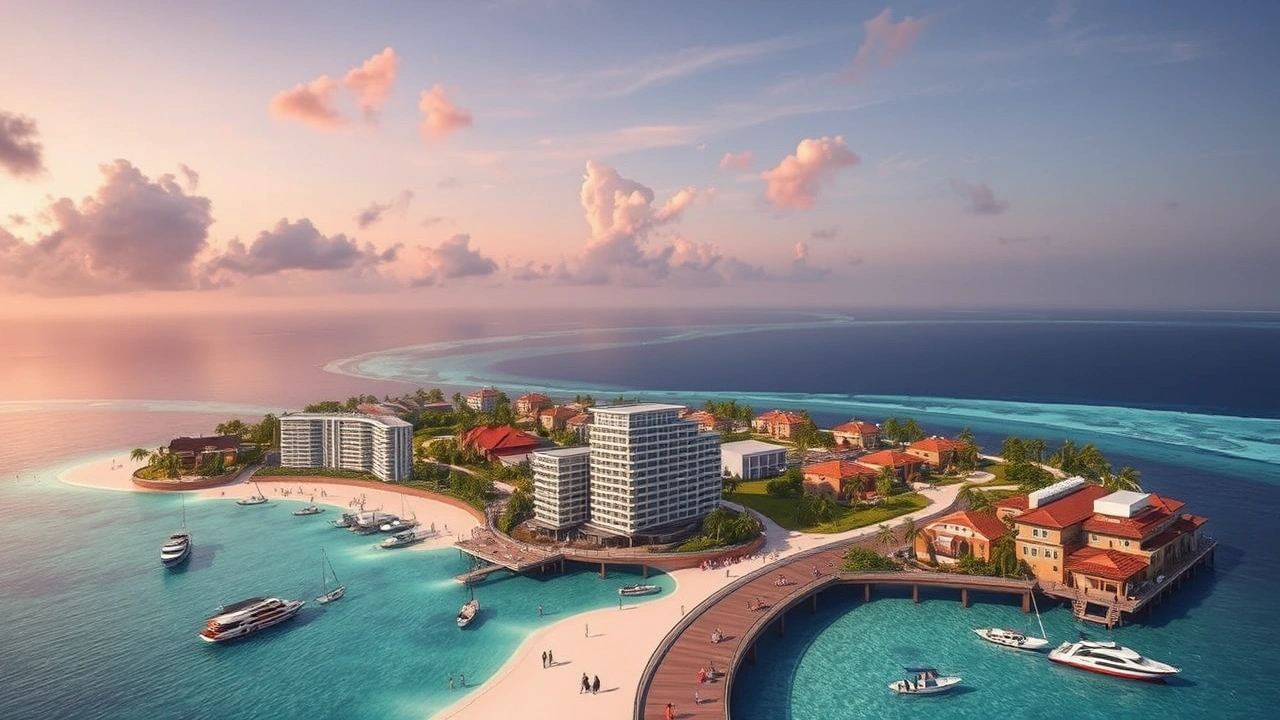
In practice, real estate accessible to foreigners is concentrated in sectors considered “high-end” or tourism-related: luxury villas, hotels, marinas, residences integrated into a resort, residential complexes in specially designated zones, or large mixed-use projects (Integrated Tourism Model, Maldives Floating City, Zamani Islands, Coral Residences, etc.).
Conversely, foreign investment is excluded or limited in small local guesthouses, retail trade, certain local transport activities, or fishing.
Concrete Forms of Property for a Foreigner
Even without freehold, the range of possibilities is vast for an investor who accepts the logic of long-term leasing.
Master Lease on an Island or Lagoon
For very large investors (hotel chains, funds, conglomerates), the most direct option is to obtain a master lease on an undeveloped island or lagoon, intended for a resort or integrated tourist resort. These islands are often offered through public tender managed by the Ministry of Tourism.
The standard lease lasts 50 years, with the possibility of an extension up to 99 years subject to payment of extension fees, which are particularly regulated by recent amendments to the Tourism Act. The tenant company finances all infrastructure (accommodations, restaurants, utilities) and pays the government an annual rent proportional to the area, along with various taxes.
Subleasing and Integrated Resorts
An increasingly common model is based on integrated tourist resorts (ITR), which combine hotels, marinas, services, and residences on one island or across multiple islands and lagoons. Regulation R‑163/2023 governs this project type. The master lease remains with a primary operator, who can then grant subleases to end investors for plots or villas.
Subleases must:
– be compatible with the master lease (no longer term, respect usage restrictions);
– include clauses giving priority to the master lessee in case of conflict;
– specify the term, rent, usage rights, and allocation of common charges;
– be approved and registered with the Ministry of Tourism.
Some branded residences operate on this model, with a parallel hotel management contract organizing seasonal rental of the properties and revenue sharing.
Strata Lease: The Maldivian Equivalent of Vacation Condominium Ownership
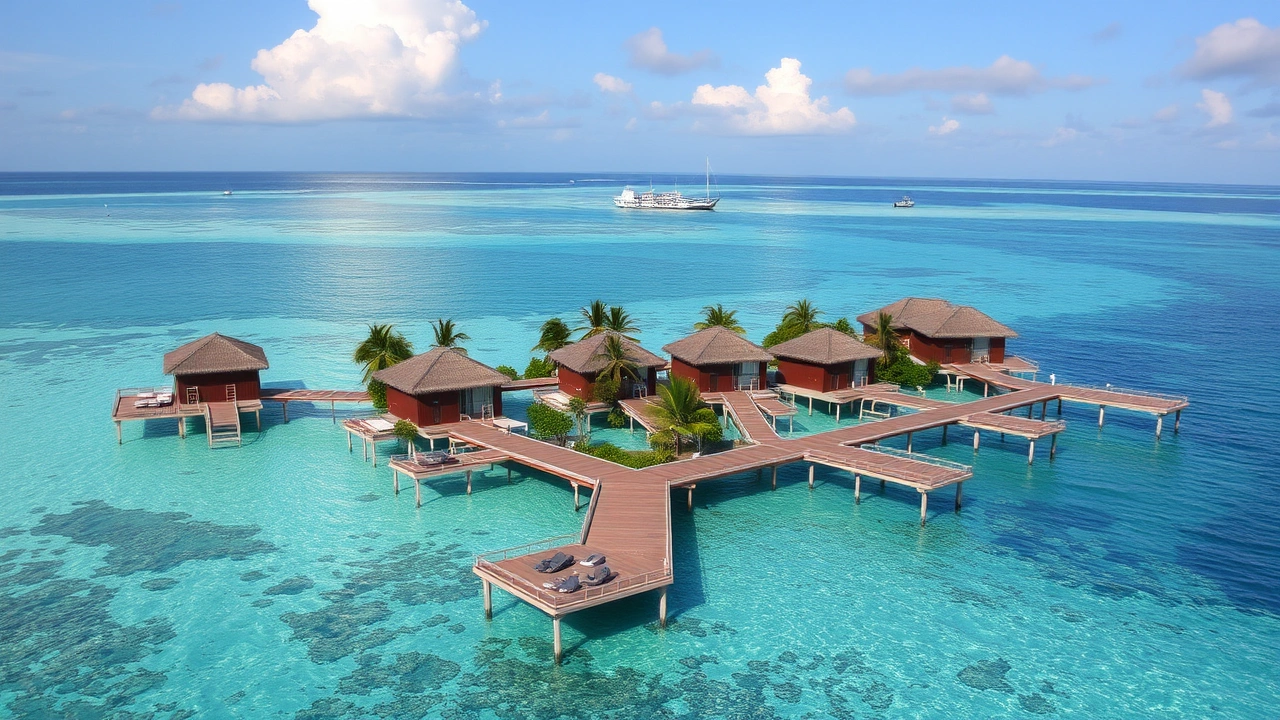
In several resorts, villas or apartments are sold as strata leases. The principle: the investor acquires an exclusive right to a unit (overwater villa, beachfront apartment, penthouse) located within a larger tourism complex, for a fixed term (often 50 years, sometimes extendable).
This right is formalized in a Strata Lease Agreement, registered with the Ministry of Tourism. It specifies:
– exclusive rights to the unit;
– usage rights to common areas (beaches, pools, restaurants);
– maintenance fees and contributions to operating expenses;
– terms for inclusion in the resort’s rental program (if the buyer opts for a rental model).
This is the scheme promoted in projects like Coral Residences, with sublease titles explicitly recognized by the state.
Leaseback and Rental Management Models
For an individual, most accessible real estate products take the form of managed residences. In these structures:
– the investor acquires a leasehold right to a villa or apartment;
– they have a certain number of weeks or months per year for personal use;
– for the rest of the time, the unit is integrated into the resort’s rental pool, marketed to tourists;
– revenues are shared according to a percentage or fixed scheme (e.g., a guaranteed minimum plus a profit share).
The Tourism Act and Ministry of Tourism regulations require that management and sublease contracts be submitted for approval, registered, and comply with transparency standards (particularly regarding revenue breakdown and expense allocation).
Real Estate Taxation: GST, Green Tax, and Lease Rent
The Maldivian tax structure is atypical: no personal income tax, no wealth tax, no inheritance tax. For a real estate investor, the tax burden comes from elsewhere: corporate tax, consumption taxes (GST, T‑GST), withholding taxes, tourism-specific taxes, and of course lease rent paid to the state.
Taxation of Income and Capital Gains
Companies are subject to the Income Tax Act:
– 15% tax on profits for non-banking companies above 500,000 MVR of taxable profit;
– 25% for banks.
A capital gain realized on the transfer of a leasehold right or shares in a real estate company may fall within the scope of this tax, depending on the structuring. For non-residents, a Capital Gains Withholding Tax (CGWT) of 10% on the sale price may apply, withheld and remitted by the buyer via a dedicated form (MIRA 608).
Consumption and Rental Taxes
The Goods and Services Tax (GST) regime is central:
– 8% for the general sector;
– 16% for tourism activities, with a confirmed future increase to 17%.
The rental of villas, apartments, or rooms to tourists is generally subject to T-GST. Operators must register with the Maldives Inland Revenue Authority (MIRA) and file regular returns, monthly or quarterly, depending on their turnover.
On the real estate transactions themselves, a GST of 6 to 8% is applied to the purchase price in most cases, with exceptions (social programs). The government also collects a stamp duty on lease transfers, calculated as a percentage of the value.
Green Tax and Tourism-Specific Taxes
Every tourist stay in a resort, hotel, tourist guesthouse, or cruise ship generates a green tax, collected by the operator and remitted to MIRA. Amounts have recently increased, with a typical schedule of 12 USD per night for luxury resorts and 6 USD for small structures on inhabited islands, with children under two exempt.
The Tourism Act additionally provides for:
– a Tourism Land Rent, an annual lease payment by the master leaseholder, often around 8 to 10 USD per m² per year for a resort, the amount depending on location and area;
– a tourist bed tax per night (historical, now integrated into the T‑GST / green tax scheme);
– various licensing fees (hotel registration, guesthouse, dive center, tourist boat license, etc.).
An investor must factor these cash flows into their business plan, even if some are borne by the hotel operator.
Withholding Tax and Tax Treaties
A non-resident receiving rent, brand royalties, management fees, or interest from the Maldives may be subject to a 10% withholding tax on the gross amount. Payments to non-resident contractors (construction, design) are subject to a 5% deduction.
The Maldives still has few bilateral tax treaties (Essentially United Arab Emirates and Bangladesh, with an agreement with Malaysia signed). International tax planning therefore remains limited.
Acquisition Process: From Approval to Registration
Obtaining real estate in the Maldives involves navigating several administrative steps, which vary depending on whether it’s a master lease, a sublease within a resort, or a simple shareholding in a holding company.
The investor must first obtain a Foreign Direct Investment approval. The Ministry of Economic Development reviews the project, shareholding, financial capacity, and sector compatibility. If approved, a license and a Foreign Investment Agreement (FIA) are issued.
In the case of a resort or integrated tourist resort, the Ministry of Tourism sometimes launches a tender for the master lease. Applicants submit financial documentation, development concept, guarantees. The best bid is selected, signs a long-term lease and a development agreement.
For a villa or apartment buyer via sublease, the procedure is simpler, but must absolutely include:
Before acquiring a property, it is crucial to conduct: a title check to verify the seller’s transferable right (lease, sublease, registration); a check for existing encumbrances (mortgages, pledges, liens) via a title search; a check of administrative approvals (license, permits, compliance, environmental approvals); and a full review of the sale and purchase agreement and rental management contract by a local lawyer.
Once the Sales & Purchase Agreement is signed, the transaction must be registered:
– with the Land Registry for the lease or sublease;
– with the Ministry of Tourism where regulations require registration (tourist sub-lease, management contract).
Payment of stamp duty, applicable GST, and registration fees is generally a prerequisite for registration.
Example Structure for a Resort Villa Investment
To illustrate, the decision and action chain may look like this:
1. Incorporation of a Maldivian company (Private Limited Company) with at least one shareholder, registered with the Registrar of Companies. 2. Application for foreign investment approval to the MED, presenting the project (acquisition of a villa via strata lease in a specific resort), simplified business plan, and financial proofs. 3. Signing of a Foreign Investment Agreement and payment of administrative fees to MIRA. 4. Legal review of the Strata Lease Agreement and Management Agreement proposed by the resort. 5. Signing of contracts, payment of a first installment, settlement of GST and stamp duty, registration with the Land Registry and Ministry of Tourism. 6. Once the villa is delivered, integration into the rental program and commencement of operations, with periodic income declaration and payment of GST, corporate tax, and any applicable withholding taxes.
Environmental and Planning Constraints: An Increasingly Strict Filter
Maldivian real estate is not just about finance and law. It’s also a matter of spatial planning and protecting extremely fragile ecosystems: coral atolls, mangroves, reefs, flood-prone areas. Over 80% of land lies less than one meter above sea level, making sea-level rise and storms a direct threat.
The core protection mechanism is the Environmental Protection and Preservation Act (EPPA) of 1993, supplemented by several waves of Environmental Impact Assessment (EIA) regulations. Any project deemed significantly impactful – resorts, land reclamation, marinas, large complexes – must undergo a full EIA, conducted by an approved consultant and validated by the Ministry of Environment or the Environmental Protection Agency (EPA).
The process includes:
A full EIA process for a coastal project includes several key stages. It begins with a screening to assess the need for a detailed study. This is followed by a scoping phase to define the terms of reference. The study itself includes modeling, field surveys, and impact analysis on reefs, mangroves, wildlife, currents, and coastal stability. A public consultation is then held, with a 10-working-day period to comment on the final report. The process concludes with the issuance of an Environmental Decision Statement, which can be favorable, favorable with conditions, or unfavorable.
This decision can come with stringent requirements: coastal protection setbacks, prohibition on cutting certain trees, reef restoration obligations, limits on sand and coral extraction, constraints on lagoon dredging, etc.
International reports (UNDP, Human Rights Watch) document issues: lack of community consultation, mangrove destruction (e.g., Kulhudhuffushi), insufficient consideration of sea-level rise. For the investor, environmental compliance becomes a legal and financial risk (fines, construction halt, permit cancellation).
Urban Planning and Land Use Plans
Beyond tourism, the Land Act and decentralization law require the development of Land Use Plans (LUP) by island and atoll councils. These plans allocate land between:
– residential zones;
– commercial zones;
– industrial or service zones;
– tourism zones;
– natural areas and protection zones.
Without an approved LUP, it is in principle impossible to allocate new land to individuals or private projects. Approval of these plans has been streamlined through a central platform managed by the Ministry of Cities, Local Government, and Public Works.
Resorts also have master plans approved by the Ministry of Tourism. It is not possible to develop any density there or add a residential program not originally planned. The Integrated Tourism Model, introduced in 2019, aims precisely to regulate these mixed uses.
Residence, Visas, and Links to Real Estate
Purchasing a leasehold right to a villa in the Maldives can come with stay benefits, but does not lead to permanent residence or citizenship.
Several statuses exist:
Overview of the different visas available for the Maldives, ranging from tourism to investment programs.
Free, valid for 30 days and extendable up to 90 days. For purely tourist stays.
For work stays, valid up to 1 year and renewable. No direct link to a property purchase required.
Granted in exchange for an investment of at least 250,000 USD in a registered Maldivian company. Valid up to 5 years.
Tied to the purchase of a property worth at least 250,000 USD in an approved development. Offers a 5-year renewable residence and allows bringing family.
Launched in partnership with Henley & Partners. Require investments of 5 to 10 million USD, often combining luxury real estate, government bonds, bank deposits, and stakes in strategic projects.
These visas authorize long-term stays, but not access to citizenship, which requires 12 years of continuous residence and remains rare.
Risks and Points of Vigilance for an Investor
The Maldivian market attracts with its potential returns and exposure to international tourism. But the regulatory framework demands particular caution.
Several key risks emerge from analyses:
Several major risks must be considered: the decline in resale value as the lease end approaches, especially if renewal conditions are unclear; potential adjustments to foreign investment laws or island allocation rules, potentially up to project recovery by the state; environmental vulnerability to climate change and cyclones, likely to increase costs; the dependence of a villa’s value on the financial health of the resort’s single operator; penalties for non-compliance, such as lack of ministerial approval; and finally, constraints related to foreign exchange and monetary regulation for repatriating income.
Hence the importance of enhanced due diligence, covering legal, financial, tax, and environmental aspects.
Key Points to Systematically Verify
Even though each project is specific, certain points should always be scrutinized:
| Checkpoint | Main Objective |
|---|---|
| Validity of master lease | Verify remaining term, renewal conditions |
| Encumbrances and charges | Identify mortgages, pledges, tax debts |
| Tourism authorizations | Ensure resort license, establishment type |
| EIA and environmental approvals | Confirm project compliance |
| Sublease / strata lease contract | Understand rights, obligations, transfer rules |
| Rental management contract | Verify revenue formula and penalties |
| Applicable tax regime | Anticipate GST, green tax, BPT, withholding taxes |
| Governance structures | Analyze developer and operator’s financial strength |
Without local support (lawyers, tax advisors, consultants), it is very difficult to secure all these aspects.
The Impact of International Context and Financial Transparency
The Maldives is no longer a regulatory “black hole.” The country has joined the OECD’s BEPS initiative against tax evasion, signed the multilateral agreement on automatic exchange of information (CRS), and is implementing rules on beneficial ownership transparency.
Concretely, any real estate investment vehicle must:
Companies must declare shareholders and beneficial owners holding more than 25% of shares or control. They are also required to comply with Anti-Money Laundering and Countering the Financing of Terrorism obligations, including Customer Due Diligence (CDD) procedures, documentation on the source of funds, and reporting to the Maldives Monetary Authority. Finally, they must accept the automatic exchange of financial information with partner countries.
For a foreign investor, this means a project in the Maldives should not be structured with opaqueness or concealment in mind. Luxury residential platforms now target a clientele seeking a lifestyle or asset diversification, rather than a tax haven.
Between Opportunity and Regulatory Complexity
The Maldives offers a very unique real estate investment framework: no land ownership for foreigners, but leases of up to 99 years; light personal taxation but a heavily regulated environment for companies; law strongly influenced by Sharia for inheritance, yet structured to international standards for investment.
For an investor ready to navigate this complexity, the archipelago offers:
These real estate investment programs are distinguished by the offer of rare products, such as overwater villas or branded residences within iconic resorts. Their return potential is primarily supported by luxury and high-end tourism.
But this requires integrating the constraints: dependence on the lease, significant power of the state as landowner, increasing environmental requirements, strict regulation of financial flows and exchange, tight control of tourism activities by the Ministry of Tourism.
The bottom line is an imperative: never rely solely on a beautiful sales brochure. In the Maldives more than elsewhere, understanding real estate laws and regulations is not a luxury, it is the essential condition to ensure the postcard doesn’t turn into a legal dispute.
Disclaimer: The information provided on this website is for informational purposes only and does not constitute financial, legal, or professional advice. We encourage you to consult qualified experts before making any investment, real estate, or expatriation decisions. Although we strive to maintain up-to-date and accurate information, we do not guarantee the completeness, accuracy, or timeliness of the proposed content. As investment and expatriation involve risks, we disclaim any liability for potential losses or damages arising from the use of this site. Your use of this site confirms your acceptance of these terms and your understanding of the associated risks.

Cyril Jarnias is an independent expert in international wealth management with over 20 years of experience. As an expatriate himself, he is dedicated to helping individuals and business leaders build, protect, and pass on their wealth with complete peace of mind.
On his website, cyriljarnias.com, he shares his expertise on international real estate, offshore company formation, and expatriation.
Thanks to his expertise, he offers sound advice to optimize his clients' wealth management. Cyril Jarnias is also recognized for his appearances in many prestigious media outlets such as BFM Business, les Français de l’étranger, Le Figaro, Les Echos, and Mieux vivre votre argent, where he shares his knowledge and know-how in wealth management.