 Published on and written by Cyril Jarnias
Over the past decade, Serbia has embarked on a vast cycle of urban transformation. In the shadow of the spectacular construction sites in Belgrade, Novi Sad, or Niš, a broader strategy is taking shape: using urban planning as an engine for growth, modernization, and rapprochement with the European Union. Between mega real-estate projects, industrial brownfield redevelopments, the long-awaited metro, preparation for EXPO 2027, and the rise of “smart cities,” the country is testing a new urban model on a large scale – all against a backdrop of intense debates on transparency, ecology, and social inclusion.
Belgrade Waterfront, Giant Lab for the New Serbian City
It’s hard to talk about the urban future in Serbia without starting with Belgrade Waterfront, the gigantic redevelopment of the banks of the Sava River in the heart of the capital. This project, led by the Emirati group Eagle Hills in partnership with the Serbian state, is presented as one of the most ambitious urban developments in the region.
On roughly 100 hectares along the river, the initial vision has already taken on a metropolitan scale: a masterplan for 1.8 million m² of built-up area, a two-kilometer waterfront, residential and office towers, hotels, shopping centers, and around 7,000 housing units. The total value of the real estate project is announced at over €12 billion, making it by far the largest real estate construction site in the country’s recent history.
The financial structure illustrates Serbia’s reliance on foreign direct investment: Eagle Hills holds 68% of the joint venture, the Serbian government 32%. The Emirati partner has injected capital, granted loans to the joint venture, and even lent the state €130 million for land acquisition in the area. Beyond the postcard image, Belgrade Waterfront is therefore also a sophisticated financial operation that fits into a national policy of attracting investors with very favorable tax and regulatory regimes.
An Urban Showcase Already Partly Completed
A significant part of the project has been built, profoundly altering the landscape of downtown Belgrade. The Kula Belgrade Tower, designed by Skidmore, Owings & Merrill, stands 168 meters tall and houses The St. Regis Belgrade hotel as well as high-end residences. Its media facade has become a canvas for light shows and fireworks, especially on New Year’s Eve.
Over 6,000 apartments have been sold in the “BW”-branded residences in Belgrade.
The complex includes spectacular public spaces: the Sava Promenada, a riverside walkway that has become a Sunday outing destination; Sava Park, internationally awarded for its landscape design; and the reconstruction of Sava Square, now the country’s largest square. Heritage buildings have been restored, such as the historic Hotel Bristol, renamed The Bristol Belgrade, or the monumental former post office at the train station square. Public facilities, including a public primary school and kindergarten, have been delivered in the backdrop of the disused train station.
Massive Extension at the Heart of Urban Controversies
While the first phase continues to densify, Belgrade Waterfront is entering a new decisive stage: extending its perimeter to 330 hectares, via a revision of the special zone plan currently under public review. This extension covers several central municipalities (Savski Venac, Stari Grad, Novi Beograd, Čukarica) and includes highly symbolic sites, such as the Belgrade Fair complex, the Terazije Terrace, Čukarica Bay, and the Topčider River corridor.
A key part of the project is based on relocating the Belgrade Fair to Surčin, near the future national stadium and EXPO 2027. The current site would be largely transformed into a residential neighborhood with towers between 70 and 120 meters tall. Only the protected Hall 1 would be preserved as a creative center, while Halls 2 and 4 would lose their protected status.
For heritage defenders, this reconfiguration marks a turning point: the Fair complex, a testament to Yugoslav modernist architecture, risks almost disappearing in favor of a dense front of residential towers. A neighborhood association, “Our Local Community,” has mobilized against the project, urging residents to submit objections during the consultation.
Green Spaces, Facilities, and Controlled Densification?
The extension of Belgrade Waterfront is not just residential. Planning documents emphasize creating or rehabilitating over 40 hectares of public green spaces, doubling the current share of parks in the area. This includes the complete redesign of the Terazije Terrace and Luka Ćelović Park, the renovation of several existing parks – near the Bristol Hotel, Gazela Bridge, in the Republika Srpska Park – as well as the creation of a large park on the site of a future tunnel near the Faculty of Economics.
Čukarica Bay and the banks of the Topčider will be decontaminated and developed with walkways, bike paths, and recreational areas. A “Linear Park” will connect Novi Beograd to Topčider Park via the old railway bridge transformed into a pedestrian bridge. More than 5.5 hectares of parks will also be created on the Belgrade Fair site, accompanying the construction of new housing.
This densification is accompanied by an effort on services: 11 new kindergartens (1,650 spots), three primary schools (1,920 pupils), a primary healthcare center, and about 2.5 hectares dedicated to sports facilities are planned. On paper, the neighborhood would thus gain in functional diversity, although the question of the financial accessibility of housing remains unresolved.
When Urban Planning Becomes a Political Issue
Belgrade Waterfront is officially recognized as a project of “particular importance” for the Republic of Serbia and benefits from a special law (no. 34/2015) that greatly relaxes the rules on expropriation, taxation, and permit issuance. This law notably allows the expropriation of private property for real estate construction purposes, which general Serbian law does not permit. This exceptional status fuels criticisms of opacity and the capture of public interest by powerful private actors.
A citizen movement, “Ne davimo Beograd” (Don’t Let Belgrade Drown), has organized around this project, denouncing a lack of consultation, suspicions of corruption, and the risk of massive gentrification in the city center. Tensions sometimes spill into the streets, in a country where urban governance is marked by a process of “autocratization” described by several researchers: concentration of decision-making, extensive use of special procedures, marginalization of public debates.
Despite this, Belgrade Waterfront is regularly presented internationally as a model public-private partnership, repeatedly awarded by the European Property Awards and showcased at Expo 2020 in Dubai as a display window for the new Serbia.
EXPO 2027 and “Modern Belgrade”: A New Urban Hub West of the Capital
A few kilometers from the Sava towers, another construction site is preparing a radical transformation of Belgrade: hosting the Specialized Exhibition 2027. The event, scheduled for 93 days, will serve as a catalyst for a series of major projects under the ” Modern Belgrade” label.
In the southwest of the city, on about 80 hectares, a brand-new site is being built to accommodate approximately 230,000 m² of pavilions, multi-purpose halls, conference centers, offices, and shops, complemented by a residential neighborhood of about 1,500 housing units for delegations. The whole is part of a larger development zone exceeding 200 hectares and including the future national stadium (52,000 seats, expandable to 60,000), an aquatic center, a theme park, leisure facilities, and hotels.
This is the amount, in billions of dollars, of infrastructure investments planned by Serbia to support EXPO 2027.
Belgrade is thus being endowed with a new hub in Surčin, linked to Nikola Tesla Airport (currently expanding), the national stadium, and the future exhibition park which, after the event, is to become the new Belgrade Fair. The current exhibition park site, on the Sava banks, will then be entirely remodeled as part of the Belgrade Waterfront extension.
The Ripple Effects of a Mega-Event
EXPO 2027 already acts as a magnet for other urban projects: new road infrastructure to link the site to existing highways, a future dedicated train line between the exhibition zone, the airport, and downtown, modernization of river ports, and creation of cultural facilities like a new Natural History Museum or the relocation of the Nikola Tesla Museum.
Hosting EXPO 2027 in Belgrade, governed by a special law accelerating public procurement, places significant financial pressure on the state budget. This constraint forces the reallocation of funds initially earmarked for other major infrastructure projects, causing delays on several of them and requiring a revision of the Belgrade metro implementation timeline.
Thus, EXPO concentrates both the advantages and the typical risks of mega-events: showcase effect, acceleration of long-delayed projects, but also increased debt, priority given to “flagship” operations to the detriment of everyday needs, and uncertainty about the real legacy for the population.
Belgrade Metro, Symbol of a Forced-Paced Modernization
To this day, Belgrade remains the largest European city without a rapid transit network like a metro or commuter rail. Metro plans have followed one another since 1938; an ambitious master plan adopted in 1976 envisioned five lines. Lacking funds and political continuity, the project remained in the drawer for decades.
This is the total length in kilometers of the first two metro lines planned in the revival project in Belgrade.
But here again, the timeline clashes with budgetary reality. Initially planned for the first line to be operational around 2028, the government has postponed the project’s overall goal to 2033, as funds were redirected towards EXPO 2027. The total cost of the first two lines fluctuates between €4.5 and €6 billion according to sources, making it one of the heaviest investments in the region’s urban history.
Despite the delays, the Belgrade metro project aims for integration with the BG Voz commuter rail network and new stations, like Prokop and the future Belgrade Fair station in Surčin. This integration is central to metropolitan restructuring: it is meant to reduce congestion, open up peripheral neighborhoods, refocus urban development around transportation corridors, and lower CO₂ emissions.
Novi Sad: Luxury Waterfront, Regenerated Heritage, and Democratic Tensions
The country’s second city, Novi Sad is also undergoing a profound transformation, between a “smart city” strategy, ambitious cultural policies, and major real estate projects. A recipient of the titles European Youth Capital, European Capital of Culture 2022, and a UNESCO label in the field of new media, the city presents itself as Serbia’s cultural showcase.
A Private Danube Waterfront that Fuels Criticism
The Novi Sad Waterfront project, led by the local company Galens, strikingly illustrates the new wave of industrial brownfield conversion. On 22 hectares of abandoned former shipyards along the Danube, a high-end residential and commercial complex is planned: buildings up to 20 stories high, nearly 2,300 apartments, and about 39,600 m² of floor area. The privatization of the site in 2017 in favor of an actor reputed to be close to local authorities has fueled a lively debate about the capture of public land and lack of consultation.
Amount, in millions of euros, of public investment in renovating 22 hectares of historic fabric in Novi Sad.
The coexistence between this participatory urbanism and mega-projects carried out under accelerated procedures – like Novi Sad Waterfront – is at the heart of local political tensions. Several academic works describe Novi Sad’s trajectory as a typical case of urban transformation steered in a context of “autocratization,” where exceptional procedures, fragmentation of planning documents, and little space for counter-projects make a balanced urban debate difficult.
Smart City, Environment, and Culture as Levers of Transformation
Alongside real estate controversies, Novi Sad is betting on a smart and green city strategy. The city has joined the Eurocities network, signed a Green City Action Plan with the EBRD, and engaged in projects for smart water metering, intelligent traffic management, or developing soft mobility. Environmental policies encourage the creation of green corridors, bike paths, bike-sharing systems (NS bike), and investment in solar and wind power.
The city is a hub of technological innovation, supported by its university and a dynamic ICT ecosystem. This dynamic is part of a national strategy aiming to make Serbia a regional hub for engineering, industrial design, and green technologies by 2035, through the development of industrial clusters and special economic zones.
Niš: Towards a “Smart Water City” Around the Nišava
The country’s third-largest urban area, Niš illustrates another face of Serbian urban development: that of an industrial city in transition, engaged in the energy transition and digital innovation while facing heavy socio-demographic challenges (departure of qualified youth, aging population, aging infrastructure).
In the 1950s–1980s, the city had developed quays, protective walls, and inflatable dams on the Nišava River to control its flow, enhance its banks, and reduce flood risks. Today, due to lack of maintenance and the effects of climate change, three of these dams are out of service. This failure leads to landscape degradation, poor water quality, algae blooms, and underuse of the banks for recreational, sports, or cultural activities.
The current proposal aims to transform this system into a smart water management system: sensors measuring level, flow, and quality; a deep learning model trained on data from the national hydrometeorological service to anticipate droughts and floods; an automated dam control unit; real-time alerts to the population. The project falls under the European WATERLINE program and benefits from support from the Serbian Ministry of Science.
Beyond the technological dimension, Niš is exploring “people-first” public-private partnership models, including sports associations (e.g., rowing club) and environmental NGOs, to make the river a real axis of urban renewal. It is a revealing example of how Serbia is trying to articulate ecological transition, digital innovation, and local participation.
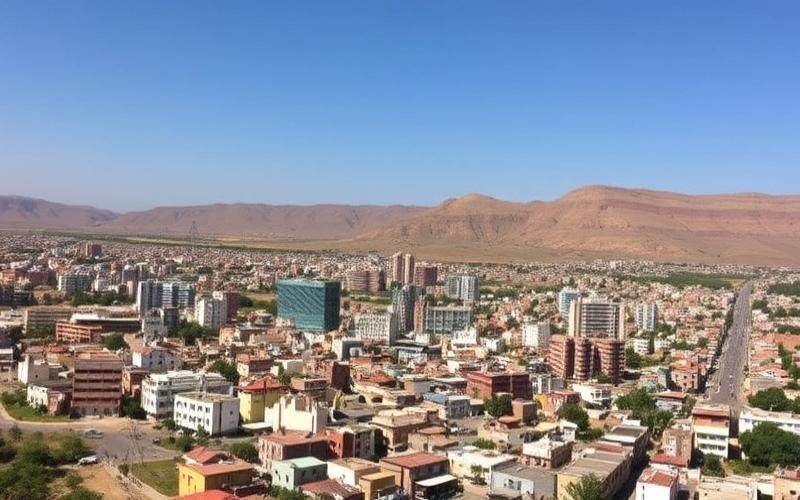
City of Niš, Serbia
A Country Under Construction: Overview of Major Urban Dynamics
While Belgrade, Novi Sad, and Niš attract most of the spotlight, Serbia’s ongoing urbanization is far from limited to these metropolises. The country has 28 cities that concentrate about 60% of the population, 74% of employment, and 75% of the value added. However, most are seeing their populations decline, with the notable exceptions of Belgrade, Novi Sad, and Novi Pazar. In this context, public authorities adopted a first Sustainable Urban Development Strategy in 2019, accompanied by an action plan and a “Green, Livable and Resilient Cities” program managed by the World Bank and partly funded by Switzerland.
Ten secondary cities have been targeted for enhanced support, notably Novi Pazar, Zrenjanin, Leskovac, Kraljevo, Kragujevac, Šabac, Niš, Užice, Zrenjanin and Sombor. Focus areas include aligning planning documents, water and waste management, flood resilience, sustainable mobility, and energy-efficient renovation.
Infrastructure, Water, Waste: Massive Needs
The figures give an idea of the scale of the challenges: nearly 41% of drinking water produced in urban networks is lost as “non-revenue water,” either through leaks or illegal connections. The investments needed to align the water and sanitation sector with European standards are estimated at around €5 billion, with an additional roughly €1 billion for solid waste management.
Air pollution-related death rate in Serbia, one of the worst in Europe, per 100,000 inhabitants.
Summary table of some estimated needs and investments for urban services:
| Sector | Estimated Need / Situation |
|---|---|
| Water and Sanitation | ~€5 billion needed to meet EU standards |
| Solid Waste | ~€1 billion in required investments |
| Non-Revenue Water | 41% on average in urban networks |
| Share of cities in emissions | 68% of national CO₂ emissions |
| Share of urban transport | 25% of national emissions |
| Share of urban buildings | ~20% of national emissions |
Source: World Bank reports / national strategies (aggregated data from report P176192).
Secondary Cities: Less Visible but Crucial Projects
In Šabac, a long-awaited wastewater treatment plant is under construction, with significant EU support, to reduce pollution in the Sava and support local industrialization. Zrenjanin and Požarevac are also working on treatment facilities, while Sombor, Zaječar, and Pančevo are extending their sewer networks. Užice and Niš are modernizing their landfills to comply with European directives.
Modernization and resilience initiatives in several Serbian cities, adapted to local challenges.
Rehabilitation of roads and bridges in Novi Pazar and Prijepolje to cope with landslide and flood risks in mountainous areas.
In Kragujevac, a vast renovation program including modernization of hospitals, public lighting, creation of green corridors, and development of digital services.
This mosaic of projects is part of a broader trend of municipalities gaining strength, encouraged to take initiative rather than wait for signals from the center. Partial fiscal decentralization and the availability of international funding (World Bank, EBRD, EIB, EU, etc.) allow many municipalities to design their own development agendas, although administrative capacities remain very uneven.
Towards Smarter Cities: Serbia in the Era of “Smart Cities”
The concept of a smart city is still in its infancy in Serbia, but signals are multiplying. A survey conducted in 2020 by the Friedrich Naumann Foundation shows that 48% of municipalities that have tested “smart” solutions have implemented electronic payment systems, 39% communication projects (public Wi-Fi, data centers), 26% smart water management, and 19% energy-related devices.
Belgrade, Novi Sad, Niš, and Kragujevac are the pioneering cities, testing sensors, data platforms, citizen applications, and automated lighting management. The government has a national strategy for artificial intelligence (2020‑2025) and promotes the opening of public data via the Office for IT and e-Government, notably on the portals data.gov.rs and Open Data Hub.
In transportation, several cities are developing sustainable urban mobility plans, like Šabac or Pirot, and testing bike lanes, bike counters, real-time bus tracking systems. Kruševac has been distinguished at the European level for its engagement in Mobility Week, after putting new cycling infrastructure and passenger information systems into service.
Beyond gadgets, the central question remains the ability of municipalities to standardize data collection, open this information in reusable formats, and involve businesses and citizens in the co-design of services. Without this open governance, the “smart city” label risks remaining mere marketing.
Governance, Planning, and Risks of Urban Fracture
Serbia has a relatively structured spatial planning system, with a national plan (SPRS 2021‑2035 under adoption), regional plans covering the entire territory, and local plans. A Sustainable Urban Development Strategy sets directions until 2030, articulated around six programs (brownfield redevelopment, fight against illegal construction, public spaces, social city, climate, heritage).
The absence of a National Development Plan and the proliferation of special laws for large projects create difficulties in arbitration and bypass usual consultation and control processes.
Heavy reliance on foreign investment – more than half of the FDI in the Western Balkans is concentrated in Serbia, with a strong presence of European, Chinese, American, and Gulf capital – pushes authorities to offer very advantageous conditions (tax exemptions, employment subsidies, cheap land, accelerated procedures). While this stimulates the construction of factories, logistics parks, shopping centers, and high-end housing, the question of redistributing benefits and long-term resilience remains.
Belgrade captures over 70% of the interest for offices, premium housing, and retail, accentuating urban primacy.
A Decisive Decade for Serbian Cities
Between the glass towers of Belgrade Waterfront, the future exhibition park of EXPO 2027, the smart dams on the Nišava, the Danube front in Novi Sad, the wastewater treatment plants in Šabac or Zrenjanin, and the modernized landfills in Užice or Niš, Serbia is engaged in a vast redefinition of its urban spaces.
The strengths of development include high land availability, a qualified workforce, a geostrategic position, access to international funding, and a growing project culture. The major risks are debt, concentration of investments in limited hubs and prestige operations, weakening of democratic planning mechanisms, and the potential aggravation of inequalities in access to housing and services.
The coming years will be decisive in determining whether future urban development projects in Serbia will result in cities that are truly greener, more inclusive, and more resilient, or if the priority given to flagship showcase projects comes at the expense of a better-shared daily life for all residents. The tools exist – national strategies, international programs, local experiences of dialogue and co-construction – it remains to be seen if they will manage to weigh sufficiently against the power of attraction of mega-projects and private capital.
Disclaimer: The information provided on this website is for informational purposes only and does not constitute financial, legal, or professional advice. We encourage you to consult qualified experts before making any investment, real estate, or expatriation decisions. Although we strive to maintain up-to-date and accurate information, we do not guarantee the completeness, accuracy, or timeliness of the proposed content. As investment and expatriation involve risks, we disclaim any liability for potential losses or damages arising from the use of this site. Your use of this site confirms your acceptance of these terms and your understanding of the associated risks.

Cyril Jarnias is an independent expert in international wealth management with over 20 years of experience. As an expatriate himself, he is dedicated to helping individuals and business leaders build, protect, and pass on their wealth with complete peace of mind.
On his website, cyriljarnias.com, he shares his expertise on international real estate, offshore company formation, and expatriation.
Thanks to his expertise, he offers sound advice to optimize his clients' wealth management. Cyril Jarnias is also recognized for his appearances in many prestigious media outlets such as BFM Business, les Français de l’étranger, Le Figaro, Les Echos, and Mieux vivre votre argent, where he shares his knowledge and know-how in wealth management.