 Published on and written by Cyril Jarnias
Renting an apartment or house long-term in Serbia may seem straightforward at first glance: supply is abundant, rents remain attractive compared to Western Europe, and landlords are generally open to foreigners. But behind this apparent ease, the market is largely informal, the legal framework is complex, and a portion of transactions still take place without a proper written contract.
For a foreign tenant, digital nomad, expat, or investor, it is essential to understand how the local real estate market works, the actual prices, the applicable legal rules, and the best practices to adopt to avoid pitfalls and secure long-term residence.
This guide provides a comprehensive overview of how to rent a property long-term in Serbia, based on the most recent data and local law.
Understanding the Rental Market in Serbia
The first particularity of Serbia is its very high homeownership rate. Approximately 98% of households own their homes, leaving a reduced space for the classical rental market. Owner-occupied housing accounts for about 87.5% of the stock, while properties actually rented out on the private market make up only about 5% of the housing stock. The public or “social” sector does not exceed 1.7%.
In practice, for a long-term tenant, the rental market is largely dominated by private landlords rather than professional companies. Furthermore, a large portion of rentals remain informal, with common practices such as the absence of a written contract, cash payments for rent, and non-declaration to tax authorities.
Despite this atypical structure, major cities have an abundant supply of apartments for rent, driven by the presence of universities, government offices, and multinational companies. Belgrade, Novi Sad, Niš, and Kragujevac concentrate the majority of the market, with a range of properties from small furnished “garsonjera” (studios) to upscale family apartments.
The other element to keep in mind is that Serbia is generally affordable compared to other European capitals, even though rents have risen significantly in recent years before stabilizing and then slightly correcting in some segments.
Where to Rent: Overview of Major Cities and Neighborhoods
The choice of city (and neighborhood in Belgrade) heavily impacts the budget, as well as daily comfort. Most expats and digital nomads concentrate in a few large urban areas.
Belgrade: Dynamic Capital and the Most Expensive Market
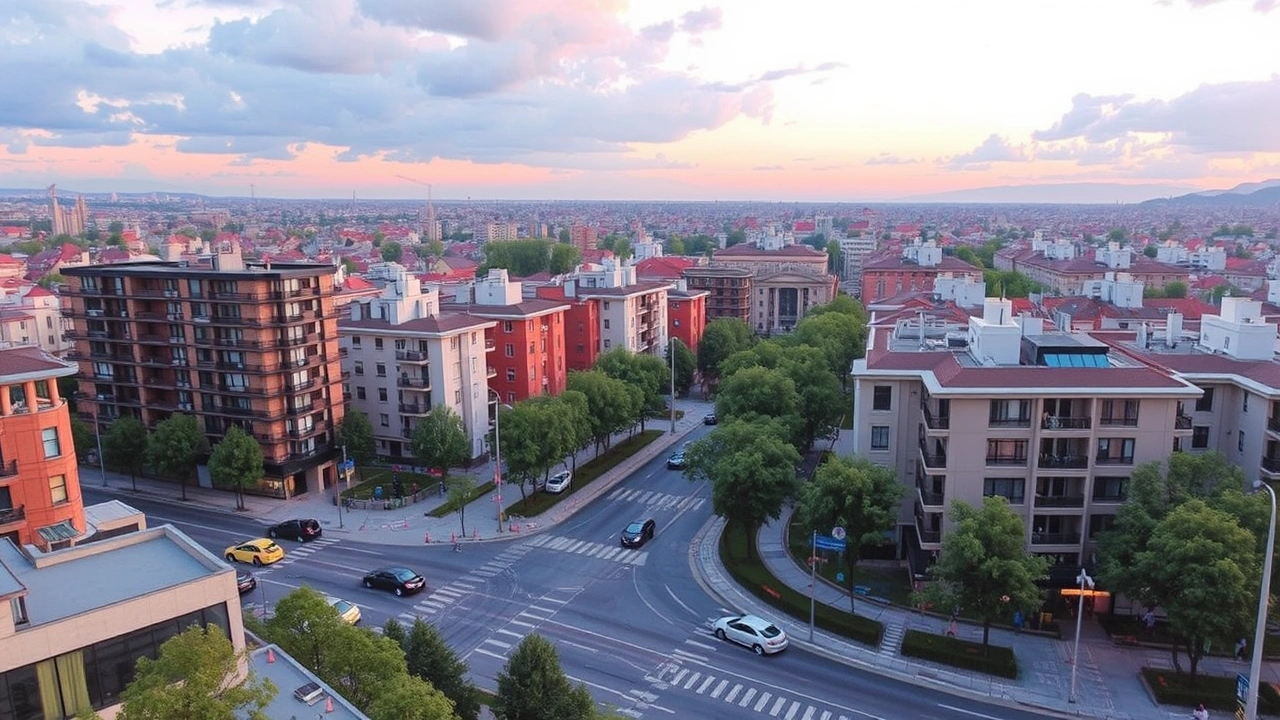
Belgrade remains the top destination for a long-term stay. The city is split in two by the Sava River, with the old town (Stari Grad, Vračar, Dorćol, Dedinje, etc.) on one side and Novi Beograd (New Belgrade) and Zemun on the other. Each neighborhood has its own vibe, amenities, and… price level.
Very central areas like Terazije, Republic Square, Vračar, Neimar, or Dedinje are among the most expensive, while Savamala is classified in the cheapest category, with Zeleni Venac, certain blocks in Novi Beograd, and parts of Zemun offering mid-range rents.
To navigate the real estate market, it is useful to consult the average rents being charged, differentiating them by size or type of housing (studio, two-room apartment, etc.). This comparison helps assess market prices and refine your search.
| Type of Housing in Belgrade | Average Monthly Rent (EUR) | Notes |
|---|---|---|
| Studio | ~300 | Varies by neighborhood and condition |
| 1-room (T1) | ~390 | Average from listings |
| 1.5-room (living room + sleeping area) | ~470 | Highly sought after by young professionals |
| Larger apartments | 680 to >1,500 | High-end possible in Dedinje, city center, Belgrade Waterfront |
Data converted to dollars and euros by location also shows the gap between center and outskirts:
| Belgrade (apartments) | City Center (EUR/month) | Outskirts (EUR/month) |
|---|---|---|
| 1 bedroom | ~766.6 | ~479.0 |
| 3 bedrooms | ~1,349.4 | ~889.1 |
Central neighborhoods like Stari Grad, Dorćol, or Vračar are appealing for their urban atmosphere, proximity to cafes, restaurants, museums, and parks (Kalemegdan, Tašmajdan, etc.), but they are noisy and parking is difficult. Vračar, for example, has a “village” vibe with lively streets, the Temple of Saint Sava, markets like Kalenić, but remains among the most expensive areas.
The average rent per square meter in the modern Novi Beograd neighborhood in Belgrade.
Novi Sad: A Calmer and Slightly Cheaper Alternative
The country’s second city, Novi Sad attracts more and more remote workers and expats looking for a more tranquil setting. The center remains lively but without the intensity of Belgrade.
Average rents there are slightly lower.
| Type of Housing in Novi Sad | Center (EUR/month) | Outskirts (EUR/month) |
|---|---|---|
| Studio | ~270 | Cheaper outside the center |
| 1 bedroom | ~496.6 | ~381.6 |
| 3 bedrooms | ~994.9 | ~693.4 |
An apartment of around 50 m² in the center rents for between 10 and 12 EUR/m², and less than 10 EUR/m² in peripheral areas. For a tighter budget but a good level of services, Novi Sad is therefore a serious option.
Niš, Kragujevac, Subotica: Lower Rents, More Local Life
Other regional cities like Niš, Kragujevac, or Subotica offer even more affordable rents.
| City | Studio (EUR/month) | 1 Bedroom Center (EUR) | 1 Bedroom Outskirts (EUR) | 3 Bedrooms Center (EUR) | 3 Bedrooms Outskirts (EUR) |
|---|---|---|---|---|---|
| Niš | ~220 | ~336.7 | ~227.7 | ~502.9 | ~351.8 |
| Kragujevac | ~175 | ~312.0 | ~244.3 | ~525.3 | ~374.7 |
| Subotica | ~170 | Partial data | Partial data | Partial data | Partial data |
In Niš, a 1-bedroom apartment of around 50 m² in the center costs around 8 EUR/m², and even less on the outskirts. These cities are well-suited for those seeking a more “local” immersion and a lower cost of living.
Rent Levels and Cost of Living: What to Expect?
To get a realistic idea of your budget, you need to factor in rent as well as utilities, transportation, and daily expenses.
Rent: From Cheap Studios to Large High-End Apartments
National figures show fairly wide ranges depending on size and city. On the general market (excluding the most expensive major metropolises), you can still find studios between 100 and 150 EUR per month and larger apartments between 200 and 350 EUR, not including utilities. In major cities, these levels have rather become a floor.
Utilities and Bills: An Expense Not to Underestimate
Utilities can weigh heavily on the monthly budget. For an 85 m² apartment, average costs for basic services (electricity, heating, water, garbage) are around 158 EUR per month. In Belgrade, depending on the season and type of heating, the bill for a similar home typically ranges between 13,357 and 30,000 RSD.
In addition to rent, several expenses may be the tenant’s responsibility. Here are the main cost items to anticipate.
Subscription to a high-speed internet connection for the home.
Mobile phone subscription, often a personal expense for the tenant.
Contribution to cleaning and maintenance costs for the building (lobby, stairs, elevator).
Fees related to cleaning, lighting, or security of a collective parking area.
| Expense Item (Monthly) | Average Cost (EUR) |
|---|---|
| Electricity, heating, water, garbage (85 m²) | ~157.98 |
| Fixed Internet (≥ 60 Mbps, unlimited) | ~25.50 |
| Mobile Plan (calls + ≥10GB data) | ~16.93 |
In condominium buildings, the monthly contribution for common area maintenance and the reserve fund is in principle the owner’s responsibility, but it is not uncommon for this cost to be incorporated into the rent or passed on by contract. It is therefore crucial to clarify in the lease who pays for what.
Transportation: Still Moderate Costs
Urban transportation remains affordable. A single ticket costs around 75 RSD, and a monthly pass about 2,300 RSD. Some sources indicate that in Belgrade public transport is free, which in practice corresponds to specific local measures; therefore, you should check the system in place upon arrival.
The price per liter of gasoline in Serbia is about 188 RSD.
Overall Budget: Single, Family, Expat, Nomad
By adding rent and utilities to daily expenses, you get a rough idea of the cost of living.
| Profile | Estimated Monthly Cost Excluding Rent* |
|---|---|
| Single person (local) | ~73,601 RSD (~630.8 EUR) |
| Family of four | ~250,846 RSD (~2,149.8 EUR) |
*Estimates for Belgrade for certain profiles, including accommodation, are: digital nomad ~2,859 USD, expat ~1,844 USD, family ~3,853 USD, local resident ~1,101 USD. These figures vary depending on lifestyle and chosen neighborhood.
The gap between the average net salary (between 90,925 and 107,500 RSD according to sources and period) and cost of living partly explains the sensitivity of the rental market to the issue of financial accessibility.
The Legal Framework for Long-Term Leases
Behind the informal market, Serbian law nonetheless clearly regulates landlord–tenant relations. Several laws apply, the main one being the Law on Obligations (often called the Contract and Tort Law). It generally defines the lease contract: the landlord makes a property available to a tenant for a given period, in exchange for rent.
Other texts complement this foundation, notably the Law on Housing and Building Maintenance, the Law on Property Relations, and, in some cases, the Law on Public Property (when the landlord is a government body or municipality).
The essential point for a foreigner renting an apartment for several months or years is not to settle for the informal practice, even if it is widespread. A written lease, ideally bilingual and well-drafted, is the only real protection in case of a dispute.
Written Contract or Verbal Agreement: What is Truly Prudent
In theory, Serbian law admits verbal contracts: an oral agreement can have legal effects and be recognized by a court, provided you can prove the existence of the tenancy (payment receipts, messages, etc.). In the public or social sector, a written contract is mandatory.
For a long-term tenant, and especially a foreign one, relying on a simple verbal agreement is very risky. Without a written document, the legal notice period in case of termination drops to only 8 days, and proof is often difficult to provide.
A good written contract must, at a minimum, contain: the contracting parties, the subject of the contract, the obligations of the parties, the price and payment terms, the duration of the contract, and the termination conditions.
A lease agreement in Serbia must absolutely include: the complete identity of the parties (landlord and tenant), a precise description of the property (address, floor, area), the amount of rent in RSD or EUR and its payment terms, the lease duration, the detailed breakdown of expenses (electricity, water, heating, internet, maintenance, parking), the amount and conditions for returning the security deposit, rules regarding subletting, guests, pets, and smoking, an explicit mention of the tenant’s right to register at the address (necessary for obtaining the “white card” or a residence permit), as well as termination procedures (notice period and grounds for early termination).
For a foreigner who does not speak Serbian, a bilingual Serbian–English lease is highly recommended. The legally “official” contract must be in Serbian, but an English version avoids misunderstandings. It is always possible to sign a text in a language you don’t understand, and it will be valid, but you then expose yourself to significant misunderstandings.
Notarization is not mandatory for the validity of a lease. However, a notarized deed turns it into an enforceable title, facilitating quick recourse in case of non-payment (advantage for the landlord). For a foreigner, it is often indispensable as it is frequently required to constitute a residence permit application.
Lease Duration, Renewal, and End of Contract
Serbian law gives parties considerable freedom to set the duration of the lease. Two main types of contracts coexist: fixed-term leases and leases for an indefinite period.
Fixed-Term Leases: The Most Common Form
In practice, most market rentals are concluded for a period of 6 to 12 months, or even longer. There is no minimum or maximum duration imposed by law. Upon expiration of the term, the contract automatically ends, without the need for notice, unless there is a renewal clause.
If a tenant remains in the property after the lease ends and the owner does not object, the law considers that a new lease for an indefinite period, under the same conditions, is automatically created. However, it is recommended to formalize this renewal with an addendum or a new contract, especially if the rent is modified.
A fixed-term lease cannot, in principle, be terminated before its term except if:
– the contract includes a specific early termination clause (for example with one or two months’ notice after a minimum period);
– one party commits a serious breach of the contract (non-payment, willful damage, etc.);
– the parties mutually agree to end it.
Leases for an Indefinite Period: More Flexibility, but More Uncertainty
If the duration is not specified, or if the contract is concluded from the outset without a term, the lease is considered for an indefinite period. Both parties can terminate it by respecting a notice period. In the absence of a specification in the contract, the law provides a minimum notice period of 8 days, provided this notice is not deemed “inopportune”.
In practice, serious leases set a notice period of about 30 days, sometimes longer, to give each party time to organize. It is essential to stipulate a clear notice period in the lease text to avoid unpleasant surprises.
In case of the death of the landlord or the tenant, the contract is not automatically terminated: it continues with the heirs, unless stipulated otherwise.
Rent, Revisions, and Security Deposit
Another particularity of the Serbian system: no law caps the level of rent or security deposits. Everything is therefore subject to negotiation.
Setting and Paying the Rent
The rent amount is freely determined by the parties, depending on location, size, condition, and equipment of the property. In Belgrade, for example, a common range was recently between 7 and 20 EUR/m² depending on the neighborhood and level of quality.
Rent is generally payable monthly, often in cash or by bank transfer, sometimes in euros even though the official currency remains the dinar. The law allows rent to be expressed in euros, while some euro-indexed charges must be paid in RSD.
For leases of one year or more, the law provides by default for semiannual payment if nothing is agreed, but in practice almost all leases specify monthly payment.
Rent Revision: What is Possible (or Not)
During a fixed-term lease, rent can only be increased if the contract expressly provides for it. The most common clauses provide for an annual adjustment indexed to inflation (Serbian price index) or another index.
In the context of a lease for an indefinite period, the owner can propose a rent increase by giving reasonable notice, for example 30 days. However, this increase is conditional on the tenant’s agreement. If the tenant refuses the proposal, the landlord retains the right to terminate the lease, provided the stipulated notice period is respected.
In the social sector, the rules are more regulated: the municipality must announce any increase at least one month in advance, and the amounts are set by administrative acts.
Security Deposit: Practices and Precautions
In the absence of a legal ceiling, the deposit amount is purely contractual. In practice, the norm is between one and two months’ rent. For luxury apartments with high-end furnishings, landlords sometimes ask for more.
The deposit is paid upon signature, along with the first month’s rent. Its purpose is to cover:
– unpaid rent;
– outstanding utility bills;
– damage attributable to the tenant.
It is highly recommended that the contract specifies:
– the exact deposit amount;
– where it is held (often simply by the landlord);
– the specific circumstances under which the landlord can withhold all or part of the deposit;
– the timeframe and procedure for its return after the final inspection.
Many contracts stipulate that if the tenant leaves the premises before the end of a fixed-term lease without respecting the conditions, the owner can keep the deposit. For a foreign tenant, it is better to try to negotiate more balanced clauses (e.g., partial return depending on the notice period respected).
Utilities, Maintenance, and Repairs: Who Pays for What?
Disputes very often concern utilities and repairs. Hence the importance of clarifying these points before signing.
Allocation of Regular Expenses
By default, the practice is as follows:
– the tenant pays: electricity, water, heating, gas, internet, television, garbage, and minor repairs related to normal use;
– the owner pays: major structural repairs, heavy building maintenance, the condominium association fee, property taxes.
Payment for utilities (water, electricity, maintenance) can vary depending on the lease. Some landlords offer rent “including charges,” others require full reimbursement of bills from the tenant. In social housing programs, regular expenses may be fully covered by the municipality, thus exempting the tenant.
The important thing is that the lease clearly lists:
– which bills are in the tenant’s or owner’s name;
– who pays for what, and to whom;
– the procedure for providing proof of payment.
Maintenance, Repairs, and Inspection
The law requires the landlord to maintain the property in usable condition and to carry out necessary repairs. If the owner does not respond and urgent work is required to preserve the property or safety, the tenant can in principle have it done and then claim reimbursement, or even deduct the amount from the rent, provided the landlord has been notified.
The tenant is obliged to maintain the property, perform minor repairs due to normal wear and tear, and inform the owner without delay of any problem or danger. Delay in reporting a serious defect, such as a leak, may hold the tenant liable for additional damage caused.
A detailed inspection report upon move-in and move-out (with photos, list of furniture and equipment, meter readings) is essential. In the social sector, it is mandatory; for the private market, it is strongly advised. Without this document, it becomes almost impossible to prove whether damage existed before or not, and discussions about the security deposit quickly become contentious.
Subletting, Assignment, and Sale of the Property
Under Serbian law, subletting is in principle allowed, unless the lease states otherwise or in special cases (public housing). However, the tenant remains responsible for the subtenant’s behavior towards the owner.
Many leases require the landlord’s prior written consent for any subletting. Subletting without this authorization, when the contract stipulates it, constitutes a breach that can lead to termination of the lease by the landlord.
Another point to know: if the owner sells the rented property, the lease continues. The new buyer takes over the existing contract and becomes the new landlord. However, the tenant has the right to terminate if this change substantially alters their situation.
Landlord’s Tax Obligations (and Impact for the Tenant)
Tax on rental income in Serbia is based on a rate of 20% applied to a reduced taxable base, taking into account standard deductions (generally 25% for individuals). The obligation to declare and pay this tax lies with the owner.
The situation, however, varies according to the status of the parties:
The rules for declaring rent vary depending on the status of the landlord and tenant.
The owner (individual) must declare the income and pay tax on the rent received.
If the tenant is a company or a sole proprietor, it is they who declare and pay the tax on behalf of the landlord.
When both parties are legal entities or entrepreneurs, the rent is directly integrated into the landlord’s taxable result.
The foreign tenant therefore has no specific rental-related tax to manage, but has an interest in ensuring the contract is registered with the tax administration. This point becomes critical when it serves as proof for a residence permit: the office in charge of foreigners may request a certificate of tax payment by the owner.
Registering as a Foreigner: The “White Card” and Residence Permit
Any foreigner who stays more than 24 hours at the same address in Serbia has a legal obligation to register with the police. This document is commonly called the “white card”. In a hotel or hostel, the reception handles this automatically. In a private rental, it is the owner’s responsibility to do the procedure, although, in practice, the tenant can present themselves with the right documents.
Registration Procedure
Registration must be done within 24 hours after arrival at the accommodation. The documents generally required are:
– the tenant’s passport;
– the lease agreement, ideally notarized;
– the owner’s ID card;
– the residence registration form (filled out in duplicate at the police station).
Failure to comply with this obligation can result in fines ranging from 5,000 to 500,000 RSD for the landlord, and from 5,000 to 150,000 RSD for the foreigner. It is therefore essential to verify, even before signing, that the owner explicitly agrees to registration at the address and provides the necessary documents.
Link to the Residence Permit
For a stay of more than 90 days, a foreigner generally must apply for a temporary residence permit (or a long-stay type D visa, depending on their situation). Renting a property alone does not constitute a sufficient legal basis, but the lease serves as proof of accommodation in the application.
The main possible bases for a residence permit are:
– professional activity (employment contract, assignment);
– starting or owning a business;
– studies or research;
– family reunification;
– ownership of real estate used as a personal residence (buying a property to rent it out does not grant this right).
In all cases, the lease must be in order, often notarized, and authorize registration at the address in question. For combined residence + work permits, the contract or a landlord’s statement is part of the supporting documents.
How to Search for Housing: Agencies, Platforms, and Word of Mouth
On the ground, three main channels allow you to find long-term rental housing.
Platforms and Classified Ads
Several Serbian real estate portals publish thousands of ads, mainly in the local language. Among the most used are:
– 4zida.rs (also a source of price statistics);
– halooglasi.com;
– nekretnine.rs;
– other specialized sites like srbija-nekretnine.org, kuca.rs, nekretnine-srbija.info.
These platforms are very useful for getting an idea of prices by neighborhood, the type of properties available, and amenities offered (furnished, parking, central or individual heating, etc.). However, it’s important to know that many ads are published by agencies, not directly by owners.
Real Estate Agencies: A Cost but a Real Service
Several agencies in Belgrade and Novi Sad have specialized in assisting foreigners. Some, like City Expert, Symbol Properties, Best Real Estate, Eurorent, Prime Real Estate, or more local structures in Novi Sad, provide:
Our service includes a targeted property search according to your criteria, accompanied viewings, preparation of bilingual contracts, assistance with registering your residence with the police, and, if needed, help with residence permit or company formation procedures.
Their commission is generally around 50% of one month’s rent on the tenant’s side, to which may be added fees on the owner’s side. This additional expense may seem high, but for a non-Serbian speaking foreigner, it often secures the transaction, limits the risk of scams (ads for non-existent properties, requests for commission before signing, inability to register at the address, etc.) and allows obtaining a legally sound contract.
Local Networks and Word of Mouth
Finally, a large portion of rentals is still concluded through word of mouth, via social networks, expat groups, or local contacts. This method can sometimes avoid agency fees and allow direct negotiation with the owner, but it requires increased vigilance regarding the legality of the lease, the actual ownership of the property (verifiable with the cadastre), and the possibility of registration.
Standard Procedure for Renting Long-Term in Serbia
A structured approach significantly reduces unpleasant surprises. In broad strokes, a proper rental process looks like this:
To rent a property in Serbia, follow these essential steps: 1) Define your budget and geographic area including all expenses. 2) Study the market via ads and agencies to refine your criteria. 3) Visit properties to check their condition, humidity, noise, and proximity to amenities. 4) Verify the landlord’s ownership via a cadastral excerpt. 5) Negotiate lease terms (rent, duration, utilities, etc.). 6) Have a written lease drafted, ideally bilingual, and have it reviewed by a lawyer for long-term commitments. 7) Sign the contract and have it notarized if needed for a residence permit. 8) Conduct a detailed move-in inspection with inventory and photos. 9) Make payments only after signing. 10) Register with the police within 24 hours to obtain the “white card”.
Managing Disputes and Protecting Your Rights
Even with a good contract, disagreements can arise: late payments, noise, repairs not done, unjustified withholding of deposit, etc. The law provides recourse, but procedures are long and costly.
Some essential principles:
A landlord cannot evict a tenant by force, change locks, or cut off services; any eviction requires a court order. Conversely, a tenant cannot unilaterally stop paying rent to compensate for defects without following legal procedures (formal notice, request for reduction). It is crucial to keep all proof of payment. In case of a serious breach by the landlord, the tenant can request termination of the lease. For advice, consult a lawyer, as tenant associations are rare and concentrated in Belgrade and Novi Sad.
In practice, most conflicts are resolved amicably, often because the landlord prefers to avoid detailed scrutiny of their tax situation and the tenant does not want to be tied up for months in a procedure.
Conclusion: Long-Term Renting in Serbia, an Opportunity Provided You Are Rigorous
Renting a property long-term in Serbia offers real advantages: reasonable cost of living, still competitive rents, vibrant urban life in Belgrade or Novi Sad, and the possibility for foreigners to conclude proper leases. The market remains largely dominated by individuals, in a context where 98% of households are homeowners and public institutions have little intervention in rent regulation or housing quality.
Informal renting, the frequent absence of a written contract, the slowness of judicial procedures, and lack of knowledge of rights require great rigor. To secure your stay, prioritize a bilingual contract, verify ownership, explicitly mention residence registration, conduct a detailed inspection, and clarify clauses on utilities and the security deposit.
By arming yourself with this legal and practical knowledge, it becomes entirely possible to rent an apartment or house in Serbia long-term, whether to work remotely, start a professional project, or settle with your family, while benefiting from a price–quality ratio difficult to find elsewhere in Europe.
Disclaimer: The information provided on this website is for informational purposes only and does not constitute financial, legal, or professional advice. We encourage you to consult qualified experts before making any investment, real estate, or expatriation decisions. Although we strive to maintain up-to-date and accurate information, we do not guarantee the completeness, accuracy, or timeliness of the proposed content. As investment and expatriation involve risks, we disclaim any liability for potential losses or damages arising from the use of this site. Your use of this site confirms your acceptance of these terms and your understanding of the associated risks.

Cyril Jarnias is an independent expert in international wealth management with over 20 years of experience. As an expatriate himself, he is dedicated to helping individuals and business leaders build, protect, and pass on their wealth with complete peace of mind.
On his website, cyriljarnias.com, he shares his expertise on international real estate, offshore company formation, and expatriation.
Thanks to his expertise, he offers sound advice to optimize his clients' wealth management. Cyril Jarnias is also recognized for his appearances in many prestigious media outlets such as BFM Business, les Français de l’étranger, Le Figaro, Les Echos, and Mieux vivre votre argent, where he shares his knowledge and know-how in wealth management.