
 Published on and written by Cyril Jarnias
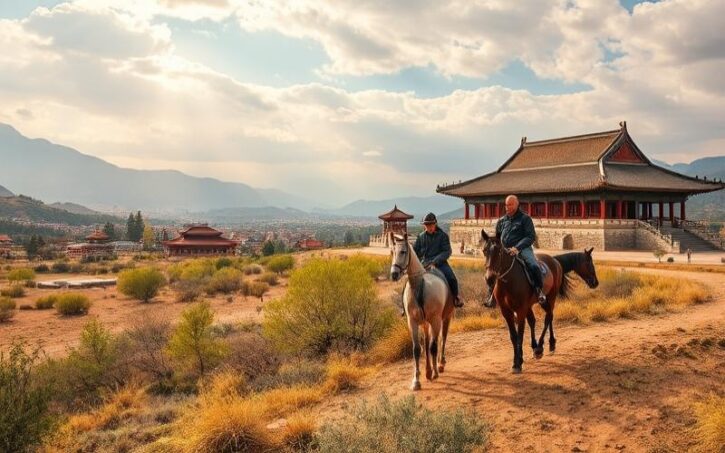
China, a country with breathtaking landscapes and a rich history, is becoming an essential destination for horse riding enthusiasts.
From the majestic North of Inner Mongolia to the lush hills of Southern Yunnan, China’s equestrian centers offer a diversity of trails and rides that capture the imagination.
Nestled in lands once ruled by famous riders from history, these places allow for rediscovering the soul of an authentic China through the lens of equestrian life.
Whether for a leisurely ride through tea fields or an exhilarating adventure across the steppes, each experience promises an unparalleled escape.
Discovering China on horseback is not just a journey through spectacular landscapes, it’s also an encounter with an ancient culture that continues to influence the contemporary identity of this fascinating country.
Introduction to Horseback Riding in China: Tradition and Modernity
Horseback riding in China stands out for its millennial heritage, shaped by iconic dynasties and enriched today by modernity and international openness.
Fundamental Historical Elements:
The practice of horseback riding in China dates back over 2500 years, as shown by archaeological evidence in Xinjiang revealing the use of horses for riding and archery as early as the 4th century BCE.
From the beginning, horses held a central place in Chinese society, symbolizing power, imperial prestige, and connection with the vast steppes of Central Asia.
| Dynasty | Major Contributions to Equestrianism | Iconic Examples |
| Han (206 BCE–220 CE) | Introduction of heavenly horses; development of training; technical innovations (metal bits) | Emperor Wu passionate about equestrian art |
| Tang (618–907) | Expansion of cavalry; refinement of equestrian arts in military and ceremonial parades | Tang cavalry famous for its demonstrations |
| Ming (1368–1644) | Perfection of equipment (saddles, harnesses); maintaining the horse as a military pillar | Massive deployment in major campaigns |
Chinese inventions like the horse collar have had a lasting impact on global practices.
Traditional Practices:
Chinese equestrian art primarily values harmony between rider and mount, seeking a deep connection rather than brute domination.
Regional equestrian festivals perpetuate these ancestral traditions with races, skill games, or shows inspired by ancient techniques.
Modernization Under Global Influence:
Especially over the past two decades:
- Rapid proliferation of urban riding clubs where both amateurs and professionals train.
- Mass adoption of Western methods: show jumping, modern dressage… International competitions stimulate this movement.
- Regular organization of international events in China that attract foreign riders and promote technical exchanges.
Globalization has thus accelerated a dual movement: preservation of local heritage while integrating global innovations.
Notable Contemporary Figures Who Modernized Chinese Equestrianism:
Alex Hua Tian: first Chinese rider to participate in eventing at the modern Olympic Games. He embodies this new generation combining international training and active promotion among the Chinese public.
Other personalities from both the sports and media worlds also contribute to democratizing this once-elitist discipline.
Summary List – Key Elements Today:
- Living preservation of traditions in certain shows or festivals
- Rapid growth in the number of urban practitioners
- Emergence on the international sports scene thanks to new generations
- Constant dialogue between local cultural heritage and global standards
Chinese equine history is thus woven between deep respect for its millennial roots—embodied by its emperor-riders—and contemporary dynamism driven by its young champions open to the world.
Good to Know:
Equestrianism in China draws its roots from the rich traditions of the Tang and Ming dynasties, where nobles and the military placed great importance on horses for war, transportation, and ceremonies. Today, these traditional practices have evolved through the influence of globalization, leading to the integration of modern techniques and China’s growing participation in international equestrian competitions, notably in the Asian and Olympic Games. Key figures like Alex Hua Tian, the first Chinese rider in eventing to participate in the Olympic Games, have played a central role in promoting and modernizing equestrianism in China. Modern equestrian centers now blend respect for cultural traditions with international standards in training and horse care.
Exploring Equestrian Centers in China: Locations and Infrastructure
| City | Main Equestrian Centers | Specific Features and Infrastructure | Supported Disciplines | Cultural Influence and Management |
|---|---|---|---|---|
| Beijing | Numerous clubs on the city outskirts | Modern facilities: indoor and outdoor arenas, spacious stables, advanced care equipment (wash stalls, farriery), tack rooms, relaxation areas, veterinary services, clubhouses, accommodations. | Show jumping, dressage, beginner lessons, polo | Strong Western influence on teaching and management; partnerships with foreign instructors; adaptation of European standards. |
| Shanghai | Private clubs, equestrian farms, County Down Club, theme parks | Luxury clubs: high-standard stables, arenas, jumping courses, dressage facilities, swimming pools, gyms, event spaces, museums, equestrian shows, family activities (carriage rides, trail rides). | Show jumping, dressage, leisure riding, polo | Culture of prestige, aristocratic model; organization of social events; European influence in horse selection and management. |
| Chengdu | Massive recent equestrian center | Impressive facilities: over 600 members, Olympic-sized arena, modern stables, tack room, spaces for care and training, recruitment of foreign instructors, equipment for various disciplines. | Show jumping, dressage, beginner lessons | Rapid development under Western influence; aim to train local instructors; adaptation to international standards. |
| Guangzhou | Urban and suburban clubs | Varied infrastructure: arenas, stables, care equipment, spaces for riders, organization of clinics and competitions. | Show jumping, dressage, leisure | Adaptation of European equestrian practices, gradual integration into urban life; growth of clubs since 2008. |
| Shenzhen | Recent equestrian clubs | Modern infrastructure, mainly focused on leisure riding and children’s lessons, care spaces, arenas, stables adapted to local climate. | Show jumping, dressage, leisure | Focus on discovery, learning, and socialization, influence of Western educational models. |
| Hong Kong | Historic clubs, racecourses | Renowned racecourses, infrastructure for racing, professional stables, veterinary equipment, VIP spaces, specialized training services. | Horse racing, polo | British heritage, professional practices, strong racing tradition, openness to international standards. |
Typical Infrastructure of Major Chinese Equestrian Centers:
- Indoor and outdoor arenas adapted for year-round training.
- Modern stables, secure tack rooms, horse wash stalls, farriery.
- Veterinary care spaces, treatment rooms, specialized feeding equipment.
- Clubhouses with dining, relaxation areas for riders and families.
- Jumping courses, dressage rings, polo fields, sometimes cross-country courses.
- Frequent recruitment of foreign instructors for training riders and local instructors.
Services Offered to Riders:
- Individual and group lessons for all levels.
- Horse rental, boarding for private horses.
- Organization of competitions, clinics, and events.
- Leisure activities: trail rides, hacks, shows, social events.
- Advice on nutrition, care, competition preparation.
Support for Various Equestrian Disciplines:
The infrastructure allows for the practice of show jumping, dressage and, in some centers, polo.
Some clubs have specific grounds for polo and courses adapted for cross-country.
Equipment is often modeled on European standards to meet the requirements of international competitions.
Influence of Local Culture and Traditions:
The history of horses in China, marked by agricultural and military use, is giving way to a modern reinterpretation inspired by Western models.
Centers emphasize prestige and exclusivity, with an important social dimension, particularly in major metropolises.
Clubs sometimes integrate elements of Chinese culture, such as celebrating the Year of the Horse or organizing shows featuring local equestrian traditions.
Management is heavily inspired by international standards, with a desire to raise the level of training and hospitality to that of major equestrian nations.
Summary of Dynamics:
The rapid growth of equestrian centers in major Chinese cities is accompanied by modernization of infrastructure and Westernization of practices, while retaining a cultural dimension unique to China, which values both prestige, tradition, and innovation in club management.
Good to Know:
In China, the main cities hosting significant equestrian centers include Beijing, Shanghai, and Guangzhou, each offering state-of-the-art infrastructure adapted to disciplines like show jumping, dressage, and polo. These centers typically provide modern training facilities, spacious and well-maintained stables, and sophisticated equipment for horse care, such as professional farriers and equine medicine specialists. Additional services often include advanced lessons for riders of all levels and sometimes cultural events that reflect the local heritage, thus influencing how these establishments are managed. For example, in Beijing, the Jinma Club offers programs that integrate equestrian poetry, thereby linking tradition and modern sport. These infrastructures effectively support local and international competitions, ensuring China an important place on the global equestrian stage.
Horseback Riding Tours: An Adventure Through Chinese Landscapes
The most popular regions for horseback riding tours in China offer a diversity of landscapes and unique experiences, appealing to both nature lovers and enthusiasts of culture and history.
| Region | Characteristic Landscapes | Cultural and Historical Experiences | Specific Flora and Fauna | Types of Horses Used |
|---|---|---|---|---|
| Inner Mongolia | Vastness of the steppes, endless grasslands | Encounters with Mongolian nomads, yurts | Antelopes, eagles, steppe grasses | Mongolian horse: small, robust, enduring |
| Sichuan (Hongyuan, Heishui) | High-altitude grasslands, steep mountains | Tibetan villages, Buddhist culture, stargazing camping | Yaks, marmots, edelweiss, rhododendrons | Tibetan horse: adapted to altitude, sure-footed |
| Yunnan (terraced rice paddies) | Terraced rice fields, subtropical forests | Crossing minority villages (Dai, Bai, Naxi), traditional architecture | Red pandas, tropical birds, bamboo | Bai or Yunnan horse: agile, docile |
| Guangxi (Li River) | Karst landscapes, winding rivers | Observing cormorant fishermen, rural villages | Water buffalo, herons, bamboo forests | Local horses, adapted to narrow trails |
Diversity of Landscapes and Experiences Offered
- The steppes of Inner Mongolia offer a feeling of total freedom, allowing riders to gallop across endless grasslands and discover the traditional nomadic lifestyle, still very much alive today.
- In Sichuan, tours traverse high-altitude grasslands and mountains, where the rider shares the daily life of Tibetan nomads and discovers authentic villages, while enjoying nights camping under exceptional starry skies.
- Yunnan captivates with journeys through terraced rice fields and lush forests, with the opportunity to visit minority villages, true witnesses to a rich cultural and architectural mosaic.
- The Guangxi region and the Li River valley offer a unique experience among karst peaks, where one observes traditional rural life and the famous cormorant fishing techniques.
Cultural and Historical Encounters
Crossing Tibetan or Mongolian villages, discovery of Buddhist monasteries, encounters with local populations perpetuating ancestral traditions (music, crafts, seasonal festivals).
Passage through historical sites like the Great Wall in the Beijing region or ancient trade routes in Yunnan.
Specific Flora and Fauna
Observation of yaks and marmots in the high plateaus of Sichuan, antelopes and eagles in the steppes of Inner Mongolia, red pandas and tropical birds in Yunnan, water buffalo and herons in the river valleys of Guangxi.
Varied flora ranging from hardy steppe grasses resistant to extreme conditions, to bamboo forests and rhododendrons at high altitudes, to rice paddies and subtropical forests in the south.
Horses Adapted to the Terrain
The Mongolian horse and the Tibetan horse are small, robust, and particularly enduring, enabling them to cover long distances over rough terrain or at high altitudes.
In subtropical and mountainous regions, local breeds are used, like the Yunnan horse, known for its agility and docility, ideal for navigating steep trails or rice terraces.
These horses, bred for centuries in these specific environments, are perfectly adapted to local conditions: cold resistance, agility on narrow trails, ability to carry loads over long distances.
Unique Experience for Riders
Riding through these varied landscapes allows for total immersion in Chinese nature and culture, while facilitating the discovery of living heritage and spectacular panoramas, often inaccessible other than by horse.
Horseback riding tours in China are an invitation to adventure, encounter, and discovery, carried by horses as resilient as they are emblematic of their region.
Good to Know:
Horseback riding tours in China offer an exceptional immersion into breathtaking landscapes, such as the vast plains of Inner Mongolia, the steep mountains of Sichuan, and the terraced rice fields of Yunnan. These regions don’t just boast natural beauty; they also reveal a rich cultural and historical tapestry with picturesque traditional villages and captivating ancestral sites. The diversity of wildlife, like Bactrian camels on the steppes or giant pandas in the forests of Sichuan, and abundant flora add a fascinating dimension to the adventure. Mongolian horses, robust and enduring, are ideal for these varied terrains, their adaptability having been refined through local equestrian traditions. Whether traversing endless steppes or climbing steep trails, they offer riders a ride that is both safe and enriching, making every tour unforgettable.
Disclaimer: The information provided on this website is for informational purposes only and does not constitute financial, legal, or professional advice. We encourage you to consult qualified experts before making any investment, real estate, or expatriation decisions. Although we strive to maintain up-to-date and accurate information, we do not guarantee the completeness, accuracy, or timeliness of the proposed content. As investment and expatriation involve risks, we disclaim any liability for potential losses or damages arising from the use of this site. Your use of this site confirms your acceptance of these terms and your understanding of the associated risks.

Cyril Jarnias is an independent expert in international wealth management with over 20 years of experience. As an expatriate himself, he is dedicated to helping individuals and business leaders build, protect, and pass on their wealth with complete peace of mind.
On his website, cyriljarnias.com, he shares his expertise on international real estate, offshore company formation, and expatriation.
Thanks to his expertise, he offers sound advice to optimize his clients' wealth management. Cyril Jarnias is also recognized for his appearances in many prestigious media outlets such as BFM Business, les Français de l’étranger, Le Figaro, Les Echos, and Mieux vivre votre argent, where he shares his knowledge and know-how in wealth management.





