
 Published on and written by Cyril Jarnias
Navigating public transportation in Trinidad and Tobago can seem confusing at first. Between large public buses, popular maxi-taxis, route taxis, the inter-island ferry, water taxi, not to mention the Caribbean Airlines air bridge, the options are plentiful, often efficient, but not very centralized. This practical guide brings together, in plain English, everything you need to know to get around like a local, respecting the rules and managing costs.
Understanding the Transportation System in Trinidad and Tobago
The transportation network relies on a mix of public and private services. The official pillar is the Public Transport Service Corporation (PTSC), a state-owned company that operates buses on both islands. Alongside it, a very dynamic ecosystem of private minibuses (maxi-taxis), shared route taxis, and private taxis handles nearly 90% of public transportation trips.
The road network is developed, with highways linking Port of Spain to major cities. Driving is on the left. Traffic jams are frequent during rush hour (6-8am and 3-6pm). Speed limits are strict: 80 km/h on most highways in Trinidad, 50–55 km/h in urban areas, and 50 km/h across the entire island of Tobago.
For a visitor, the first thing to know is that the country has no subway, no tram, and no commuter rail. Rail did exist, but the Trinidad Government Railway was abandoned in 1968, and an ambitious rapid transit network project was canceled in 2010 despite costly studies. Today, getting around is done by bus, minibus, taxi, boat… or plane for inter-island connections.
PTSC Public Buses: The Official Backbone
The public buses are managed by the Public Transport Service Corporation. This state-owned company operates about 300 buses per day, carries around 50,000 passengers daily, and remains largely subsidized by the government.
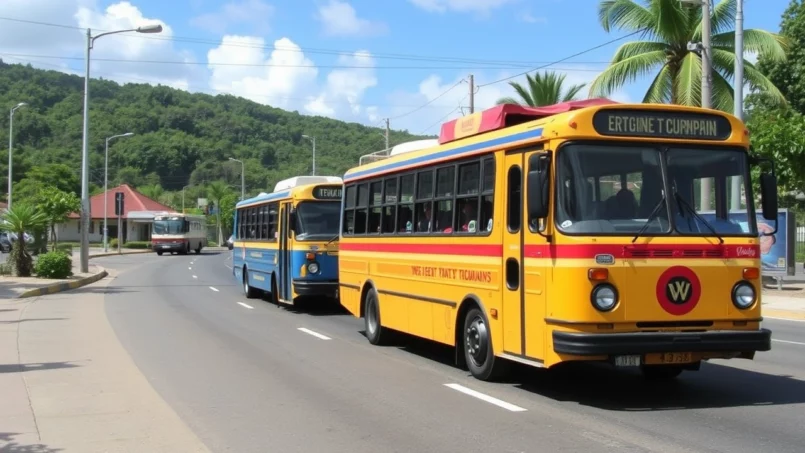
Visually, PTSC buses are easy to spot: they display the national colors, red, white, and black, and are fully air-conditioned. Two main categories coexist: a “regular” service and a more comfortable “express” service.
Types of Buses, Schedules, and Operation
“Regular” buses are often described as blue and white vehicles, while “express commuter” coaches are red and white, more comfortable, more direct, and a bit more expensive. In practice, what mainly distinguishes the express service is that it makes fewer stops and targets home-to-work commutes.
This is the approximate service day length, in hours, for buses in Trinidad and Tobago, from 4:30 AM to 9:00 PM.
On both islands, stops are often simple concrete shelters or a sign on a pole. You can’t board anywhere: you generally need to be near these identified points.
Fares, Tickets, and Free Travel
Prices are calculated based on distance and remain very affordable. In Trinidad, a trip typically costs between TT$2 and TT$12. In Tobago, fares range between TT$2 and TT$8.
PTSC does not sell tickets on board: you must buy your ticket before boarding. This can be done at the ticket counters of main terminals (e.g., City Gate in Port of Spain, Sangster Hill in Scarborough), or at certain authorized small shops. On some routes linked to the airport, it is sometimes possible to pay the driver, but this is not the general rule.
The PTSC bus network offers several fare options, including weekly and monthly passes, as well as a Travel Card (launched in 1993) for unlimited travel on defined routes. This card, which became popular, uses a color code by municipality (pink for Arima, orange for Chaguanas, gray for San Fernando). Furthermore, students in uniform enjoy free travel on PTSC buses, making this mode of transport a preferred choice for families.
A simplified overview of fares can be summarized as follows:
| Zone / Service | Price Range (one-way) | Main Notes |
|---|---|---|
| PTSC Bus – Trinidad | TT$2–12 | Price by distance, express slightly more expensive |
| PTSC Bus – Tobago | TT$2–8 | Network covering the entire island |
| “Know Your Country” | TT$50–150 | Tourist excursions, meals not included |
| Air bridge (plane) | US$24 (one-way) | Piarco–ANR Robinson flight, flexible ticket |
| Inter-island ferry | TT$50 (passenger) | TT$150 for a standard vehicle |
For seniors and certain social welfare recipients, a free pass system exists, managed by the Social Welfare Division. Those eligible include: people over 65 receiving an old-age pension, as well as recipients of certain benefits (public assistance or disability grant). The application is made at the social welfare office in the district of residence.
Main Hubs and Strategic Routes
In Trinidad, City Gate is the major nerve center. Officially the Port of Spain Transit Centre, this terminal occupies the former railway building at South Quay. This address also houses the PTSC administrative headquarters and boarding areas for some maxi-taxis.
The public transportation network in Trinidad and Tobago includes important hubs in San Fernando, Chaguanas, and Scarborough. Significant time savings are offered on the Port of Spain-Arima route thanks to the Priority Bus Route (PBR), a fast lane reserved exclusively for buses and maxi-taxis, prohibited for private cars and regular taxis.
In addition to daily routes, PTSC operates tourist circuits, the “Know Your Country” tours. These excursions depart notably from City Gate and the San Fernando terminal to sites like Los Iros, Blanchisseuse, the Pitch Lake, or the southeast coast. An iconic example is the circuit passing through the Ortoire River, Manzanilla, and Mayaro, blending history, coconut grove landscapes, and ancient Amerindian villages.
Service for People with Disabilities
PTSC offers a specialized service for adults and children with a physical disability preventing them from using regular transportation. This service provides door-to-door transportation: buses pick up the user at their home to take them to essential destinations, like government offices or supermarkets.
This service remains limited in capacity and requires prior registration, but it illustrates a beginning of consideration for accessibility. At the same time, activists grouped within a Welfare Committee advocate for better signage of priority seating on new buses, following incidents where disabled travelers were forced to stand, worsening their health problems.
Maxi-Taxis: The True Backbone of Daily Life
If PTSC is the official face of public transport, daily reality relies mainly on maxi-taxis. These private minibuses, usually air-conditioned, operate on defined routes with fixed fares. They accommodate between a dozen and thirty passengers, depending on the model.
They do not follow strict schedules: during the day, you simply wait for them to be full before they depart. Their frequency is highest during rush hours, between 6 AM and 10 AM, then 3 PM and 8 PM. On some routes, especially the east-west corridor, they run late into the night.
Color Band System in Trinidad
In Trinidad, the trick to spotting a maxi-taxi’s destination is the color band painted on its body. Each color corresponds to a geographical area or a main route.
| Band Color | Area Served (Trinidad) | Example Routes |
|---|---|---|
| Yellow | West of Port of Spain | Chaguaramas, Diego Martin, Petit Valley, St James, Carenage, Maraval |
| Red | East | Port of Spain – Sangre Grande, via Arima |
| Green | Center / Southwest | Port of Spain – Chaguanas, sometimes to San Fernando |
| Black | South | San Fernando – Princes Town, towards Mayaro |
| Brown | Southwest | San Fernando – Point Fortin, Cedros, Siparia |
In Tobago, all maxi-taxis have a blue band. Their most consistent route connects Scarborough to Charlotteville, although some vehicles are chartered for specific school or tourist trips. After 9 PM, it can be difficult to rely on this mode of transport in Tobago, where nighttime service remains sporadic.
How to Use Them, How Much They Cost
Maxi-taxis can be hailed anywhere along their route, provided there are available seats. It is often more effective to go to a structured departure point (City Gate, King’s Wharf, bottom of Scarborough) to have more choices, especially during busy hours.
Inside the vehicle, a bell near the windows is used to signal your desired stop. Simply press it shortly before your stop, or verbally tell the driver the desired intersection. As a courtesy, local custom dictates greeting other passengers when boarding and avoiding taking up multiple seats with your luggage.
Fares are known locally and sometimes displayed in the vehicle. They generally range between TT$3 and TT$10 in Trinidad, or TT$4–15 for longer distances. When you don’t know the exact price, a common technique is to hand over a TT$10 or TT$20 bill and wait for change. The price difference with PTSC buses is small, but the frequency and flexibility of maxi-taxis often make them the most practical solution.
Route Taxis and Private Taxis: Useful Complements, but Use with Caution
In addition to minibuses, Trinidad and Tobago have a vast network of route taxis, meaning private cars used in shared mode. These vehicles have a license plate starting with the letter “H” (H for hire). They follow fixed routes from well-identified “stands” in towns and cities, wait to fill up (4 to 6 passengers), then set off.
Route taxis are faster than maxi-taxis, as they make fewer stops, and are a bit more expensive. They can also be hailed roadside with a simple wave of the hand. Locals use hand signals to indicate the desired direction at the next junction.
To request a stop, a key phrase is enough: “next corner, driver” at the right moment. Again, when you don’t know the exact fare, you hand over a TT$10 or TT$20 bill and get change.
Advice for taxi passengers in Trinidad
Private taxis, on the other hand, operate by the trip and not in shared mode. They are found at airports, in front of some hotels, or can be reserved by phone. They are not equipped with meters, so it is essential to agree on a fixed price before departure. In Trinidad, a 24/7 service called Phone-A-Taxi (628‑TAXI) is often recommended. In Tobago, hotels usually have trusted drivers.
Identifying Official Taxis and Avoiding Risks
An essential safety element: only vehicles with an “H” plate are legally authorized to transport passengers for payment. However, many individuals use cars registered with a “P” (private) plate to pick up customers, especially at night or on rural routes. These “pirate taxis” are neither insured for paid transportation nor regulated. In case of an accident, passengers risk having no coverage.
Recommendations to avoid risks associated with unofficial transportation, especially during night or isolated trips.
Never get into a vehicle with a ‘P’ plate with a stranger, even if they present themselves as a taxi.
For late or isolated trips, use a taxi recommended by your accommodation or a service like Phone‑A‑Taxi.
Use tracked booking apps like TT RideShare, Drop, or Reach, which guarantee identified drivers.
Inter-Island Connections: Ferry, Water Taxi, and Air Bridge
The two main islands are separated by a sea passage known to be rough. Getting between them is done by boat or plane, depending on time available, budget, and sensitivity to seasickness.
Ferry between Port of Spain and Scarborough
The maritime connection is operated by the Inter-Island Ferry Service, under the aegis of the Port Authority of Trinidad and Tobago. Two fast catamarans, the T&T Spirit and the T&T Express, handle most crossings between Wrightson Road in Port of Spain and Milford Road in Scarborough.
The advertised duration is between 2 hours 30 minutes and 3 hours, although some technical delays can lengthen the journey. The sea can be rough, with strong currents in the Bocas. Regulars advise sitting in the center of the ship to minimize seasickness and, if necessary, planning to take anti-nausea tablets.
There are up to six daily rotations on average for the crossing.
Unlike elsewhere, tickets for same-day departures cannot be reserved by phone or online: they must be purchased on-site at the terminal ticket counters. During peak periods (Carnival, Easter, major boat races), advance tickets are essential and must be obtained in person, either at the terminal or via authorized sales points.
Water Taxi between Port of Spain and San Fernando
Within the island of Trinidad, a water shuttle offers a fast alternative to road traffic jams between Port of Spain and San Fernando. This service, operated by the National Infrastructure Development Company (NIDCO), takes about 45 to 50 minutes to connect the two cities.
The fare is set at TT$15 for an adult. Infants under one year travel free, and seniors over 65 enjoy free travel on some off-peak crossings. The boats, like the HC Katia or HC Milancia, depart from the Wrightson Road terminal in Port of Spain, adjacent to the ferry terminal to Tobago.
A route to Chaguaramas existed but has been suspended. Studies discuss extending the service to other points on the west coast (e.g., Mayaro, Toco, Felicity), but these projects remain to be realized.
Caribbean Airlines Air Bridge
Finally, for fast travel between the two islands, Caribbean Airlines operates a very dense “air bridge.” Up to twenty daily flights connect Piarco International Airport (Trinidad) and A.N.R. Robinson International Airport (Tobago). The flight lasts barely 20 to 24 minutes.
Fares are attractive: US$24 one-way, US$48 round-trip, with flexible tickets allowing date and time changes without major penalty. You can buy your ticket online, as an e‑ticket, or directly at the airline’s counters at Piarco, in Port of Spain (Nicholas Towers), and in Tobago.
All these connections make the inter‑island link one of the densest in the Caribbean, to the point that the Piarco–ANR Robinson route is considered the region’s leading domestic route in terms of seats offered.
Getting from Piarco Airport to Port of Spain
Piarco International Airport is located in the town of Piarco, about twenty kilometers from Port of Spain (sources vary between 18 and 30 km, with a road distance around 24–25 km). There is no train. The options are PTSC bus, official taxis, private transfers, and car rental.
PTSC Bus Piarco – Port of Spain
PTSC operates a direct line connecting the airport to City Gate, the large terminal at South Quay in Port of Spain. The journey takes about 30 to 40 minutes, depending on traffic, for a very advantageous price: about TT$4 (equivalent to US$1).
The service runs Monday through Saturday, from 5:45 AM to 7:05 PM, with departures about once an hour, but there are variations on weekends. There is no service on public holidays. The bus departs from bay 4, just outside the arrivals hall.
Tickets are purchased at the Piarco airport news kiosk, in its atrium, or at City Gate. On this route, it is sometimes possible to pay the driver directly, but only in cash. It is therefore wise to have local currency and to check the up-to-date schedules on the PTSC website.
Airport Taxis
Official, regulated taxis are available 24/7 at the north terminal, opposite the food court, under a dedicated canopy. A dispatcher manages the line and assigns vehicles, which can be sedans or minivans. Fares are regulated and often posted.
For a daytime trip between Piarco and Port of Spain, expect US$45 to US$60 (or TT$200–300). A surcharge applies at night (midnight–5am), bringing the fare to about TT$305. Some vehicles use a taxi meter (flag drop ~TT$13, ~TT$1.50/km, ~TT$1.20/min). In any case, agree on the price before departure.
Many taxis do not accept credit cards, so it is better to have TT dollars in cash. A modest tip (e.g., 10%) is appreciated for good service but is not strictly mandatory.
Private Transfers and Car Rental
Several platforms, like Welcome Pickups or AirportTransfer.com, offer prepaid transfers with personalized meet-and-greet at the arrivals hall. These services are often charged at a fixed price (e.g., starting around forty euros for a group of three), with online payment, the ability to choose the vehicle type, and additional options (child seat, pet transport, etc.).
For those who wish to drive themselves, international and local rental companies are present at Piarco. The road to Port of Spain goes via the Churchill–Roosevelt Highway, then the Beetham Highway and Wrightson Road. It takes about twenty minutes without traffic, longer during rush hour.
Accessibility, Safety, and Practical Tips
While the legal framework makes transportation accessibility an obligation, the reality remains mixed. Many buses and maxi-taxis are not wheelchair accessible, and infrastructure (sidewalks, bus shelters) is not always easy to access for people with reduced mobility or visual impairments.
Accessibility and Rights of Persons with Disabilities
International best practices for accessibility include low-floor buses, ramps or lifts for wheelchairs, secure parking spaces, audible and visual stop announcements, signage in braille or with relief, and specific driver training.
Bus accessibility is still developing. Pending the widespread use of pictograms on priority seats, it is recommended that persons with disabilities carry a document attesting to their status to avoid conflicts. Other travelers are encouraged to voluntarily give up their seats.
Transportation Safety Tips
Violent crime is a reality in certain urban areas, notably in and around Port of Spain. Without being paranoid, a few simple rules can reduce the risks when using public transportation:
To get around safely, it is advisable to avoid traveling alone late at night, especially on infrequent routes. Prefer official taxis recommended by a hotel, a reputable company, or a reliable app for nighttime returns. Keep your personal belongings (phone, wallet, passport) close to your body, in a closed and visible bag, and avoid displaying jewelry, large wads of cash, or valuable electronic equipment. Stay alert in major hubs like City Gate, ferry terminals, and the bus stations of San Fernando and Scarborough. Finally, stay informed about areas to avoid by following the advice of locals, hotel staff, or any official alerts.
During a state of emergency or heightened police operations, you are asked to keep a valid ID on you at all times.
In case of a problem, several emergency numbers exist: 999 or 911 for police, 990 for fire and ambulance, 811 for medical services, 634‑4440 for the coast guard. A tourist police unit can also be contacted, especially in Tobago.
Driving, Car Rental, and Soft Alternatives
Despite the density of the public transportation network, the car remains king in Trinidad and Tobago, with a very high rate of vehicle ownership. Renting a car offers great freedom, especially for exploring rural areas of Trinidad or isolated beaches in Tobago.
Conditions for Driving and Renting a Car
Driving is on the left, seat belts are mandatory for all, and drunk driving is prohibited with frequent checks. Using a cell phone while driving is also prohibited. A local peculiarity: driving shirtless is prohibited for men.
Visitors can drive with a valid foreign or international driver’s license for the first three months of their stay. After that period, it is mandatory to obtain a local license by applying at the Licensing Division located on Wrightson Road in Port of Spain. To rent a vehicle, agencies generally require the driver to be at least 25 years old, present a valid driver’s license, and provide a credit card for the security deposit.
Daily rates for a small car start around US$30, often between US$46 and US$80 depending on the model and period. The price generally includes third-party insurance and unlimited mileage. A security deposit, sometimes around US$170 in Tobago, is taken via credit card imprint.
CDW (Collision Damage Waiver) insurance is common and typically costs between US$5 and US$20 per day to reduce or eliminate the deductible. It is crucial to carefully check the rental contract, the vehicle’s condition (by taking photos), and to ensure the license plate is of type “R,” which is the standard for rental vehicles.
Two-Wheelers and Bicycles
Motorcycle rental is not recommended in Trinidad, given the dense and sometimes unpredictable traffic. In Tobago, on the other hand, on quieter roads, a scooter can be an attractive option for experienced riders, provided you wear a helmet (mandatory) and respect the speed limits.
The bicycle remains a marginal mode of transport. A few rental companies exist in Trinidad and Tobago, but the lack of dedicated bike lanes and the heat make cycling tricky, except in certain flat and quiet areas, like the Crown Point area in Tobago or little-traveled valleys in Trinidad. For short trips and recreation, however, it can be enjoyable.
Tourism, Excursions, and Complementary Services
Beyond daily travel, many tourism stakeholders offer integrated transport services: airport transfers, bus tours, boat excursions, shuttles to natural sites.
Tourist services are regulated by professional associations, and officially recognized guides carry accreditation. In some protected areas, like the Nariva Swamp or the Trinity Hills Wildlife Reserve, the use of a licensed guide is mandatory.
PTSC itself targets this niche with its “Know Your Country” circuits, which allow you to discover major sites while benefiting from the logistics of structured public transport at very reasonable prices.
Choosing the Right Mode of Transport for Your Profile
The choice of the ideal mode of transport depends largely on the type of trip, budget, and the desired comfort level. The main strengths and limitations can be summarized as follows:
| Mode of Transport | Main Advantages | Limitations / Points to Note |
|---|---|---|
| PTSC Bus | Very inexpensive, air-conditioned, structured network | Schedules sometimes spaced out, tickets must be bought in advance |
| Maxi-taxis | Very frequent, flexible, local immersion | Not accessible for persons with reduced mobility, no fixed schedules, sometimes crowded |
| Route Taxis (“H”) | Fast, good cost/time compromise | No meter, need to know or negotiate price |
| Official Private Taxis | More comfortable, personalized service | Higher cost, especially from the airport |
| Inter-island Ferry | Low fare, vehicle transport possible, sea views | Sea can be very rough, tickets purchased on-site |
| Water Taxi | Avoids traffic jams, moderate price | Limited schedules, restricted connections |
| Caribbean Airlines Air Bridge | Very fast, flexible tickets, many flights | Reservation needed, fare in US dollars |
| Car Rental | Total freedom, ideal for Tobago and rural areas | Left-hand drive, dense traffic, insurance to check |
For a traveler on a tight budget, combining PTSC buses and maxi-taxis is often the best solution, accepting some flexibility with schedules. For a short stay or business travel, official taxis and the air bridge are necessary to save time. For families or groups of friends, renting a car in Tobago and using the ferry can be economically interesting.
Towards a More Sustainable and Inclusive System?
Trinidad and Tobago faces several transportation challenges. High individual car ownership, recurrent traffic jams, and the major role of roads in greenhouse gas emissions are pushing authorities to consider changes. Plans exist to convert a significant portion of the vehicle fleet to compressed natural gas (CNG) to reduce liquid fuel consumption and the sector’s carbon footprint. Ambitions express the desire to shift 15 to 20% of vehicles to this cleaner fuel.
Transportation governance must increasingly include persons with disabilities. This involves driver training, installation of adapted equipment (ramps, audible announcements, clear signage), and effective respect for priority seating, reflecting a growing awareness.
For now, the system remains largely informal, flexible, sometimes confusing, but also surprisingly efficient for those who understand its codes. With good preparation, a few useful numbers noted in your phone, and a dose of curiosity, public transportation in Trinidad and Tobago becomes a fantastic observatory of local life – and an economical way to enjoy the richness of both islands.
Disclaimer: The information provided on this website is for informational purposes only and does not constitute financial, legal, or professional advice. We encourage you to consult qualified experts before making any investment, real estate, or expatriation decisions. Although we strive to maintain up-to-date and accurate information, we do not guarantee the completeness, accuracy, or timeliness of the proposed content. As investment and expatriation involve risks, we disclaim any liability for potential losses or damages arising from the use of this site. Your use of this site confirms your acceptance of these terms and your understanding of the associated risks.

Cyril Jarnias is an independent expert in international wealth management with over 20 years of experience. As an expatriate himself, he is dedicated to helping individuals and business leaders build, protect, and pass on their wealth with complete peace of mind.
On his website, cyriljarnias.com, he shares his expertise on international real estate, offshore company formation, and expatriation.
Thanks to his expertise, he offers sound advice to optimize his clients' wealth management. Cyril Jarnias is also recognized for his appearances in many prestigious media outlets such as BFM Business, les Français de l’étranger, Le Figaro, Les Echos, and Mieux vivre votre argent, where he shares his knowledge and know-how in wealth management.





