
 Published on and written by Cyril Jarnias
Nestled in the heart of Europe, Austria packs an astonishing density of Alpine landscapes, imperial cities, postcard-perfect villages, and UNESCO World Heritage sites into a relatively modest territory. From the baroque alleys of Vienna and the cliffs above the Danube in the Wachau to the tranquil waters of Hallstätter See and the snow-capped peaks around Innsbruck, the country offers a mosaic of places that feel like they’ve been lifted straight from a postcard… until you realize that in real life, they’re even more spectacular.
This article provides a comprehensive tour of Austria, focusing on its essential sites: UNESCO-listed locations, major cultural cities, natural wonders, and iconic experiences. The goal is to map out a coherent journey to capture the country’s essence, rather than listing numerous addresses.
Vienna, the Imperial and Musical Heart of the Country
It’s hard to talk about Austria’s must-see tourist attractions without starting with Vienna. As the political, cultural, and historical capital of the country, the city sets the scene from the start: baroque palaces, cozy coffeehouses, classical music concerts, and the Danube as a backdrop.
Vienna’s Historic Center, an Open-Air Stage
Vienna’s historic center, roughly corresponding to the 1st district, is a UNESCO World Heritage site. In just a few streets, it condenses centuries of European urban planning, from the medieval city to the monumental ring of the Ringstrasse, built in the late 19th century on the former fortifications.
St. Stephen’s Cathedral, with its Gothic spire nicknamed “Steffl” and its unmistakable tiled roof, is the landmark. Around it, lanes open onto squares lined with baroque, neoclassical, and Art Nouveau architecture. The Ring, a grand circular boulevard, showcases—almost theatrically—the State Opera, Parliament, the Neo-Gothic City Hall, the Burgtheater, and the twin art and natural history museums.
The historic center is a lived-in space where cafés, bookshops, and cultural institutions still occupy the original buildings. However, UNESCO has placed it on the List of World Heritage in Danger due to real estate pressure and skyscraper projects that threaten its urban coherence.
Imperial Palaces: Hofburg, Schönbrunn, Belvedere
Vienna also sums up Central European history through its Habsburg palaces. Three complexes dominate the tours: the Hofburg in the city center, Schönbrunn a bit farther out, and the Belvedere southeast of the center.
The Hofburg was long the political heart of the Habsburg Empire. Today, the vast complex houses the Austrian presidency, museums (including the Sisi Museum and the Imperial Treasury), and the famous Spanish Riding School, where Lipizzaner horses continue a dressage tradition dating back to the 16th century. The ensemble reflects the city’s major architectural phases, from the Middle Ages to the historicist period.
The former summer residence of the Habsburgs, the rococo Schönbrunn Palace is a UNESCO World Heritage site. Designed as a unified project, it includes over 1,400 rooms (partially visitable), a vast baroque park, the Gloriette, the Neptune Fountain, and the Tiergarten, the oldest continuously operating zoo in the world. The ensemble illustrates the lifestyle of this powerful European dynasty.
The Belvedere, finally, combines terraced gardens and two baroque palaces, now turned into a museum. It houses one of the world’s most famous paintings, Gustav Klimt’s “The Kiss,” a symbol of the Vienna Secession and the city’s artistic modernity.
A Capital Shaped by Music and Coffeehouses
Beyond its facades, Vienna cultivates an identity built on music and coffee. The city was home to Mozart, Beethoven, Haydn, Schubert, Brahms, Mahler, and the Strauss dynasty. The Musikverein, home of the Vienna Philharmonic, is among the world’s most renowned concert halls, while the State Opera remains an international benchmark.
This musical vibrancy is matched by a coffeehouse culture elevated to an art of living. Historic cafés like Demel or Café Sacher (birthplace of the Sachertorte, created in 1832) carry on a tradition of intellectual and bourgeois sociability that is unique in Europe. In these wood-paneled rooms, another pillar of Viennese identity can be felt: “Gemütlichkeit”—that cozy comfort of conviviality, deliberate slowness, and generous pastries.
Salzburg, Baroque City and Capital of Mozart
Salzburg offers a striking counterpoint to Vienna. Smaller, nestled at the foot of the mountains, and crossed by the Salzach River, it combines baroque heritage, the figure of Mozart, and the popular imagination of the musical “The Sound of Music.” Its historic center is also a UNESCO World Heritage site.
A Preserved Old Town Between River and Hills
Salzburg’s Altstadt is one of the best-preserved urban centers north of the Alps. The site lies mainly on the left bank of the Salzach, between the Festungsberg and Mönchsberg, two hills that frame and protect the city. Roman roots (Juvavum), growth under the prince-archbishops, and wealth from the salt trade have left a particularly legible layer of history.
The squares unfold like chapters in a book: Residenzplatz with its monumental fountain, Domplatz at the foot of the cathedral, Mozartplatz with its bronze statue, Kapitelplatz adorned with the golden sphere Sphaera and its giant chessboard. The whole exudes a form of baroque theatricality where the city becomes a stage and the visitor, an extra.
Hohensalzburg Fortress, an Intact Sentinel
Towering over the city from the Festungsberg, Hohensalzburg Fortress is one of the largest fully preserved medieval castles in Central Europe. Begun in 1077 under Archbishop Gebhard and remodeled until the early 16th century, it was never taken by enemy troops, which explains its exceptional state of preservation.
The historic site covers a total area of 32,000 square meters.
Access is either on foot or via the FestungsBahn, Austria’s oldest funicular, in service since 1892. From the top, views of Salzburg, the Salzach Valley, and the surrounding Alps are spectacular, especially at sunset. In the evening, classical music concerts, often branded “Best of Mozart,” take advantage of the historic halls’ acoustics, enhancing the romantic atmosphere of the place.
A City Shaped by Mozart and Baroque Art
Salzburg proudly claims its status as the birthplace of Wolfgang Amadeus Mozart. His birthplace on Getreidegasse and his later residence on Makartplatz are both museums. They display handwritten letters, original instruments such as the composer’s childhood violin, and offer a glimpse into the daily life of a family of musicians in the 18th century.
The city’s uniqueness lies in its religious and princely architectural heritage. The baroque cathedral, with its dome over 70 meters high and the baptistery where Mozart was baptized, is part of a coherent ensemble with the Residence Palace and the DomQuartier complex. Abbeys such as St. Peter’s (founded in the 7th century, the oldest active monastery in the German-speaking world) and Nonnberg bear witness to the power of the prince-archbishops who ruled the city until the early 19th century.
Just a few minutes’ walk away, Mirabell Palace and its gardens, where Mozart played as a child in the Marble Hall, extend this baroque setting. The flowerbeds, Pegasus Fountain, Dwarf Garden, and trimmed hedge alleys gained fame through “The Sound of Music,” which greatly contributed to the city’s international renown.
Hallstatt, a Museum Village Between Lake and Mountains
Among the must-see tourist attractions in Austria, Hallstatt holds a special place. This tiny village of fewer than 800 residents, wedged between cliffs and Hallstätter See in the Salzkammergut, attracts over a million visitors each year. Its center, part of the vast Hallstatt–Dachstein / Salzkammergut cultural landscape designated by UNESCO, epitomizes the union of natural and historical heritage.
A Cradle of Civilization Linked to Salt
Hallstatt is not just a charming mountain village: it is a major archaeological site. Salt has been mined here since the 2nd millennium BCE, and the so-called Hallstatt culture, a key phase of the European Iron Age, takes its name from the cemeteries and artifacts discovered on site. The mines are the oldest known salt mines in the world still in operation.
Discover seven millennia of history, from the earliest prehistoric communities to modern excavations, including the Roman period, and explore the reasons behind the site’s UNESCO inscription.
Browse seven millennia of history, from the earliest prehistoric communities to modern archaeological excavations.
Explore a section dedicated to the Roman era, a key phase in the site’s history.
Understand the reasons for the inscription, which goes beyond the village to include the reliefs, the mine, the lake, and neighboring villages.
A Fairytale Setting Under Tourist Pressure
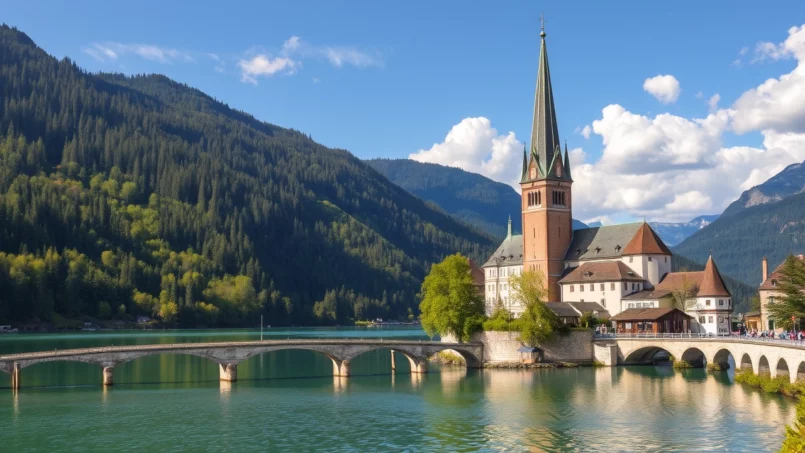
In the collective imagination, Hallstatt has become the archetype of the idyllic Alpine village. Its colorful houses nestled against the mountain, its church spire reflected in the lake, its narrow lanes opening onto the market square—all form the perfect cliché of the “Austrian postcard.” The viewpoint north of the village, often called the “postcard angle,” draws photographers, influencers, and visitors from around the world.
This popularity has ambivalent effects. On one hand, tourism sustains a large portion of the local population, supporting hotels, restaurants, craft shops, and boat operators. On the other, the nearly non-stop flow of buses and day-trippers strains infrastructure and the daily life of a tiny community. Authorities have had to establish parking lots outside the center, limit traffic, and encourage overnight stays to spread out the crowds.
Between Salt Mine, Skywalk, and Hikes
Despite its small size, Hallstatt offers a surprising range of experiences. The funicular climbs above the village to the Skywalk, a platform 350 meters above the lake, and the entrance to the salt mine. Guided tours of the mine, with galleries, exhibits, and wooden slides, provide a concrete understanding of how “white gold” shaped the region.
Originally a defense tower turned into a panoramic restaurant, the Rudolfsturm hangs over the void with spectacular views of the village rooftops and the dark waters of the lake. Electric boats, pedal boats, or rowboats are easily rented for a more peaceful exploration of Hallstätter See, while hiking trails lead to neighboring valleys, waterfalls, and high-altitude glacial gardens.
Rudolfsturm
The proximity of the Dachstein massif adds a more pronounced Alpine dimension. From the Dachstein Krippenstein station, a cable car takes visitors to breathtaking platforms like the “5 Fingers,” metal fingers suspended above the void, and to spectacular ice caves. The Hallstatt–Dachstein–Salzkammergut area thus embodies the very Austrian union of ancient culture and high mountain landscapes.
Wachau, Danube Valley Between Abbeys and Vineyards
About an hour from Vienna, the Wachau reveals another face of Austria’s must-see tourist attractions. Here, it’s not the verticality of the Alps that dominates, but the sinuous Danube, terraced vineyard slopes, and silhouettes of ruined castles above medieval villages. This 24- to 40-kilometer stretch of valley between Melk and Krems is also a UNESCO World Heritage site.
Melk, the Abbey That Dominates the River
At the western end of the Wachau, Melk is inseparable from its immense Benedictine abbey. Perched on a rocky spur overlooking the Danube and the small town, Melk Abbey is considered the largest baroque monastic ensemble in Europe. Benedictine monks have lived and worked here without interruption since the late 11th century.
Although the monastery dates from the Middle Ages, the current appearance of the site is that of a gigantic 18th-century baroque project. Visitors pass through a series of rooms, including an Imperial Gallery, a so-called “Marble Hall” (mostly stucco), a monumental library with frescoes by Paul Troger, and then a dome-topped church of impressive proportions. The gardens, a fresco-decorated pavilion, a museum, and a terrace overlooking the river complete the visit.
The abbey survived the Reformation, the Napoleonic occupations, and the Nazi period, partly thanks to its intellectual prestige. A major restoration carried out at the end of the 20th century was partially funded by the sale of a precious Gutenberg Bible, proof that heritage here is also a matter of economic means.
Dürnstein, Krems, and the Castle Route
Farther east, the valley alternates wine-growing villages, fortresses, and small river ports. Dürnstein, perhaps the most famous, juxtaposes a baroque monastery with a blue tower and the ruins of a feudal castle where Richard the Lionheart was held captive in the late 12th century. The ruins of Aggstein, Hinterhaus, Schönbühel, and other perched castles recall that the Wachau was once dotted with toll stations and eagle’s nests used by robber barons.
Krems combines a preserved historic center with a wine-growing tradition. The valley’s villages, such as Spitz or Weißenkirchen, blend baroque heritage with cellars. In Willendorf, a museum presents the famous Venus of Willendorf, a 30,000-year-old prehistoric statuette attesting to very early human settlement.
Cruises, Biking, and White Wines
The Wachau is particularly suited to a boat–bike combo. The Danube is navigable, with regular boat services between Melk, Spitz, Dürnstein, and Krems. Sailing down the valley by boat and then returning by train or bike along the cycle path—or vice versa—offers changing perspectives on the vineyard terraces and wooded cliffs.
Vineyards are everywhere. The slopes produce renowned white wines, especially Riesling and Grüner Veltliner. Numerous wine taverns and cellars offer tastings, often paired with local specialties such as Wachau apricots, turned into jams, liqueurs, or schnapps. Here again, UNESCO recognized not just a “natural” landscape, but a cultural landscape shaped by centuries of viticulture and human settlement.
Graz, the Discreet Capital of Design and Gastronomy
Often overshadowed by Vienna or Salzburg in classic itineraries, Graz deserves a top spot on the list of must-see tourist attractions in Austria. The country’s second-largest city and capital of Styria, it combines a remarkably preserved medieval center, bold contemporary architecture, and a reputation as a culinary capital.
A UNESCO-Listed Old Town
Graz’s historic core, also a UNESCO World Heritage site, spreads out in the Mur Valley at the foot of Schlossberg hill. The ensemble blends Gothic buildings, Renaissance facades, baroque palaces, and more recent constructions without losing coherence. Over a thousand buildings, from the Middle Ages to the 18th century, make up this dense urban fabric, revealing the city’s role as a crossroads between the Germanic world, the Balkans, and the Mediterranean.
The Hauptplatz, a trapezoidal main square lined with 17th- and 18th-century houses, is dominated by the City Hall. Nearby, the Landhaus, a masterpiece of the Italian Renaissance by Domenico dell’Allio, houses the regional parliament and features a remarkable arcaded courtyard. The castle (Burg) contains a unique double-spiral Gothic staircase, where two identical flights cross without ever meeting.
Schloss Eggenberg, a Baroque Palace with Hidden Astronomy
Included in the same UNESCO zone as the center, Schloss Eggenberg lies on the western edge of the city. This baroque palace, surrounded by a vast park, was conceived as a kind of cosmic clock: 24 state rooms, over 500 ceiling paintings, and a spatial organization symbolically reflecting the cycle of days, months, and years. A secondary residence of the nobility and later the Habsburgs, the castle now houses several collections of the Universalmuseum Joanneum.
A City as a Laboratory for Contemporary Architecture
One of Graz’s strengths is its ability to integrate very contemporary architecture without disfiguring its historic center. The Kunsthaus, a modern art museum with an organic silhouette nicknamed the “Friendly Alien,” is the best-known example. Its BIX media facade, composed of over a thousand luminous acrylic panels, transforms the building into an artistic display screen at night.
On the Mur River, the Murinsel is an artificial island designed by Vito Acconci, incorporating a footbridge, a café, and a stage, evoking a futuristic floating object. This urban landscape is also enriched by works from architects like Zaha Hadid and Ben van Berkel, as well as local creations from the “Graz School.” These contemporary interventions dialogue harmoniously with the historic facades without overpowering them.
Culinary Capital of Austria
With over 60,000 students among roughly 330,000 inhabitants, Graz has the energy of a university town. But it especially claims the title of “Culinary Capital of Austria.” The surrounding Styria provides vegetables, wines, oils (notably pumpkin seed oil), meats, and cheeses that fuel a renowned gastronomic scene. Terraces, markets, and parks contribute to a relaxed atmosphere very different from Vienna’s imperial formality.
Innsbruck, Capital of the Alps and Winter Sports Kingdom
While must-see tourist attractions in Austria are not limited to the mountains, it’s impossible to ignore Innsbruck. The “Capital of the Alps,” nestled in the Inn Valley and surrounded by peaks over 2,000 meters, has hosted the Winter Olympics several times. It exemplifies how a medium-sized city can combine a historic center, a rich cultural offering, and nearly immediate access to a premier Alpine playground.
Old Town, Golden Roof, and Imperial Legacy
Innsbruck’s medieval center revolves around the famous “Golden Roof” (Goldenes Dachl). This loggia, covered with thousands of gilded copper shingles, built around 1500, served as the emperor’s box for watching tournaments and festivities on the square below. Behind it, colorful alleys, arcades, and painted facades give the old town a nearly Italian charm.
Innsbruck combines a rich cultural heritage (castles, museums, theaters, baroque cathedral) with a spectacular setting in the Alps. The mountains, like the Nordkette range, seem to rise directly behind the buildings. In just a few minutes on foot, you can go from a bustling street to a panoramic viewpoint over the peaks.
A Year-Round Mountain Hub
What sets Innsbruck apart from other Alpine cities is the density of sports options available right from the center. A collection of ski areas, most reachable in under an hour, covers the surrounding slopes. The SKI plus CITY Pass Stubai Innsbruck allows you to combine 12 resorts (including Stubai Glacier, Kühtai, Axamer Lizum, Patscherkofel, Schlick 2000…) and 22 urban attractions (museums, castles, Alpine Zoo, etc.) with a single pass.
The numbers give an idea of the scale of the playground: over 250 to nearly 300 kilometers of slopes depending on the source, altitudes reaching up to 3,212 meters at the Stubai Glacier, 111 lifts, dozens of kilometers of cross-country ski trails or winter hiking paths. Access is facilitated by a free ski bus network for guests with a guest card, a railway connection, and an airport just a few kilometers from the center.
This is the altitude in meters of the Hafelekar summit, reachable from the city center in about 20 minutes.
A Metropolitan Ski Resort
Unlike other more monolithic winter sports destinations, Innsbruck functions as a kind of “ski metropolis”. You’ll find a rich cultural scene (opera, theaters, museums), a lively nightlife, restaurants for every budget, but also well-structured ski schools, well-stocked equipment rental shops, and family-friendly resorts just a few tram stops away, like Muttereralm or Patscherkofel.
Sports events like the freestyle Air & Style competition at the Olympic ski jump, World Cup and championship ski or snowboard races, and numerous music festivals maintain this close link between city and mountain. At the same time, the presence of traditional villages in the neighboring valleys, mountain huts, and alpine farms allows you to experience a more rural side of Tyrol without traveling long distances.
Overview of Major UNESCO Sites in Austria
A common thread runs through many of the places mentioned so far: UNESCO recognition. Austria has 12 World Heritage properties, 11 cultural and 1 natural, plus a few transboundary sites. This density makes it a top destination for travelers seeking to combine tourism with the discovery of heritage of universal value.
A summary of some of the main UNESCO World Heritage sites in Austria, mentioned in the article or related to its major tourist locations.
The historic heart of the capital, bearing witness to urban and architectural evolution since the Middle Ages, with its imperial palaces, parks, and Ringstrasse.
A region of exceptional natural beauty, combining an iconic lakeside village, mountain landscapes, and a millennia-old history of salt production.
Danube Valley renowned for its vineyards, medieval villages, and abbeys, between Melk and Krems.
One of the world’s first mountain railways, a pioneering feat of civil engineering crossing a spectacular landscape.
A harmonious blend of medieval and Renaissance architecture with contemporary interventions, reflecting Central European cultural influences.
A transboundary area with Hungary, characterized by its large steppe lake, marshes, and a rich centuries-old interaction between humans and nature.
| UNESCO Site | Type | Region / State | Key Features |
|---|---|---|---|
| Historic Center of Vienna | Cultural | Vienna | Imperial capital, European musical center, from Middle Ages to Ringstrasse |
| Palace and Gardens of Schönbrunn | Cultural | Vienna | Summer residence of the Habsburgs, rococo palace, oldest zoo in the world |
| Historic Center of the City of Salzburg | Cultural | State of Salzburg | Baroque city, ecclesiastical city, linked to Mozart and salt trade |
| Hallstatt-Dachstein / Salzkammergut Cultural Landscape | Cultural | Upper Austria & Styria | Multi-millennial salt mines, village of Hallstatt, Dachstein massif |
| Wachau Cultural Landscape | Cultural | Lower Austria | Danube Valley between Melk and Krems, terraced vineyards, abbeys and castles |
| City of Graz – Historic Center and Schloss Eggenberg | Cultural | Styria | Preserved medieval center, mix of styles, baroque palace with cosmic design |
| Semmering Railway | Cultural | Lower Austria & Styria | First major standard-gauge mountain railway in Europe |
| Primeval and Ancient Beech Forests (Austrian part) | Natural | Lower & Upper Austria | Five protected forest areas, notably in Kalkalpen National Park |
These sites obviously do not cover all of the country’s points of interest, but they give a good idea of Austria’s strengths: complex historic cities, cultural landscapes shaped by agriculture or industry (salt, wine, iron, etc.), and a few exceptional natural pockets like the ancient beech forests.
Other Must-Sees: Lakes, Alpine Roads, and Small Towns
Beyond the major cities or listed sites, Austria is full of places that regularly appear in travel stories and itinerary recommendations.
The Salzkammergut and the Great Alpine Lakes
The Salzkammergut, of which Hallstatt is just one facet, stretches across several of the country’s most emblematic lakes: Wolfgangsee, Traunsee, Attersee, Mondsee, and farther south, Zeller See. Each body of water has its own atmosphere, from the resort charm of St. Wolfgang to the sheer cliffs plunging into Lake Traunsee, where Ort Castle stands.
Lake activities change with the seasons: swimming and boating in summer, hikes in autumn, and Christmas markets or ice skating in winter. The region is well served by train and road, and its proximity to Salzburg makes it easy to combine a city stay with a lakeside getaway.
Scenic Roads and Waterfalls
Austrian Alpine roads are almost tourist attractions in their own right. The Grossglockner High Alpine Road, subject to a tentative UNESCO listing, is probably the most famous. It winds for about 30 miles with 36 switchbacks, offering views of the country’s highest peak, the Grossglockner, and the Pasterze Glacier.
Other routes like the Silvretta High Alpine Road or the climb to certain passes in Tyrol and Vorarlberg round out this network of scenic drives. The Krimml Waterfalls, the tallest in Austria, in the Hohe Tauern National Park, further reinforce this sense of natural power accessible to the public.
Small Towns and Character Villages
Outside the regional capitals, many smaller localities deserve a day or an overnight stay. Zell am See, on the shore of its namesake lake; Kitzbühel with its medieval old town at the foot of famous slopes; Alpbach with its traditional wooden architecture; Bregenz with its floating opera stage on Lake Constance; or Dürnstein, already mentioned, illustrate the diversity of urban settings on offer.
A constant feature of the region is the easy transition between densely built towns and natural spaces of high environmental quality. These include national parks (Hohe Tauern, Gesäuse, Thayatal), nature reserves, and traditionally managed high-altitude forests and pastures.
Summary: A Country to Explore by Theme, Not by Checklist
Faced with such variety, the temptation is to frantically tick off “must-sees” in a row. Yet Austria’s must-see tourist attractions are best approached thematically rather than as a fixed list. Some travelers will focus on UNESCO cities and imperial history, others on Alpine landscapes and ski resorts, still others on lakeside villages, abbeys, or vineyards.
One could imagine, for example: the various applications of technology in daily life.
Discover Austria through four thematic itineraries, designed to explore its cultural, natural, and scenic riches.
An itinerary linking Vienna, Salzburg, and Graz, with a side trip to the Wachau wine region.
A stay centered on Innsbruck, its ski areas, and exploration of Tyrolean valleys.
A loop around the Salzkammergut, from Hallstatt to St. Gilgen, then on to Zell am See or the lakes of Carinthia.
A route combining the Grossglockner High Alpine Road, Krimml Waterfalls, glaciers, and traditional villages.
In any case, Austria lends itself well to a type of tourism where you take your time: strolling along the Ringstrasse, lingering in a Viennese coffeehouse, extending the evening at Hohensalzburg Fortress after a concert, watching the light fade over Hallstätter See or the vineyard terraces of the Wachau. Behind the perfectly organized brochure, the country then offers its most precious asset: a rare ability to create a dialogue between nature, culture, and the good life.
Disclaimer: The information provided on this website is for informational purposes only and does not constitute financial, legal, or professional advice. We encourage you to consult qualified experts before making any investment, real estate, or expatriation decisions. Although we strive to maintain up-to-date and accurate information, we do not guarantee the completeness, accuracy, or timeliness of the proposed content. As investment and expatriation involve risks, we disclaim any liability for potential losses or damages arising from the use of this site. Your use of this site confirms your acceptance of these terms and your understanding of the associated risks.

Cyril Jarnias is an independent expert in international wealth management with over 20 years of experience. As an expatriate himself, he is dedicated to helping individuals and business leaders build, protect, and pass on their wealth with complete peace of mind.
On his website, cyriljarnias.com, he shares his expertise on international real estate, offshore company formation, and expatriation.
Thanks to his expertise, he offers sound advice to optimize his clients' wealth management. Cyril Jarnias is also recognized for his appearances in many prestigious media outlets such as BFM Business, les Français de l’étranger, Le Figaro, Les Echos, and Mieux vivre votre argent, where he shares his knowledge and know-how in wealth management.





