
 Published on and written by Cyril Jarnias
While Uruguay draws visitors for its beaches, relaxed atmosphere, and traditions of mate and asado, the key to a successful stay also hinges on a very practical detail: getting around. In this largely urban country – nearly 95% of the population lives in cities, about half of them in the Montevideo area – public transportation shapes daily life as much as it does visitors’ journeys.
Good to know:
Uruguay has a generally reliable and affordable transportation network, including buses, taxis, ride-hailing apps (Uber, Cabify), a few trains, and ferries to Argentina, with growing electrification. However, disparities in accessibility for people with reduced mobility, differences between Montevideo and small towns, limited rural networks, and uneven application of regulations should be noted.
This practical guide aims to provide a clear and concrete overview of public transportation in Uruguay, with a particular focus on Montevideo and intercity connections, while integrating issues of accessibility, environment, and safety.
Understanding Uruguay’s Transportation Landscape
Uruguay is a small country in size but well-equipped with infrastructure: nearly 78,000 km of roads, over 1,600 km of navigable waterways, and a railway network of about 1,600 to 2,900 km depending on whether active or inactive sections are considered. Despite this diversity, one mode dominates by far: the bus.
Regular bus lines connect major cities like Montevideo, Punta del Este, Colonia del Sacramento, Salto, or Paysandú to medium-sized towns and numerous beach resorts. Most intercity trips do not exceed six hours, making the bus competitive with planes for internal distances.
Note:
The Uruguayan railway network, centered on Montevideo, offers very few passenger services. Apart from a regional connection in the north and some tourist trains, the service has almost disappeared. The Montevideo commuter rail service is suspended for several years. Therefore, the train is not a pillar of daily transportation.
On the other hand, roads and road transport concentrate the majority of traffic, including freight. This historical choice, combined with the rise of cars and motorcycles, has generated congestion and pollution problems in large urban areas, which authorities are now trying to curb through an active policy of sustainable mobility and electromobility, particularly in Montevideo.
City Buses in Montevideo: The Backbone of Mobility
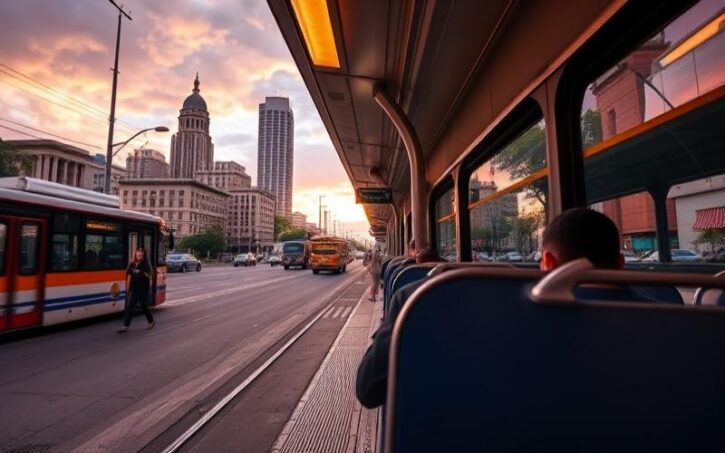
In the capital, buses – ómnibus in Spanish – constitute the quasi-exclusive form of public transport. There is no metro or tramway, but a vast network of lines operated by several private companies under municipal regulation. There are about 141 lines and 8 major transfer hubs.
How the STM Network Works
The Montevideo Metropolitan Transportation System, the STM (Sistema de Transporte Metropolitano), covers the capital and part of the neighboring Canelones department. Several companies participate, the most well-known being Cutcsa, COETC, COME, UCOT, Copsa, and other smaller operators. Together, they provide service from early morning until late evening, with good frequencies on main routes.
On major corridors like Avenida 18 de Julio or Avenida Brasil, buses run every 6 to 12 minutes during peak hours, and rather every 12 to 20 minutes during off-peak daytime. On weekends, frequencies are more relaxed but remain decent on major lines, often between 15 and 25 minutes, with reductions after 10 p.m.
The network serves central neighborhoods (Ciudad Vieja, Centro, Cordón), newer residential areas (Pocitos, Punta Carretas, Malvín, Carrasco), and main activity hubs, notably the Tres Cruces terminal, a major interchange for city and intercity buses. Night lines also provide minimal continuity between the center and coastal areas.
Fares, STM Card, and Combined Tickets
The fare system is based on a combination of single-ride payment and rechargeable smart cards, with a clear policy encouraging card use.
The structure of city bus fares can be summarized as follows:
| Ticket Type (Montevideo) | Payment Method | Indicative Price (UYU) | Particularities |
|---|---|---|---|
| “Común” ticket (standard) | STM Card | ≈ 33–46 | Reduced fare compared to cash |
| “Común” ticket (cash) | Cash (pesos) | ≈ 52–56 | Payment to driver |
| 1-hour ticket (“1 hora”) | STM Card | ≈ 30 | Unlimited transfers for 1 hour |
| 2-hour ticket (“2 horas”) | STM Card | ≈ 49 | Unlimited transfers for 2 hours |
| “Céntrico” trip on 18 de Julio | STM or cash | Slightly cheaper | Valid on Tres Cruces–Independencia axis |
The exact amounts change over time, but the order of magnitude remains modest by international standards: around 1.2 to 1.5 USD per ride when paying directly, slightly less with the card.
Tip:
Here are some practical tips to optimize your experience: make sure you understand the instructions well, organize your work effectively, and don’t hesitate to ask for clarifications if needed. These simple tips can help you save time and improve your results.
– Only local currency, the Uruguayan peso (UYU), is accepted on board.
– Payment by credit or debit card directly on the bus is generally not possible, even though some vehicles are starting to test electronic payments.
– Drivers don’t always have a lot of change; it’s better to board with small bills and coins.
– After payment, a paper receipt is printed; you must keep it until the end of the trip in case of inspection.
The STM card is the most convenient solution for anyone staying a few days or more. It can be requested by presenting a passport at authorized points: transportation agencies, kiosks, some city terminals, and especially Abitab stores – the latter being closed on Sundays. The card is sometimes free, sometimes with a small issuance fee, but in all cases, it reduces the cost of each trip and provides access to 1 or 2-hour tickets with unlimited transfers.
The card balance does not expire and can be reloaded with cash or by card at the same points, or even via operator apps or supermarkets. This flexibility makes it an essential tool for getting around without worrying about finding change for every ride.
Boarding, Getting Off, Finding Your Way: Key Things to Know
For a foreign traveler, Montevideo buses remain simple to use provided you master a few unspoken rules. First, you almost always need to signal your desire to board by making a clear gesture to the driver as the bus approaches: without this, the vehicle may not stop, especially if the stop is not very busy.
Good to know:
Payment is made directly to the driver or attendant upon boarding. To get off, you must press a stop button located near the doors or along the bars, and do so several blocks before your destination. Stops are generally announced by displays or by habit, but it’s recommended to track your journey via an app like Google Maps or Moovit for added security.
The stops themselves are not always perfectly marked, especially outside major arteries. The official city app “Cómo ir” or Moovit helps locate nearby stops, estimate wait times, and display walking or bus routes. “Cómo ir” allows searches by address, intersection, point of interest, or line number, which is very valuable when you’re not familiar with local place names.
An amusing cultural detail: it’s not uncommon for musicians or singers to board the bus to perform a piece. It’s good manners to applaud if you enjoyed them, or even to leave a small coin, although nothing obliges you to do so.
City Accessibility: Progress and Limitations
Montevideo is often presented as the country’s most accessible city for wheelchair users. Its sidewalks are generally wide, many intersections have curb ramps, the Rambla – that coastal promenade of about 13 to 14 miles – offers a regular surface suitable for wheeled mobility, and many beaches and parks are equipped with ramps.
Example:
In historic neighborhoods like Montevideo’s old town or the center of Colonia del Sacramento, ramps and adapted routes have been installed to improve accessibility. However, these facilities are often degraded (potholes in sidewalks, damaged ramps, presence of dog waste) and offer less comfort than newer areas like Pocitos or Punta Carretas.
Regarding the transportation itself, while Montevideo has low-floor buses, they remain a minority across the network, and the city has not yet reached the level of accessibility mandated by law. In the rest of the country, intercity buses generally lack ramps or adapted equipment, which considerably limits the autonomy of wheelchair-using travelers.
Some progress does exist, however: taxis equipped with ramps operate in Montevideo, but it is highly recommended to book them in advance. Private companies specialize in accessible tours, such as Accessible Uruguay Tours, which offers adapted itineraries with modified vehicles. On ferry connections with Buenos Aires, accessible ferries also operate, providing an easier entry and exit point for people with reduced mobility.
Intercity Buses: The Best Way to Travel the Country
Beyond Montevideo, the bus remains the number one tool for connecting different regions. The country has historically relied on this form of transport, resulting in an efficient network that reaches most cities and many beach or spa resorts.
Major Companies and Comfort Levels
Several companies share the long-distance bus market, the most cited being COT, Turil, Agencia Central, COPSA, Núñez, Rutas del Sol, Chadre, or EGA for international routes. They operate from the central Tres Cruces terminal in Montevideo, which also functions as a shopping center with cafes, shops, and each company’s ticket counters.
Coaches are generally modern: air-conditioned, reclining semi-cama seats, luggage compartments inspired by airline standards, sometimes Wi-Fi and toilets on board. Depending on the company and class, this comfort can be even higher, with some “premium” offerings including more legroom or additional services.
A few examples give an idea of travel times and prices:
| Route | Common Companies | Approximate Duration | Indicative Price |
|---|---|---|---|
| Montevideo – Colonia del Sacramento | COT, Turil, DCOM Travel | ≈ 2 h 10 (fast route) | ≈ 360 UYU (~13 USD) |
| Montevideo – Punta del Este | COT, COPSA, others | ≈ 2 h (fastest route) | Variable, moderate |
| Montevideo – Treinta y Tres | Various operators | ≈ 4 h | ≈ 17 USD one way |
| Montevideo – Salto / Paysandú | COT, Agencia Central, etc. | 5–6 h depending on stops | Intermediate fares |
So-called “lecheros” buses make many intermediate stops. They are useful for reaching numerous small towns but lengthen travel time. Conversely, some express routes only stop in major cities, keeping travel times very competitive.
Booking, Buying Tickets, and Seasonality
To prepare for these trips, consulting the Tres Cruces terminal website is often essential. It centralizes the schedules of all companies departing from or arriving in Montevideo. You can search by departure city (Origen), destination (Destino), and filter by company (Empresa), check the trip duration (Duración) and price (Precio).
Good to know:
Platforms like AndesTransit, Busbud, CheckMyBus, horariosdeomnibus.org, or bookbusworld.com allow you to consult, compare, and sometimes book bus trips online. It is useful to note that their interfaces may be in Spanish only.
Tickets can be purchased:
– Directly at company counters in terminals (Montevideo or provincial cities).
– Online on operators’ websites (COT, Turil, etc.), sometimes with seat selection.
– By phone, with some companies accepting reservations by name and possibly passport number, requiring ticket pickup and payment at least 30 minutes before departure.
Note:
Outside peak periods, advance booking is not essential as bus frequency usually allows finding a seat on the same day. However, it is highly recommended to purchase your ticket at least 24 hours in advance during high-traffic periods: Christmas, New Year, Carnival, Easter Week (or Tourist Week), and the high beach season (December-February). This precaution is particularly important on very popular routes like Montevideo–Punta del Este or Montevideo–Colonia.
A point to know: some operators accept standing passengers during high season or on short-distance trips. This practice, common in the region, is not ideal in terms of comfort or safety and is best avoided if possible.
International Connections and Combined Ferries
As Uruguay is sandwiched between Argentina and Brazil, cross-border connections are numerous and varied. The best known are those linking Montevideo and Colonia del Sacramento to Buenos Aires, often via fast ferries like Buquebus or Colonia Express. These operators sometimes offer combined ferry + bus tickets, for example Buenos Aires – Colonia – Punta del Este.
Good to know:
Direct bus lines connect Montevideo to cities like Porto Alegre, Foz do Iguaçu, Rosario, and other mid-sized Argentine and Brazilian cities. These departures are mainly concentrated at the Tres Cruces terminal. Immigration checks follow applicable rules, but border crossing generally remains straightforward for passengers.
Long-Distance Bus Accessibility
This is one of the system’s weak points: intercity coaches are, for the most part, not equipped to accommodate wheelchairs on board. Travelers with disabilities therefore depend on manual transfers (boarding with assistance, wheelchair stored in the luggage compartment) or must resort to adapted private vehicles.
This situation has been highlighted by the United Nations Committee on the Rights of Persons with Disabilities, which noted the lack of full accessibility in transportation and the absence of a strong national authority to monitor compliance with standards. A comprehensive law protecting persons with disabilities, Law 18.651, has been in effect since 2010, and Uruguay ratified the corresponding International Convention in 2008. The problem lies more in implementation and monitoring than in a lack of legal framework.
Nevertheless, some initiatives exist. For example, the municipality of Maldonado announced in 2024 that it would cover, up to $300,000, the cost of transportation tickets for persons with disabilities, after a presidential decree on free suburban and inter-departmental travel was not effectively implemented. However, this type of measure remains localized, lacking a coordinated national plan.
Taxis, Ride-Hailing Apps, and Local Apps: Complementing the Network
For shorter trips, late-night service, or connections between poorly connected neighborhoods, taxis and ride-hailing apps play an important role, especially in Montevideo and major beach resorts like Punta del Este.
Taxis: How to Use Them Without Surprises
City taxis are generally perceived as safe and relatively affordable in the local context. In Montevideo, official vehicles are black and yellow. They can be hailed on the street, taken from a taxi stand, or ordered by phone via dispatchers like Celeritas (1919) or Radio Taxi Punta Gorda (1771).
Good to know:
An available taxi is indicated by a lit red light on the front windshield. Vehicles are equipped with meters, but the displayed fare corresponds to a reference on a laminated card, to which a fixed amount of about 108 pesos (approx. 3 USD) must be added. It’s advisable to consult this fare chart to verify the amount to pay. A surcharge of 25 to 50% may apply in the evening and on weekends.
In practice, a 10 to 15-minute ride costs around 6 USD. The trip between Carrasco International Airport and Montevideo’s old town is significantly more expensive: reports mention a price of around 66 USD via official airport taxis, while an Uber for the same distance is charged around 42 USD.
A few practical tips are in order:
– Ask for a price estimate before getting in, especially if you have bulky luggage.
– Check that the meter is working and is indeed turned on.
– Avoid large bills (e.g., 1,000 pesos) for small rides; it’s better to have change or 100 or 200 peso notes.
– If the driver doesn’t use the trunk, luggage is often placed on the front seat; only very large bags go in the trunk.
Tipping is neither automatic nor obligatory, but always appreciated if the driver was helpful.
Uber, Cabify, etc.: Ride-Hailing on the Rise
Ride-hailing services have taken a significant place in Uruguayan urban mobility, with Uber leading since its launch in Montevideo in 2016. Cabify is also present, as are carpooling or bus apps like BlaBlaCar, and local taxi solutions like “Voy en Taxi” and “Taxi Uruguay”.
110000
Uber recorded up to 110,000 active users per week in Uruguay in the third quarter of 2023.
In practice, Uber and Cabify are often more economical than traditional taxis for urban rides, with the added advantage of knowing the estimated fare before the ride and paying by card directly in the app. Authorities regulate these services to align their safety standards with those of taxis, notably by imposing checks on drivers. As elsewhere, it’s recommended to check the license plate and driver’s photo before getting in, and to use trip-sharing functions for more peace of mind, especially at night.
Local Taxi Apps: Voy en Taxi and Taxi Uruguay
In addition to international giants, Uruguay has seen the emergence of its own apps for connecting with taxis:
Taxi Apps in Uruguay
Two popular apps for ordering a taxi formally and with tracking in Uruguay.
Voy en Taxi
Developed by FRITZ S.R.L., this app allows you to request a taxi anywhere in the country with geolocation. It only works with formal drivers, displays the trip in real-time, and sends a sound alert upon arrival. Downloaded over 100,000 times.
Taxi Uruguay
Works on a similar principle: the user confirms their location, the app shows them the assigned driver and vehicle, and their progress to the pickup point.
These tools are of particular interest to those who prefer not to use Uber or who favor pre-booked official taxis, especially in the evening or for travel with luggage.
Trains: A Network Mostly for Freight, with Only One True Passenger Line
The Uruguayan railway network is paradoxical: historically extensive, standardized (1,435 mm track gauge, diesel traction on all lines, with one double-track exception), it now only marginally serves passengers. About half of the roughly 2,900 km are in service, mainly for freight, and regular passenger services have been drastically reduced.
Current State of Passenger Rail
For several years, only one true passenger train line has operated regularly: the Tacuarembó–Rivera connection in the north of the country, operated five times a week by AFE (Administración de Ferrocarriles del Estado). The 110 km journey takes about 2 hours and 10 minutes, with fares proportional to distance: 55 pesos minimum for 35 km, and up to about 200 pesos for a full Tacuarembó–Rivera trip.
Tickets can only be purchased at stations; no online, app, or phone sales are available. There is also no railpass-type discount system, differentiated comfort classes, or detailed information on baggage allowances or bicycle transport. This is far from European rail standards, and the service remains very local.
Good to know:
The last commuter rail services in Montevideo are suspended for at least three years due to major works on the Ferrocarril Central line to Paso de los Toros. Historically, the capital was connected by train to towns like 25 de Agosto, Florida, San José, and Ingeniero Victor Sudriers, but these connections have been gradually closed.
For heritage enthusiasts, some tourist trains run occasionally, notably those of the Montevideo Railway Museum, which run old locomotives over short distances for cultural purposes.
Rail Modernization and Major Projects
Despite the train’s minor role in daily transport, Uruguay has not abandoned its network. On the contrary, the country has undertaken a profound modernization focused on freight, notably through the Ferrocarril Central project: 273 km of line rehabilitated or built between the port of Montevideo and Paso de los Toros, with 343 km of new track, 128 concrete bridges, six trenches, and the upgrading of about 250 level crossings.
4
Annual freight transport capacity of the project, in millions of tons.
Priorities include renovating the railway bridge over the Río Negro – a major bottleneck –, heavy maintenance of the Paso de los Toros–Rivera corridor, the planned reopening of the Peñarol–José Pedro Varela line (290 km), essential for rice exports, as well as improving rail connections to the port of Montevideo and the La Teja refinery. Investments in signaling and automation of level crossings are also planned.
In the longer term, studies conducted with international funding outline the possibility of a return of more ambitious passenger services, for example on the Montevideo–Florida/Progreso line, with estimated ridership ranging from 19,500 to 37,700 passengers per day depending on the fare level. But this remains prospective, with no firm timetable at this stage.
For today’s travelers, the conclusion is simple: almost all intercity travel is by bus, and train use remains anecdotal.
Ferries, Planes, and Cars: The Other Pieces of the Puzzle
Even though this guide focuses on land-based public transport, it’s hard to understand the ecosystem without mentioning ferries, planes, and cars, each playing a specific role.
Ferries on the Río de la Plata
Fast ferries between Uruguay and Argentina are an essential component of tourist flows. Companies like Buquebus or Colonia Express connect Buenos Aires to Montevideo or Colonia del Sacramento, often combining the crossing with buses to other Uruguayan destinations like Punta del Este or Piriápolis.
The ships are modern, comfortable, and some are equipped for wheelchair users. They constitute a pleasant alternative to flying for moving from one capital to the other, with the added bonus of views over the Río de la Plata estuary.
Carrasco, a Modest but Modern Air Hub
Carrasco International Airport, about forty minutes from Montevideo’s center, handles just over 1.5 million passengers per year. From here depart most international flights, operated by airlines like Aerolíneas Argentinas, Air Europa, American Airlines, Copa, LATAM, or Gol, among others.
75-100
The average cost in USD of a domestic flight segment, a price well above that of the bus.
From or to the airport, you can take:
Transportation Options from the Airport
Several means of transport are available to reach the city center from the airport, suited to different budgets and needs.
City Bus Lines
Lines (700, 701, 703, 704, 705, 710, 711, 724) serve the city. Frequency can be as high as 7 minutes during the day. Fare: approx. 3 USD.
Official TaxisRide-hailing (Uber, Cabify)Shared or Private Shuttles

Cyril Jarnias is an independent expert in international wealth management with over 20 years of experience. As an expatriate himself, he is dedicated to helping individuals and business leaders build, protect, and pass on their wealth with complete peace of mind.
On his website, cyriljarnias.com, he shares his expertise on international real estate, offshore company formation, and expatriation.
Thanks to his expertise, he offers sound advice to optimize his clients' wealth management. Cyril Jarnias is also recognized for his appearances in many prestigious media outlets such as BFM Business, les Français de l’étranger, Le Figaro, Les Echos, and Mieux vivre votre argent, where he shares his knowledge and know-how in wealth management.





