
 Published on and written by Cyril Jarnias
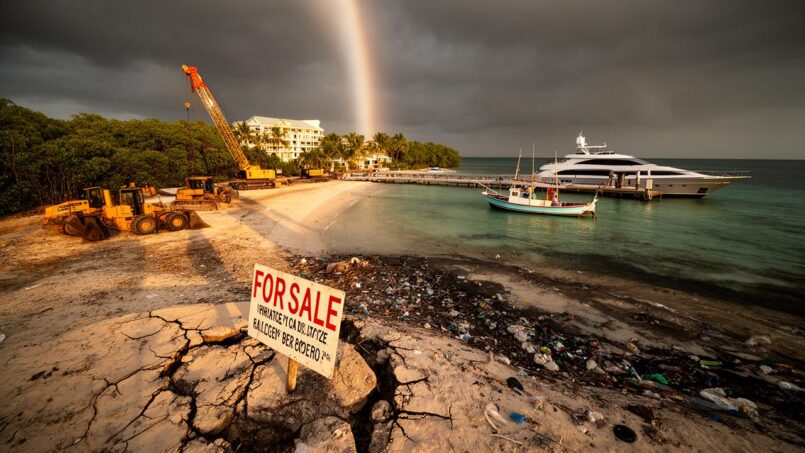
Belize spontaneously evokes postcard beaches, the barrier reef, tropical jungle, and the imagery of a small Caribbean paradise. But behind this image lies a much more fragile reality. High public debt, extreme exposure to natural disasters, dependence on tourism, persistent corruption, violent crime, brain drain, a pressured healthcare system: the very foundations of society are under multiple strains.
Belize combines economic, climate, institutional, and social risks that limit the absorption capacity of Belizean society as a whole, beyond just state or investment issues.
A Highly Indebted and Structurally Vulnerable State
One of the main systemic risks for Belize lies in its public debt and its structure. Public debt reaches 4.6 billion Belize dollars, and even though the debt-to-GDP ratio dropped sharply after the pandemic – from over 100% of GDP in 2020 to around 61% in 2024 – the trajectory remains under close scrutiny from international institutions.
The figures show that without a sustained effort of fiscal discipline, the debt sustainability remains precarious. To lower debt to 50% of GDP by 2030, IMF analyses indicate the country must maintain a primary fiscal surplus of at least 2% of GDP from 2026 onward, which implies both higher revenues and a reorientation of public spending.
Repeatedly Restructured Debt
Belize is now classified among “serial defaulters.” Over about fifteen years, the country has renegotiated its external commercial debt four times (2007, 2013, 2017, then 2021 with the “blue bond” mechanism). Between 2007 and 2017, three successive restructurings were deemed insufficient: overly optimistic macroeconomic assumptions, limited debt relief, exclusion of many public creditors (multilateral, bilateral, domestic) in favor of a burden concentrated on bondholders.
This pattern has several consequences for society:
– it weakens the country’s financial credibility, potentially making access to credit more expensive and limiting room to finance education, health, or infrastructure;
– it increases the risk of new episodes of fiscal strain as soon as a shock occurs (hurricane, pandemic, drop in tourism);
– it traps the country in a cycle where rising debt and then fiscal consolidation alternately weigh on growth and employment.
The IMF classified Belize’s debt as “unsustainable” at the time of the 2021 transaction, stressing that even after converting the former “Superbond” into a blue bond with marine conservation commitments, the debt remained excessive without further consolidation.
A Debt Structure That Increases Crisis Risks
The risk comes not only from the level of indebtedness but also from its composition. Since independence, the share of external debt has persistently exceeded safe thresholds. External financing needs have recurrently strained the central bank’s foreign exchange reserves, which fell to less than one month of goods imports in the mid-2000s.
For Belize, the risk of a refinancing crisis increases significantly when debt exceeds 60% of GDP, a threshold crossed for much of the last two decades with peaks above 100%. At these levels, debt presents high risks.
– increases the economy’s sensitivity to growth and interest rate shocks;
– slows public investment because a growing share of the budget is absorbed by debt service;
– reduces the state’s ability to finance climate adaptation, which is vital for the country.
When debt remains above 60% of GDP, real GDP growth tends to be lower in the long term.
Debt and Natural Disasters: A Vicious Circle
Belize is regularly hit by major hurricanes and floods. Massive reconstruction following hurricanes Keith (2000) and Iris (2001) required about $50 million over three fiscal years, widening deficits and fueling the debt accumulation that led to a restructuring in 2006.
The same pattern recurs: a major climate shock can immediately add up to 7 percentage points of GDP in additional debt, and a “1-in-100-year” hurricane scenario could produce economic losses of at least $565 million US, nearly a quarter of GDP.
Thus we reach a very concrete limit: the higher the debt, the less the state can invest in prevention (dykes, building codes, warning systems), which increases the scale of damage during the next hurricane and… further increases the debt. This vicious circle weighs heavily on society’s resilience.
Exceptional Climate and Environmental Vulnerability
Belize is one of the most exposed countries in the world to climate and natural disaster risks. Its territory, largely low-lying and coastal, combines multiple threats: hurricanes, sea-level rise, erosion, floods, droughts, heatwaves, degradation of the barrier reef and mangroves.
Frequent, Increasingly Intense Hurricanes
Since 1995, the country has suffered the devastating effects of nine tropical storms and eight hurricanes. On average, a major event strikes the country every three years. Over the long term, more than 50 storms have been recorded since the 19th century, including at least 16 hurricanes that directly hit or brushed the territory.
Several notable episodes illustrate the scale of human and economic risk:
| Event | Year | Max wind (mph) | Victims / human impacts | Estimated cost |
|---|---|---|---|---|
| Storm 5 | 1931 | 125 | ~ 2,500 deaths | – |
| Hurricane Hattie | 1961 | up to 200 | 400 deaths, thousands homeless, capital relocated | ~ $413 M US (in 2007 dollars) |
| Hurricane Keith | 2000 | – | – | damage ≈ 45% of GDP |
| Hurricane Iris | 2001 | – | thousands homeless, agriculture and aquaculture devastated | damage ≈ 25% of GDP |
| Hurricane Dean | 2007 | – | – | indirect losses ≈ $42 M US |
| Hurricane Earl | 2016 | – | – | cost ≈ 11% of GDP |
| Hurricane Lisa | 2022 | 85 | 14,789 people affected, no deaths, 4,483 households affected | ≈ $193.9 M BZD (damage + losses) |
Beyond dramatic shocks, the average annual value of hurricane-related losses is estimated at about $7.7 million US (0.45% of GDP). Average annual losses from all hazards (hurricanes, floods, etc.) are around $27 million.
Climate projections show that major hurricanes will become more frequent and intense in the Caribbean. Additionally, these storms will develop more quickly, reducing available time for preparation or evacuation.
Sea-Level Rise, Flooding, and Loss of Territory
Sea-level rise is another existential risk. In a high-emissions scenario, sea level could rise by over one meter by 2100, with a median rise of about 0.47 m between 2040 and 2065. A rise of barely 0.5 m would already submerge approximately 600 km² of coastal land.
Data show that: the trends are stabilizing, growth is sustained and forecasts indicate continued improvement.
– nearly 60% of the population lives near the coast;
– more than a third of the population lives in low-altitude zones;
– more than half of the population is in the broader coastal zone.
One assessment ranks the proportion of people living less than 5 m above sea level among the top risks, with a very high score (8.73 out of 10). Concretely, this means a significant portion of the population is potentially threatened in the medium term by erosion, marine flooding, saltwater intrusion, and chronic inundation.
Belize City illustrates this extreme vulnerability: a low-lying coastal city built on a delta at the mouth of the Belize River, it is exposed to storm surges, heavy rains, and river flooding. Its levees, about one meter high, would be overtopped by a category 5 storm surge estimated at nearly 6 meters.
Accelerated Ecosystem Degradation: Barrier Reef, Mangroves, Forests
The coastal ecosystems that protect and sustain Belizean society are in sharp decline.
Over twenty years, about 80% of living coral cover has been lost on some segments of the barrier reef, the second longest in the world.
Yet these ecosystems perform vital functions: coastal protection, fishing nurseries, tourist attraction, carbon storage. Their degradation therefore combines physical risks (less storm protection), economic risks (lower income from fishing, tourism, and even agriculture), and social risks (loss of livelihoods for coastal communities).
Expected Economic Impacts of Climate Change
Sectoral studies provide a measure of potential long-term losses:
| Sector | Projected losses / key impacts |
|---|---|
| Agriculture | Expected productivity decline of 10 to 20% by 2100; losses of $232 M US already observed between 2006 and 2016; increased risks of droughts, hurricanes, saltwater intrusion in sugar and banana areas |
| Fishing | Decline in sector value from $128 M BZD (2014) to $28.6 M BZD (2017); coastal stocks threatened by sea warming, acidification, and storms; 15% of the population involved in fishing |
| Electricity | Expected increase in demand due to heat; additional cost estimated at $58 M BZD by 2080 for the electricity sector alone; vulnerability of hydropower which provides about half of electricity |
| Tourism | Economic impact of climate change estimated at about $48.3 M BZD for the sector; potential losses around $24 M US per year for ecotourism (erosion, coral bleaching, sargassum, extreme heat) |
Belize has already lost an average of 4% of its GDP per year due to short- and long-term climate disasters. A UNDP report even mentions, based on an international model, a scenario where the country could lose up to 75–100% of its GDP by 2100 compared to a world without climate change, which would effectively place Belizean society before an existential challenge.
Dependence on Tourism: Engine of Growth, Source of Fragility
Belize’s economy has transformed: from an agricultural base, it has become primarily a service economy, with services representing more than 60% of GDP. At the heart of these services, tourism plays a central role, but this specialization creates serious limitations and fragilities for society.
An Over-Concentrated Economic Pillar
Figures vary by source and year, but converge on one point: tourism weighs very heavily.
– Tourism accounts for about 13% of direct GDP, and much more if indirect and induced effects are included (some estimates go up to 18–25% of GDP).
– It contributes about 40% of exports of goods and services, and nearly 60% of foreign exchange earnings in some years.
– Before the pandemic, it supported about 25,000 jobs across more than 2,200 registered enterprises and generated over one billion Belize dollars in visitor spending, more than double merchandise exports.
In other words, a significant portion of income that finances households, businesses, and the state depends on the country’s ability to attract foreign visitors.
Massive Exposure to the US Economy
The profile of tourist demand illustrates extreme dependence on the United States: approximately 65–70% of overnight tourist arrivals come from that country. These flows mostly transit through a few air hubs (Miami, Dallas, Houston, Atlanta), increasing vulnerability to the slightest traffic disruption or US economic shock.
Budget crises in Washington, such as a federal shutdown, lead to airport delays due to security staff shortages, economic uncertainty reducing household confidence, and trip postponements or cancellations. After a post-pandemic rebound with over 560,000 arrivals in 2024, the first months of 2025 show a 7 to 8% year-on-year decline.
For an economy where tourist spending fuels consumption, employment, real estate, tax revenue, and foreign exchange reserves, these variations quickly translate into:
Negative effects include loss of seasonal and permanent jobs, decline in household income in tourist areas, fiscal strain from reduced tourism-related taxes, and a slowdown in private investment in the hotel, restaurant, and recreation sectors.
Cruise Tourism vs. Stayover Tourism
Another angle of fragility lies in the structure of tourism supply. Cruises represent a majority of arrivals (about 60% in some years), but generate much less revenue per visitor than stayover tourism.
| Visitor type | Approximate share of arrivals | Average spend | Economic effect |
|---|---|---|---|
| Stayover tourist (overnight) | ≈ 40% of arrivals | Significantly higher | Spending on accommodation, food, excursions, shopping; strong local impact |
| Cruise passenger | ≈ 60% of arrivals in some years | ≈ $90 US per visit expected in optimized scenarios | Brief stop, fewer overnight stays, partial value capture by cruise lines |
Expansion strategies for cruise ports around Belize City thus spark debate over the cost-benefit for society: pressure on infrastructure, environmental risks (dredging, maritime traffic), saturation of already fragile sites (reefs, beaches), for economic returns often lower than those from stayover tourism.
Stress on Infrastructure and Land
The growth of tourism and associated real estate creates concrete pressures:
Infrastructure is marked by degraded roads, a poorly rated international airport and limited night-flight capacity, with deficient internal connections to the south and west. Urban services suffer from gaps in waste management, water supply, sanitation, and electricity, especially in Ambergris Caye and Placencia. Furthermore, 75 to 80% of coastal land has been purchased by foreign investors for residences, condos, or resorts, to the detriment of mangroves and coastal forests.
For Belizean society, this translates into more difficult access to the coast for locals, rising rents, and a form of dualization between upscale tourist areas and precarious neighborhoods in the background, sometimes built on filled mangroves without planning or adequate protections.
Limited Capacity to Diversify
The economy remains poorly diversified: agriculture, seafood, and tourism constitute the pillars. Industry is modest (about 14% of GDP), concentrated around agro-processing and construction. The country’s scale (about 430,000 inhabitants), size of the domestic market, dependence on external capital, and weak industrial fabric limit the ability to rapidly develop new sectors.
This specialization restricts the range of options for young people and fuels migration dynamics (see further). It also reinforces a structural characteristic: society depends, to a large extent, on the health of a sector that is inherently volatile and exposed to external shocks, including climate.
Crime, Violence, and a Fragile Social Contract
Beyond the economy and climate, Belize faces a level of crime and violence that heavily weighs on social cohesion, trust in institutions, and the country’s attractiveness.
Homicides, Gangs, and Drug Trafficking
Figures from the last two decades are high: the homicide rate has risen to over 40 per 100,000 inhabitants, placing the country among the most violent in the world. Belize City, and especially its southern part (Southside), concentrates much of this violence, with a rate that has exceeded 100 homicides per 100,000 inhabitants.
Street gangs, often inspired by North American models (Bloods, Crips), control part of the micro-drug trade (marijuana, crack, cocaine) and are in regular conflict, sometimes armed with assault rifles or even grenades. It is estimated that 900 to 1,400 gang members operate in the country, mainly in the economic capital.
Nearly 30% of homicides involve young people, according to the content provided.
Impunity and Distrust of the Police and Justice System
The problem is not only the frequency of crime, but also its low clearance rate. Over nearly a decade, only about 10% of homicide cases resulted in a conviction. Investigative capacities, slow procedures, and a lack of resources for the police and judiciary fuel a sense of impunity.
Surveys indicate limited trust:
– trust in the judiciary around 43%;
– trust in the police around 38%, one of the lowest levels in Central America.
Testimonies and reports mention cases of collusion between police, military, and traffickers, as well as corrupt practices at border posts. This further undermines trust in the state and feeds a perception that violence and crime are rarely punished fairly.
For residents, this has several consequences:
The constant feeling of insecurity limits public space for young people, pushing them toward informal or criminal activities, and discourages local investment such as shops and small businesses in high-risk areas.
Widespread Victimization, Domestic Violence, and Trafficking
Violence is not limited to homicides. Surveys show that the vast majority of young people (nearly 99%) have been exposed to violence in some form. Rates of sexual assault and rape are among the highest in the region. The prison system is overcrowded, with a very high incarceration rate and nearly 40% of inmates awaiting trial.
At the same time, Belize has become a country of origin, transit, and destination for human trafficking, especially women and minors, exploited in prostitution or forced labor. The combination of porous borders, regional migration flows, and limited institutional capacity makes fighting these phenomena particularly difficult.
For society, the limit is clear: when violence and crime structure daily life in certain neighborhoods, social capital erodes, civic participation declines, school loses its appeal, and the idea of emigrating becomes a rational strategy for many families.
Corruption, Weak Institutions, and Eroded Trust
The risks and limitations of Belizean society also stem from the weaknesses of its institutions and persistent corruption which, even if reform efforts exist, continues to undermine public trust.
Perception of Corruption and Incomplete Legal Framework
After several years of absence, Belize reappeared in Transparency International’s Corruption Perceptions Index with a score of 36/100, below the global average (42). The country remains far from its historical best score (45) and has declined since 2022 (43).
On paper, Belize has ratified the United Nations Convention against Corruption (UNCAC) and has several mechanisms: Integrity Commission, Access to Information Act, asset declaration requirements, etc. But in practice, many questions remain unanswered:
– who actually verifies the asset declarations of public officials?
– how many cases have resulted in prosecutions?
– what sanctions are effectively applied for non-compliance?
Draft laws and consultations exist, but no comprehensive regime for disclosure, auditing, and sanctions of campaign financing is yet operational.
Limited Access to Information and Delayed Budget Oversight
The functioning of oversight mechanisms illustrates these limits. A recent case of a request under the Freedom of Information Act for information on lawyer fees paid by the state was refused by the relevant ministry, partially intervened by the Ombudsman, and is now under court appeal. Such resistance significantly slows transparency.
Parliamentary oversight suffers from massive delays: for example, the Public Accounts Committee reviewed an Auditor General’s report on fiscal year 2015–2016 nearly ten years later. In other words, potential irregularities are examined only after their effects have largely dissipated into the economic and social fabric, without quick correction.
Corruption, Rule of Law, and Social Factors
Often inadequate public salaries, an economy still largely cash-based, the presence of high-risk sectors (offshore, casinos, free zones), and weak resources for the judiciary and police create fertile ground for favoritism, nepotism, and bribery in daily transactions (permits, licenses, public contracts, immigration).
For society, the effect is twofold:
– materially: public resources are poorly allocated, access to services may depend on knowing someone or paying, fair competition is distorted;
– symbolically: trust in the state and democracy erodes, the idea of equality before the law is challenged, fueling cynicism and civic disengagement.
A society where corruption is perceived as endemic struggles to mobilize its citizens for long-term efforts, whether for climate adaptation, educational reforms, or fiscal consolidation.
Health, Education, Migration: Human Capacities Under Strain
A society’s ability to face its risks is also measured through its education, health, and social protection systems. Yet data show these pillars remain fragile in Belize.
An Undersized Healthcare System for Major Shocks
The public healthcare system, supported by a few private hospitals and clinics, suffers from underfunding, staff shortages, and incomplete technical platforms. There are barely eight major public hospitals, about sixty clinics, and around 700 beds for the entire country. Most specialized equipment is concentrated in Belize City.
Despite progress (establishment of a national health insurance in some areas, development of a health information system), several structural limits persist:
Haiti suffers from a medical and nursing density below standards, with professionals concentrated in cities and nearly absent from rural areas. The country relies on personnel trained abroad, lacking a local medical school. Emergency and intensive care services are limited, without a world-class trauma center, which is critical in the face of hurricanes and criminal violence. Finally, high costs in the private sector and medical evacuations weigh heavily on households.
International assessments note that while the country meets most expectations for child health, it falls in a “very poor” zone for reproductive health, and access to quality care remains highly unequal depending on place of residence, income, and migration status.
A major hurricane, epidemic, or large-scale environmental disaster could therefore quickly overwhelm health capacities, with significant social and political consequences.
Education Under Pressure and Escaping Human Capital
Belize has made a significant budgetary effort in education, with the Ministry of Education being the best-funded in the country. Yet several warning signs appear:
More than 60% of young people aged 14 to 17 are said to be out of the school system in some areas.
These gaps spill over into the labor market: the country suffers from a skills deficit, particularly in strategic sectors like quality tourism, health, or engineering. Businesses report difficulty finding skilled workers, which hampers development.
At the same time, Belize faces a brain drain: more than 60% of highly skilled people born in the country lived abroad in 2010, and the trend has been markedly upward in recent decades. Belizean migrants, often young and educated, primarily settle in the United States.
This emigration can have positive effects (remittances, diaspora networks, skills transfers for returnees), but it also reduces the talent base available to run public services, businesses, and climate adaptation initiatives.
Poverty, Inequality, and Limited Social Safety Nets
Poverty remains high, even if the last years of strong growth temporarily reduced it. One report noted nearly half of children living in multidimensional poverty. Income distribution is unequal (Gini coefficient around 0.42), and pockets of extreme poverty are particularly concentrated in some rural areas and among ethnic minorities.
This situation translates into:
– heavy dependence on informal activities (40–47% of the economy), which largely evade taxes and reduce revenue needed to finance adaptation;
– increased exposure of vulnerable households to climate shocks (precarious housing in flood zones, lack of savings, limited access to insurance or credit);
– heavy reliance on migrant remittances as a survival strategy, which reinforces dependence on emigration.
In the face of a hurricane, prolonged drought, or economic crisis, these households have extremely limited room to maneuver. Disasters can therefore have lasting social impacts: falling into chronic poverty, interrupted schooling, deteriorating health, rising economic or organized crime.
A Society on the Frontline of Global Climate Disruption
One of the most striking aspects of Belize’s situation is the gap between its negligible contribution to climate change (less than 0.01% of global emissions) and the severity of the impacts it faces. The country has committed to reducing its emissions, strengthening coastal resilience, developing renewable energy, and preparing climate finance plans. It has also innovated with mechanisms like the debt-for-nature swap focused on marine conservation.
But despite these initiatives, room for maneuver remains narrow: the necessary adaptation is costly (over $600 million in identified public investments for climate and development in the medium term, with an estimated funding gap of at least $146 million for adaptation alone), while the weight of debt and the small size of the economy limit the ability to mobilize domestic resources.
Belizean society thus finds itself at the intersection of several sustainability frontiers:
– ecological sustainability: rapid degradation of ecosystems that provide coastal protection and underpin the tourism and fisheries economy;
– financial sustainability: high debt, recurrent fiscal pressures after each disaster, dependence on restructurings and external aid;
– social sustainability: persistent poverty, inequality, high crime, weak institutions, limited trust in the state;
– demographic and human sustainability: youth exposed to violence, brain drain, constrained education and health systems.
In this context, every shock – whether climatic, economic, or political – tests the limits of society’s resilience. The question is not whether Belize is a “tax haven” or a “natural paradise,” but to what extent this small state can absorb repeated crises without irreversibly eroding the living conditions of its population.
Belize
For now, data show a real capacity to bounce back: strong post-pandemic growth driven by tourism, recent improvement in the primary fiscal balance, rapid reduction in the debt-to-GDP ratio, financial innovations like the blue bond, and gradual strengthening of disaster risk management frameworks. But they also highlight that this rebound rests on still fragile foundations.
The risks and limitations of society in Belize are not due to a lack of will or awareness, but to a combination of extreme exposures and constrained capacities. It is this asymmetry that makes Belize one of the most emblematic laboratories of the challenges facing small coastal societies in the face of the twin shocks of financial globalization and climate disruption.
A wealth project or a question? Contact us now to speak with an expert in wealth management.
Disclaimer: The information provided on this website is for informational purposes only and does not constitute financial, legal, or professional advice. We encourage you to consult qualified experts before making any investment, real estate, or expatriation decisions. Although we strive to maintain up-to-date and accurate information, we do not guarantee the completeness, accuracy, or timeliness of the proposed content. As investment and expatriation involve risks, we disclaim any liability for potential losses or damages arising from the use of this site. Your use of this site confirms your acceptance of these terms and your understanding of the associated risks.

Cyril Jarnias is an independent expert in international wealth management with over 20 years of experience. As an expatriate himself, he is dedicated to helping individuals and business leaders build, protect, and pass on their wealth with complete peace of mind.
On his website, cyriljarnias.com, he shares his expertise on international real estate, offshore company formation, and expatriation.
Thanks to his expertise, he offers sound advice to optimize his clients' wealth management. Cyril Jarnias is also recognized for his appearances in many prestigious media outlets such as BFM Business, les Français de l’étranger, Le Figaro, Les Echos, and Mieux vivre votre argent, where he shares his knowledge and know-how in wealth management.





