
 Published on and written by Cyril Jarnias
Baku has been attracting foreign investors for several years looking for solid returns with still reasonable entry costs. But behind attractive average prices, the Azerbaijani capital is not a homogeneous market. In 2026, “Real Estate in Baku: The Best Neighborhoods to Invest in 2026” is actually played out in a mosaic of micro-zones highly differentiated by prices, rents, buyer profiles, and above all future momentum.
To avoid choosing the wrong segment in Baku, you need to go beyond the “center” or “outskirts” label: the city operates as at least four overlapping markets, organized according to three key criteria — district, period of building construction, and target buyer type.
A market at the peak of its cycle, but still attractive
In 2025, apartment prices in Baku climbed by about 9.4%, after several already strongly bullish years. As a result, most analysts now describe a city “overheating,” where prices have risen faster than incomes (13.8% versus 6.1% at the start of 2025). Yet rating agencies such as S&P Global Ratings do not predict a crash. The dominant scenario for 2026 is stabilization: slower growth, on the order of 5 to 6% per year, with a market that remains at the top of its cycle, but without further runaway growth.
For an investor, this situation means abandoning the search for “speculative plays,” which has become riskier. It is preferable to prioritize purchases focused on rental income and inflation protection. Moreover, despite past increases, average prices remain competitive compared with many European capitals, which makes these investments relevant.
The order of magnitude is as follows: the average apartment price in Baku is around 2,400 manats per square meter, or about $1,450 (dollar estimates sometimes give $2,500, depending on the source and segment considered). But this average masks a much more contrasting reality, with a ratio ranging from one to four, or even one to five, between the cheapest outskirts and certain waterfront streets.
Still-solid gross yields
The overall yield figures set the tone: gross rental yields in Baku average between 5 and 8% per year, with higher peaks on the outskirts. The aggregate data indicate:
| Segment | Average price (USD/m²) | Average gross yield |
|---|---|---|
| Baku center | ~3,500 | ≈ 5.5% |
| “Midtown” neighborhoods | ~2,750 | ≈ 6.5% |
| Baku suburbs | ~1,750 | ≈ 7.8% |
At the city level, the payback period is between 12 and 18 years, which remains competitive for a major capital. This general framework is the backdrop against which the neighborhoods to prioritize stand out.
To understand where to invest in Baku, it is useful to start with segmentation by price level, as it emerges from local portals such as Bina.az or Emlak.az. Schematically, five categories can be distinguished.
The top of the pyramid is concentrated in a few very limited areas: the Səbail district around the seaside boulevard and İçəri Şəhər, the surroundings of the 28 May station in Nəsimi, and the vast Ağ Şəhər project, the modern “White City” on the waterfront.
In this premium core, prices range between 4,000 and 9,500 manats per square meter. Some addresses break records. On Neftçilər Avenue, one of the most expensive stretches of Sabail, the square meter exceeds 9,640 manats on average, and in some elite buildings, listings reach more than 17,500 manats. In other words, the most exclusive properties approach $10,000 per square meter.
A table helps locate the main ultra-premium spots:
| Street / area | District | Average price (₼/m²) | Comment |
|---|---|---|---|
| Neftçilər Prospekti | Sabail | ≈ 9,640 (observed average) | Showcase of the waterfront, view of Baku Bay |
| Uzeyir Hacıbəyli | Expanded center | > 14,000 | Highly valued address, shortage of supply |
| Ağ Şəhər (White City) | Khatai / premium segment | > 8,000 (on high-end projects) | Redeveloped waterfront, planned urban development |
This segment mainly attracts wealthy local buyers and an international clientele seeking prestige, more than yield-focused investors. Luxury here is treated as a separate asset class: turnkey finishes, imported materials, higher ceiling heights, integrated smart-home systems, hotel-style services, concierge, secure underground parking, “hotel-style” management. All this is expensive to buy, but can sometimes be resold with more limited liquidity than in the mid-market.
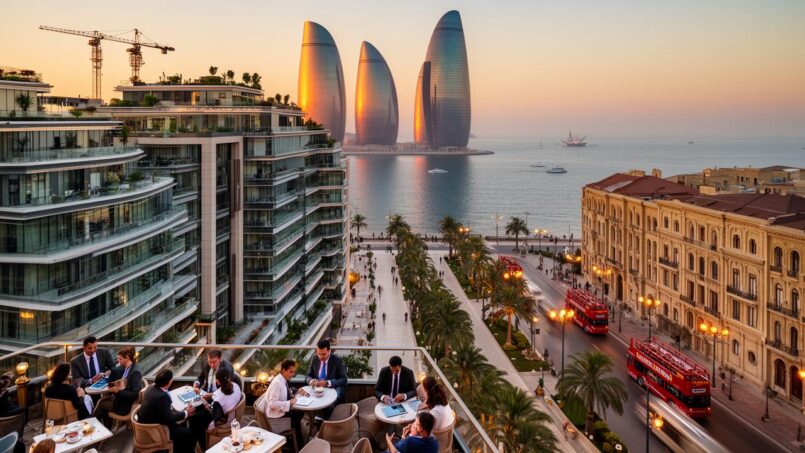
For a rental investor, central luxury is not the most efficient entry point: yields as a percentage of capital invested are lower there, and resale times potentially longer. On the other hand, for those aiming at long-term wealth preservation and appreciation of a prestigious address, Sabail, Baku Bay, and the iconic towers around the Flame Towers remain unmissable.
2. The “upper mid”: central Yasamal, Narimanov, Nizami
Just below the premium core is a set of neighborhoods considered “upper-middle”: Yasamal around Bəsti Bağırova Street, the Nərimanov district, and new developments in Nizami.
In these areas, prices range between 2,500 and 4,100 manats per square meter. They offer an interesting compromise between quality of life, relative proximity to the center, and more accessible entry prices than on the waterfront.
A few reference points:
| District / micro-zone | Price range (₼/m²) | Profile |
|---|---|---|
| Yasamal – Bəsti Bağırova area | ≈ 2,200–3,985 | Good-standing residential neighborhood, mix of old/new |
| Narimanov – new buildings | ≈ 2,500–3,980 | Close to airport routes, professionals and families |
| Nizami – recent construction | ≈ 2,780–3,025 | Residential/commercial mix, good accessibility |
This segment has a key characteristic for investors: it is where many “conditional buy” opportunities identified in analyses are located. Mid-tier apartments bought in cash, under $300,000, in areas such as Khatai or Narimanov, can offer gross yields of 6.5 to 7%, while remaining eligible for the investment thresholds for a residence permit (starting at around $59,000).
Another advantage of these districts: they benefit directly from major infrastructure projects, especially the metro extension planned for 2028, which further strengthens the connectivity of areas that are already relatively well served.
3. The urban “mass market”: Khatai, Binagadi, outskirts of Nasimi and Yasamal
The vast majority of apartment transactions are concentrated in this intermediate tier: the fringes of Nəsimi and Yasamal, but also Xətai and Binəqədi. Here, prices range between 1,700 and 2,600 manats per square meter. It is in this band that you begin to find stronger yields, without completely sacrificing liquidity.
These areas fuel middle-class first-time buyer activity, thanks to a varied housing stock: renovated Soviet towers, 1990s–2000s buildings, and recent complexes delivered partly as “shell & core” (raw floor plates to be fitted out).
For investors, two subcases deserve particular attention:
– Khatai, particularly around White City, straddling mid-market and premium, where yields are around 6.5–8% depending on the property type.
– Ahmadli, a Khatai area about 8 kilometers east of the center, very well connected by metro and major roads, which remains below Baku’s average price, with steady rental demand from families and workers.
Ahmadli illustrates the logic of this segment well: a neighborhood without sea views or glamorous nightlife, but practical and affordable, with a good size-to-price ratio and direct transit access, which suits both owner-occupiers and investors seeking cash flow.
4. The “garden” suburbs: Sabunchu, Mardakan, Buzovna, Zabrat, Bakıxanov
As you move away from the urban core, you shift into the “suburban” segment. Apartment prices there generally range between 1,100 and 1,800 manats per square meter. In these localities – Sabunçu, Mərdəkan, Buzovna, Zabrat, Bakıxanov – apartment buildings sit alongside many garden houses, plots, and seasonal or permanent villas.
The maximum gross yield observed on 100–150 m² apartments in the suburbs, with prices per square meter of $1,300 to $1,500 for budgets under $500,000.
Foreign investors seeking a residence permit linked to a real estate purchase – accessible from around $59,000 in property value – are increasingly turning to these outskirts, where the entry cost remains reasonable and where tourism growth and developing infrastructure support rental demand.
5. Outer Absheron: Hövsan, Pirallahi, Binə, Lökbatan
Finally, at the edges of the peninsula, there is the segment known as “Outer Absheron”, with prices between 700 and 1,400 manats per square meter for apartments, and sometimes between 500 and 1,000 manats for just the built structure of detached houses.
These are more speculative sectors, often with still-incomplete infrastructure, but they can offer, over the long term, significant value gains when structuring projects are put in place. Hövsan (Govsan) is cited by experts as one of the hotspots to watch: the construction of large complexes by the public agency MİDA, the expected population increase, and the potential to become a “quasi-city” independent in the medium term create a cocktail conducive to appreciation.
Villas and houses: a different price geography
It would be misleading to overlay the apartment map onto the house map. Data show that premium villa zones do not always coincide with the most expensive areas for multifamily buildings.
For houses, the following are notably distinguished:
| House type | Typical location | Building price (₼/m², excluding land) |
|---|---|---|
| Premium central villas | Sabail (boulevard, İçəri Şəhər), parts of Yasamal | 4,000–9,000 |
| Premium coastal houses | Sea Breeze, Bilgəh seafront, Mərdəkan areas | 2,500–5,500 |
| Standard urban houses | Xətai, Binəqədi, Suraxanı | 1,200–2,400 |
| Suburban garden houses | Inland Mərdəkan, Buzovna, Şüvəlan, Sabunçu | 700–1,500 |
| Outer Absheron houses | Hövsan, Pirallahı, Lökbatan, Qaraçuxur | 500–1,000 |
Caution is required: these ranges cover only the building cost, without including land value, which can represent a major share of the total price, especially in coastal areas or the most sought-after districts such as Khazar.
A dual challenge for investors: sustainable rental income and capital appreciation thanks to land scarcity.
Target affluent families or seasonal rentals along the coast, with strong markets such as Mardakan, Bilgah, and Sea Breeze.
Invest in well-located areas whose land availability is gradually shrinking, guaranteeing long-term appreciation potential.
Where to target for 2026: a read by investor type
Market data and forecasts for 2026 suggest distinguishing strategies according to budget and risk profile.
Budget up to $300,000: urban mid-market and profitable outskirts
For an investor with capital of around $150,000 to $300,000, studies mainly recommend mid-tier apartments in Khatai or Narimanov, as well as high-yield suburbs such as Binagadi, Sabunchu (including Sea Breeze), or certain areas of Yasamal.
Available indicators provide the following benchmarks:
| Location | Average price (USD/m²) | Estimated gross yield |
|---|---|---|
| Sabail / Yasamal (tier 1) | – (overall price around 3,000–4,000) | ≈ 5–6% |
| Narimanov / Khatai (tier 2) | ≈ 1,470–1,800 | ≈ 6–7% |
| Binagadi (tier 3) | ≈ 1,316 | ≈ 7.5% |
| Sabunchu – Sea Breeze | ≈ 1,400 | ≈ 8.5% |
Outskirts such as Ahmadli, east of the center, combine two advantages: prices still below Baku’s average and steady rental demand from families and workers who prioritize metro access and budget control. They are natural candidates for a no-frills “buy-to-let” strategy.
Budget up to $500,000: quality suburban and residential
Below the $500,000 threshold, analyses see an “ideal window” on large suburban apartments (100 to 150 m²) at $1,300–$1,500 per square meter. At these sizes, advertised gross yields range from 6 to 10%, with the possibility of using the property for mixed purposes: second home, eventual primary residence, or pure rental.
With a sufficient budget, you can buy several properties (e.g., two apartments on the outskirts) instead of a single high-end one in the center. This strategy spreads rental risk and targets varied audiences: local year-round families, expatriates, or short stays in tourist areas.
Premium and luxury segment: long-term capitalization more than cash flow
In ultra-central neighborhoods such as Sabail or the iconic addresses of Nasimi near Fountain Square and the boulevard, gross rental yields often fall into the low range (5–6%, or even 4–5% at the very high end). On the other hand, the historical price growth there is among the strongest, and the probability of seeing these areas lose their prestigious status is low.
For a first ticket, luxury is not necessarily the way to enter, because liquidity is thinner, the buyer pool narrower, and potential capital gains tax something to watch. On the other hand, for wealth portfolios seeking trophy assets, views over the bay, proximity to the boulevard, the towers near the Flame Towers, or complexes such as Port Baku remain safe bets.
Real estate experts
The special case of Sea Breeze and structured coastal projects
Among the areas drawing attention in 2026, Sea Breeze occupies a special place. Located on the Caspian coast, about twenty minutes from central Baku and 15–20 minutes from the airport, this vast seaside project has established itself as a full-fledged investment hub.
The figures highlighted speak for themselves: average prices of around $1,400 per square meter, theoretical yields approaching 8.5% on certain segments, all in an environment conceived as a “city within a city” with schools, a hospital, a marina, restaurants, fitness centers, casinos, and branded hotels.
Studios and 1+1 apartments near the beach are particularly well suited to short-term rentals, fueled by growing tourism and by affluent local clientele seeking weekend stays. At the other end of the spectrum, large residences with sea views fit more into a logic of prestige and long-term appreciation.
Sea Breeze illustrates a broader movement in Baku: the emergence of large waterfront complexes combining residences, hotels, offices, and retail (White City, Baku Marina, Crescent Bay…). These developments share several advantages: structured urban planning, strong international visibility, appreciation through direct proximity to the seaside boulevard, and often partnerships with hotel operators or international brands.
For investors, the key is to choose the right subsegment within these projects: a studio geared toward tourist rental does not have the same risk or management profile as a three-room apartment intended for a long-term expatriate tenant.
A two-speed dynamic: center vs. outskirts
2025 data and early 2026 confirm a “two-speed” market structure. On one hand, central and well-equipped districts – Sabail, Nasimi, Yasamal, Narimanov, Khatai – continue to show above-average price increases, especially on new projects and those in the foundation phase. On the other, more distant outskirts are seeing their pace of appreciation slow, with declining liquidity.
In the first quarter of 2026, the average increase in new apartment prices reached 3 to 5%, with peaks of 6 to 10% in premium central neighborhoods.
Forecasts for all of 2026 outline the following pattern:
| Segment | Projected annual increase 2026 |
|---|---|
| New apartments | ≈ 10–12% |
| Existing resale (older) | ≈ 5–7% |
| Projects in foundation phase | ≈ 13–18% |
| Land | ≈ 15% (after +20% in 2025) |
This hierarchy is not neutral for investors. It suggests that off-plan and under-construction purchases remain the most dynamic playground for rapid capital gains, provided the developer and location are well chosen. Studies show that between buying at the pit stage and delivery, an apartment’s value can increase by 30 to 50%. But this strategy requires great rigor in due diligence.
Rents: a tight market, especially in the center
On the rental side, data confirm upward pressure. Rents are rising faster than sale prices: nearly 8% annual increase observed at the end of 2025, versus 5–6% expected for transaction values in 2026. This gap mechanically supports gross yields.
A few figures give an idea of the entry cost:
Overview of average rents in manats by apartment type and location
Average rent of about 800 manats per month, with a range of 500 to 1,500 manats.
Average rent of around 450 manats per month for a one-bedroom apartment on the outskirts.
Average rent of about 1,640 manats per month, with a range of 1,000 to 3,000 manats.
Average rent of around 770 manats per month for a three-bedroom apartment outside the center.
In a district such as Nasimi, which alone accounts for about 35% of long-term rental demand in central Baku, rents range from 650 manats for a small Soviet apartment to several thousand manats for a penthouse at Port Baku Residence (up to 10,000 manats per month).
This rental tension is fueled by several drivers: continued urbanization, internal migration from the regions, an influx of expatriates and digital nomads, and tourism development that pushes some owners to switch to short-term rentals in the most touristy areas.
Risks not to underestimate
If Baku receives an overall rating of around B+ and an investment score around 68/100 (“Moderate Buy”), that does not mean the risk is negligible. Several points of caution recur regularly in analyses.
Two major risks stand out: first, the Azerbaijani economy’s heavy dependence on oil and gas revenues, where a shock to crude prices could affect household solvency, public budgets, and consequently real estate momentum. Second, the legal framework presents uncertainties, particularly regarding potential nationalization risks, as well as regulatory changes affecting foreign ownership and taxation.
The recurring recommendation is therefore to: regularly review your goals and priorities.
– Plan for an investment horizon of at least 5 to 7 years.
– Diversify, rather than concentrating all your funds in a single spectacular deal.
– Work with local professionals (lawyers, notaries, recognized agencies) to secure titles (the famous “çıxarış”), contracts, and tax compliance.
– Do not take advertised yields at face value without verifying on the ground the state of demand and rents actually signed.
Practical due diligence: essential reflexes
Experts in the Baku market insist on a few simple actions that avoid many unpleasant surprises.
First, never pay a deposit without making sure the property has an up-to-date title deed. If it does not, you must require a written commitment specifying the time and cost of regularization. Without “çıkarış,” resale or possible bank financing can become problematic.
Do not blindly trust the areas listed in real estate listings. Take a tape measure and measure the main rooms yourself to confirm that the stated number of square meters really corresponds to actual living space.
Another point: verify the exact distance to the metro or major roads on a map, rather than believing an appealing description like “5 minutes from the metro.” In Baku as elsewhere, a few hundred extra meters can translate into hundreds of manats less on the price per square meter.
Finally, it is strongly recommended to ask the agent for at least two or three recent comparable transactions in the building or street, with the actual sale prices (not the advertised listing prices), and to cross-check this data with an automated valuation tool. The gap between asking price and signed price can be significant, especially in overheated markets.
Infrastructure and master plan: areas to watch
Another guiding thread for identifying “the best neighborhoods to invest in 2026” is infrastructure evolution. Baku is engaged in a massive modernization program through 2040: demolition of some 16,000 dilapidated buildings, metro extension (a first phase is to be delivered in 2028), overhaul of water networks, development of tramways, and new green spaces.
Historically, major transport operations – new metro stations, improved roads – have systematically boosted real estate value in their area of influence. The extension of the green line, for example, will improve service to several areas undergoing redevelopment, with the expected effect of a gradual rise in residential demand.
In the short and medium term, several areas are identified as particularly promising.
– Hövsan, already mentioned, where the arrival of many public housing units and infrastructure improvements should push prices upward.
– The areas around the Ziya Bunyadov / Heydar Aliyev corridors, where the construction of large mixed-use complexes increases attractiveness.
– The coastal corridor, with projects such as Sea Breeze, Bibiheybat, Shikh, and the promenade extensions, which stretch the notion of “first line” beyond the historic center.
The lesson is clear: do not limit yourself to already-expensive districts, but observe the fringes that concretely benefit from improved connectivity or new urban amenities.
Conclusion: how to position yourself in Baku in 2026
In 2026, investing in real estate in Baku means entering a market at the top of its cycle, but still in a phase of moderate growth, with rental yields higher than those offered by many Western metropolises. The challenge is no longer to ride the catch-up wave of previous years, but to choose precisely your neighborhoods and segment.
For rental yield, target the urban mid-market (Khatai, Narimanov, Binagadi, Yasamal, Ahmadli) or structured suburbs (Sabunchu, Mardakan, Buzovna, Sea Breeze) with affordable prices and solid demand. For prestigious long-term wealth, favor Sabail, central Nasimi, White City, or high-end coastal complexes, but with more modest yields.
In all cases, the trade-off between a stabilized center and developing outskirts, between off-plan apartments and existing stock, between classic rental use and short-term tourist use, must be made in light of the numbers – price per square meter, actually observed rents, gross yields, growth forecasts – rather than simple impressions.
Baku is entering a more mature market phase, where analytical discipline and rigorous due diligence will make the difference between a solid deal and a risky bet. Those who can combine fine-grained reading of micro-markets, understanding of major urban projects, and demanding property selection still have, in 2026, strong cards to play in Baku real estate.
A wealth project or a question? Contact us now to speak with a wealth management expert.
Disclaimer: The information provided on this website is for informational purposes only and does not constitute financial, legal, or professional advice. We encourage you to consult qualified experts before making any investment, real estate, or expatriation decisions. Although we strive to maintain up-to-date and accurate information, we do not guarantee the completeness, accuracy, or timeliness of the proposed content. As investment and expatriation involve risks, we disclaim any liability for potential losses or damages arising from the use of this site. Your use of this site confirms your acceptance of these terms and your understanding of the associated risks.

Cyril Jarnias is an independent expert in international wealth management with over 20 years of experience. As an expatriate himself, he is dedicated to helping individuals and business leaders build, protect, and pass on their wealth with complete peace of mind.
On his website, cyriljarnias.com, he shares his expertise on international real estate, offshore company formation, and expatriation.
Thanks to his expertise, he offers sound advice to optimize his clients' wealth management. Cyril Jarnias is also recognized for his appearances in many prestigious media outlets such as BFM Business, les Français de l’étranger, Le Figaro, Les Echos, and Mieux vivre votre argent, where he shares his knowledge and know-how in wealth management.





