
 Published on and written by Cyril Jarnias
Two different tests decide whether a Swiss company you run from abroad still holds in 2027. Passing one does not pass the other.
Listen to this article
Contents
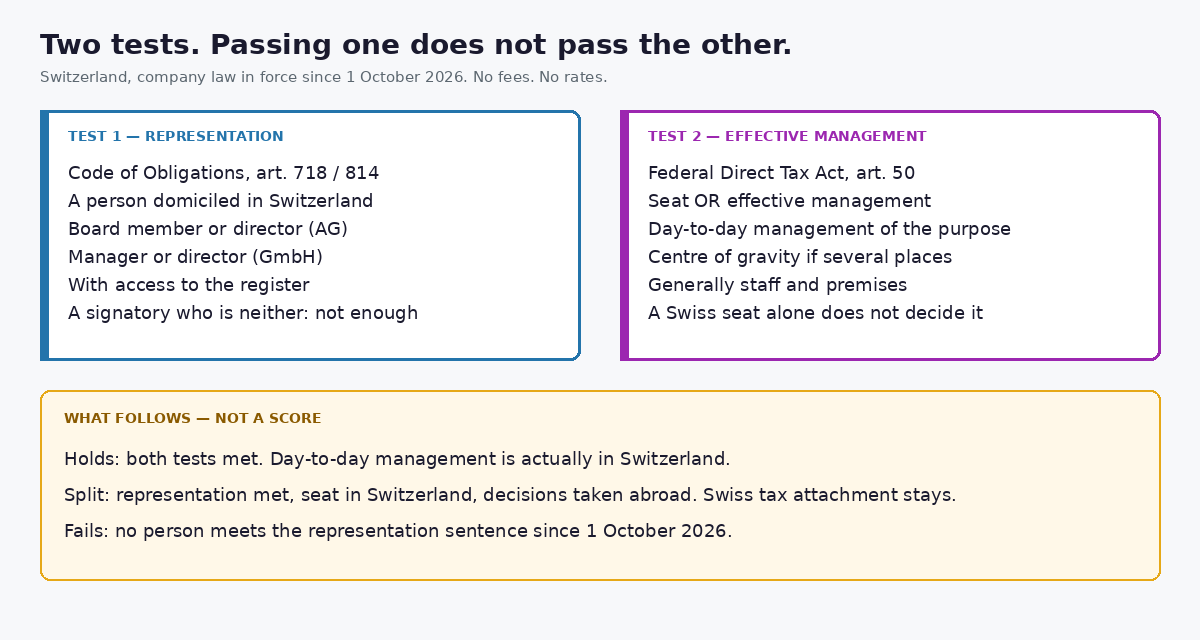
Company law, in force since 1 October 2026: the company must be representable by a person domiciled in Switzerland who is a board member or a director (AG) or a manager or a director (GmbH), and who has access to the share register or the quota register.
Swiss federal tax: the company is taxable in Switzerland if its seat or its effective management is in Switzerland. Effective management is where day-to-day management of the company’s purpose actually happens. A registered seat does not decide that.
This structure becomes relevant if day-to-day decisions will actually be taken in Switzerland. It becomes the wrong purchase if the only Swiss element is a name on a letterhead.
Elena is a non-resident founder. Her Swiss AG has a Swiss-domiciled person on the paperwork, but she takes every day-to-day decision from her home country. The structure holds on paper. Whether it holds in substance is a different question.
What Changed on 1 October 2026 — a Name with Signing Power Is Not the Test
The Federal Act of 26 September 2025 on transparency of legal entities revised the Swiss Code of Obligations (CO). The change is in force since 1 October 2026 (RO 2026 323).
For an AG, CO art. 718 para. 4 now reads:
“The company must be able to be represented by a person domiciled in Switzerland. That person must be a board member or a director. That person must have access to the share register.”
For a GmbH, CO art. 814 para. 3 now reads:
“The company must be able to be represented by a person domiciled in Switzerland. That person must be a manager or a director. That person must have access to the quota register.”
The sentence has three cumulative elements. The person must be domiciled in Switzerland, must hold one of the listed offices, and must have access to the register. A person who is neither a board member nor a director (AG), or neither a manager nor a director (GmbH), does not meet the current sentence. That reading follows directly from the text quoted above.
Before 1 October 2026, a different reading could be argued. That does not matter for a company set up or reviewed today: the current sentence listed above is the one that applies, and a signatory who is not a board member, director, or manager (depending on the form) does not meet it.
The rule is identical in substance for both forms. There is no AG vs GmbH choice here: both require a Swiss-domiciled representative who holds one of the listed offices and has register access.
A Swiss Seat Is Not Effective Management
The Federal Direct Tax Act (art. 50) uses two separate attachment grounds:
“Legal entities are liable to tax on the basis of personal attachment if their seat or their effective management is in Switzerland.”
The seat is the registered seat. Effective management is a different test. The Federal Council message (FF 2024 1607) describes the administrative practice:
“under the practice relating to art. 50 of the Federal Direct Tax Act, the place of effective management is where a Swiss or foreign company has its economic and effective centre, that is, where the management normally exercised at the seat is actually carried on; what matters is the day-to-day management within the company’s purpose; if there are several places, the centre of gravity of that management is decisive.”
This is administrative practice, not a statutory definition. The word “generally” matters in the second sentence of the practice:
“Companies whose effective management is in Switzerland have an activity in Switzerland that justifies taxation, which generally presupposes the employment of staff and premises.”
A registered seat in Switzerland does not, by itself, place effective management in Switzerland. And a Swiss-domiciled director does not, by that fact, place effective management in Switzerland either. The two tests are different. One is about representation under company law. The other is about where day-to-day management of the company’s purpose actually happens.
Three Outcomes in 2027: Holds / Split / Fails
The scenarios below depend on two variables: whether the CO representation sentence is met, and where day-to-day management of the company’s purpose actually happens. The hypotheses are stated in prose first.
Favorable hypothesis: the company has a Swiss-domiciled board member or director (AG) or manager or director (GmbH) with register access, and day-to-day management of the company’s purpose actually happens in Switzerland — the centre of gravity of management, generally with staff and premises. This option becomes relevant only if that is the real operating plan, not a package.
Median hypothesis: the CO sentence is met, the seat is in Switzerland so art. 50 still attaches, but day-to-day management happens abroad. This is not “illegal”. It is a split: Swiss tax attachment by seat is intact; effective management is not in Switzerland under the practice quoted above. What the other country claims is outside this page.
Unfavourable hypothesis: no person meets CO art. 718 para. 4 or art. 814 para. 3. The representation sentence is not met. No fine, deadline, or register sanction is added here — none of that is sourced.
| Favorable | Median | Unfavourable | |
|---|---|---|---|
| Representation (CO art. 718 or 814) | Met: Swiss-domiciled board member or director (AG), or manager or director (GmbH), with register access | Met on paper | Not met |
| Where day-to-day management of the company’s purpose happens | In Switzerland (centre of gravity; generally staff and premises) | Abroad | Abroad |
| Swiss tax attachment under art. 50 | By seat and by effective management | By seat (effective management not in Switzerland under the practice) | By seat (the seat is in Switzerland; art. 50 does not cease to apply) |
| What this page cannot tell you | The other country’s claim | The other country’s claim | The other country’s claim |
KEY FIGURE
Since 1 October 2026, the Swiss-domiciled person must be a board member or a director (AG) or a manager or a director (GmbH), with access to the register. A signatory who is neither does not meet the sentence.
What a Local Director Does Not Prove
A director domiciled in Switzerland satisfies the CO representation sentence — provided that person is a board member or director (AG), or manager or director (GmbH), and has register access. That is all the sentence requires.
It does not prove effective management. The art. 50 practice asks where day-to-day management of the company’s purpose actually happens. A Swiss-domiciled director who does not take those decisions does not move the centre of gravity to Switzerland.
ATTENTION
a director domiciled in Switzerland does not, by that fact, place effective management in Switzerland.
The two tests are independent. You can meet the CO sentence and still have effective management abroad. You can have effective management in Switzerland and fail the CO sentence if the Swiss-domiciled person does not hold one of the listed offices. Passing one test does not pass the other.
KEY FIGURE
both articles — CO art. 718 para. 4 for the AG and art. 814 para. 3 for the GmbH — set the same three cumulative conditions: Swiss domicile, one of the listed offices (board member or director for the AG; manager or director for the GmbH), and access to the relevant register.
The two tests side by side:
| Test | What satisfies it | What does not |
|---|---|---|
| Representation (CO art. 718 para. 4 / art. 814 para. 3, from 1 October 2026) | A person domiciled in Switzerland who is a board member or director (AG), or manager or director (GmbH), with access to the share or quota register | A signatory who is neither; a Swiss office address alone; a Swiss-domiciled person without register access |
| Effective management (art. 50 practice, FF 2024 1607) | Day-to-day management of the company’s purpose happens in Switzerland — the centre of gravity, generally with staff and premises | A Swiss seat on its own; a Swiss-domiciled director who takes no decisions; decisions taken from abroad |
When Managing from Abroad Becomes the Wrong Structure
Managing from abroad is not automatically a problem. The structure holds if the CO representation sentence is met and if the day-to-day management of the company’s purpose actually happens in Switzerland. It becomes the wrong purchase when the only Swiss element is a name on a letterhead.
Three situations make the structure fragile:
- The Swiss-domiciled person is a signatory only. A signatory who is neither a board member nor a director (AG), or neither a manager nor a director (GmbH), does not meet the CO sentence since 1 October 2026. The representation sentence is not met.
- The Swiss-domiciled person holds the right office but takes no decisions. The CO sentence is met. Effective management is not in Switzerland under the art. 50 practice. The result is the median scenario: Swiss tax attachment by seat is intact, effective management is abroad.
- Day-to-day management is abroad and the seat stays in Switzerland. Art. 50 attaches by seat or effective management. Moving the decisions abroad does not switch Swiss tax attachment off if the seat stays in Switzerland.
ATTENTION
holding a Swiss seat and a correctly formed board is not the same as operating the company in Switzerland. The tax question follows where the management of the company’s purpose is actually run, not where the signatory lives.
EXAMPLE
Elena runs her Swiss AG from her home country. A Swiss-domiciled board member with register access meets CO art. 718 para. 4. The seat is in Switzerland, so art. 50 still attaches. But day-to-day management of the company’s purpose happens abroad. The structure holds on paper; effective management is not in Switzerland under the practice quoted above.
EXAMPLE
Tomas runs a Swiss GmbH the other way. He is the Swiss-domiciled managing director with access to the quota register, works from an office in Switzerland, and takes the operating decisions from there. Both conditions are met: representation under CO art. 814 para. 3 and effective management in Switzerland under the art. 50 practice. This structure matches the favourable scenario — and it costs what a real Swiss presence costs, not a virtual-signature package.
GOOD TO KNOW
art. 50 is seat OR effective management. Moving the decisions abroad does not switch Swiss tax attachment off if the seat stays in Switzerland.
What this page cannot tell you is what your home country will do. No foreign statute, CFC rule, or treaty article is analysed here. The question of whether the structure holds for you depends on two Swiss tests — the CO representation sentence and the art. 50 attachment — and on the other country’s own claim, which is outside this page.
IN SUMMARY
- Since 1 October 2026, a Swiss-domiciled signatory who is not a board member, director, or manager (depending on the form) does not meet the CO representation sentence.
- A Swiss seat does not prove effective management. Effective management is where day-to-day management of the company’s purpose actually happens.
- Art. 50 attaches by seat or effective management. A seat in Switzerland keeps Swiss tax attachment intact even if decisions are taken abroad.
- The structure holds when the CO sentence is met and day-to-day management actually happens in Switzerland. If the only Swiss element is a name on a letterhead, the structure is the wrong purchase.
BEFORE YOU PAY
A Swiss director on paper is not a structure that holds.
An independent review checks the two tests against how you will actually run the company: who can represent it since 1 October 2026, and where the day-to-day decisions will be taken.
This page does not cover year-one cost, the remote incorporation procedure, the bank account, or the choice between AG and GmbH. Those sit on the parent guide, remote incorporation, the bank account, and legal forms.
FAQ
1.Can I manage a Swiss company from abroad in 2027?
Yes, but the structure must meet two separate tests. Under company law since 1 October 2026, the company must be representable by a person domiciled in Switzerland who is a board member or a director (AG) or a manager or a director (GmbH), with register access. Under tax law, art. 50 attaches by seat or effective management. Managing from abroad does not break the CO sentence if it is met; it does affect where effective management is.
2.Does a Swiss-domiciled director make effective management Swiss?
No. The CO representation sentence and the effective management test are different. A Swiss-domiciled director satisfies CO art. 718 para. 4 or art. 814 para. 3 if that person holds the listed office and has register access. Effective management under the art. 50 practice is where day-to-day management of the company’s purpose actually happens. A director who does not take those decisions does not move effective management to Switzerland.
3.Is a signatory enough after 1 October 2026?
No. The current CO sentence requires the Swiss-domiciled person to be a board member or a director (AG) or a manager or a director (GmbH), with access to the share register or quota register. A signatory who is neither does not meet the sentence. This is the direct reading of CO art. 718 para. 4 and art. 814 para. 3, as revised by the Federal Act of 26 September 2025, in force since 1 October 2026.
4.Does the company stop being taxed in Switzerland if I run it from home?
No. Art. 50 attaches by seat or effective management. If the seat is in Switzerland, Swiss tax attachment remains intact even if day-to-day management happens abroad. Effective management may not be in Switzerland under the art. 50 practice, but the seat alone keeps the company within Swiss tax attachment. The other country’s claim is a separate question outside this page.
5.Does forming the company make me a Swiss tax resident?
No. Forming a Swiss company does not, by itself, make you a Swiss tax resident. This page does not cover residence. For the interaction between a Swiss company and your personal situation, including residence permits and moving to Switzerland, see the parent guide on Swiss company formation.
Sources
- Swiss Code of Obligations (CO), art. 718 and art. 814
- Federal Direct Tax Act, art. 50 and art. 51
- Federal Council message, FF 2024 1607
Disclaimer: The information provided on this website is for informational purposes only and does not constitute financial, legal, or professional advice. We encourage you to consult qualified experts before making any investment, real estate, or expatriation decisions. Although we strive to maintain up-to-date and accurate information, we do not guarantee the completeness, accuracy, or timeliness of the proposed content. As investment and expatriation involve risks, we disclaim any liability for potential losses or damages arising from the use of this site. Your use of this site confirms your acceptance of these terms and your understanding of the associated risks.

Cyril Jarnias is an independent expert in international wealth management with over 20 years of experience. As an expatriate himself, he is dedicated to helping individuals and business leaders build, protect, and pass on their wealth with complete peace of mind.
On his website, cyriljarnias.com, he shares his expertise on international real estate, offshore company formation, and expatriation.
Thanks to his expertise, he offers sound advice to optimize his clients' wealth management. Cyril Jarnias is also recognized for his appearances in many prestigious media outlets such as BFM Business, les Français de l’étranger, Le Figaro, Les Echos, and Mieux vivre votre argent, where he shares his knowledge and know-how in wealth management.





