
 Published on and written by Cyril Jarnias
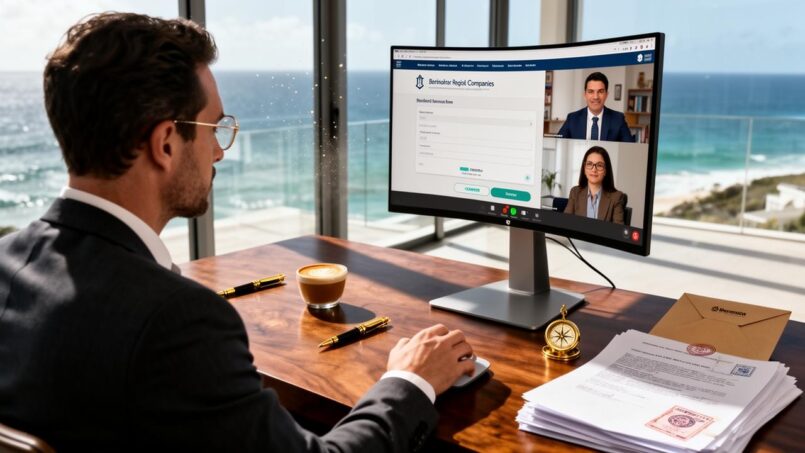
Setting up an offshore structure in Bermuda without ever setting foot on the archipelago is a fantasy for many entrepreneurs and international groups. With its high-end financial center image, very light taxation, and sophisticated regulatory framework, the destination attracts as much as it intimidates. The questions always come back: is it really possible to do everything remotely? What are the real constraints behind the marketing veneer? And, above all, when does Bermuda require real economic substance on the ground?
Good to know:
Incorporation can be fully managed remotely through a local provider. However, after formation, the company must comply with economic substance requirements, KYC/AML obligations, and have a local resident representative. The ultimate beneficial owner may never travel to the island, but a legal anchor in the jurisdiction remains mandatory.
How Is an Offshore Company in Bermuda Actually Created Remotely?
Incorporating a company in Bermuda is a highly structured process, fully governed by the Companies Act 1981, the Bermuda Monetary Authority (BMA), and the Registrar of Companies (ROC). The good news for foreign investors is that all these steps can be delegated to a law firm, an accounting firm, or a local corporate service provider (CSP), with no travel required.
The Central Role of the Local Provider and Resident Representative
A key point for anyone wanting to manage everything remotely: it is impossible to incorporate without the support of a provider based in Bermuda. The law requires that a company have:
– a registered office on the island, which serves as its official legal address for correspondence and the safekeeping of certain records;
– and, for exempted companies, at least one officer or resident representative: a director, a secretary, or a resident representative ordinarily resident in Bermuda.
This representative must meet strict criteria. They must:
– be resident in Bermuda or be a duly incorporated local entity;
– be authorized and, where applicable, licensed to carry out company management or corporate services activities;
– have a real physical address: a mere post office box or a “virtual office” without actual premises is not sufficient.
Tip:
In practice, this function is carried out by a law firm or a CSP, which typically combines the roles of registered office, resident representative, and sometimes company secretary. It is this same provider that handles all interactions with the BMA and the ROC remotely.
The Main Steps of Remote Incorporation
Even without traveling, the founder must go through a well-structured sequence of steps, orchestrated by their provider.
1. Pre-Incorporation and Choice of Structure
Before any formalities, the Bermuda firm discusses with the client their objectives (holding company, financing vehicle, fintech structure, insurance company, etc.), the target level of regulation, and any potential licensing needs. It is at this stage that the following is also considered:
– the possible need for a regulatory license (banking, insurance, investment business, digital asset business, etc.);
– the implications of the Economic Substance Act 2018 (whether the activity is “relevant” or not);
– and, for large groups, the impact of the Corporate Income Tax Act 2023 (CIT Act), which introduces a 15% tax for entities belonging to multinational groups with more than €750 million in revenue.
2. Company Name Reservation and Type
The company name must be available and comply with local rules (often with suffixes such as “Limited”, “Ltd.”, “Incorporated”, “Inc.”, “Corporation”, “Corp.”). The provider checks availability in the companies register and makes a reservation for a limited period (several sources mention reservations ranging from 10 days to 3 months depending on the procedure).
Attention:
The client must select the legal form of the company, particularly exempted company, LLC, partnership, or SAC for sophisticated structures. For the majority of international investors, the exempted company is the standard choice.
3. Bermuda Monetary Authority (BMA) Consent
For an exempted company, the BMA must give its green light under the Exchange Control Act. The authority reviews:
– the identity of the ultimate beneficial owners (any person generally holding over 25% control, or 10% in the context of CSPs);
– the control structure and source of funds;
– the profiles of directors and officers, who must be “fit and proper”.
The submitted file typically includes:
– application forms;
– Personal Declarations signed by significant shareholders;
– a business plan describing the intended activity;
– evidence of source of funds and, if necessary, financial statements.
This step is the bottleneck of the timeline. Depending on the complexity of the file and whether ministerial consent is required, the turnaround time ranges from a few days to one to two weeks.
4. Drafting and Filing of the Constitution
Good to know:
After the green light, the provider drafts the Memorandum of Association and the bye-laws. The Memorandum is filed with the ROC and becomes public, while the bye-laws remain private and detail shareholders’ rights, board powers, and meeting rules.
The filing is accompanied by:
– the appointment of the registered office;
– an initial list of directors and the secretary;
– the declaration of authorized capital (often around USD 12,000 of “assessable capital” to optimize fees).
In the absence of any special circumstances, the ROC can issue the Certificate of Incorporation within a few business days of receiving a complete file.
5. Delivery of the “Company Kit” to the Client
Everything is done remotely: documents are signed electronically where permitted, or sent by mail for handwritten signatures. The client then receives:
– the certificate of incorporation;
– copies of the Memorandum and bye-laws;
– the minutes of the first board meeting;
– share certificates;
– and, often, a tax assurance confirming the absence of certain taxes until a deadline (historically 2035 for many exempted companies).
At this point, the company legally exists, without its founder having left their country of residence.
Timelines and Costs: What Remote Incorporation Really Allows
The timelines quoted by providers vary depending on the client profile and whether a financial license is required, but the following ranges are commonly seen:
| Step | Typical timeframe (excluding complex cases) |
|---|---|
| Pre-analysis & KYC collection | 2 to 3 days |
| BMA consent | 1 to 2 weeks (sometimes less) |
| Filing and registration with the ROC | 1 to 5 business days |
| “Door-to-door” incorporation | 1 to 2 weeks |
On the budget side, the observed ranges are as follows (excluding highly regulated sectors):
| Cost items | Order of magnitude (USD) |
|---|---|
| Simple formation fees (excluding bank/license) | ~ 5,900 to 10,700 depending on package |
| Government – initial fees (basic exempted company) | ~ 1,995 to over 10,000 depending on authorized capital |
| Annual government fees (based on share capital) | ~ 1,995 to 31,120 |
| Registered office & resident representative service / year | Several thousand dollars depending on service level |
For an investor who is not seeking a banking license, an insurance license, or DABA authorization, a 100% remote incorporation over 2 to 4 weeks, with an overall budget in the low/mid five figures, is therefore realistic.
Remote Incorporation… Under Close KYC/AML Scrutiny
Saying that a company can be incorporated without traveling does not mean that anonymity or regulatory lightness prevail. Bermuda positions itself as a financial center that is both offshore and heavily regulated, with KYC/AML obligations inspired by FATF recommendations.
Identification Requirements for Natural Persons
Regulated financial institutions (RFIs) and CSPs are required to carefully verify the identity of each client, whether natural or legal persons. For an individual, the minimum information to collect and verify includes:
– full legal name, former names and aliases;
– primary residential address;
– date and place of birth;
– nationality;
– identification number or unique identifier from an official document (passport, ID card, driver’s license).
Verification can be done through physical documents, electronic data, or a combination of both. The idea is to use reliable, independent official documents, including a photo and at least one of the following: address, date of birth, place of birth, or nationality.
Remote KYC Solutions
Technology providers enable remote identity checks without the client’s physical presence, using real-time services.
Shufti Pro
Real-time KYC verification solution, offering remote checks through advanced technologies.
IDMERIT
Provider specializing in real-time KYC services, facilitating verifications without physical presence.
Ondato
Real-time KYC service, enabling remote identity checks through digital solutions.
Identomat
Provider of real-time KYC solutions, ensuring efficient and secure remote checks.
– identity document capture (photo, NFC);
– authenticity checks (holograms, MRZ, micro-printing, forgeries);
– liveness check via video selfie;
– proof of address verification (utility bill, bank statement, administrative document, dated within the last three months).
These solutions integrate into the onboarding flows of Bermudian banks and CSPs, which largely explains the possibility of fully remote incorporation and onboarding.
KYC/KYB for Entities: In-Depth Identification
When a client is a legal entity, due diligence becomes even more structured. RFIs and CSPs must identify and verify:
25
The ownership threshold above which a natural person is considered an ultimate beneficial owner in company law, often reduced to 10% for CSPs on a risk basis.
The minimum information required for a company includes:
– full corporate name, and trade names where applicable;
– date and place of incorporation;
– registered office address, and correspondence address if any;
– place of principal activity;
– official identification number, and competent regulator if any;
– nature of the business and purpose of the business relationship;
– ownership and control structure (including multi-tier shareholding chains).
To verify the existence and structure of a company, RFIs may:
– consult the companies register of the jurisdiction of incorporation;
– examine the certificate of incorporation, articles of association, and register of shareholders;
– verify a listing on a recognized stock exchange;
– use commercial information services or reputable law/accounting firms;
– visit the place of business or check the company’s website.
Good to know:
All KYC (individuals) and KYB (entities) checks are documented and archived. RFIs must retain CDD (Customer Due Diligence) records for several years, in accordance with BMA requirements.
Digital Tools and 100% Online Onboarding
For an entrepreneur looking to do everything remotely, this digital infrastructure is a major asset. KYC/AML platforms:
– enable remote capture of identity documents and proof of address;
– integrate AML screening modules (sanctions lists, PEPs, adverse media);
– enable electronic signature and secure storage of self-certification forms.
Some, like Ondato, go further by providing complete KYB modules: customized forms, automatic data retrieval from business registries, mapping of ultimate beneficial ownership, and screening of directors.
Concretely, to create a company in Bermuda remotely, the client must therefore accept providing a full set of personal and corporate documents, often certified (notarization, apostille, translations), and be subject to regular screenings. Physical distance does not reduce the intensity of the checks in any way.
The Economic Substance Requirement: The Real Obstacle to a “Purely Virtual” Company
Many entrepreneurs still confuse “offshore” with “mailbox company.” Yet, since the Economic Substance Act 2018 and its regulations, Bermuda, like other financial centers, imposes substance tests on entities carrying out certain activities known as “relevant activities”.
Which Activities Are Affected?
The framework applies to all types of Bermudian entities (companies, LLCs, partnerships, permit companies) that carry out at least one of the following nine activities:
– banking;
– insurance;
– fund management;
– financing and leasing;
– headquarters;
– shipping;
– distribution and logistics;
– holding activity (pure equity holding and others);
– intellectual property (IP).
For these “in scope” entities, simply managing the company from another country with a minimal registered office is no longer sufficient. They must demonstrate real economic presence in Bermuda.
The Five Economic Substance Criteria
For each relevant activity, the entity must simultaneously satisfy five requirements:
1. Be managed and directed from Bermuda
This implies that strategic, risk management, and key operational decisions must be made in Bermuda. Concretely, this takes the form of:
Example:
To demonstrate the economic substance of a Bermudian company, it is recommended to hold board meetings physically on the island, ensure a quorum of directors present in Bermuda during those meetings, and keep detailed minutes available locally.
Meetings by phone or video conference are permitted but are not sufficient, as it must be demonstrated that the governing bodies meet within the jurisdiction to steer the company.
2. Carry out the “core income generating activities” (CIGA) in Bermuda
Activities at the heart of income generation (underwriting risk for an insurance company, portfolio management for a fund, investment decisions for a financing company, for example) must be actually performed locally. Part of them may be outsourced to a provider, but only if that provider is itself established in Bermuda. Outsourcing CIGA abroad is prohibited for in-scope entities.
3. Maintain adequate physical presence
The company must have premises suited to the nature and scale of its activities: a dedicated office or a “substantial” coworking solution. A simple mail forwarding service, without functional workspaces, will not pass the test.
4. Employ a sufficient number of qualified employees on the island
Good to know:
The entity must have full-time employees or competent local providers to perform or supervise the CIGA. The number and qualifications are assessed on a case-by-case basis, depending on the size and complexity of the business.
5. Incur adequate operating expenses in Bermuda
Finally, the company must incur a level of local expenses consistent with its operations: rent, salaries, provider fees, operating costs. These expenses must be proportionate to the nature and size of the business.
All of these elements are reported annually in an Economic Substance Declaration (ESD) filed with the Registrar within six months of the end of the fiscal year.
Special Cases: Pure Holding and Local Entities
Certain company profiles benefit from reduced regimes:
– Pure equity holding entities (holding companies with no other activity) are subject to minimal requirements: they must essentially comply with the governance obligations of the Companies Acts (maintaining records, fulfilling legal formalities) and maintain a reasonable level of presence (people and premises) appropriate to the simple holding of shares.
Good to know:
Local entities majority-owned by Bermudians, operating solely in Bermuda and outside an international group, are in principle in scope but exempt from proving substance under certain conditions. They nevertheless remain subject to reporting obligations.
Conversely, an entity that can prove its tax residence in another state (provided that state is not on the EU blacklist and applies equivalent substance requirements) may be considered a “non-resident entity” and fall outside the scope of the law, provided it provides the Registrar with evidence from the foreign tax authority.
The Annual ESD: Reporting that Locks Down the “Reality” of Presence
Each entity subject to the ES Act must file, through the ROC online portal, a substance declaration stating at least:
– whether it carries out a relevant activity and which one;
– whether it conducts high-risk IP activity;
– its gross revenue;
– the location of its premises in Bermuda;
– the number of full-time employees and their functions;
– the list of resident directors, managers, or members;
– details of CIGA performed locally;
– its operating expenses related to the relevant activity.
This data can be cross-checked with the company’s accounts, employment contracts, office leases, provider invoices, board meeting minutes, etc. In other words, the ability to remain purely “virtual” from abroad is limited once you fall within the scope of relevant activities.
Governance, Registers, and Ongoing Compliance Obligations at a Distance
Once the company is incorporated, the corporate and regulatory life does not stop. Even remotely, shareholders must ensure compliance with a set of governance and reporting obligations.
Governance Structure: Flexibility but Discipline
The Companies Act 1981 sets a fairly flexible framework:
– a minimum of one director for an exempted company (older texts or some guides sometimes mention two, but current practice accepts a single director, subject to the articles and the sector concerned);
– no nationality or residency requirement for directors (the residency requirement falls on the director/secretary/resident representative under exempted company status);
– possibility of corporate directors (except for specific sectoral restrictions);
– no quota of independent or diversity directors imposed by law;
– no legal obligation to have audit, remuneration, or other committees.
The bye-laws generally provide that:
Good to know:
The board determines directors’ remuneration. Its meetings may be held by telephone or electronic means if all members can communicate simultaneously. No minimum number of annual meetings is imposed, but good governance recommends holding several, especially for entities subject to substance obligations.
For regulated entities (banks, insurers, digital asset businesses, funds, etc.), the BMA imposes higher governance standards: board composition and experience, committees, compliance officer function, etc.
Registers and Documents to Be Kept in Bermuda
A Bermudian company must maintain, at its registered office or another approved location in Bermuda, a series of registers and documents:
– register of members (shareholders);
– register of directors and officers (including the resident representative);
– beneficial ownership register, unless exempt;
– registers of charges and security interests;
– minutes of general meetings and board meetings;
– accounts and accounting records sufficient to show the financial position at least every three months;
– annual financial summary (kept at the registered office, but not filed with the ROC).
Good to know:
The register of shareholders is accessible locally, while the register of ultimate beneficial owners remains confidential and non-public. However, authorities can access it through the BOSS system (Beneficial Ownership Secure Search).
Annual Filings and Updates
From a distance, the shareholder must ensure that their provider:
– files the annual return with the ROC each year, together with payment of government fees;
– updates the list of directors within 30 days of any change;
– updates the beneficial ownership register within 14 days of any change and notifies the ROC of these changes within 30 days;
– files the Economic Substance Declaration if the company is in scope, attaching financial statements if necessary.
A failure in these obligations (absence of a registered office, incomplete BO register, failure to file the ESD, etc.) can lead to penalties, or even the striking off of the company by the Registrar. For a remote shareholder, this means carefully choosing their local representative and providing the required information in a timely manner.
Banking, Digital Assets, Finance: When Remote Incorporation Gets Complicated
While forming a simple holding company or an unregulated service company is relatively smooth remotely, the picture changes when targeting sectors supervised by the BMA: investment business, insurance, digital asset business, etc.
Investment and Asset Management Activities
Anyone wishing to carry on investment business from or in Bermuda must, unless exempt, obtain a license or registration from the BMA. The regulated activities include, in particular:
– dealing in investments (buying/selling, subscribing, underwriting as principal or agent);
– arranging deals in financial instruments;
– portfolio management;
– investment advice;
– custody and administration of assets;
– promoting investments.
License applications require:
– a detailed business plan (nature of activity, financial projections, governance structure);
– “fit and proper” questionnaires for all directors, controlling shareholders, and key officers;
– comprehensive AML/CFT policies compliant with the Proceeds of Crime Regulations;
– the appointment of a compliance officer notified to the BMA, with contact details, and, where applicable, a reporting officer.
Good to know:
Although licenses can be applied for remotely, the BMA requires actual operational presence in Bermuda: offices, experienced staff, and robust governance. A purely “on paper” license is hard to defend.
Digital Asset Business (DABA): A Sophisticated Framework
Bermuda has established a comprehensive regime for digital asset activities (cryptocurrencies, tokens, stablecoins, etc.) through the Digital Asset Business Act (DABA) and the Digital Asset Issuance Act (DAIA). Any entity that, from or in Bermuda, professionally carries out:
– the issuance, sale, or redemption of digital assets;
– the operation of a trading platform;
– the provision of wallet custody services;
– the operation of a derivatives exchange on digital assets;
– the provision of digital asset payment services;
– the provision of trustee or market maker services on digital assets,
must obtain a DABA license (Class F, M, or T) before launching operations. Here again, the BMA requires:
Requirements for a Full Bermuda License
To obtain a full license (DABA), companies must meet strict criteria covering governance, security, compliance, and real local presence.
Adapted Governance
Put in place a clear governance structure suited to local regulatory requirements.
Technology Security Policies
Document and implement detailed technology security policies to protect systems and data.
Robust AML/KYC Framework
Deploy a comprehensive anti-money laundering (AML) and identity verification (KYC) framework that meets standards.
Physical Presence and On-Site Officers
Maintain a physical presence in Bermuda and senior executives on the ground, in line with the principle of being directed and managed from Bermuda.
You can prepare and file a license application entirely remotely, but the grant of the license is conditional on the reality of a local implementation of the activity.
Practical Difficulty: Opening a Bank Account
Even if incorporation is done remotely, banking often remains the most delicate link. Bermudian banks, subject to the BMA and international standards (Basel III, etc.), apply very strict KYC. They often expect:
– a clear understanding of the business model and financial flows;
– evidence of economic substance, or at least a credible strategy for local presence;
– a banking history for the group or founder in other jurisdictions.
Moreover, some banks still require an in-person meeting with a director or signatory, even if the company was formed remotely. This depends on each institution’s policy, but it effectively limits the possibility of a 100% virtual journey, especially for sensitive activities (crypto, finance, etc.).
Taxation, the CIT Act, and Its Interplay with Substance
One of Bermuda’s historic attractions is the absence of many classic taxes: no corporate income tax, no dividend tax, no withholding tax, no capital gains tax, no wealth tax, etc. The tax system relies mainly on payroll taxes, customs duties, and social contributions.
The Arrival of Corporate Income Tax for Large Groups
Under pressure from OECD Pillar Two, Bermuda has adopted the Corporate Income Tax Act 2023. This legislation introduces, for fiscal years beginning in 2025, a 15% profits tax for Bermuda Constituent Entities belonging to multinational groups with consolidated revenue of at least €750 million in at least two of the four preceding fiscal years.
A few key points:
– The concept of tax residence is introduced for Bermudian entities: they are presumed resident unless they can prove tax residence elsewhere, based on the place of management and control.
– Entities falling under this CIT are often already subject to high substance requirements: type of business, scale and exposure, etc.
– The CIT does not change anything for the majority of small and medium-sized structures: they remain under the “zero corporate tax” regime, provided they are outside the scope of the CIT (less than €750 million in consolidated group revenue).
Close Link Between Substance and Tax Position
The Economic Substance and CIT frameworks complement each other. For large international structures:
Tip:
If the Bermudian entity is fully in scope of the CIT, it will need to demonstrate its substance (via the ES Act) and calculate its taxable base (CIT Act). If the group chooses to locate certain key functions there for operational or regulatory reasons (insurance, fintech, etc.), it will need to align governance, human presence, premises, expenses, and tax reporting.
For an individual investor or an international SME that does not exceed the revenue thresholds and does not carry out a relevant activity, Bermuda remains a tax-neutral environment, but not a haven for empty shell structures without transparency or a BO register.
So, Is It Really Possible to Set Up an Offshore Company in Bermuda Remotely?
At the end of this overview, the answer is nuanced.
What Is Actually Possible Remotely
From a legal and procedural standpoint, it is entirely possible to:
– carry out the entire incorporation process from abroad, through a local firm;
– sign documents remotely (electronically or by mail);
– complete all registration formalities (BMA, ROC, registers, BO) without traveling to Bermuda;
– set up, remotely, the initial governance elements (directors, secretary, resident representative) and the necessary registers.
Modern KYC/AML infrastructure (video KYC, digital identity platforms, automated screening) also enables fully remote onboarding of ultimate beneficial owners and directors.
For simple structures – holding companies, unregulated intra-group financing vehicles, limited B2B service companies – remote incorporation is now the norm.
Where the Distance Hits Its Limits
Conversely, several factors limit the possibility of fully virtual operations:
Attention:
As soon as an entity carries out a relevant activity under the ES Act, it must demonstrate material substance in Bermuda (premises, employees, active board on the ground), with no possibility of relying on electronic signatures from London or Dubai. Regulated activities (banking, insurance, asset management, digital assets) require robust operational presence, a management team based on the island, and appropriate governance, ruling out any “remote company” model. Opening a bank account may require the physical presence of directors and a credible narrative of Bermudian anchoring. Finally, ongoing governance obligations (board meetings, registers, BO, annual ESD) require that decisions be made in Bermuda, obliging shareholders to accept that effective management is not solely in their country of residence.
In other words, you can indeed incorporate an offshore company in Bermuda remotely. But you cannot keep operating it indefinitely as a relocated shell company without risking non-compliance, once the activity falls within the scope of substance laws or financial regulation.
Old-School Offshore… Gone for Good
Bermuda’s approach aligns with that of other centers such as Cayman, BVI, or Jersey: the era of phantom structures without presence or transparency is over. Bermuda positions itself as an institutional-grade offshore center, combining:
Good to know:
Most entities do not pay profit taxes, within a solid and recognized common law legal framework. However, the regulatory environment is demanding (KYC/AML, substance, governance), and the jurisdiction specializes in niche sectors: insurance, ILS, fintech, digital assets, and funds.
Creating a company remotely there is therefore not only possible but commonplace. One must still accept that the real question is no longer “can I do everything from home without ever going to Bermuda?” but rather “am I ready to structure a real presence, even through providers, so that my Bermudian company is compliant, credible, and sustainable?”.
In this context, remote offshore incorporation in Bermuda is not a myth, but a serious undertaking that requires anticipation, transparency, and specialized support – far removed from the promises of substance-less shell companies still too often found in certain marketing pitches.
A wealth planning project or a question? Contact us now to speak with a wealth management expert.

Cyril Jarnias is an independent expert in international wealth management with over 20 years of experience. As an expatriate himself, he is dedicated to helping individuals and business leaders build, protect, and pass on their wealth with complete peace of mind.
On his website, cyriljarnias.com, he shares his expertise on international real estate, offshore company formation, and expatriation.
Thanks to his expertise, he offers sound advice to optimize his clients' wealth management. Cyril Jarnias is also recognized for his appearances in many prestigious media outlets such as BFM Business, les Français de l’étranger, Le Figaro, Les Echos, and Mieux vivre votre argent, where he shares his knowledge and know-how in wealth management.





