
 Published on and written by Cyril Jarnias
Greece, the cradle of Western civilization, possesses a rich and complex history spanning several millennia. Let’s embark together on this journey through time to discover the key moments that shaped this extraordinary country.
Legendary Origins: When Gods Walked the Greek Land
The history of Greece begins in the mists of myth and legend. The ancient Greeks believed their civilization was founded by heroes and demigods, direct descendants of the Olympian deities. These stories, passed down orally and later in writing, forged the Greek cultural identity for centuries.
The first civilizations appeared on Greek soil as early as the Neolithic period, around 6500 BCE. Archaeological excavations have revealed traces of organized farming communities, particularly in Thessaly and Macedonia. These early inhabitants laid the foundations for what would later become Greek civilization.
The Bronze Age: The Emergence of the First Great Civilizations
Around 3000 BCE, Greece entered the Bronze Age. This period saw the emergence of two major civilizations that would profoundly mark the country’s history:
1. The Minoan Civilization: Centered on the island of Crete, it developed from 2700 BCE. The Minoans built great palaces, like that of Knossos, and developed a sophisticated writing system, Linear A.
2. The Mycenaean Civilization: Appearing around 1600 BCE on the Greek mainland, it takes its name from the city of Mycenae. The Mycenaeans were formidable warriors and traders, extending their influence throughout the Aegean Sea.
These two civilizations mysteriously collapsed around 1200 BCE, giving way to a dark age in Greek history.
Good to Know:
Greek myths, like that of the Minotaur in Crete, often find their origins in these ancient civilizations, blending historical reality and imagination.
The Archaic Period: The Birth of Classical Greece
After several centuries of decline, Greece experienced a spectacular revival starting in the 8th century BCE. This period, called the Archaic period, saw the emergence of city-states (poleis) which would become the quintessential Greek political model.
Greek colonization also began during this era. Cities like Corinth, Megara, or Miletus sent colonists to found new cities along the coasts of the Mediterranean and the Black Sea. This expansion helped spread Greek culture throughout the Mediterranean basin.
This period also saw the development of the Greek alphabet, adapted from the Phoenician alphabet. This tool enabled the written transmission of Greek culture, notably through the works of Homer, the Iliad and the Odyssey.
The Height of Ancient Greece: The Age of Pericles
The 5th century BCE marks the height of ancient Greek civilization, often called the “Age of Pericles.” Athens, victorious in the Greco-Persian Wars against the Persian Empire, became the dominant city-state in Greece.
Under the leadership of Pericles, Athens experienced unprecedented cultural and artistic growth:
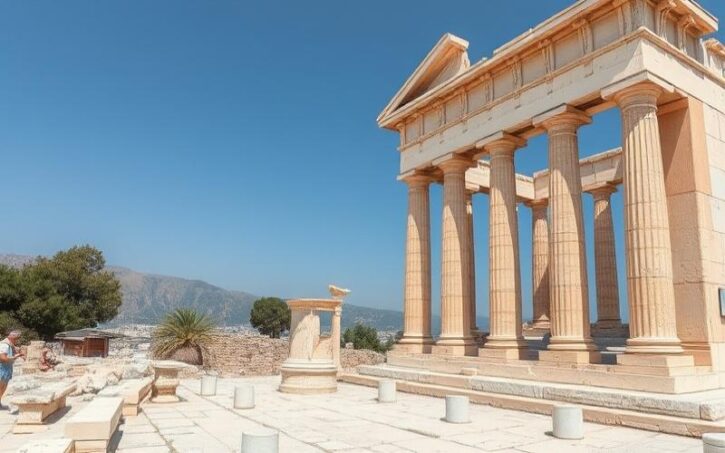
– Democracy developed, giving Athenian citizens an active role in managing their city. – Architecture reached its peak with the construction of the Parthenon on the Acropolis. – Philosophy flourished with thinkers like Socrates, Plato, and Aristotle. – Theater developed, with the tragedies of Aeschylus, Sophocles, and Euripides.
However, this glorious period was also marked by internal conflicts, notably the Peloponnesian War which pitted Athens against Sparta from 431 to 404 BCE.
Good to Know:
The name “Greece” comes from the Latin “Graecia,” itself derived from the Greek “Γραικός” (Graikós). The Greeks themselves called their country “Hellas” and referred to themselves as “Hellenes.”
The Hellenistic Era: When Greece Conquered the World
In the 4th century BCE, Greece fell under the domination of Macedonia. Philip II unified the Greek city-states under his authority, paving the way for the conquests of his son, Alexander the Great.
Alexander extended Greek influence as far as India, creating a vast empire and spreading Hellenistic culture throughout the ancient world. After his death in 323 BCE, his empire was divided among his generals, giving rise to the Hellenistic era.
This period saw Greek culture blend with Eastern traditions, creating a cosmopolitan civilization centered on great cities like Alexandria in Egypt.
Roman Greece: A Cultural Province of the Empire
In 146 BCE, Greece was conquered by Rome and became a province of the Roman Empire. Despite this loss of political independence, Greek culture continued to exert a major influence on the Romans.
Many Romans came to study in Greece, considered the cradle of knowledge and philosophy. The Greek gods were assimilated into Roman deities, and Greek art deeply inspired Roman artists.
Good to Know:
Although under Roman rule, Greece was never “colonized” in the modern sense of the term. It retained much of its cultural identity while integrating into the Roman Empire.
The Byzantine Empire: When Greece Became the Heart of the Christian East
After the division of the Roman Empire in 395, Greece became part of the Eastern Roman Empire, which would become the Byzantine Empire. Constantinople (the ancient Byzantium, now Istanbul) became the new capital, heir to the Greco-Roman culture and center of Orthodox Christianity.
For over a thousand years, the Byzantine Empire kept the Greek language and culture alive, while integrating them into the Christian tradition. This period saw the construction of many churches and monasteries that still mark the Greek landscape today.
Ottoman Rule: Four Centuries Under the Turkish Yoke
The fall of Constantinople in 1453 marked the beginning of Ottoman domination over Greece. For nearly four centuries, the Greeks lived under the authority of the Turkish Sultan.
Despite the hardships, Greek culture survived:
– The Orthodox Church played a crucial role in preserving Greek identity. – Prosperous Greek communities developed in the major cities of the Ottoman Empire and in Europe. – The Modern Greek Enlightenment movement in the 18th century revived interest in the ancient Greek heritage.
The War of Independence: The Rebirth of the Greek Nation
In 1821, the Greeks rose up against Ottoman rule. After a war of liberation lasting nearly ten years, Greece’s independence was recognized in 1830.
The new Greek state was initially a monarchy, with a Bavarian king, Otto I. The country sought to reconnect with its ancient past, making Athens its capital and restoring many ancient monuments.
Modern Greece: Between Tradition and Modernity
The 20th century was a tumultuous period for Greece:
– The Balkan Wars and World War I allowed the country to expand. – The “Great Catastrophe” of 1922 saw the expulsion of Greeks from Asia Minor by Turkey. – World War II and the Nazi occupation were followed by a devastating civil war. – The Regime of the Colonels (1967-1974) marked the country’s last authoritarian period.
Since 1974, Greece has been a stable parliamentary republic. Its entry into the European Union in 1981 accelerated its modernization, despite recurring economic difficulties.
Good to Know:
Despite the vicissitudes of history, Greeks have always maintained a strong sense of national identity, rooted in their ancient heritage and millennial culture.
Greece Today: A Country Rich in its Past, Looking to the Future
Today, Greece is a modern country that plays an important role within the European Union and NATO. While facing economic and social challenges, it remains a major tourist destination, attracting millions of visitors each year thanks to its exceptional historical heritage and Mediterranean landscapes.
Greek culture continues to influence the world, whether through its cuisine, music, cinema, or literature. Greeks are proud of their history and unique identity, the result of millennia of evolution and cultural exchange.
For expatriates who choose to settle in Greece, understanding this rich and complex history is essential to fully appreciate the country’s culture and integrate into Greek society.
Disclaimer: The information provided on this website is for informational purposes only and does not constitute financial, legal, or professional advice. We encourage you to consult qualified experts before making any investment, real estate, or expatriation decisions. Although we strive to maintain up-to-date and accurate information, we do not guarantee the completeness, accuracy, or timeliness of the proposed content. As investment and expatriation involve risks, we disclaim any liability for potential losses or damages arising from the use of this site. Your use of this site confirms your acceptance of these terms and your understanding of the associated risks.

Cyril Jarnias is an independent expert in international wealth management with over 20 years of experience. As an expatriate himself, he is dedicated to helping individuals and business leaders build, protect, and pass on their wealth with complete peace of mind.
On his website, cyriljarnias.com, he shares his expertise on international real estate, offshore company formation, and expatriation.
Thanks to his expertise, he offers sound advice to optimize his clients' wealth management. Cyril Jarnias is also recognized for his appearances in many prestigious media outlets such as BFM Business, les Français de l’étranger, Le Figaro, Les Echos, and Mieux vivre votre argent, where he shares his knowledge and know-how in wealth management.





