
 Published on and written by Cyril Jarnias
To tell the story of the country in Egypt is to traverse more than five millennia of human experience, invention, conquest, and political rebirth. Rarely has a single territory so thoroughly crystallized the very idea of civilization: from the first agricultural villages on the banks of the Nile to debates about Egypt’s regional role in the 21st century, through pyramids, pharaohs, Persian, Greek, Roman and then Arab conquests, or the nationalist wave of the 20th century.
To understand contemporary Egypt, it is essential to consider the four structuring pillars of its history: the Nile as its geographical and economic backbone, the State as a permanent obsession with organization, religion as the traditional language of power, and a geopolitical position that has always attracted covetousness. These successive layers are all indispensable to understanding the country.
The Nile, Matrix of a Country and a State
Long before the pharaohs, the Nile created the framework within which the history of the country in Egypt would be written. The river stretches for more than 6,800 kilometers, crossing or draining eleven African countries, but it was in its valley and delta, only a few kilometers wide, that one of the world’s first state societies was built.
In antiquity, the desertification of the Sahara from the 6th millennium BCE pushed pastoral populations toward the Nile Valley. The annual floods deposited fertile black silt there, enabling highly productive agriculture. The Egyptians named this region Kemet (“the Black Land”), distinguishing it from the sterile desert called Deshret (“the Red Land”).
The river’s cycle structures economic and religious life. The year is divided into three seasons, directly modeled on the Nile: Akhet (the inundation), Peret (the emergence/growth), and Shemu (the harvest). This regularity inspires a worldview dominated by the idea of order and stability, summarized by the concept of Ma’at, a principle of justice and cosmic balance. The ruler’s precise mission would be to maintain this Ma’at, both in nature and in society.
Without the Nile, no agricultural surplus, no state apparatus, no great constructions. With it, Egypt very early on had an economic base capable of supporting administrators, specialized artisans, scribes, priests, soldiers—in short, everything that allows for the emergence of a powerful central authority.
The Nile, Foundation of Egyptian Civilization
From Neolithic Villages to the Unification of the Country
The first sedentary communities appeared as early as the 10th millennium BCE, around an economy of cereal grinding. From the 6th millennium onward, tribes of Upper Egypt mastered agriculture and animal husbandry. Predynastic cultures—Badarian and especially Naqada—developed refined pottery, worked copper, and wove a network of exchanges toward Nubia, the Levant, and the Eastern Mediterranean.
In this phase, the country was already conceived as an entity of two regions: Upper Egypt in the south, Lower Egypt in the north. Each developed its own centers of power and tutelary gods. Competition between these kingdoms eventually led to a process of unification.
Toward the end of the 4th millennium BCE, the ruler Narmer (identified with the legendary Menes) unified the “Two Lands.” The Narmer Palette depicts him wearing the white crown of Upper Egypt and the red crown of Lower Egypt, a foundational political imagery of Pharaonic ideology.
This unification was not merely a symbolic gesture: it enabled the creation of an administration covering the valley and the delta, with a capital established at Memphis, at the pivot point between the two regions. The country henceforth conceived of itself as a unitary state, and this framework—Upper and Lower Egypt united—would remain the reference point until the modern era.
The Pharaonic Machine: State, Religion, and Monumentality
With the first dynasties, between the 32nd and 27th centuries BCE, the political matrix that would dominate the entire Old Kingdom took shape. The pharaoh concentrated power: military leader, supreme judge, high priest, theoretical owner of all land. He was perceived as a liminal being, halfway between gods and humans, charged with ensuring agricultural prosperity, social cohesion, and victory in battle.
The ancient Egyptian state was structured around a vizier, a number two official supervising taxation and major works. The territory was divided into nomes, administered by nomarchs whose power increased over time. Temples, beyond their religious role, were crucial economic centers: they stored harvests, redistributed rations, and employed a considerable workforce.
This system relied on a decisive tool: writing. The first hieroglyphs matured at the end of the predynastic period, then stabilized during the 1st and 2nd Dynasties. The Egyptians called this system medu netjer, “words of the gods.” It was not merely about representing things, but about mastering a language considered active: writing a name, a spell, or a funerary formula meant producing a real effect in the world.
The Egyptian hieroglyphic system, composed of hundreds of phonetic and semantic signs, gave rise to the cursive hieratic and demotic scripts, used for bureaucracy. In the long term, it influenced the earliest alphabets of the Sinai, then Phoenician and Greek scripts, thus laying the foundations for many modern writing systems.
Table below, a synthesis of the role of writing in the organization of the Pharaonic state:
| Dimension | Role of Writing in Ancient Egypt |
|---|---|
| Administration | Tax registers, land surveys, official correspondence |
| State Religion | Temple texts, hymns, rituals, king lists |
| Funerary | Pyramid Texts, Coffin Texts, Book of the Dead |
| Economy | Contracts, delivery receipts, inventories of goods |
| Diplomacy | Treaties, international correspondence (often in Akkadian cuneiform) |
| Scholarly Culture | Literature, moral teachings, medical and mathematical treatises |
The Age of Pyramids and the First State Crisis
The Old Kingdom, between the 3rd and 6th Dynasties, embodies the pinnacle of sacred monarchy and monumental architecture. Under Djoser, a genius architect, Imhotep, designed at Saqqara an immense funerary complex dominated by the first step pyramid, considered the oldest large-scale dressed stone structure in the world. It crystallized a central idea: the royal tomb as a “resurrection machine,” destined to ensure the pharaoh’s ascension to the sky.
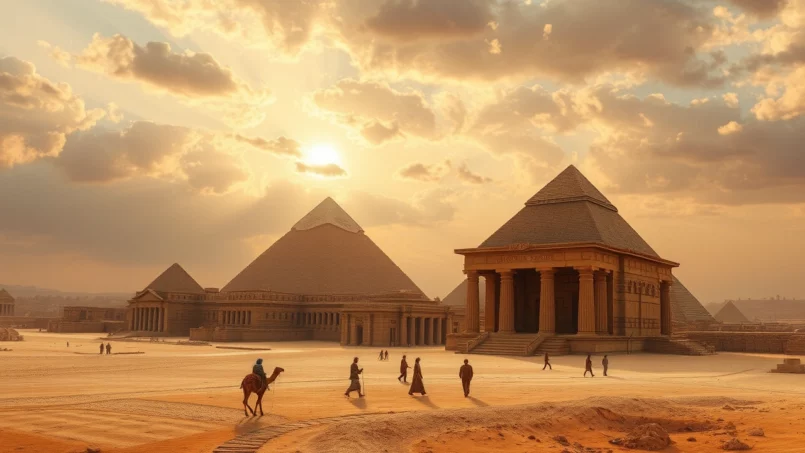
The Pyramids of Giza, whose construction was perfected by the pharaohs Sneferu, Khufu, Khafre, and Menkaure, were built by tens of thousands of skilled workers, not by slaves. These specialized laborers were paid, organized in teams, and provided with food, housing, and healthcare at the construction sites. They were assisted by conscripted peasants during the Nile’s inundation season, a period when agricultural work was halted.
Simultaneously, the religious apparatus became more complex. The sun god Ra gained importance, notably at Heliopolis, and theology shaped the image of a king as the son of Ra. The Pyramid Texts, carved inside the monuments of the 5th and 6th Dynasties, codified a set of magico-religious formulas meant to guide the ruler in the afterlife.
Duration in years of the First Intermediate Period, an era of political fragmentation that followed the collapse of the Egyptian Old Kingdom.
Renaissance and Maturity: The Middle and New Kingdoms
Facing political fragmentation, a new center emerged at Thebes, in Upper Egypt. Around the beginning of the 2nd millennium BCE, a Theban ruler, Mentuhotep II, managed to subdue the entire country and restore unity. This marks the birth of the Middle Kingdom, a golden age of classical Egyptian literature and a key moment of administrative consolidation.
The power strengthened control over the nomarchs, developed vast irrigation projects, notably in the Fayoum, and relaunched the exploitation of Nubian mines and quarries. The kings of the 12th Dynasty, Amenemhat I, Senusret I, Senusret III, Amenemhat III, were great builders and administrators, moving the capital to a new city, Itjtawy, while making Thebes a major religious center.
From the 17th century BCE onward, the stability of the Egyptian model was shaken by external shocks. Groups from the Levant, the Hyksos, exploited internal weaknesses to conquer Lower Egypt and establish their capital at Avaris, in the eastern Delta. They appropriated Pharaonic titles and customs while introducing major military innovations, such as the light war chariot, demonstrating a capacity for reciprocal adaptation and assimilation.
A Theban power persisted in the south and finally, after decades of conflict, gained the upper hand under the reign of Ahmose I. The expulsion of the Hyksos marks the entry into the New Kingdom, a period of unprecedented imperial expansion, from Sudan to the Levant. Thutmose III led a series of campaigns as far as the Euphrates, Hatshepsut developed trade with the mysterious land of Punt, Amenhotep III ruled over an opulent kingdom, woven with diplomatic alliances.
Within this framework, Thebes became the showcase of Egyptian power, with the temples of Karnak and Luxor and the Valley of the Kings necropolis. It is there that the pharaohs of the New Kingdom would be buried, including Tutankhamun, known for the intact richness of his tomb.
In the 14th century BCE, King Amenhotep IV, in reaction to the growing power of the Amun priesthood in Thebes, instituted a radical religious reform. He promoted the exclusive worship of the solar disk Aten, changed his name to Akhenaten, moved the capital to Amarna, and banned the public worship of other gods. This experiment, often incorrectly labeled as monotheistic, was in fact an exclusive henotheism, where the existence of other deities was not denied, but their public veneration was prohibited.
After about twenty years, the reform collapsed. Tutankhamun, then his successors, restored the traditional pantheon and moved the court back to Thebes then Memphis. The Pharaonic system regained its reflexes, but the fracture had consequences. In the following centuries, the New Kingdom had to face external threats—”Sea Peoples,” Libyans, Nubians—and internal troubles. The 20th Dynasty saw an increase in tomb robberies, strikes by artisans at Deir el-Medina, and rivalries between royal power and the high priests of Amun.
From Fragmentation to Foreign Domination
With the death of Ramesses XI, the last great ruler of the New Kingdom, Egypt entered an era of prolonged fragmentation. In the north, kings ruled from Tanis; in the south, the high priests of Thebes exercised a quasi-dynastic power. Libyan chiefs integrated into the army eventually founded their own dynasties. Later, Kushite kings from Nubia, like Piye and Taharqa, briefly reunified the country under the 25th Dynasty, before being themselves displaced by newcomers: the Assyrians, who sacked Memphis and Thebes in the 7th century BCE.
Before 332 BCE, Egypt experienced a period of instability and foreign domination. After the Saite dynasties supported by the Assyrians, it was conquered by the Persians under Cambyses II. A brief restoration of Pharaonic power was followed by a return of the Persians, severely curtailing indigenous sovereignty. Upon the arrival of Alexander the Great, a segment of the Egyptian elite, weary of the Achaemenid yoke, welcomed him as a liberator.
The Macedonian conqueror respected local codes: coronation at Memphis, consultation of the oracle of Amun at Siwa, foundation of a new capital, Alexandria, oriented toward the Mediterranean but soon integrated into the Egyptian pantheon through the creation of hybrid deities like Serapis. After his death, one of his generals, Ptolemy, seized the country and founded the Ptolemaic (Lagid) dynasty, which would rule for nearly three centuries.
The Ptolemies governed from Alexandria, a cosmopolitan city and center of learning, but adopted Pharaonic codes for the interior of the country. They had themselves depicted as pharaohs in the great temples, maintained the traditional religious apparatus, and made Egypt a key economic actor in the Mediterranean, exporting wheat, papyrus, and glassware, and importing timber, metals, and luxury goods.
This prosperity whetted the appetite of a new rising power: Rome. Mired in internal rivalries and financial dependencies, the last Lagids, including the famous Cleopatra VII, saw the trap closing. Defeated by Octavian at Actium, Cleopatra and her ally Mark Antony committed suicide. In 30 BCE, Egypt became a Roman province.
Roman Egypt, Christian Egypt, Arab Egypt
Under Rome and then Byzantium, Egypt was primarily an economic asset. The country was the “breadbasket” of the Empire. The emperor directly controlled the province, whose Greek and Egyptian elites managed local administration under the eye of an equestrian prefect. Emperors still had themselves depicted as pharaohs on the walls of some temples, but the traditional religion began to erode.
From the 1st century CE onward, Christianity took root, first in major cities like Alexandria, before spreading to the valley. Over the centuries, Egyptian monks invented new forms of ascetic life that would influence all of Eastern Christianity. The Egyptian language, transcribed in Greek letters enriched with demotic signs, gave rise to Coptic, the liturgical language of the country’s Christians.
In 391, Emperor Theodosius banned pagan cults, leading to the closure of temples and the end of hieroglyphic engraving by the 5th century, causing the forgetting of part of the religious and linguistic heritage. Having become a Byzantine province, Egypt was then marked by wars with the Sassanian Empire, which briefly occupied it at the beginning of the 7th century, and by theological conflicts between Chalcedonian and non-Chalcedonian Christians.
It was in this context that a new actor appeared: the young Muslim state led from Medina then Damascus. In 639, an Arab general, ‘Amr ibn al-‘As, convinced Caliph ‘Umar of the strategic interest in conquering Egypt, wealthy and poorly defended. At the head of a few thousand men, he crossed the eastern border, successively took border towns, besieged the Babylon Fortress, and after several months of fighting and negotiations, obtained the surrender of the Byzantine authorities.
The agreement with Cyrus of Alexandria established the conquerors’ sovereignty over Egypt in exchange for a tribute. The Christians, the majority, obtained the status of *dhimmis*: protected but subject to the *jizya* (tax), they kept their churches and hierarchy. Many, previously persecuted by Byzantium for doctrinal differences, perceived this new regime as less oppressive. The Coptic Patriarch Benjamin, in exile, was recalled and reinstated in his functions.
‘Amr founded a new capital, Fustat, near the old Babylon. From there, the Umayyad and then Abbasid governors administered a strategic province, where a system of Arab garrisons dominating a still Christian and Coptic Egyptian majority was established over several centuries. The Arabization and Islamization of the country were slow, accelerating around the 9th and 10th centuries, until Muslims became the majority.
From Caliphate Province to Center of the Islamic World
Between the 7th and 11th centuries, Egypt changed status several times. First a dependent province of Damascus then Baghdad, it gained de facto autonomy with the Tulunid dynasty, then with the Ikhshidids. During these periods, governors managed to control local fiscal resources, cultivated their own army, and positioned themselves as arbiters between the caliphal center and regional forces.
In 969, the Shiite Ismaili Fatimid dynasty conquered Egypt. Their general Jawhar then founded the palace-city of al-Qahira (Cairo) to house the caliph and his army. He built the al-Azhar Mosque there, which became a center for disseminating Fatimid doctrine before becoming a major Sunni university. Under their rule, Egypt became the heart of a caliphate extending over the Maghreb, Syria, the Hejaz, and part of the Mediterranean.
Under the Fatimids and then their successors, the Ayyubids and the Mamluks, the Nile Valley again became a major center of Islamic politics. Saladin, who overthrew the Fatimids in the 12th century, restored Sunnism and organized the resistance against the Crusaders. In the 13th century, the Mamluks of Turkish then Circassian origin, former slave-soldiers, seized power, repelled the Mongols at Ain Jalut, and finally evacuated the last Latin strongholds in Palestine.
The Black Death carried off nearly 40% of Cairo’s population in the 14th century.
In 1517, a new empire from Anatolia, the Ottoman Empire, defeated the Mamluks and annexed Egypt. The country became an indispensable but subordinate province of Istanbul. The Mamluks, however, continued to play a role in day-to-day management, while the Ottoman sultan proclaimed himself caliph of the Sunni world.
From Ottoman Province to the Construction of a Modern State
At the end of the 18th century, the fragile balance linking Istanbul to Cairo was disrupted by the irruption of European powers. The Bonaparte expedition in 1798, even though it lasted only a few years, marked a lasting shock: France’s military and scientific superiority, the systematic surveys of antiquities, the discovery of the Rosetta Stone—which would allow the decipherment of hieroglyphs in the 19th century—accelerated the awareness of the technological gap with Europe.
After the French departure, an Albanian officer in Ottoman service, Muhammad Ali, managed to eliminate his rivals, notably the last Mamluks, and have himself recognized as governor. Very quickly, he transformed this function into a quasi-hereditary sovereignty. Relying on a conscript army, land reforms, state manufactures, and tight control of exports, he built a regional power that temporarily extended over Syria, parts of Arabia, Sudan, and even Greece.
Egypt’s modernization project, based on the forced mobilization of peasants and a directed economy, integrated it into the industrial world-economy via cotton cultivation for Europe, road development, and the adoption of modern techniques. However, indebtedness, rivalries with the Ottoman Empire, and the distrust of British and French powers led to the country’s financial tutelage.
The opening of the Suez Canal in 1869 confirmed Egypt’s strategic importance as a mandatory passage between the Mediterranean and the Indian Ocean. But it also completed its transformation into prey for European imperialisms. In 1882, under the pretext of restoring order in the face of a nationalist movement led by Ahmed Urabi, the United Kingdom bombarded Alexandria then occupied the country. Officially, Egypt remained an Ottoman province, then a British protectorate from 1914. In practice, London controlled the army, diplomacy, and finances.
Nationalism, Monarchy, and Republican Revolution
At the turn of the 20th century, Egyptian society seethed. The rise of an urban bourgeoisie, the emergence of political parties, and the spread of liberal and nationalist ideas fueled growing contestation of the “protectorate.” After World War I, a delegation led by Saad Zaghloul demanded independence at the Paris Peace Conference. His arrest triggered an unprecedented wave of demonstrations across the country in 1919, both urban and rural, involving Muslims and Christians alike.
In 1922, under pressure, London recognized a limited independence for Egypt. Sultan Fuad became king. A liberal constitution in 1923 established a parliamentary monarchy, dominated electorally by the nationalist Wafd party. However, the king retained extensive powers and the British kept control of defense, imperial communications, and Sudan. Repeated interventions by the British army and unilateral changes to the constitution maintained a climate of political frustration.
World War II further strengthened the British military presence in the country. By 1952, the situation was explosive: corruption of the regime, humiliation from defeats by Israel, anti-British resentment. A group of officers, the “Free Officers,” led by Gamal Abdel Nasser and Mohammed Naguib, overthrew King Farouk in July. The monarchy was abolished the following year, and the Republic proclaimed. The new power dissolved parties, restructuring political life around a Revolutionary Command Council.
Nasser established himself by understanding that Egypt had to free itself from Western tutelage to ensure its sovereignty. To mobilize the region, he proposed Pan-Arabism as a unifying narrative.
Nasser and Egypt, “Big Sister” of the Arab World
In the 1950s and 1960s, the history of the country in Egypt largely merged with that of Arab nationalism. Nasser built an authoritarian state but one carrying social promises: land reform limiting large estates, nationalizations, development of the public sector, industrialization, expansion of education and health. His discourse of “Arabism” combined calls for the unity of Arab peoples, anti-imperialism, and demands for social justice.
In response to the withdrawal of American and British funding for the Aswan Dam, Egyptian President Gamal Abdel Nasser nationalized the Suez Canal in 1956. This decision triggered a joint military intervention by France, the United Kingdom, and Israel. However, joint diplomatic pressure from the United States and the USSR forced the aggressors to withdraw. This episode, occurring in the context of Nasser’s refusal of Western alliances and his role in the Non-Aligned Movement, made Egypt a symbol for the peoples of the Global South of a postcolonial country’s ability to resist former colonial powers.
This aura was reinforced with the creation of the United Arab Republic, a brief but highly publicized union with Syria between 1958 and 1961, and with Cairo’s active support for liberation movements, from Algeria to Yemen. Egyptian soft power also shone through other channels: cinema, music, literature, and reference Arab press.
The defeat of 1967 against Israel led to the loss of territories and shattered the myth of invincibility. The regime survived, but it was undermined by the military concentration of power, the absence of pluralism, and economic mistakes that compromised its future.
From Sadat to Mubarak: Cold Peace and Routine Authoritarianism
Upon Nasser’s death in 1970, his vice-president Anwar el-Sadat inherited a wounded country, economically fragile but with still strong symbolic capital. Quickly, he carried out several strategic reorientations. Internally, he launched the policy of “infitah,” economic opening meant to attract private capital and foreign investments, partially breaking with state socialism. Externally, he drew closer to the United States, expelled Soviet advisors, and prepared a new limited military confrontation with Israel to break the status quo.
In 1973, the Egyptian army crossed the Suez Canal, surprising Israel and ending the myth of its invincibility. Although the war had no decisive victor, Egyptian President Anwar el-Sadat used this event to justify a diplomatic turn. He went to Jerusalem in 1977, then signed the Camp David Accords in 1978 under the auspices of U.S. President Jimmy Carter, leading to the first peace treaty between an Arab state and Israel. Egypt thus recovered the Sinai Peninsula, but this initiative earned it the anger of part of the Arab world and a temporary suspension from the Arab League.
Internally, the president played a delicate tune: he loosened some controls, allowed relative pluralism, partially rehabilitated Islamist currents to counterbalance Nasserists and the left, while maintaining a very presidential regime. This ambiguity turned against him: in 1981, during a military parade, he was assassinated by a jihadist commando from within the army.
Anwar el-Sadat’s successor, Hosni Mubarak, maintained his predecessor’s foreign policy: respect for the peace treaty with Israel, strategic alliance with the United States (with substantial annual military aid), and a role as regional mediator (Palestinian issue, 1991 Gulf War). Domestically, the regime hardened: the state of emergency, declared after Sadat’s assassination, became permanent, elections were controlled, and opposition was harassed, although some leeway was given to the Muslim Brotherhood and a few legal parties.
Egypt continued to present itself as the “big sister” of the Arab world, strong with its largest population, powerful army, and cultural weight. But behind this facade, economic imbalances worsened: over-indebtedness, massive youth unemployment, glaring inequalities, corruption perceived as endemic, frustration at the prospect of a hereditary succession in favor of the president’s son.
Revolution, Counter-Revolution, and Inward Turn
In January 2011, in the wake of the Tunisian then Libyan uprisings, an unprecedented mobilization erupted in Egypt. It brought together connected urban youth, impoverished middle classes, long-time activists, unions, and Islamists. Tahrir Square became the epicenter of a movement demanding the end of the regime, social justice, and dignity. After 18 days of protests and under pressure from the army, Hosni Mubarak resigned. Many then imagined a transition toward a more open system, based on the political accountability of leaders, and respect for rights and freedoms.
Following free elections in 2012, the Muslim Brotherhood, capitalizing on their social roots, won Parliament and the presidency with Mohamed Morsi. However, this transition was marked by difficulties: fragile institutions, a declining economy, and growing tensions with secular forces and the security apparatus. The situation deteriorated notably after a controversial constitutional decree by Morsi aimed at temporarily shielding him from judicial oversight, illustrating the challenges of a chaotic learning of power.
In June 2013, massive demonstrations demanded his departure. The army, led by General Abdel Fattah el-Sisi, intervened, deposed the president, and suspended the constitution. The repression that followed, especially against supporters of the Muslim Brotherhood, was of an unprecedented scale in Egypt’s recent history. Hundreds were killed during the dispersal of sit-ins, thousands were arrested, and the Brotherhood was designated a “terrorist organization.”
A new constitutional text was adopted in 2014, then amended in 2019 to further strengthen the political role of the armed forces and extend presidential terms. Sisi was elected, then re-elected, in tightly controlled polls. The main counter-powers—opposition parties, independent media, NGOs—were closely monitored, if not neutralized.
On the regional level, Egypt has military assets (one of the most powerful armies in the Arab world), strategic assets (control of the Suez Canal), and diplomatic assets (a role as an occasional mediator). However, its influence is considered to be in decline compared to the activism and financial support of Gulf powers like Saudi Arabia and the United Arab Emirates.
The power’s priorities are largely turned inward: fight against jihadist insurgencies, especially in Sinai, major infrastructure projects, management of crushing debt, inflation, water crisis surrounding the Ethiopian Renaissance Dam. Issues of human rights, political pluralism, and civil-military balance remain at the heart of criticism from many observers.
The table below helps visualize the major modern political phases:
| Period | Regime and Main Characteristics |
|---|---|
| 1805 – end of 19th century | Muhammad Ali dynasty, modernization, growing autonomy from Istanbul |
| 1882 – 1922 | De facto British occupation, Khedivate then Sultanate under tutelage |
| 1922 – 1952 | Kingdom of Egypt, limited independence, fragile constitutional monarchy |
| 1952 – 1970 | Nasserist Republic, Pan-Arabism, state socialism, confrontation with the West |
| 1970 – 1981 | Sadat Presidency, economic opening, peace with Israel, pivot toward the United States |
| 1981 – 2011 | Mubarak Presidency, stable authoritarianism, regional mediator role, rise of discontent |
| 2011 – 2013 | Revolutionary transition, pluralist elections, Morsi Presidency, acute tensions |
| 2013 – present | Sisi regime, authoritarian restoration, security and economic priorities |
Continuities and Ruptures in the History of the Country in Egypt
Faced with this long trajectory, it is tempting to remember only the flamboyant highlights: pyramids, pharaohs, conquests, revolutions. Yet several common threads run through the centuries and help understand the permanence behind the transformations.
The first, obvious one, is the centrality of the Nile. From Pharaonic agriculture irrigated by natural floods to contemporary negotiations on water sharing with Ethiopia and Sudan, the river remains the material condition for the country’s very existence. Today, over 90% of the population still lives near its banks.
In this region, the central state, in its various historical forms (Pharaonic, caliphal, Ottoman, monarchical, or republican), constitutes a structuring horizon, relying on a dense bureaucracy. It is characterized by a distrust of local particularisms and values a unifying administration for a narrow and populous territory. Since the modern era, the military institution has played a disproportionate role, a guarantor of national cohesion and an autonomous political actor.
The third constant lies in the relationship between Egyptian identity and broader affiliations. Under the pharaohs, Egypt thought of itself as a world apart, even as it intensely exchanged with Nubia, the Levant, and the Mediterranean. In the Greco-Roman period, it was both a cosmopolitan province and the guardian of a millennial tradition. With Islam, Egypt became both an Arab, African, and Muslim country. In the 20th century, Nasser theorized the compatibility between Egyptian patriotism and Arab nationalism, then other discourses emphasized sometimes its Africanness, sometimes its Islamic belonging, sometimes the country’s cultural uniqueness.
Egypt’s history is marked by changing relations between religion and power, from the divine pharaoh to the caliph, to modern leaders alternating between Islamist alliances and secular discourse. These political uses of religion coexist with a diversity of popular practices, local cults, and syncretism, illustrating that Egyptian society cannot be reduced to a single ideology.
At the end of this journey, Egypt appears less as a fixed backdrop of postcards than as a laboratory of political, religious, and social experiences, constantly recomposed around a few basic facts—the river, the valley, human density, geographical position. It is this capacity to reinvent itself on an ancient foundation that continues to make the history of the country in Egypt an inexhaustible subject of study, and a mirror, often unsettling, of the questions that many states still ask themselves today between heritage, sovereignty, and globalization.
Disclaimer: The information provided on this website is for informational purposes only and does not constitute financial, legal, or professional advice. We encourage you to consult qualified experts before making any investment, real estate, or expatriation decisions. Although we strive to maintain up-to-date and accurate information, we do not guarantee the completeness, accuracy, or timeliness of the proposed content. As investment and expatriation involve risks, we disclaim any liability for potential losses or damages arising from the use of this site. Your use of this site confirms your acceptance of these terms and your understanding of the associated risks.

Cyril Jarnias is an independent expert in international wealth management with over 20 years of experience. As an expatriate himself, he is dedicated to helping individuals and business leaders build, protect, and pass on their wealth with complete peace of mind.
On his website, cyriljarnias.com, he shares his expertise on international real estate, offshore company formation, and expatriation.
Thanks to his expertise, he offers sound advice to optimize his clients' wealth management. Cyril Jarnias is also recognized for his appearances in many prestigious media outlets such as BFM Business, les Français de l’étranger, Le Figaro, Les Echos, and Mieux vivre votre argent, where he shares his knowledge and know-how in wealth management.





