
 Published on and written by Cyril Jarnias
Traveling in Sweden without a car is not only possible but often the simplest, most economical, and most eco-friendly solution. Between high-speed trains, efficient metros, regional bus networks, and ferries integrated into the public system, the country has built one of the most reliable transportation networks in Europe. This practical guide details how public transport works in Sweden, with an in-depth focus on the Stockholm metro, the country’s only underground network.
Understanding Transport Organization in Sweden
In Sweden, public transport is primarily managed at the regional level. Each county has its own transport authority, coordinating buses, regional trains, sometimes trams, and ferries. Despite this decentralized organization, the system functions like a well-oiled puzzle: each regional piece fits into a national network of long-distance trains and buses.
In Sweden, public transport is managed by different operators depending on the region (e.g., SL in Stockholm, Västtrafik in Gothenburg). A single ticket, valid for a defined zone, typically covers all local modes of transport (bus, tram, metro, commuter trains, sometimes ferries).
The result is a dense network, especially in the south of the country, where trains and buses create a tight grid between towns and villages. In the north, major railway lines remain present, but some secondary lines have been closed and replaced by intercity buses, essential for serving remote areas and even transporting mail.
Punctuality, cleanliness, and accessibility are at the core of the Swedish model. Most vehicles are accessible to people with reduced mobility, with ramps, reserved spaces, and visual and audio announcements. Anti-discrimination legislation also requires reasonable accommodations throughout the public sector, including transport.
The Main Regional Actors
Even if a traveler doesn’t need to memorize all the names, understanding the regional logic helps navigate the system, especially when buying the right ticket or downloading the appropriate app.
Overview of the main regional transport authorities in France and their service areas
Transport authority for the Île-de-France region. Manages metro, RER, tram, and bus networks in the region’s eight departments.
Transport authority for the Lyon Metropolis. Operates the TCL network including metro, tram, trolleybus, and bus.
Organizes urban transport within its territory, including the RTM network in Marseille (metro, tram, bus) and intercity networks.
Transport authority for the Nantes urban area. Manages the TAN network (tram, busway, bus, and river shuttles).
Manages public transport for Toulouse Métropole, including the metro, tram, cable car, and bus network.
Coordinates major transport projects for Greater Paris, notably the Grand Paris Express (new automated metro lines).
| Region / Operator | Main Cities Served | Main Modes |
|---|---|---|
| SL (Stockholm) | Stockholm and Stockholm County | Metro, bus, tram, trains, ferries |
| Västtrafik | Gothenburg, Borås, Skövde, Trollhättan, Uddevalla… | Bus, tram, trains, ferries |
| Skånetrafiken | Malmö, Lund, Helsingborg, Kristianstad, Ystad… | Bus, trains (to Denmark) |
| UL (Uppsala) | Uppsala, Arlanda, Västerås, Gävle… | Bus, trains |
| Östgötatrafiken | Linköping, Norrköping, Motala… | Bus, trains, tram (Norrköping) |
| Länstrafiken Norrbotten | Kiruna, Luleå, Gällivare, Haparanda… | Bus |
| Länstrafiken Västerbotten | Umeå, Skellefteå, Lycksele… | Bus |
| Din Tur | Sundsvall, Härnösand, Örnsköldsvik… | Bus |
| Jönköpings Länstrafik | Jönköping, Nässjö, Värnamo… | Bus, trains |
| Hallandstrafiken | Halmstad, Varberg, Laholm… | Bus |
| Blekingetrafiken | Karlskrona, Ronneby, Karlshamn… | Bus |
In almost all these regions, you’ll find the same principles: multi-modal tickets, discounts for youth, students, and seniors, rechargeable cards, and mobile apps to purchase and validate tickets.
The Central Role of Trains at the National Level
For long distances, trains remain the backbone of the Swedish network. The national company SJ serves the main routes (Stockholm–Gothenburg, Stockholm–Malmö, Stockholm–Luleå/Kiruna, etc.) with high-speed and intercity trains. Other private or foreign operators complement the service (VR, Snälltåget, VY, Mälartåg, Öresundståg, Flixtrain).
Sweden has a railway network of about 15,000 km, more than half of which is electrified.
For the user, the essentials lie elsewhere: trains are generally fast, comfortable, and seat reservations are mandatory on most long-distance trains. SJ tickets are no longer sold onboard but via the app, website, or resellers like Pressbyrån or 7-Eleven. Buying in advance allows access to very low “last-minute” fares, sometimes around 95 SEK on certain routes, or 195 SEK on the fastest trains.
Long-Distance Buses: The Economical Alternative
On many intercity routes, especially between major cities, buses operated by companies like FlixBus, Svenska Buss, Ybuss, or VY Bus4You offer an alternative often cheaper than trains. These coaches are modern, often equipped with Wi-Fi, power outlets, and toilets.
The intercity bus market has been completely liberalized since the late 1990s. In areas less served by trains, like in the north of the country, these private or regional lines sometimes constitute the only public transport available to connect small towns. Many lines are specifically coordinated with train schedules: regional “länstrafik” buses are designed as extensions of railway lines, ensuring seamless service from start to finish.
For international travelers, these buses provide a practical gateway to Sweden or neighboring countries (Norway, Denmark, Germany, Poland, or even further south via Eurolines or FlixBus connections).
Focus on Stockholm: An Integrated System Around the Tunnelbana
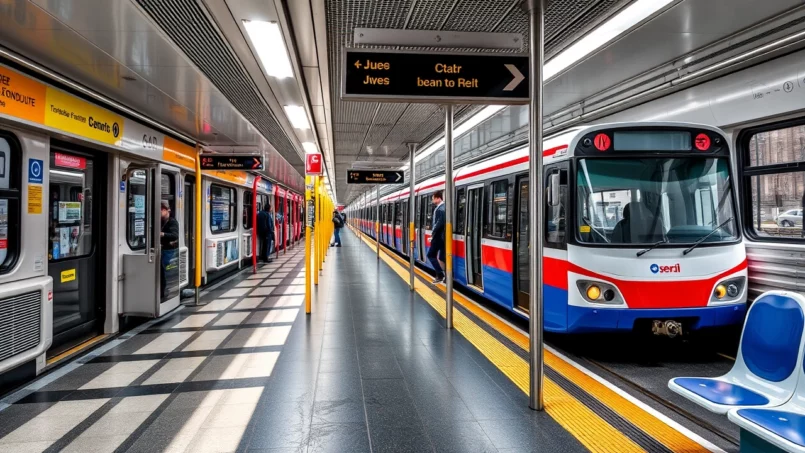
The case of Stockholm is unique: it’s the only city in Sweden with a metro. This network, called Tunnelbana or Tunnelbanan, is operated by SL (Storstockholms Lokaltrafik) and considered the backbone of the capital’s transport system.
Around this metro orbit:
– nearly 500 bus lines, including about fifty night lines;
– several tram lines (including Tvärbanan, Lidingöbanan, Nockebybanan, and Spårväg City);
– a commuter train network (Pendeltåg) connecting Stockholm to towns like Märsta, Södertälje, Uppsala, or Nynäshamn;
– several ferries integrated into the SL network, notably to Djurgården and parts of the nearby archipelago.
All of this operates with a unified fare system: a single ticket allows switching from metro to bus, then to tram or commuter train, with no extra zone charges within Stockholm County and within the ticket’s validity period.
The Stockholm Metro: Key Figures and Network Structure
Opened in 1950, the Tunnelbana was the first metro in the Nordic countries. It remains Sweden’s only underground network. Just over 105 km long, it has 100 stations, all located in SL’s fare zone A. About half the stations are underground, the other half surface-level or elevated.
The network is structured around three main colored lines – green, red, blue – each subdivided into seven numbered services. All lines pass through the city center, making the structure strongly radial: there is no circular line.
| Line (Color) | Official Designation | Length (km) | Stations (Total) | Underground Stations | Main Services (T) |
|---|---|---|---|---|---|
| Green | Tunnelbana 1 | 41.256 | 49 | 12 | T17, T18, T19 |
| Red | Tunnelbana 2 | 41.238 | 36 | 20 | T13, T14 |
| Blue | Tunnelbana 3 | 25.516 | 20 | 19 | T10, T11 |
The three lines intersect at T-Centralen, the large central underground station beneath Stockholm Central Station. This is the network’s busiest station, with about 161,000 passengers per day. Other important interchange hubs are Fridhemsplan, Slussen, and Gamla stan.
The estimated number of passengers transported annually by the Tunnelbana, in millions.
Metro, Art, and Culture: The “World’s Longest Art Gallery”
Beyond the numbers, the Stockholm metro is famous for its decorated stations. More than 90 of the 100 stations feature artworks, murals, sculptures, light installations, or graphics created by over 150 artists. This cultural policy, formalized in the late 1950s by the city council, has become one of the city’s signatures.
T-Centralen, for example, is known for its blue and white painted vaults. Solna Centrum features long red and green tunnels depicting rural life scenes and environmental messages. Stadion is adorned with a famous monumental rainbow over the tracks. SL even organizes guided “art in the metro” tours, turning a simple journey into a cultural walk.
Schedules and Frequency: A Metro Nearly 24/7
The operation of the Tunnelbana is adapted for intensive use, with extended hours and increased service during peak times.
On weekdays and Saturdays, service starts around 5 AM and stops around 1 AM. On Sundays, start time is later, around 7 AM. On Friday to Saturday and Saturday to Sunday nights, some sections operate all night with reduced frequency.
Train intervals vary depending on the time of day:
| Time of Day | Typical Interval per Branch | Interval in the Central Core |
|---|---|---|
| Morning/Evening Peak (approx. 6:30–9 AM & 4–6:30 PM) | 4–6 minutes | 2.5–5 minutes |
| Midday | 5–6 minutes | — |
| Evening (until ~9 PM) | 10 minutes | — |
| Night (after ~9 PM) | 15 minutes | — |
| After midnight (except 24h nights) | ~30 minutes | — |
| Friday/Saturday all-night service | ~30 minutes | — |
For the user, this translates, in central sections, to a feeling of an “on-demand” metro, especially during work hours when you rarely wait more than a few minutes.
Accessibility and Comfort: A Network Designed for All
The Tunnelbana and the entire SL network maintain very high standards for accessibility. Several elements combine to facilitate travel for people with reduced mobility or disabilities:
– platforms level with trains allowing almost step-free access;
– elevators in almost all stations, supplemented by escalators;
– tactile paving strips and tactile guidance for visually impaired persons;
– systematic audio and visual announcements;
– real-time digital displays showing departures;
– assistance available for deploying ramps, upon request.
An international index published in 2021 ranked Stockholm at the maximum level (100) for accessibility for people with reduced mobility, compared to other major global cities. Major stations also have public toilets and outdoor platform heating systems to prevent snow and ice in winter.
Rolling Stock and Technology
The Stockholm metro primarily uses two families of trains: the older but still dominant C20, and the newer C30. A full train is about 140 meters long and can carry nearly 1,250 passengers. The green and blue lines rely mainly on the C20 fleet; the red line mixes C20 and C30.
Trains run on the left-hand track, following the Swedish railway standard, and are powered electrically via a third rail. Maximum speeds are achievable under these conditions.
– 80 km/h on the red and blue lines;
– 70 km/h on the green line;
– 50 km/h approaching stations.
The green line is equipped with an Automatic Train Operation (ATO) system, which assists driving and optimizes intervals. The red and blue lines operate with an older safety system provided by Union Switch & Signal.
Extension Projects: The “Nya tunnelbanan”
Stockholm is expanding, and so is its metro. A major program called “Nya tunnelbanan” (New Metro) plans over 30 km of new tunnels and many additional stations by the 2030s.
Among the main projects:
– extension of the blue line northwest from Akalla to Barkarby, with the new stations Barkarbystaden and Barkarby;
– extension southeast from Kungsträdgården towards Nacka, with stations planned at Sofia, Hammarbykanal, Sickla, Järla, and Nacka Centrum;
– rerouting of the Hagsätra branch, currently attached to the green line, to connect it to the blue line via Årstaberg;
– creation of a green line branch between Odenplan and Arenastaden, via Hagastaden;
– project for a new yellow line (T20/T21) between Fridhemsplan and Älvsjö;
– expansion of the Högdalen depot to accommodate new trains.
In the longer term, an extension to the Bromma Airport area is under consideration, even though the airport is scheduled to close by 2038. For users, these projects will mean more direct lines, fewer transfers, and improved service to new developing neighborhoods.
The general principle in Sweden is simple: each region has its own fares and tickets, but the spirit is the same everywhere. Stockholm provides a good example of this system.
The Fare System in Stockholm (SL)
SL has abandoned the old multi-zone system for a largely unified one. A single ticket grants access to the bus–metro–tram–commuter train–certain ferry line network for a set duration, with unlimited transfers.
For 2025, the benchmarks for the central zone (A) are as follows:
| Ticket Type (Zone A, SL) | Validity Duration | Standard Adult Fare (approx.) | Reduced Fare (Youth 7–19, Students, Seniors 65+) |
|---|---|---|---|
| Single ticket | 75 minutes | 43 SEK | ~20–26 SEK |
| 24 hours | 24 h | 180 SEK | — (in practice ~110–120 SEK based on grids) |
| 72 hours | 72 h | 360 SEK | — |
| 7 days | 7 days | 470 SEK | — |
| 30 days | 30 days | 1,060 SEK | — |
| 90 days | 90 days | 3,070 SEK | — |
| 365 days | 365 days | 11,130 SEK | — |
Children under 7 travel for free, and children aged 7–11 travel free when accompanied by an adult with a valid ticket (within certain limits per adult). A local particularity: on Stockholm’s red city buses, a parent with a stroller does not pay their fare, while this free ride does not apply to the blue articulated buses in the center.
For Pendeltåg (commuter train) trips to Arlanda Airport, a specific surcharge is added to the standard SL ticket. The Arlanda Express train, however, uses a completely separate ticketing system, much more expensive but offering a very fast journey.
Payment Methods in Stockholm
SL provides several purchase channels, which is valuable in a largely cashless country:
In Stockholm, several options exist for purchasing and validating transport tickets. The **SL Access Card** is a rechargeable smart card (about 20 SEK) onto which you load short-term tickets (75 min, 24/72h) or passes (7 to 365 days). You validate it by tapping it on readers. The **SL “Journey planner and tickets” App** allows you to plan a route, purchase and store tickets via a bank card or Swish, and provides real-time traffic info. **Contactless payment** (Visa/Mastercard/Amex bank card or Apple/Google Pay) on a reader automatically purchases a 75-minute adult single ticket. **SMS purchase** (e.g., sending “H”) is still possible with a Swedish phone subscription. Finally, **physical sales points** include SL Center ticket offices, Pressbyrån kiosks, 7-Eleven stores, and ticket machines.
SL tickets are “activated” upon purchase: there’s no need to separately stamp them. Control is performed by mobile inspectors or at station entrances, and traveling without a valid ticket risks a fixed penalty fine of 1,500 SEK.
Gothenburg, Malmö, and Other Regions: Common Spirit, Different Details
In Gothenburg, the Västtrafik authority applies a similar logic in its main urban area (Zone A): a single ticket valid for 90 minutes covers bus, tram, commuter trains, and ferries. You can pay by contactless card directly onboard, via the “Västtrafik To Go” app, or with a rechargeable Västtrafik card.
The price in SEK for a 3-day pass allowing complete freedom on the transport network.
In Malmö and throughout Skåne, Skånetrafiken manages an integrated bus–train network extending to Denmark and other neighboring counties. Here too, a dedicated app, rechargeable cards, and contactless payment simplify life for travelers.
Discounts for Youth, Students, and Seniors
A constant in almost all regions: substantial discounts for:
– youth (often 7–19 years old);
– full-time or part-time students meeting defined thresholds (often 75% of a semester);
– seniors aged 65 and over.
Students typically use digital cards like Mecenat, Studentkortet, or WeStudents, displaying a specific “travel symbol” validated by transport authorities (varies by region). Without this symbol, the student discount may be refused during an inspection.
The example of Stockholm is telling: SL applies about –33% on certain student tickets and passes, provided you are enrolled in at least 75% of a full-time course and the Mecenat card displays the SL logo.
Getting Around at Night: Late-Night Metros and Night Buses
On weekdays, the Tunnelbana generally closes around 1 AM. Beyond that, the network doesn’t completely shut down. In the capital, about fifty night bus lines take over, often numbered in the 90 series or with the letter N before the number (N91, N92, N93, etc.). These buses mainly depart from T-Centralen and follow the main arteries of the metro and commuter train lines.
Fares are fixed, the same day and night, ensuring no surprise charges. The frequency varies by line: from 20 to 30 minutes on the busiest routes, down to once an hour in some areas.
On Fridays and Saturdays, the metro operates all night on several branches, with intervals of about 30 minutes between trains. Commuter trains (Pendeltåg) also extend their service. In other major cities, like Gothenburg or Uppsala, night bus networks also exist, with generally higher density on weekends.
Connections to Airports
Sweden’s main airports are well-connected by public transport, but each case has its specifics.
To reach Stockholm Arlanda (ARN), the Arlanda Express train is the fastest (18-20 min) but expensive. More economical alternatives exist: the Pendeltåg commuter train (with an SL/UL ticket and a surcharge), or Flygbussarna/FlixBus coaches. For Bromma (BMA), use a bus from Brommaplan metro station (line 152) or a tram then bus from Alvik, with an SL zone A ticket. Skavsta (NYO) is accessible by long-distance buses (tickets from private operators). For regional airports, prioritize Flygbussarna shuttle buses (cheaper tickets online) or check for combined offers from local operators like Västtrafik.
Ferries: Public Transport on Water
With its multitude of islands and long coasts, Sweden relies on ferries as an integral component of public transport. In several regions, transport authorities integrate maritime lines on par with buses.
In Stockholm, the SL public transport network integrates certain local services, including maritime connections. For example, the Djurgårdsfärjan ferry between Slussen and Djurgården (with a possible stop at Skeppsholmen) is accessible with the same SL ticket as for the metro. Similarly, suburban ferry line 83 connects the center to Vaxholm at very modest fares compared to typical tourist cruises.
Beyond these integrated ferries, the Stockholm archipelago is served by Waxholmsbolaget, a public company owned by the county. Its boats travel the archipelago north to south year-round. In the low season, an SL period pass is sometimes valid on these ferries, extending the reach of urban tickets out to the islands.
In the Gothenburg region, Västtrafik also operates several maritime lines, notably to the southern archipelago, where some islands are entirely car-free. Again, a simple Västtrafik ticket allows boarding the ferries, with the possibility of bringing bicycles within space limits.
National Accessibility: A Country Designed for All Travelers
Beyond metros and trams, accessibility is a priority across all Swedish public transport. National SJ trains provide carriages with spaces for wheelchairs, lift platforms, and reserved seats. Modern buses are equipped with low floors and retractable ramps.
Number of locations listed in the Swedish accessibility database (Tillgänglighetsdatabasen).
In public spaces, pedestrian crossings with audible signals, wide sidewalks, and tactile paving complement this setup. Swedish national parks themselves develop adapted trails and facilities.
Usage and Social Codes in Transport
Using public transport in Sweden also means adopting some implicit codes strongly rooted in local culture.
The first is respect for quiet. Talking loudly on the phone in a carriage or chatting noisily is considered rude. Swedes generally avoid conversations with strangers on buses or the metro: public space remains a space of retreat, not forced socialization.
In public transport, it’s important to manage space considerately. If there are free seats, avoid sitting directly next to someone. Placing a bag on a free seat next to you is considered impolite, especially during rush hour. However, if you sat next to someone due to lack of space, immediately moving when another seat becomes free can be perceived as a slight towards that person.
On platforms or at stops, the rule is clear: let passengers exit before boarding, do not block doors, stand to the sides rather than in front. On escalators, stand on the right and leave the left free for those who want to walk up. At bus stops, a queue forms spontaneously, everyone maintaining a courteous distance.
These social codes, combined with a system of digital tickets and a culture very respectful of schedules, contribute to making Swedish transport spaces particularly orderly.
Safety, Rules, and Environment
On the regulatory side, a whole set of rules aims to maintain a safe and pleasant atmosphere: prohibition of smoking or vaping in vehicles and on platforms, alcohol consumption banned, loud music and disruptive behavior prohibited. On the Tunnelbana, electric scooters and other battery-powered devices are now banned for fire safety reasons.
Non-folding bicycles are generally prohibited in the metro and limited on trains, while folding bicycles may be tolerated outside peak hours. Furthermore, operators enforce a strict policy against graffiti. For example, RATP reduced damage by more than half between 2018 and 2022, thanks to significant resources.
Environmental commitment is also reflected in technical choices: urban buses running on biodiesel or other alternative fuels, electric trams, projects for battery-electric buses with in-line charging (Gothenburg is even experimenting with wireless charging at some stops). Ferries, especially those of public operators, have also begun their energy transition.
Essential Apps and Digital Tools
In a highly digitalized country, the smartphone quickly becomes the traveler’s best ally.
For planning and ticket purchases, each region offers its own app:
– “SL – Journey planner and tickets” for Stockholm;
– “Västtrafik To Go” for Gothenburg and the west;
– the Skånetrafiken app for Malmö and Skåne;
– the SJ app for long-distance trains.
Transport apps provide real-time schedules, traffic alerts, intermodal routes (train, bus, metro), and allow purchasing and storing tickets. Third-party apps, like Omio, aggregate offers from multiple operators (trains, buses) to facilitate price comparison.
For Stockholm, independent apps complement the offering, like “SL Stockholm Commute” or “Stockholm Public Transport,” which allow checking maps and schedules offline, or tracking your SL Access Card, but don’t sell tickets.
Integrating Biking and Walking into Your Travels
Swedish cities strongly emphasize active modes: walking and cycling. In Stockholm, Gothenburg, Malmö, or Uppsala, cycling networks often extend several hundred kilometers, with traffic light priority, secure bike parking near stations, and sometimes the possibility of taking your bike on certain regional trains.
Percentage of Malmö residents commuting to work by bicycle, a much higher share than in Stockholm.
This strong integration is felt on the ground: bus stops designed as hubs with bike parking, wide sidewalks separated from cycle paths, traffic lights specific to cyclists. Combining a transport pass and a bike (your own or shared) is often the most efficient way to get around daily.
Practical Tips for Traveling by Public Transport in Sweden
To conclude, a few simple principles allow you to get the most out of the Swedish network:
For efficient and economical travel in Sweden, prioritize a local card or app for multi-day stays in the same region (e.g., SL, Västtrafik). Plan airport trips in advance by comparing options (express train, regional train, bus). Take advantage of discounts for youth, students, and seniors (have proof ready). Use official apps for real-time traffic info. Adopt local codes (quiet, priority to exiting passengers, stand right on escalators) for a smooth experience. Finally, for long distances, the train, while sometimes more expensive, often offers a better comfort/speed ratio with beautiful scenery.
Public transport in Sweden is not just a functional way to get from point A to point B; it reflects a certain idea of a sustainable, inclusive, and cultural city. Between underground art in the Tunnelbana, public ferries gliding between islands, and trains speeding through forests, getting around becomes an integral part of the journey.
Disclaimer: The information provided on this website is for informational purposes only and does not constitute financial, legal, or professional advice. We encourage you to consult qualified experts before making any investment, real estate, or expatriation decisions. Although we strive to maintain up-to-date and accurate information, we do not guarantee the completeness, accuracy, or timeliness of the proposed content. As investment and expatriation involve risks, we disclaim any liability for potential losses or damages arising from the use of this site. Your use of this site confirms your acceptance of these terms and your understanding of the associated risks.

Cyril Jarnias is an independent expert in international wealth management with over 20 years of experience. As an expatriate himself, he is dedicated to helping individuals and business leaders build, protect, and pass on their wealth with complete peace of mind.
On his website, cyriljarnias.com, he shares his expertise on international real estate, offshore company formation, and expatriation.
Thanks to his expertise, he offers sound advice to optimize his clients' wealth management. Cyril Jarnias is also recognized for his appearances in many prestigious media outlets such as BFM Business, les Français de l’étranger, Le Figaro, Les Echos, and Mieux vivre votre argent, where he shares his knowledge and know-how in wealth management.





