
 Published on and written by Cyril Jarnias
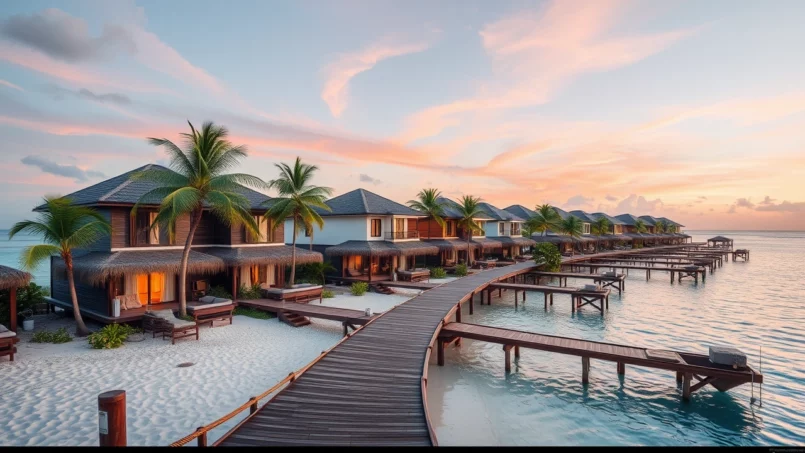
The Maldives captivate with their turquoise lagoons and overwater villas. But beyond the postcard-perfect vacation, another landscape emerges: that of expatriates who settle there to work, invest, or simply change their lives. Their reality is not that of “all-inclusive” bungalows, but of neighborhoods, rents, schools, and daily commutes. And, most importantly, a strategic choice: on which island to unpack your bags in a country fragmented into over a thousand islands?
The Maldives offer a wide variety of environments for expatriates, each with its own clientele, price level, and atmosphere. Malé provides urban density, Hulhumalé offers planned modernity, Vilimale’ a peaceful beachside feel, while Maafushi and Thulusdhoo offer a more local charm.
Malé and Greater Malé: The Urban Heart of Expat Life
For most expatriates, the starting point is simple: everything converges towards Malé and Greater Malé, this urban area that groups together Malé, Hulhumalé, Hulhulé (the airport island), and Vilimale’, plus a few industrial islands like Thilafushi or Gulhifalhu. This is where skilled jobs, government offices, hospitals, the best schools, and essential services are concentrated.
Malé, Ultra-Dense Capital and Nerve Center
Malé is both a city and an island, and above all one of the most densely populated capitals in the world. On just over 3 square miles, the population has climbed from about 20,000 inhabitants in the late 80s to over 200,000 today. Nearly a third of the country’s population lives here, not counting a “floating population” of workers from the atolls and neighboring countries.
For expatriates, Malé’s appeal is clear: everything is there. The main hospitals (including a renowned private one), most ministries, banks, major supermarkets, headquarters of Maldivian or international companies, as well as a dense network of schools, including several institutions with international or British curricula, often expensive but highly sought after.
The city is divided into several neighborhoods, each with its own vibe and expat profile.
Henveiru: The Historic Heart, Between Markets and Institutions
Henveiru is often described as the historic “heart” of Malé. This is where you find some of the country’s symbols: the old Friday Mosque, Sultan Park, the fish and produce markets, the busiest streets. Activity is intense, noise is constant, traffic is dense, and parking is nearly impossible.
This neighborhood in Malé is particularly suitable for expatriates working in administration, finance, or nearby services, as well as those seeking a very urban lifestyle with all shops and services accessible on foot. The housing stock consists mainly of apartments, often modest in size, located in densely built buildings, but benefiting from a central and convenient location.
It’s not the quietest or greenest neighborhood, but it is a logical landing spot for those who want to be at the center of everything: shops, small restaurants, cafes, banks, government offices, and major mosques.
Galolhu: Central, Active, and Practical
Galolhu is another central neighborhood with a strong mix of residential and commercial. You’ll find busy streets, shops, services, as well as important sports facilities like the national stadium and Galolhu Stadium. Historically, several major cultural sites are located in this area.
For expat families, Galolhu can appeal for its practicality: many services nearby, quick access to schools and hospitals, good transport links. However, in terms of comfort, one must accept the density, lack of parking, and a generally very built-up environment. It’s a neighborhood of compromise: functional, lively, strategic for work, less ideal for seeking peace and quiet.
Maafannu: Residential, Diverse, and More “Livable”
Maafannu is often presented as a more residential neighborhood, with a slightly calmer atmosphere than the hyper-centers. It offers a great diversity of housing: modern apartments, new buildings, but also older structures. The neighborhood has shopping centers, schools, healthcare facilities, and is relatively close to Malé’s artificial beach, a meeting point for families.
For an expatriate, the Maafannu neighborhood in Malé offers an interesting compromise: it allows you to stay in the capital, close to work, services, and schools, while moving slightly away from the hustle and bustle of the historic center. While it’s not a neighborhood of villas with gardens (Malé’s urban density doesn’t allow it), it’s one of the residential areas for middle-class Maldivian families, giving the neighborhood a relatively stable social fabric.
Machchangolhi: Commerce, Neighborhood Life, and Narrow Streets
Machchangolhi is the most “commercial” face of Malé: small shops, cafes, modest restaurants, neighborhood markets, narrow alleys where scooters, pedestrians, and deliveries mix. It’s a very local neighborhood, with a strong presence of small businesses and real street life.
For an expatriate seeking cultural immersion – living amidst the local population rather than in an international bubble – Machchangolhi has its arguments: sometimes slightly lower rents than in the most prestigious sectors, neighborhood atmosphere, proximity to many mosques and a dense commercial fabric. However, one must accept the noise, lack of space, and little greenery.
Malé Budget Side: A Tight Real Estate Market
Demographic pressure and lack of land make housing in Malé expensive, even compared to the local cost of living. For expatriates, the rent for a simple one-bedroom apartment easily reaches, according to cost of living surveys, around $650 to $1,000 USD per month, with much higher amounts for more spacious or better-located accommodations.
Estimated monthly budget in MVR for a family of four in Malé, including housing and living expenses.
Purchase prices per square meter are also high, with average city values around 4,000 MVR per square foot (comparable to urban markets in developed countries), and still around 1,500 MVR on the outskirts. In practice, central areas of Malé can exceed €5,000/m² for some properties.
Daily Life: Services, Transport, Safety
Malé is a city where everything is geographically close – you can walk across most neighborhoods in less than 15 minutes – but where the density sometimes makes getting around tedious. Many residents, including foreigners, get around by scooter. Municipal buses, operating in the Greater Malé region, complement the system, with very affordable tickets (around 10 MVR).
Regarding safety, available indices qualify Malé as relatively safe, although petty crime, street harassment, and some political tensions exist. For an expatriate, the basic recommendations apply: avoid isolated areas at night, don’t provoke, be cautious during gatherings. Religious constraints are real: it’s a 100% Muslim country, with a public ban on alcohol on inhabited islands and required modest dress codes.
Hulhumalé: The New Town Attracting Expat Families
If Malé remains the historic, administrative, and political center, Hulhumalé stands out as the new flagship address for many expatriates. This artificial island, reclaimed from the sea since the late 1990s, was designed to relieve congestion in Malé and accommodate urban growth. It is now at the heart of a vast “smart city” and “sustainable township” project.
A Planned, Modern, and Connected Island
Hulhumalé is connected to Malé and the airport island of Hulhulé by the Sinamalé Bridge and a causeway, making it a near-natural extension of the capital. Development projects plan to eventually accommodate up to 240,000 inhabitants, more than the current population of Malé.
The island is distinguished by: diverse landscapes, rich biodiversity, and a unique culture.
– wide roads,
– modern residential buildings,
– a marina,
– urban parks (including a Central Park popular with families),
– popular beaches like Huvan Beach,
– and above all, planning focused on mobility, green spaces, and services.
For expatriates, the appeal is obvious: you find better air quality than in Malé, more walking spaces, a more relaxed atmosphere, while remaining about ten minutes from the airport and a short trip from the capital.
Key Infrastructure: Health, Schools, Transport
Hulhumalé benefits, along with Malé, from the best medical services in the country. It’s one of the few areas where ambulances and emergency services are considered reliable, a major factor for families and foreign retirees.
The island also hosts several educational institutions, including international schools or those following foreign curricula:
– The British School (located in Hulhumalé) offers a British program, sports and arts activities, and support services (tutoring, counseling).
– Other institutions in the Greater Malé region – such as Villa International High School, Billabong High International School, or Ghiyasuddin International School – are easily accessible from Hulhumalé via the bus network and the bridge.
Public transport connects Hulhumalé to Malé and the airport via frequent bus lines. The airport-Hulhumalé bus ticket is around $1 USD, while a taxi between the airport and Hulhumalé generally costs between $5 and $10 USD.
Cost of Living and Rents: More Expensive, But More Spacious
Comparative data indicates that the cost of living in Hulhumalé is slightly higher than in Malé: about $2,600 USD per month versus $2,430 USD for a typical profile, i.e., 6.5% more. Regarding housing, average rents for a one-bedroom apartment hover around $650 USD per month, with much higher ranges for upscale apartments.
For the most sought-after properties (modern residences, sea view, large apartments, or penthouses), rents for long-term leases range from $3,000 to $8,000 USD per month. These prices are explained by more generous square footage, contemporary finishes, the recent construction of the residence, and amenities like a pool or gym.
A table allows for a quick comparison of some indicators Malé / Hulhumalé (in average values mentioned in sources):
| Indicator | Malé | Hulhumalé |
|---|---|---|
| Estimated Monthly Cost of Living | $2,430 USD | $2,600 USD |
| Average Rent, 1 Bedroom | ≈ $650 USD | ≈ $650 USD |
| Coffee at a Restaurant | $3.50 USD | $2.50 USD |
| Average Residential Internet Speed | 30 Mbps | 25 Mbps |
| Safety Index | 75 | 80 |
In practice, Hulhumalé particularly attracts:
– expatriate families working in Malé or at the airport,
– hospitality or airline industry executives,
– some entrepreneurs and freelancers seeking a more comfortable living environment.
Neighborhood Vibe: Between Beach, Cafes, and Parks
Hulhumalé has a much more “urban beach” image than Malé. The seaside promenade, cafes along Huvan Beach, spots frequented by young professionals, jogging paths at sunrise give a more relaxed tone.
However, one shouldn’t forget that it’s still an inhabited Maldivian island: no alcohol in restaurants, respect for dress codes on public beaches (one-piece swimsuits and cover-ups recommended, bikinis reserved for specific tourist zones), call to prayer five times a day. But, on the scale of the Maldives, Hulhumalé represents a modern and fairly cosmopolitan version of island life.
Vilimale’: The Peaceful Refuge a Stone’s Throw from the Capital
A few minutes by ferry from Malé lies Vilimale’ (often also spelled Villimalé), a small island that administratively is part of Malé City but offers a radically different atmosphere. Where Malé suffocates, Vilimale’ breathes.
A “Green City” Focused on Quality of Life
Vilimale’ is known for its beaches, relatively abundant vegetation, and some eco-friendly initiatives, grouped under the “Green City” project label. The island has an atypical past: formerly a tourist resort, it also served as a prison before being redeveloped into a residential neighborhood.
Vilimale offers expatriates the atmosphere of a calm small island, with beaches accessible on foot, very limited traffic, and a green environment. It also allows for easy access to Malé via a regular ferry service.
The profiles who settle here are often:
– NGO or environment-related organization employees,
– families seeking tranquility, willing to accept a daily commute to Malé,
– expats working remotely or with flexible hours.
Access and Daily Constraints
The main link with Malé is by boat: regular ferries make the crossing quickly, but impose a stricter schedule than a simple bus or scooter ride across the Sinamalé Bridge.
This has a real impact on the choice of schools for children, extracurricular activities, and even work schedules. For some expatriates, it’s an excellent compromise; for others, dependence on the ferry is too restrictive on a daily basis.
Local Tourist Islands: Maafushi, Thulusdhoo, Dhigurah
Beyond Greater Malé, several inhabited islands have emerged as flagship destinations for more budget-conscious travelers… and logically, as interesting bases for some expatriates, particularly tourism entrepreneurs, digital nomads, or freelancers.
Maafushi: Capital of Local Tourism and Dynamic Expat Base
Located about 30 minutes by speedboat from the capital, Maafushi is the emblematic example of “local tourism” development. The island lines up guesthouses, small hotels, dive centers, cafes, and restaurants, many run by local families. It’s even described as the “capital” of budget tourism in the Maldives.
For expatriates, Maafushi offers:
– more accessible housing costs than in Greater Malé: between $1,200 and $3,000 USD per month for well-located long-term rentals,
– a real social life, with a growing community of expats,
– strong cultural immersion (local cuisine, traditional island life),
– immediate access to renowned snorkeling spots, directly from the beach.
The island’s infrastructure is basic to moderate. It offers local clinics and services sufficient for daily life, but for serious hospitalization or international schooling, it’s often necessary to go to Malé. This island is particularly suitable for tourism professionals (guesthouse managers, dive instructors, guides), online workers without school-aged children, or young couples seeking adventure.
Thulusdhoo: Surfers’ Paradise and Creative Village
Thulusdhoo, about 45 minutes by speedboat from Malé, is the country’s most famous surf spot, with legendary waves like ‘Cokes’ and ‘Chickens’. The island cultivates a very particular image: colorful murals on facades, small beach bars (without alcohol, but with music and atmosphere), an international surf community, eco-initiatives, and the emergence of some coworking spaces.
Long-term rents generally range between $1,500 and $4,000 USD per month, which, relative to the island’s size, places it in a mid-range price bracket: more expensive than Maafushi, less costly than ultra-luxury islands.
Thulusdhoo attracts:
– digital nomads,
– long-term surfers,
– tourism entrepreneurs,
– creatives seeking an inspiring environment.
The island’s infrastructure is developing: high-speed internet is available and shared workspaces are appearing. However, schools are local and healthcare is limited to primary care. For an expatriate with children or complex medical needs, Thulusdhoo is better suited as a temporary base than for a long-term family settlement project.
Dhigurah: Discreet Luxury and Nature Immersion
Located in South Ari Atoll, Dhigurah is a long sandbank over 1.2 miles long, renowned for its waters rich in marine megafauna: whale sharks and manta rays can be observed year-round in a protected marine area.
The residential offering is limited but upscale: a few small resorts and high-end villas available for annual rental, with budgets ranging from $5,000 to $12,000 USD per month. The island has a locally managed health center and small food cooperatives, but its infrastructure remains deliberately limited to preserve the site’s exclusive character.
Dhigurah mainly attracts:
– very wealthy expatriates,
– investors focused on high-end ecotourism,
– families or couples passionate about marine biology, willing to live in isolation.
The distance is real: access is by domestic flight (about an hour) or fast speedboat from Malé, which complicates frequent trips to the capital.
A comparative table well illustrates the positioning of these three islands very popular with certain expat profiles:
| Criterion | Hulhumalé | Maafushi | Thulusdhoo | Dhigurah |
|---|---|---|---|---|
| Time from Airport | ~10 min (bridge) | ~30 min (speedboat) | ~45 min (speedboat) | ~1 hr (flight) or long speedboat |
| Monthly Rent Range | $3,000–8,000 USD | $1,200–3,000 USD | $1,500–4,000 USD | $5,000–12,000 USD |
| Infrastructure | Very comprehensive | Basic to moderate | Developing | Limited but upscale |
| Lifestyle | Modern urban | Authentic, sociable | Surf & creativity | Marine serenity, luxury |
Industrial and Service Islands: Thilafushi, Addu City, Bodu Huraa
Less prominent in tourist brochures, other islands nonetheless play a central role in the economic and expatriate life of the Maldives.
Thilafushi: The Country’s Industrial Face
Thilafushi is often referred to as the “garbage island” of the Maldives, as it long concentrated the archipelago’s waste. But it is also, increasingly, a major industrial and logistics platform: factories, warehouses, infrastructure related to construction and energy.
Thilafushi, an artificial island in the Maldives, is primarily an economic and technical activity hub for expatriates.
Thilafushi is not a typical residential destination for expatriates, but a site dedicated to professional activities.
The island mainly attracts engineers, project managers, and executives from the construction sector.
Expatriate workers typically spend the day there before returning to live in Malé or the neighboring island of Hulhumalé.
Addu City: Major Southern Hub with a Small Expat Community
In the far south of the country, Addu Atoll (Addu City) stands out for its size and infrastructure: an international airport on Gan, islands connected by causeways, a military history (former British base). Some expatriates manage guesthouses, dive centers, or travel agencies there.
Rents there are generally lower than in Greater Malé, and life has a more “provincial” feel, with less urban pressure but also fewer high-end services. For tourism entrepreneurs or retirees seeking tranquility off the beaten track, Addu can become an interesting base, provided one accepts the distance from the capital.
Bodu Huraa and Other Resort-Related Islands
Bodu Huraa is among those inhabited islands that often serve as logistical or residential bases for staff of neighboring resorts. Hotels organize boat shuttles for their employees, creating micro-expatriate communities, centered around work.
On these islands, expatriates live according to their job’s rhythm, rarely for the pleasure of the neighborhood itself. Housing is then often provided or subsidized by the employer, under very variable conditions (from a simple dorm room to more comfortable studios for executives).
Expat Neighborhoods Through the Prism of International Schools
For expatriate families, the map of “desirable” neighborhoods largely overlaps with that of international schools. In the Maldives, the latter are in fact concentrated around Malé and Hulhumalé.
Malé: Concentration of International Program Institutions
Several schools in the capital follow British or international curricula:
Presentation of the main international educational institutions located in Malé, offering globally recognized study programs like Cambridge IGCSE, A-Levels, and IB.
Combines an IB program with Cambridge IGCSE and A-Levels. Places a strong emphasis on languages and has modern facilities.
Follows the Cambridge curriculum and welcomes students from ages 6 to 16.
Offers UK National and Cambridge programs, from nursery through grade 12.
Highly regarded for its Edexcel A-Levels and links with Cambridge Assessment International Education.
Aligned with Cambridge programs, with science labs, a library, and sports facilities.
Tuition fees at these institutions can climb from $8,000 to $12,000 USD per year for some levels, making it a key expense item for expat families. These schools are mostly located in central areas of Malé (Henveiru, Maafannu, Machchangolhi, etc.), making residential proximity very attractive.
Hulhumalé: Rising Educational Power
Hulhumalé, thanks to its status as a new town, is seeing an increase in private and international school projects, starting with The British School, already established. The island’s development plans explicitly include an increase in educational and healthcare offerings, which explains the growing interest from foreign families.
For couples with children, a common lifestyle option is to choose a modern and spacious home in Hulhumalé, while ensuring children’s schooling in institutions located nearby or in Malé, accessible via the bridge.
Cost of Education: A Determining Factor
According to aggregated cost-of-living data, international primary school tuition runs around $3,600 USD per year per child, but rises significantly in Malé’s most prestigious schools. Private preschools charge an average equivalent of $160 USD per month.
A summary table gives an order of magnitude for the education budget for an expat child:
| Type of Institution | Main Location | Fee Level (order of magnitude) |
|---|---|---|
| Private Preschool / Kindergarten | Malé / Hulhumalé | ≈ 2,500 MVR / month (≈ $160 USD) |
| Standard International Primary | Malé / Hulhumalé | ≈ $3,600 USD / year |
| High-End International Schools (Malé) | Malé | $8,000–12,000 USD / year depending on level |
This budget item directly influences neighborhood choice: living near the school limits children’s commute times in an already dense urban environment, but often increases housing costs.
Desirable Neighborhoods and Expatriate Profiles: Who Goes Where?
By cross-referencing all this data – costs, services, access to schools, quality of life, type of housing – typical profiles emerge, distributed across the different islands/neighborhoods.
Executives, Families, and Investors: Hulhumalé Leads
For luxury tourism executives, hotel or airline managers, consultants, and families with children, Hulhumalé ticks many boxes: modern housing, proximity to the airport, access to the bridge to Malé, developing international schools, parks, beaches, better air quality.
Rents there are high in the upscale segments, but the incomes of these profiles (often above the average Maldivian salary, around $900 USD net per month) allow for absorbing the extra cost.
Young Professionals, International Officials, Singles: Malé Proper
Expatriates without children, or those with very young children, often prioritize Malé, to stay close to ministries, NGOs, corporate headquarters, and urban life. Henveiru and Galolhu attract more urban profiles and management positions; Maafannu and Machchangolhi, slightly more residential, appeal to those seeking a compromise between neighborhood life and accessibility.
For certain profiles, immediate proximity to the workplace, a hospital, or a school is a major advantage, which largely compensates for the lack of space and housing density.
Tourism Entrepreneurs, Digital Nomads: Maafushi and Thulusdhoo
Foreigners setting up guesthouses, dive centers, local agencies, or those living mainly from online income but wanting to enjoy a decidedly active beach environment turn to Maafushi and Thulusdhoo.
The island of Maafushi retains an advantage in terms of tourist volume and offers a more vibrant nightlife, albeit within the country’s prevailing Islamic restrictions. In contrast, Thulusdhoo attracts mainly a community of surfers and creatives, forming smaller but very tight-knit groups.
Rents there are more affordable than in Greater Malé, the atmosphere is more relaxed, but services are simpler. These are very attractive islands for “chosen” expatriation, solo or as a couple, sometimes with a horizon limited to a few years.
Ultra-Wealthy and Resident-Investors: Private Islands and High-End Projects
Another segment – very limited but visible – is that of ultra-wealthy expatriates investing in private developments like Coral Residences: villas on private islands, sold under 50-year+ leases, incorporating solar power, water recycling, a yacht club, wellness center, underwater observatory, concierge, and a rental program.
These residents live practically outside the usual circuits of inhabited neighborhoods: their “neighborhood” is a residential resort, accessible by private catamaran from Malé, with a service level designed for the needs of an international elite.
Conclusion: Choosing Your Expat Neighborhood in the Maldives, a Balancing Act
Settling in the Maldives isn’t just about choosing an atoll from a postcard. For expatriates, the real question is: what kind of neighborhood does one want – and can one afford to – live in, given one’s job, family situation, and budget?
An overview of the different living options in the Maldives, from the bustling capital to high-end island retreats, to help you choose based on your lifestyle and plans.
The capital offers urban density, all services, schools, and great proximity, at the cost of a saturated environment and very tight rents.
A modern and airy version of urban life, very attractive for families and executives, with high rents for quality properties.
A calm refuge within ferry reach, ideal for those who accept some commute to significantly gain in quality of life.
The “local tourist island” option, perfect for tourism entrepreneurs, digital nomads, and surf enthusiasts.
The ultra-high-end niches, suited for international fortunes and investors seeking returns and prestige.
Beyond the paradisiacal images, the decision is fundamentally pragmatic. It depends on priorities: schooling, healthcare, social life, nature, comfort, or the profitability of a real estate investment. In a country where the sea separates everything, the very notion of “neighborhood” takes on a unique geographic and logistical dimension. That’s what makes the charm – and complexity – of expat life in the Maldives.
Disclaimer: The information provided on this website is for informational purposes only and does not constitute financial, legal, or professional advice. We encourage you to consult qualified experts before making any investment, real estate, or expatriation decisions. Although we strive to maintain up-to-date and accurate information, we do not guarantee the completeness, accuracy, or timeliness of the proposed content. As investment and expatriation involve risks, we disclaim any liability for potential losses or damages arising from the use of this site. Your use of this site confirms your acceptance of these terms and your understanding of the associated risks.

Cyril Jarnias is an independent expert in international wealth management with over 20 years of experience. As an expatriate himself, he is dedicated to helping individuals and business leaders build, protect, and pass on their wealth with complete peace of mind.
On his website, cyriljarnias.com, he shares his expertise on international real estate, offshore company formation, and expatriation.
Thanks to his expertise, he offers sound advice to optimize his clients' wealth management. Cyril Jarnias is also recognized for his appearances in many prestigious media outlets such as BFM Business, les Français de l’étranger, Le Figaro, Les Echos, and Mieux vivre votre argent, where he shares his knowledge and know-how in wealth management.





