
 Published on and written by Cyril Jarnias
Investing in Real Estate in Dubai Marina, Downtown, and Palm Jumeirah means stepping into the heart of the most dynamic residential market in the Middle East. These three neighborhoods concentrate luxury, rental appeal, the highest price per square foot, and a large share of the international capital flows heading to Dubai. For a foreign investor, however, they do not play the same role: Dubai Marina has become the “blue-chip” value, Downtown the premium urban core, and Palm Jumeirah the global prestige asset more geared toward capital appreciation than yield.
Before signing a purchase agreement, it is essential to understand the positioning, prices, yields, and legal framework of the three flagship markets. This guide offers a strategic, data-driven perspective for non-resident investors.
A Generally Solid Market, but Entering a Maturity Phase
The general context in Dubai weighs heavily when analyzing a purchase in Dubai Marina, Downtown, or Palm Jumeirah. The market has come off several years of spectacular price increases and is moving toward a phase of more measured growth, focused on quality rather than euphoria.
The most recent data show that the residential sector remains extremely active: nearly 200,000 transactions were recorded in 2025 for a total value of approximately 538 billion AED, representing double-digit growth in both volume and value compared to the previous year. The average price per transaction is around 2.69 million AED.
In the first quarter of 2026, sales of high-end properties reached approximately 35.3 billion AED, an increase of 23% compared to the previous year.
Major research houses, however, converge on one diagnosis: after a phase of “exceptional growth” between 2023 and 2025 (12–22% annual increase), 2026 marks a transition toward slower growth, more like 3 to 8% per year, driven by the best locations, construction quality, and land scarcity. In other words, the central question for the foreign investor is no longer “is the market rising?” but “in which micro-segments will the gains concentrate?”
Legal and Tax Framework: Why Dubai Attracts Foreign Capital
Before comparing Dubai Marina, Downtown, and Palm Jumeirah, we must recall what makes Dubai one of the most welcoming real estate markets in the world for a non-resident.
Freehold Ownership in Designated Zones
All three neighborhoods we are looking at – Dubai Marina, Downtown, and Palm Jumeirah – are designated freehold zones where foreigners can buy in full ownership. The 2002 law and subsequent 2006 regulations established a simple principle: in these areas, a non‑Emirati buyer can own, sell, lease, or gift their property without nationality restrictions, without residency requirements, and without a prior visa.
You will find a wide range of assets: studios, apartments, penthouses, villas, and even plots. The buyer can choose off‑plan new builds, secondary market properties, usufruct, or long‑term leases (up to 99 years).
There is no age requirement (beyond the age of majority), no minimum stay obligation, and no need for a local sponsor. A valid passport is sufficient to conduct the transaction, although opening a local bank account makes things easier.
No Recurring Property Taxes
The main driver of foreign investor interest is fiscal. In Dubai, an individual does not pay:
Rental income is exempt from income tax, annual property tax, wealth tax, inheritance tax, withholding tax on rents, and capital gains tax on resale.
In practice, the entire gross rent (excluding service charges and management fees) and all of the capital gain stay in the owner’s pocket. There is a one‑off registration fee of 4% on the purchase price (paid to the Dubai Land Department), akin to a “stamp duty” or transfer fee, but no recurring taxes like Anglo‑Saxon property tax or occupancy tax.
The costs that must be factored into the business plan are therefore primarily:
– the DLD transfer fee of 4%,
– the agency commission (often around 2%),
– the trustee office fees (approximately 4,000–5,000 AED),
– the municipal housing contribution (5% of the rental value, collected via the water and electricity bill),
– and above all, the service charges set by RERA for each building or community.
In a rental scenario, service charges can significantly affect the net yield, especially on Palm Jumeirah where they are among the highest in the city.
Residency Visa Through Real Estate Investment
Buying a property in one of these three neighborhoods can also pave the way for a residency visa, adding a personal and wealth‑planning dimension to the investment.
Two schemes are directly relevant to the real estate investor:
– the 2‑year investor visa,
– the 10‑year Golden Visa (via the real estate route).
For the 2‑year visa, the rules were significantly relaxed in 2026: the minimum property value threshold (formerly 750,000 AED) has been removed for sole owners holding a completed property registered in their name. For joint purchases, each co‑owner must hold a share worth at least 400,000 AED.
The 10‑year Golden Visa requires a real estate portfolio valued at a minimum of 2 million AED, in completed or off‑plan properties, possibly under mortgage. The decisive condition is no longer the amount already paid but the certified value on the title deed (or Oqood for off‑plan). A 1‑bedroom apartment at Marina Cove around 2.3 million AED or a high‑end unit in Downtown or on the Palm can typically reach this threshold.
Financing for Non‑Residents: What Is a Realistic Leverage Margin?
Foreign non‑residents can access mortgage loans from several major UAE banks, but under more conservative conditions than residents.
Loan‑to‑Value Ratios and Down Payment
In practice, a non‑resident can typically expect:
– on a completed property up to 5 million AED: a maximum LTV of around 50–60%,
– above 5 million AED (common for villas on Palm Jumeirah or large penthouses in Downtown): LTV rather around 55%, sometimes less,
– on an off‑plan property: LTV capped at 50% for all profiles.
Banks require a down payment of 35 to 50% of the price for non‑residents, exceeding the 25% minimum for resident expatriates.
For an apartment in Dubai Marina at 2.5 million AED, a typical arrangement would be to finance 60% through the bank (1.5 million AED) and inject 1 million AED in equity, plus approximately 6.5% of the price for acquisition costs (DLD, agent, trustee, miscellaneous), and a liquidity buffer often required by the bank (5 to 10%).
Interest Rates and Loan Term
Mortgage rates for non‑residents in 2026 range, depending on the product, from roughly 4 to 6% per year, with fixed‑rate offers over 3 to 5 years around 4.7–5.5%, followed by a variable rate indexed to 3‑month EIBOR plus a bank margin.
For a non‑resident, the maximum mortgage term is generally 25 years, but an age constraint applies: the loan must be fully repaid by age 65 for an employee or 70 for a self‑employed person. Thus, a 55‑year‑old borrower cannot obtain a loan longer than 15 years.
Banks also require:
– a minimum monthly income, often between 10,000 and 15,000 AED equivalent,
– a satisfactory banking and credit history,
– a credit score of at least 650–700,
– a complete set of supporting documents (bank statements, payslips or financial statements, passport, etc.).
For a foreign investor targeting Dubai Marina, Downtown, or Palm Jumeirah, leverage is possible but significantly less aggressive than in other jurisdictions. The trade‑off is lower systemic risk and a natural selection of buyers.
Dubai Marina: The “Blue‑Chip” of the Residential Market
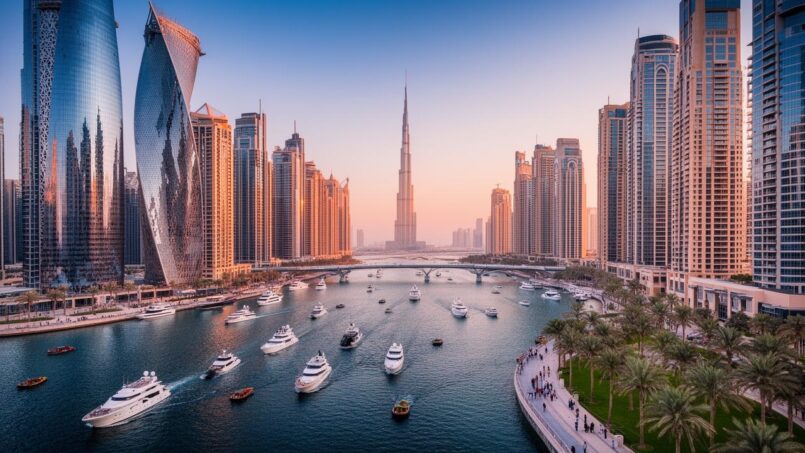
For over twenty years, Dubai Marina has established itself as the archetype of upscale urban waterfront living. Rows of glass towers, a 7‑km artificial marina, a lively promenade, and direct access to JBR beach: the neighborhood combines density, spectacular views, and a resort lifestyle.
Neighborhood Profile and Rental Demand
Dubai Marina is now considered one of the most liquid and international markets in the emirate. It has even topped the Dubai Land Department rankings in transaction value, with over 25 billion AED traded in the first half of 2025 alone.
Rental demand is driven by several very solid engines:
Discover the types of people attracted to this dynamic sector of Dubai
Professionals working in Dubai Media City, Internet City, and adjacent areas, seeking accommodation close to their workplace.
Expats who want quick access to JBR (Jumeirah Beach Residence) beach for a coastal lifestyle.
Individuals attracted by the quality of life, connectivity (metro, tram, Marina Walk), and an environment conducive to remote work.
Vacancy rates are below 3%, which translates into rapid absorption of quality units and good rental resilience.
Price Levels and Typology
Consolidated data show a wide price range, depending on the age of the tower, the view, and proximity to the water. This can be summarized as follows:
| Indicator | Dubai Marina (Apartments) |
|---|---|
| Average price per sq.ft (approx. converted from sq.m) | Equivalent to 1,800–2,600 AED/sq.ft depending on location |
| General observed range | ≈ 1,450–1,820 AED/sq.ft along Marina Walk |
| Older towers, inland view | From about 1,400 AED/sq.ft |
| Prime towers facing the marina | Over 3,000 AED/sq.ft for the best views |
| Average studio price | ≈ 1.38 million AED |
| Average 1‑bedroom price | ≈ 1.75 million AED |
| Average 2‑bedroom price | ≈ 2.92 million AED |
| Average 3‑bedroom price | ≈ 4.32 million AED |
| Average 3‑bedroom villa price | ≈ 7.86 million AED |
| Average 4‑bedroom villa price | ≈ 18.3 million AED |
In terms of rents, the average levels recorded are as follows:
| Unit Type | Average Annual Rent in Dubai Marina |
|---|---|
| Studio | ≈ 70,000 AED |
| 1 bedroom | ≈ 101,000 AED |
| 2 bedrooms | ≈ 157,000 AED |
| 3 bedrooms | ≈ 236,000 AED |
Based on this data, the average gross yield for apartments is around 5.6% to over 7% depending on the source and exact location, with a commonly cited average near 7.1% for the apartment segment. This places Dubai Marina at the high end of prime neighborhoods, while still below the 8–9% seen in more peripheral areas like JVC.
Recent Performance and Potential
Apartment prices in Dubai Marina have risen by approximately 15% between 2022 and early 2026, from an average of 2,090 to 2,400 AED/sq.ft. Over the trailing twelve months, some DLD data indicate an increase close to 16%. However, the pace of growth is slowing: quarterly growth has dropped from over 4% at the end of 2025 to about 1.8% in early 2026, a sign of a healthy plateau rather than a bubble.
For an investor, Dubai Marina appears as a core portfolio holding: high liquidity, attractive yield, very low vacancy, and international recognition. The best strategies identified for expatriates in 2026 involve targeting ready‑to‑move‑in units, on high floors with unobstructed views of the marina or the sea, and building a rental strategy tailored to new hybrid usage (remote work, mid‑term stays).
Downtown: The Iconic Urban Center – More Expensive but Liquid
Downtown plays a different role. Here, value comes not from the water but from the hyper‑center: Burj Khalifa, Dubai Mall, Dubai Opera, fountains, boulevards, and an iconic skyline. It is the most expensive neighborhood in the emirate for apartments, and one of the most sought‑after by premium tenants.
Price per Square Foot and Premium Over the Rest of the Market
All databases agree on one point: Downtown commands a significant premium over Dubai Marina and Business Bay. Price comparisons per sq.ft are particularly revealing.
| Community | Average Price per sq.ft (Order of Magnitude) |
|---|---|
| Downtown | ≈ 2,800–3,800 AED depending on segment |
| Dubai Marina | ≈ 1,800–2,600 AED |
| Business Bay | ≈ 1,200–1,900 AED |
Some finer studies even suggest an average around 3,100 AED/sq.ft for Downtown in autumn 2025, 40 to 50% more expensive than Dubai Marina and 30 to 45% above Business Bay. In the first quarter of 2026, transactions there hovered around 2,850 AED/sq.ft, up about 17% year‑on‑year.
Over the period 2022–early 2026, the neighborhood recorded an appreciation of approximately 21%, rising from 2,400 to 2,900 AED per square foot.
Price Levels and Rents
The price ranges by typology in Downtown are significant for the foreign investor comparing with Dubai Marina.
| Typology | Average Price Downtown (AED) | Average Price Dubai Marina (AED) |
|---|---|---|
| Studio | ≈ 1.36 million | ≈ 1.38 million |
| 1 bedroom | ≈ 2.39 million | ≈ 1.75 million |
| 2 bedrooms | ≈ 4.65 million | ≈ 2.92 million |
| 3 bedrooms | ≈ 8.07 million | ≈ 4.32 million |
The premium becomes particularly marked for larger units, especially when the view is directly onto Burj Khalifa or the fountains, where ultra‑luxury values reach 5,700 to over 15,900 AED/sq.ft.
On the rental side, Downtown holds up well despite its high price level, with gross yields generally observed between 5.4 and 6.2%. Average rents recorded are:
| Unit Type | Average Annual Rent Downtown |
|---|---|
| Studio | ≈ 82,000 AED |
| 1 bedroom | ≈ 132,000 AED |
| 2 bedrooms | ≈ 227,000 AED |
| 3 bedrooms | ≈ 382,000 AED |
Combining these rents with average prices yields a gross average yield of around 5.2–5.3% for apartments, slightly lower than Dubai Marina but with a very robust demand profile and excellent resale market depth.
Downtown or Dubai Marina? A Yield vs. Prestige Trade‑off
The choice between Downtown and Dubai Marina often comes down to the investor’s priorities.
For a higher gross yield and a more accessible entry ticket, choose Dubai Marina (≈ 7.1%). For exposure to the iconic city center with strong global demand and appreciation potential, opt for Downtown (≈ 5.2% yield but a capital‑gain‑focused profile). Both are prime sectors combining rental profitability and upside potential.
Palm Jumeirah: A Global Prestige Asset, More About Capital Than Yield
Palm Jumeirah plays in a different league. This man‑made palm‑shaped island has become an international symbol, where price records are set one after another, especially in the waterfront villa segment. It is the most expensive market in Dubai, and its positioning is very clear: capital preservation and growth first, yield second.
Price Explosion and Maturity Phase
Since 2021, prices on Palm Jumeirah have skyrocketed, with impressive increases in the luxury segment: one study cites a 386% increase in ultra‑luxury property prices since 2021. In 2025, secondary villas on the Palm recorded annual increases of 17–18%, far outstripping markets like London, New York, or Singapore.
Branded residences can reach over 7,000 AED per square foot.
Recent progress is equally striking: between 2022 and the first quarter of 2026, the average price per sq.ft on the Palm is estimated to have risen from about 1,850 to 2,750 AED, an increase of nearly 49% in four years. Combined with rental income, a 2022 buyer can easily achieve over 60% total cumulative return by 2026.
Recent signals, however, indicate a normalization: annual growth is now more in the range of 4–8% depending on the segment, far from the surges of the 2020–2024 period. The market is increasingly segmenting between:
– older, unrenovated stock with stagnating prices,
– new, renovated, serviced, or very well‑positioned products (tip of frond, branded residences) that continue to appreciate strongly.
Prices and Yields by Typology
For an investor, the big difference from Dubai Marina and Downtown lies in the yield / entry ticket combination. Average figures give a clear picture:
| Typology (Palm Jumeirah) | Average Price (AED) | Average Rent (AED/year) | Approx. Gross Yield |
|---|---|---|---|
| Studio (Bayut average) | ≈ 1.65 million | ≈ 105,000 | ≈ 6.4% |
| 1 bedroom (Bayut average) | ≈ 2.8 million | ≈ 165,000 | ≈ 5.9% |
| 2 bedrooms | ≈ 5.1 million | ≈ 280,000 | ≈ 5.5% |
| 4‑bedroom villa | ≈ 25 million | ≈ 950,000 | ≈ 3.8% |
On average, apartments on Palm Jumeirah offer a gross yield of around 5 to 5.6%, with peaks around 6.4% on the best‑positioned studios. Villas, on the other hand, tend to run around 3 to 4% gross, which, after service charges and management fees, often translates to 2.5 to 3.5% net.
Another dataset summarizes the situation well.
| Palm Jumeirah Segment | Typical Gross Yield | Net Yield After Service Charges |
|---|---|---|
| Apartments (long‑term) | 4.5–6% | 3.5–4.5% |
| Branded residences (long‑term) | 4.5–5.5% | 3.5–4.5% |
| Villas (long‑term) | 3–4% | 2.5–3.5% |
| Short‑term rentals (apartments) | 7–9% gross | 5–7% net (if well managed) |
High service charges partly explain these moderate net yields: on average around 23 AED/sq.ft per year, and up to 30–38 AED/sq.ft in some luxury buildings. On a 1,200 sq.ft unit, the annual bill easily exceeds 27,000–30,000 AED, which weighs on the yield.
STR and Ultra‑Luxury: More Lucrative Niches
Where Palm Jumeirah stands out is in two sub‑markets:
1. Vacation rentals (short‑term rentals) for well‑decorated apartments, especially studios and 1‑2 bedrooms on the trunk, close to beaches and clubs. 2. Ultra‑luxury villas catering to a very wealthy international clientele, generating enormous absolute rents, even if the relative yield remains modest.
Operating data from platforms and specialized managers show that:
Annual gross income for a well‑managed premium 1‑bedroom in Dubai.
On the villa segment, absolute numbers are spectacular: a garden home at 35 million AED can generate between 1.8 and 2.2 million AED in gross short‑term rental income, a 5.1 to 6.3% gross yield. But the entry barrier is very high, and the investor is buying first and foremost an address, a lifestyle, and a wealth‑preservation asset.
In summary, Palm Jumeirah is above all a capital growth and prestige strategy. The data message is clear: “It is a parking spot for global long‑term capital rather than a cashflow machine.” For a foreign investor seeking income, the most efficient segments (Shoreline/Golden Mile apartments, managed STR residences) should be targeted, or one should turn to Dubai Marina and Downtown for a better yield / entry ticket balance.
Comparing Marina, Downtown, and Palm: Who Is Each For?
Putting the three neighborhoods side by side quickly reveals whom each is for.
Overview of Prices and Yields
| Neighborhood | Average Price per sq.ft (Apartments) | Typical Gross Yield | Dominant Profile |
|---|---|---|---|
| Dubai Marina | ≈ 1,800–2,600 AED | 5.5–7.1% | Yield/Capital mix |
| Downtown | ≈ 2,800–3,800 AED | 5.2–6.2% | Capital + Prestige |
| Palm Jumeirah | ≈ 2,600–3,800 AED (apartments) | 4.5–6% (apt), 3–4% (villas) | Prestige/Capital |
Some practical takeaways emerge:
For a first investment with high liquidity and good yield, choose Dubai Marina. For exposure to the hyper‑center and long‑term value growth, Downtown is recommended despite a slightly lower yield. Finally, for a showcase asset and strong capital protection, opt for Palm Jumeirah, accepting a lower net yield.
Unit Sizes and Typical Budgets
Average unit sizes in Dubai Marina and Downtown are comparable: a 1‑bedroom often ranges between 570 and 1,200 sq.ft in both neighborhoods. The differences are mainly in price per square foot.
Some order‑of‑magnitude budgets:
| Unit Type | Dubai Marina (Range) | Downtown (Range) | Palm Jumeirah (Order of Magnitude) |
|---|---|---|---|
| Studio | 0.9–1.35 million AED | 1.34–1.6 million AED | ≈ 1.6–2.5 million AED |
| 1 bedroom | 1.6–2.6 million AED | 1.9–2.5 million AED (standard), up to 4.5 million with Burj view | ≈ 2.5–5 million AED |
| 2 bedrooms | 2.6–4.5 million AED | 3–8 million AED | ≈ 4–10 million AED |
This table highlights two realities:
– For the same typology, Downtown commands a substantial premium over Dubai Marina,
– Palm Jumeirah quickly escalates in price as soon as you move beyond the smallest apartments.
Purchase Process for a Foreigner: Steps and Key Points
Whether for Dubai Marina, Downtown, or Palm Jumeirah, the purchase process follows the same highly regulated framework.
After defining your objectives (income, capital gain, personal use, or a mix), the investor must work with an agent holding a RERA broker card, verifiable via the Dubai REST app or the official register. It is strongly recommended to cross‑check listed prices with DLD transaction data for comparable units to avoid overpaying in highly publicized neighborhoods.
The typical process includes: types of training, practical internships, integrative projects, and competency‑based assessment.
Search and viewings (physical or showrooms for off‑plan) with verification of quality, DEWA charges, and maintenance. Signing an MOU (Form F) or developer SPA, deposit of 10% of the price (secondary market) or 5–20% (off‑plan), and written clarification on whether any EOI is refundable. Obtaining the developer’s NOC (3 to 10 days, fee 500–5,000 AED) confirming no outstanding dues. Transfer at a DLD trustee office: payment of 4% DLD, final signature, and issuance of the title deed within 24–48 hours, possible by power of attorney for foreign buyers.
Total additional costs (DLD 4%, agency ≈2%, trustee, DEWA connections, insurance, etc.) typically amount to 7 to 10% of the purchase price, to be included in any real yield calculation.
How to Position Your Investment According to Your Profile
The foreign investor looking at Dubai Marina, Downtown, and Palm Jumeirah must first clarify their hierarchy of objectives: net income, value growth, prestige, personal use, Golden Visa eligibility.
Some typical strategies, in light of the data:
Four approaches based on your goals: yield, appreciation, prestige, or long‑term residence
Target a 1‑ or 2‑bedroom in Dubai Marina, high floor with unobstructed view, in a building from a reputable developer (Emaar, Select Group, LIV, Sobha…). Aim for 6–7% gross yield with strong rental liquidity.
Acquire a 1‑ or 2‑bedroom in Downtown with a Burj view or overlooking Mohammed Bin Rashid Boulevard. Accept a slightly lower gross yield for continued appreciation driven by the scarcity of the hyper‑center.
Buy an efficient apartment on Palm Jumeirah (Shoreline, Golden Mile, Tiara…) for the “Palm” cachet without extreme service charges. For high net worth, opt for a garden home or signature villa focused on capital appreciation and personal use.
Structure a purchase around the 2 million AED threshold: a 1‑bedroom in Marina Cove, Peninsula Four (Business Bay), Downtown, or on the Palm. Combine real estate investment with a 10‑year long‑term residency.
In any case, the 2026 market is more selective than at the peak of the speculative phase: buyers are comparing payment plans, construction quality, building management, rental relevance more closely. The era of easy capital gains on any product in a prime zone appears over; an era of growth driven by the best assets is settling in.
Conclusion: Choosing Among Three Market Locomotives
Real Estate in Dubai Marina, Downtown, and Palm Jumeirah: A Guide for Foreign Investors – the title itself sums up the stakes. These three neighborhoods are the locomotives of Dubai’s residential market, each with its own investment DNA:
– Dubai Marina, a “blue‑chip” value combining good yield, excellent liquidity, strong international recognition, and a still reasonable entry ticket for a prime neighborhood.
– Downtown, the iconic hyper‑center, more expensive, whose figures attest to a high revaluation capacity and solid rental demand driven by unique urban assets.
– Palm Jumeirah, a prestige island where net yield is sacrificed in favor of scarcity, capital security, and long‑term capital gains in the most qualitative sub‑markets (renovated villas, branded residences, premium STR products).
Dubai offers foreigners freehold ownership, no income tax or property tax, and a residency visa tied to real estate, allowing investors to combine attractive gross yield, potential capital appreciation, near‑zero taxation, and long‑term residency.
For a foreign investor, the key is to read the numbers beyond the marketing: actually compare the price per square foot, the cost of service charges, verified rents, building and management quality, and to work with a RERA agent and ideally independent legal counsel. That is how Dubai Marina, Downtown, or Palm Jumeirah will become, not merely prestigious names on a title deed, but solid lines in an international investor’s portfolio.
A wealth planning project or a question? Contact us now to speak with a wealth management expert.
Disclaimer: The information provided on this website is for informational purposes only and does not constitute financial, legal, or professional advice. We encourage you to consult qualified experts before making any investment, real estate, or expatriation decisions. Although we strive to maintain up-to-date and accurate information, we do not guarantee the completeness, accuracy, or timeliness of the proposed content. As investment and expatriation involve risks, we disclaim any liability for potential losses or damages arising from the use of this site. Your use of this site confirms your acceptance of these terms and your understanding of the associated risks.

Cyril Jarnias is an independent expert in international wealth management with over 20 years of experience. As an expatriate himself, he is dedicated to helping individuals and business leaders build, protect, and pass on their wealth with complete peace of mind.
On his website, cyriljarnias.com, he shares his expertise on international real estate, offshore company formation, and expatriation.
Thanks to his expertise, he offers sound advice to optimize his clients' wealth management. Cyril Jarnias is also recognized for his appearances in many prestigious media outlets such as BFM Business, les Français de l’étranger, Le Figaro, Les Echos, and Mieux vivre votre argent, where he shares his knowledge and know-how in wealth management.





