
 Published on and written by Cyril Jarnias
Malaysia, an emerging Southeast Asian country, offers a diverse and rapidly expanding real estate market. With its sustained economic growth and appeal to foreign investors, the country presents attractive opportunities in the real estate sector. This article provides an in-depth analysis of real estate prices in major Malaysian cities and explores market evolution prospects.
The Malaysian Real Estate Landscape: A Kaleidoscope of Prices and Opportunities
The Malaysian real estate market is characterized by significant price diversity across its different cities. This variation reflects the economic, demographic, and cultural disparities that exist within the country.
Kuala Lumpur, the Bustling Capital
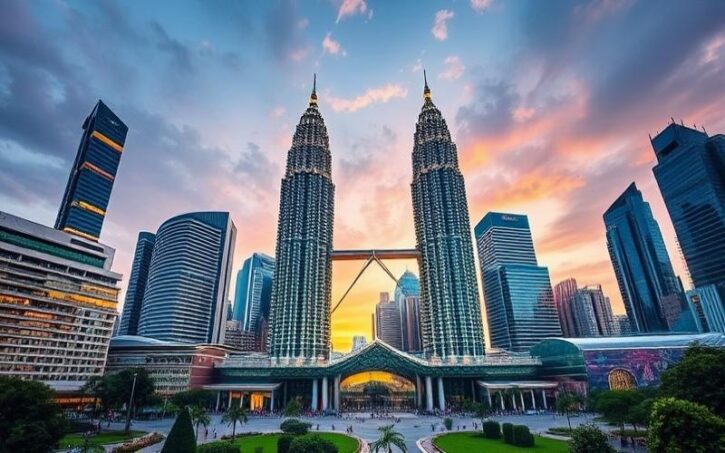
Kuala Lumpur, the capital and economic center of Malaysia, displays the highest real estate prices in the country. In the city center, the average price per square meter for a luxury apartment can reach 7,000 to 9,000 Malaysian ringgit (RM), approximately $1,400 to $1,800. Prime areas like KLCC (Kuala Lumpur City Centre) or Bukit Bintang even see prices exceeding 10,000 RM/m² for high-end properties.
In the suburbs, prices are more affordable, ranging between 4,000 and 6,000 RM/m² for mid-range apartments. Popular residential areas like Petaling Jaya or Subang Jaya offer a good compromise between accessibility and quality of life.
Penang, the Island of Real Estate Treasures
Penang, the country’s second economic hub, also experiences strong real estate demand. In George Town, a UNESCO World Heritage site, prices can range between 5,000 and 7,000 RM/m² for well-located apartments. Coastal areas like Batu Ferringhi or Tanjung Bungah, popular among expatriates and foreign retirees, display similar or even higher prices for properties with sea views.
Johor Bahru, the Gateway to Singapore
Johor Bahru, located at the border with Singapore, benefits from its proximity to the city-state to attract investors. Real estate prices there are generally more affordable than in Kuala Lumpur, with quality apartments available between 3,500 and 5,500 RM/m². Development projects like Iskandar Malaysia have stimulated the local market, with new properties showing higher prices, around 6,000 to 8,000 RM/m².
Kota Kinabalu, the Pearl of Borneo
In Kota Kinabalu, the capital of Sabah state on Borneo island, the real estate market is booming. Average prices for quality apartments range between 4,000 and 6,000 RM/m². Coastal areas and new developments like Likas Bay or Tanjung Aru can reach higher prices, up to 7,000 to 8,000 RM/m² for high-end properties with sea views.
Good to Know:
Real estate prices in Malaysia vary considerably from one city to another, with Kuala Lumpur leading the ranking. Investors can find interesting opportunities in secondary cities like Penang or Johor Bahru, offering good growth potential at more affordable prices.
Trends and Prospects: Towards a Contrasted Evolution of the Malaysian Real Estate Market
The future of the Malaysian real estate market looks promising, but with important nuances depending on regions and market segments. Several factors will influence price evolution in the coming years.
Sustained Economic Growth
Malaysia is expected to maintain robust economic growth in the coming years, which will support real estate demand. According to World Bank forecasts, Malaysian GDP should grow by 4.3% in 2025 and 4.4% in 2026. This economic growth will likely translate into moderate but steady increases in real estate prices in the country’s main cities.
Favorable Government Policies
The Malaysian government has implemented several initiatives to stimulate the real estate market and attract foreign investors. The Malaysia My Second Home (MM2H) program, although recently revised with stricter conditions, continues to attract foreign retirees and investors. Additionally, efforts to develop special economic zones like Iskandar Malaysia in Johor or the Tun Razak Exchange in Kuala Lumpur should support real estate demand in these regions.
Growing Urbanization
Rapid urbanization in Malaysia will continue to fuel housing demand in large cities. According to United Nations projections, the country’s urbanization rate should reach 80% by 2030. This trend will exert upward pressure on real estate prices in urban centers, particularly in Kuala Lumpur and surrounding satellite cities.
Persistent Regional Disparities
Real estate price evolution is expected to remain uneven between different regions of the country. Kuala Lumpur and its metropolitan area should continue to record the strongest price increases, with estimated annual growth between 3% and 5% for the coming years. Secondary cities like Penang and Johor Bahru might experience more moderate growth, around 2% to 4% per year.
A Luxury Market Under Pressure
The luxury segment, particularly in Kuala Lumpur, might experience a period of stabilization, or even a slight price decrease. The oversupply of high-end properties in certain areas of the capital has led to excess supply, which could hinder price growth in this segment. Investors might turn more towards mid-range properties offering better value for money.
The Impact of Sustainable Development
The growing trend towards eco-friendly and sustainable buildings should influence the Malaysian real estate market. Green-certified properties might see their value increase faster than conventional buildings, due to rising demand for environmentally friendly housing.
The Rise of the Rental Market
With increasing living costs and growing difficulty for young Malaysians to access homeownership, the rental market should experience strong growth. This trend could stimulate investment in properties intended for rental, particularly in high-density urban areas.
Good to Know:
The prospects for the Malaysian real estate market are generally positive, with expected growth in most regions. However, investors must remain attentive to regional disparities and specific evolutions in each market segment to optimize their investments.
Conclusion: A Dynamic Market Offering Great Opportunities
The Malaysian real estate market presents a contrasted picture, with significant price variations between different cities and regions of the country. Kuala Lumpur remains the most expensive and dynamic market, but cities like Penang, Johor Bahru, and Kota Kinabalu offer interesting alternatives for investors seeking good value for money.
Price evolution prospects are generally positive, supported by robust economic growth, increasing urbanization, and favorable government policies. However, investors must remain vigilant regarding regional disparities and potential price corrections in certain market segments, particularly luxury.
To make the most of the Malaysian real estate market, it is essential to understand local dynamics, emerging trends like sustainable development, and specific opportunities in each city. A diversified approach, combining different locations and property types, could help maximize returns while minimizing risks.
Disclaimer: The information provided on this website is for informational purposes only and does not constitute financial, legal, or professional advice. We encourage you to consult qualified experts before making any investment, real estate, or expatriation decisions. Although we strive to maintain up-to-date and accurate information, we do not guarantee the completeness, accuracy, or timeliness of the proposed content. As investment and expatriation involve risks, we disclaim any liability for potential losses or damages arising from the use of this site. Your use of this site confirms your acceptance of these terms and your understanding of the associated risks.

Cyril Jarnias is an independent expert in international wealth management with over 20 years of experience. As an expatriate himself, he is dedicated to helping individuals and business leaders build, protect, and pass on their wealth with complete peace of mind.
On his website, cyriljarnias.com, he shares his expertise on international real estate, offshore company formation, and expatriation.
Thanks to his expertise, he offers sound advice to optimize his clients' wealth management. Cyril Jarnias is also recognized for his appearances in many prestigious media outlets such as BFM Business, les Français de l’étranger, Le Figaro, Les Echos, and Mieux vivre votre argent, where he shares his knowledge and know-how in wealth management.





