
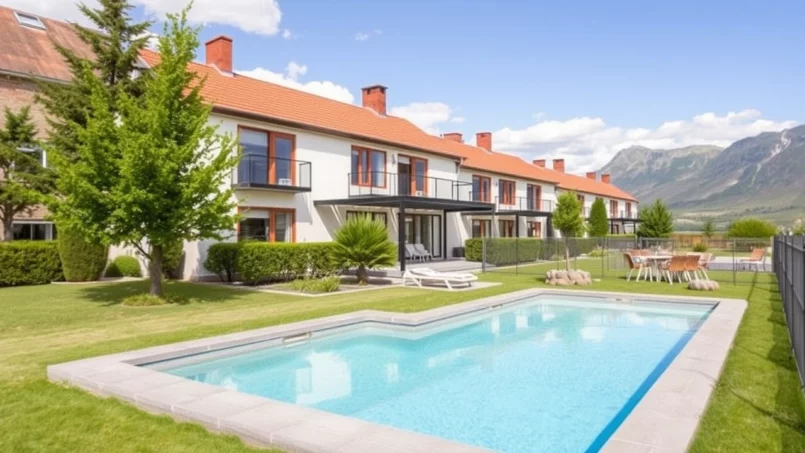
 Published on and written by Cyril Jarnias
Settling in Bolivia for several months or even years is attracting more and more expats, retirees, and digital nomads seeking lower costs of living and a slower pace. Renting a long-term home in Bolivia is by no means trivial: the legal framework is specific, the market is highly segmented between traditional rentals and platforms like Airbnb, and the risk of scams exists, especially for foreigners.
Good to know:
This article, based on market data and Bolivian law, provides a practical guide to understanding prices, choosing the right rental format, securing your contract, managing utilities, and avoiding common pitfalls.
Understanding the Bolivian Rental Context
The rental real estate market in Bolivia operates quite differently from that of many developed countries. However, for those who know how to go about it, it is possible to live in a comfortable apartment for a few hundred dollars a month in the best neighborhoods of major cities.
Warning:
Residential leasing is governed by the Civil Code (Articles 685 to 712) and the 1959 Tenancy Law. It is considered a matter of public order: contractual clauses cannot deviate from the fundamental protective rules for tenants.
Another key point: in matters of rental, foreigners have the same rights as Bolivians. Equal treatment is guaranteed by immigration law. Restrictions for non-nationals mainly concern the purchase of rural land or property near borders, not standard urban rentals.
Two Main Paths for Housing: Airbnb or Traditional Rental
For a long-term stay, two main options coexist:
– going through Airbnb (or aparthotels),
– taking the traditional route: real estate agency, formal contract, generally unfurnished accommodation.
When to Favor Airbnb
Airbnb has established itself in Bolivia, with about 5,000 listings across the country, mostly apartments or individual houses. This model is especially suitable:
– for newcomers who want to “land softly” for a few weeks or months,
– for those who do not want to buy furniture or manage the setup of services (water, electricity, internet, gas).
Good to know:
Airbnb accommodations are almost always furnished, with utilities included (or largely integrated) and assistance provided if problems arise. The price difference with traditional rentals remains notable, but it is less pronounced than in wealthy countries.
On average, we observe:
| Type of property | Method | Average monthly rent (USD) |
|---|---|---|
| 1 bedroom, attractive neighborhood | Airbnb | ~350 |
| 1 bedroom, attractive neighborhood | Traditional | ~200 |
| Individual house (family) | Airbnb | ~1,600 |
| Individual house (family) | Traditional | ~700 |
Airbnb is therefore generally 20 to 50% more expensive than a standard rental, but includes peace of mind: turnkey accommodation, furnishings, and services already in place. For stays of a few weeks to a few months, the extra cost is often acceptable. For a project longer than six months, the bill eventually adds up.
Why Traditional Rental Becomes More Interesting in the Long Run
As soon as we talk about a stay of at least six months, and especially beyond a year, the traditional rental becomes significantly more economical. The ratios are striking: in large cities, a good apartment rented the traditional way often costs 25 to 40% of the price of an equivalent property in a developed country, while an Airbnb tends to be between 20 and 35%.
Example:
A few examples drawn from average data, concretely illustrating the trends or typical values presented in the article.
| Type of property / Good neighborhood | Traditional (USD) | Airbnb (USD) |
|---|---|---|
| 1 bedroom, sought-after neighborhood | 250 – 350 | ~450 |
| 2 bedrooms, sought-after neighborhood | ~450 | ~600 |
| 3 bedrooms, sought-after neighborhood | ~600 | ~900 |
| Standard family house | ~1,400 (trad.) | ~1,800 |
| High-end family house | ~2,500 (trad.) | ~3,500 |
The gap is particularly noticeable for individual houses and large apartments. At the other end of the spectrum, in more modest (and even unsafe) areas, it is possible to find:
– a studio around USD 100–120,
– a three-room around USD 250.
These extremely low rents often come with infrastructure problems, inefficiencies, and safety risks. In practice, no expatriate resides in these very deteriorated neighborhoods.
To maintain a comfort level close to that of a developed country, experts recommend following the choices of the upper-middle Bolivian classes: aim for good urban neighborhoods and decent buildings, without necessarily seeking luxury.
What Budget for Long-Term Housing?
Market figures provide a precise idea of what to expect, depending on the standard of living targeted.
What Bolivians Pay, According to Their Income Level
Local spending habits provide an initial reference:
| Household profile | Monthly rent 1 bedroom (USD) | Total housing expenses (USD) | Cost per day (USD) |
|---|---|---|---|
| Modest household | ~120 | ~150 | ~5 |
| Middle-class household | ~200 | ~250 | ~8 |
| Upper-middle-class household | ~350 | ~500 | ~17 |
It is clear that an expat living like a local upper-middle class can very reasonably plan on USD 350 in rent for a good one-bedroom, and around USD 500 including utilities and basic administrative fees.
Price Levels by Property Type
Data gathered from various urban markets yields these typical ranges for traditional rentals (properties in good condition, decent neighborhoods):
| Type of rental (traditional) | Typical monthly rent (USD) |
|---|---|
| Studio or 1 bedroom “cheap” | 200 – 250 |
| 1 bedroom good quality | 300 – 350 |
| 2 bedrooms modest | ~250 |
| 2 bedrooms standard | ~450 |
| 3 bedrooms standard | ~600 |
| 3 bedrooms high-end | 1,000 – 1,200 |
| Standard family house | 700 – 1,400 |
| High-end single-family house | 1,500 – 2,500 |
| Top houses in the most upscale neighborhoods | ~1,500 |
The very low extremes (USD 100–120 for a small home, USD 250 for a large one) correspond to areas considered unsafe. At the other end, very luxurious houses via Airbnb can reach USD 3,500 per month.
Price Differences by City
Prices vary from one major city to another. The following figures, drawn from market data, provide an order of magnitude for traditional rents:
| City | Studio (USD) | 1 br (USD) | 2 br (USD) | 3 br (USD) | 4+ br (USD) |
|---|---|---|---|---|---|
| Santa Cruz | 400 | 400 | 550 | 650 | 750 |
| Cochabamba | 330 | 300 | 380 | 450 | 750 |
| La Paz | 350 | 362 | 376 | 550 | 1,000 |
Note: Santa Cruz de la Sierra is described as one of the most profitable cities in South America for rental investment, with gross yields around 6 to 8% per year. In Cochabamba and La Paz, gross yields are also around 6–7%. Part of these figures translates into slightly higher rents in highly demanded central areas.
Weight of Rent in the Cost of Living
On average, living alone in Bolivia (including rent) costs:
– around USD 715 per month according to one estimate,
– or about USD 1,120, according to another methodology covering several cities.
300-550
The housing and utilities share in budgets in Bolivia, varying by city and standard, in US dollars.
| Comparison | Cost difference vs. Bolivia |
|---|---|
| Cost of living without rent – Canada | +56.2% |
| Cost of living with rent – Canada | +60.5% |
| Rent – Canada | +71.2% |
| Cost of living without rent – USA | +60.4% |
| Cost of living with rent – USA | +66.5% |
| Rent – USA | +78.7% |
For a foreigner coming from a developed country, the exchange rate effect and price differential make Bolivian rents very attractive, even in the best neighborhoods.
Legal Framework of Long-Term Rentals
To rent serenely over the long term, it is crucial to understand the main principles of Bolivian rental law. They structure the landlord-tenant relationship, limit certain abuses, and set the conditions for termination or eviction.
Lease Duration and Contractual Freedom
The legislation does not set a mandatory minimum duration for a residential lease. In theory, a property can be rented for a single day. However, for residential leases, practice tends to settle around:
– one-year leases, often renewable,
– sometimes longer durations, as long as they do not exceed 10 years, the cap provided by the Civil Code.
In the absence of a specified duration, certain supplementary rules apply. Many contracts also provide that upon expiration, if no one formally requests termination, the lease converts into a renewable monthly contract (month-to-month).
Tenant Rights and Obligations
Bolivian law emphasizes several major protections for the tenant:
– right to a habitable dwelling: sound structure, basic installations (water, electricity, sanitation) compliant with municipal standards;
– right to privacy: the landlord may only enter with reasonable notice, except in an emergency;
– right to non-discriminatory treatment: impossibility of refusing a tenant on grounds of race, religion, sex, origin, family status, etc.;
– protection against arbitrary eviction: a legal reason and judicial procedure are required.
In return, the tenant must: pay the rent on time as agreed and fulfill other obligations stipulated in the lease.
Tip:
To maintain a good relationship with your landlord and avoid disputes, it is crucial to meet your main tenant obligations. This includes paying rent on the agreed date, using the property only as a residence, and not engaging in illegal activities. You must also handle minor routine repairs and maintenance. Finally, it is your responsibility to preserve the rented property and inform the landlord without delay of any structural problem or significant deterioration.
Subletting or assignment of the lease is generally prohibited without the landlord’s written consent. However, a contract may expressly allow it.
Interesting legal anecdote: in the event of the tenant’s death or definitive departure, the lease continues for the benefit of their direct ascendants or descendants, which protects the family against abrupt eviction.
Landlord Rights and Obligations
The landlord naturally retains the right to: ensure that the property is used in accordance with the terms of the contract and applicable legislation.
– set the amount of rent and the rules of use of the property, within the legal framework,
– collect rent on the agreed dates, and apply late payment penalties provided for in the contract,
– initiate an eviction procedure in case of non-payment or serious breach of clauses.
But he is subject to strict duties:
– deliver a property that is sound and compliant with hygiene and safety rules,
– cover major works (structure, water/electricity networks, plumbing),
– respect the tenant’s peaceful enjoyment of the property,
– pay property taxes and the monthly tax on rental income (RC-IVA), which can never be transferred to the tenant.
100000-500000
Amount of fines, in bolivianos, provided for landlords refusing to rent to national tenants or to married couples with children.
Security Deposit and Rent Determination
In practice, the security deposit requested generally ranges between one and three months’ rent, depending on whether the property is furnished or not. It must be returned within about 30 days after the end of the lease, less any unpaid rent or abnormal damage.
Regarding the level of rent, the old Tenancy Law theoretically limited rent to 10% per year of the revised cadastral value of the property. In reality, the market has largely liberalized, although mechanisms for controlling increases remain, particularly in La Paz, where increases:
– can only occur once a year,
– must be notified in writing 90 days in advance.
Rent must be paid in the currency specified in the contract. Rents denominated in US dollars exist, often accompanied by clauses referencing a value unit (UFV) to adjust for inflation.
Lease Termination and Eviction
A lease can end: by the arrival of the term specified in the contract, by agreement between the parties, by breach of obligations stipulated in the lease, or by judicial termination requested by one of the parties.
– by mutual agreement,
– at the expiration of the agreed duration,
– for legal cause: repeated non-payment, illicit use of the property, unauthorized subletting, etc.
Warning:
Terminating a lease generally requires a written notice of about 30 days. An early departure by the tenant may result in penalties, such as the total or partial loss of the security deposit or payment of a percentage of the remaining rent due.
Eviction, for its part, follows a precise procedure:
– 1. written formal notice (with a 5 to 10 day period to regularize payment, for example);
2. referral to the competent civil judge in verbal-summary proceedings (theoretical deadline of 15 days);
3. obtaining an eviction order;
4. granting the tenant a period to vacate the premises:
– 30 days for a room,
– 60 days for an apartment,
– 90 days for an entire house.
The tenant may request this period at any time during the procedure, and the judge is required to grant it. Savage evictions (changing the locks, willful cutting of water or electricity by the landlord) are in principle contrary to the law.
Dispute Resolution
In case of conflict, several avenues exist:
– direct negotiation, encouraged but often limited if the relationship has deteriorated;
– mediation or arbitration (when provided for in the contract), faster than court;
– referring the matter to the Housing Commissariats (Comisarías de Vivienda), capable of:
– examining complaints related to leases,
– imposing fines ranging from tens of thousands to several hundred thousand bolivianos;
– recourse to civil courts, competent for evictions and damages.
Decisions of the Housing Commissariats can be challenged before the mayor of the municipality, who then renders a final decision.
The Practical Process of a Traditional Rental
Beyond the legal framework, renting long-term via the classic route involves a series of concrete steps, with documents, costs, and real precautions to take.
Preparing Your Papers and Status
A foreigner wishing to rent long-term will generally need to provide:
– a valid passport;
– a tourist visa for a stay of less than three months, or a residence permit / foreigner card for a long-term stay;
– sometimes proof of income (pay stubs, recent bank statements);
– references from a previous landlord or a Bolivian guarantor for the most formal leases.
Immigration law guarantees that foreigners can sign a lease like a Bolivian citizen, but in practice, some landlords are more comfortable with a local guarantor.
Finding a Property: Recommended Agencies and Platforms
The Bolivian rental market does not have an MLS (centralized filing system) like in the United States. Listings are scattered among:
– real estate agencies,
– listing websites,
– newspapers,
– “Se Alquila” signs on facades,
– and social networks (including Facebook Marketplace, widely used but riddled with risks).
Experts strongly recommend focusing, for a first lease, on well-established international agencies:
– ReMax,
– Century 21.
Good to know:
Two main networks accumulate about 3,000 sales and rental listings across the country, offering a minimum of professionalism, traceability, and verification of mandates. For a foreigner, it is more difficult to sort through serious local agencies, such as Firmas Propiedades in La Paz, Servial Inmobiliaria in Cochabamba, or UNO Corporación in Santa Cruz.
Portals like Ultracasas.com, Infocasas.com, or Inmobiliaria.com centralize part of the supply, but do not necessarily filter out scams. As for classified ads in the press (El Deber, El Diario, Los Tiempos, Correo del Sur), they remain a lead, to be handled with caution.
Checking the Property and the Landlord: the “Informe Rápido”
Before any signature, it is strongly recommended to obtain an Informe Rápido. This document, costing USD 15 to 20, summarizes:
– the identity of the legal owner,
– the characteristics of the property,
– the possible existence of mortgages, seizures, or disputes.
It ensures that the person renting has the right to do so, and that the property is not tangled in a legal mess. This document is one of the best protections against fake landlords and fraudulent schemes.
Hiring a Lawyer… and Choosing Very Carefully
Hiring a lawyer to oversee the lease is strongly recommended. Reasonable fees for handling a rental case, according to collected data, are between USD 50 and 100 (other sources mention higher ranges, USD 200–500, for comprehensive support).
However, the average reputation of the profession is poor: many actors are known to be unscrupulous, especially with foreigners. Hence some practical advice:
Tips for a Secure Investment in Bolivia
Key recommendations for foreign investors wishing to protect their interests and minimize risks when concluding a contract in Bolivia.
Seek Official Recommendations
Consult your embassy or a major Bolivian bank for advice and reliable references.
Have the Contract Legally Checked
Systematically submit the contract for review by several independent lawyers for a complete legal analysis.
Avoid Informal Sources
Be wary of advice found only through classified ads or social media; prioritize official channels.
A good lawyer will help: defend your rights, advise you on legal procedures, represent your interests in court, and negotiate settlements in your favor.
– decode the lease clauses,
– confirm that nothing violates the law (abusive clause),
– oversee the creation of a public deed (escritura pública) if you choose this level of protection.
Verbal Contract, Private Contract, or Public Deed?
Bolivian law accepts three forms of lease:
1. Verbal contract (simple oral agreement and payment receipts),
2. Private written contract, signed between the parties,
3. Public deed (escritura pública), drawn up by a notary and registered.
In practice:
– the verbal contract is to be totally avoided for a foreigner: no security in case of a dispute;
– the private contract has legal effects, but remains more fragile in case of challenge (over signatures, content, etc.);
– the public deed offers the best protection: the notary (a specialized lawyer) checks identities, property title, party consent, and registers the deed with the Office of Real Rights (Oficina de Derechos Reales).
For a long-term lease with significant financial commitment (deposit, furnishing, etc.), having the contract raised to a public deed is highly recommended, despite the additional costs.
The “Minute of Lease” and the Role of the Notary
Creating a public deed generally involves:
Example:
The legal formalization of a lease includes several key steps: drafting a lease project by a lawyer or agency, preparing a minute of lease by a legal assistant, presenting this minute to a notary for validation, then the official signing by the parties and registration of the document.
Notaries in Bolivia are specialized lawyers, guarantors of the formal validity of the document. They add a layer of seriousness and facilitate, if necessary, future judicial proceedings (for example, in matters of eviction).
What a Good Lease Contract Should Contain
A well-drafted lease should at least mention: the full names of the parties, the description of the rented property, the amount of rent, the duration of the lease, the payment terms, the responsibilities of the tenant and the landlord, the termination clauses, the conditions for maintenance and repairs, and the security deposit.
– the complete identity of the parties (tenant, landlord),
– the precise description of the property (address, area, ancillary lots),
– the duration of the lease (start and end dates, possible renewal),
– the amount of rent, the currency, the monthly due date,
– the late payment penalties (daily flat fee, percentage),
– the amount of the security deposit and conditions for its return,
– the allocation of charges and services (electricity, water, gas, internet, common area maintenance, etc.),
– the authorized use of the property (residence, prohibition of certain activities),
– the policy on subletting, pets, smokers, DIY,
– the terms for early termination and notice periods,
– the competent jurisdiction in case of dispute.
Some clauses are explicitly prohibited by law and are therefore considered null and void, for example:
– authorizing the landlord to change the locks on their own initiative,
– compelling the payment of several months’ rent in advance,
– allowing disproportionate mechanical increases unrelated to the law.
Managing Utilities: Water, Electricity, Internet, and More
One of the major changes from Airbnb when switching to a traditional rental is handling all utilities directly. In Bolivia, this area can sometimes be a source of surprises for newcomers.
Setting Up Services: Procedure and Paperwork
In many long-term rentals, especially in cities:
– water and electricity are already connected, often under the landlord’s name,
– bills are then paid by the tenant (this should be stated in the contract),
– gas may be distributed via cylinders delivered to the home or through an urban network,
– fixed internet sometimes requires a specific process and presentation of the lease.
The steps are generally done in person, with:
– ID,
– lease contract,
– sometimes proof of residence or residence permit.
Good to know:
It is important to know that companies do not systematically send bills by mail. They often offer bills to be picked up or paid directly at the agency, bank, or certain supermarkets.
Average costs for a single person remain modest:
| Monthly expense item | Typical range (USD) |
|---|---|
| Electricity | 8 – 32 |
| Running water | 8 – 25 |
| Gas / heating | 12 – 45 |
| Fixed internet (50 Mbps+) | 30 – 78 |
| Mobile phone | 10 – 35 |
| Utility bill 1 person (aggregate) | ~30 – 50 |
| Utility bill family (aggregate) | ~47 – 80 |
For an overall housing budget, these charges are added to the rent, which explains why an upper-middle-class household spends about USD 500 per month on housing, including rent and utilities.
Water and Electricity Particularities
In Santa Cruz, the water company SAGUAPAC, organized as a cooperative, is often cited as a model of management in Latin America. The water is treated systematically, but it remains recommended for newcomers not to drink tap water for the first few weeks, until they know the local quality, and to prefer:
– filtered water fountains,
– returnable bottles (bidones, sifones) delivered to the home,
– or boiled water.
Warning:
If payment is overdue by more than two months, water suppliers may cut off service until the account is regularized.
For electricity, there is a notable voltage difference:
– in Santa Cruz, the grid is 220 volts,
– in La Paz, you encounter 110 volts.
Using multiple transformers (110 → 220 or vice versa) is not advised: it overloads installations and can cause incidents. It is better to adapt your equipment or buy it locally.
Internet and Connectivity
Major Bolivian cities have seen significant improvements in internet speeds in recent years. A high-speed subscription rarely exceeds USD 50–70 per month for a good fixed plan. For digital nomads, check before signing:
– the existence of a line in the building,
– the available bandwidth in the neighborhood,
– and the installation time.
In some aparthotels or service residences (in La Paz, Cochabamba, Santa Cruz, Sucre), internet and sometimes weekly cleaning are included in the rent, which can represent a good compromise between Airbnb and an entirely bare rental.
The Particular Option of the Anticretico
Bolivia has a very specific rental form called anticretico. The principle:
– the tenant pays the landlord a large sum of money at the start of the contract, often equivalent to several years of rent,
– they occupy the property without paying monthly rent for the agreed period,
– at the end, the landlord returns the full amount paid.
This arrangement resembles an interest-free loan granted to the landlord, secured by the use of the property. In case of non-repayment of the sum at maturity, some contracts even provide for the transfer of property ownership to the occupant.
Description of the reverse mortgage mechanism
The anticretico is very common among Bolivians, but for a foreigner, it combines:
– a significant capital immobilization,
– a crucial need to secure the legal structure,
– a non-negligible risk in case of conflict or landlord insolvency.
Without a seasoned lawyer, a proper public deed, and local market expertise, this mechanism is not recommended for newcomers.
Risks of Scams and Strategies to Avoid Them
The Bolivian rental market is not immune to fraud and abusive behavior, especially towards foreigners perceived as wealthy. The main risks are:
– fake landlords or intermediaries who collect a deposit and then disappear,
– contracts riddled with illegal or unbalanced clauses,
– overcharged lawyer or broker fees,
– properties that are in dispute, mortgaged, or subject to legal proceedings.
To limit these dangers, specialists recommend:
Tip:
To rent a property in Buenos Aires safely, it is advised to: initially limit your search to ReMax and Century 21 agencies for their reliability, demand and verify the ‘Informe Rápido’ (quick report) on the property, and always formalize the agreement with a written contract, ideally authenticated by a notary. It is also crucial to have the lease reviewed by a lawyer recommended by an embassy or a major bank. Finally, a thorough visit of the property is essential, paying special attention to the condition of the electrical and plumbing installations, water pressure, and any signs of dampness or structural problems.
Finally, it is prudent never to transfer a large sum (deposit, several months in advance) before having:
– proof of ownership,
– a signed contract,
– and the key in hand.
Airbnb or Classic Lease: How to Decide for a Long Stay?
In practice, many expats adopt a two-step strategy:
– 1. Arrive via Airbnb for one to three months:
– to discover the city,
– to get a feel for the neighborhoods,
– to handle administrative matters (visa, residence, bank account).
2. Switch to a traditional rental once settled in:
– to reduce the rent bill by 20 to 40%,
– to choose the exact building and neighborhood,
– to personalize the interior with your own furniture.
The extra cost of Airbnb at the beginning is largely offset by:
– avoiding immediate setup of water, electricity, and internet,
– flexibility (cancellation, quick neighborhood change),
– the ability to calmly view traditional properties before committing.
For stays well over a year, the traditional rental almost always becomes the most economical solution, even when adding:
– the cost of furnishing,
– lawyer’s fees,
– notary costs for the public deed.
Conclusion: Affordable Rent, Provided You Play by Bolivian Rules
Renting long-term in Bolivia combines three inseparable dimensions:
– a clear economic advantage, with rents much lower than those in North America or Western Europe;
– a protective legal framework for the tenant, provided they know it and sign a contract compliant with the law;
– and a minefield of risks for anyone who ventures in without precautions, especially outside solid professional channels.
a few hundred
It is possible to live in very good conditions for a few hundred dollars a month, plus utilities, by following a careful approach.
For a relocation or long stay project, the wisest approach remains:
– start with Airbnb while you get your bearings,
– then negotiate a classic one-year renewable lease in a neighborhood frequented by the upper-middle class,
– rigorously applying the reflexes discussed in this article.
Bolivia, often overlooked by major expat flows, thus offers a rare combination: low housing costs, a relatively well-defined rental law, and great contractual freedom, provided local specificities are respected and the legal dimension of any lease is not neglected.

Cyril Jarnias is an independent expert in international wealth management with over 20 years of experience. As an expatriate himself, he is dedicated to helping individuals and business leaders build, protect, and pass on their wealth with complete peace of mind.
On his website, cyriljarnias.com, he shares his expertise on international real estate, offshore company formation, and expatriation.
Thanks to his expertise, he offers sound advice to optimize his clients' wealth management. Cyril Jarnias is also recognized for his appearances in many prestigious media outlets such as BFM Business, les Français de l’étranger, Le Figaro, Les Echos, and Mieux vivre votre argent, where he shares his knowledge and know-how in wealth management.





