
 Published on and written by Cyril Jarnias
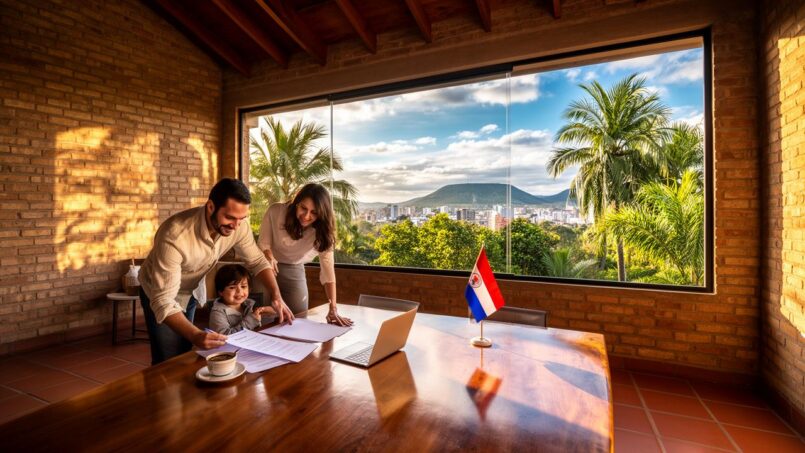
Buying an apartment in Paraguay is attracting more and more French people looking for sunshine, attractive rental yields, and a light tax environment. The country is one of the most open in the world when it comes to foreign ownership, prices remain relatively low, and the legal framework is rapidly modernizing. However, buying thousands of miles from France means you need to have a minimum grasp of local rules, procedures, and good practices.
This guide covers all the key steps to buying in Paraguay: finding an apartment, financing, taxes, residency options, and title registration. It is aimed at French investors or future residents, with a practical, step-by-step approach.
Understanding the legal framework for a French buyer
Before looking for an apartment, it is essential to know what a French person is allowed – or not – to buy in Paraguay, and under what conditions.
Property rights: near‑total equality with locals
The key point, which clearly sets Paraguay apart from many other countries, is simple: a foreigner has practically the same property rights as a Paraguayan citizen. In practice, this means a French person can:
– Buy an apartment, a house, a commercial space, or most types of land directly in their own name.
– Hold full title (dominio pleno), without limited usufruct or ground lease.
– Freely rent, sell, gift, or bequeath their property, without any specific administrative authorization.
– Own multiple properties, with no cap on the number of properties or square footage, except in very specific cases (e.g., huge agricultural holdings).
Law 117/91 guarantees equal treatment between foreign and domestic investors: there is no obligation to have a local partner or to go through a “golden visa” program that ties a real estate purchase to a residency status.
Residency and visa: no requirement to buy
A French person can perfectly well buy an apartment in Paraguay as a simple tourist. The rules are clear:
– No residency is required to buy.
– No special visa is needed to sign the purchase deed.
– A valid passport is sufficient as identification for the entire procedure.
Having residency (and the cédula, the local ID card) then makes certain administrative matters easier, especially getting a RUC tax ID number and filing for rental income. But it is not a prerequisite for becoming an owner.
The only real limits: border zones and public lands
For a French person targeting an apartment in a city (Asunción, Encarnación, Ciudad del Este, etc.), restrictions are almost nonexistent. The limits mostly concern rural land:
Zones within 50 km of borders are regulated: nationals of neighboring countries (Argentina, Brazil, Bolivia) cannot freely buy rural land there, while other foreigners can buy through formalities or a Paraguayan company. Public lands owned by INDERT are prohibited from sale to foreigners, even after a title has been transferred to a Paraguayan (10‑year waiting period). Any purchase of more than 10,000 hectares of agricultural land by a foreigner requires parliamentary approval.
For buying an apartment in an urban area, these restrictions are theoretically irrelevant, but it is crucial that your notary verify that the property does not come from an old tax lot that is still subject to restrictions on transfer to a foreigner.
Where to buy an apartment in Paraguay as a French person
Once the legal framework is clear, the key question remains: which city and which neighborhood to invest in? Not all markets are equal, and buyer profiles vary too.
Asunción: capital and the heart of the expat market
For most expats, Asunción remains the natural choice. The capital concentrates:
– the best infrastructure (roads, shops, services),
– most of the private healthcare options,
– fiber optic internet for remote work,
– a well‑established expat community.
The neighborhoods most popular with foreigners, especially French, are:
In Asunción, Villa Morra is an upscale neighborhood with shopping centers like Shopping del Sol, international restaurants, and schools – ideal for expats despite high rents. Carmelitas, nearby, is livelier with bars and coworking spaces, popular with digital nomads. Las Mercedes offers a quiet, green residential setting. Ycuá Satí and Mburuvichá Róga / Las Lomas / Itapúa offer modern or recently built homes with good value, while closer suburbs (Fernando de la Mora, Luque, San Lorenzo) are more affordable but require a car.
The outlying and more working‑class neighborhoods (San Vicente, parts of Lambaré or Fernando de la Mora) have significantly lower prices per square meter, but with more fluctuating rental demand and a less “international” environment.
Secondary cities: Encarnación, Ciudad del Este, Villarrica…
Outside Asunción, several cities may interest a French buyer:
The monthly rent for a simple apartment in Villarrica can be around 200 USD.
In these cities, rental investment can work, but resale liquidity is generally lower than in Asunción. For a first remote purchase, many expats favor the capital, which is easier to understand and more dynamic.
Price levels: rental and purchase
To evaluate a purchase, it is useful to look at ballpark figures for both rental and purchase, neighborhood by neighborhood.
Indicative monthly rents
The following figures give an idea of asking rents for furnished or semi‑furnished standard apartments:
| City / Neighborhood | Property type | Monthly rent range (USD) |
|---|---|---|
| Asunción – Villa Morra / Carmelitas / Recoleta | Studio / 1 bedroom | 400 – 700 |
| Asunción – Villa Morra | 2 bedrooms | 900 – 1,400 |
| Asunción – Las Mercedes | 2 bedrooms | 700 – 1,100 |
| Asunción – Carmelitas | 2 bedrooms | 600 – 900 |
| Asunción – Itapúa | 2 bedrooms | 500 – 800 |
| Asunción – central areas (generic) | Studio | 250 – 400 |
| Asunción – central areas (generic) | 2 bedrooms | 400 – 700 |
| Asunción – more affordable neighborhoods | 1 bedroom | 250 – 400 |
| Asunción – more affordable neighborhoods | 2 bedrooms | 350 – 700 |
| Ciudad del Este | 1 bedroom | 200 – 400 |
| Ciudad del Este | 2 bedrooms | 300 – 600 |
| Ciudad del Este – high‑end | Luxury apartment | 600+ |
| Villarrica | Simple apartment | ≈ 200 |
These figures are indicative but provide a basis for a gross yield calculation. In Asunción’s most sought‑after neighborhoods, a good‑quality two‑room apartment can easily rent for 600 to 1,000 USD, which is significant relative to the acquisition cost.
Purchase prices
On the purchase side, the following ballpark figures are generally observed:
| Area / City | Approximate price (USD/m²) | Comments |
|---|---|---|
| Asunción – sought‑after neighborhoods (Villa Morra, Carmelitas, Las Mercedes) | 800 – 1,800 | Newer buildings, most desirable areas |
| Asunción – more working‑class / peripheral areas | 400 – 800 | Older buildings or secondary locations |
| City center (average data) | ≈ 1,400 | Estimate converted from guaraníes |
| Outside center (average data) | ≈ 1,000 | Same |
| Apartment 80 m² (decent neighborhood) | 50,000 – 100,000 | Depending on condition and exact location |
| House 150 m² with garden (urban area) | 80,000 – 180,000 | Wide range depending on neighborhood |
| Secondary cities (Encarnación, Ciudad del Este) | From 30,000 – 60,000 for a family home | Lower prices than Asunción |
For a French investor, these levels remain attractive compared to most large European cities, especially given very moderate property taxes and a territorial tax system.
How to search for an apartment in Paraguay from France
Now let’s get practical: how to identify good properties remotely, without already knowing the country.
The search often starts online. A few major resources:
Discover the main websites and tools for finding housing in Paraguay, from structured portals to very active social networks.
Comprehensive platform with well‑structured listings, new developments, and high‑end properties.
Large general classifieds site, with a wide selection but sometimes less detailed information.
Useful portals for scanning the market, though listings are not always up to date.
Extremely popular locally. Many owners and agents post properties here, and good deals go fast.
Groups like ‘Expats in Paraguay’ or ‘Alquileres en Asunción’ for experiences, agent contacts, and neighborhood reviews.
Once you spot a property, the typical approach is to contact the advertiser via WhatsApp, a nearly universal tool for local exchanges.
Real estate agents and on‑the‑ground prospecting
Since Paraguay does not have a very strict licensing regime for agents, anyone can call themselves an “inmobiliaria”. This calls for some caution:
– Favor well‑known agencies (e.g., Century 21 Paraguay) or those widely recommended by other expats.
– Ask for references, and spell out the terms of compensation in writing.
– Never rely solely on the agent’s lawyer or notary: it is prudent to have your own counsel.
Supplement your search by walking around neighborhoods of interest, spotting “Se vende” signs on buildings and calling the numbers directly, since part of the market is not published online.
Visit and compare before deciding
Even if the temptation to do everything remotely is strong, it is strongly recommended:
– to physically visit the apartments, or at least to appoint a trusted person or a professional to film and verify the actual condition;
– to see the neighborhood at different times (day, night, weekend) to judge noise, traffic, and perceived safety;
– to talk to a few residents or shopkeepers to get unfiltered opinions on the area.
Ideally, plan 2 to 4 weeks on the ground to refine your choice and compare several similar properties before committing.
The step‑by‑step purchase process for a French buyer
Once the target property is identified, the purchase procedure follows a fairly standard framework, even if each transaction has its particularities. Here is the typical sequence.
Step 1 – Negotiate and reserve the property
After your visits and initial checks, it’s time to make an offer:
– Negotiating 5 to 15% below the asking price is common, especially if you pay cash.
– Once an agreement is reached, an intent to purchase or reservation document (reserva / intención de compra) is signed to set the basic terms (price, deadline for the final contract, etc.).
– A reservation deposit is often paid at this stage:
– sometimes symbolic (a few percent),
– sometimes more substantial (around 5%) to secure first right of purchase.
This document is not yet the final contract, but it formalizes your mutual commitment to proceed and essentially takes the property off the market for a short period.
Step 2 – The preliminary contract and deposit
If everything goes smoothly, you then move to the preliminary contract:
– Often called a Boleto de Compraventa or Contrato privado de compraventa.
– It specifies in detail:
– total price,
– payment schedule,
– conditions precedent (results of legal checks, possible financing, etc.),
– deadline before signing the notarized deed,
– penalties for unjustified withdrawal by either party,
– a precise list of what is included: parking space, storage room, air conditioners, water heater, appliances, built‑in furniture, curtains, light fixtures, etc.
At this stage, it is customary for the buyer to pay a deposit of 10 to 30% of the price directly to the seller, as escrow is rarely used. The best protection is to route the funds through a trusted notary (escribano) or a lawyer’s account, and to make this payment only after the initial basic checks have been completed.
Once this contract is signed, both parties are legally bound. Breaking the agreement can result in loss of the deposit or payment of penalties, depending on the terms.
Step 3 – Legal and technical due diligence
This is the most crucial step, the one you bitterly regret having skimped on when a problem arises later. It is handled by your escribano and/or your lawyer.
Several documents and checks are essential:
– 1. Title deed and actual owner
– Request a Certificado de Propiedad or Certificado de Registro from the Dirección General de los Registros Públicos (DGRP).
– Verify that the seller is indeed the registered owner, and that their identity (passport or cédula) matches the title exactly.
– Analyze the chain of ownership over at least 20 years to detect any irregularities (poorly regularized inheritances, contested sales…).
Get a Certificado de libertad de gravamen listing all encumbrances (mortgages, seizures, etc.). If debts exist, provide in the final deed that part of the price will be used to pay them off before the final transfer.
– 3. Cadastral correspondence and boundaries
– Check the Certificado catastral and compare it with the physical reality: area, lot, unit number, boundaries.
– For a house or land, it is advisable to hire a surveyor (agrimensor) to verify there is no overlap with the neighboring parcel.
– 4. Local taxes and charges
– Verify that property tax (impuesto inmobiliario) and municipal taxes are up to date.
– Request a certificate of no municipal debt.
– Check electricity (ANDE), water (ESSAP or private network), and internet bills to ensure no arrears will be transferred to the buyer.
– 5. Condominiums and co‑ownership rules
– For an apartment in a building, examine the Condominium Regulations (Reglamento de Copropiedad): rental rules (Airbnb allowed or not), pet policy, use of common areas, etc.
– Check the common charges (gastos comunes), the condominium’s cash position, and whether a reserve fund exists.
– 6. Planning compliance and permits
– Verify that the allowed use (residential, commercial, or mixed) matches your project (living, office, tourist rental…).
– Check building permits for recent constructions, especially for new or very recent developments.
This due diligence phase typically takes 1 to 3 weeks depending on the complexity of the file and costs, for a complete title search, from a few hundred to around 1,000 USD. That is a trivial investment compared to the headaches it can prevent.
Step 4 – The notarized deed (Escritura Pública)
If the checks are satisfactory, it’s time for the signing of the final deed of sale:
The escribano drafts the escritura pública de compraventa in Spanish, which includes all the transaction details (property, parties, price, payment terms, tax declarations, etc.). On the day of signing, the seller and buyer (or their authorized representative with a special power of attorney) sign the deed before the notary, the balance of the price is paid (usually by bank transfer or cashier’s check), and the notary does a final check of identity, legal capacity, and any recent encumbrances on the property.
At the end of this step, you receive a certified copy of the notarized deed, which serves as immediate proof of ownership in everyday practice.
Step 5 – Registration with the public registry
The notarized deed must then be registered with the property registry:
– The notary files the escritura pública with the Dirección General de los Registros Públicos (DGRP).
– This registration makes the sale enforceable against third parties: in other words, it legally locks your title against potential creditors or challengers.
– The announced timeline for the registration process typically ranges from 30 to 90 days, although the digitization of the system (Registro Unificado Nacional, RUN) should gradually shorten these delays.
Throughout this period, your notarized copy serves as valid proof, but it is prudent to wait for the registration confirmation before considering a resale, mortgage, or complex structure.
What a purchase really costs: taxes, fees, and charges
Beyond the apartment’s price, a French buyer must factor in the transaction costs and recurring charges. These remain generally moderate compared to Europe, but they cover several items.
Purchase and closing costs
Costs borne by the buyer mainly include: notary fees, stamp duties, registration fees, and costs related to obtaining a mortgage loan.
| Cost item | Indicative rate (on declared price) | Observations |
|---|---|---|
| Transfer tax (ITI / transfer duty) | ≈ 1.5 – 3% | Often shared, negotiable |
| Municipal transfer tax (Asunción) | ≈ 0.3% | Slightly less in other cities |
| Registry fees (Judiciary / Registro) | ≈ 0.5 – 0.8% | Deed registration |
| Notary fees (Escribano) | ≈ 0.5 – 2% (+ 10% VAT) | Split to agree (50/50 common) |
| Lawyer fees (due diligence) | ≈ 1 – 2% | Optional but strongly recommended |
| Miscellaneous (certificates, translations, etc.) | Fixed amounts | Vary by file |
Sources give slightly different ranges, but in practice most transactions fall between 3 and 8% of the price in direct costs for the buyer, depending on complexity, whether notary fees are shared, and the depth of legal support.
To that is sometimes added VAT (IVA) in certain cases:
– For a new apartment bought from a developer, VAT (10%) generally applies to 30% of the declared value of the property.
– This VAT is often included in the listed price, but you must verify this point in black and white.
The real estate agency is usually paid by the seller (3 to 5% of the price), although some arrangements may pass all or part of this commission to the buyer during negotiation.
Property tax and recurring charges
The annual property tax is one of the country’s great advantages:
The annual property tax amount for an apartment worth about 100,000 USD, reflecting a very low effective rate of 0.1% of the real value
Add to that:
– condominium fees (gastos comunes), highly variable depending on the building, whether it has a pool, 24/7 security, gym, etc.;
– electricity, water, internet, and telephone bills.
To give an idea, for an 85 m² apartment occupied by two people in Asunción:
– electricity + water + gas: about 36 USD per month;
– high‑speed internet: about 16 USD per month;
– mobile plan 10GB+: about 13 USD per month.
So you can count on around 65 USD per month for basic utilities, not including condominium fees.
Taxation of rents and capital gains
Paraguay benefits from a territorial tax system: only income generated locally is taxed.
For a tax resident, rental income is taxed at 10% on net income with allowances. For a non‑resident, withholding tax of 10 to 15% applies on gross rent. Capital gains on real estate are taxed at a flat 8% on net gain.
On the other hand:
– There is no wealth tax,
– no gift tax,
– no inheritance tax on assets held in Paraguay.
For a French person, this must of course be coordinated with French tax rules (especially the concept of tax residency and international treaties), but the local framework remains particularly favorable for investors.
Financing your purchase: local and international options
Real estate transactions in Paraguay are very often done in cash, without resorting to banks. For a French buyer, several options exist.
Cash purchase or seller/developer installment plans
Full cash payment remains the simplest and most common solution:
– It often allows you to get a 5 to 15% discount on the asking price.
– It simplifies the structure, speeds up the signing, and avoids any exchange rate risk on long‑term installments.
However, many developers and some sellers accept installment plans:
– initial down payment of 20 to 40%;
– balance paid over 12 to 60 months, sometimes interest‑free, sometimes with an annual rate of 0 to 12%;
– ownership is often transferred to the buyer only after full payment, with the contract being notarized and registered in the meantime.
Some developers even offer direct financing without a bank, specially designed for foreigners with no local credit history: down payment then monthly installments over 24 to 36 months, without a traditional mortgage, based on a notarized contract.
Bank loan in Paraguay for a non‑resident
Unlike other markets, Paraguayan banks are starting to open up credit more to foreigners:
Major local banks like BBVA, Banco Continental, or Itaú offer mortgage loans to non‑residents, financing 60 to 70% of the property value (sometimes more with additional guarantees) and requiring a down payment of 30 to 50%. Conditions include proof of income, bank statements, and possibly a foreign credit file. Monthly payments are capped at 30‑40% of net income, the maximum age is 65‑70 at loan maturity, and life insurance and home insurance are mandatory.
Local interest rates for foreigners are generally higher than those offered to residents and higher than French standards, making these financing options interesting mainly when you lack immediate cash but absolutely want to secure a given property.
Financing from France
A French buyer can also consider financing through a bank in France, using their French assets or income:
Rates for non‑residents are around 3.5% to 4.25% over 20‑25 years. The required down payment is 20% to 30% (LTV 70‑80%) and the maximum debt‑to‑income ratio is 35% of income. Some private or international banks may tie the loan to an investment portfolio for wealth structuring.
This type of arrangement is particularly relevant if you already have liquidity or assets in Europe and you want to benefit from the stability of the French banking system while investing in a Paraguayan property.
Buying remotely: power of attorney, signatures, and compliance
For a French person still living in France, it’s not always possible to travel to Paraguay multiple times. Fortunately, the Paraguayan system allows much of the process to be handled remotely.
Special power of attorney and electronic signatures
If you cannot travel: solutions exist to help you. You can consider options like remote work, delivery services, or remote consultations.
– You can sign a special power of attorney (Poder Especial) in favor of a lawyer or a trusted person in Paraguay.
– This document must be:
– signed before a notary in France,
– apostilled (or legalized) then
– translated into Spanish by a sworn translator in Paraguay.
With this power of attorney, your representative will be able to:
– sign the preliminary contracts,
– sign the notarized deed,
– handle the registration procedures,
– open a local bank account if necessary.
Many developers and real estate agents accept scanned signatures or secure electronic signatures for reservations and certain contracts. However, the final deed signed before a notary remains subject to strict rules and cannot be replaced by these methods.
Fund traceability and SEPRELAD compliance
As everywhere, anti‑money laundering rules require:
– justifying the source of funds, especially for amounts above 10,000 USD;
– providing, upon request, bank statements, income statements, and sometimes a criminal record certificate.
The Paraguayan agency in charge of these checks (SEPRELAD) may require the notary to ensure that financial flows are legitimate and traceable. So prepare in advance documents showing:
– your income,
– your previous savings,
– transfers made from your French accounts to the account receiving the purchase funds.
Residency by investment: the Investor Pass and real estate
Even though buying an apartment does not automatically grant a residence permit, Paraguay has recently introduced a residency‑by‑investment scheme that may interest French people wishing to settle long‑term.
The Paraguay Investor Pass – Real estate track
A new regulation (Resolution 0283/2026) created an Investor Pass that allows obtaining direct permanent residency by investing, among other things, in real estate:
The investment threshold is set at **200,000 USD** in real estate, calculated at the official exchange rate in dollars or guaraníes. This investment must be **productive** (rental, business activity, etc.), not purely personal. It can be justified either by a **registered purchase deed** (property paid in full) or by a **notarized private contract** with at least **30% paid** (e.g., 60,000 USD on 200,000 USD), with the balance financed over 24 to 36 months.
Once the documents are gathered, the ministry issues an Investor Certificate, which serves as a basis for the permanent residency application with the immigration authorities. Residency can thus be obtained without going through a two‑year temporary residency phase, saving considerable time.
A couple must invest 400,000 USD in productive real estate to obtain residency, since the threshold applies per person.
Alternative: the SUACE program
Another route to permanent residency is through the SUACE program for investors, which is based on:
– creating or developing a Paraguayan company,
– a commitment to invest 70,000 USD over 10 years,
– creating local jobs (in practice, at least 5 positions),
– focusing on industrial, commercial, or service sectors.
In this case, buying an apartment is not sufficient if done strictly privately. It must be integrated into a business project (e.g., a local real estate company) to be taken into account.
Practical tips and mistakes to avoid for French buyers
To conclude this guide, a few points of attention specific to French buyers can make the difference between a successful investment and a bad experience.
Always have your own notary / lawyer
In Paraguay, the notary is a central player, far more than in France where roles are more widely shared. But that does not mean you have to accept the notary proposed by the seller or agent:
– choose an independent escribano, not linked to the seller;
– put the fee amount and the details of the steps covered (obtaining all certificates, title search, registration filing, etc.) in writing;
– do not hesitate to hire a lawyer to review the contracts drawn up by the notary, especially if you are not fluent in legal Spanish.
Never pay a large deposit without checks
Before paying 10, 20, or 30% of the price:
Before any purchase, ensure the seller provides at least the property certificate, the certificate of no encumbrances, a certificate of correct tax status, and a satisfactory cadastral cross‑check. Favor payment through the notary’s professional account or an escrow service to avoid a direct transfer to the seller, especially if they are unknown to you.
Check the physical reality and common areas
For an apartment:
– inspect or have inspected all visible structural elements: cracks, dampness, condition of common areas, elevators, roofs;
– check that the equipment you think you are buying with the apartment is explicitly listed in the contract;
– for a recent building, ensure the horizontal condominium regime has been properly formalized and that each unit has its own title number.
Beware of deals that are “too good to be true”
The warning signs are standard:
Be cautious of prices far below the local market, a seller who refuses to show the original title deed and always refers to a family notary without transparency, and heavy pressure to sign quickly or pay deposits without clear documentation.
In all such cases, it is better to walk away than to deal with a dispute remotely in a country whose codes you have not yet fully mastered.
Think about exit strategy and rental from the start
Even before buying, ask yourself:
– If I have to resell in 5 or 10 years, will there be buyers for this type of property in this neighborhood?
– What is the realistic rent level I can expect today, and what is the typical vacancy rate in the area?
– Is it wiser to hold this property in my own name or through a Paraguayan company, in terms of inheritance, taxation, and wealth transfer to my heirs in France?
A brief consultation with a local tax specialist or a lawyer experienced with foreign investors can easily pay for itself.
In a nutshell
For a French person, buying an apartment in Paraguay is legally straightforward, tax‑attractive, and financially accessible, provided you follow a few common‑sense rules:
To invest smoothly in Paraguay, make sure you choose the right location (Asunción being the safest option for a first purchase), surround yourself with reliable professionals (notary, lawyer, recommended agent), never neglect due diligence (title, charges, cadastre, local taxes), anticipate financing methods and fund transfer constraints, and think about rental and eventual exit from the outset.
With thorough preparation and a medium‑ to long‑term vision, buying an apartment in Paraguay can become an interesting building block in your international wealth strategy, whether to diversify your assets, prepare for retirement under sunnier skies, or build a rental portfolio in a market still far from European saturation.
Have a wealth project or a question? Contact us now to speak with a wealth management expert.
Disclaimer: The information provided on this website is for informational purposes only and does not constitute financial, legal, or professional advice. We encourage you to consult qualified experts before making any investment, real estate, or expatriation decisions. Although we strive to maintain up-to-date and accurate information, we do not guarantee the completeness, accuracy, or timeliness of the proposed content. As investment and expatriation involve risks, we disclaim any liability for potential losses or damages arising from the use of this site. Your use of this site confirms your acceptance of these terms and your understanding of the associated risks.

Cyril Jarnias is an independent expert in international wealth management with over 20 years of experience. As an expatriate himself, he is dedicated to helping individuals and business leaders build, protect, and pass on their wealth with complete peace of mind.
On his website, cyriljarnias.com, he shares his expertise on international real estate, offshore company formation, and expatriation.
Thanks to his expertise, he offers sound advice to optimize his clients' wealth management. Cyril Jarnias is also recognized for his appearances in many prestigious media outlets such as BFM Business, les Français de l’étranger, Le Figaro, Les Echos, and Mieux vivre votre argent, where he shares his knowledge and know-how in wealth management.





