
 Published on and written by Cyril Jarnias
Between the towers of Port of Spain, the wild coves of Trinidad‘s north coast, and the postcard-perfect beaches of Tobago, the second-home market in Trinidad and Tobago is undergoing significant change. Driven by an economy more industrialized than the Caribbean average, yet also constrained by specific regulations for foreigners—especially in Tobago—this segment blends genuine opportunities with unique challenges.
This article details the secondary residence real estate market in the archipelago, covering the economic context, the most sought-after areas, the specific legal framework for non-residents, price levels, potential rental yields, as well as the unique dynamics of Tobago as a ‘second home’ vacation and tourism destination.
A Unique Caribbean Country, a Playground for Second Homes
Trinidad and Tobago first distinguishes itself from the rest of the Caribbean through its economic structure. While many neighbors live almost exclusively on tourism, the Republic relies primarily on oil and natural gas, complemented by industry, services, and growing but non-hegemonic tourism. GDP is estimated at nearly US$24 billion, with moderate annual growth around 1.5%.
Annual increase in residential prices during periods of high oil prices.
For a second-home buyer, this means a market less volatile than in some paradises overly dependent on tourist flows, but also a sensitivity to the fluctuations of the energy sector, which continues to dictate the national economic tempo.
Trinidad, Dynamic Island; Tobago, Vacation Island
The two main islands play distinctly different roles. Trinidad, large, urbanized, industrial, concentrates the majority of the population (about 1.3 million inhabitants for the entire country) and economic activity. It features a diversified real estate market, dominated by local demand, where a second home is often a weekend house, a pied-à-terre “Down D’ Islands,” or a retreat on the north coast.
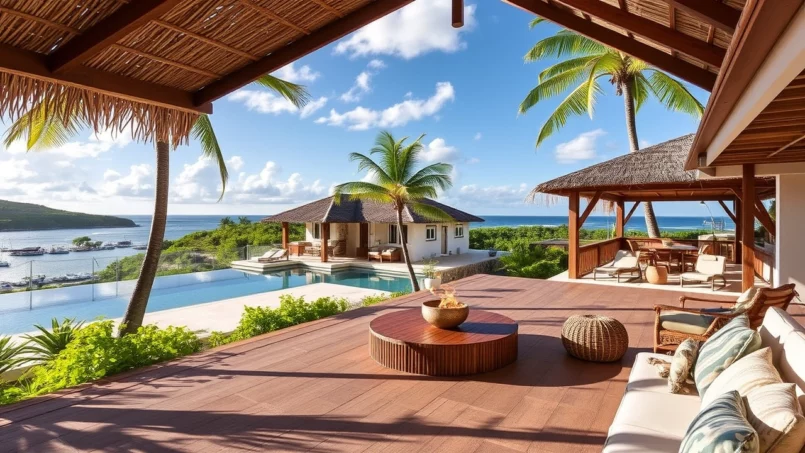
Tobago, smaller and tourism-oriented, relies heavily on vacationing and leisure real estate. Its offerings include beachfront villas, homes with views of Buccoo Reef, and condos in resorts like Tobago Plantations or Elephant Tree Resort. This economic model relies on a mixed clientele: affluent Trinbagonians, European and North American retirees, and investors attracted by seasonal rental income.
The country also benefits from a major advantage for any vacation home buyer: it is located on the edge of the main hurricane belt, which reduces the extreme climate risk compared to other Caribbean islands.
Who Buys a Second Home in Trinidad and Tobago?
The profile of buyers varies by island and region, but the main trends are clear.
In Tobago, academic research on “Second Home Tourism” in the rural villages of the northwest (Castara, Englishman’s Bay, Parlatuvier, Bloody Bay) paints a picture of a primarily foreign clientele, mostly retirees or pre-retirees from the United Kingdom, other European countries, and the United States. They use their homes as a seasonal vacation spot, sometimes combined with a rental activity to generate supplemental income.
The estimated number of inhabitants in Castara, where the presence of second homes is significant.
At the scale of Tobago, a study by Island Investments agency estimates that between 15,000 and 16,000 adult second-home owners invested on the island over an 18-year period. Sales to non-nationals for residential use are estimated to have represented 40 to 45% of all land transactions during this period, a considerable weight for a small island. Most of these buyers concentrated in the southwest, from Plymouth to Crown Point and Bacolet, but pockets of development exist in more rural areas.
In Trinidad, second homes are varied: villas in Mayaro, houses in Blanchisseuse, properties on Monos or Gasparee Island, or sea-view apartments near Port of Spain, serving both as leisure and rental investments. Buyers are mainly local or from the diaspora, although wealthy foreigners target high-end segments, particularly in the west of the island.
Legal Framework: What Foreigners Can (and Cannot) Buy
For a non-resident, the attractiveness of a second-home market depends as much on the landscapes as on the clarity of acquisition rules. In Trinidad and Tobago, the regime is relatively open in Trinidad, but significantly more restrictive in Tobago.
The General Rule: The Foreign Investment Act of 1990
Since the end of the old Aliens (Landholding) Act, it is the Foreign Investment Act of 1990 that governs the purchase of real estate by non-citizens. This text, in principle, allows foreigners to acquire properties in the country, subject to land area limits and, in some cases, obtaining a license.
For a second-home project, the key rules are as follows:
– A non-citizen may acquire up to 1 acre of land (a single lot) for residential use without a specific license in Trinidad;
– Beyond this area, a foreign investment license becomes necessary;
– For commercial uses, the threshold is raised to 5 acres, beyond which a development permit is required.
This relatively flexible framework has paved the way for decades of foreign investment, especially in Tobago. But it is precisely on this island that legislators backtracked starting in 2007.
Tobago: Return of Licenses and Designated Areas
Since a Cabinet Order dated 2007, any land purchase in Tobago by a non-national is subject to the obligation to obtain a license, regardless of the size of the land. The stated goal: to better control speculation and regulate foreign settlement, in a territory where land is by definition limited and where tensions between residents and investors have been felt.
The government has established “Designated Development Areas” where obtaining a license is almost automatic. These zones cover major tourist sites like Englishman’s Bay Estate, Culloden Estate, portions of Arnos Vale and Grafton, Mount Irvine Estate, Buccoo Estate, Golden Grove Estate, Lowlands Estate (including Tobago Plantations Resort), Diamond Estate (Indigo Bay Resort), and parts of Bacolet Bay. A specific perimeter is also defined in Crown Point to encourage tourism development around the airport.
In these sectors, a foreign investor who follows the procedures therefore has a strong chance of seeing their license application approved without major difficulty. On the other hand, outside these zones, each application is examined case by case and processing can take up to a year. At the time of the law’s implementation, a freeze on sales for nearly 33 months even occurred, illustrating the regulation’s capacity to abruptly slow the market.
Penalties, Exceptions, and Precautions
Compliance with these rules is not optional. Acquiring land or a villa without a license when required exposes one to a fine of up to TT$100,000 and the outright confiscation of the property by the State. Licenses granted are not transferable from one foreigner to another, requiring each new buyer to go through the administration. Licenses granted are not transferable from one foreigner to another.
Exceptions to the acquisition permit exist for foreigners: acquisition by inheritance (with an obligation to comply within one year), multiple plots via an annual lease of less than five acres, or joint purchase with a spouse who is a citizen of a CARICOM state residing locally. It is also possible to purchase through a Trinidadian-registered company, which involves additional steps but does not exempt from license obligations in Tobago.
In all cases, industry practitioners recommend including, in any sales agreement, a contingency clause making the transaction conditional upon obtaining the “alien landholding” license, to avoid being committed to a legally unfeasible purchase.
How Does a Second Home Acquisition Proceed?
For the most part, the process of buying a second home in Trinidad and Tobago resembles that of other common law countries, with a few specificities.
The buyer starts by identifying a property via agencies (Terra Caribbean, TrinidadRealtor.com and other networks bring together hundreds of agents), selling banks (Republic Bank, RBC, Scotiabank, First Citizens, etc.), or private listings. Once the offer is negotiated and accepted, it is customary to pay a deposit of about 10% of the price, held in escrow by the agent, lawyer, or broker.
A local lawyer drafts the deed of sale and performs legal checks (land title, easements, property boundaries), sometimes with a surveyor. For a purchase with financing, an appraisal by a certified evaluator is mandatory for the bank and tax authorities.
The closing period is generally 90 days, at the end of which the signing of the deed of conveyance (or memorandum of transfer) takes place against payment of the balance of the price and ancillary fees. Legal fees often represent around 1.5 to 2% of the purchase price. Registering the deed at the Land Registry can take four to eight weeks.
Tax Pressure at Purchase: The Impact of Stamp Duty
Second homes are not exempt from transfer taxes, called stamp duty. The scale is progressive and depends on both the nature of the property (vacant land or built property) and the transaction value. For residential housing, the system strongly favors first-time homebuyers, exempt up to TT$1.5 million if they prove they do not own another property.
For a second-home buyer, the following brackets apply in the absence of first-purchase status:
| Residential Property Value (TT$) | Applicable Stamp Duty Rate |
|---|---|
| Up to 850,000 | 0% |
| 850,001 to 1,250,000 | 3% on the difference |
| 1,250,001 to 1,750,000 | 5% on the difference |
| Over 1,750,000 | 7.5% on the difference |
For vacant land, the scale starts at 0% up to TT$450,000, with rates of 2%, 5%, and then 7% beyond, according to successive brackets. To this are added lawyer’s fees, a possible agency commission, appraisal fees, and, if applicable, the costs of applying for a license in Tobago.
Once an owner, the buyer is subject to property tax, calculated on the basis of an “Annual Taxable Value” representing 90% of the annual rental value estimated by the tax authorities. The rate for residential properties is around 2 to 3% of this base, depending on the version of the text considered, which remains moderate compared to the overall costs of a second home.
Price Levels: From the TT$700,000 Apartment to the Prestige Villa
Data from listing portals and transaction analyses allow for drawing a fairly precise price map. A real estate aggregator lists over 200 properties for sale nationwide, with price tags ranging from less than TT$500,000 for agricultural land to over TT$16 million for prestige villas in Goodwood Park.
A few examples illustrate the range:
| Type of Property and Location | Indicative Price (TT$) | Brief Commentary |
|---|---|---|
| 2-Bed Apartment in Gonzales | 700,000 | Entry-level product, urban |
| Residential Lot in Gated Development (outside west) | ≤ 750,000 | Ready-to-build plots of 5,000 to 10,000 ft² |
| 2–3 Bed Apartments/Houses in East/Central | 1.25–1.75 M | New or recent, for middle class |
| 3-Bed Townhouses/Apts in West Hills or Victoria Keyes | Up to 2 M | Sought-after western areas, decent amenities |
| Villa “Down D’ Islands” with Private Dock | 4.5–5.25 M | Typical luxury second home |
| Villa in Goodwood Park | 16.8 M | Ultra high-end segment |
| Beachfront Villa in Mayaro | ≈ 5 M | Spacious vacation home, wild beach |
This grid shows that, with a budget between 1.25 and 2 million TT$, a buyer can already enter the leisure residence segment, either via an apartment near business and entertainment zones, or via a family home in a gated community in the east or center of Trinidad, potentially used as a pied-à-terre.
The budget in Trinidad and Tobago dollars to access recent properties with a pool, large townhouses, or homes with a sea view.
Beyond 4.5 million TT$, one enters the world of prestige villas: residences with pools, large gardens, sophisticated architecture, often located in sought-after neighborhoods in the west (Maraval, Haleland Park, Goodwood Park) or in beachfront sites like Mayaro or the islands off the northwest coast. These are, for the most part, primary residences for very high incomes or high-end second homes, sometimes rented out occasionally.
Tobago: Vacation Villas and Resort Condos
In parallel, Tobago displays clearer prices for the foreign investor seeking a second home in a tourist setting. Luxury villas generally range from US$475,000 to US$750,000, while more affordable vacation villas or condominiums start around US$350,000.
For seasonal rentals, nightly rates illustrate the positioning well.
| Tobago Vacation Villa (examples) | Location | Capacity / Bedrooms | Indicative Rate (USD/night) |
|---|---|---|---|
| Fair View Villa | Mt. Irvine | 4 bd / 8 pers. | 265 |
| Condo Cassia A (Tobago Plantations) | Lowlands | 2 bd / 8 pers. | 210 |
| Villa with Buccoo Reef View | Buccoo | 3 bd / 8–10 pers. | 430 |
| BluBell Villa | Courland (Turtle Beach) | 5 bd / 12 pers. | 375–500 |
| Hawksbill House | Grafton | 3 bd / 8 pers. | 300–500 |
| Tobago Haven | Buccoo | 3 bd / 6 pers. | 250–300 |
| 4-Bed Villa in Tobago Plantations | Lowlands | 4 bd / 8 pers. | 450–525 |
These figures confirm Tobago’s positioning as a second-home market strongly oriented towards short-term rentals, with price levels that remain competitive compared to some better-known destinations like Barbados or Saint Martin.
Rental Yield: Mixed Signals Between Trinidad and Tobago
For an investor who also views their second home as a yield product, two markets coexist in reality.
At the national level, aggregated data on short-term rentals show a supply of about 1,268 active listings (across all platforms) with an average annual revenue of about US$16,000, a median occupancy rate of 41%, and an average nightly rate around US$106. In this context, estimated gross yields for a two-bedroom apartment vary around 5% for annual rental and theoretically reach over 12% for well-managed short-term rentals.
But these figures hide strong differences between islands. Tobago, for example, shows higher rental indicators, while still falling short of some Caribbean giants.
Tobago: Comfortable Revenues, but Occupancy Rate Risk
A data operator specializing in seasonal rentals lists about 872 active listings in Tobago, with an average annual revenue of US$26,000 and an average nightly rate of US$155. The median occupancy rate is 45%, with strong seasonal variations: August is the most lucrative, March also sees strong demand, while months like September or November are significantly lower.
The distribution of performance highlights a very heterogeneous market:
| Performance Segment in Scarborough (Tobago) | Typical Monthly Revenue (USD) | Typical Occupation (%) | Average Rate (USD/night) |
|---|---|---|---|
| Top 10% of Properties | > 6,295 | > 65% | > 493 |
| Upper Quartile (top 25%) | ≥ 3,277 | ≥ 45% | ≥ 332 |
| Median | ≈ 1,612 | ≈ 26% | ≈ 202 |
| Lower Quartile (bottom 25%) | ≈ 694 | ≈ 14% | ≈ 91 |
Here we see that a few well-positioned villas capture significant revenue, while a significant portion of the supply struggles to exceed two weeks rented per month. The verdict from scoring algorithms is mixed: Tobago ranks in the upper half of Caribbean markets for revenue and price levels, but only reaches the lower tier for occupancy rates. As a result, the overall “investability” score is considered average to low (grade E, in the top 20% riskiest).
To partially self-finance the investment, it is essential to prioritize the most sought-after locations (like Crown Point, Buccoo, Mt. Irvine, Old Grange and Scarborough), optimize hosting capacity by targeting properties that can accommodate 6 to 8 people, and entrust management to a professional to mitigate the effects of a very marked seasonality.
Trinidad: A More Domestic Market, but “Staycation” Potential
Trinidad, more oriented towards its own population and expatriates, offers a more domestic profile. Villas on the north coast (Blanchisseuse, Toco, Grande Riviere, Maracas) or in Mayaro, as well as properties on the islands (Monos, Gasparee, etc.), are very suitable for weekend or short-stay vacations.
Booking platforms feature many seaside or nature cottages and houses, often managed as short-term rentals. The pandemic acted as an accelerator: after the 2020 lockdowns, sales of “staycation” houses in Tobago, Blanchisseuse and Mayaro reportedly jumped over 250% between 2020 and 2021 compared to 2019, with Trinidadian buyers seeking nearby refuges suitable for remote work and outdoor living.
This dynamic shifted the balance in favor of single-family homes, to the detriment of apartments, and gave rise to a segment of second homes that are simultaneously leisure spaces, remote workspaces, and income-generating assets via rental.
Tobago and “Second Home Tourism”: Local Impacts and Sustainability Issues
What distinguishes Tobago from many Caribbean destinations is the existence of a body of academic research on the impact of second homes. In several villages in the northwest of the island, surveys of residents, local officials, and second-home owners have allowed for a nuanced assessment.
The presence of second homes is beneficial for the local economy. It generates jobs in the construction, renovation, gardening, and maintenance sectors. It also stimulates fishing activities, small businesses, and informal catering. In some villages, income related to these foreign owners represents a significant share compared to the average monthly household income of Tobagonians, which is about TT$5,170.
On a social and cultural level, the effects are considered rather limited, without major disruption to community cohesion, although tensions can arise around rising land prices or feelings of marginalization among some residents. On an environmental level, the study even suggests that the presence of owners attentive to landscape quality can contribute to preserving or improving certain sites, provided local authorities properly regulate development.
The “sustainable” nature of this model, however, remains an open question. Researchers emphasize the need for additional studies, especially quantitative ones, to more precisely measure impacts on ecosystems, local housing access, and long-term land price evolution.
Financing: What Options for a Non-Resident?
Non-residents can, in theory, access local mortgage credit to finance a second home in Trinidad and Tobago. Several banks and international financial institutions present in the country offer loans to foreigners, provided they meet income, creditworthiness, and collateral value criteria.
Banks consider non-resident borrowers, whose income mainly comes from abroad, as presenting a higher risk. Therefore, they generally require a larger personal contribution, often between 20% and 40% of the property’s value, and may apply slightly higher interest rates than for residents.
The application process is also heavier: proof of income (pay slips, tax returns), bank statements for several months, proof of fund legality, identification and immigration status documents, sometimes credit references from the country of origin. In the case of properties primarily intended for rental, some institutions may use approaches similar to a “Debt Service Coverage Ratio” (DSCR), where rental potential weighs more than the borrower’s personal income.
To circumvent financing constraints abroad, some buyers use financing in their country of residence, mobilize personal savings, or use Lombard loans secured by assets. It is recommended to quickly engage in dialogue with a bank advisor familiar with the local jurisdiction, in order to assess and precisely calibrate the real acquisition budget before any commitment to a property.
Market in Transition: Towards More Security, Technology, and Flexibility
Beyond the numbers, it is the expectations of second-home buyers that shape the market. Recent trends observed in Trinidad and Tobago align with those of other real estate markets: rise of gated communities, preference for “turnkey” properties, increased demand for connectivity and comfort for remote work, interest in “smart home” solutions (remote management of air conditioning, lighting, and security).
Projects like The St. Georges in Champ Fleurs and The Reserve at Munroe Road in Cunupia illustrate the evolution of the Trinidadian real estate market. They offer premium amenities (pool, gym, clubhouse, 24/7 security) and benefit from a strategic location near highway arteries and economic hubs. These residences target both a wealthy local clientele and international buyers seeking a comfortable second home easily accessible from Piarco International Airport.
In Tobago, projects like Elephant Tree Resort and Villas, backed by an international hotel brand, bet on a mixed model: privately owned villas, integrated into a resort offering services, rental management, and international visibility, which speaks directly to second-home buyers wanting to delegate rental operations.
Brazil seeks to attract remote workers to diversify its tourism beyond seasonal events. Proposals include creating specific visas for “digital nomads,” improving electronic payment methods, and enhancing accommodation quality. The goal is to reduce seasonality and stabilize visitor flows.
Strengths and Limits of the Second-Home Market
Trinidad and Tobago is neither the cheapest Caribbean destination, nor the most expensive, nor the most saturated. For a second-home buyer, the balance of advantages and constraints plays out on several levels.
Among the strengths are a pleasant climate, a location outside the usual hurricane path, a vibrant culture (Carnival, calypso, soca, steelpan), an English-speaking population, a solid banking system, and, in the case of Tobago, landscapes still largely preserved. Gross rental yields can be attractive in certain segments, especially for short-term rentals in Tobago or highly sought-after spots in Trinidad.
Real estate investment in Tobago faces complex licenses, procedures that can last a year, high transfer taxes on luxury goods, and strong tourist seasonality affecting occupancy. Furthermore, the national dependence on fossil fuels represents a macroeconomic risk for the market.
For local communities, finally, the rise of second homes poses a fundamental question: how to capture the economic benefits of an influx of foreign capital without destabilizing housing access for residents or damaging the very environment that gives these investments their value? Tobago, by forcing itself to regulate foreign purchases and launching studies on the impacts of “second home tourism,” is testing a form of regulation that could inspire other islands.
Conclusion: A Solid Niche Market, to be Approached Methodically
The second-home market in Trinidad and Tobago is not an El Dorado where one gets rich effortlessly, but neither is it a mirage. For an informed buyer, ready to deal with a specific regulatory framework and think in the medium or long term, it offers a rare cocktail: a relatively robust national economy, an advantageous geographical location, landscapes still largely preserved, and a real diversity of products, from the pied-à-terre apartment in Port of Spain to the beach villa in Buccoo or Mayaro.
The choice between Trinidad and Tobago determines the use and economic potential of the residence. In Trinidad, it primarily serves as a second home for weekends or a patrimonial investment, benefiting from gradual market appreciation. In Tobago, it offers a hybrid model: it can be a seasonal living space, generate rental income, and directly participate in the island’s tourist economy.
In all cases, such an acquisition should not be improvised. Consulting local lawyers well-versed in the Foreign Investment Act, working with agents belonging to a recognized professional association, validating financing capacity upfront, and not underestimating the tax and management dimensions of the project are all prerequisites for ensuring the dream of a vacation home in Trinidad and Tobago remains a pleasure, not a source of trouble.
Disclaimer: The information provided on this website is for informational purposes only and does not constitute financial, legal, or professional advice. We encourage you to consult qualified experts before making any investment, real estate, or expatriation decisions. Although we strive to maintain up-to-date and accurate information, we do not guarantee the completeness, accuracy, or timeliness of the proposed content. As investment and expatriation involve risks, we disclaim any liability for potential losses or damages arising from the use of this site. Your use of this site confirms your acceptance of these terms and your understanding of the associated risks.

Cyril Jarnias is an independent expert in international wealth management with over 20 years of experience. As an expatriate himself, he is dedicated to helping individuals and business leaders build, protect, and pass on their wealth with complete peace of mind.
On his website, cyriljarnias.com, he shares his expertise on international real estate, offshore company formation, and expatriation.
Thanks to his expertise, he offers sound advice to optimize his clients' wealth management. Cyril Jarnias is also recognized for his appearances in many prestigious media outlets such as BFM Business, les Français de l’étranger, Le Figaro, Les Echos, and Mieux vivre votre argent, where he shares his knowledge and know-how in wealth management.





