
 Published on and written by Cyril Jarnias
Long overshadowed by its giant neighbors, the country between Brazil and Argentina has established itself in just a few years as one of the favorite playgrounds for wealthy investors. The Uruguayan luxury property market, driven by flagship destinations like Punta del Este, José Ignacio, and Montevideo, combines scarcity of supply, political stability, a “green” environment, and a culture of legal transparency that reassures international capital. Within this landscape, José Ignacio, a coastal village that has become a symbol of an ultra-exclusive “shabby chic” lifestyle, now plays a strategic role.
This article is a comprehensive guide to the Uruguayan luxury real estate market, focusing on the José Ignacio region and the Maldonado coast. It targets both investors seeking returns and asset security, and “lifestyle” buyers attracted by safety, nature, and contemporary architecture.
A Showcase Country: Stability, Transparency, and Green Energy
Uruguay is often described as “the Switzerland of South America”. This is not just a marketing slogan. The country combines a series of fundamentals that make it almost unique on the continent: a democracy rated as “full” by the Economist Intelligence Unit, a rule of law ranked first in Latin America by the World Justice Project, the region’s lowest level of corruption according to Transparency International, and an investment-grade sovereign rating from Moody’s, Fitch, and Standard & Poor’s.
This is the projected annual GDP growth rate for the country in the coming years.
Another key driver, particularly compelling for ESG investors: Uruguay has switched its electricity grid to nearly 99% renewable energy. This performance places the country in the very exclusive club of almost decarbonized economies in terms of electricity production. As a result, the “Green Safe-Haven” narrative is not just a slogan, but a tangible argument for capital seeking sustainable real estate.
A Tax System Designed to Attract Wealthy Residents
Uruguayan taxation is based on the principle of territoriality: tax essentially applies to income from local sources, while a large portion of income and assets located abroad are tax-exempt. For new residents, a “tax holiday” on certain foreign passive income (dividends, interest) can extend for 11 years, with the alternative option of a permanent reduced rate of 7%.
Tax residence can be obtained through a real estate investment exceeding a specific threshold (expressed in indexed units), combined with minimal physical presence in the territory. Although the required investment amounts have been increased and access conditions will become stricter starting in 2026, this country remains one of the region’s most advantageous environments for simultaneously optimizing one’s lifestyle and wealth structure.
For non-resident real estate investors, the framework is clear: the same property rights as citizens, no sectoral or geographic restrictions, the possibility of buying in one’s own name or via a company, no control on capital outflow. Direct taxation mainly affects rental income (a 12% rate on net income for non-residents) and capital gains (also taxed at 12% for non-resident individuals), while local taxation materializes through the Contribución Inmobiliaria (municipal property tax) and the primary education tax, calculated on a cadastral value generally lower than market value.
A National Market in Steady Growth
At the national level, the residential sector is progressing at an annual rate of about 4.5% until 2028, with a rising volume of transactions: more than 52,000 transactions in 2024, a recent record, and more than 27,500 in the first seven months of 2025. Almost all transactions are denominated in US dollars, protecting foreign investors from peso fluctuations.
Average prices for new constructions illustrate the gradual rise of the market.
Recent Price Evolution for New Houses
| Indicator | Q2 2024 | Q2 2025 |
|---|---|---|
| National Average Price (UYU/m²) | 85,000 | 90,000 |
| National Average Price (USD/m², approx.) | 2,038 | 2,244 |
| National Annual Variation | +13.33 % | +5.88 % |
| Montevideo (UYU/m²) | — | 117,000 |
| Montevideo (USD/m², approx.) | — | 2,918 |
| Montevideo Annual Variation (real) | — | -1.01 % (inflation-adjusted) |
Montevideo accounts for about a third of the country’s transactions and remains the deepest market, with prime neighborhoods like Carrasco, Punta Carretas, or Punta Gorda around 4,000 USD/m² for luxury apartments, while more popular sectors can go down to 750 USD/m². Gross rental yields in the capital generally range between 5 and 7%, with studios and small units often the best performers.
But it is on the Atlantic coast, from Punta del Este to José Ignacio, where the true high-end game is played.
Punta del Este and Its Galaxy: Engine of Uruguayan Luxury
Punta del Este, nicknamed alternately the “Monaco” or “Saint‑Tropez” of South America, has gradually transformed from a seasonal beach resort into a year-round residential and financial hub. The permanent population has nearly doubled in a decade, driven notably by the arrival of affluent families, tech and finance professionals, European and North American retirees, and also digital nomads attracted by the quality of life and connectivity.
Prices in Punta del Este rose by approximately 10% year-on-year by mid‑2025.
Seafront villas typically trade between 2 and 20 million dollars, with a core market between 2 and 6 million. A few “trophy assets” peak beyond 20 million, notably on Playa Brava or in certain ultra-select beach clubs.
Price Range and Yield in Punta del Este
| Property Type / Location | Typical Price Range | Estimated Gross Rental Yield |
|---|---|---|
| Studio / 1 bedroom, downtown | 150,000 – 250,000 USD | 6.5 – 7.5 % |
| Sea view apartment, not waterfront | 200,000 – 400,000 USD | 6 – 7 % |
| Waterfront apartment, luxury | 500,000 – 2,000,000 USD | 6 – 10 % |
| Luxury waterfront villa | 2,000,000 – 20,000,000+ USD | 6 – 7 % (seasonal) |
| Entry-level properties on the periphery | from 150,000 USD | up to ~10 % for rentals |
In terms of yield, the seasonal rental market remains one of the most interesting in the region. Based on recent Airbnb data, a portfolio of over 3,100 active listings shows an average occupancy rate of about 28% annually for “median” properties, but the top 10% performers reach over 66% occupancy, with daily rates above 350 USD. In the high season (December to February), monthly income can exceed 3,500 to 5,000 USD for a well-located apartment, while some prestigious villas surpass 140,000 USD in rental income over the summer.
Seasonal Rental Market Dynamics (Punta del Este)
| Indicator (Airbnb) | Approximate Median Value | Top 10% of Properties |
|---|---|---|
| Average Daily Rate (ADR) | 140 – 150 USD | 350+ USD |
| Average Annual Occupancy Rate | ~28 % | 66 % and above |
| Average Monthly Revenue | ~1,300 USD | 3,400+ USD |
| Monthly Revenue in High Season (median) | ~3,700 USD | peak at ~5,200 USD |
| Estimated Gross Annual Rental Yield | ~12 % (short-term, optimized property) | — |
In this context, the premium segments of La Barra, Manantiales, and, above all, José Ignacio stand out as both more expensive and more resilient submarkets.
José Ignacio: Uruguay’s Most Exclusive Micro‑Market
Originally a simple fishing village, José Ignacio has become the ultimate beach sanctuary of the Maldonado state, often called the “Hamptons of the South”. In contrast to flashy skylines, the village cultivates an aesthetic of chic simplicity: low-rise constructions, controlled density, contemporary architecture integrated into the landscape, preserved dunes, sandy paths. The heart of the town consists of only 36 blocks, making it a naturally scarce territory. Strict construction rules and the shortage of available land create a structural scarcity effect: the global demand for luxury finds an extremely limited space here, which sustainably supports prices.
Comparisons with St‑Tropez or St‑Barths are not unwarranted: José Ignacio attracts a high-end international clientele – celebrities, artists, tech leaders, globetrotting entrepreneurs – simultaneously seeking discretion, raw nature, and a very selective social life. The New York Times described it as “chic but not famous”; the reality today is that the village has acquired global prestige while managing to preserve a near-confidential atmosphere.
Two Beaches, Two Vibes, the Same Level of Exclusivity
The village is organized around two major beaches, which also structure the real estate map.
West of the lighthouse, the bay of La Mansa, historically dedicated to fishing, is now the most sought-after sector for investment, notably the Mansa/Laguna Escondida corridor. Offering spectacular views, better wind protection, and quick access to coveted beach clubs, new constructions well positioned on this corridor will command a premium of 10 to 15% starting in 2026.
To the east, La Brava stretches kilometers of almost virgin sand towards the Garzón lagoon, with powerful waves favored by surfers. This is where the social heart of José Ignacio beats, with legendary addresses like Parador La Huella, a beach restaurant ranked among Latin America’s 50 best restaurants. Here, they practice what regulars call “barefoot luxury”: barefoot in the sand, wood-fired grills, but with billionaire guests and the global jet set.
Price Levels and Concrete Examples in José Ignacio
The figures clearly illustrate the market’s elevation. Based on a survey of listings, the average price of a house in José Ignacio approaches 2.9 million dollars, with a typical range between about 975,000 USD and over 12 million. The average price per square foot is around 648 USD. More modest properties – if one can still use that term here – such as some villas at 600,000 USD, already correspond to 300 m² houses 200 meters from the sea on plots of about 1,300 m².
The luxury real estate market in Punta del Este features exceptional properties, such as a 500 m² residence with an infinity pool, located waterfront on a 1,600 m² plot valued at 20 million dollars. Also found in the gated community Club de Mar is a 500 m² house with direct beach access priced at 7.2 million dollars. Furthermore, large farms in the countryside, especially near Laguna Garzón or the Medellín Faro area, reach seven-figure amounts, often combining residential use with winemaking, olive-growing, or equestrian activities.
Orders of Magnitude in the José Ignacio Area
| Property Type | Land Area (approx.) | Built Area (approx.) | Indicative Price |
|---|---|---|---|
| House 200 m from the sea (Arenas de José Ignacio) | 1,346 m² | 300 m² | 600,000 USD |
| 5-hectare farm, Laguna Garzón view | 5 ha | — | 1,200,000 USD |
| 6-hectare farm with vineyard (4 ha) and guest houses | 6 ha | 825 m² | 2,950,000 USD |
| 43-hectare farm with olive grove (5,000 trees) | 43 ha | — | 1,400,000 USD |
| Contemporary house Pinar del Faro (lot 1,036 m²) | 1,036 m² | 305 m² | 1,400,000 USD |
| Village house, sea view (lot 1,620 m²) | 1,620 m² | 350 m² | 4,300,000 USD |
| Waterfront residence Club de Mar | — | 500 m² | 7,200,000 USD |
| Villa on Playa Brava waterfront, infinity pool | 1,600 m² | 500 m² | 20,000,000 USD |
The underlying trend is clear: prices in José Ignacio have climbed more than 25% over the last three years, with international demand far exceeding the absorption capacity of this micro-market with limited land. This scarcity is reinforced by restrictive urban planning rules that protect both the landscape and long-term property values.
The “Finca + Beach Club” Model: The New Luxury Equation
Faced with the relative saturation of the village, growth is shifting inland, about fifteen minutes’ drive away, towards native hills and areas like Eco Chacras Garzón or Las Cárcavas. In these sectors, wealthy buyers seek plots of at least 5 hectares, which they transform into “art-farms” blending signature architecture, olive groves, vineyards, open-air sculptures, and native landscapes.
A high-performing real estate model involves owning a design finca in a quiet setting with a view, coupled with a beach club service on the coast offering privileged access, concierge, dining, and nautical activities. According to observers, this combination currently constitutes the asset class with the strongest capital appreciation in the Garzón – José Ignacio corridor.
The famous “James Turrell effect” illustrates this dynamic: the James Turrell’s Ta Khut art installation at Posada Ayana has helped shift attention and investments inland, transforming the surrounding countryside into a natural extension of the coastal luxury market.
Architecture, Design, and Sustainability: The DNA of Uruguayan High-End
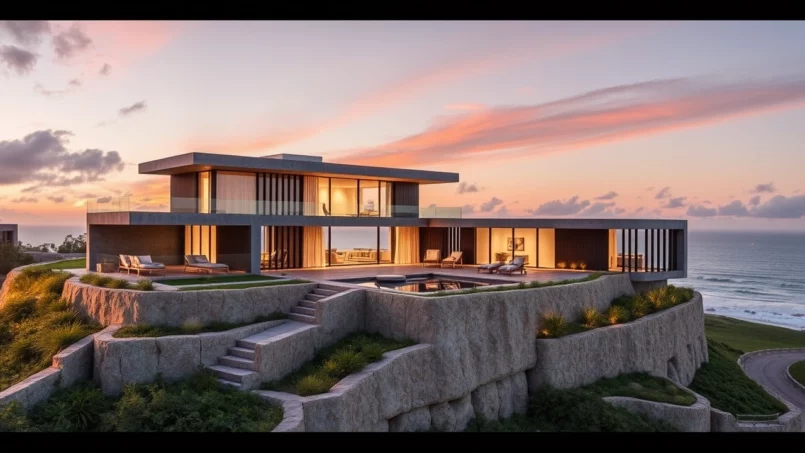
A distinctive feature of the Uruguayan luxury market, particularly visible in José Ignacio, lies in its architectural quality. Many villas are signed by renowned architects like Martín Gómez, Diego Montero, Mario Connio, or major Argentine and Brazilian studios. The dominant aesthetic favors fusion with the environment: structures of raw stone, wood frames, extensively glazed facades, green roofs, interior patios, large terraces facing the ocean or lagoon.
Modern construction standards now systematically integrate sustainable features to reduce environmental impact and optimize resources.
Installation of solar panels and rainwater harvesting systems for energy and water autonomy.
Landscaping with native plant species, adapted to the local climate, requiring less water and maintenance.
Use of low-consumption lighting and bioclimatic design optimizing building orientation.
Integration of electric vehicle infrastructure from the design phase of new projects, as seen in Petanque or La Juanita.
Most high-level properties are sold turnkey, fully furnished, with advanced home automation, fitted kitchens, private pools, and landscaped gardens designed by specialists like Roberto Mulieri. Generous plots guarantee privacy and unobstructed views, a crucial argument for a clientele fleeing excessive urbanization.
Gated Communities, Condo-Hotels, and New Projects
The real estate fabric around José Ignacio and Maldonado is organized around several typologies: isolated individual villas, multi-hectare farms, gated communities, and mixed condo-hotel type projects.
Among the most high-performing complexes are communities like El Secreto, Pinar del Faro, Club de Mar, or Village del Faro. Club de Mar stands out as the only gated community in José Ignacio with direct beach access. Some of these residences offer a rare combination of security, hotel services, and immediate access to the sea, which justifies the high price levels and strong value retention over time.
A specific project in the 2026 offering includes 40 lots totaling 700,000 square feet of area with ocean views.
Financially, the condo-hotel model has reached a certain maturity: projects like Casa Grande or Juanita Beach II now deliver net yields above 6%, combining professional hotel occupancy and personal enjoyment for the owner.
Gastronomy, Art, and Lifestyle: The “Intangible” Drivers of Value
In this ecosystem, the restaurant is much more than an ancillary service: the gastronomic scene is a genuine driver of real estate value. Parador La Huella, located on Playa Brava, embodies this synergy: originally a simple beach shack, the place is now among Latin America’s best restaurants. You’ll encounter as many Argentine families as tech billionaires like Mark Zuckerberg, artists, designers, and nomadic entrepreneurs. Getting a table in high season often requires booking several months in advance.
Around the culinary lighthouse of Garzón, other institutional addresses like Marismo, Susana, Cruz del Sur, Tres, La Panaderia, Juana, Santa Teresita, La Olada, and the Chiringuito (Francis Mallmann’s table) have emerged. More recent establishments with a sustainable DNA, such as Bliss (“garden-to-table” cuisine) and Guayabo (reimagined Uruguayan gastronomy), complete the offering. In the countryside, the restaurant at Bodega Garzón, ranked among the continent’s 50 best tables, anchors the wine tourism dimension of this corridor.
The art scene plays a comparable role. Local galleries – Galerie de las Misiones, Gallery Las Caracoles, Galeria Oto Lugar – fuel a dynamic art market, while the presence of major works like James Turrell’s skyspace at Posada Ayana creates a sort of cultural halo that boosts real estate values. The José Ignacio International Film Festival (JIFF) and the annual gastronomic fair complement this calendar, attracting an increasingly broad international audience and building a community of seasonal residents.
A Recreational and Natural Environment that Strengthens Residential Appeal
One of the great assets of coastal Uruguay is the possibility to combine beach life, sports, and high-intensity nature. Around José Ignacio, two lagoons structure leisure activities: the José Ignacio lagoon, renowned for bird watching and kitesurfing, and the Garzón lagoon, accessible by an iconic circular bridge, a privileged setting for picnics, water sports, and horseback riding.
Year of construction of the José Ignacio lighthouse, declared a national historic heritage site in 1970.
The available activities – water skiing, surfing, kitesurfing, polo, horseback riding on the beach – complement the cultural and gastronomic offerings. The Punta del Este Polo & Country Club, with its three regulation fields and international tournaments since the late 1980s, helps anchor the region in a very “old money” lifestyle universe.
At night, social life shifts to La Juanita, with private parties, beach bars with curated music programming, and ephemeral spots like Ferona or The Lab that attract the cosmopolitan youth in transit.
Yields, Financing, and Transaction Framework for International Buyers
For a foreign investor interested in luxury properties in Uruguay, the first question is generally about the combination of yield – security – liquidity. The country clearly checks the boxes for stability and legal security. In terms of yield, the figures are solid without being extravagant: 5 to 7% gross yield on long-term rentals in major cities, 6 to 7% gross (sometimes more) on vacation rentals in Punta del Este or José Ignacio, with highly profitable seasonal peaks.
Total transaction costs for a property buyer typically represent between 7 and 10% of the purchase price.
Summary of Main Costs for a Foreign Buyer
| Cost Item | Indicative Range |
|---|---|
| Notary (escribano) | ~3% of price + 22% VAT |
| Agency commission (buyer) | 3% of price + 22% VAT |
| Transfer Tax (ITP) | 2% of cadastral value |
| Registration fees | 0.5 – 1 % |
| Estimated total closing costs | 7 – 10 % of purchase price |
Most transactions are cash-based, especially in the luxury segment, but local financing remains possible. Banks like Banco República, Santander Uruguay, or Scotiabank offer dollar loans to non‑residents for terms of about 20 years, with rates ranging between 6 and 10% and loan-to-value ratios generally limited to 50–70%. In practice, many buyers prefer to use bank leverage in their home country or opt for short-term seller financing offered by some developers.
The purchase is secured by a notary who verifies the property’s history, charges, and compliance. After the offer, a purchase agreement is signed with a deposit of 10 to 20% in escrow. The timeline to the final deed is 30 to 60 days. Non-residents can complete most procedures remotely via an apostilled power of attorney.
A Market Driven by Foreigners but Anchored in Local Fundamentals
In luxury areas, foreigners dominate by a large margin. In Punta del Este as in José Ignacio, they represent about 75% of buyers in the high-end segment, with a majority of neighboring Argentines and Brazilians, but a growing presence of North Americans and Europeans. At the national level, the share of international investors in premium area transactions ranges between 30 and 66%.
Amount in billions of dollars of planned infrastructure investments, of which 3.7 billion are allocated to the road network.
The major risk therefore is not an internal fragility of the country, but rather external shocks: a prolonged crisis among neighbors, a global slowdown affecting capital flows and tourism, rising construction costs (already +10.6% in dollars over a recent year), or a sustained rise in global interest rates around 6–10% for real estate loans.
Outlook: Where are the Opportunities in the Uruguayan Luxury Market?
Projections converge: prices for prime coastal properties should continue to rise, with expectations of an annual increase of 8 to 12% for Punta del Este and its satellites in the near term, and a growth scenario of 6 to 10% per year for coastal areas in the medium term.
For waterfront properties in José Ignacio or the most sought-after gated communities, land scarcity and urban planning protection suggest sustained appreciation over 10 to 20 years, beyond even regional economic cycles. Conversely, some more remote developing areas, in the province of Rocha for example, offer prices still significantly lower today, but with higher revaluation potential if infrastructure and ecotourism projects materialize as planned.
For an investor wanting to enter the Uruguayan luxury property market, a few main lines emerge:
Four axes for premium real estate investment in Uruguay, combining capital preservation, value creation, and diversification.
Waterfront in José Ignacio, Mansa/Laguna Escondida, Club de Mar. Properties signed by iconic architects. Ideal for capital preservation and collecting ‘trophy assets’.
Acquisition of a large parcel in the Garzón – José Ignacio corridor, coupled with usage rights at a beach club. Strong value creation potential at the intersection of sustainable and gastronomic trends.
La Barra, Manantiales, certain areas of Rocha or Atlántida. Recent appreciation rates of 10‑15% per year, while still below José Ignacio levels.
To balance a portfolio, investing in the capital’s prime neighborhoods (Carrasco, Punta Carretas, Pocitos) offers regular rental income and higher liquidity.
In all cases, the combination of political stability / legal sophistication, coupled with a very clear positioning on energy sustainability, gives Uruguay a unique place in the wealth strategy of international high-net-worth individuals. José Ignacio, with its improbable mix of wild dunes, radical design, world-class gastronomy, and global capital seeking refuge, is today its most spectacular expression.
The Uruguayan luxury real estate market stands out for its stability in an uncertain regional context. It rests on a solid rule of law, benefits from quality tourist and migratory flows, and relies on a national policy oriented towards green energy and innovation. This unique combination makes it a privileged destination for investors seeking yield, capital security, and quality of life, with José Ignacio as a major point of interest.
Disclaimer: The information provided on this website is for informational purposes only and does not constitute financial, legal, or professional advice. We encourage you to consult qualified experts before making any investment, real estate, or expatriation decisions. Although we strive to maintain up-to-date and accurate information, we do not guarantee the completeness, accuracy, or timeliness of the proposed content. As investment and expatriation involve risks, we disclaim any liability for potential losses or damages arising from the use of this site. Your use of this site confirms your acceptance of these terms and your understanding of the associated risks.

Cyril Jarnias is an independent expert in international wealth management with over 20 years of experience. As an expatriate himself, he is dedicated to helping individuals and business leaders build, protect, and pass on their wealth with complete peace of mind.
On his website, cyriljarnias.com, he shares his expertise on international real estate, offshore company formation, and expatriation.
Thanks to his expertise, he offers sound advice to optimize his clients' wealth management. Cyril Jarnias is also recognized for his appearances in many prestigious media outlets such as BFM Business, les Français de l’étranger, Le Figaro, Les Echos, and Mieux vivre votre argent, where he shares his knowledge and know-how in wealth management.





