
 Published on and written by Cyril Jarnias
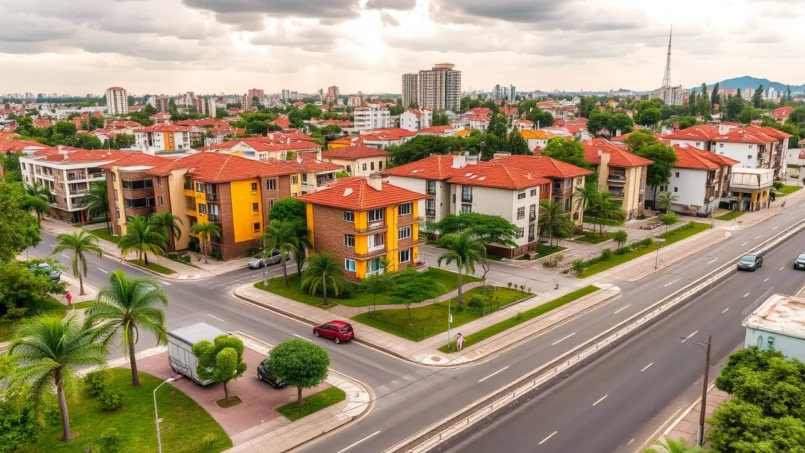
Belo Horizonte doesn’t make headlines as often as Rio de Janeiro or São Paulo. However, for a real estate investor, the capital of Minas Gerais is increasingly ticking key boxes: price growth significantly above the national average, solid rental yields, strong demand for modern housing, a wave of new developments, and major infrastructure projects. This is coupled with a reasonable cost of living, a high quality of life, and a legal framework generally favorable to foreigners.
Good to know:
This article provides a comprehensive analysis of the Belo Horizonte real estate market, including price per sqm, yields by property type, recommended neighborhoods, applicable taxation, and procedures for non-residents. It also highlights potential risks, thus offering an essential overview for a French-speaking investor.
A Market Outperforming the Rest of Brazil
In terms of price dynamics, Belo Horizonte is among the national leaders. Between 2021 and 2024, real estate values there climbed by 30.8%, representing an average annual increase of about 6.2%. This trend even accelerated: in 2024, prices rose by 12.53%, while inflation remained contained at 4.64%. And by spring 2025, the annual progression had already reached 13.95%, nearly double the national FipeZap index (7.97%).
15122
The average price per square meter for an apartment in São Paulo, more than double that of houses.
Another strong signal: in some segments, Belo Horizonte is catching up with, or even surpassing, the giants São Paulo and Rio de Janeiro. The average apartment at R$15,122/sqm far exceeds the R$9,500/sqm of São Paulo or the R$8,200/sqm of Rio, even if the comparison must be nuanced by the diversity of locations and properties.
Projections for 2026 remain optimistic, with expected growth between 8 and 10% per year. The pace should therefore normalize, without breaking the appreciation dynamic, as a key factor persists: the demand for housing clearly exceeds supply, especially in central neighborhoods well served by transportation.
Economic and Demographic Portrait of Belo Horizonte
To understand this market, one must look beyond real estate. Belo Horizonte is Brazil’s sixth largest city by population (about 2.4 million inhabitants within city limits according to some sources, 1.4 million according to other estimates) and the country’s third-largest metropolitan area, with over 5 to 6 million people spread across 34 municipalities. More than two-thirds of the metropolitan region’s inhabitants are concentrated in Belo Horizonte, Betim, and Contagem.
16
Percentage of Brazil’s biotechnology companies located in the city’s metropolitan region.
Major international groups are not mistaken: Google established an R&D center for Latin America there, investing $200 million. Other players like Deloitte, Thoughtworks, Fiat, Vale, Gerdau, Toshiba, and CEMIG are present. This is coupled with an influx of about 30,000 tech-savvy professionals to the city, attracted by this dynamism.
This solid economic base, coupled with a cost of living lower than Rio or São Paulo, makes Belo Horizonte an attractive hub for executives, students, entrepreneurs, and also expatriates looking for a more affordable big city. All this against a backdrop of appreciated quality of life: mild climate, good healthcare offerings, renowned universities like UFMG, and an active cultural scene, even if some observers feel “there isn’t that much to do” compared to other Brazilian metropolises.
Observers on the quality of life in Belo Horizonte
Prices, Rents, and Yields: Key Figures to Know
Quantitative data confirms a market that is both tight and profitable, especially for rental investors.
Price Levels: Apartments, Houses, Land
Overall, apartments dominate the market in volume and value. By mid-2025, in central sectors, the median price sits between R$14,800 and R$15,200/sqm. Houses, more present on the periphery and in suburban-type neighborhoods, range between R$6,500 and R$7,000/sqm. Land in developing areas, for example in the Leste region, starts around R$2,230/sqm.
A summary overview:
| Property Type / Sector | Estimated Median or Average Price |
|---|---|
| Apartment (central areas) | ~ R$14,800 – R$15,200/sqm |
| House (periphery / suburban neighborhoods) | ~ R$6,500 – R$7,000/sqm |
| Apartment Lourdes (average) | ~ R$10,700/sqm |
| Luxury Penthouses (BH, prime) | ~ R$2,000,000 per property |
| Land Leste region (development) | ~ R$2,230/sqm |
| Apartment center (maximum observed value) | up to ~ R$8,650/sqm (some datasets) |
It is worth noting that different databases give slightly divergent levels for the center, related to methodology or the precise period, but the trend remains clear: vertical residential in central areas is expensive, and the gap with houses is widening.
Rental Market: Rapid Rise and Solid Yields
On the rental side, the tension is clear. In 2023, rents per square meter jumped by 22.8%, reaching R$33.73/sqm, then R$39.20/sqm in June 2024, an increase of about 20% in one year. A standard apartment rents for around R$2,000/month, but well-located small units easily exceed this level.
Example:
A few benchmarks for average monthly rents: in Paris, a studio can cost about €800, a two-room apartment €1,100, and a three-room apartment €1,500. In the provinces, in a large city like Lyon, rents are generally lower, with a studio around €550, a two-room at €750, and a three-room at €950. These amounts serve as indicators for assessing the rental market.
| Property Type / Location | Average Monthly Rent (approx.) |
|---|---|
| 1 bedroom – downtown (average) | ~ R$2,260 – R$2,990 |
| 1 bedroom – outside downtown | ~ R$1,460 |
| 3 bedrooms – downtown | ~ R$3,840 |
| 3 bedrooms – outside downtown | ~ R$2,515 |
| Room in shared apartment / student housing | ~ R$500 – R$1,500 per person |
| Studio (entry-level) | starting from ~ R$1,500 |
| Coliving | starting from ~ R$1,400 |
At the city level, the rental range is extremely wide (from R$350 to over R$1 million per month for some exceptional properties), with an overall average rent around R$10,169 according to a platform aggregating various listings.
Tip:
Gross yields are interesting for a large urban center, offering attractive profitability potential in these areas with high demographic and economic concentration.
– Average yield: about 5% per year;
– 1 bedroom: 6.68%;
– 2 bedrooms: 6.19%;
– 4 bedrooms and more: 4.69%;
– up to 8% in the most sought-after and well-positioned sectors.
The differential clearly shows that it is the small apartments – well-located studios and 1-bedrooms – that offer the best yield/risk combination. Large family homes, on the other hand, show more modest yields and more frequent vacancies.
Indices like “price to rent” (price/annual rent) confirm this diagnosis: around 18 in the center, 15 in the periphery, which remains in a reasonable zone for a long-term investment, especially with significant Brazilian inflation.
Annual or Short-Term Rentals: Where are the Opportunities?
The Belo Horizonte rental market rests on two pillars: long-term rentals (students, families, young professionals, executives on assignment) and a short-term rental market on the rise, driven by business travelers and incidental tourism.
Long-Term: A Very Stable Demand Base
The presence of UFMG and other higher education institutions, a network of local and international companies, and a growing urban middle class creates a constant demand for annual rentals. Students represent an essential pool, often in shared apartments or studios near campuses. Student housing occupancy rates were estimated at 95% in 2023, illustrating the size of this segment.
Attention:
Young professionals, particularly in tech and services, favor central and lively neighborhoods (Savassi, Lourdes, Funcionários) for their public transportation accessibility. Conversely, families primarily seek residential areas with good schools and services, like Cidade Nova or Buritis.
Short-Term Stays (Airbnb and similar): An Expanding Niche
The short-term rental market remains less publicized than that of Rio or the coast, but the numbers show clear progression. Over a recent period (November 2024 – October 2025), there were about 2,852 active listings on a major platform. Entire apartments dominate overwhelmingly (over 70% of offers), often 1 or 2 bedrooms.
Key Indicators
Some key indicators to measure and track performance.
Conversion Rate
Measures the percentage of visitors who take a desired action, like a purchase or sign-up.
Site Traffic
Analyzes the volume and source of visitors to your digital platform.
Customer Satisfaction
Assesses the level of customer satisfaction via surveys or ratings.
Retention Rate
Indicates the percentage of customers who continue to use your services over a given period.
| Short-term stay indicator (approximation) | Observed Value |
|---|---|
| Total number of active listings | ~ 2,852 |
| Dominant type | Entire apartment/condo (73.8%) |
| Most frequent capacity | 1 bedroom, 2 people |
| Median revenue per property | ~ $514 / month |
| Top 10% of properties (monthly revenue) | > $1,452 / month |
| Occupancy rate in high season | ~ 48.9% |
| Average lead time before booking | ~ 22 days |
| Share of Brazilian travelers | ~ 90.2% |
| Top foreign clientele | United States (~ 3.1%) |
Local regulations remain relatively light for short-term rentals for now, leaving room to optimize revenue, particularly during peak attendance (professional events, holidays, major concerts, or soccer matches).
For an international investor, the message is clear: a well-decorated small apartment, in the city center or a trendy neighborhood, can generate a competitive gross yield, especially if one masters online marketing and dynamic pricing management.
Neighborhoods: Where to Invest in Belo Horizonte?
The metropolis is a mosaic of very different neighborhoods. The key, for an investor, is to cross-reference three criteria: capital gain potential, rental yield, and risk profile (vacancy, crime, property obsolescence, etc.).
Lourdes, Savassi, Funcionários: The High-End Triangle
Lourdes and Savassi are the postcards of chic Belo Horizonte. Lourdes, renowned for its elegant architecture, luxury boutiques, and high-end restaurants, shows a median price around R$10,700/sqm, with a range going well beyond in some new buildings. Savassi, a lively and trendy neighborhood, is packed with bars, cafes, coworking spaces, and nightlife, making it the epicenter for young executives and freelancers.
Funcionários, adjacent to these two poles, plays the card of a residential business district, a stone’s throw from downtown. Many new developments there incorporate coworking spaces, meeting rooms, and shared services.
In these three sectors, it is not uncommon to see gross yields around 5–7% for well-positioned small units, with an annual price appreciation potentially exceeding 12–15% in the encompassing Centro-Sul zone.
Belvedere and Mangabeiras: Breathtaking Views and Exclusivity
Belvedere, in the southern heights, combines panoramic views, secure condominiums, and immediate proximity to one of the city’s largest shopping malls (BH Shopping). The neighborhood particularly attracts senior executives and entrepreneurs and is experiencing a boom of start-ups and coworking spaces. The price per square meter rivals Lourdes, even surpassing it on some very premium projects.
Good to know:
The Mangabeiras neighborhood, perched on the Serra do Curral, is a symbol of luxury in Belo Horizonte. It houses the Palácio das Mangabeiras, the governor’s official residence, and one of the largest urban parks in Latin America. Real estate prices there are very high, with villa rentals starting around R$8,000 per month and can far exceed R$30,000 for the most prestigious properties.
These two neighborhoods are more targets for capital appreciation than pure yield: your tenants will be less students and more business leaders or wealthy expatriates, or even Brazilian families seeking a primary residence.
Pampulha: Between UNESCO Heritage and Airport Effect
Pampulha is an interesting case. This sector mixes a lagoon, architecture signed by Oscar Niemeyer (UNESCO World Heritage site), and proximity to Confins International Airport via the modernized MG-10 corridor. Real estate values there are progressing steadily, and rental demand is strengthening with improved connectivity and the arrival of new international flights operated by Azul to the Caribbean and the United States.
Good to know:

Cyril Jarnias is an independent expert in international wealth management with over 20 years of experience. As an expatriate himself, he is dedicated to helping individuals and business leaders build, protect, and pass on their wealth with complete peace of mind.
On his website, cyriljarnias.com, he shares his expertise on international real estate, offshore company formation, and expatriation.
Thanks to his expertise, he offers sound advice to optimize his clients' wealth management. Cyril Jarnias is also recognized for his appearances in many prestigious media outlets such as BFM Business, les Français de l’étranger, Le Figaro, Les Echos, and Mieux vivre votre argent, where he shares his knowledge and know-how in wealth management.





