
 Published on and written by Cyril Jarnias
Nicaragua’s real estate market is entering a new phase. While prices remain significantly lower than in Costa Rica, Panama, or Belize, the trend is clearly upward. With annual price growth of 4.9% to 7% nationally, a solid rebound since 2020, and a projected increase of +25% to +40% by 2030, the country is attracting more and more foreign capital, particularly from North America and Europe.
For an investor, the question is no longer whether to invest in Nicaragua, but rather how to precisely identify the best neighborhoods and areas. Not all markets offer the same balance between rental yield, capital appreciation potential, and risk level.
This article reviews the main investment hubs—Managua, Granada, León, the Pacific coast (San Juan del Sur, Tola/Popoyo, Rivas, Gran Pacifica), the islands, and the highlands—with a focus, where relevant, on the most promising neighborhoods and micro-markets.
A Booming Market… But Highly Segmented
The starting point is a national market that is still affordable, with a median price of around $1,230 per m² for apartments and $930 per m² for houses. However, these averages hide a very diverse landscape: strong growth on the Pacific coasts and in urban centers, slower rates in some inland cities.
Annual urban population growth is nearly 1.9%, driving the market upward.
But the drivers vary by area. Some markets are primarily rental yield plays (Managua), while others are bets on long-term appreciation (Tola, Rivas, Corn Islands, hills of San Juan del Sur). Hence the importance of understanding the local dynamics.
Managua: The Capital of Rental Yields
With about 1.6 million inhabitants, Managua concentrates the strongest rental demand in the country. Students, executives, expatriates, middle-class families, digital nomads, and remote workers fuel an active urban market where modern apartments rent quickly and command high rents relative to the cost per square meter.
According to compiled data, apartments here generate gross yields of 8% to 11%, among the highest in Central America, with occupancy rates reaching 95% to 98% in new buildings in neighborhoods favored by expatriates.
Premium Neighborhoods to Watch
Several neighborhoods stand out, each with a slightly different profile.
Los Robles is an upscale area, considered safe and highly appreciated by expatriates and upper-middle-class Nicaraguan households. It features parks, the large Metrocentro mall, numerous restaurants, cafes, hotels, shops, and even embassies. It is typically a neighborhood for high-end apartments or houses, targeting an international and professional clientele, with rents per square meter at the top of the range ($8 to $12 per m²).
Las Colinas, a gated community popular with expatriates, features high prices with an average single-family home around $250,000. However, opportunities exist below market value, such as a 170 m² house for $140,000 (approximately $823 per m²), especially if one accepts renovations, which remain affordable (e.g., a bathroom remodel for about $1,500).
Santo Domingo is often called Managua’s “Beverly Hills.” It’s one of the capital’s most prestigious sectors, home to part of the economic elite. It features upscale malls like Plaza Viejo Santo Domingo and Galerías Santo Domingo, as well as a very dense offering of restaurants and services. Houses here are in the same price range as Las Colinas, around $250,000, but the entry ticket for land and luxury apartments can climb much higher.
Bolonia is an upper-middle-class neighborhood, considered safe for visitors. It has a variety of shops, restaurants, and hotels, as well as attractions like the Dennis Martínez National Stadium and the Loma de Tiscapa Historical Park. The presence of numerous police or military checkpoints, related to government affairs, contributes de facto to a high level of security. For an investor, the neighborhood allows targeting a mixed clientele (civil servants, tourists, expatriates) with an attractive price-to-rent ratio.
Altamira stands out for its tree-lined streets, buildings with sometimes historical architecture, and a vibrant cultural scene favored by artists and writers. Houses here average around $150,000, significantly less than Las Colinas or Santo Domingo. It’s typically an area to consider if looking for a compromise between prestige, character, and affordable prices, with appreciation potential driven by gradual gentrification.
Other areas mentioned such as El Dorado, Alameira, Reparto San Juan, Ciudad Jardín, or the suburb of Ciudad Sandino complete the map, with profiles that are more “middle-class” or peripheral, thus potentially more profitable in percentage terms but riskier (vacancy, tenant quality, eviction procedures known to be lengthy and complicated).
Yields and Prices in Managua: What the Numbers Say
The rent levels recorded in Managua show a market that is still very accessible for tenants but capable of generating high yields for investors.
Here is a summary of typical rents and prices in Managua:
| Type / Location | Average Monthly Rent (USD) | Range (USD) | Rent/m² (USD) | Purchase Price/m² (USD) |
|---|---|---|---|---|
| Studio/1 bed – downtown | 257 | 120 – 400 | 6 – 10 | ~1,167 |
| Studio/1 bed – suburbs | 190 | 70 – 250 | 4 – 7 | ~443 |
| 2 beds – downtown | ~600 | – | 8 – 12 (premium neighborhoods) | ≥1,500 |
| 2 beds – suburbs | ~500 | – | 4 – 7 | 300 – 400 (periphery) |
| 3 beds – downtown | 437 | 250 – 1,200 | 6 – 10 | ~1,167 |
| 3 beds – suburbs | 449 | 400 – 498 | 4 – 7 | 300 – 400 |
| New residential – expanding areas | – | – | 5 – 9 | 800 – 1,200 |
We see that Managua’s premium neighborhoods can reach $8 to $12 per m² in rent, while the median acquisition cost is around $1,235 per m² for apartments. Based on this, the reported gross yields of 8% to 11% are consistent, especially for well-positioned, medium-sized units without overinvestment in the building.
High-end houses in gated communities can offer very low rental yields. A concrete example shows that a house valued at $130,000, with a net monthly rent of $375, might only achieve a 1.7% yield after deducting expenses (vacancy, taxes, management, maintenance). To aim for an 8% to 10% yield, it is preferable to target more affordable properties, even if that involves higher risk.
Social Housing Programs and Urban Dynamics
Another factor impacting Managua’s future is the proliferation of social and intermediate housing programs. Initiatives like “Nuevas Victorias” and “Bismarck Martínez” are delivering thousands of houses and apartments in and around the capital. The “New Victories Apartments” program alone is set to add over 3,000 units, including a first “Roberto Clemente” block of 134 two-story apartments.
These projects, often partly financed by regional organizations or China, help structure urbanization in areas like Sabana Grande or near the Augusto C. Sandino Airport (example: “Residencial Monte Nebo”). For the private investor, the challenge is twofold: avoid direct competition with these subsidized products, but capitalize on improved infrastructure and accessibility along the relevant corridors, particularly the Carretera a Masaya corridor, promised strong residential and commercial development.
Granada: The Colonial Safe Bet
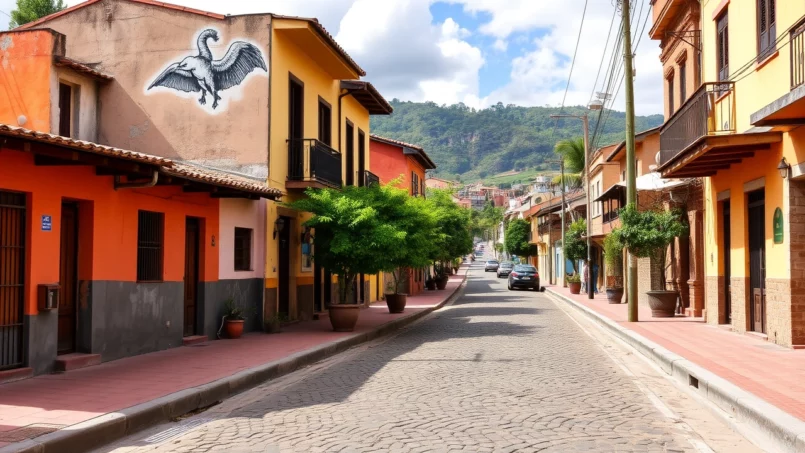
Located on the shores of Lake Nicaragua, Granada is the country’s colonial postcard: a colorful historic center, cobblestone streets, imposing cathedral, cafes on Calle La Calzada, excursions to the volcanic islets of Las Isletas or the Mombacho volcano reserve. It’s also one of the most visited tourist hubs, with a reputation for safety far superior to many other Central American cities.
The Historic Center, Heart of Investment
The bulk of investment activity is concentrated in the historic center (Zona Colonial). Colonial houses, often converted into small inns, boutique hotels, or vacation rentals, show prices per square meter around $878 (32,218 córdobas), with a wide range: from around $45,000 for a small house to renovate up to $600,000 for large, fully restored mansions. Most restored properties range from $80,000 to $200,000.
Net rental yields in the historic center, driven by growing tourist flow and quality supply.
Granada also boasts a high perceived level of security, thanks to visible police presence, regular tourist police patrols, and improved infrastructure (LED lighting, cameras at main intersections). For an investor focused on short-term rentals to international tourists, this is a major selling point.
Price Evolution and Outlook
The colonial market in Granada has already risen significantly: over half of the large Spanish-style houses are said to have been bought and restored by Americans. Prices have increased by about 7% per year in recent years. In the most sought-after neighborhoods, bargains are rare, and prices of $300,000 to $500,000 for a turnkey property are no longer exceptional.
Tourist demand in Antigua is growing, driven by domestic tourism, cultural events (international poetry festival, gastronomy and folklore festival), and an image of an authentic and safe city. Projections indicate annual appreciation of 4% to 6% for colonial properties in the coming years. This investment is considered a long-term asset play, offering reasonable rental cash flow and value preservation, rather than a quick capital gains opportunity.
León: The Student + Tourism Combination
León, the country’s second-largest city, offers a complementary profile to Granada. It is a dynamic university city, with a historic university (UNAN-León) that hosts between 45,000 and nearly 50,000 students, and a strong cultural and political identity. The surrounding volcanoes, cathedral, and proximity to beaches (Poneloya, Las Peñitas) also attract growing tourism.
Neighborhoods with Potential
Several micro-markets emerge:
– The Centro Histórico, where beautiful colonial houses typically sell for between $100,000 and $200,000 for properties in good condition, with the possibility of finding units to renovate well below $100,000. A renovation budget of $20,000 to $50,000 can often bring them up to tourist standards.
This is the number of students on the main campus, explaining the constant demand and low vacancy rates in the university district.
– Areas like Sutiava, the Mercado Central, Rolando Rodríguez G., or the outskirts of the Panamericana, where local housing, small businesses, and some expatriates mix. These sectors still offer low entry prices (sometimes land or farms for less than $1 per m² in the peri-urban area) but require excellent on-the-ground knowledge, especially regarding land titles.
Overview of real estate opportunities in the coastal areas near León, such as Poneloya and Las Peñitas, offering appreciation potential.
Beachfront properties can start around $30,000, with land prices sometimes close to $7 per square foot.
These sectors are still relatively undiscovered compared to the south coast (San Juan del Sur / Tola), presenting an upside potential as León develops.
Prices and Yields in León
Here is a simplified overview of the León market:
| Segment | Price Range (USD) | Typical Rental Yield |
|---|---|---|
| Small houses in town | 40,000 – 90,000 | 6 – 8% gross |
| Colonial houses downtown | 100,000 – 230,000 | 5 – 7% gross |
| Premium properties (colonial + boutique) | 250,000 – 600,000+ | 5 – 6% gross |
| Student housing (small units) | 30,000 – 70,000 | ~7% gross |
Price increases remain moderate, projected at around 4‑6% per year, but in a context where structural rental demand (students + tourism) is solid and competition is still limited compared to coastal “hotspots.”
San Juan del Sur: Coastal Star… But in a Digestion Phase
San Juan del Sur is arguably the best-known name on the Nicaraguan Pacific coast. A surfing, beach, and party town, it attracts families, retirees, remote workers, rental investors, with a very present English-speaking expatriate community and several international schools.
The recent years have seen a real boom: according to some analyses, real estate values have tripled in three years in some segments, with lot prices rising from around $10,000–$15,000 in 2020 to $30,000–$50,000 or more today for sought-after locations.
An Overheated Short-Term Rental Market
On the seasonal rental side, the numbers tell a different story. A study on Airbnb revenue shows that the San Juan del Sur area (municipality) leads the country in average monthly revenue (over $1,400/month for top platforms), but this average hides wide dispersion. In some sub-markets like luxury villas, gross yields fall to around 2.8%, due to an oversupply.
The town is therefore in a ‘digestion’ phase: prices have already risen significantly, many tourist accommodations have been built, and rental yields are compressing. Short-term projections suggest price stabilization or low growth (1 to 3% per year), as demand catches up with supply.
Analysis of the town’s real estate market
For an investor, this means San Juan del Sur remains a very attractive destination for quality of life, but one must be selective about products and wary of overly optimistic business plans for seasonal rentals.
Main Neighborhoods of San Juan del Sur
Even though details by micro‑neighborhood vary, several areas stand out:
– El Centro (the “town center”) where land prices reach high levels (about $1,000 per m² of land for old houses needing renovation). The municipality allows building up to three stories here, opening the door for mixed-use small building projects (commercial + apartments).
The hills around the bay, called “San Juan del Sur Hills,” offer several gated developments with beautiful views. This area is to be considered primarily for long-term capital appreciation investment, offering upside potential, rather than for immediate rental yield.
– The so-called “speculation” zone, still relatively affordable and within walking distance of the center. Development is seen as inevitable in the medium term. For patient investors, this is one of the last pockets of “reasonably” priced land.
– Pacific Marlin, an iconic gated community perched on the Christ the Redeemer hill, known for its spectacular villas and sunsets. But analyses converge: it’s a “lifestyle” market rather than a yield market. Seasonal rents do not really compensate for the required investment level.
– The La Talanguera sector, which combines direct beach access and well-maintained gated communities. It remains highly sought after by the international clientele.
In summary, for San Juan del Sur, value lies more in well-placed land with a 5‑10 year horizon, or in small operations targeting a specific niche (e.g., co-living for long-term remote workers), than in buying a large seasonal villa hoping for high cash flow from year one.
Tola, Popoyo, and the “Emerald Coast”: The Growth Bet
The department of Rivas, which encompasses the southern portion of the Pacific coast, is now the leader in price increases in Nicaragua. Houses there average around $1,395 per m² (over 51,000 córdobas), with annual appreciation potentially reaching 12%. Beachfront villas generally trade between $150,000 and $500,000.
At the heart of this dynamic, the Tola/Popoyo area – sometimes called the “Emerald Coast” – concentrates major projects: luxury beachfront, world-class surf, gated resorts, golf courses, international schools.
The Coastal Highway Effect
The construction of the major coastal highway (“La Costanera” or the “Emerald Coast Highway”), a project of over $400 million USD supported by the CABEI and the state, is one of the main catalysts. A completed section has reduced travel time between Managua and Popoyo by over 30%. Ultimately, the road is to connect the port of Corinto in the north to the San Juan del Sur tourism hub in the south, serving a myriad of previously semi‑isolated beaches.
Projected annual price growth for real estate in the most exposed sectors of Nicaragua.
Land and Housing Prices
The data collected gives an idea of the current level:
| Property Type / Location | Indicative Price |
|---|---|
| Beachfront villas – Emerald Coast | 150,000 – 500,000 USD |
| Beachfront land – Tola | ~150 – 200 USD/m² |
| Ocean-view land – Tola | 60 – 80 USD/m² |
| Golf course land 200m from beach | ~75 USD/m² |
| Turnkey villas – projects like Valle De Samsara | <150,000 USD (entry level) |
Products between $150,000 and $250,000 are particularly sought after, as they combine the “Emerald Coast” image, a budget still accessible for a North American buyer, and potential for seasonal rentals.
Gran Pacifica and Integrated Developments
Among the coastal projects near Managua, Gran Pacifica stands out: a 1,100-hectare development about 1.5 hours from the capital, offering everything from apartments to land to single-family homes. Some houses are offered around $100,000, designed to be self-sufficient (off-grid) and incorporating smart home technologies. The developer offers financing of up to 80% of the price, accepts payments in Bitcoin, and clearly targets an international clientele.
Rental yields there are described as modest: the goal is not to generate strong cash flow, but rather to cover costs while waiting for capital appreciation, betting on improved infrastructure (highway, expanding Managua International Airport, possible reopening of the local Costa Esmeralda airport).
Corn Islands, Ometepe, Highlands: Eco‑Tourism Niches
Beyond the Pacific, other areas offer more niche opportunities, often driven by eco‑tourism or the search for temperate climates.
Corn Islands: The Caribbean Bet
The Corn Islands, off the Atlantic coast, attract investors seeking Caribbean beaches still relatively untouched. Prices there are rising, with a projected increase of 3 to 7% in 2025 for beachfront condos and luxury villas. Portions of virgin beach are said to have sold for around $75,000 per acre, or less than $29 per m², which remains very low by Caribbean standards.
Interest is focusing on small boutique hotels and eco‑friendly lodges. This market, still underdeveloped compared to the Pacific, has more fragile infrastructure and greater exposure to weather risks, making it a higher-risk investment but with significant appreciation potential.
Ometepe, Matagalpa, Jinotega: The “Nature” Card
Ometepe Island, a UNESCO biosphere reserve, promotes sustainable tourism: eco-lodges, organic farms, solar-powered accommodations. Projects like Totoco Eco‑Lodge or Finca del Sol show the way for a low‑impact model. For an investor, the challenge is to align with this eco‑touristic logic, with well-integrated small-scale projects.
The price per acre of land along the road between Matagalpa and Jinotega, Nicaragua, can drop to this level.
These are nascent markets, driven more by use value and long‑term potential than by immediate rental yield.
Estelí and Secondary Urban Markets: Accessibility and Potential
Estelí, the country’s eighth-largest city, is mentioned as the most affordable urban market, with average prices around $679 per m² (24,924 córdobas). Known for its cigar industry, the city is starting to attract investors related to this sector (businesses, niche tourism). Annual price growth remains modest (about 2%), with a market largely dominated by local buyers.
For a foreign investor, Estelí may be of interest for very specific strategies: real estate linked to cigar tourism, affordable housing projects supported by international programs, or well-positioned boutique hotels. However, this city does not compete with the attractive profile of the coasts or the capital Managua.
Other cities like Masaya (artisan market, growing cultural tourism), Matagalpa, León, Granada, or some towns in Rivas also benefit from massive public housing construction programs (Nuevas Victorias, Bismarck Martínez, CABEI programs). These investments improve infrastructure and create demand for services and commerce, which can open niches for commercial or mixed-use real estate.
Airbnb and Short-Term Rentals: Where Does It Really Work?
AirROI data on short-term rentals allows for comparison between different municipalities. For example:
| Municipality | Ranking (AirROI) | # of Properties | Avg. Monthly Revenue (USD) | Avg. Daily Rate (USD) | Occupancy Rate (%) | Regulation |
|---|---|---|---|---|---|---|
| San Juan del Sur (mun.) | #1 | 562 | 1,425.76 | 193.47 | 31.72 | Low |
| Managua | #2 | 277 | 407.33 | 61.65 | 30.46 | Low |
| Granada (mun.) | #3 | 249 | 931.74 | 110.43 | 36.00 | Low |
| Tola (mun.) | #4 | 222 | 2,198.59 | 254.18 | 36.96 | Moderate |
| León (mun.) | #5 | 129 | 449.18 | 82.13 | 26.58 | Low |
We see that Tola has the highest average monthly revenue, with a very high daily rate (over $250) and a solid occupancy rate. San Juan del Sur leads in volume of supply but with a lower occupancy rate, a probable consequence of market saturation.
Granada offers a good balance between rental income and occupancy (36%). Managua is better suited for long-term rentals, remaining a niche destination for short stays (business travelers, overnight stopovers).
For an Airbnb-oriented investor, the ideal equation is often found in markets where regulation remains flexible (“low” constraint level) but where supply hasn’t exploded yet: certain parts of Tola, Rivas outside San Juan del Sur, or even Granada.
Nicaragua vs. Neighbors: A Massive Price Differential
One recurring theme in all analyses is that for a comparable product, Nicaraguan prices remain significantly lower than those in Costa Rica or Panama.
For beachfront villas, for example:
| Country | Typical Beachfront Villa Range (USD) |
|---|---|
| Nicaragua | 150,000 – 500,000 |
| Costa Rica | Starting at 300,000, often up to 1.5M+ |
| Panama | Starting at 400,000, up to 2M for prime |
In other words, a property costing $300,000 on the Nicaraguan Pacific coast could be worth double or triple in some comparable areas of Costa Rica. This structural “discount” is one of the strong arguments for those betting on a progressive convergence of values in the long term.
Key Takeaways for Choosing the “Best Neighborhoods”
Based on all the factual data, we can summarize the main points as follows:
– For stable rental yield and structural demand, the best candidates are the modern apartment neighborhoods of Managua (Los Robles, Las Colinas, Santo Domingo, Altamira…), with gross yields often between 8 and 11%, and demand driven by urbanization and the emerging middle class.
– For heritage and cultural tourism, the historic center of Granada and certain sectors of León (Centro Histórico, university district) combine growing tourist flows, relative security, and steady value increases, with net yields around 5‑7%.
Maximum potential annual capital appreciation in high-growth coastal areas of Nicaragua, driven by major infrastructure projects.
– San Juan del Sur, despite its aura, is now an investor-savvy market: very good quality of life, beautiful expatriate community, but oversupply in seasonal rentals, compressed yields, and prices already significantly increased. Here, patience and very fine product selection are essential.
Nicaragua presents real investment opportunities, but in a risky environment including political tensions, complex land disputes, and inconsistent application of the law. A rigorous approach is essential: thorough due diligence on property titles, guidance from local lawyers, use of agencies licensed by INVUR, and an investment horizon of at least 5 years.
In this context, the “best neighborhoods to invest in Nicaragua” are not only those where prices rise the fastest, but those where the combination of entry price, appreciation potential, quality of rental demand, legal security, and quality of life is the most balanced. Today, this cocktail is found, first and foremost, in the good neighborhoods of Managua, the colonial centers of Granada and León, and on certain well-chosen stretches of the southern Pacific coast.
Disclaimer: The information provided on this website is for informational purposes only and does not constitute financial, legal, or professional advice. We encourage you to consult qualified experts before making any investment, real estate, or expatriation decisions. Although we strive to maintain up-to-date and accurate information, we do not guarantee the completeness, accuracy, or timeliness of the proposed content. As investment and expatriation involve risks, we disclaim any liability for potential losses or damages arising from the use of this site. Your use of this site confirms your acceptance of these terms and your understanding of the associated risks.

Cyril Jarnias is an independent expert in international wealth management with over 20 years of experience. As an expatriate himself, he is dedicated to helping individuals and business leaders build, protect, and pass on their wealth with complete peace of mind.
On his website, cyriljarnias.com, he shares his expertise on international real estate, offshore company formation, and expatriation.
Thanks to his expertise, he offers sound advice to optimize his clients' wealth management. Cyril Jarnias is also recognized for his appearances in many prestigious media outlets such as BFM Business, les Français de l’étranger, Le Figaro, Les Echos, and Mieux vivre votre argent, where he shares his knowledge and know-how in wealth management.





