
 Published on and written by Cyril Jarnias
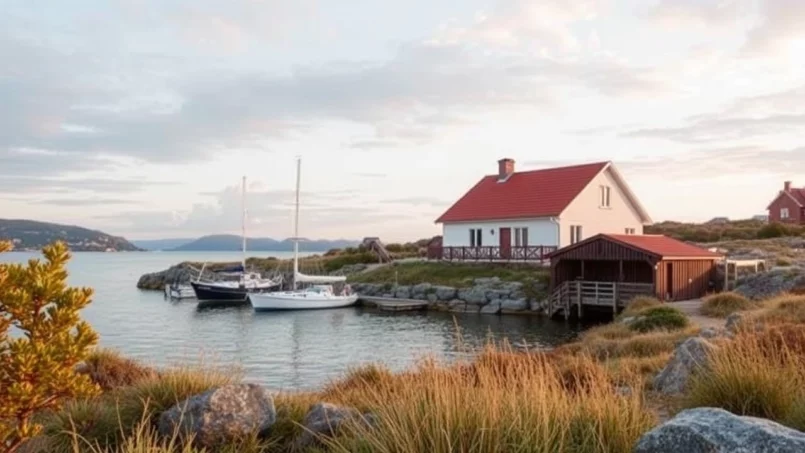
Buying a seaside house in Sweden means combining a solid real estate market, a spectacular natural setting, and a country very open to foreign investors. But behind the postcard images of red cabins by the water, there are strict zoning regulations, real climate challenges, and a coastal market that varies dramatically by region.
This guide covers the essential aspects of buying a seaside property in Sweden: search areas, price ranges, financing options, climate risks to anticipate, and the specific steps for a non-resident buyer.
Understanding the Swedish real estate market before targeting the coast
The starting point, even before choosing a bay or an archipelago, remains the general functioning of the market.
Sweden is considered one of the most transparent and well-regulated real estate markets in the world. The economy is strong, the country boasts a triple-A rating from major agencies, inflation has returned close to the 2% target, and the central bank (Riksbank) has begun lowering its rates after a very sharp cycle of hikes in 2022–2023.
After a property price drop of this magnitude between 2022 and mid-2024, the market stabilized in 2024.
The major trends to keep in mind before a seaside purchase are as follows:
A severe housing shortage in major cities supports rental demand and prices nationwide. At the same time, interest rates are gradually decreasing, with the policy rate dropping from 4% in 2023 to 2.25% in mid-2025, and new mortgage rates, currently around 3.1%, are expected to approach 3% by the end of 2025. However, the construction sector is in crisis (‘byggkris’), with a drop in housing starts despite high demand, which limits the risk of oversupply in the medium term, including in coastal areas.
For a foreign buyer, two other factors work in favor of a coastal project in Sweden: the relative weakness of the krona (even though it has recovered somewhat in 2024–2025), which makes properties more affordable in euros, and a legal framework very open to non‑residents.
A market extremely open to foreign buyers
Legally, Sweden is an exception in Europe: there are no quotas, residency requirements, or special regime for foreigners. A non‑resident, whether European or not, buys a property under the same conditions as a Swede.
The main points to know are simple:
No special permit is required to buy a house, apartment, or residential land, even by the sea. There is no link between property ownership and a right of residence: the purchase does not grant access to a “golden visa,” a residence permit, or citizenship. Non-resident buyers have the same ownership rights as Swedish residents, are subject to the same taxes, and follow the same purchase procedure. It is possible to manage the entire process remotely via a power of attorney given to a lawyer or a real estate agent.
Only special cases: certain agricultural or forest lands, including in rural coastal areas, may require approval from local authorities, whether you are Swedish or not. But for a seaside vacation home, an archipelago, or a classic coastal villa, there are no specific legal barriers for foreigners.
Choosing your coast: Baltic East, South, or Atlantic West?
With nearly 7,600 km of “main” coastline and about 48,000 km of shoreline including islands, islets, and rocks, Sweden offers an extremely wide spectrum of maritime landscapes. The coast is generally divided into three major areas: the east coast, south coast, and west coast.
East Coast: Baltic Sea, Stockholm Archipelago, Gotland, Öland
The eastern coast is bordered by the Baltic Sea, with brackish waters, less salty than the Atlantic. It includes:
– Norrlandskusten (along the Gulf of Bothnia) with sections still sparsely populated, but where the population is increasing;
– the Stockholm Archipelago, over 30,000 islands, some highly sought-after, with prices that can exceed 5 to 50 million SEK for premium properties near the capital;
– the large islands of Gotland and Öland, with modest permanent populations but a strong summer influx.
The Stockholm Archipelago is served by ferries and roads, allowing for living on an island while working in the capital. Its second-home market is dense and international, suitable for both personal use and seasonal rental.
Gotland and Öland combine beaches, historical heritage, and coastal villages. However, Öland already suffers from erosion on parts of its southern and eastern coasts, which must be factored into long-term considerations.
South Coast: Skåne and Blekinge
The southern coast around Skåne and the Blekinge archipelago is one of the most sought-after by foreign buyers, especially Danes and Germans. Access is facilitated by the Öresund Bridge (between Malmö and Copenhagen) and a high density of transport links.
Skåne combines several advantages:
Key assets and dynamics of Sweden’s southernmost region.
Relatively mild climate for Sweden, with a long and varied coastline: from large sandy beaches (Ystad, Falsterbo) to rocky shores.
Immediate proximity to Denmark, with a flow of about 19,000 commuters daily between the two countries.
Prices rising sharply, faster than the national average, especially in coastal cities like Malmö and Helsingborg.
Studies show that property prices in Skåne are rising faster than in other regions, particularly on the southern coastal front, where beach erosion is nonetheless a real issue.
West Coast: Skagerrak, Kattegat, Bohuslän and the Gothenburg Archipelago
To the west, Sweden faces the Atlantic via the Skagerrak and Kattegat. This is where the Bohuslän coast is found, famous for its bohus granite rocks, fishing villages, and thousands of islets. Gothenburg, the country’s second-largest city, is the major urban hub on this coast.
Recent data shows that:
Increase in vacation home prices in 2023 in the coastal areas of Västra Götaland, exceeding the national average of 3.3%.
Bohuslän and the Gothenburg Archipelago have thus become real “hotspots” for seaside houses, with a dynamic market, strong Norwegian and German demand, and attractive rental yield potential.
Population density and development pressure on the coast
The clear long-term trend is towards a concentration of the population along the coasts: approximately 40% of Swedes live within 5 km of the sea or a major shoreline, and 97% of population growth between 1995 and 2005 occurred in this coastal strip. The three major metropolitan areas — Stockholm, Gothenburg, and Malmö — are themselves coastal cities.
Key figures illustrate this development pressure:
| Coastal Indicator | Approximate Value |
|---|---|
| Share of coastline with buildings within < 100 m of the coast | 40 % |
| Share of coastline with buildings within < 300 m | 74 % |
| Proportion of all Swedish buildings located within < 100 m of the coast or a shoreline | 14 % |
| Share of the population living in coastal regions | > 82 % |
In practice, this means that on many attractive stretches of coastline, possibilities for new construction are limited, and the pressure on the existing stock translates into high prices and significant sea view premiums.
Types of seaside properties and price ranges
For a buyer targeting the Swedish coast, three main types of properties dominate:
– individually owned houses (äganderätt);
– vacation homes / second homes (fritidshus);
– cooperative apartments or villas (bostadsrätt), especially in coastal towns.
Individually owned vs. cooperative
Full ownership (äganderätt) remains the simplest form if you want an independent house, with land and sometimes direct access to the sea. In this case, the buyer owns the land and the building and pays property taxes directly.
Bostadsrätter are more common in major coastal cities (Malmö, Gothenburg, Stockholm) and dense seaside resorts. You own a share in the cooperative giving you the right to the exclusive use of a dwelling, but the association’s finances and its rules (especially on rentals) strongly influence the value and freedom of use.
Bostadsrätter (Cooperative Tenancies)
Price levels: coastal cities vs. rural coastline
The price differences are dramatic between an island near Stockholm and a more remote coastal village.
Some benchmarks:
| Area / type of market | Indicative price (apartments) |
|---|---|
| Stockholm city center (possible sea view) | 90,000–110,000 SEK/m² (≈ €7,700 /m²) |
| Gothenburg city center | 45,000–60,000 SEK/m² (≈ €4,700 /m²) |
| Malmö city center | 30,000–45,000 SEK/m² (≈ €2,750 /m²) |
| Malmö suburbs | ≈ 27,700 SEK/m² |
| Västra Götaland coasts (vacation homes) | ≈ €2,650 /m² on average |
| Small towns / rural coastal areas | €1,000–2,000 /m² |
In the Stockholm archipelago, waterfront properties with direct water access and a private dock easily exceed several million euros. Conversely, on some more northern or remote sections of the Gulf of Bothnia, it is possible to find houses close to the sea at much more affordable prices, albeit with more limited services and infrastructure.
Nationally, waterfront properties benefit from a significant premium: a recent study estimates that a “waterfront” location adds about 14% to the price of a home, all else being equal.
Financing a seaside house in Sweden
For a foreign buyer, the question is not only the listed price, but also the conditions for accessing credit in Sweden.
General financing conditions
The main points to remember are as follows:
Foreigners can obtain a mortgage in Sweden, but it’s easier with a local connection (employment, personnummer, bank account). The loan-to-value ratio (LTV) is capped at 85% by law, but is often limited to 60-75% for a non-resident, requiring a down payment of 25% to 40%. Amortization is mandatory: above 50% LTV, 1% of the principal per year minimum, and 2% above 70%. Rates for new loans were around 3.1% in 2025, down from a peak of over 4.5% in 2023.
Concretely, for a seaside house priced at 5 million SEK, a Swedish bank could typically lend 3.0 to 3.75 million SEK to a non‑resident, with the remainder coming from equity. Hence the interest, for some investors, in combining local financing with a loan from their home country.
Documents and expected profile
Swedish banks require a solid application, even though competition among institutions for international clients has increased. You will typically be asked for: a bank statement from the last 3 months, identification documents, and proof of address.
– valid passport;
– proof of income (pay slips, tax returns);
– recent bank statements;
– credit history (national or international report);
– proof of down payment;
– for self-employed individuals, accounting records and certificates from the accountant.
Having a Swedish personal identity number (personnummer) or, failing that, a coordination number (samordningsnummer), facilitates opening an account and accessing credit, but is not legally required to purchase. In practice, without a local anchor, many banks will prefer cash purchases or require a very high down payment.
Acquisition costs and taxation of a coastal property
Beyond the listed price, a seaside house project involves a series of quite specific purchase costs and recurring taxes.
Transaction cost: what the buyer pays
In the case of a house in full ownership, the buyer mainly bears:
– stamp duty (lagfart), equivalent to a property transfer tax: 1.5% of the price (or the assessed tax value, whichever is higher) for an individual, 4.25% for a company;
– registration fee for the Land Registry: 825 SEK;
– fee for registering a mortgage (pantbrev): 2% of the loan amount + 375 SEK;
– possible legal fees: typically 10,000 to 15,000 SEK for a standard transaction;
– the cost of a technical inspection: between 7,000 and 15,000 SEK for a comprehensive survey of a house.
The real estate agent is paid by the seller, with a commission generally between 3 and 5% of the sale price.
This is the range, as a percentage of the purchase price, that the so-called ‘buyer’s costs’ represent for a property in Sweden.
Property tax: a capped system
The good news, for long-term projects, is that Swedish property tax is relatively moderate and capped. The kommunal fastighetsavgift for dwellings (primary residences, vacation homes, cooperative apartments) is 0.75% of the assessed property value, but with a uniform national cap.
Some recent figures:
| Tax year (income) | Property tax cap for residences (per property) |
|---|---|
| 2024 | 9,525 SEK |
| 2025 | 10,074 SEK |
| 2026 | 10,425 SEK |
The assessed property value generally represents about 75% of the market value. In practice, for a seaside house with a tax base of 2.15 million SEK, the theoretical tax would be 16,125 SEK (0.75%), but the 10,074 SEK cap applies. For a more modest coastal property with a tax value of 950,000 SEK, the tax would be about 7,125 SEK, below the cap.
Newly constructed houses benefit from a property tax exemption for 15 years, which can weigh in the comparison between a new construction project by the sea and buying an existing house.
Taxation of rental income and capital gains
Renting out a seaside house for a few weeks a year to cover costs is a common scenario. The tax regime is then as follows:
The flat-rate tax rate on rental income in Sweden, applicable to net income.
Upon resale, capital gains on a private residence (vacation home or primary residence) are taxed at 22% of the gain (which technically corresponds to 30% on two-thirds of the profit). The taxable gain is calculated by subtracting the purchase price, related acquisition costs, improvement expenses, and selling costs from the sale price.
There are tax deferral schemes in case of reinvestment in another home within the EU or EEA, especially if the sold property was the primary residence. For a seaside second home, the tax strategy should be studied with an advisor, particularly if you are a tax resident of another country.
Climate and coastal risks: a point not to be overlooked
Buying by the sea in Sweden is not just about checking the sun orientation and the quality of the sauna. The country is warming twice as fast as the global average according to climate data, winters are already 1 to 2°C warmer on average compared to last century, and extreme weather events (storms, heavy rains, heatwaves) are increasing.
Sea level rise and exposure of coastal homes
Projections for 2100 vary by scenario:
– global mean sea level rise of 53 cm (“mild” scenario) to 90 cm (pessimistic scenario);
– combined with storm surges, the extreme water level could locally reach nearly 2.6 to 2.9 m above the current level during exceptional events.
The current exposure of Swedish homes is already significant:
| Coastal risk indicator | Estimated value |
|---|---|
| Owned or cooperative houses within < 3 km of the coast and < 5 m elevation | ≈ 8% of the housing stock (≈ 230,000 homes) |
| Buildings potentially exposed to coastal erosion with +88 cm sea level | ≈ 150,000 |
| Approximate value of properties at erosion risk | ≈ 220 billion SEK |
Southern regions, notably Skåne, Blekinge, Öland, and Gotland, are the most vulnerable to erosion. On the southern coast of Skåne, some beaches have retreated more than 200 meters in four decades. In coastal towns like Ystad, a 88 cm sea level rise could place about 20% of buildings below the 5-meter elevation contour under the 100-year flood level.
In the north of the country, sea level rise is partially offset by isostatic rebound (land uplift). In the south, however, this phenomenon is no longer occurring; subsidence (land sinking) or the cessation of uplift significantly amplifies the flood risk.
Regulation: coastal protection and right of access
Swedish legislation explicitly protects shorelines. The Nature Protection Act in principle requires that the first 100 to 300 meters of the coast be preserved from new development. Obtaining a building permit by the sea often requires an exemption from this strandskydd (shore protection), which limits new construction and partly explains the scarcity of plots truly “right on the water.”
At the same time, the principle of allemansrätten (the right of public access to nature) allows the public to move along shorelines, provided they do not intrude upon the immediate privacy of a dwelling. Concretely, owning a seaside house does not necessarily come with a monopoly on the entire beach in front of it: the development and privatization of shorelines remain strictly regulated.
Insurance, long-term value, and public responses
From a financial perspective, these risks are not theoretical. Studies indicate that:
The value of the Swedish coastal real estate stock is threatened by climate risks, potentially leading to localized price drops and insurance difficulties. Coverage denials, as documented in Kristianstad in 2018, and rising costs are anticipated, leading Finansinspektionen (the Swedish Financial Supervisory Authority) to launch an inquiry in 2025 into the impact of extreme weather events.
At the same time, the state and local authorities are beginning to structure their response: national adaptation strategy adopted in 2018, updated in 2024, regional plans in all 21 counties, pilot projects for “nature-based” solutions to protect the coast, a proposal to allocate 100 billion SEK by 2100 for adaptation infrastructure.
For a buyer, this means two very concrete things:
– systematically consult flood risk maps, erosion and landslide maps, available from the municipality, the SGI (Swedish Geotechnical Institute) or the SRSA (Swedish Civil Contingencies Agency);
– factor in the potential cost of adaptation measures (land raising, protections, foundation adaptation) and the possibility of rising insurance premiums into the financial projection.
Choosing the right location for your seaside house
Beyond the sea view, a successful purchase depends on many very concrete factors: accessibility, local climate, services, seasonality, and type of community.
Accessibility and transport
Criteria to examine closely:
– travel time to a major city or airport (Gothenburg Landvetter, Stockholm Arlanda, Malmö via Copenhagen, etc.);
– quality of the road network, especially in winter: some small coastal roads can be difficult to maintain;
– public transport connections, ferries for islands (Stockholm archipelago, Bohuslän, Gotland, Öland);
– viability of daily commuting if considering a primary residence.
In major coastal urban areas, infrastructure like the Öresund Bridge profoundly alters territorial dynamics. This bridge allows residents to live on the Swedish side, in Malmö in the Skåne region, and work in Copenhagen, Denmark. This increased accessibility partly explains the recent boom in the coastal real estate market in Skåne.
Services, climate, and seasonality
Many seaside houses are fritidshus, originally designed as summer residences. They are not always insulated for winter, sometimes have simple electric heating, and water installations not suitable for freezing. However, winters, even as they warm, remain severe in much of the country.
Before buying, it is crucial to check:
Before renting a house for a prolonged stay or permanent relocation, it is crucial to check several points. Ensure the house is “winterized,” meaning properly insulated, with a heating system and plumbing suitable for year-round use. Check the quality of the electrical supply, as overhead lines can be vulnerable to strong winds and falling trees. Inquire about mobile coverage and internet access: fiber optic is widespread but not available everywhere, especially on remote islands. Finally, assess the proximity to shops, healthcare services, and schools if you are considering permanent residential use.
Data also shows a trend of converting vacation homes into primary residences along the coasts, which is attractive but requires properly assessing the cost of upgrading and the reality of daily life off-season.
Technical inspection and condition of the house
In Sweden, the law imposes on the seller a liability for hidden defects for 10 years, but the fundamental principle remains that the buyer has a duty to inspect the property carefully (undersökningsplikt). In practice, anything that could have been detected during a professional inspection becomes their responsibility.
What does a standard inspection cover?
A serious inspection should at minimum cover:
The maximum cost in Swedish kronor for installing an individual sewage treatment system, according to the list of essential checkpoints when buying a house.
In some regions, it is also recommended to check radon levels. A house with a chimney or wood stove requires regular inspections every 2–3 years, costing a few thousand SEK.
An energy performance certificate is generally mandatory and must be renewed every ten years. However, there are exceptions: it is not required for small dwellings under 50 m² or for homes used less than four months per year, as is often the case with vacation cottages.
Maintenance costs in a coastal area
Proximity to the sea is idyllic but demanding: sea spray, winds, and temperature variations accelerate material wear. It is prudent to budget for annual maintenance costs of around 1 to 2% of the property’s value, especially if renting and if the house is used intensively.
You must also account for:
– snow removal and maintenance costs for private roads (600–800 SEK per year for a small road, or more);
– potentially higher insurance costs for properties highly exposed to storms and floods;
– the need to maintain a minimum level of heating in winter even when unoccupied to prevent pipes from freezing.
Purchase procedure: from search to lagfart
The Swedish process is very structured, relatively fast (1 to 3 months on average), and largely managed by the real estate agent, who plays a neutral intermediary role between seller and buyer.
Search and offer
Most properties are listed on platforms like Hemnet, Booli, Blocket or through major agencies (Fastighetsbyrån, Svensk Fastighetsförmedling, etc.). On tight coastal markets, it is common for properties to sell before the first “open house,” based on private viewings or networks of known buyers.
After listing, an open bidding system follows where offers are relayed by the agent. Legally, nothing is binding until the sales contract is signed, allowing the seller to accept a higher offer even after receiving proposals.
Contract, deposit, and prior due diligence
Once an agreement is reached, a köpekontrakt (sales contract) is drafted. The buyer then pays a deposit, typically 10% of the price, often held in a dedicated account by the agent. It is possible to insert a conditional clause for inspection to secure the transaction: if the inspection report reveals major problems, the buyer can renegotiate or withdraw.
Once financing is secured and the property inspection is satisfactory, the balance of the price is paid. This final step allows for the establishment of the köpebrev, the definitive deed of sale.
Registration and title deed
The buyer must then apply to register their title (lagfart) with Lantmäteriet (the Swedish Mapping, Cadastral and Land Registration Authority), paying the stamp duty and fixed fee. It is this registration that makes you the legal owner of the property.
For a bostadsrätt apartment, you additionally need the approval of the cooperative’s board to become a member. It is essential, beforehand, to analyze the association’s accounts, its level of debt, planned renovation projects, and rental rules.
Renting out your seaside house: potential and constraints
Rental yield data in Sweden is generally attractive, especially outside Stockholm:
– national average gross yield: ≈ 5.6%;
– Stockholm: 4.2% on average (between 2.7 and 5.7% depending on size and location);
– Gothenburg: ≈ 5%;
– Malmö: ≈ 6%;
– Uppsala: ≈ 7%, with peaks over 8% in some segments.
In tourist coastal areas, a well-located and properly managed house can generate substantial income, particularly during the summer season. The market is also evolving with growing demand for longer-term rentals and extended stays.
However, several factors must be considered:
– strict tenant protection rules and rent control, especially for long-term rentals;
– restrictions often imposed by cooperatives for bostadsrätter (prior authorization, maximum durations, rent caps);
– sometimes specific municipal regulations on Airbnb-style rentals.
For investors living abroad, property management services (handling bookings, cleaning, maintenance) charged at 8 to 12% of gross rents are often essential, especially in archipelagos or rural areas.
How to integrate climate risk into a coastal purchase
In the face of rising sea levels and erosion, the goal is not to abandon a seaside house project in Sweden, but to conceive it with a 20–30 year horizon and a genuine site analysis.
Some structuring questions:
Before any purchase or project in a coastal area, it is crucial to check several key points: the elevation of the land relative to sea level and extreme flood projections (maps available from municipalities), its presence in SGI erosion inventories and the history of shoreline retreat, the existence of existing or planned protections (dikes, beach nourishment) as well as the funding for their construction and maintenance, and finally the conditions for flood and storm risk coverage in home insurance (possible exclusions).
It must be accepted that a property very close to the sea, at low elevation and in a region like Skåne or parts of Öland or Gotland, carries a higher structural risk than the same house set back a bit further. This risk can weigh on long-term value but also on the ability to resell or insure the property.
In return, some regions further north, where land uplift partially offsets sea level rise, offer opportunities with less risk of flooding, at the cost of a harsher climate and a shorter tourist season.
Conclusion: an attractive opportunity, provided you are structured
Buying a seaside property in Sweden means investing in a politically stable, economically strong country, with a high quality of life and a real estate market very open to foreigners. The Swedish coasts—whether the rocks of Bohuslän, the islands of the Stockholm archipelago, or the long beaches of Skåne—offer a diversity rare in Europe and interesting potential for both personal use and rental.
But the success of such a project rests on several very concrete pillars:
Acquiring a property in Sweden, especially on the coast, requires in-depth analysis. You need to compare prices and dynamics between coastal regions, plan for a significant financial contribution if you are non-resident, rigorously assess climate risks (sea level rise, erosion) and local regulations, like the right of public access (allemansrätten). A technical inspection is crucial, especially for renovated older vacation homes. Finally, it is essential to anticipate ongoing costs (taxes, maintenance) and tax implications in case of rental or resale.
By combining these elements with the structural strengths of the Swedish market—transparency, stability, modern infrastructure, sustainability culture—a seaside purchase can form part of a solid long-term investment strategy. The key is not to be guided solely by the water view, but to treat this Swedish waterfront house for what it also is: a long-term investment, exposed to a beautiful but demanding natural environment.
Disclaimer: The information provided on this website is for informational purposes only and does not constitute financial, legal, or professional advice. We encourage you to consult qualified experts before making any investment, real estate, or expatriation decisions. Although we strive to maintain up-to-date and accurate information, we do not guarantee the completeness, accuracy, or timeliness of the proposed content. As investment and expatriation involve risks, we disclaim any liability for potential losses or damages arising from the use of this site. Your use of this site confirms your acceptance of these terms and your understanding of the associated risks.

Cyril Jarnias is an independent expert in international wealth management with over 20 years of experience. As an expatriate himself, he is dedicated to helping individuals and business leaders build, protect, and pass on their wealth with complete peace of mind.
On his website, cyriljarnias.com, he shares his expertise on international real estate, offshore company formation, and expatriation.
Thanks to his expertise, he offers sound advice to optimize his clients' wealth management. Cyril Jarnias is also recognized for his appearances in many prestigious media outlets such as BFM Business, les Français de l’étranger, Le Figaro, Les Echos, and Mieux vivre votre argent, where he shares his knowledge and know-how in wealth management.





