
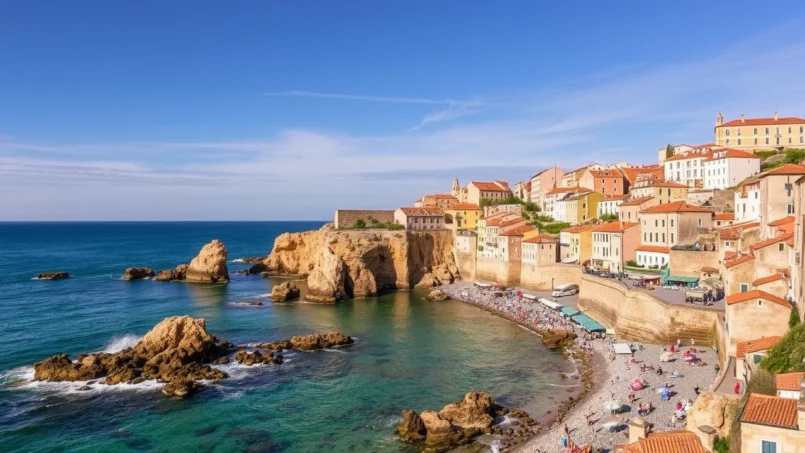
 Published on and written by Cyril Jarnias
A coral island set at the eastern end of the Caribbean, Barbados concentrates an astonishing density of remarkable sites within its 166 square miles. From postcard-perfect beaches and 17th-century plantations linked to the history of sugar and the triangular trade, to spectacular underground caves, tropical gardens, fishing villages, and a UNESCO-listed capital, the island offers a concentrated blend of landscapes, memory, and culture.
Barbados offers a coastline of nearly 62 miles between the Caribbean Sea and the Atlantic Ocean, featuring a landscape of coral terraces, caves, and gullies. With a population of about 300,000, it is easy to explore. The official language is English, the currency is the Barbadian dollar, and the climate is tropical (75-84°F almost year-round). The dry season, from December to May, is the ideal time for land and sea visits.
Within this panorama, certain places stand out as must-sees for understanding the island’s soul: the historic capital Bridgetown, the grand plantation houses, rum distilleries, limestone caves, botanical gardens, nature reserves, and of course a selection of the Caribbean’s most beautiful beaches.
Bridgetown and its Garrison: A UNESCO-Listed Historic Heart
To immediately grasp Barbados’s uniqueness, one must start with Bridgetown. The capital concentrates the essence of the island’s colonial history, as well as its contemporary rhythm, blending commerce, institutions, and a lively waterfront. Its center, combined with the military Garrison area, is inscribed as a UNESCO World Heritage site under the name “Historic Bridgetown and its Garrison.”
A Colonial Port with a Singular Street Plan
Built from the 17th century onward, Bridgetown does not follow the strict grid pattern of neighboring Spanish or Dutch cities. Its winding streets testify to organic growth, guided by the terrain and the natural harbor of Carlisle Bay, long the first port of call for ships crossing the Atlantic. The city was an essential node in British trade in the Americas, including the slave trade.
This is the number of protected buildings within the UNESCO perimeter, including Victorian buildings, merchant houses, churches, and institutions.
A simple look at the most emblematic places allows one to grasp the scale of the site.
| Place | Main Interest | Particularity |
|---|---|---|
| Barbados Parliament | Neo-Gothic architecture | Seat of legislative power in the heart of Bridgetown |
| Independence / National Heroes Square | Central square | Monuments, views of the Careenage |
| The Careenage | Urban basin | Historic waterfront, boats, and promenades |
| Nidhe Israel Synagogue | Place of worship and museum | One of the oldest synagogues in the hemisphere, 17th-century mikveh |
| Blackwoods Screw Dock | Historic dock | The only surviving screw dock of its kind in the world |
The Nidhe Israel Synagogue and its museum tell a lesser-known chapter of local history: the Jewish community that introduced sugar cane in the 17th century, giving rise to the plantation system that profoundly shaped the island. The Blackwoods Screw Dock illustrates the maritime power of the port in the late 19th century, with a dry dock screw technology now almost extinct.
The Garrison Savannah: Horses, Cannons, and Barracks
A few minutes from the center, the Garrison sector completes the picture. This former British military quarter grouped together barracks, fortifications, and parade grounds. Today, it is one of the island’s eight major heritage conservation areas.
The Garrison Savannah is a vast grass oval in Barbados that has hosted horse racing since the mid-19th century, including the prestigious Sandy Lane Gold Cup event. This same site also has national historical importance, as it is where the Barbadian flag was first raised during the country’s independence.
A few steps away stands St. Ann’s Fort, which now houses the Barbados Defence Force and a collection of artillery including a rare Elizabethan cannon, as well as George Washington House. This house hosted, in 1751, the future first president of the United States during his only stay outside the North American continent. Restored to its 18th-century appearance, it offers a concrete glimpse into the daily life of a planter family of the time.
Within the same perimeter, the Barbados Museum & Historical Society, housed in a former 19th-century military prison, unfolds the island’s history, from pre-Columbian archaeology to contemporary heritage. A useful stop for contextualizing the cane fields, great houses, and Barbados’s role in the British Empire.
Plantations, Great Houses, and the Memory of Sugar
Behind the beaches and rum, Barbados bears a heavy history, inseparable from sugar cane and slavery. The great plantation houses, very numerous from the 17th to the 19th century, sometimes survive intact. Some are open for visits, offering a dual perspective: on the refinement of the colonial elite, and on the economic system built on forced labor.
St. Nicholas Abbey: A Jacobean Manor and a Living Distillery
In the parish of St. Peter, St. Nicholas Abbey stands as an architectural gem. Built around 1658, this Jacobean-style house is one of the last of its kind in the entire Western Hemisphere. Symmetrical facade, scrolled gables, period woodwork: the ensemble was meticulously restored by the Warren family starting in 2006.
The estate was long a sugar plantation. Rum distillation is attested there as early as the 1750s, driven by Sir John Gay Alleyne. In the late 19th century, a steam engine was installed to modernize sugar production, a still-visible witness today that is fired up during demonstrations.
The visit includes discovery of the great hall with its antique furniture, a roughly 30-minute film on plantation life, exploration of the distillation equipment and garden, as well as a tasting of rums aged on-site (5, 8, 15, 22 years, and a white rum flavored with hazelnut and vanilla). A small souvenir flask is offered to complete the experience.
In recent years, a steam train, the St. Nicholas Abbey Heritage Railway, takes visitors through cane fields and a mahogany forest to the lookout at Cherry Tree Hill, which overlooks the east coast. A nod to the island’s former sugar railway network.
Sunbury Plantation House, Drax Hall, and Other Great Houses
Still within the realm of grand estates, Sunbury Plantation House, in St. Philip, dates back to the 1660s. This house, open to the public, retains antique furniture, silverware, porcelain, as well as an impressive collection of carriages and wagons in its former outbuildings. The shaded courtyard often hosts a restaurant, making it a pleasant stop for lunch amidst the fields.
Drax Hall Estate, in the parish of St. George, is one of the oldest intact plantation houses in the Caribbean, with parts dating from the early 1650s. Its name recalls the central role of planter families in establishing the sugar model and slavery in Barbados, even if the site is less staged for tourism than other plantations like St. Nicholas Abbey or Sunbury.
Other houses complete this picture, like Fisherpond Great House, sometimes open for lunches, or the ruins of the great house at Farley Hill, integrated into a national park. At Morgan Lewis, an entire windmill has been restored, a symbol of the 506 windmills that dotted Barbados at the height of sugar. Managed by the Barbados National Trust, it is the largest surviving sugar windmill in the Caribbean.
A comparative glance allows for better situating these places.
| Site | Era / Function | Main Interest |
|---|---|---|
| St. Nicholas Abbey | 17th-century plantation, Jacobean manor, distillery | Rare architecture + craft rum + steam train |
| Sunbury Plantation House | House from 1660 | Furnished interior, carriages, and restaurant |
| Drax Hall Estate | Mid-17th-century plantation | One of the oldest intact plantation houses in the region |
| Morgan Lewis Windmill | Restored windmill | Last complete large sugar windmill in the Caribbean |
| Farley Hill National Park | Ruins of a 19th-century manor | Scenic park overlooking the east coast |
For those wishing to delve deeper into the theme, the project “The Industrial Heritage of Barbados: The Story of Sugar and Rum” is on UNESCO’s Tentative List as a potential future heritage ensemble, covering several parishes and sites linked to this industrial history.
Barbados, the Birthplace of Rum: Distilleries and Tasting Experiences
It is impossible to talk about Barbados’s must-see sites without mentioning rum. The island is often described as the birthplace of this spirit, whose early forms – then nicknamed “kill-devil” or “rumbullion” – were born from the fermentation and distillation of molasses from sugar cane. Some hypotheses even attribute the discovery of this process to enslaved people on the plantations.
Mount Gay, Over Three Centuries of Liquid History
The name Mount Gay resonates in rum bars worldwide. The distillery, located in St. Lucy, claims the title of the oldest operating rum brand, with a distillation technique that has remained faithful to the principles established in the early 18th century. The water used comes from a well dug at the time, naturally filtered by the coral rock.
The tourist experience spans the industrial site in the north and the Visitor Centre near Bridgetown, with tasting tours, cocktail workshops, food-rum pairings, and immersive dinners. Prices range from about twenty to over 200 US dollars. Trudiann Branker embodies the renewal of a centuries-old tradition there.
Trudiann Branker, Barbados’s first female master blender
Foursquare, West Indies Rum Distillery, and the Archipelago of Brands
Another major player, Foursquare Rum Distillery, in St. Philip, occupies a former eight-hectare plantation established around 1720 and revived in 1996 by the Seale family. The operation can be visited freely, with no entrance fee, and is organized as a “Heritage Park,” with historic buildings, a folklore museum, and period sugar machinery. The distillery also stands out for its environmental efforts, such as reusing bagasse (cane residue) as an energy source or treating wastewater.
Discover the different rum brands and bottlings produced by the Foursquare distillery, renowned for its Barbadian know-how.
An iconic brand of Foursquare rums, offering expressions from young to aged, known for their balance and authenticity.
A traditional and robust rum, appreciated for its strong character, representative of Barbados’s classic style.
A historic brand of Foursquare rums, perpetuating a legacy and a name famous in the Barbadian rum universe.
A range of rums named after Barbados’s independence, offering distinct and carefully crafted aromatic profiles.
Exceptional rums, aged and bottled under the Foursquare label, representing unique vintages and specific years.
To the west, near Brighton Beach, the West Indies Rum Distillery, founded in 1893 by George Stade, is now the island’s largest rum producer, with about 80% of total output. It houses the oldest pot still still in service in the world. Acquired in 2017 by the French house Ferrand, it distills brands like Cockspur, Malibu, Plantation, and Blue Chair Bay, and welcomes visitors for the “Stade’s Rum Experience,” which includes a tasting directly from the barrels.
The diversity of sites allows for creating a true rum trail.
| Distillery / Site | Location | Tourist Specificity |
|---|---|---|
| Mount Gay Distillery & Visitor Centre | St. Lucy / St. Michael | Tastings, cocktail workshops, rum-pairing meals |
| Foursquare Rum Distillery & Heritage Park | St. Philip | Free visit, museum, environmental approach |
| St. Nicholas Abbey Distillery | St. Peter | Aged rum, great house and steam train tour |
| West Indies Rum Distillery | West coast (near Brighton Beach) | Largest distillery on the island, “Stade’s Rum Experience” tour |
| Local rum shops | All over the island | Neighborhood bars, social heart of rum culture |
Beyond the major brands, the island indeed has a multitude of “rum shops,” small neighborhood stores where you’re more likely to order a flask of rum, a bottle of soda, and a bucket of ice than a simple rum-and-coke by the glass. These places are as much windows into Barbadian sociability as they are into its emblematic drink.
Caves, Gullies, and Coral Terrain: Underground Barbados
Composed of over 80% coral limestone, Barbados is pierced by an impressive network of over 130 recorded caverns, gullies, and passages. These underground spaces reveal another face of the island, blending geology, adventure, and sometimes archaeological memory.
Harrison’s Cave: A “Natural Wonder” by Electric Tram
In the center of the island, in the parish of St. Thomas, Harrison’s Cave is often presented as one of the “seven wonders of Barbados.” The cavity, perched about 690 feet above sea level, stretches over 1.4 miles of main and secondary galleries, with an active underground river, waterfalls, emerald pools, stalactites, stalagmites, columns, and flows of calcite.
Mentioned in documents as early as the late 18th century, the cave was truly explored in the 1970s, before being developed and opened to the public in 1981. Access is via the Boyce Tunnel, a tunnel drilled to allow the passage of electric trams. Standard tours last about three hours, with 30 to 60 minutes underground. Prices start around 30 Barbadian dollars for basic packages and can rise to 90 BDS for passes combining several activities in what is now an Eco-Adventure Park.
Beyond the tram tour, the site offers a so-called “Monkey Zipline,” a high ropes course (Gully Challenge), a nature trail, an aviary, a pool, and a lounge dedicated to Mount Gay rum. An interpretation center completes the discovery with exhibits and historical objects. The cave, managed by the National Conservation Commission, remains open every day, first tours at 9 a.m., last ones in the afternoon.
Animal Flower Cave: At the Island’s Tip, Between Waves and Anemones
At the extreme north, in the parish of St. Lucy, Animal Flower Cave offers a total contrast. Here, no tram, but a descent by stairs carved into the rock to reach a sea cave open to the Atlantic. Natural “windows” cut into the cliff and frame the swell, while some rocky pools are suitable for swimming when the sea allows.
This cave, named after the local sea anemones nicknamed “animal flowers,” is an unmissable tourist site with an entrance fee of about 10 USD. From February to May, the surrounding cliffs offer an excellent vantage point for spotting humpback whales. A cliff-top restaurant, offering cuisine based on local produce sometimes from the owners’ farm, complements the visit.
Other Gullies and Gorges: Cole’s Cave, Welchman Hall Gully, Turners Hall Woods
For the more adventurous, Cole’s Cave, in the island’s center, offers a more engaged exploration. This network, connected to the Harrison’s Cave system, consists of passages about 10 feet high and wide, with stalactites, stalagmites, small streams, and basins. A large room, nicknamed “the cathedral,” marks the highlight of the route. Due to risks related to rain and the site’s morphology, it is recommended to go only with an experienced local guide.
An ancient collapsed cave located in St. Thomas, near Harrison’s Cave, this gully is home to lush vegetation (giant palms, ferns, bamboo) and green monkeys, most visible in late morning. The maintained trails and guided tours make it an excellent introduction to the island’s coral geology. Entrance costs about 12 US dollars for adults.
Further northeast, Turners Hall Woods preserves what some consider a fragment of the primeval forest that once covered the island. Nestled in the heart of the “Scotland District,” an area of eroded hills on the Atlantic coast, this wood offers trails, picnic tables, and a jungle ambiance, with free access. Good walking shoes, even poles, are advised.
Gardens, Reserves, and Forests: Green Barbados
Thanks to its subtropical climate and coral soils, Barbados is home to surprisingly diverse flora for an island of its size. Botanical gardens, forests, gullies, and reserves have been developed, offering a lush counterpoint to the beaches.
Andromeda, Hunte’s Gardens, Flower Forest: The Botanical Palette
Created in the 1950s in the parish of St. Joseph, the Andromeda Botanic Gardens cover nearly six acres of sloping terrain. Here, one discovers a spectacular collection of tropical plants: orchids, heliconias, rare trees, as well as a monumental bearded fig tree, the national tree of Barbados. Colorful butterflies and birds pollinate or nest in this profusion. Visits are generally self-guided, with maps in hand, allowing everyone to wander at their own pace.
Not far away, Hunte’s Gardens occupy the bottom of an ancient natural sinkhole. Landscape designer Anthony Hunte has composed an intimate, very vertical garden there, where plants echo each other under the discreet sound of classical music playing in the background. Winding paths open onto small clearings with benches, while the veranda of the owner’s house often serves as an impromptu tea room.
Anthony Hunte, landscape designer
Also on the heights of St. Joseph, Flower Forest Botanical Gardens takes over the site of a former cane plantation and opens it up to 53 acres of greenery. Paths traverse flower beds, tropical trees, and lookouts with plunging views of the Atlantic coast. An on-site cafe allows extending the visit over lunch or a fresh juice.
Barbados Wildlife Reserve, Grenade Hall, and Other Wildlife Refuges
Opposite Farley Hill National Park, in the parish of St. Peter, the Barbados Wildlife Reserve spans four acres of mahogany woodland. Founded in the early 1980s by Canadian primatologist Jean Baulu and his wife, it originated from a research center dedicated to the green monkey, a species introduced to Barbados in the 17th century and now omnipresent.
The particularity of this park is the almost complete absence of cages: most animals (green monkeys, tortoises, iguanas, peacocks, deer, etc.) roam freely among visitors. Only dangerous animals like large snakes are enclosed. Buildings are constructed from coral stone from neighboring cane fields, and paths are paved with bricks salvaged from old sugar factories.
Twice a day, at 11 a.m. and 2 p.m., the monkey feeding attracts clusters of primates, sometimes from outside the reserve. Entrance, around 15 US dollars for an adult and 7.50 for a child, includes access to the forest and the Grenade Hall signal station, the park’s direct neighbor. There, two kilometers of trails wind under the canopy, punctuated by signs on flora and fauna, while the restored tower offers a 360° panoramic view of the hills and sea.
Other natural spaces complete this network: PEG Farm and Nature Reserve, on the cliffs of the east coast, which combines sustainable farming, an organic restaurant, and hikes; or Walkers Reserve, a former sand quarry transformed into an ecological restoration zone, where one can participate in a tree-planting program (“One Tree for Every Bajan”) or discover the role of bees in island ecosystems.
Beaches and Coastline: From the “Platinum Coast” to the Wild Atlantic Shore
All beaches in Barbados are public, by legal principle. From north to south, west to east, they offer a great diversity of landscapes and atmospheres. The west, facing the Caribbean Sea, lines up coves with calm, clear waters. The east, exposed to the Atlantic, is more spectacular, but often dangerous for open-water swimming. In between, the south combines sheltered lagoons and water sports spots.
Carlisle Bay and Folkestone: Snorkeling Paradise
Just outside Bridgetown, Carlisle Bay alone illustrates the Bajan postcard: white sand, turquoise water, underwater visibility regularly exceeding 50 to 65 feet, and several easily accessible shipwrecks. The area, protected as a marine park, includes several beaches – Brownes Beach, Pebbles Beach, Bayshore – and is home to six ships sunk at depths from 10 to 55 feet, including the Berwyn and the Bajan Queen. Green and hawksbill turtles, tropical fish, rays, and seahorses find refuge there, as do numerous corals and gorgonians.
On certain beaches like Harbour Lights or Lobster Alive, early in the morning (between 6 and 9 a.m.), it’s possible to witness an unusual spectacle: racehorses from the Barbados Turf Club are brought into the sea for a therapeutic bath.
Further north, in St. James, Folkestone Marine Park protects a fringing reef fed by the wreck of the Stavronikita, sunk in the 1970s to serve as an artificial reef. An area reserved for snorkeling, marked and prohibited to motorized craft, allows safe exploration of corals and fish. A visitor center, a small museum, an aquarium, as well as showers, picnic tables, and equipment rentals complete this site, popular with families and divers alike.
West Coast: Paynes Bay, Mullins, Sandy Lane, and Tranquil Coves
Along the “Platinum Coast,” from Holetown to Speightstown, calm bays ideal for swimming and turtle watching succeed one another. Paynes Bay, near Holetown, combines an arc of golden sand, clear water, and the regular presence of green and hawksbill turtles. A small fishing complex sometimes allows buying fresh fish, while loungers, umbrellas, and showers cater to practical needs.
Mullins Beach, located in the bay of the same name, combines calm sea, beach services, restaurants (Sea Shed, CiCi’s Beach Bar), and water activities like jet-skiing or tubing. Nearby, Gibbes Beach offers a more peaceful ambiance, lined with trees, and is known for discreet snorkeling along the reef.
Sandy Lane Beach symbolizes Caribbean luxury: water of remarkable clarity, fine sand, and high-end hotels in the background. A bit further down, Batts Rock Beach and Brandons Beach, at the gates of Bridgetown, gather local families and visitors around restaurants like La Cabane or floating amusement parks like Rascals Water Park.
South and East Coasts: Surf, Natural Pools, and Cliffs
In the south, Accra Beach (Rockley Beach) combines moderate waves for bodyboarding, a swimming area, picnic tables, and proximity to a boardwalk, the Richard Haynes Boardwalk, which follows the sea to Hastings. Dover Beach, in the lively St. Lawrence Gap area, charms with its light sand, waters conducive to water sports, and the multitude of surrounding bars and restaurants. Near Oistins, Miami / Enterprise Beach offers a lagoon sheltered by a jetty, ideal for families, with snack stands and the presence of lifeguards.
Silver Sands Beach, located at the extreme south, is known for transforming into an ideal spot for kitesurfing and windsurfing when the wind picks up, thanks to protection from a reef. The landscape is marked by the South Point lighthouse, recognizable by its red and white stripes and dating from the mid-19th century.
On the east coast, Bathsheba Beach embodies wild Barbados: enormous rock blocks stranded in the Atlantic swell, powerful waves, the famous “Soup Bowl” surf spot, and, between the rocks, natural bathing pools where one can soak at low tide. Further south, Bath Beach, protected by a reef, is an exception among Atlantic beaches, with a relatively safe, supervised body of water, equipped with picnic areas and showers.
In the southeast, Bottom Bay and Crane Beach feature cliffs and coconut palms above pale sand beaches. Bottom Bay, accessible by a long staircase, remains wild, without services, with a sea often rough. Crane Beach, dominated by the famous Crane Resort, offers in places slightly pinkish sand and waves appreciated for bodyboarding.
A quick overview allows for comparing these emblematic major beaches at a glance.
| Beach / Bay | Coast | Main Assets | Caution |
|---|---|---|---|
| Carlisle Bay | Southwest | Clear water, shipwrecks, turtles, beach clubs | Boat traffic, follow marked zones |
| Folkestone Marine Park | West | Protected marine park, reef, museum | Stay in the dedicated snorkeling area |
| Paynes Bay | West | Turtles, calm sea, services | Heavy crowds in high season |
| Miami / Enterprise Beach | South | Sheltered lagoon, family-friendly, near Oistins | Crowds on weekends |
| Silver Sands | South | Kitesurfing, windsurfing | Currents and waves for inexperienced swimmers |
| Bathsheba Beach | East | Spectacular landscapes, surfing, natural pools | Open-water swimming not advised |
| Bottom Bay | Southeast | Cliffs, palm trees, isolation | Currents, no lifeguards |
| Bath Beach | East / Southeast | Protected bay, picnic area | Monitor sea conditions depending on swell |
Towns, Villages, and Cultural Symbols
Beyond Bridgetown, Barbados can also be read through its small towns and more recent places of memory.
Speightstown, in the northwest, is a former important port turned into a peaceful town blending seaside cafes, a market, and colonial houses. Further south, Holetown commemorates the arrival of the first British settlers in the 1620s. Finally, Oistins, on the south coast, is animated by fishing, its Fish Festival, and its Friday night Fish Fry, where grilled fish, music, and dancing create a major popular celebration.
In the capital, one street now attracts many visitors: Rihanna Drive, formerly Westbury New Road, where the world-famous singer grew up. Murals, plaques, and souvenirs make it a pop pilgrimage, reflecting Barbadian cultural pride.
In St. John, the parish church perched on a cliff, St. John’s Parish Church, offers a breathtaking view of the east coast and houses the tomb of historical figures. In Holetown, St. James Anglican Church, built on the site of the island’s first place of worship, recalls the deep-rooted early British presence.
Museums, Crafts, and Urban Experiences
Aside from the great plantation houses and museums already mentioned in Bridgetown, the island has other places of interest that usefully complement a more cultural discovery.
Discover the island’s rich history and national passions through these interactive and thematic museums.
Located in Speightstown in an 18th-century building, this interactive museum explores local history and maritime life.
In St. James, this museum details sugar-making processes, from cane to crystal.
In St. Michael, this space celebrates great Barbadian players of this national passion sport.
Craftsmanship is expressed notably at Earth Works Pottery and Batik Studio, where colorful ceramics and batik fabrics are produced on-site. Agapey Chocolate Factory, for its part, opens the doors of its chocolate factory to visitors to reveal the steps of chocolate making.
In Bridgetown, walking tours – whether guided by a local company or self-organized – allow linking Parliament, the Careenage, synagogues, churches, markets, and shopping streets in a few hours. Food tours, on the other hand, offer tastings of fish cakes, macaroni pie, fish cutters, cou-cou, and other specialties accompanied by rum punch.
Festive Atmosphere: When Sites Transform into Stages
Barbados also lives through its festivals, which often take over the same places tourists visit by day. The Garrison Savannah becomes the theater for major horse races like the Sandy Lane Gold Cup. Carlisle Bay and its surroundings host concerts, fireworks, and Crop Over events, the vast national festival marking the symbolic end of the cane harvest, between June and August.
Holetown transforms during its annual festival into a stage for living history, with reenactments, parades, and performances. Oistins makes its wharves and market square the epicenter of the Oistins Fish Festival, celebrating fishermen and maritime traditions through fish-filleting competitions, crab races, and greased pole climbs.
Music lovers find their fill during the Barbados Reggae Festival or the Barbados Food & Rum Festival, where distilleries, beaches, and restaurants blend with ephemeral stages. In Bridgetown’s port, Barbados Sailing Week gathers racing yachts for coastal regattas and the famous Mount Gay Round Barbados Race.
Practical Tips for Enjoying the Must-See Sites
Exploring these multiple sites requires a minimum of organization, without turning the stay into a marathon. A few points of reference are essential.
First, consider the climate: the dry season, from December to May, corresponds with calmer waters for snorkeling and boat trips, particularly on the west coast. The hurricane season, from July to October, can make the sea rougher in some areas.
Next, anticipate logistics: an online customs and immigration form must be filled out before arrival on the island. On-site, renting a car remains an excellent way to link caves, gardens, and more secluded beaches, keeping in mind that driving is on the left. The bus network, inexpensive, nonetheless covers most major localities, including sites like Harrison’s Cave via some rural lines.
For structured visits (distilleries, caves, museums), always check opening hours, generally between 9 a.m. and late afternoon. It’s advisable to book the most popular experiences in advance, either via platforms like Viator or GetYourGuide, or by contacting the sites directly. Prices can vary considerably: expect about 10 to 15 US dollars for a mid-sized museum, while a major experience including transport, lunch, and several visits can exceed a hundred dollars.
A few simple precautions significantly improve the experience: closed, non-slip shoes for caves and gullies, near-constant sun protection and hat, mosquito repellent for reserves and forests, a reusable water bottle, swimsuit and towel at hand to seize every swimming opportunity, from the natural pool at Bathsheba to the basins of Animal Flower Cave.
Barbados is home to sea turtles, reefs vulnerable to bleaching, and sensitive wildlife. To protect them, it is essential to observe from a distance, not to feed animals, avoid touching corals, take your trash with you, and support conservation initiatives.
—
Between a UNESCO-listed historic city, plantation houses frozen in time, innovative rum distilleries, spectacular gullies, lush gardens, wildlife reserves, and breathtaking beaches, Barbados offers much more than a simple vacation backdrop. It is a territory where natural beauty constantly blends with the layers of a complex history, from the slave system to struggles for freedom, from sugar monoculture to independence and current environmental challenges.
To explore its must-see tourist sites is to accept this plurality: raising a glass of rum while keeping in mind the plantations it came from, photographing a coastal landscape while knowing it was once a nerve center of transatlantic trade, admiring a green monkey in a reserve while leaving nature the space it deserves. It is in this tension, between the pleasure of discovery and awareness of what one is observing, that Barbados establishes itself as a destination that is both enchanting and profoundly instructive.
Disclaimer: The information provided on this website is for informational purposes only and does not constitute financial, legal, or professional advice. We encourage you to consult qualified experts before making any investment, real estate, or expatriation decisions. Although we strive to maintain up-to-date and accurate information, we do not guarantee the completeness, accuracy, or timeliness of the proposed content. As investment and expatriation involve risks, we disclaim any liability for potential losses or damages arising from the use of this site. Your use of this site confirms your acceptance of these terms and your understanding of the associated risks.

Cyril Jarnias is an independent expert in international wealth management with over 20 years of experience. As an expatriate himself, he is dedicated to helping individuals and business leaders build, protect, and pass on their wealth with complete peace of mind.
On his website, cyriljarnias.com, he shares his expertise on international real estate, offshore company formation, and expatriation.
Thanks to his expertise, he offers sound advice to optimize his clients' wealth management. Cyril Jarnias is also recognized for his appearances in many prestigious media outlets such as BFM Business, les Français de l’étranger, Le Figaro, Les Echos, and Mieux vivre votre argent, where he shares his knowledge and know-how in wealth management.





