
 Published on and written by Cyril Jarnias
Moving to Slovakia often starts with a simple yet crucial question: which neighborhood should you call home? The country is attracting more and more expats thanks to its moderate cost of living, central European location, and an overall safe environment. But in practice, a large portion of newcomers concentrate in the capital, Bratislava, and a few major cities like Košice or Prešov.
The rental market for expats is primarily concentrated in Bratislava, which is analyzed in detail. The cities of Košice and other developing hubs are also presented as up-and-coming alternatives.
Understanding the Slovak context before choosing your neighborhood
Before zooming in on neighborhoods, you need to grasp a few contextual elements that directly influence the choice of where to live: salary levels, real estate prices, city structure, and the profile of expats settling there.
Slovakia has approximately 5.5 to 5.8 million inhabitants. The landlocked country is in the heart of Central Europe, bordering Austria, Hungary, Poland, Ukraine, and the Czech Republic. The euro is the official currency, the language is Slovak, and the capital, Bratislava, concentrates political power, a large share of skilled jobs, major corporate headquarters, and thus the majority of expat communities.
The average gross salary in Bratislava is around €2,250 per month.
However, compared to many Western capitals, Bratislava is still considered “affordable” by many expats. Daily costs (restaurants, transport, some fresh produce) remain lower than in Vienna, Paris, or Munich, even though housing takes a big chunk of the budget.
The estimated monthly cost of living for a single expat in Bratislava, including housing.
The table below provides a concise overview of some expense categories in Bratislava:
| Expense Category | Average Level in Bratislava |
|---|---|
| Average net salary (Bratislava) | ~€1,360 to €1,660 / month |
| 1-bedroom apt. city center | €650 to €1,100 / month |
| 1-bedroom apt. outside center | €500 to €850 / month |
| 3-bedroom apt. city center | €1,000 to €1,850 / month |
| 3-bedroom apt. outside center | €780 to €1,300 / month |
| Shared apartment / room | €300 to €450 / month |
| Utilities (85–95 m²: heating, water, etc.) | €150 to €340 / month |
| Fixed internet (≥ 60 Mbps) | €13 to €25 / month |
| Public transport ticket (30 min) | ~€0.97 |
| Monthly transport pass | ~€36–40 |
In this context, choosing a neighborhood becomes an exercise in balance between budget, lifestyle, proximity to work and schools, access to nature, and the quality of the international community.
Bratislava, heart of the expat communities
Bratislava resembles a small capital city: just over 470,000 inhabitants, a compact historic center on the banks of the Danube, and a network of trams and buses that allows you to cross the city in about thirty minutes. Officially, the city is divided into five large districts (Bratislava 1 to 5), themselves subdivided into 17 administrative boroughs or neighborhoods.
Most expats – multinational company employees, expat families, international students, freelancers – concentrate in a few well-identified areas: the historic center (Staré Mesto), large residential neighborhoods like Ružinov, Nové Mesto, Karlova Ves or Petržalka, and some peripheral sectors experiencing a real estate boom.
The following table summarizes the profile of Bratislava’s main districts cited as attractive for foreigners:
| District / Main Neighborhood | General Profile for Expats | Most Common Type of Resident |
|---|---|---|
| Bratislava 1 – Staré Mesto | Historic center, very lively, touristy, expensive, very international | Young professionals, students, short-term stays |
| Bratislava 2 – Ružinov | Residential, mix of old/new, close to business district | Young families, executives, digital nomads |
| Bratislava 3 – Nové Mesto | Larger, greener, near the hills, larger apartments | Families, couples, outdoor enthusiasts |
| Bratislava 4 – Karlova Ves | Very green, near Danube and hills, international schools | Expat families with school-aged children |
| Bratislava 5 – Petržalka | Large, dense neighborhood, well-connected, affordable, transforming | Tight budgets, Austria commuters, students |
Staré Mesto (Bratislava 1): The historic center, international showcase
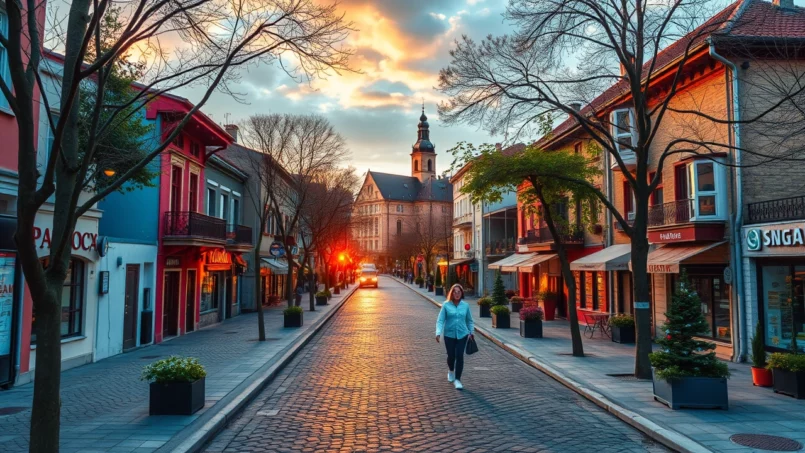
Staré Mesto is the postcard image of Bratislava: cobbled streets, baroque facades, specialty cafes, art galleries, immediate proximity to the castle and the Danube. It is also, very clearly, one of the most sought-after neighborhoods by expats.
The advantages are obvious: everything is within walking distance, public transport radiates from here, restaurants and bars abound, cultural life is dense, and the international community is well established. Many young foreign professionals, consultants, employees of regional company headquarters, as well as university exchange students choose Staré Mesto for the first year, in order to be “in the heart of the action.”
The buildings here are often renovated old structures, with high ceilings and sometimes atypical apartments. Many expats settle on streets like Dunajská, Moskovská, or in the Palisady area, a highly sought-after residential sector on the slopes leading to the castle, known for its beautiful historic buildings, embassies, and views over the city.
The flip side is the price and size of the apartments. Apartments are smaller than in peripheral neighborhoods, and high demand keeps rents at the top of the range. According to recent market data, a one-bedroom apartment in the center can easily cost between €700 and €1,000 per month, or even more for high-end or new properties (projects like Sky Park or Eurovea City). The new modern residences on the Danube waterfront, integrated with shopping malls and offices, explicitly target an international clientele willing to pay for “Western capital city” comfort.
Average rents by sector confirm this hierarchy:
| Bratislava Neighborhood | Average Apartment Rent (all sizes, Q2 2025) |
|---|---|
| Staré Mesto | ~€1,181 / month |
| Nové Mesto | ~€849 / month |
| Karlova Ves | ~€796 / month |
| Ružinov | ~€790 / month |
| Other districts | ~€630–740 / month |
Staré Mesto is therefore clearly positioned at the top of the rental market. Nevertheless, many expats choose it, even if it means sacrificing some space, because the possibility of doing everything on foot, going out in the evening without relying on transport, and living in a very international environment largely compensates for some of them.
Ružinov (Bratislava 2): Winning compromise for families and young professionals
East of the center, Ružinov stands out as one of the favorite neighborhoods for expats looking for a compromise between centrality, budget, and quality of life. This former residential sector from the 70s-80s has seen modern buildings, office complexes, and many new real estate projects spring up. Today, it’s one of the epicenters of the Slovak urban middle class… and young expat families.
Part of the Ružinov neighborhood, centered around Mlynské Nivy and the new Nivy Station bus terminal, has undergone a complete transformation. It now hosts office buildings, a shopping mall, coworking spaces, and trendy restaurants. This evolution gives Ružinov a very cosmopolitan character, marked by a high concentration of multinational company employees and freelancers.
Farther back, in areas like Trávniky, Štrkovec, Mierová, Jegeho, or Trnavka, the scenery changes: renovated apartment blocks, small local shops, neighborhood parks, and especially a strong presence of Slovak families. It’s this combination of local life, numerous services, parks, and lakes (Štrkovec, Zlaté Piesky a bit further) that attracts foreigners with children.
Financially, Ružinov is cheaper than Staré Mesto, but still in the higher range of the Bratislava market. National data shows average rents close to €790 per month for apartments of all types. In practice, it’s still possible to find a decent two-room apartment for €700–800, but new residences or well-renovated apartments rent for more, especially if furnished (which often adds a €50 to €100 monthly premium).
One minor drawback of the neighborhood is traffic: during rush hour, some main roads are congested, especially near the business district and major routes to the ring road. Another point noted by residents: proximity to the Slovnaft refinery in part of the district, which can cause unpleasant odors depending on the weather. But these inconveniences don’t prevent Ružinov from being frequently cited by expats as offering “the best value for money” in Bratislava.
Nové Mesto (Bratislava 3): Space, greenery, and family life
Further north, Nové Mesto attracts those looking for more space and direct access to nature without being completely removed from the city. It’s a vast district, stretching from residential neighborhoods near the center to the first slopes of the Little Carpathians.
The city has a large urban park and wooded areas with lakes, allowing for swimming in summer and ice skating in winter. The surrounding hills offer many trails for walking, biking, or trail running. For expats, being able to end a workday with a walk in the forest just ten minutes from home is a decisive advantage.
Housing here is often more spacious than in the center: renovated apartment blocks, small buildings, townhouses, and villas on the heights. Many expats report that “you get more for your money” in terms of square footage in Nové Mesto compared to Staré Mesto or Ružinov.
At the same time, the district has established itself as a major hub for foreign families: it’s home to several international or bilingual schools, making it a logical area for parents who don’t want to enroll their children in the Slovak public school system.
The downside are the mobility constraints in some hilly or poorly served areas, and parking problems in some sectors. Despite this, Nové Mesto remains a preferred choice for couples and young families seeking peace without completely giving up on urban vibrancy.
Karlova Ves (Bratislava 4): The “green” neighborhood for expat families
West of the center, on the left bank of the Danube, Karlova Ves combines several ingredients highly appreciated by expats with children: plenty of green spaces, proximity to the river and hills, relatively quick access to the center, and especially the presence of several international schools.
The majority of Bratislava’s student residences are also in this area, which brings a young and dynamic vibe, without turning the neighborhood into a zone of unbridled nightlife. Karlova Ves is rather perceived as a quiet, family-friendly place, with parks, playgrounds, and bike paths along the Danube.
The presence of nature-oriented institutions (zoo, botanical garden, River Park) makes the area attractive, which generates high demand. Consequently, prices have increased sharply, with an average rent of around €800 per month for an apartment. This amount varies depending on size, condition, and proximity to schools or the riverbanks.
For expats sent by companies or international organizations with a substantial housing budget, Karlova Ves is often the number one option, especially when children are enrolled in the British, American, or international schools in the area.
Petržalka (Bratislava 5): The residential “monster” reinventing itself
Seen from the castle, the forest of concrete panel buildings in Petržalka is one of the most iconic – and sometimes most feared – landscapes of Bratislava. A massive legacy of communist urban planning, this district, located on the right bank of the Danube, is the city’s most populous, with about 100,000 inhabitants. Long saddled with a bad reputation (it was compared to the “Bronx of Bratislava” due to crime and drug problems in the 90s-2000s), the neighborhood has changed a lot.
Today, Petržalka stands out mainly for three characteristics that interest expats: more affordable rents than in other sought-after areas, a plethora of housing options, and exceptional connectivity to the center and to Austria.
Practically, the district is covered by bus and tram lines. On the nature side, it’s not just concrete panels: there are parks, lakes like Veľký and Malý Draždiak for swimming or fishing, long bike paths along the Danube, as well as Sad Janka Kráľa Park, one of the oldest public parks in Central Europe, very popular for walks and picnics.
For cross-border commuters, Petržalka is simply strategic: the neighborhood train station allows you to reach Austria in one stop, and Vienna in about an hour by train. Many Petržalka residents work in Austria, benefiting from Slovak housing costs combined with Austrian salaries.
Regarding rent, a one-bedroom apartment can start around €700, but there’s a wide range depending on location, renovation, and parking availability. The latter is actually a point of frustration for many residents: parking is not always included in rents and can cost an extra €50 to €100 per month. Many areas are still under construction, giving a feeling of a permanent building site.
Despite these limitations, Petržalka is attracting more and more expats, particularly students, young professionals on a tight budget, and Austria-Slovakia cross-border commuters. The neighborhood is multiplying renovation projects, new, more modern buildings, and shops. It’s considered by many investors to be one of the “up-and-coming” sectors of Bratislava.
Other Bratislava areas appearing on expats’ radar
Beyond these classic areas, several other neighborhoods or sub-districts deserve the attention of foreigners considering a slightly longer stay or wanting to move away from the postcard image.
Kramáre: Peace, greenery, and proximity to hospitals
Often considered part of Nové Mesto, Kramáre is an elevated, very green sector, about a fifteen-minute bus ride from the historic center. The atmosphere is decidedly more tranquil: small apartment buildings, modern houses, tree-lined streets, nice views of the city.
Proximity to a major hospital makes the neighborhood particularly attractive for expat healthcare professionals, as well as retirees or families looking for a peaceful environment. Residents describe a very warm neighborly atmosphere, where people readily greet each other in the street.
The Kramáre neighborhood offers peace and nature, ideal for expats seeking tranquility. However, it can feel isolated with few walkable local shops, a limited restaurant scene, and virtually no nightlife. A car quickly becomes necessary for getting around beyond the local bus line.
Koliba, Rača, Lamač, Stupava: Green belts and more “house-oriented” living
On the northern heights of Bratislava, Koliba is among the most upscale sectors, with its villas offering panoramic city views and direct access to the Železná studnička nature reserve. Expats who settle here usually have comfortable budgets and are looking for large spaces, gardens, peace, and a wooded environment.
Further out, Rača and Vajnory, known for their vineyards and traditional festivals, are gradually attracting families who want a compromise between a quiet suburban life and relative proximity to the city. Prices there are still slightly more affordable than in the heart of Bratislava, even though demand is increasing.
To the west, the Lamač neighborhood offers a quiet setting, new residences, and proximity to shopping centers. Beyond the administrative limit, the town of Stupava is an alternative for expats looking for space, though commutes need to be factored in. A two-bedroom house can be rented for around €1000 per month, a competitive rate for a family compared to a large city apartment.
Neighborhoods to avoid or approach with caution
Bratislava residents often mention the southeastern part of the city, towards the Hungarian border, as less attractive. Boroughs like Vrakuňa or Podunajské Biskupice are sometimes cited as less desirable, due to a more disadvantaged image or local issues (traffic, age of buildings, perceived safety).
In Petržalka, specific streets like Kopčianska are mentioned as less recommended, as is Stavbárska street in Podunajské Biskupice, known for its social difficulties. This doesn’t mean these areas are systematically dangerous, but for an expat new to Slovakia, starting in more established and better-perceived neighborhoods can ease integration.
Košice: A serious alternative and neighborhoods to watch
Bratislava concentrates most expats, but the country’s second city, Košice, is increasingly establishing itself as a credible destination, especially for digital nomads, engineers, and workers in industry and services.
Košice, Slovakia’s second city, has about 229,000 inhabitants.
For housing, several areas stand out in expat testimonies:
– the historic city center, very pleasant, pedestrian, with immediate access to cafes, restaurants, and trams;
– the Barca neighborhood, more residential, appreciated for its peace and single-family houses;
– the KVP sector, a large residential complex reminiscent of Petržalka but on a smaller scale, with affordable rents and good transport links.
Overview of the advantages and key services for residents, particularly expats, in Slovakia’s second city.
A one-bedroom apartment in the city center costs between €350 and €500 per month, a rent significantly lower than in the capital.
The city offers a good transport and retail network, making daily life easier.
A dedicated ‘Expat and International Centre’ offers events, individual consultations, and networking evenings to foster integration.
For families, Košice is starting to develop an interesting offer of bilingual schools and services. For digital nomads, cafes with Wi-Fi, a few coworking spaces, and an active online community (“Kosice Digital Nomads”, “Expats in Košice”) make daily life easier.
Other popular towns and neighborhoods outside Bratislava
Beyond the two main hubs, several Slovak towns regularly appear on the radar of expats and nomads: Nitra, Prešov, Trenčín, Žilina, Banská Bystrica, Trnava, or historic small towns like Bardejov, Levoča, or Banská Štiavnica. You rarely find distinct “expat neighborhoods” there. Foreigners who live there tend to settle in city centers or immediately adjacent residential areas, where services, cafes, and transport are accessible on foot.
Synthetic table of rent levels for furnished apartments in safe central neighborhoods, compared to Bratislava.
Main reference point for comparing rent levels in other cities.
The rents presented specifically concern equipped and furnished housing.
Data focuses on central areas known for their safety.
The table presents several price ranges for different types of apartments.
| Town (safe central neighborhood) | Typical Monthly Rent (1 furnished bedroom) |
|---|---|
| Bratislava | €350–500 (excluding more expensive premium zones) |
| Banská Bystrica | €250–400 |
| Košice | €300–500 |
| Poprad | €250–400 |
| Prešov | €250–400 |
| Trnava | €250–400 |
| Nitra | €250–400 |
In these towns, expats who settle are often students, teachers, engineers, or professionals seconded to industry or agriculture. Central neighborhoods or those just next to the center remain the most sought after, as they allow for car-free living and maximum enjoyment of local amenities (cafes, small performance venues, markets).
Expat profiles and neighborhood choices: who goes where?
The Slovak rental market remains dominated by owner-occupancy: over 90% of households are owners, and only 6 to 7% are tenants. Consequently, the private rental segment accessible to expats is relatively limited, with a low vacancy rate, especially in major cities.
Market data shows that in Bratislava, tenants are distributed approximately as follows: 40% young professionals, 25% students, 15% expats in the strict sense (people coming from abroad to work or study), with the rest being locals in transition or other profiles.
Clear trends are observed, however:
In Bratislava, the choice of neighborhood and rental budget varies significantly depending on the expat’s profile. Young professionals and digital nomads favor central, dynamic neighborhoods like Staré Mesto, Ružinov (around Nivy), and parts of Nové Mesto, with budgets of €600 to €900 for a furnished studio or room. Foreign families concentrate more in residential neighborhoods like Karlova Ves, Ružinov, and Petržalka, looking for 2 to 3-room apartments for €800 to €1,100 per month. Expats on well-paid contracts, often with children in international schools, choose sought-after sectors like Karlova Ves, Koliba, or new Danube-front residences. Finally, cross-border workers commuting to Austria and students on tighter budgets tend to head to Petržalka or more affordable peripheral neighborhoods.
At the same time, about 60% of tenants in Bratislava prefer furnished apartments, which adds on average €50 to €100 to the rents compared to an unfurnished place. Well-located properties at market price are usually rented within 10 to 15 days, with demand peaks between August and October (start of the academic and professional year) and in January.
Practical tips for choosing your neighborhood in Slovakia
Without offering one-size-fits-all recipes – every situation is different – several principles emerge from experience feedback and available data.
A single, active expat coming for one or two years with a comfortable budget will benefit from being close to the center: Staré Mesto stands out as the most practical choice, even if Ružinov (Nivy area) or parts of Nové Mesto offer a more affordable alternative while still being well-served.
For families with young children, especially those aiming for an international school, the priority neighborhoods are Karlova Ves, Ružinov, and Nové Mesto, with Koliba for a more residential and green setting. The essential selection criteria are: proximity to schools, presence of parks, apartment size, and access to shops.
A student or young professional on a tighter budget might target Petržalka, some areas in Ružinov or Nové Mesto, or even shared apartments in residential belts. Sharing an apartment (room for €300–450) remains common among new arrivals, while they get to know the city and market better.
For remote workers, those in industry or research, or those prioritizing a lower cost of living, the cities of Košice, Nitra, Prešov, and Banská Bystrica are interesting alternatives. They offer pleasant city centers, more affordable rents, and good accessibility by train and bus. Expats there generally live integrated among locals, in city centers or on the outskirts, rather than in neighborhoods specifically reserved for foreigners.
Beyond the numbers, one point regularly comes up: learning a few basics of Slovak, frequenting expat networks (Facebook groups, communities like Internations, International Club in Košice), and taking the time to visit several neighborhoods with an open mind rather than rushing for the first listing. In a country where the vast majority of residents are homeowners and the rental stock is relatively small, patience, flexibility, and a good understanding of urban areas often make the difference between a mere temporary accommodation and a true “adopted neighborhood“.
Disclaimer: The information provided on this website is for informational purposes only and does not constitute financial, legal, or professional advice. We encourage you to consult qualified experts before making any investment, real estate, or expatriation decisions. Although we strive to maintain up-to-date and accurate information, we do not guarantee the completeness, accuracy, or timeliness of the proposed content. As investment and expatriation involve risks, we disclaim any liability for potential losses or damages arising from the use of this site. Your use of this site confirms your acceptance of these terms and your understanding of the associated risks.

Cyril Jarnias is an independent expert in international wealth management with over 20 years of experience. As an expatriate himself, he is dedicated to helping individuals and business leaders build, protect, and pass on their wealth with complete peace of mind.
On his website, cyriljarnias.com, he shares his expertise on international real estate, offshore company formation, and expatriation.
Thanks to his expertise, he offers sound advice to optimize his clients' wealth management. Cyril Jarnias is also recognized for his appearances in many prestigious media outlets such as BFM Business, les Français de l’étranger, Le Figaro, Les Echos, and Mieux vivre votre argent, where he shares his knowledge and know-how in wealth management.





