
 Published on and written by Cyril Jarnias
The history of the country in Slovakia is a long thread running through empires, wars, and ideological shifts, yet it maintains a remarkable continuity of population and culture. From the first human traces to the radical transformations of the 20th century, Slovak territory has often been a pivotal space between the Germanic, Slavic, Hungarian, and later, Soviet worlds. Understanding this past also sheds light on what it means today to be Slovak in an independent state born from the peaceful dissolution of Czechoslovakia.
From the First Human Traces to the Celts and Romans
The territory of present-day Slovakia has been inhabited for hundreds of thousands of years. Prehistoric tools shaped using the Clactonian technique have been unearthed near Nové Mesto nad Váhom, while a Neanderthal skull discovered at Gánovce attests to a well-established human presence in the Paleolithic era. Among the most famous witnesses of this very long history is the “Venus of Moravany,” a female figurine carved from mammoth bone, dated to around 22,800 BCE and found near Moravany nad Váhom.
After the Paleolithic, the region experienced Neolithic cultures and then the Metal Ages. The Neolithic is attested by structured villages (e.g., Želiezovce, Domica) based on agriculture and livestock. The Bronze Age saw the coexistence of several regional cultures (Únětice, Mad’arovce, Lusatian, etc.). Finally, the Iron Age (Calenderberg and Hallstatt periods) is characterized by large burial mounds and princely tombs, notably in western Slovakia.
From around the 4th century BCE, Celtic tribes belonging to the La Tène culture settled in the region. They founded fortified oppida in Bratislava or Devín, minted their own silver coins – bearing inscriptions like “Biatec” or “Nonnos” – and organized specialized craft centers, for example, for ironworking in Zemplín or glassmaking in Liptovská Mara. This equilibrium was shattered around 60 BCE, when the Dacian king Burebista briefly extended his power to the Middle Danube before his kingdom disintegrated.
The northern border of the Roman Empire followed the Danube, with outposts established on its left bank like Gerulata (Rusovce), Celemantia (Iža), and installations at Devín and Bratislava. Further north, the camp of Laugaricio (Trenčín) commemorates the victory of the II Legion over the Quadi in 179 CE. Between 8–6 BCE and 179 CE, a Germanic kingdom, that of Vannius, united the Quadi and Marcomanni in western and central Slovakia, before succumbing to Roman and then Hunnic pressures.
Slavs, Avars, and the Birth of a First Slavic Power
At the turn of the early Middle Ages, the region became an area of great migrations. The expansion of the Huns, and then their fall, led to the displacement of Germanic populations. In the 5th and 6th centuries, Slavic groups gradually settled in the Carpathian region, as evidenced by settlements of the “Prague-Korchak complex.” In the second half of the 6th century, a Turko-Mongol confederation, the Avar Khaganate, imposed its domination over the Carpathian Basin, integrating the Slavs into its sphere of influence.
The duration in years of the Kingdom of Samo, formed after the Slavic revolt against the Avars around 623-624.
Avar power, however, persisted until the Frankish campaigns of Charlemagne, who, between 788 and 803, shattered the Khaganate. In 805, Slavic groups attacked and drove the Avars from key points like Devín and Komárno. As early as the 8th century, the Slavs of the region increased their agricultural productivity with the iron plow and built powerful fortified sites, the hradiská, at Pobedim, Nitra–Martinský vrch, and Devín. Aristocratic graves like that of Blatnica signal the emergence of a Slavic warrior elite.
Great Moravia: The Medieval Matrix of Slovakia
In the 9th century, these political formations became structured. Entities like the Principality of Moravia and the Principality of Nitra took shape. A Latin text, the Conversio Bagoariorum et Carantanorum (c. 870), reports that Mojmír, a Moravian leader, expelled a certain Pribina. Most historians identify the “Nitrava” ruled by Pribina as present-day Nitra, in the heart of western Slovakia. By conquering this territory around 833, Mojmír I unified the Slavic tribes north of the Danube and founded what tradition would later call Great Moravia.
Under Mojmír I and then his nephew Rastislav, installed in power in 846 by the Germanic King Louis the German, the young state attempted to free itself from Frankish tutelage. Rastislav repelled a Frankish campaign in 855, was active in alliance politics within the Frankish world, and fortified his domain, notably around a castle called Dowina, identified by some as Devín. Above all, he sought to reduce the influence of the Frankish clergy, which gave the Carolingian Empire considerable political leverage.
After an unsuccessful request to Pope Nicholas I, Prince Rastislav turned to Constantinople. In 863, the Byzantine Emperor Michael III sent the brothers Constantine (later Cyril) and Methodius, natives of Thessalonica. Constantine created the Glagolitic alphabet, the first Slavic writing system, and translated with his brother the main liturgical texts, including the Gospels, into Old Church Slavonic. This allowed for the establishment of a Slavic-language liturgy, eventually approved by Pope Adrian II, who recognized it as a fourth liturgical language alongside Latin, Greek, and Hebrew.
This experiment did not last. After the death of Methodius in 885, his disciples were expelled under pressure from Bishop Wiching of Nitra, who was hostile to the Slavic liturgy. They took refuge notably in Bulgaria, where the Slavonic tradition and Glagolitic writing would give rise to the Cyrillic alphabet. But the legacy of Cyril and Methodius remains fundamental in the Slavic world, and the Byzantine double cross they introduced remains a central symbol of Slovakia today.
After overthrowing his uncle Rastislav in 870 with Frankish support, Svatopluk I became king of Great Moravia. His reign marked the territorial peak of the state, which stretched from Bohemia to northern Serbia. He consolidated his power by skillfully maneuvering between the Franks, Bulgarians, and Magyars, even using the latter as mercenaries.
A Structured Society and a Network of Fortresses
Great Moravia was a monarchy dominated by the Mojmírovci dynasty. The territory was probably divided into counties led by župans, whose number seems to have grown from the 9th to the 10th century. Subjugated tribes retained some autonomy under vassal governors. The army, led by the prince or a voivode, relied on a core of professional cavalry supplemented by levies from free men.
Excavations in the 1950s–1960s revealed an impressive network of fortified centers: Mikulčice, Staré Město, Pohansko on the Morava River, Nitra and its constellation of hradiská, but also Bratislava, Devín, Ducové, Trenčín, Beckov, Svätý Jur, Čingov, or Bojná. These sites combined stone and wood ramparts, masonry palaces, three-nave basilicas – like on Bratislava Castle Hill – and artisan quarters. The agglomeration of Mikulčice, a serious candidate for the capital “Veligrad,” covered between 30 and 50 hectares and contained about a dozen churches. A small chapel in Kopčany, Slovakia, is the only building still standing unanimously attributed to this era.
Socially, the whole evolved toward a stage of nascent feudalism. The presence of slavery and peasant dependency is attested, and Great Moravia seems to have served as a hub for the slave trade.
Fall of Great Moravia and Slavic Continuity
The death of Svatopluk I in 894 weakened the structure. His sons, Mojmír II and Svatopluk II, disputed the inheritance and invited Frankish interventions. At the same time, the Magyars (Hungarians), a people from the east, gradually settled in the Carpathian Basin around 896. Exploiting internal divisions, they multiplied raids and conquests. Sources cease to mention Mojmír II and Svatopluk II after 906, suggesting they died in clashes against the Magyars.
In 907, the Hungarians crushed the Bavarians near Bratislava. This date traditionally marks the end of Great Moravia, although its dissolution may have begun as early as 902. Its territory was then partitioned: present-day Moravia joined the Kingdom of Bohemia, while present-day Slovakia was gradually integrated into the Kingdom of Hungary, a process completed by the 14th century.
Archaeological traces and place names, however, indicate a strong continuity of the Slavic population. The local elite often merged into the nascent Hungarian nobility, and the territorial organization of Great Moravia seems to have inspired the later Hungarian county system. This memory is so deep that the Constitution of the modern Slovak Republic explicitly mentions the “historical legacy of Great Moravia” in its preamble.
Slovakia in the Kingdom of Hungary: Integration, Cities, and Diversity
Between the late 9th and early 10th centuries, the Magyars, under the leadership of princes Álmos and Árpád, took control of most of the Carpathian Basin. Their conquest, planned between 862 and 895, also extended over large parts of present-day southern Slovakia. The oldest Hungarian graves in the country date from the late 9th century in the Medzibordožie region. Between 930 and 940, new groups settled south of a line connecting Bratislava to Rimavská Sobota, on about 15% of current Slovak territory. Further north, the Slavic settlement structure and local administration persisted for a long time.
From the year 1000 onward, the coronation of Stephen I by Pope Sylvester II gave birth to the Christian Kingdom of Hungary. On Slovak territory, the sovereign founded at least eight counties – Abov, Boršod, Esztergom, Hont, Komárno, Nitra, Tekov, Zemplín – while sparsely populated mountain areas remained royal forests. A dual ecclesiastical organization, with the Archdiocese of Esztergom and the Diocese of Eger, covered Slovak space.
This is the estimated share of the population that perished during the Mongol invasions of 1241–1242 due to fighting, famine, and epidemics.
Walloons, Germans, Poles, Ruthenians, and others joined the Hungarian and Slavic populations, bringing mining, craft, and urban know-how. Cities received freedom charters: Trnava in 1238, Zvolen and Krupina before 1241, then Košice, Nitra, Banská Štiavnica, and Bratislava in the late 13th century. Mining towns like Banská Štiavnica, Banská Bystrica, and Kremnica became centers of gold, silver, copper, or iron production. By the mid-14th century, Kremnica minted up to 400 kg of gold per year.
As early as the Middle Ages, present-day Slovak territory was one of the most urbanized regions of the Kingdom of Hungary. A 1498 decree already classified six of its cities (Košice, Bratislava, Bardejov, Prešov, Trnava, Levoča) among the ten most important in the kingdom. To defend their privileges and trade, these cities organized into leagues, like the Community of the Spiš Saxons or the Pentapolis of the East.
The ethnic mosaic was rich: Germans, Slovaks, and Hungarians dominated the towns, while Jews, present at least since the 13th century, benefited from a status confirmed by Béla IV in 1251, despite restrictions. There was even a small Muslim community, mostly around Nitra, which disappeared – likely through conversion – by the end of the 13th century.
Politically, some magnates built virtually independent principalities: Amade Aba in the east, Matthew III Csák in the west. The latter controlled a large part of western Slovakia from Trenčín until his death in 1321, after the defeat of his forces by King Charles I of Hungary at Rozhanovce in 1312. Later, the Hungarian nobility remained powerful, but Slovak space remained a central component of the Crown of Saint Stephen.
Between Habsburgs and Ottomans: Crossroads of Two Empires
From the 16th century, the Ottoman advance further disrupted the region. The Hungarian defeat at Mohács in 1526, where King Louis II died, opened the way for Turkish occupation of a large part of the kingdom. In 1541, the Ottoman capture of Buda shifted the capital northward: Pressburg, present-day Bratislava, became the capital of Habsburg Hungary and the coronation city from 1536 to 1848. Nineteen sovereigns were crowned there in St. Martin’s Cathedral.
The southern areas of present-day Slovakia fell under the control of Ottoman eyalets of Budin, Eğri, or Uyvar (around Nové Zámky). Between the two powers, a “Royal Hungary” ruled by the Habsburgs survived in the north, encompassing most of present-day Slovakia. The fortresses of Komárno, Nové Zámky, or Fiľakovo became flashpoints of a shifting border. In the 17th century, a brief Ottoman vassal state, the Principality of Upper Hungary, led by Imre Thököly, took shape in the north of the country, before disappearing after the great Ottoman defeat at Vienna in 1683.
The 1655 publication in Trnava of the *Cantus Catholici*, a collection of Catholic hymns in the Slovak language, was an important milestone of the Counter-Reformation, which brought the majority of Slovaks back to Catholicism after a period of strong Protestant influence.
Benedikt Szöllősi, Jesuit
The Habsburgs also organized education: the Academia Istropolitana was founded in Bratislava in 1465, then the Mining Academy of Banská Štiavnica in 1762, the first specialized school in mining techniques in Europe. Empress Maria Theresa introduced compulsory schooling in 1774, and her son Joseph II abolished serfdom in 1785, while promulgating the Edict of Toleration that improved the status of non-Catholics.
Slovak National Awakening and the End of Hungarian Domination
Until the 18th century, Slovaks were mainly defined as a linguistic group within the multiethnic Natio Hungarica, but the Enlightenment and Romanticism gave rise to a specific national movement. The territory where Slovak was spoken was designated by the term Slovensko – “land of the Slavs” – and the ethnonym Slovák already appears in medieval sources, gradually supplanting the older Slověninъ. The form Slovensko is attested as early as 1675, while the adjective slovenský appears in documents from 1294.
In the late 18th century, Anton Bernolák codified a first written version of Slovak, based on a western dialect and supported by Catholics. Lutherans, on the other hand, used a Czech form influenced by Slovak. In the 1840s, Ľudovít Štúr, with Jozef Hurban and Michal Hodža, established a new linguistic standard based on a central dialect, more representative of the Slovak population. This standard, accepted in 1847, would become the basis of modern Slovak.
The national awakening also relied on institutions. In Turz-St. Martin (Martin), the true cultural capital of the country, the Matica slovenská, an all-Slovak cultural institution, was founded in 1863, quickly followed by a National Museum and then the creation of the Slovak National Party in 1871. These structures became the mouthpieces of a distinct Slovak identity.
After the failure of the 1848-1849 Hungarian Revolution, supported by Slovak volunteers hoping for autonomy, Vienna disarmed its allies. The Austro-Hungarian Compromise of 1867 granted wide autonomy to the Kingdom of Hungary. Integrated into this part of the Empire, Slovakia then underwent a policy of forced Magyarization, including the closure of Slovak high schools, the dissolution of the Matica slovenská cultural institution in 1875, and school laws imposing Hungarian as the language of instruction.
At the turn of the 20th century, about 2.1 million people declared themselves Slovak, representing 3.8% of the total population of the Dual Monarchy and 10.7% of the population of the Hungarian lands. Economic difficulties and national pressure caused massive emigration: some 500,000 Slovaks left the country, mainly for the United States, around 1900. The political scene was divided between a rather Russophile Slovak National Party and Andrej Hlinka’s Slovak People’s Party, more rooted in popular Catholicism.
In this context, the idea of close cooperation with the Czechs took shape. In 1896, the concept of “Czecho-Slovak mutuality” was formulated in Prague to support Slovak aspirations. During World War I, Czech and Slovak elites in exile – Tomáš Garrigue Masaryk, Milan Rastislav Štefánik, Edvard Beneš – advocated for a common state independent of Austria-Hungary. Czechoslovak legions fought alongside the Allies.
Birth of Czechoslovakia and the Redefinition of Slovakia
In October 1918, the Austro-Hungarian Empire faltered. On October 18, Masaryk, Štefánik, and Beneš proclaimed the independence of Czechoslovak territories in Washington. On October 28, the Czechoslovak state was officially proclaimed in Prague. Two days later, on October 30, 1918, Slovak political representatives gathered in Turčiansky Svätý Martin adopted the “Declaration of Martin,” in which they pronounced in favor of union with this new state.
The Treaties of Saint-Germain (1919) and Trianon (1920) fixed the borders of the new state, granting it formerly Hungarian regions like Slovakia and Subcarpathian Ruthenia. Czechoslovakia was a multiethnic state, composed of about 51% Czechs, 16% Slovaks, 22% Germans, 5% Hungarians, 4% Ruthenians, and other minorities. The official ideology promoted a single “Czechoslovak nation,” a political fusion of Czechs and Slovaks. This concept, associated with centralization dominated by Czechs, was often perceived in Slovakia as a new form of subjugation.
Despite these tensions, the First Czechoslovak Republic was a stable parliamentary democracy, with social advances (universal suffrage, eight-hour workday, social security) and allied with France, Romania, and Yugoslavia in the “Little Entente.” Bratislava inherited its official Slovak name, Comenius University was founded there in 1919, and the Matica slovenská reopened. But the economic crisis of the 1930s, the rise of authoritarian regimes in the region, and the demands of minorities, notably the Sudeten Germans, gradually undermined this structure.
World War II and the First Independent Slovak State
The crisis accelerated with the Munich Agreements of September 1938, which handed over the Sudetenland, a predominantly German-speaking border region, to Nazi Germany. Under pressure, Prague also accepted territorial concessions: the First Vienna Award in November 1938 granted Hungary areas in southern Slovakia. In reaction, the state was federalized, and Slovakia gained wide autonomy within a restructured “Czecho-Slovakia.”
In March 1939, Adolf Hitler summoned the Slovak leader Jozef Tiso to Berlin and ordered him to proclaim independence, under threat of letting Hungary annex Slovakia. On March 14, the Slovak parliament complied: this was the birth of the first Slovak state, often called the First Slovak Republic. Germany and Italy immediately recognized it, but Great Britain, France, the USSR, and the United States denounced it as a puppet state.
On March 23, 1939, a treaty placed Slovakia under German protectorate. It ceded a military zone in western Slovakia and accepted close economic cooperation with Berlin. In exchange, Germany guaranteed theoretical political independence and territorial integrity. In practice, the country became a satellite of the Third Reich, with power monopolized by the single party HSĽS.
Tiso, a Catholic priest, held the presidency, while Vojtech Tuka, a passionate Germanophile admirer of National Socialism, headed the government until 1942 and advocated for a deep Slavicization of society on the Nazi model. The 1939 constitution was inspired by the authoritarian regimes of Salazar (Portugal) and Dollfuss (Austria). Paramilitary organizations – the Hlinka Guard, Hlinka Youth – controlled the population, an internment camp for opponents was opened in Ilava, and press censorship became the norm.
Slovakia became an active military ally of Nazi Germany. Its troops participated in the invasion of Poland in 1939 and Operation Barbarossa against the USSR in 1941. One division even reached the Caucasus in 1942, despite low morale and numerous desertions. The country officially joined the Axis by signing the Tripartite Pact in November 1940, then declared war on the USSR, the United Kingdom, and the United States.
Domestically, the regime distinguished itself by its active participation in the Holocaust. A “Jewish Code” promulgated in September 1941 introduced racial criteria, excluding Jews from most aspects of public life. Between March and October 1942, about 58,000 Jews – roughly two-thirds of the community – were deported to German extermination camps, often in exchange for a payment of 500 Reichsmarks per person to Germany. Only a handful survived the war. After the failure of the national uprising, a new wave of deportations and murders completed the annihilation of the Slovak Jewish community.
Despite some attempts by Tiso to maintain cultural distance from Nazi ideology, the regime remained profoundly authoritarian, nationalist, and antisemitic. Its alliance with Berlin, its participation in the war against Slavic nations, and the presence of German “advisors” in ministries made it increasingly unpopular, especially among Protestants and large segments of the Catholic population.
The Slovak National Uprising: Resistance and Tragedy
From the start of the war, resistance organized. The communist movement, harshly repressed, remained an essential actor, even though its line on Slovak independence oscillated with Moscow’s directives: acceptance of an independent Slovakia after Soviet recognition in 1939; project of a “Slovak Soviet Republic” after 1940; return to the idea of a federal Czechoslovakia when Stalin recognized Beneš’s exile government in 1941. In parallel, civic and social-democratic networks remained in contact with London.
In 1943, negotiations brought together young communists led by Gustáv Husák and young agrarians around Ján Ursíny. On December 25, 1943, the “Christmas Agreement” concluded in Bratislava sealed the union of a “socialist bloc” (communists, social democrats) and a “civic bloc” (mostly agrarian). They created the Slovak National Council (SNR), the supreme body of the resistance, initially composed of six members, then co-chaired by Vavro Šrobár and Karol Šmidke. Their goals were clear: overthrow the Tiso regime, expel German domination, restore a democratic Czechoslovakia based on equality of the Czech and Slovak nations and aligned with the USSR.
On the military front, Edvard Beneš tasked Lieutenant Colonel Ján Golian in March 1944 with preparing an insurrection in Slovakia. A “Military Council” was created within the SNR, and a clandestine command post was established in Banská Bystrica, the heart of a mountainous central region conducive to resistance. Vast stocks of food, fuel, and money were accumulated: by spring 1944, the central region had three months’ worth of provisions, 1.3 million liters of gasoline, and 3.54 billion crowns deposited in the local bank.
The plan was to concentrate forces in a triangle formed by Banská Bystrica, Brezno, and Zvolen, with two scenarios: an offensive breakthrough toward the Dukla Pass to welcome the Red Army from the east, or a retreat according to a “crisis plan” in case of total German occupation. The Slovak army was reorganized into three groups: about 16,000 men in the west, 18,000 in the center, and 24,000 in an eastern army considered the elite.
Simultaneously, a significant partisan movement developed from 1942 onward. It grew in 1944, composed of deserters, former prisoners of war, Jews escaped from labor camps, and political opponents. In May 1944, the Czechoslovak partisan movement was officially placed under the leadership of Ukrainian partisans in Kiev. Special Soviet units were parachuted into Slovakia. Coordination with the insurrection command, however, remained difficult, with partisans often operating autonomously and triggering actions that drew German attention earlier than expected.
Outbreak and Course of the Uprising
The triggering event occurred in Martin on August 27, 1944. There, partisans under Soviet command and mutinous Slovak soldiers intercepted a convoy of German officers returning from Romania, arrested 22 of them, and executed them. Berlin then demanded the military occupation of Slovakia. On August 28, German troops crossed the border. Under pressure from the German envoy Hanns Ludin, President Tiso officially accepted this presence under the pretext of fighting “partisan bands.”
On the evening of August 29, at 8 p.m., Ján Golian sent the coded message “Začnite s vysťahovaním” (“Begin the evacuation”), the order to launch the insurrection. Revealingly, at the same time, Defense Minister Ferdinand Čatloš announced on the radio that the Slovak army must not resist German troops, validating the occupation. The uprising therefore began in great confusion.
On August 30, the insurgents seized Banská Bystrica, which became the de facto capital of the liberated territory. An insurgent army was proclaimed under the name “1st Czechoslovak Army in Slovakia.” At the height of the uprising, this territory covered nearly 22,000 km² – more than half the country – and was home to about 1.7 million people, 64% of the population. The insurgent army numbered between 40,000 and 47,000 soldiers, plus some 18,000 partisans. Fighters of over 30 nationalities participated, including Czechs, Hungarians, Poles, French, and nearly 2,000 Jews, notably from the labor camps of Nováky, Sereď, or Vyhne.
Number of soldiers of the Eastern Slovak Army disarmed by trickery on August 30-31, depriving the uprising of a major force.
The Red Army launched the Carpathian offensive on September 8, 1944, aiming to break through at the Dukla Pass to join the uprising. The bloody fighting lasted until October 28. They cost the lives of about 21,000 Soviet and Czechoslovak soldiers, with 89,000 wounded, and only liberated Subcarpathian Ruthenia and some areas of eastern Slovakia. Meanwhile, Soviet strategy prioritized an advance further south, via Romania, relegating the breakthrough toward Slovakia to second place. Soviet aid remained limited and prioritized groups controlled directly by Moscow, to the detriment of the insurgent army.
Within the liberated territory, relations between the military command and partisan units remained tense. A “war council” set up on September 12 to coordinate actions failed to overcome differences, with some units essentially obeying orders from their Soviet handlers rather than the SNR structures.
The German command also changed hands. On September 14, Waffen-SS General Hermann Höfle replaced Berger and implemented a strategy of systematic encirclement. Ružomberok, an important center of Slovak armories, fell on September 22, handing over strategic factories to the Germans. By the end of the month, the insurgent territory had shrunk to about 6,800 km² populated by 340,000 inhabitants.
For a time, a German counteroffensive in early October failed to capture the “central triangle.” On October 7, General Rudolf Viest, sent from London, took command of the insurgent army, replacing Golian. But the situation deteriorated rapidly: material losses were heavy – nearly 80% of armored vehicles and over half the artillery lost, insufficient supply of weapons, limited reinforcements expected from the Soviet side. By mid-October, about 36,000 soldiers remained, only a third properly armed. After the fall of the Horthy regime in Hungary on October 16, Germany could also redeploy over 35,000 men to the Slovak front from the south.
The main phase of the Slovak National Uprising lasted sixty days.
Human and Political Toll
The losses of the uprising were considerable. On the insurgent side, about 1,700 to 2,000 soldiers died in regular combat, 3,600 were wounded, and 10,000 to 12,000 others were killed, missing, or executed during and after operations, including guerrilla fighting. Nearly 10,000 insurgents were taken prisoner. German losses are estimated between 4,200 and 10,000 dead, with about 5,000 wounded.
Civilians paid a particularly heavy price. In areas controlled by the insurgents, a wave of score-settling hit the German minority hardest: up to 1,500 people perished. German repression and Slovak militia actions after regaining control were even deadlier: between 4,000 and 5,300 civilians were executed, including about 2,000 Jews, and some 30,000 Slovaks were deported to German camps. The German offensive was accompanied by the systematic destruction of 93 to 100 villages, among them Čierny Balog, Kalište, Baláže, Tokajík, Telgárt, Ostrý Grúň, or Kľak. In the latter, 40 children were among the victims. Massacres occurred at Kremnička (at least 747 people, mostly Jews and Roma) and Nemecká (about 900 victims), where bodies were burned in lime kilns to hide traces. In total, 211 mass graves from this period have been identified.
For Germany, the uprising was an opportunity to complete the destruction of the Slovak Jewish community: more than 14,000 additional Jews were deported or murdered after September 1944. Of the 75,000 to 80,000 Jews present on Slovak territory before the war, about 70,000 perished.
Despite the military failure, the Slovak National Uprising played a decisive political role. It placed Slovakia in the camp of the anti-Hitler coalition in the eyes of the Allies and forced both London and Moscow to recognize the legitimacy of the Slovak National Council. After the war, this participation in the resistance was a major argument for integrating Slovakia into a restored Czechoslovakia, not as a defeated country.
Slovakia in Communist Czechoslovakia
Liberated in the spring of 1945 by the Red Army and Romanian and Czechoslovak units, Slovakia saw the disappearance of the first Slovak state, while Czechoslovakia was restored under the presidency of Edvard Beneš. Jozef Tiso’s collaboration led to his trial and execution in 1947. Under the Beneš decrees and inter-Allied agreements, over 80,000 Hungarians and 32,000 Germans were expelled or “resettled” from Slovakia.
The country, however, quickly shifted into the Soviet sphere. In February 1948, the Communist Party of Czechoslovakia, backed by Moscow, orchestrated a coup. President Beneš was forced to appoint a government dominated by communists, ending the post-war democratic experiment. Czechoslovakia became a communist state, a member of the Eastern Bloc.
The state was named the Czechoslovak Republic until 1960, before being renamed the Czechoslovak Socialist Republic. On paper, Slovakia gained the status of a “Socialist Republic of Slovakia” within a federation including a Czech Socialist Republic in 1968, but power remained heavily centralized in Prague and monopolized by the Communist Party. Slovakia, however, experienced accelerated industrialization, largely planned, transforming a still predominantly rural society into an urbanized country integrated into the Council for Mutual Economic Assistance (Comecon).
Prague, Bratislava, and the Prague Spring of 1968
In the mid-1960s, the limits of the economic and political model became apparent: stagnation, shortages, bureaucratic heaviness, lack of freedoms. The reform movement that began in Prague in 1968 had a strong Slovak dimension: the new First Secretary of the Communist Party, Alexander Dubček, was Slovak. Under his impetus, a vast program of “socialism with a human face” was launched: relaxation of censorship, economic reform with a “New Economic Model” giving more space to the market, a project to federalize the state, and unprecedented cultural openness.
In April 1968, an “Action Program” outlined a new, more democratic type of socialism. On June 27, the Slovak writer Ludvík Vaculík published the “Two Thousand Words” manifesto, calling for open public debate and societal mobilization against conservatives. Enthusiasm was palpable both in Prague and Bratislava. Slovaks also saw it as an opportunity to assert their autonomy within a renewed Czechoslovakia. In August, however, Soviet leaders and their Eastern allies became alarmed.
On August 3, 1968, the “Bratislava Declaration” was signed between the USSR, GDR, Poland, Hungary, Bulgaria, and Czechoslovakia, reaffirming the unity of the socialist camp. Less than three weeks later, on the night of August 20-21, Warsaw Pact troops – Soviet, Polish, Hungarian, and Bulgarian – invaded Czechoslovakia, brutally ending the Prague Spring. There were 137 Czechoslovak civilian deaths and 500 seriously wounded during this intervention.
After the removal of the reformist leadership and the replacement of Alexander Dubček by Gustáv Husák in 1969, a long period of “normalization” began. Although the federalization of the state was officially adopted in October 1968 with the creation of Czech and Slovak national councils, the Communist Party in reality retained control of all major decisions, and Prague remained the center of power.
Repression, Dissent, and Society in Slovakia
Under Husák, the regime relied on stability, political conformity, and an implicit compromise: in exchange for a relative improvement in living standards and a certain apoliticism, society accepted strict limitations on freedoms. Internal purges eliminated the reformers of the Prague Spring; hundreds of thousands of party members were expelled, including many Slovaks.
Repression also took a judicial form. In Slovakia, over 20,000 people were arrested by the NKVD and deported to Siberia after the war. Between 1948 and 1952, Slovak communist authorities imprisoned 27,000 people on political grounds, then 70,700 more between 1953 and 1967. In total, some 186,000 people served sentences in labor camps. At least 15,726 prisoners died in Slovak prisons; 238 were executed. Nearly 450,000 people fled to the West to escape the terror, and 60,000 later emigrated legally. After the 1968 invasion, a new wave of exile affected 70,000 people immediately and about 300,000 in total over the period.
More than 6,000 clergy and nuns were sentenced to prison terms averaging over five years during repression operations in 1950.
However, forms of intellectual and civic resistance emerged. In 1977, Charter 77, a petition based on the 1975 Helsinki Accords, demanded respect for human rights. In 1978, the Committee for the Defense of the Unjustly Persecuted (VONS) was born. Clandestine publishing circuits, samizdat, developed, including the “Edice Petlice” (“Padlock Editions”) series. Culturally, the “Jazz Section” of the Musicians’ Union became an important venue for independent expression before being dissolved in 1985. Among notable dissidents were Václav Havel, a playwright who would later become president, and writer Ludvík Vaculík.
Families classified as “politically unreliable” paid dearly for their relatives’ opposition: children were often denied access to higher education and good jobs. Nonetheless, Slovak culture continued to develop, debates on national identity resurfaced, and the memory of Great Moravia or the National Uprising remained alive, sometimes instrumentalized by the regime, sometimes reclaimed by the opposition.
The “Velvet Revolution” and the Path to Independence
In the late 1980s, Czechoslovakia remained one of the most rigid regimes in the Soviet bloc. The reforms of Mikhail Gorbachev – perestroika, glasnost – were well received by the population, but the Prague power paid only lip service to them. In Slovakia, demonstrations like the “candlelight demonstration” in Bratislava in March 1988, gathering believers to demand religious freedom, were violently dispersed, a sign that the regime would not tolerate organized opposition.
On November 19, 1989, about 500 Slovak artists, intellectuals, and personalities, including Milan Kňažko and Ján Budaj, founded the movement ‘Public Against Violence’ (Verejnosť proti násiliu) in Bratislava. It was the Slovak equivalent of the Czech Civic Forum. The next day, demonstrations began in Bratislava. On November 21, a growing crowd gathered on the city’s main squares. That same day, Alexander Dubček, a figure of the 1968 Prague Spring, made his first public appearance after years of silence and was cheered by the crowd.
During these gatherings, demands quickly sharpened. They called for the release of political prisoners, notably the Slovak Ján Čarnogurský, who was freed on November 23. At a Public Against Violence meeting, writer Ľubomír Feldek openly demanded the abolition of the constitutional article enshrining the “leading role” of the Communist Party. On November 22, striking students forced the Slovak government and the regional party leadership to start a dialogue. Federal television journalists also demanded the right to broadcast truthful information, threatening to go on strike.
Under pressure from the streets and Moscow, the leadership structures gave way. On November 24, the entire presidium of the Communist Party of Czechoslovakia, including General Secretary Miloš Jakeš, resigned. The more moderate Karel Urbánek succeeded him. On November 25, demonstrations in Bratislava peaked with about 100,000 people. On November 27, a two-hour general strike mobilized about 75% of the population: in factories, offices, and schools, people stopped working, often jingling keys to signal to the communists it was time to “go home.”
The last year a largely non-communist government was appointed in Czechoslovakia before the Velvet Revolution.
From Federation to the “Velvet Divorce”
The years following the revolution saw the establishment of democratic institutions, price liberalization, privatization of enterprises, and economic restructuring. But they were also marked by a growing debate on the organization of the state. The federation created in 1969, long emptied of substance by party centralism, was reinvested by new political forces. In Slovakia, the Public Against Violence movement fragmented, giving way to more clearly nationalist formations, like the Movement for a Democratic Slovakia (HZDS) led by Vladimír Mečiar.
Czech and Slovak elites clashed over the pace and nature of economic reforms, the distribution of powers, and financial transfers. Slovakia, whose GDP per capita was about 20% lower than the Czech Republic’s in the early 1990s, considered the transition too rapid and unequal, especially as federal transfers were halted in 1991.
In the June 1992 elections, two men became the architects of the future country: Václav Klaus, whose party triumphed in the Czech Republic, and Vladimír Mečiar, whose HZDS won a large majority in Slovakia by advocating Slovak sovereignty. Quickly, federal institutions were paralyzed by their disagreements. On July 17, 1992, the Slovak National Council adopted a Declaration of Sovereignty of the Slovak Nation. Federal President Václav Havel preferred to resign rather than sign a federal constitution he considered meaningless.
On July 23, Mečiar and Klaus met in Bratislava and agreed on an orderly separation of the two republics. In November, the Federal Parliament adopted Constitutional Law 541 regulating the division of assets, then Law 542 setting the dissolution of the state for December 31, 1992. Public opinion, however, did not follow this logic: a September 1992 poll showed only 37% of Slovaks and 36% of Czechs supported the dissolution. But it was the political elites who decided.
On the night of December 31, 1992, to January 1, 1993, Czechoslovakia ceased to exist. Two independent states were born: the Czech Republic and the Slovak Republic. This peaceful separation, quickly dubbed the “Velvet Divorce,” became a textbook case of negotiated secession.
Slovak Independence and the Legacy of a Long History
On January 1, 1993, Slovakia regained full state sovereignty, for the first time in a democratic framework, after the compromised experience of 1939–1945. Michal Kováč became the first president in February 1993. The country joined the United Nations on January 19, introduced the Slovak koruna in February, and then embarked on a sometimes chaotic path toward Euro-Atlantic structures, marked by internal political tensions, the controversial figure of Vladimír Mečiar, scandals like the kidnapping of President Kováč’s son, and a difficult economic transition.
From 1998 onward, under the reformist government of Mikuláš Dzurinda, Slovakia refocused on Western integration: economic reform, privatizations, accession to NATO and the European Union in 2004, and entry into the Eurozone in 2009. The following decades saw alternating center-right and left-wing governments, the rise of populist currents, but also the affirmation of a European identity. Presidents like Rudolf Schuster, Ivan Gašparovič, Andrej Kiska, or Zuzana Čaputová, the first woman to lead the state, embodied this political diversity. In 2024, former Prime Minister Peter Pellegrini was elected president.
Symbolically, Slovakia today assumes the entirety of its past: it claims the heritage of Great Moravia and the mission of Cyril and Methodius, values the memory of the national uprising against fascism, recognizes the crimes of the Tiso regime and the oppressive nature of the communist dictatorship. A law adopted in 1993 explicitly qualifies the communist regime as illegal and the Communist Party as a “criminal organization,” marking a desire for a break.
Through this long trajectory, the history of the country in Slovakia appears as that of a territory constantly integrated into larger entities – Great Moravia, the Kingdom of Hungary, the Habsburgs, Czechoslovakia, the Eastern Bloc – without ever losing the continuity of its Slavic population or the specificity of its identity. From the Kingdom of Samo to the Velvet Revolution, from the Principality of Nitra to the institutions in Brussels, Slovaks have constantly had to navigate between foreign domination, federal projects, and national aspirations.
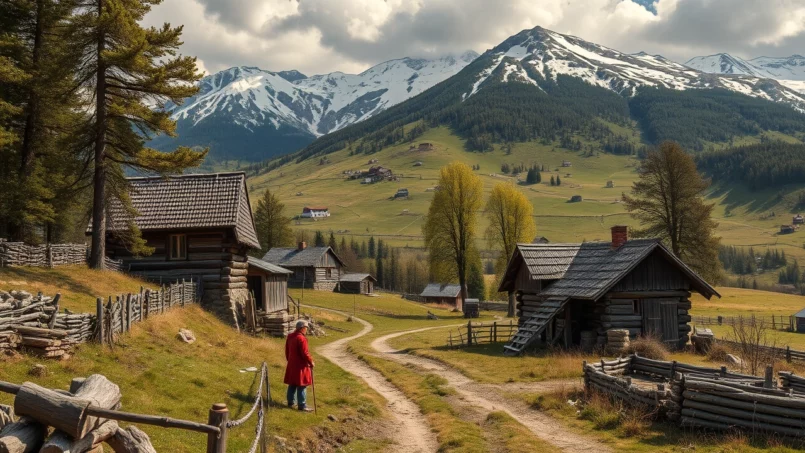
The Slovak landscape illustrates a complex European history. The ruins of Spiš Castle, the wooden churches of the Carpathians, villages like Vlkolínec, and fortified towns like Bardejov or Levoča embody the medieval past. Castles like Orava and Trenčín complete this narrative. Monuments from the 20th century, like those of the National Uprising in Banská Bystrica, Holocaust memorials, and plaques for victims of political trials, recall the darker and more conflictual periods.
By retracing this history, we better understand how a small landlocked state, born from a peaceful divorce, can claim both a prestigious medieval heritage, a decisive participation in the fight against fascism, and a full place in contemporary Europe. Modern Slovakia is the heir to a history where Slavic continuity is combined with a succession of imperial, national, and ideological affiliations, which the country continues, to this day, to debate and learn from.
Disclaimer: The information provided on this website is for informational purposes only and does not constitute financial, legal, or professional advice. We encourage you to consult qualified experts before making any investment, real estate, or expatriation decisions. Although we strive to maintain up-to-date and accurate information, we do not guarantee the completeness, accuracy, or timeliness of the proposed content. As investment and expatriation involve risks, we disclaim any liability for potential losses or damages arising from the use of this site. Your use of this site confirms your acceptance of these terms and your understanding of the associated risks.

Cyril Jarnias is an independent expert in international wealth management with over 20 years of experience. As an expatriate himself, he is dedicated to helping individuals and business leaders build, protect, and pass on their wealth with complete peace of mind.
On his website, cyriljarnias.com, he shares his expertise on international real estate, offshore company formation, and expatriation.
Thanks to his expertise, he offers sound advice to optimize his clients' wealth management. Cyril Jarnias is also recognized for his appearances in many prestigious media outlets such as BFM Business, les Français de l’étranger, Le Figaro, Les Echos, and Mieux vivre votre argent, where he shares his knowledge and know-how in wealth management.





