
 Published on and written by Cyril Jarnias
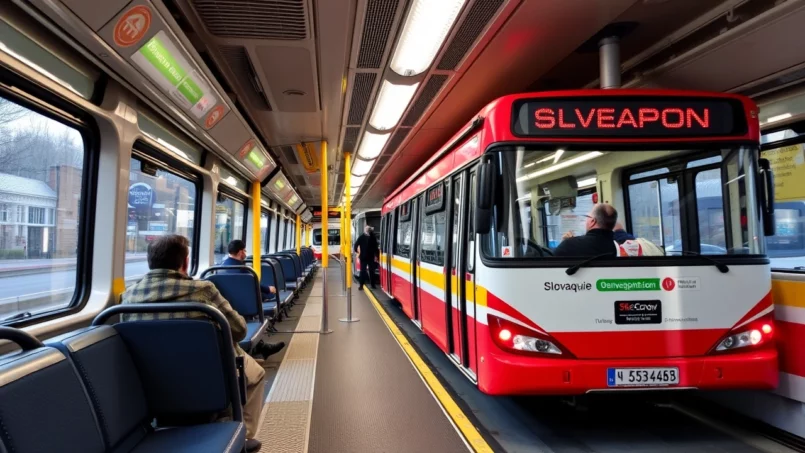
Public transportation in Slovakia forms an astonishingly dense network for a country of modest size. Between high-speed trains connecting the territory from end to end, efficient urban networks in major cities, and extensive bus lines covering rural areas, it is entirely possible to travel without a car, whether you are a visiting tourist or a resident moving around daily. This practical guide compiles essential information from numerous specialized sources to help you prepare and optimize your journeys.
Understanding the Slovak System’s Architecture
Before discussing tickets or schedules, it is useful to understand how the system is structured. Slovakia operates with several levels of transportation coordinated more or less closely depending on the region.
The national network, approximately 3,600 km long, is primarily operated by the public company ZSSK. Nearly half of the tracks are electrified. It mainly serves the west and east of the country, with a main axis Bratislava–Žilina–Poprad–Košice and other important corridors via Zvolen or Červená Skala.
Around this railway skeleton, a tight network of buses takes over. Major companies like Slovak Lines or Turancar operate domestic and international lines, while regional SAD companies serve small towns and villages. For longer regional or international trips, operators like FlixBus, RegioJet, BlaBlaCar Bus, or GoOpti complement the offering.
In Slovakia, urban transportation (Mestská hromadná doprava or MHD) combines buses, trolleybuses, and streetcars depending on the city. For instance, Bratislava and Košice have streetcar networks, while trolleybuses operate in Bratislava, Prešov, Košice, and Banská Bystrica. Other major cities primarily rely on bus networks.
Finally, some regions have integrated systems where train, urban buses, and regional buses share a common fare structure. This is the case with the IDS BK system in the Bratislava region, which is particularly developed and interesting for travelers.
Overview of Key Players
The following table summarizes the main operators you will most frequently encounter when traveling by public transportation in Slovakia.
| Type of Transportation | Main Operator | Primary Role |
|---|---|---|
| National passenger trains | ZSSK | Intercity and regional connections |
| Railway infrastructure | ŽSR | Owner/manager of the rail network |
| Regional buses (BA region) | Slovak Lines, Arriva | Regional and international lines |
| Private long-distance buses | FlixBus, RegioJet, Turancar… | Low-cost domestic and international connections |
| Bratislava urban transportation | Dopravný podnik Bratislava (DPB) | Buses, streetcars, trolleybuses, day and night |
| Košice urban transportation | DPMK | Streetcars and buses |
| Bratislava integrated system | IDS BK | Integrated fare and ticketing across multiple modes |
This plurality of actors may seem complex, but route planning applications (CP, IDS BK, Moovit, NAVITIME Transit…) make the task easier by aggregating schedules and routes.
Getting Around Cities: Focus on Bratislava and Other Major Urban Areas
Urban networks often represent a visitor’s first experience with Slovak public transportation, especially in Bratislava, the country’s main gateway.
Bratislava’s Network (DPB): Buses, Trams, and Trolleybuses
In Bratislava, public transit is managed by the municipal company Dopravný podnik Bratislava. Under the name MHD, the network combines three modes: buses, streetcars (trams), and trolleybuses, making it the largest urban system in Slovakia.
During the day, approximately 70 bus lines cover the city, complemented by 9 tram lines and 13 trolleybus lines. Service starts around 4:20–4:30 AM and continues until about 11:00–11:30 PM. Most vehicles are modern, often low-floor, and display the next stop on interior screens with announcements in Slovak, often repeated in English.
Bratislava has a long tradition of electric transport. The first tram line was inaugurated there in 1895, when the city was still part of the Austro-Hungarian Monarchy, under the names Pozsony (Hungarian) or Pressburg (German). Trolleybuses appeared as early as 1909, were interrupted in 1915, and relaunched in 1941. Today, DPB operates a fleet of several hundred vehicles, including diesel buses, natural gas buses, bi-mode trolleybuses, electric buses, and even some hydrogen buses (Solaris Urbino 12 Hydrogen), introduced recently.
Schedules and Night Lines
An advantage of Bratislava is the presence of a structured night network. Twenty night lines, identified by an “N” before the number (N21, N29, N91, etc.), take over between about 11:30 PM and 3:30 AM. They generally run every hour, with frequency sometimes increased to 30 minutes during certain slots.
All night buses converge at the main railway station Hlavná stanica, which serves as the central transfer hub, with a second gathering point at Hodžovo námestie (Hodžovo Square). The principle is that buses arrive at fixed times and wait a few minutes for each other at these points, giving passengers the necessary time to change lines.
The same travel passes valid during the day are also valid at night, simplifying life for occasional users and tourists alike.
Tickets and Fares in Bratislava
In the capital, the key rule is simple: you buy your ticket before boarding and validate it immediately upon boarding. Drivers do not sell tickets for urban lines.
Tickets are sold in yellow or orange coin-operated vending machines present at most stops, in newsstands, tourist information offices, or DPB ticket offices. The same ticket allows you to use buses, trams, and trolleybuses.
Tickets are based on duration, with several options. Exact amounts may change, but the approximate prices are as follows:
| Nominal Duration | Transfer Allowed | Approximate Price (Full Fare) | Particularities |
|---|---|---|---|
| 15 minutes | No | ~€0.70 | Ideal for short trips without transfers |
| 30 minutes | Yes | ~€0.90 | Valid for 90 min on weekends |
| 60 minutes | Yes | ~€1.20 | Valid for 90 min on weekends |
| 24 hours | Yes | €3.50–4.50 | Unlimited travel, including night lines |
| 72 hours | Yes | ~€8.00 | Very practical for a short stay |
| 168 hours | Yes | €11.40–15.00 | 7-day ticket, for intensive use |
These so-called “tourist” tickets (24 h, 48 h, 72 h, 7 days) allow for unlimited travel on all DPB lines, including night lines.
For frequent users, the integrated IDS BK system offers travel passes for 7, 30, 90, or 365 days, valid not only on DPB lines but also on regional Slovak Lines buses and regional ZSSK trains within the chosen zones. Prices depend on the number of zones; the urban zones of Bratislava (100 and 101) count double. Purchase is made using a contactless card (DPB, ZSSK, Slovak Lines, compatible student cards, or the Bratislava City Card), with a 10% discount on Bratislava zones if using the latter.
Discounts and Free Travel
Slovakia has a fairly generous policy of discounts in urban and regional transportation, particularly in Bratislava.
Within the DPB/IDS BK network, you will find in particular:
Transportation in Slovakia offers free travel for children under 6 years old and for people over 70 years old in urban networks. A discount of approximately 50% applies to children aged 6 to 16/17, students (upon presentation of an ISIC or equivalent card), and retirees. In the Bratislava region, this 50% discount also applies to persons with disabilities holding a ŤZP or ŤZP‑S card.
These rules apply to urban tickets and IDS BK tickets, with some nuances depending on the medium (paper, app, smart card).
Inspections and Fines
Validating your ticket upon boarding is not a trivial formality. Plainclothes inspectors regularly patrol and have the right to check ticket validity. In case of fraud or forgotten validation, the standard fine is €50 if paid immediately or within five days, and €70 if paid later at the DPB office. Forgetting a travel pass or not paying for the transport of an animal or bicycle results in a reduced penalty of €5.
Inspectors must be able to prove their identity (badge, professional card) and may ask for the passenger’s identification documents. In case of refusal to pay on the spot, they may call the police.
Practical Case: Connecting the Railway Station, Airport, and Downtown
For visitors, a few routes are particularly useful and well-documented.
– Main Station → Airport: Bus line 61 provides a direct connection between Hlavná stanica and M. R. Štefánik Airport. Expect about twenty minutes off-peak, more like 30 minutes or more around 5–6 PM. A 60-minute ticket (approx. €1.20) is a safe choice.
– Main Station → Bus Station (Mlynské Nivy): Trolleybus line 210 connects the railway station directly to the main bus station in about 10 minutes. A 15-minute ticket is sufficient.
To reach the historic center (Námestie SNP) from the main station, you must first walk two minutes to the SAV bus stop. From there, take bus lines 83 or 93 and get off at the Zochova stop after two stops. This journey then places the traveler a few minutes’ walk from the Old Town.
Many stops also serve as tourist landmarks, such as Námestie SNP (main square), Suché mýto (near the Presidential Palace), Šafárikovo námestie (Danube riverbank and the National Museum), or Malá scéna (Eurovea shopping center).
Other Major Cities: Košice, Žilina, Prešov, Banská Bystrica…
Outside of Bratislava, each major city manages its own MHD with specific rules, but the general principles remain similar: tickets must be validated, networks are primarily bus-based supplemented by trams or trolleybuses where applicable, and sometimes with a night service.
In Košice, the country’s second-largest city, the company DPMK operates 16 tram lines and 41 bus lines, including 7 night lines (N1 to N7) running between approximately 11:10 PM and 4:30 AM. All night departures are centralized at Staničné námestie (Station Square), in immediate proximity to the railway and bus stations.
In Žilina, urban transport is provided by DPMŽ. A particularity is the existence of a single night line, 50, which loops through large residential districts, with four departures per night and an interval of about 90 minutes.
Prešov also has a small night service, with two lines (N1 and N2) operating from 11 PM to 5 AM, mainly to serve the large housing estates.
Fares vary from city to city. For example, in Nitra, a single ticket costs around €0.70 and is purchased from the driver; in Banská Bystrica, a €0.70 ticket allows a trip with no restrictions on duration or number of stops; in Košice, there are low-priced tickets limited to a few stops for short trips.
Trains: The Backbone of Intercity Travel
To cross the country or connect major cities, the train is often the most comfortable solution, and sometimes the fastest.
A Dense and Modernized Network
The Slovak railway network covers approximately 3,600 kilometers, mostly standard gauge (1,435 mm). Nearly 1,600 kilometers are electrified, with recent modernization projects around Košice, Moldava nad Bodvou, or Bánovce nad Ondavou. The country has 75 tunnels (over 43 km cumulative) and more than 2,300 bridges, signs of a technically sophisticated network in often mountainous terrain.
The main backbone connects Bratislava to Košice via Žilina and Poprad. Alternative axes pass through Zvolen or Margecany. The major railway junctions are Bratislava, Žilina, Košice, Poprad, Zvolen, and Nové Zámky.
In practice, a Bratislava–Košice journey takes about 4 hours 50 minutes by fast train, up to 5–6 hours depending on the category. Bratislava–Žilina is around 1 hour 45 minutes, Bratislava–Poprad around 3 hours 30 minutes, and Bratislava–Banská Bystrica about 3 hours 40 minutes.
Train Categories and Comfort
Slovakia uses a whole range of categories, comparable to those of its Central European neighbors.
| Category | Main Role | Key Remarks |
|---|---|---|
| Os | Local trains (Osobný vlak) | Frequent stops, local connections |
| R / RR | Fast regional trains (Rýchlik, RR) | Connect major cities and regions |
| Ex | Express | Medium/long-distance intercity trains |
| EC | EuroCity | International trains, high quality, air-conditioned |
| EN | EuroNight | International night trains |
| REX | Regional Express | Fast regional anchors, notably to Vienna |
| IC | InterCity | Fast connections, 1st class, mandatory reservation (recently removed on some lines) |
| SC | SuperCity | Czecho-Slovak Pendolino, mandatory supplement |
| RJX | Railjet Express (ÖBB) | High-end connection to Austria and beyond |
EuroCity trains and some InterCity trains offer air conditioning, power outlets, sometimes WiFi, and dining cars. Night trains have couchette and sleeper cars, with mixed compartments or women-only compartments on some segments.
Tickets, Reservations, and Free Travel
ZSSK tickets are easily found: at stations, the Slovakrail.sk website, the “Ideme vlakom” app, by SMS, or even on board (with a surcharge). A particular Slovak feature to remember: tickets bought at the ticket counter are often subject to an additional one euro charge, while buying from the conductor costs about €3 more. The underlying idea is to push towards online or mobile ticketing, which already represents over half of ZSSK sales.
This is the price in euros for a 100 km journey in 2nd class in France.
Reservations are mandatory on some trains (IC, EC on some sections, private operators like RegioJet or Leo Express) and highly recommended during peak times on fast trains (R, Ex). A supplement of about €1–2 is common for simple ZSSK reservations, more for some premium categories.
The Slovak railway system offers partial free travel to full-time students up to 25–26 years old and to seniors from age 62 on most ZSSK trains, subject to registration and a special card. This also applies to EU residents under conditions. Furthermore, children under 6 travel for free and those aged 6 to 16 benefit from fare discounts.
Passes also exist, such as the national pass valid in summer (July–August) on the entire ZSSK network and the Tatras electric network, or Interrail/Eurail passes (Slovakia version or global) for international travelers.
International Trains
Slovakia is well integrated into the European network. Multiple direct connections exist to neighboring countries and beyond:
– Bratislava–Vienna: Frequent regional trains, approximately 1 hour travel time.
– Bratislava–Budapest: EuroCity in about 2 hours 40 minutes.
– Bratislava–Prague: EuroCity or private RegioJet trains, in about 4 hours.
– Bratislava–Berlin or Warsaw: EuroNight night trains, around 8 to 10 hours.
– Košice–Prague or Košice–Vienna: RegioJet, Leo Express services, or combined connections via Poprad and Žilina.
– Seasonal connections to Split (Croatia) in summer, sometimes with car transport (motorail).
Discover the partner railway companies that operate international connections in cooperation.
National railway company of the Czech Republic, operating international connections.
Austrian Federal Railways, partner for connections to Austria.
Hungarian State Railways, operating international services.
Polish State Railways, partner for connections with Poland.
Private railway operator offering international services.
Private transport operator providing international rail connections.
Luggage, Bicycles, and Accessibility
On ZSSK trains, small carry-on luggage is free as long as it fits under or above the seat and can be handled by the passenger themselves. For larger items, dedicated spaces in the cars or “mobile luggage” areas are provided on most long-distance trains.
Bicycles are accepted on the vast majority of trains, subject to space availability and with a supplement (bike ticket, often around €1.50 for a single journey, daily or weekly tickets available). For some lines or categories, a bicycle space reservation is essential, and pictograms in the schedules indicate the conditions (transport allowed, reserved, or excluded). Folding bicycles, once folded, can be considered as carry-on luggage.
Recent or renovated trains have PRM areas, ramps or lifts, and accessible toilets. Priority seats are reserved for persons with reduced mobility, with the possibility to request assistance at least 24 hours in advance via the ZSSK contact center.
Buses: An Indispensable Complement to Rail
While trains serve the main corridors well, buses are essential for reaching small towns and rural areas, or for some international trips.
National and International Network
Domestic bus lines connect all major cities to each other and serve medium-sized towns. You can find routes such as:
– Bratislava–Nitra–Zvolen–Košice,
– Bratislava–Trnava–Nitra–Zvolen–Lučenec,
– Tornaľa–Rimavská Sobota–Zvolen–Banská Bystrica,
as well as connections to Austria, Hungary, the Czech Republic, Ukraine, or Germany. Slovak Lines Express, based in Bratislava since 1949, plays a leading role, notably on the heavily traveled Bratislava–Vienna route (and Schwechat Airport). It has a fleet of over 300 buses for regional and international purposes, equipped with WiFi, USB ports, air conditioning, reclining seats, and toilets.
Turancar, based in Nitra, operates numerous lines and offers bus rentals and trips via its agency CK Turancar. FlixBus completes the picture with a dense low-cost network, both domestic and international.
Where and How to Buy Tickets
Bus tickets are sold through three main channels:
Bus tickets in Slovakia can be purchased in several ways: directly from the driver in cash for many regional lines (SAD, local), at bus station ticket offices (like Mlynské Nivy in Bratislava), or online via operator websites/apps (Slovak Lines, FlixBus, etc.) or comparison platforms (CheckMyBus, Wanderu). These online platforms allow you to compare schedules, durations, prices, and onboard services.
Fares vary depending on distance and type of bus. To give some benchmarks, a Bratislava–Nitra ticket is around €4.5, while a Bratislava–Košice long-distance bus can cost about €18 depending on the operator and time.
Refund policies differ among bus companies. Slovak Lines generally allows a full refund up to 24 hours before departure, but none after that. Turancar, on the other hand, offers no refunds. There are sometimes paid options (“Refund for Any Reason”) on some websites, allowing a very late refund for an additional fee.
Onboard Services and Luggage Rules
Most major bus operators offer a set of standard free services: air conditioning, WiFi, reclining seats, sometimes power outlets, transportation of one carry-on bag and one checked bag included in the price. Slovak Lines, for example, allows one 10 kg carry-on and one 25 kg checked bag, with a supplement of about €5 for an additional bag. Turancar applies similar rules, with a 10 kg carry-on (55 x 40 x 20 cm) and a 20 kg checked bag, with fees of €10 per additional bag.
Bicycles are accepted by some companies, often subject to reservation and dedicated fees, either in the luggage compartment or on an external bike rack if the bus is equipped. Small pets (dogs or cats) are generally allowed in a suitable carrier; larger ones must be muzzled or sometimes relegated to the luggage compartment depending on the operator.
The Bratislava Integrated System (IDS BK): Unifying Bus, Tram, and Train
The Bratislava region has implemented an integrated fare and information system, IDS BK, which deserves special attention as it greatly simplifies life for users.
Principle and Coverage
IDS BK covers:
– DPB urban lines (buses, trams, trolleybuses, night lines),
– Arriva Mobility Solutions regional lines (numbered 205 to 799, plus cross-border line 901),
– Regional Os and REX trains of ZSSK and Leo Express (lines S8–S70, R20–R70, depending on segments).
IDS BK tickets (paper, electronic, or smart card) are valid on all modes of transport, provided the indicated zones and duration are respected. However, other media like SMS tickets or contactless payment on board are only accepted on DPB lines.
Zones, Durations, and Media
The system is based on a division into zones. The central urban zones of Bratislava (100 and 101) are the most used by visitors. Tickets are primarily based on a validity duration, coupled with a maximum number of zones.
The media are varied:
– Paper tickets purchased from vending machines or sales points,
– Electronic tickets on the IDS BK app (generally 10% cheaper),
– E-wallet (eWallet) debits on a contactless card (DPB, Slovak Lines, TransCard/ISIC, Bratislava City Card),
– Direct payment by bank card when validating on the onboard validator (30, 60 minutes, or 24-hour options),
– SMS tickets (only for DPB lines).
On weekends and public holidays, a full-fare 24h ticket can be used as a family ticket, valid for a maximum of two adults and three children.
IDS BK Application
The IDS BK application plays a central role. It allows you to:
– Purchase single tickets at a discount compared to physical vending machines,
– Buy 7, 30, 90, or 365-day passes,
– Choose the ticket activation time (immediate, delayed up to 90 minutes, or set to a departure time up to 180 minutes in advance),
– Cancel a not-yet-activated ticket (up to 5 minutes before) with a credit refund,
– Check real-time schedules, maps, and disruption information,
– Check if an upcoming departure is operated by a low-floor vehicle (wheelchair pictogram).
Payment is made by bank card or prepaid credit in the app, which generally requires using a card linked to a European bank.
Accessibility, Bicycles, and Luggage: Useful Rules
Slovak public transportation has gradually strengthened its efforts regarding accessibility and multimodality.
Accessibility
In Bratislava, almost all buses and trolleybuses, and a good portion of trams, are low-floor. Dedicated spaces for wheelchairs exist at the front of each vehicle, with ramps deployed by the driver if necessary. Tactile guidance strips are installed at major hubs (airport, main station, bus station), and many stops are equipped with real-time information LED screens.
The ZSSK company provides accessible areas and toilets for PRM in its newer trains, as well as ramps or lifting platforms. Assistance can be reserved at least 24 hours in advance via the national contact center. In Bratislava, the Hlavná stanica, Petržalka, Rača, Lamač, Nové Mesto, and Devínska Nová Ves stations have accessible platforms.
Transporting Bicycles in the City and on Trains
In urban areas, rules for bringing bicycles on buses and trams aim to avoid overcrowding during peak hours. In Bratislava, transporting bicycles on buses and trams is allowed outside peak hours (weekdays from 9 AM to 1 PM and from 6 PM to 6 AM, all day on weekends and public holidays), subject to the driver’s approval and respecting a limit of two bicycles per vehicle. A special ticket, based on a reduced 15-minute ticket but valid for 180 minutes for bicycles, is required. Cyclists must use specific doors marked with a bicycle or stroller pictogram.
The ZSSK railway company allows bicycles on almost all its trains. Options range from simple spaces in vestibules to specific cars equipped with hooks. A reservation is often required, especially for fast and international trains. The cost is low, with daily or weekly tickets suitable for cycling tourists.
Luggage and Animals
In urban transportation, small-sized luggage (up to approximately 60 x 45 x 25 cm) and animals in a carrier of the same dimensions travel for free. Beyond that, a specific reduced ticket is required, including for some pets outside of a carrier. Regional or international lines (like Slovak Lines) have their own rules, often quite strict on allowed contents in checked luggage (prohibition of valuables, dangerous goods, etc.).
On trains, luggage is tolerated as long as it does not obstruct the aisles or doors. Pets can travel in 2nd class, sometimes in a carrier or with a muzzle depending on size.
The Slovak digital ecosystem around transportation is surprisingly well-supplied, which largely compensates for the potential complexity of the system.
Among the most useful tools:
A selection of essential mobile apps for planning, purchasing, and tracking your journeys on public transportation in Slovakia.
Indispensable for the Bratislava region. Allows ticket and pass purchase, provides real-time information, and identifies low-floor vehicles.
National app for checking schedules and finding routes, covering trains, regional and urban buses with a powerful search engine.
Official ZSSK app for buying train tickets, checking schedules, and benefiting from digital fares.
Allows you to track train delays on a map, a useful tool for adjusting connections.
App of the bus company, dedicated to regional and international trips. Offers ticket sales and options like premium seat or arrival guarantee.
Multimodal journey planners integrating major urban networks like Bratislava, with step-by-step guidance and fare estimates.
These tools are available for free on Android and iOS; some require a bank card from a European institution for in-app payment.
Toward a National “Super-Ticket”: Future Integration at the Country Scale
A major change is being prepared in the coming years: the implementation of a national integrated ticketing system, entrusted to the company Asseco Central Europe. The idea is that a single account and a single type of ticket will allow you to use trains, urban transportation, suburban buses, and later other shared mobility services (bikes, scooters, car-sharing, taxis) everywhere in Slovakia.
The Metropolis platform, the core of the solution, is already operational in a region of Poland where it is used by millions of travelers and hundreds of operators. Its adaptation for Slovakia aims at three main objectives: harmonize pricing, facilitate revenue sharing among different carriers, and radically simplify the user experience. This simplification materializes through a single app for travelers, a single payment, and automatic calculation of the most advantageous fare performed retrospectively.
Alongside this national integration, ZSSK is also experimenting with “pay as you go” via the FAIRTIQ app, already deployed in some German and Swiss networks. The principle: you “swipe” to start your journey, swipe again to end it, and the system then calculates the best price based on the segments traveled. Slovakia is the first country in Central and Eastern Europe to test this solution on a complete national rail network.
Practical Tips for Using Slovak Public Transportation Effectively
To conclude this guide, a few simple habits will allow you to travel more serenely on public transportation in Slovakia.
Arriving slightly early at stops remains prudent, especially for regional buses or long-distance coaches, where it is advisable to be there 15 to 30 minutes before departure. In the city, aiming for 5 to 10 minutes early is generally sufficient.
Always buy and validate your ticket before or just upon boarding, especially in MHD where drivers do not sell tickets. In the Bratislava region, using the IDS BK app or a contactless bank card on the validator is often the simplest and cheapest solution.
For travel between cities, it is advisable to systematically compare train and bus options. Indeed, some journeys are faster by train, while others may be more direct by bus. To facilitate this comparison, you can use online platforms such as CP, CheckMyBus, Omio, Busbud, or Wanderu.
If you are a student or senior, inquire seriously about rights to free travel or discounts, which are often very advantageous but sometimes require registration or a specific card.
Finally, do not hesitate to exploit complementarity with other means of transport: bicycles (including rental or free-floating systems in some cities), electric scooters, taxis and ride-hailing via apps like Bolt, Uber, or HOPIN, or even boats on the Danube between Bratislava and Vienna. In a country where accessibility by public transportation remains uneven across regions, this flexibility allows you to get the most out of a system that, despite its limitations, is one of the most open and affordable in Central Europe for travelers without a car.
Disclaimer: The information provided on this website is for informational purposes only and does not constitute financial, legal, or professional advice. We encourage you to consult qualified experts before making any investment, real estate, or expatriation decisions. Although we strive to maintain up-to-date and accurate information, we do not guarantee the completeness, accuracy, or timeliness of the proposed content. As investment and expatriation involve risks, we disclaim any liability for potential losses or damages arising from the use of this site. Your use of this site confirms your acceptance of these terms and your understanding of the associated risks.

Cyril Jarnias is an independent expert in international wealth management with over 20 years of experience. As an expatriate himself, he is dedicated to helping individuals and business leaders build, protect, and pass on their wealth with complete peace of mind.
On his website, cyriljarnias.com, he shares his expertise on international real estate, offshore company formation, and expatriation.
Thanks to his expertise, he offers sound advice to optimize his clients' wealth management. Cyril Jarnias is also recognized for his appearances in many prestigious media outlets such as BFM Business, les Français de l’étranger, Le Figaro, Les Echos, and Mieux vivre votre argent, where he shares his knowledge and know-how in wealth management.





